CS221
Computer Organization
Lecture2Digital Logic
2
This Lecture
Binary Storage
Registers
Binary Logic
Boolean Algebra
Boolean Algebra Functions
Boolean Function Implementation
Canonical & Standard Forms
Gate Level Minimization
3
Binary storage & registers
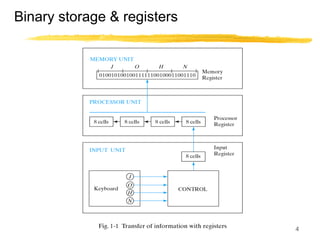
How do we store binary information?
Binary cell : place to store one bit of information. 0 or 1.
Register: a group of binary cells.
Register transfer: An operation in a digital system
4
Binary storage & registers
5
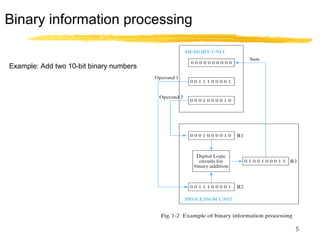
Binary information processing
Example: Add two 10-bit binary numbers
6
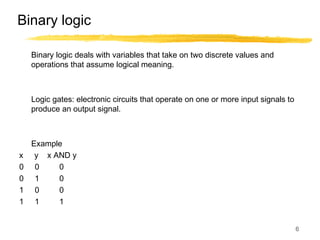
Binary logic
Binary logic deals with variables that take on two discrete values and
operations that assume logical meaning.
Logic gates: electronic circuits that operate on one or more input signals to
produce an output signal.
Example
x y x AND y
0 0 0
0 1 0
1 0 0
1 1 1
7
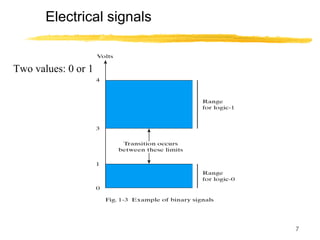
Electrical signals
Two values: 0 or 1
8
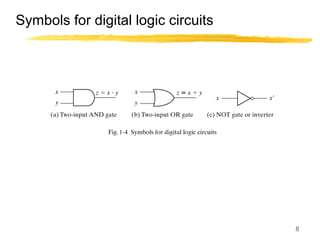
Symbols for digital logic circuits
9
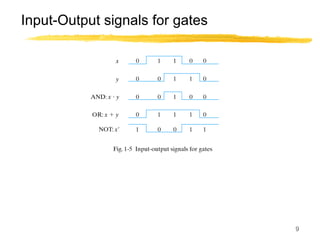
Input-Output signals for gates
10
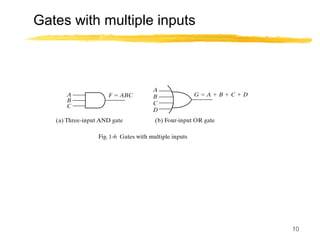
Gates with multiple inputs
11
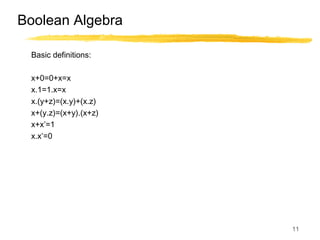
Boolean Algebra
Basic definitions:
x+0=0+x=x
x.1=1.x=x
x.(y+z)=(x.y)+(x.z)
x+(y.z)=(x+y).(x+z)
x+x’=1
x.x’=0
12
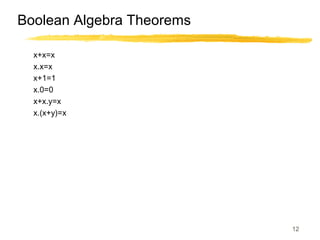
Boolean Algebra Theorems
x+x=x
x.x=x
x+1=1
x.0=0
x+x.y=x
x.(x+y)=x
13
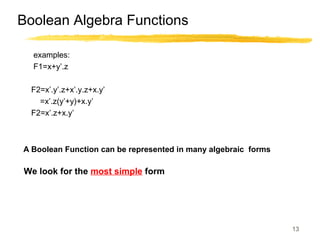
Boolean Algebra Functions
examples:
F1=x+y’.z
F2=x’.y’.z+x’.y.z+x.y’
=x’.z(y’+y)+x.y’
F2=x’.z+x.y’
A Boolean Function can be represented in many algebraic forms
We look for the most simple form
14
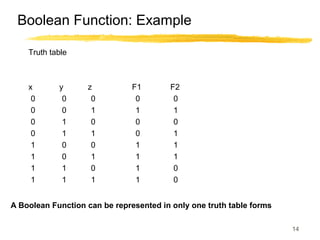
Boolean Function: Example
Truth table
x y z F1 F2
0 0 0 0 0
0 0 1 1 1
0 1 0 0 0
0 1 1 0 1
1 0 0 1 1
1 0 1 1 1
1 1 0 1 0
1 1 1 1 0
A Boolean Function can be represented in only one truth table forms
15
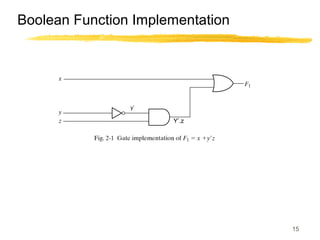
Boolean Function Implementation
y’
Y’.z
16
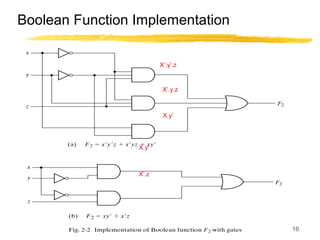
Boolean Function Implementation
X’.y’.z
X’.y.z
X.y’
X.y’
X’.z
17
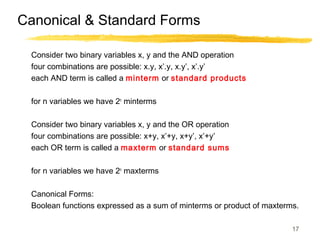
Canonical & Standard Forms
Consider two binary variables x, y and the AND operation
four combinations are possible: x.y, x’.y, x.y’, x’.y’
each AND term is called a minterm or standard products
for n variables we have 2n
minterms
Consider two binary variables x, y and the OR operation
four combinations are possible: x+y, x’+y, x+y’, x’+y’
each OR term is called a maxterm or standard sums
for n variables we have 2n
maxterms
Canonical Forms:
Boolean functions expressed as a sum of minterms or product of maxterms.
18
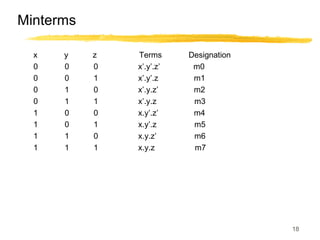
Minterms
x y z Terms Designation
0 0 0 x’.y’.z’ m0
0 0 1 x’.y’.z m1
0 1 0 x’.y.z’ m2
0 1 1 x’.y.z m3
1 0 0 x.y’.z’ m4
1 0 1 x.y’.z m5
1 1 0 x.y.z’ m6
1 1 1 x.y.z m7
19
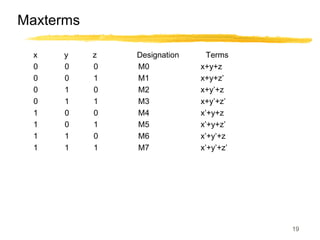
Maxterms
x y z Designation Terms
0 0 0 M0 x+y+z
0 0 1 M1 x+y+z’
0 1 0 M2 x+y’+z
0 1 1 M3 x+y’+z’
1 0 0 M4 x’+y+z
1 0 1 M5 x’+y+z’
1 1 0 M6 x’+y’+z
1 1 1 M7 x’+y’+z’
20
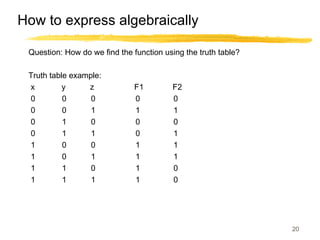
How to express algebraically
Question: How do we find the function using the truth table?
Truth table example:
x y z F1 F2
0 0 0 0 0
0 0 1 1 1
0 1 0 0 0
0 1 1 0 1
1 0 0 1 1
1 0 1 1 1
1 1 0 1 0
1 1 1 1 0
21
How to express algebraically
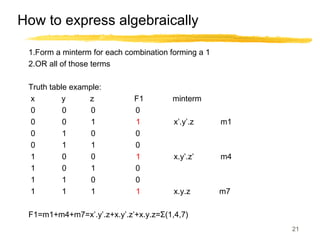
1.Form a minterm for each combination forming a 1
2.OR all of those terms
Truth table example:
x y z F1 minterm
0 0 0 0
0 0 1 1 x’.y’.z m1
0 1 0 0
0 1 1 0
1 0 0 1 x.y’.z’ m4
1 0 1 0
1 1 0 0
1 1 1 1 x.y.z m7
F1=m1+m4+m7=x’.y’.z+x.y’.z’+x.y.z=Σ(1,4,7)
22
How to express algebraically
Truth table example:
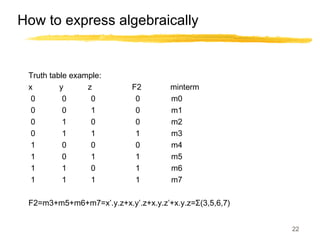
x y z F2 minterm
0 0 0 0 m0
0 0 1 0 m1
0 1 0 0 m2
0 1 1 1 m3
1 0 0 0 m4
1 0 1 1 m5
1 1 0 1 m6
1 1 1 1 m7
F2=m3+m5+m6+m7=x’.y.z+x.y’.z+x.y.z’+x.y.z=Σ(3,5,6,7)
23
How to express algebraically
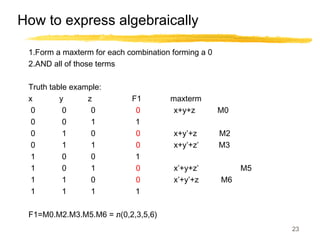
1.Form a maxterm for each combination forming a 0
2.AND all of those terms
Truth table example:
x y z F1 maxterm
0 0 0 0 x+y+z M0
0 0 1 1
0 1 0 0 x+y’+z M2
0 1 1 0 x+y’+z’ M3
1 0 0 1
1 0 1 0 x’+y+z’ M5
1 1 0 0 x’+y’+z M6
1 1 1 1
F1=M0.M2.M3.M5.M6 = л(0,2,3,5,6)
24
How to express algebraically
Truth table example:
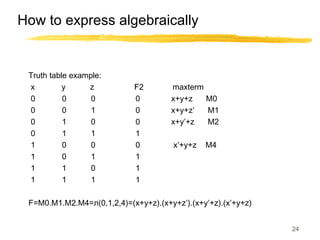
x y z F2 maxterm
0 0 0 0 x+y+z M0
0 0 1 0 x+y+z’ M1
0 1 0 0 x+y’+z M2
0 1 1 1
1 0 0 0 x’+y+z M4
1 0 1 1
1 1 0 1
1 1 1 1
F=M0.M1.M2.M4=л(0,1,2,4)=(x+y+z).(x+y+z’).(x+y’+z).(x’+y+z)
25
Maxterms & Minterms: Intuitions
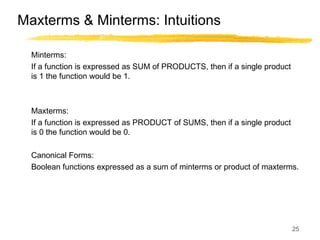
Minterms:
If a function is expressed as SUM of PRODUCTS, then if a single product
is 1 the function would be 1.
Maxterms:
If a function is expressed as PRODUCT of SUMS, then if a single product
is 0 the function would be 0.
Canonical Forms:
Boolean functions expressed as a sum of minterms or product of maxterms.
26
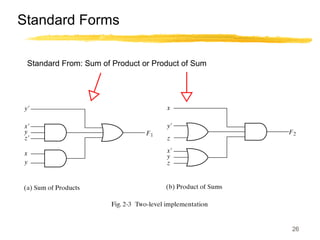
Standard Forms
Standard From: Sum of Product or Product of Sum
27
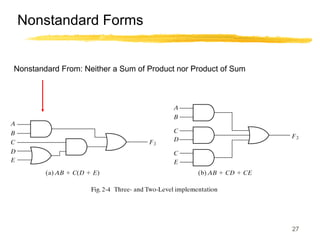
Nonstandard Forms
Nonstandard From: Neither a Sum of Product nor Product of Sum
28
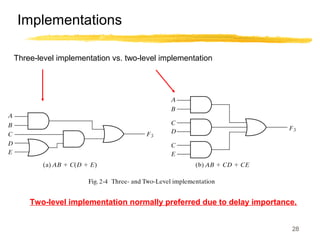
Implementations
Three-level implementation vs. two-level implementation
Two-level implementation normally preferred due to delay importance.
29
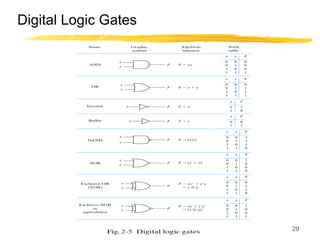
Digital Logic Gates
30
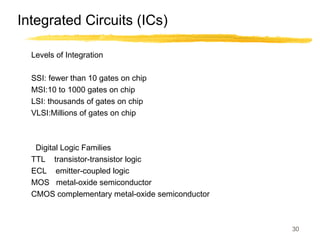
Integrated Circuits (ICs)
Levels of Integration
SSI: fewer than 10 gates on chip
MSI:10 to 1000 gates on chip
LSI: thousands of gates on chip
VLSI:Millions of gates on chip
Digital Logic Families
TTL transistor-transistor logic
ECL emitter-coupled logic
MOS metal-oxide semiconductor
CMOS complementary metal-oxide semiconductor
31
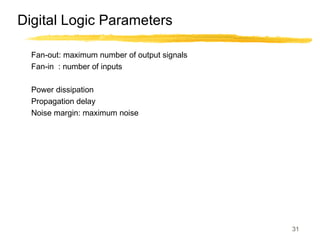
Digital Logic Parameters
Fan-out: maximum number of output signals
Fan-in : number of inputs
Power dissipation
Propagation delay
Noise margin: maximum noise
32
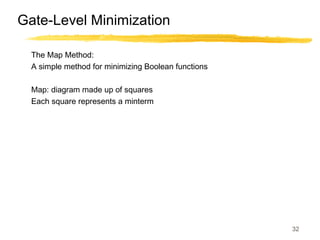
Gate-Level Minimization
The Map Method:
A simple method for minimizing Boolean functions
Map: diagram made up of squares
Each square represents a minterm
33
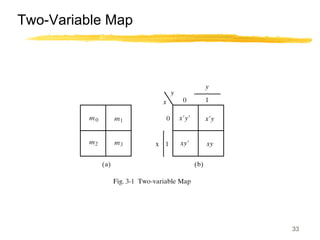
Two-Variable Map
34
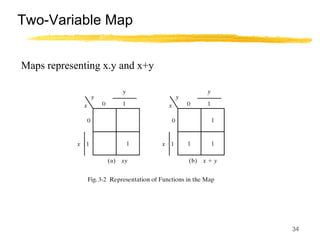
Two-Variable Map
Maps representing x.y and x+y
35
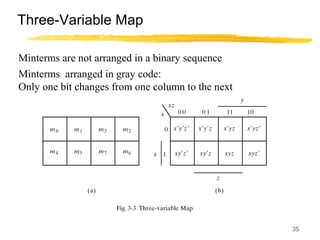
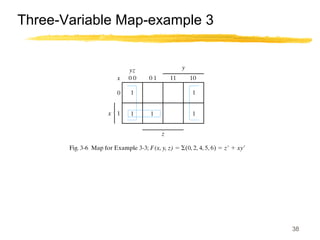
Three-Variable Map
Minterms are not arranged in a binary sequence
Minterms arranged in gray code:
Only one bit changes from one column to the next
36
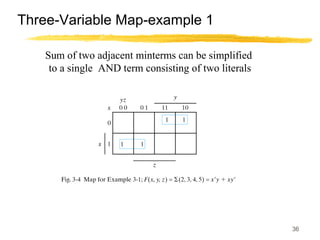
Three-Variable Map-example 1
Sum of two adjacent minterms can be simplified
to a single AND term consisting of two literals
37
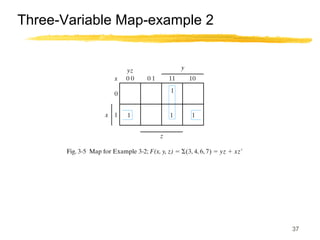
Three-Variable Map-example 2
38
Three-Variable Map-example 3
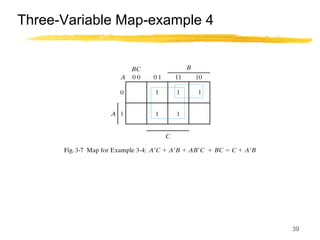
39
Three-Variable Map-example 4
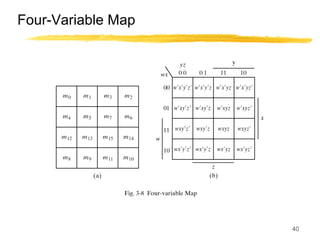
40
Four-Variable Map
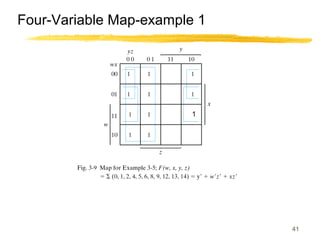
41
Four-Variable Map-example 1
1
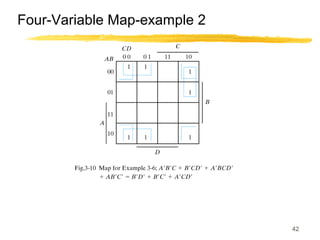
42
Four-Variable Map-example 2
43
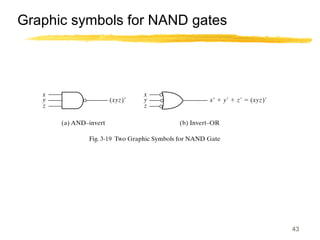
Graphic symbols for NAND gates
44
Summary
Logic
Gates
Combinational Circuit
Integrated Circuits
Gate Level Minimization
45
Recommended Reading
• Read textbook & readings
• Solve exercises
• Digital Design
Fifth edition,
by Morris Mano, Prentice Hall Publishers

02 combinational logic