Single Phase Transformer
• The efficiency of electrical power transmission has
been improved by the use of higher voltages.
• This is one of the main reasons that alternating
current (AC) has nearly entirely replaced direct
current (DC) for power transmission and distribution.
• While it is true that the AC generator is better than
the DC generator for producing higher voltages.
• The transformer is the device or machine primarily
responsible for the wide use of AC today.
• Basically, the transformer is a device for
transferring electrical energy from one circuit
to another circuit without a change in
frequency.
• The transformer accomplishes the change in
voltage without use of moving parts, and
therein lies its great advantage.
• The cost per kilowatt is comparatively low, and
the efficiency is high.
• As a matter of fact, the transformer is the most
efficient piece of electrical machinery, and
efficiencies of 98 and 99% are not at all
uncommon.
• Since there are no moving parts, maintenance is
simpler and cheaper, and the required insulation
for the extremely high voltages obtained can
more easily be constructed.
• A transformer is a static (or stationary) piece of
apparatus by means of which electrical power in
one circuit is transformed into electric power of
the same frequency in another circuit.
• It can raise (step up) or lower (step down) the
voltage in a circuit but with a corresponding
decrease or increase in current.
• Physically, a transformer is mutual induction
between two circuits linked by a common
magnetic flux.
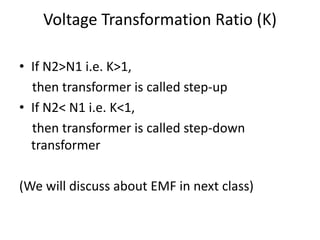
Voltage Transformation Ratio (K)
• If N2>N1 i.e. K>1,
then transformer is called step-up
• If N2< N1 i.e. K<1,
then transformer is called step-down
transformer
(We will discuss about EMF in next class)
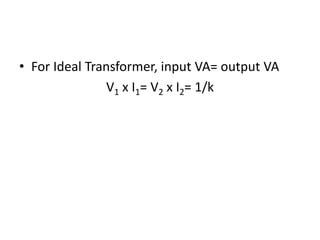
• For Ideal Transformer, input VA= output VA
V1 x I1= V2 x I2= 1/k
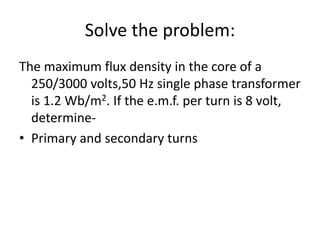
Solve the problem:
The maximum flux density in the core of a
250/3000 volts,50 Hz single phase transformer
is 1.2 Wb/m2. If the e.m.f. per turn is 8 volt,
determine-
• Primary and secondary turns
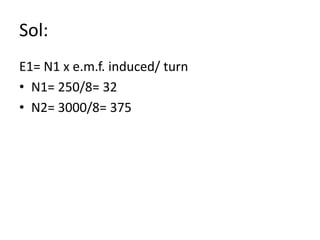
Sol:
E1= N1 x e.m.f. induced/ turn
• N1= 250/8= 32
• N2= 3000/8= 375

Lecture 1 transformer

  • 1.
  • 2.
    • The efficiencyof electrical power transmission has been improved by the use of higher voltages. • This is one of the main reasons that alternating current (AC) has nearly entirely replaced direct current (DC) for power transmission and distribution. • While it is true that the AC generator is better than the DC generator for producing higher voltages. • The transformer is the device or machine primarily responsible for the wide use of AC today.
  • 3.
    • Basically, thetransformer is a device for transferring electrical energy from one circuit to another circuit without a change in frequency. • The transformer accomplishes the change in voltage without use of moving parts, and therein lies its great advantage.
  • 4.
    • The costper kilowatt is comparatively low, and the efficiency is high. • As a matter of fact, the transformer is the most efficient piece of electrical machinery, and efficiencies of 98 and 99% are not at all uncommon. • Since there are no moving parts, maintenance is simpler and cheaper, and the required insulation for the extremely high voltages obtained can more easily be constructed.
  • 5.
    • A transformeris a static (or stationary) piece of apparatus by means of which electrical power in one circuit is transformed into electric power of the same frequency in another circuit. • It can raise (step up) or lower (step down) the voltage in a circuit but with a corresponding decrease or increase in current. • Physically, a transformer is mutual induction between two circuits linked by a common magnetic flux.
  • 6.
    Voltage Transformation Ratio(K) • If N2>N1 i.e. K>1, then transformer is called step-up • If N2< N1 i.e. K<1, then transformer is called step-down transformer (We will discuss about EMF in next class)
  • 7.
    • For IdealTransformer, input VA= output VA V1 x I1= V2 x I2= 1/k
  • 8.
    Solve the problem: Themaximum flux density in the core of a 250/3000 volts,50 Hz single phase transformer is 1.2 Wb/m2. If the e.m.f. per turn is 8 volt, determine- • Primary and secondary turns
  • 9.
    Sol: E1= N1 xe.m.f. induced/ turn • N1= 250/8= 32 • N2= 3000/8= 375