Name ID. No.
Ms. Rehana Akter ID: 102-296-511
Mir Md Emam Uddin ID: 102-168-511
Md. Jamil Uddin ID: 102-085-511
Md. Mahbub Mehedi ID: 102-049-511
MD. Shariful Amran ID: 102-102-511
“Microcontroller based single axis solar tracker ”
This Project is submitted fulfillment for the requirements of the
Degree of Bachelor of Science in Electrical & Electronic Engineering
Prepared By
Department of Electrical & Electronic Engineering
Atish Dipankar University of Science &
Technology (ADUST)
Paltan Cumpas , Dhaka, Bangladesh
July, 2013
Introduction:
This is a solar tracking system which can be used as a
power generating method from sunlight. This method of
power generation is simple and is taken from natural
resource. This needs only maximum sunlight to generate
power. This project helps for power generation by setting
the equipment to get maximum sunlight automatically. This
system is tracking for maximum intensity of light. When
there is decrease in intensity of light, this system
automatically changes its direction to get maximum
intensity of light.
Objective:
The aim of our projects is to utilize the maximum solar
energy through solar panel. For this a digital based
automatic sun tracking system is proposed. This project
helps the solar power generating equipment to get the
maximum sunlight automatically thereby increasing the
efficiency of the system. The solar panel tracks the sun
from east to west automatically for maximum intensity of
light.
Renewable Energy:
Renewable energy is energy that is generated from natural
processes that are continuously replenished. This includes
sunlight, geothermal heat, wind, tides, water, and various
forms of biomass. This energy cannot be exhausted
and is constantly renewed.
Renewable energy uses energy sources that are
continually replenished by nature the sun, the wind, water,
the Earth’s heat, and plants
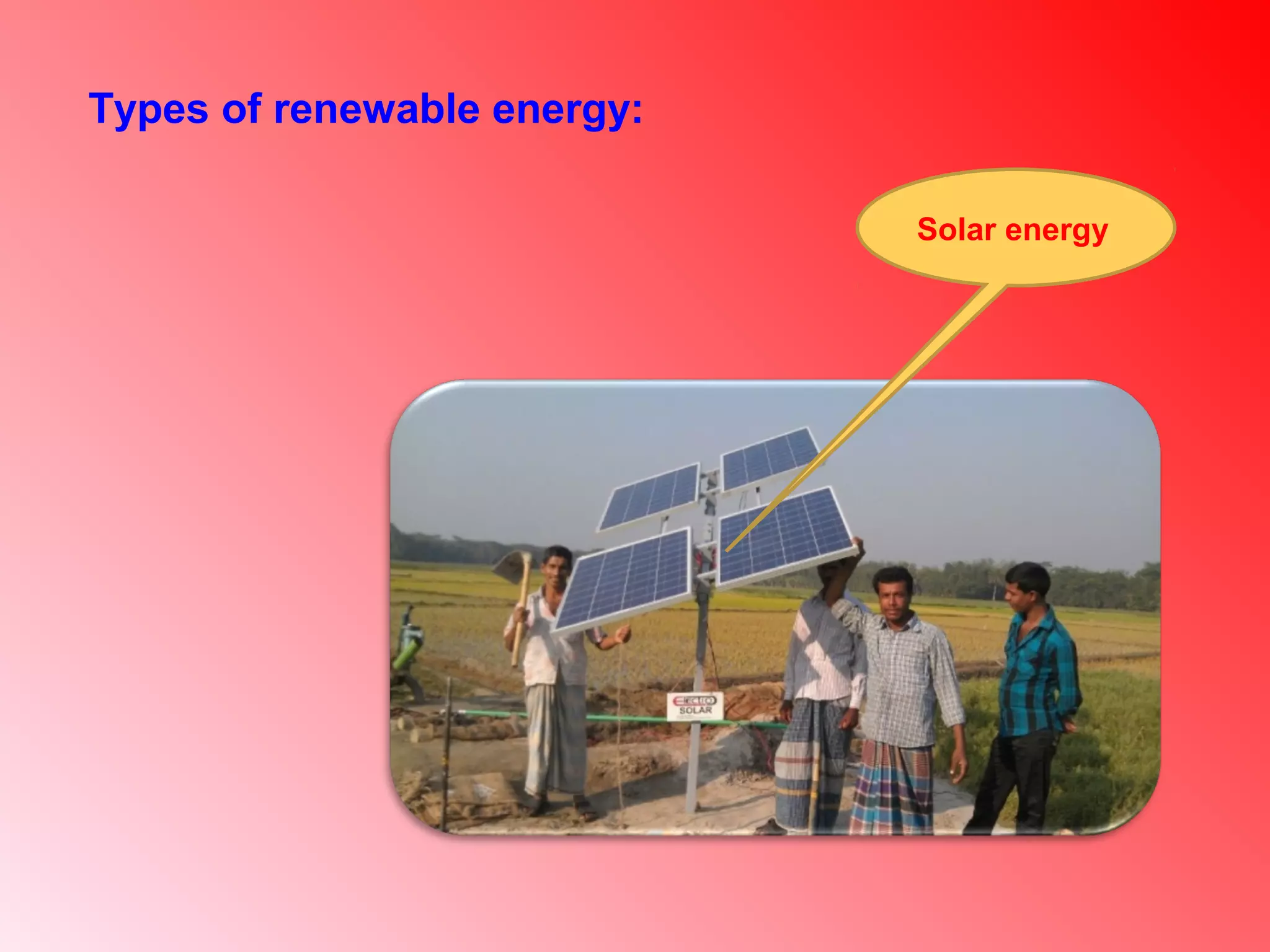
Solar energy
Types of renewable energy:
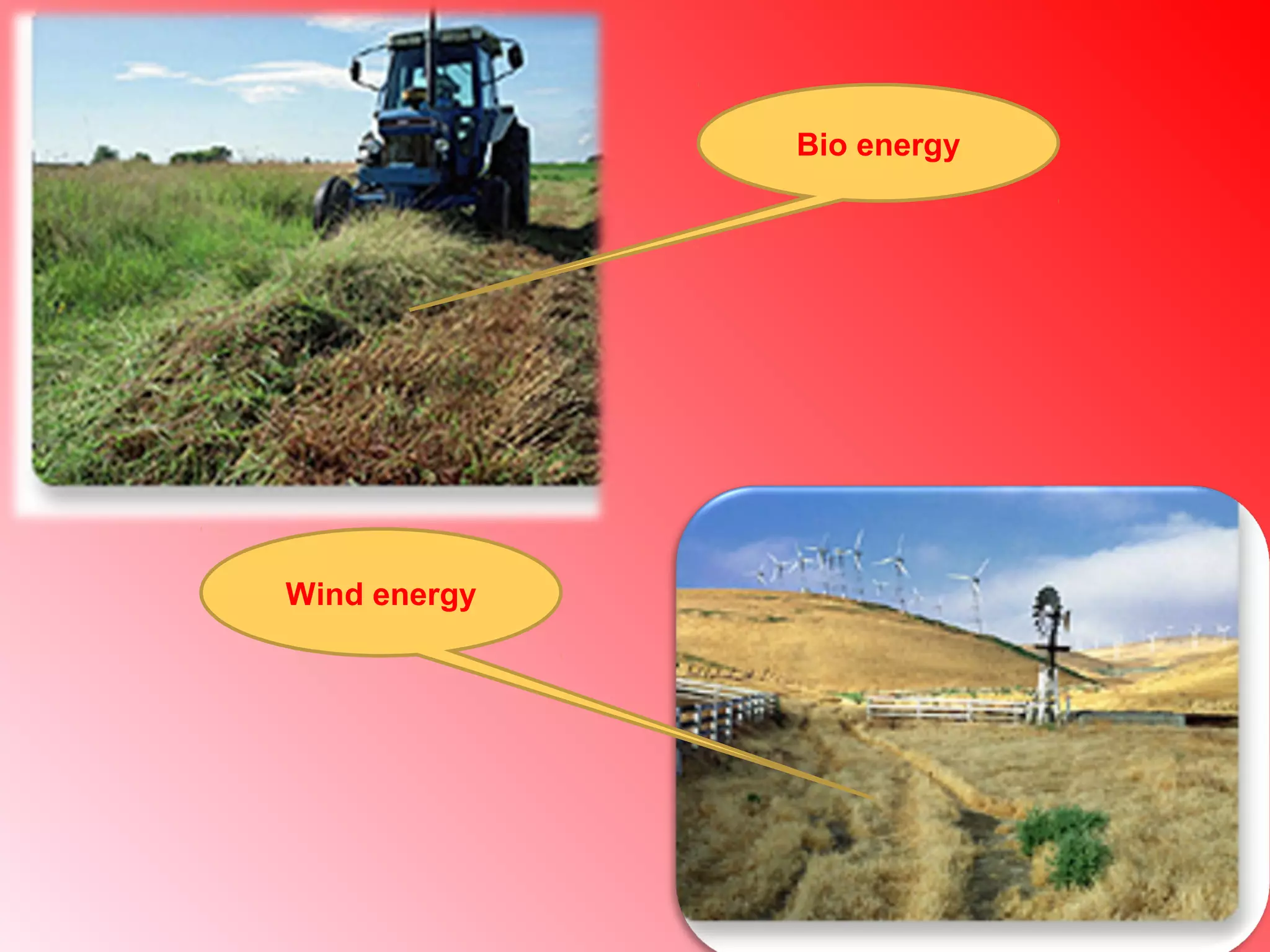
Bio energy
Wind energy
Ocean energy
Geothermal
energy
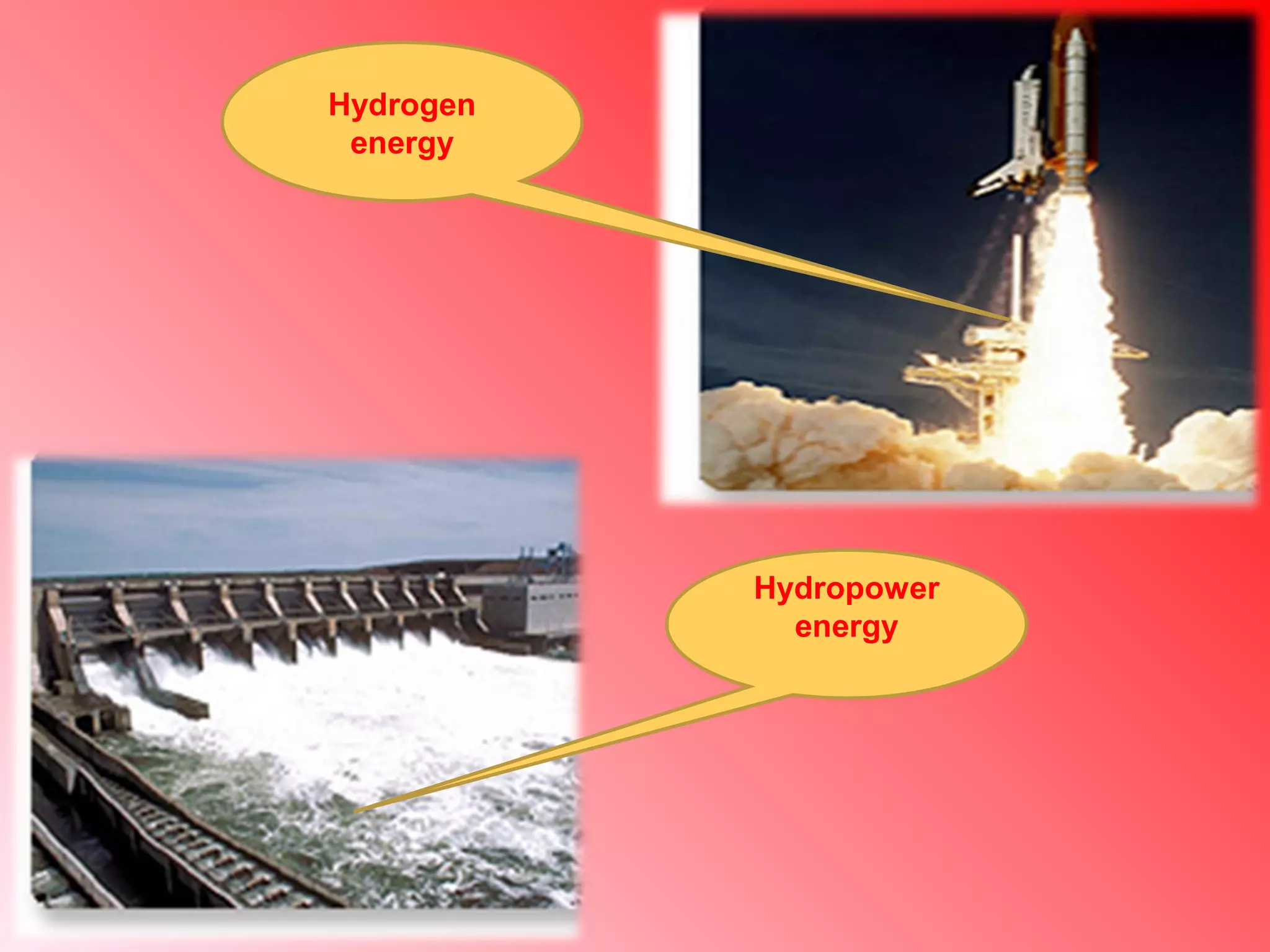
Hydrogen
energy
Hydropower
energy
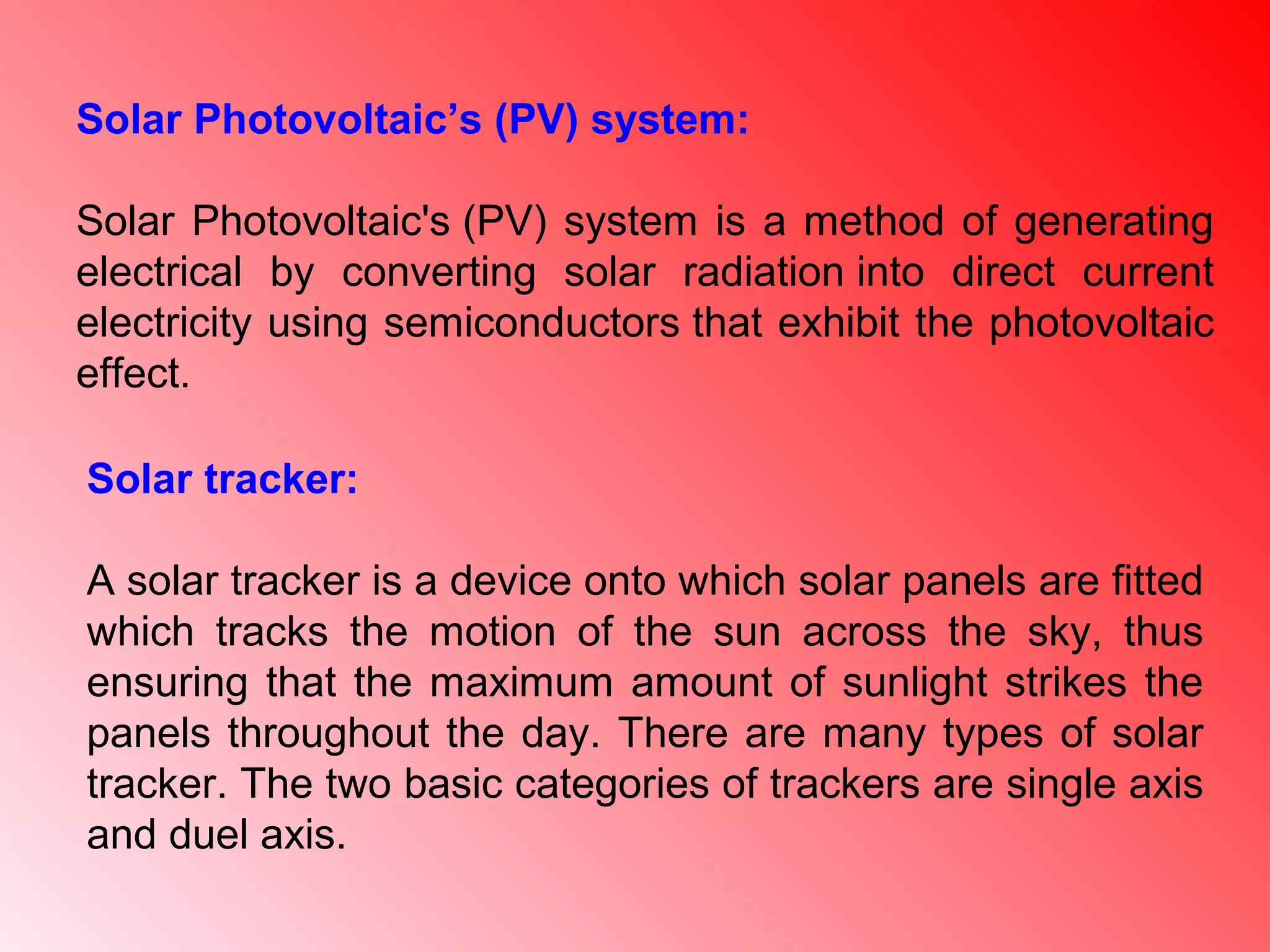
Solar tracker:
A solar tracker is a device onto which solar panels are fitted
which tracks the motion of the sun across the sky, thus
ensuring that the maximum amount of sunlight strikes the
panels throughout the day. There are many types of solar
tracker. The two basic categories of trackers are single axis
and duel axis.
Solar Photovoltaic’s (PV) system:
Solar Photovoltaic's (PV) system is a method of generating
electrical by converting solar radiation into direct current
electricity using semiconductors that exhibit the photovoltaic
effect.
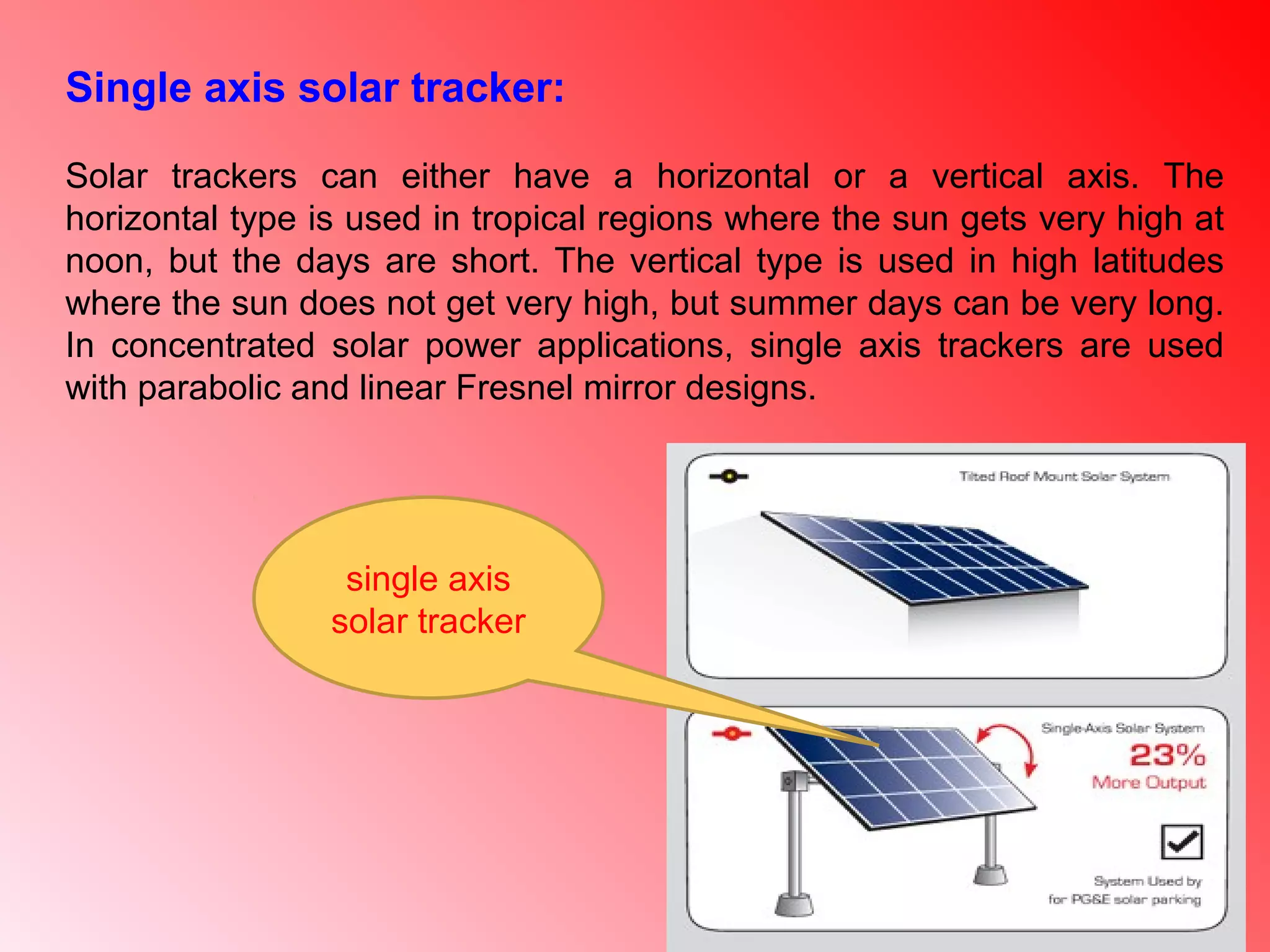
single axis
solar tracker
Single axis solar tracker:
Solar trackers can either have a horizontal or a vertical axis. The
horizontal type is used in tropical regions where the sun gets very high at
noon, but the days are short. The vertical type is used in high latitudes
where the sun does not get very high, but summer days can be very long.
In concentrated solar power applications, single axis trackers are used
with parabolic and linear Fresnel mirror designs.
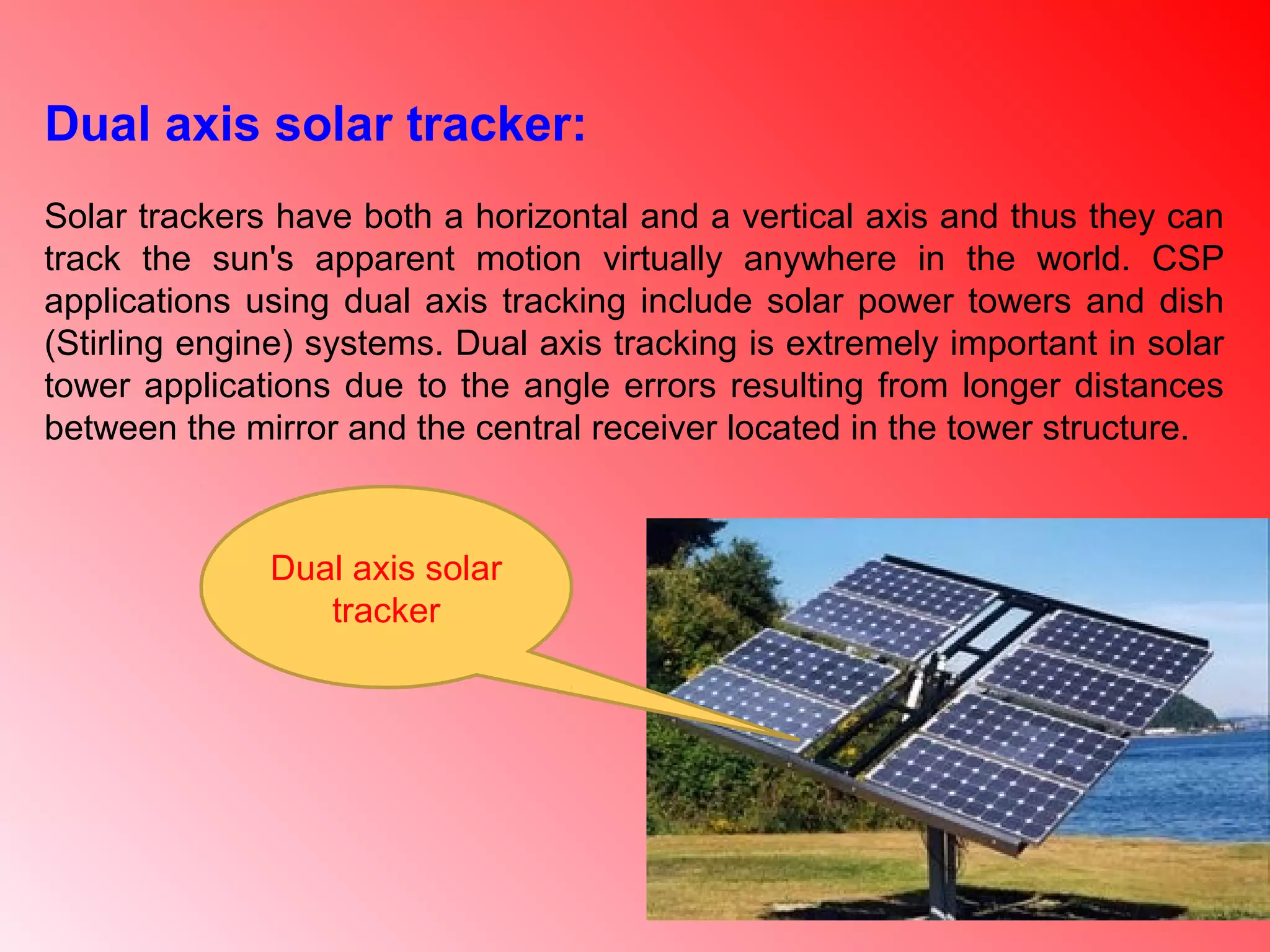
Dual axis solar
tracker
Dual axis solar tracker:
Solar trackers have both a horizontal and a vertical axis and thus they can
track the sun's apparent motion virtually anywhere in the world. CSP
applications using dual axis tracking include solar power towers and dish
(Stirling engine) systems. Dual axis tracking is extremely important in solar
tower applications due to the angle errors resulting from longer distances
between the mirror and the central receiver located in the tower structure.
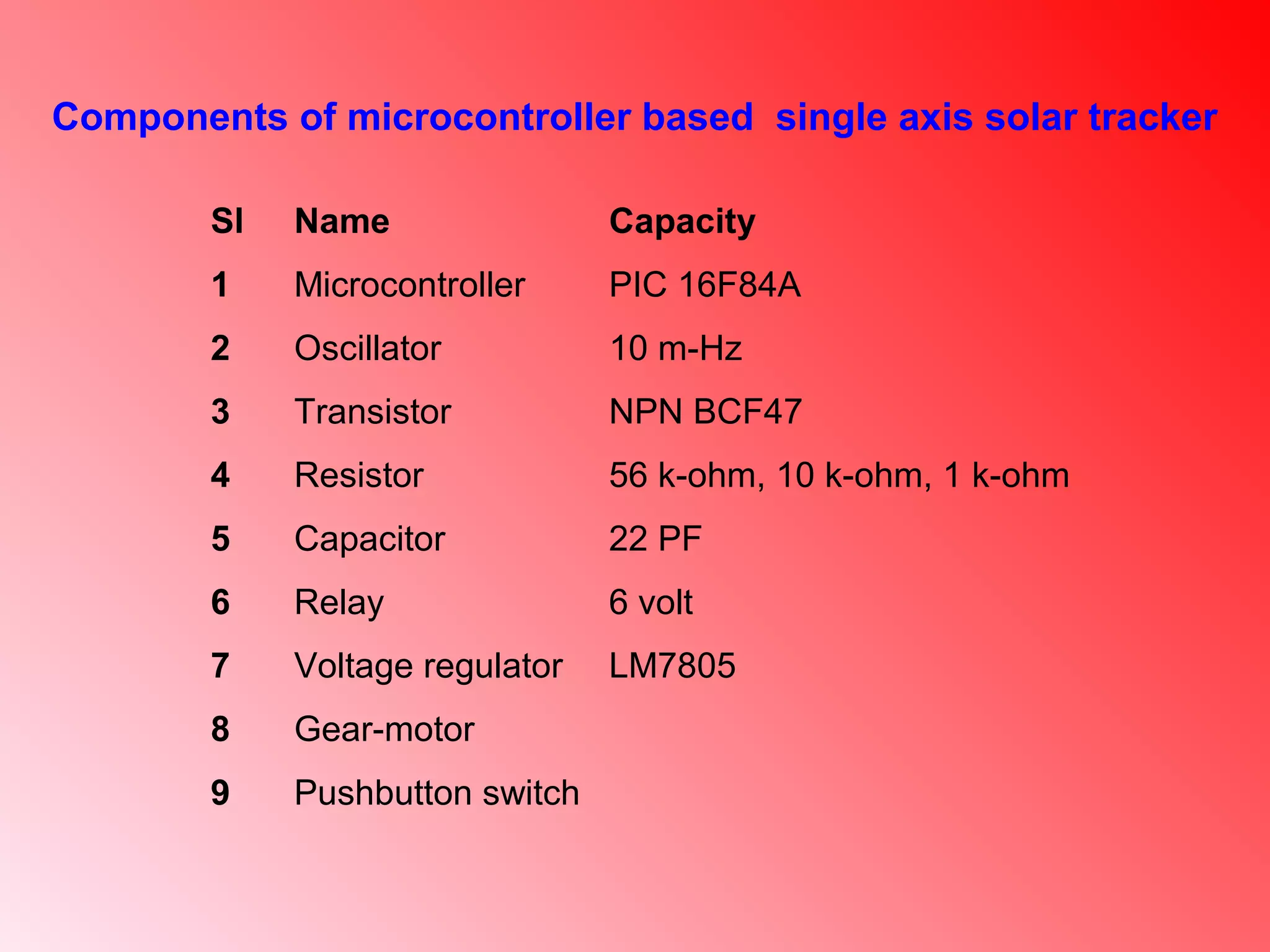
Components of microcontroller based single axis solar tracker
Sl Name Capacity
1 Microcontroller PIC 16F84A
2 Oscillator 10 m-Hz
3 Transistor NPN BCF47
4 Resistor 56 k-ohm, 10 k-ohm, 1 k-ohm
5 Capacitor 22 PF
6 Relay 6 volt
7 Voltage regulator LM7805
8 Gear-motor
9 Pushbutton switch
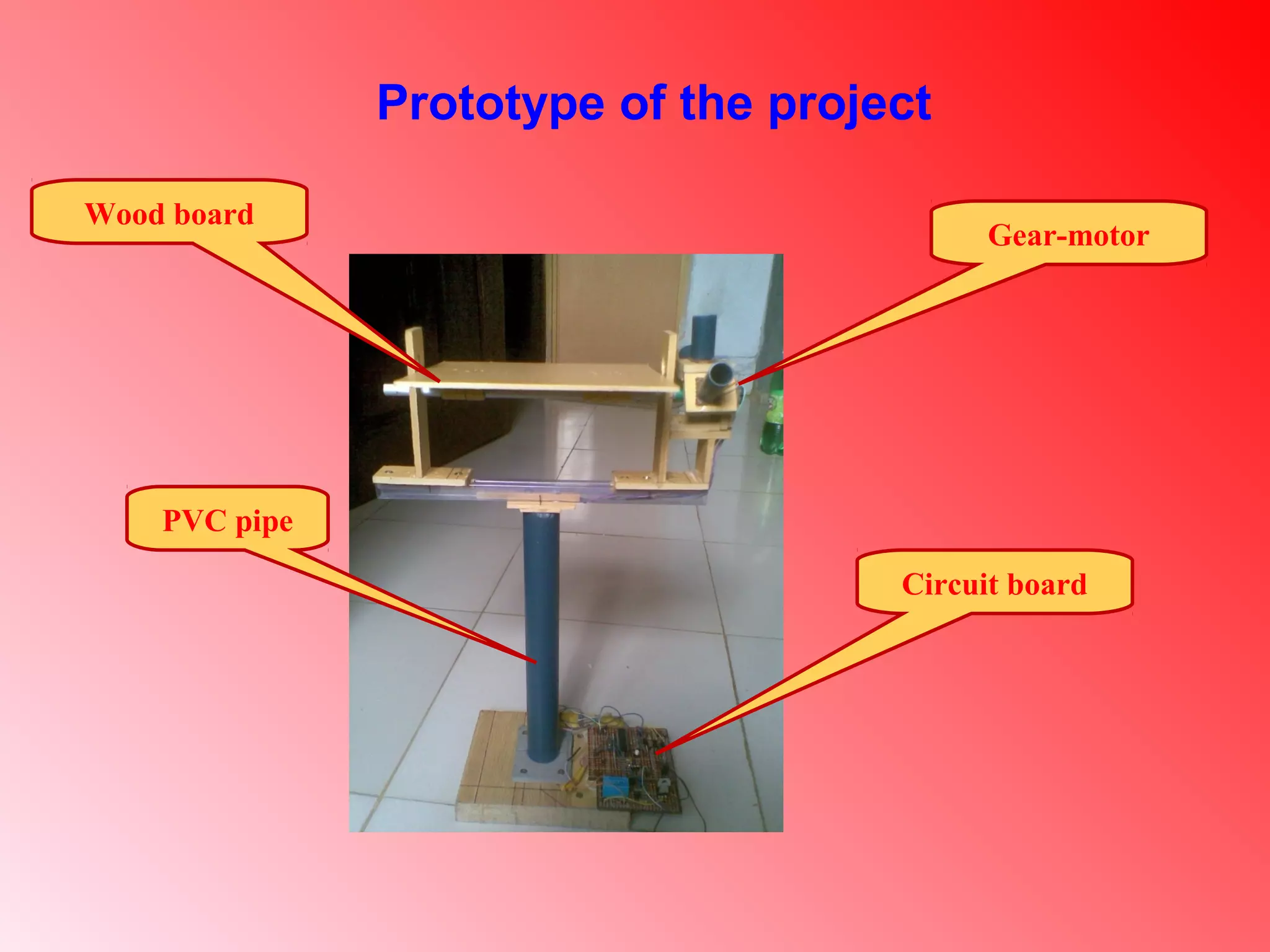
Gear-motor
Wood board
PVC pipe
Circuit board
Prototype of the project
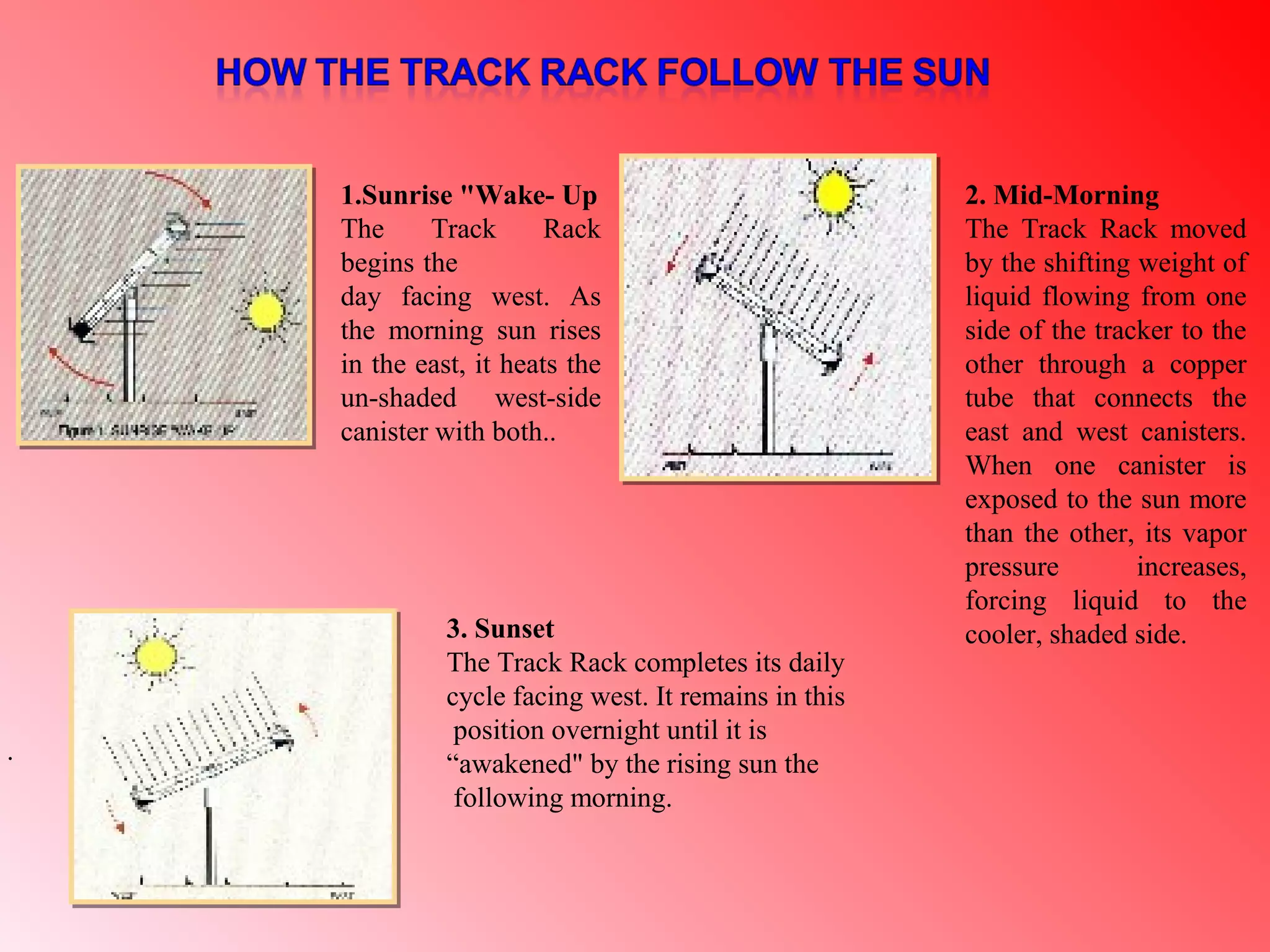
1.Sunrise "Wake- Up
The Track Rack
begins the
day facing west. As
the morning sun rises
in the east, it heats the
un-shaded west-side
canister with both..
2. Mid-Morning
The Track Rack moved
by the shifting weight of
liquid flowing from one
side of the tracker to the
other through a copper
tube that connects the
east and west canisters.
When one canister is
exposed to the sun more
than the other, its vapor
pressure increases,
forcing liquid to the
cooler, shaded side.3. Sunset
The Track Rack completes its daily
cycle facing west. It remains in this
position overnight until it is
“awakened" by the rising sun the
following morning.
.
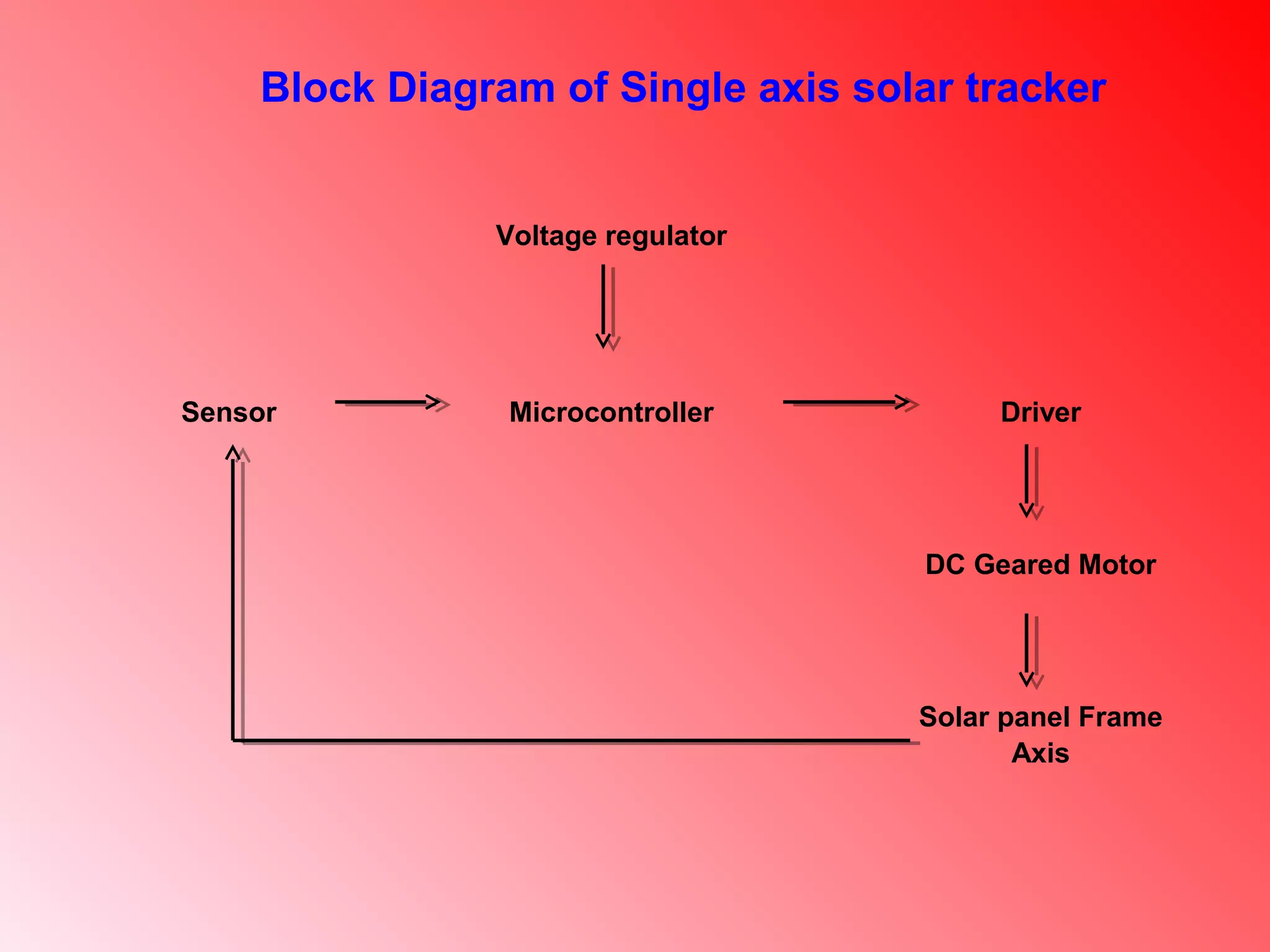
Block Diagram of Single axis solar tracker
Voltage regulator
Sensor Microcontroller Driver
DC Geared Motor
Solar panel Frame
Axis
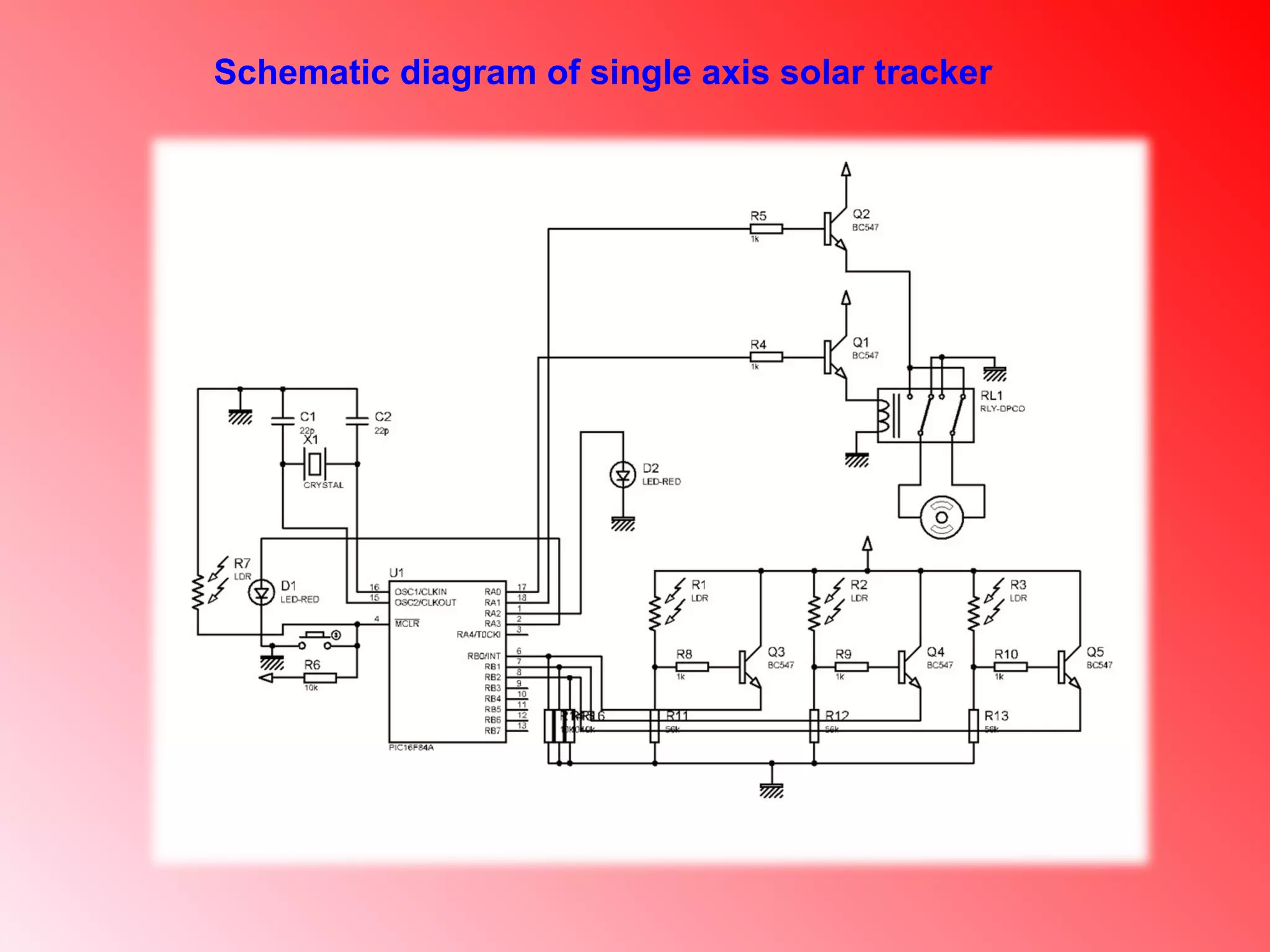
Schematic diagram of single axis solar tracker
Working principle:
The project is built using a balanced concept which is three signals from
the different sensors are compared. Light Dependent Resistor (LDR) as a
light sensor has been used. The three light sensors are separated by
divider which will create shadow on one side of the light sensor if the solar
panel is not perpendicular to the sun. For the controlling circuit,
microcontroller PIC16F84A acts as a brain that controls the movement of
the motor via relay. Data received from the sensors and processed by the
microcontroller. The microcontroller will send a data to the Bi-directional
DC-geared motor via relay to ensure solar panel is perpendicular towards
the Sun. Relay controls the rotation of the motor either to rotate clockwise
or anticlockwise. The solar panel that attached to the motor will be reacted
according to the direction of the motor.
Scope of future work of solar tracker:
• Improving the mechanical structure.
• Improving the load carrying capacity.
• Putting solar panel with total system.
• Adjusting the gear ratio to decrease energy loss.
• Stopping the motors while there is no need of movement.
• Reducing the cost of mechanical structure.
Conclusion :
•Solar tracking systems are used to continually orient photovoltaic panels
towards the sun and can help maximize the investment in PV system.
•They are beneficial as the sun's position in the sky will change gradually
over the course of a day and over the seasons throughout the year.
•Advantages to using a tracker system like this will depend mainly on it's
placement in determining how well it will increase the effectiveness of the
panels.
•Energy production is at an optimum and energy output is increased year
round. This is especially significant throughout the summer months with
its long days of sunlight available to capture and no energy will be lost.
•For those with limited space this means that a smaller array only needs
to be installed, a huge advantage for those smaller sites with only a small
area to place solar tracker.
Thank you

Presentation of single axis solar tracker

  • 2.
    Name ID. No. Ms.Rehana Akter ID: 102-296-511 Mir Md Emam Uddin ID: 102-168-511 Md. Jamil Uddin ID: 102-085-511 Md. Mahbub Mehedi ID: 102-049-511 MD. Shariful Amran ID: 102-102-511 “Microcontroller based single axis solar tracker ” This Project is submitted fulfillment for the requirements of the Degree of Bachelor of Science in Electrical & Electronic Engineering Prepared By Department of Electrical & Electronic Engineering Atish Dipankar University of Science & Technology (ADUST) Paltan Cumpas , Dhaka, Bangladesh July, 2013
  • 3.
    Introduction: This is asolar tracking system which can be used as a power generating method from sunlight. This method of power generation is simple and is taken from natural resource. This needs only maximum sunlight to generate power. This project helps for power generation by setting the equipment to get maximum sunlight automatically. This system is tracking for maximum intensity of light. When there is decrease in intensity of light, this system automatically changes its direction to get maximum intensity of light.
  • 4.
    Objective: The aim ofour projects is to utilize the maximum solar energy through solar panel. For this a digital based automatic sun tracking system is proposed. This project helps the solar power generating equipment to get the maximum sunlight automatically thereby increasing the efficiency of the system. The solar panel tracks the sun from east to west automatically for maximum intensity of light.
  • 5.
    Renewable Energy: Renewable energyis energy that is generated from natural processes that are continuously replenished. This includes sunlight, geothermal heat, wind, tides, water, and various forms of biomass. This energy cannot be exhausted and is constantly renewed. Renewable energy uses energy sources that are continually replenished by nature the sun, the wind, water, the Earth’s heat, and plants
  • 6.
    Solar energy Types ofrenewable energy:
  • 7.
  • 8.
  • 9.
  • 10.
    Solar tracker: A solartracker is a device onto which solar panels are fitted which tracks the motion of the sun across the sky, thus ensuring that the maximum amount of sunlight strikes the panels throughout the day. There are many types of solar tracker. The two basic categories of trackers are single axis and duel axis. Solar Photovoltaic’s (PV) system: Solar Photovoltaic's (PV) system is a method of generating electrical by converting solar radiation into direct current electricity using semiconductors that exhibit the photovoltaic effect.
  • 11.
    single axis solar tracker Singleaxis solar tracker: Solar trackers can either have a horizontal or a vertical axis. The horizontal type is used in tropical regions where the sun gets very high at noon, but the days are short. The vertical type is used in high latitudes where the sun does not get very high, but summer days can be very long. In concentrated solar power applications, single axis trackers are used with parabolic and linear Fresnel mirror designs.
  • 12.
    Dual axis solar tracker Dualaxis solar tracker: Solar trackers have both a horizontal and a vertical axis and thus they can track the sun's apparent motion virtually anywhere in the world. CSP applications using dual axis tracking include solar power towers and dish (Stirling engine) systems. Dual axis tracking is extremely important in solar tower applications due to the angle errors resulting from longer distances between the mirror and the central receiver located in the tower structure.
  • 13.
    Components of microcontrollerbased single axis solar tracker Sl Name Capacity 1 Microcontroller PIC 16F84A 2 Oscillator 10 m-Hz 3 Transistor NPN BCF47 4 Resistor 56 k-ohm, 10 k-ohm, 1 k-ohm 5 Capacitor 22 PF 6 Relay 6 volt 7 Voltage regulator LM7805 8 Gear-motor 9 Pushbutton switch
  • 14.
    Gear-motor Wood board PVC pipe Circuitboard Prototype of the project
  • 15.
    1.Sunrise "Wake- Up TheTrack Rack begins the day facing west. As the morning sun rises in the east, it heats the un-shaded west-side canister with both.. 2. Mid-Morning The Track Rack moved by the shifting weight of liquid flowing from one side of the tracker to the other through a copper tube that connects the east and west canisters. When one canister is exposed to the sun more than the other, its vapor pressure increases, forcing liquid to the cooler, shaded side.3. Sunset The Track Rack completes its daily cycle facing west. It remains in this position overnight until it is “awakened" by the rising sun the following morning. .
  • 16.
    Block Diagram ofSingle axis solar tracker Voltage regulator Sensor Microcontroller Driver DC Geared Motor Solar panel Frame Axis
  • 17.
    Schematic diagram ofsingle axis solar tracker
  • 18.
    Working principle: The projectis built using a balanced concept which is three signals from the different sensors are compared. Light Dependent Resistor (LDR) as a light sensor has been used. The three light sensors are separated by divider which will create shadow on one side of the light sensor if the solar panel is not perpendicular to the sun. For the controlling circuit, microcontroller PIC16F84A acts as a brain that controls the movement of the motor via relay. Data received from the sensors and processed by the microcontroller. The microcontroller will send a data to the Bi-directional DC-geared motor via relay to ensure solar panel is perpendicular towards the Sun. Relay controls the rotation of the motor either to rotate clockwise or anticlockwise. The solar panel that attached to the motor will be reacted according to the direction of the motor.
  • 19.
    Scope of futurework of solar tracker: • Improving the mechanical structure. • Improving the load carrying capacity. • Putting solar panel with total system. • Adjusting the gear ratio to decrease energy loss. • Stopping the motors while there is no need of movement. • Reducing the cost of mechanical structure.
  • 20.
    Conclusion : •Solar tracking systemsare used to continually orient photovoltaic panels towards the sun and can help maximize the investment in PV system. •They are beneficial as the sun's position in the sky will change gradually over the course of a day and over the seasons throughout the year. •Advantages to using a tracker system like this will depend mainly on it's placement in determining how well it will increase the effectiveness of the panels. •Energy production is at an optimum and energy output is increased year round. This is especially significant throughout the summer months with its long days of sunlight available to capture and no energy will be lost. •For those with limited space this means that a smaller array only needs to be installed, a huge advantage for those smaller sites with only a small area to place solar tracker.
  • 21.