2/13 
Presented by- 
SHAKIL 
MUHAMMAD 
UET PESHAWAR 
PAKISTAN 
Transformer
TRANSFORMER 
A TRANSFORMER is a device that transfers electrical energy from one circuit 
to another by electromagnetic induction (transformer action). 
or 
A transformer is an electrical device that steps up or steps down the AC 
voltage. 
The electrical energy is always transferred without a change in frequency, 
but may involve changes in magnitudes of voltage and current. Because a 
transformer works on the principle of electromagnetic induction, it must be 
used with an input source voltage that varies in amplitude. There are many 
types of power that fit this description; for ease of explanation and 
understanding, transformer action will be explained using an ac voltage as 
the input source. 
3/13
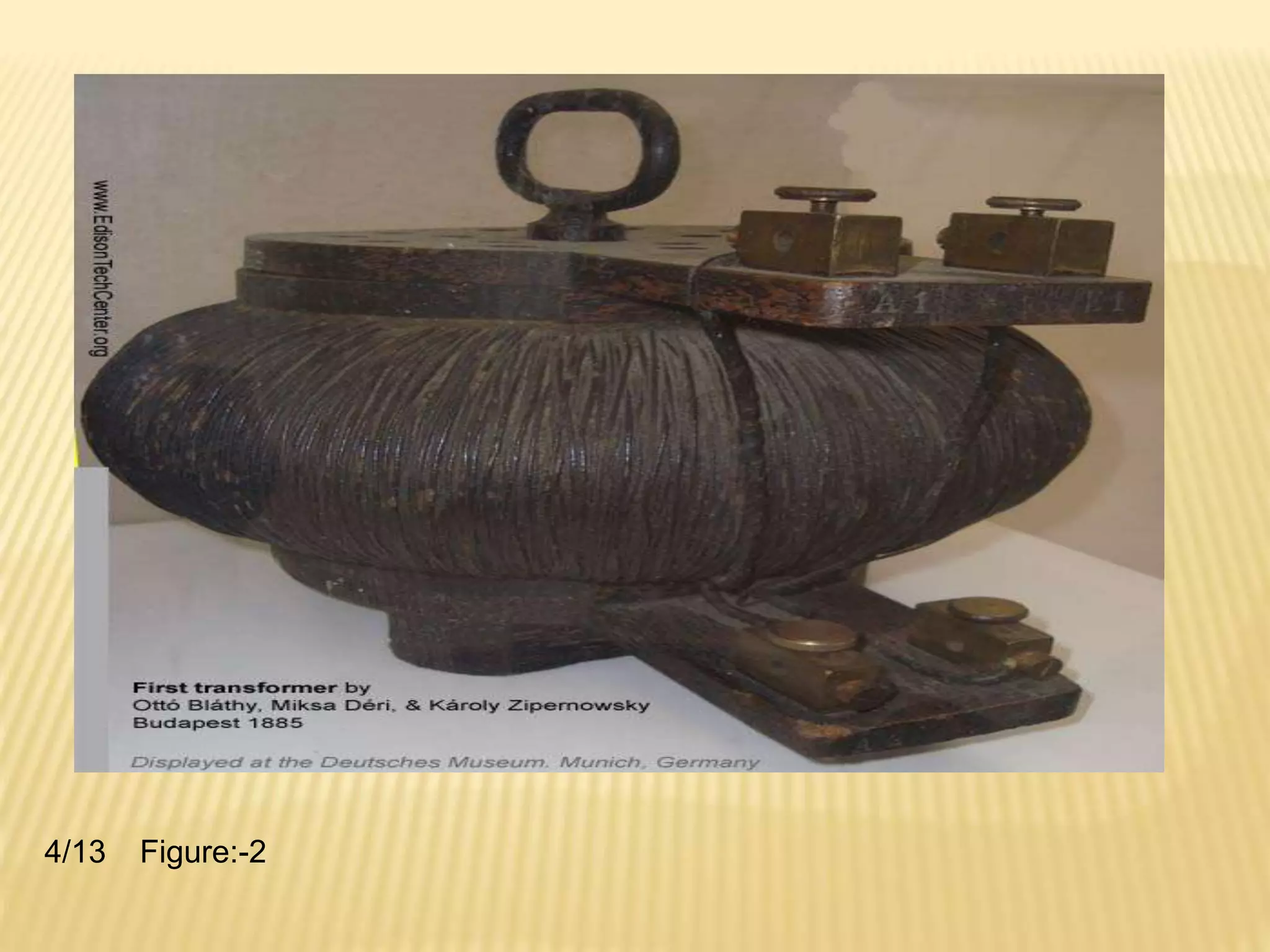
4/13 Figure:-2
THE COMPONENTS OF A TRANSFORMER 
Two coils of wire (called windings) are wound on some type of core material. In 
some cases the coils of wire are wound on a cylindrical or rectangular 
cardboard form. In effect, the core material is air and the transformer is 
called an AIR-CORE TRANSFORMER. Transformers used at low 
frequencies, such as 50 hertz and 400 hertz, require a core of low-reluctance 
magnetic material, usually iron. This type of transformer is called 
an IRON-CORE TRANSFORMER. Most power transformers are of the iron-core 
type. The principle parts of a transformer and their functions are: 
 The CORE, which provides a path for the magnetic lines of flux. 
 The PRIMARY WINDING, which receives energy from the ac source. 
 The SECONDARY WINDING, which receives energy from the primary 
winding and delivers it to the load. 
 The ENCLOSURE, which protects the above components from dirt, 
moisture, and mechanical damage. 
5/13
BASIC OPERATION OF A TRANSFORMER 
In its most basic form a transformer consists of: 
 A primary coil or winding. 
 A secondary coil or winding. 
 A core that supports the coils or windings. 
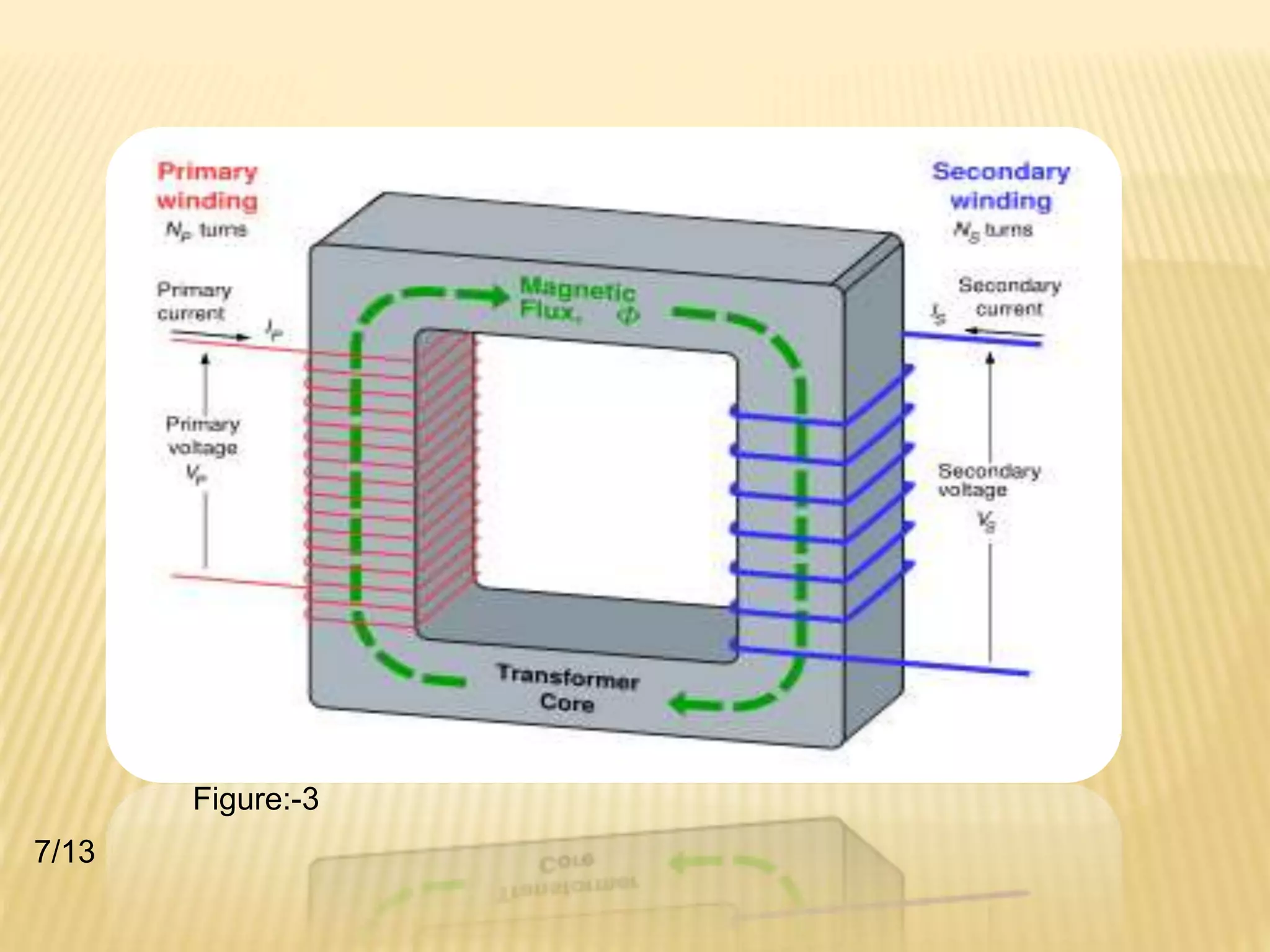
Refer to the transformer circuit in figure (3) as you read the following 
explanation: The primary winding is connected to a 50 hertz ac voltage 
source. The magnetic field (flux) builds up (expands)and 
collapses (contracts) about the primary winding. The expanding and 
contracting magnetic field around the primary winding cuts the secondary 
winding and induces an alternating voltage into the winding. This voltage 
causes alternating current to flow through the load. The voltage may be 
stepped up or down depending on the design of the primary and secondary 
windings. 
6/13
Figure:-3 
7/13
SCHEMATIC SYMBOLS FOR TRANSFORMERS 
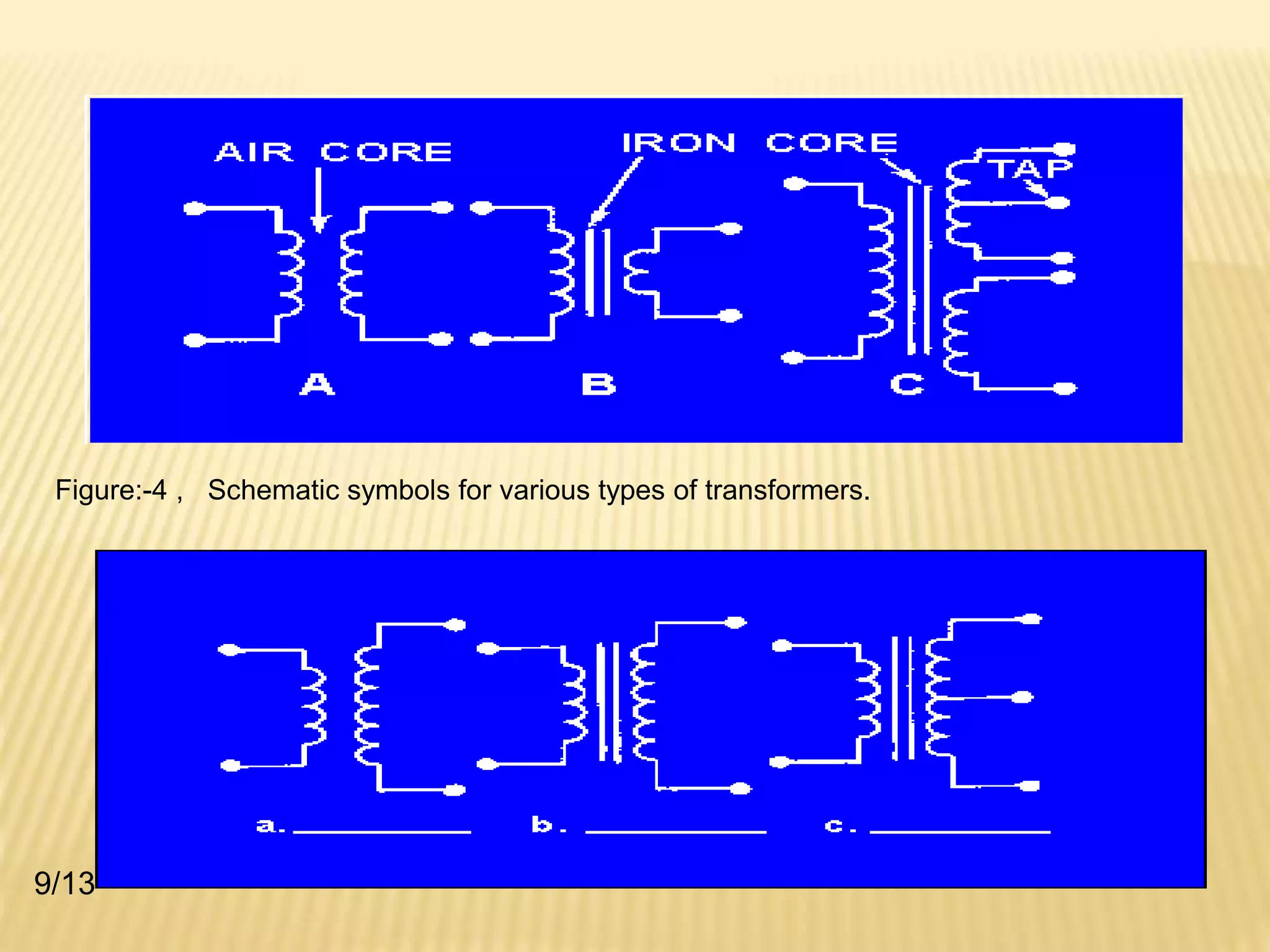
Figure (4) shows typical schematic symbols for transformers. The symbol for an 
air-core transformer is shown in figure (4-A). Parts (B) and (C) show iron-core 
transformers. The bars between the coils are used to indicate an iron 
core. Frequently, additional connections are made to the transformer 
windings at points other than the ends of the windings. These additional 
connections are called TAPS. When a tap is connected to the center of the 
winding, it is called a CENTER TAP. Figure (4- C) shows the schematic 
representation of a center-tapped iron-core transformer. 
8/13
Figure:-4 , Schematic symbols for various types of transformers. 
9/13
TYPES AND APPLICATIONS OF TRANSFORMERS 
The transformer has many useful applications in an electrical circuit. A brief 
discussion of some of these applications will help you recognize the 
importance of the transformer in electricity and electronics. 
POWER TRANSFORMERS:- Power transformers are used to supply 
voltages to the various circuits in electrical equipment. These transformers 
have two or more windings wound on a laminated iron core. The number of 
windings and the turns per winding depend upon the voltages that the 
transformer is to supply. 
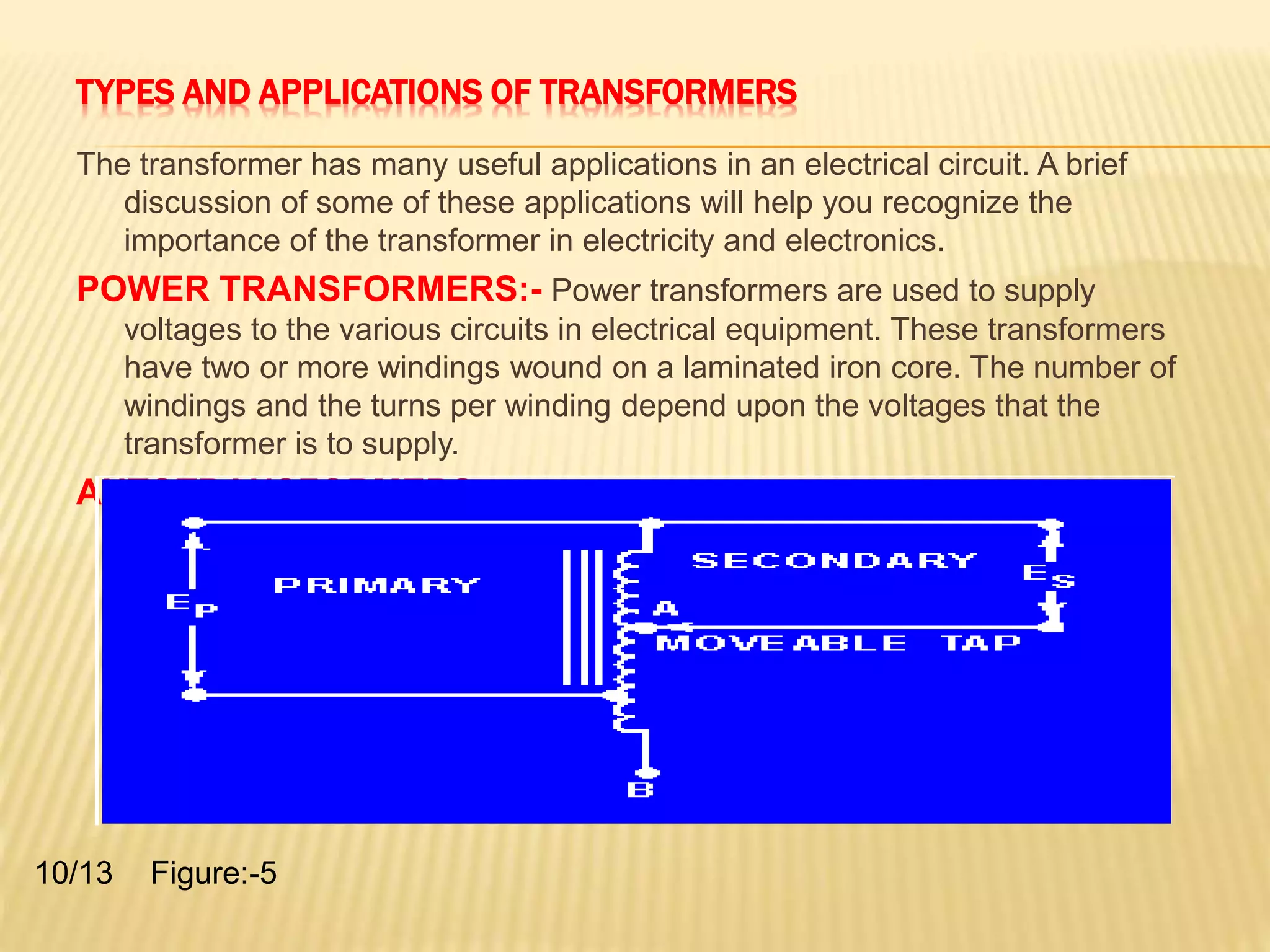
AUTOTRANSFORMERS:- Figure (5) is a schematic diagram of an 
autotransformer. 
10/13 Figure:-5
The voltage across the secondary winding has the same relationship to the voltage 
across the primary that it would have if they were two distinct windings. The 
movable tap in the secondary is used to select a value of output voltage, either 
higher or lower than E p, within the range of the transformer. That is, when the tap 
is at point A, Es is less than Ep; when the tap is at point B, Es is greater than E p. 
some other examples are: 
 AUDIO-FREQUENCY TRANSFORMERS:- 
 RADIO-FREQUENCY TRANSFORMERS:- 
 IMPEDANCE-MATCHING TRANSFORMERS:- 
11/13
REFERENCES:- 
 http://edisontechcenter.org/transformer/ZBDtran 
sformer600.jpg (Figure-5) 
 http://edisontechcenter.org/LocalSites/GreatBarri 
ngton/ZBDtransformerInventors.jpg(Figure-4) 
12/13
Transformer a short presentation

Transformer a short presentation

  • 1.
    2/13 Presented by- SHAKIL MUHAMMAD UET PESHAWAR PAKISTAN Transformer
  • 2.
    TRANSFORMER A TRANSFORMERis a device that transfers electrical energy from one circuit to another by electromagnetic induction (transformer action). or A transformer is an electrical device that steps up or steps down the AC voltage. The electrical energy is always transferred without a change in frequency, but may involve changes in magnitudes of voltage and current. Because a transformer works on the principle of electromagnetic induction, it must be used with an input source voltage that varies in amplitude. There are many types of power that fit this description; for ease of explanation and understanding, transformer action will be explained using an ac voltage as the input source. 3/13
  • 3.
  • 4.
    THE COMPONENTS OFA TRANSFORMER Two coils of wire (called windings) are wound on some type of core material. In some cases the coils of wire are wound on a cylindrical or rectangular cardboard form. In effect, the core material is air and the transformer is called an AIR-CORE TRANSFORMER. Transformers used at low frequencies, such as 50 hertz and 400 hertz, require a core of low-reluctance magnetic material, usually iron. This type of transformer is called an IRON-CORE TRANSFORMER. Most power transformers are of the iron-core type. The principle parts of a transformer and their functions are:  The CORE, which provides a path for the magnetic lines of flux.  The PRIMARY WINDING, which receives energy from the ac source.  The SECONDARY WINDING, which receives energy from the primary winding and delivers it to the load.  The ENCLOSURE, which protects the above components from dirt, moisture, and mechanical damage. 5/13
  • 5.
    BASIC OPERATION OFA TRANSFORMER In its most basic form a transformer consists of:  A primary coil or winding.  A secondary coil or winding.  A core that supports the coils or windings. Refer to the transformer circuit in figure (3) as you read the following explanation: The primary winding is connected to a 50 hertz ac voltage source. The magnetic field (flux) builds up (expands)and collapses (contracts) about the primary winding. The expanding and contracting magnetic field around the primary winding cuts the secondary winding and induces an alternating voltage into the winding. This voltage causes alternating current to flow through the load. The voltage may be stepped up or down depending on the design of the primary and secondary windings. 6/13
  • 6.
  • 7.
    SCHEMATIC SYMBOLS FORTRANSFORMERS Figure (4) shows typical schematic symbols for transformers. The symbol for an air-core transformer is shown in figure (4-A). Parts (B) and (C) show iron-core transformers. The bars between the coils are used to indicate an iron core. Frequently, additional connections are made to the transformer windings at points other than the ends of the windings. These additional connections are called TAPS. When a tap is connected to the center of the winding, it is called a CENTER TAP. Figure (4- C) shows the schematic representation of a center-tapped iron-core transformer. 8/13
  • 8.
    Figure:-4 , Schematicsymbols for various types of transformers. 9/13
  • 9.
    TYPES AND APPLICATIONSOF TRANSFORMERS The transformer has many useful applications in an electrical circuit. A brief discussion of some of these applications will help you recognize the importance of the transformer in electricity and electronics. POWER TRANSFORMERS:- Power transformers are used to supply voltages to the various circuits in electrical equipment. These transformers have two or more windings wound on a laminated iron core. The number of windings and the turns per winding depend upon the voltages that the transformer is to supply. AUTOTRANSFORMERS:- Figure (5) is a schematic diagram of an autotransformer. 10/13 Figure:-5
  • 10.
    The voltage acrossthe secondary winding has the same relationship to the voltage across the primary that it would have if they were two distinct windings. The movable tap in the secondary is used to select a value of output voltage, either higher or lower than E p, within the range of the transformer. That is, when the tap is at point A, Es is less than Ep; when the tap is at point B, Es is greater than E p. some other examples are:  AUDIO-FREQUENCY TRANSFORMERS:-  RADIO-FREQUENCY TRANSFORMERS:-  IMPEDANCE-MATCHING TRANSFORMERS:- 11/13
  • 11.
    REFERENCES:-  http://edisontechcenter.org/transformer/ZBDtran sformer600.jpg (Figure-5)  http://edisontechcenter.org/LocalSites/GreatBarri ngton/ZBDtransformerInventors.jpg(Figure-4) 12/13