Energy bands and charge carriers
in semiconductors
2
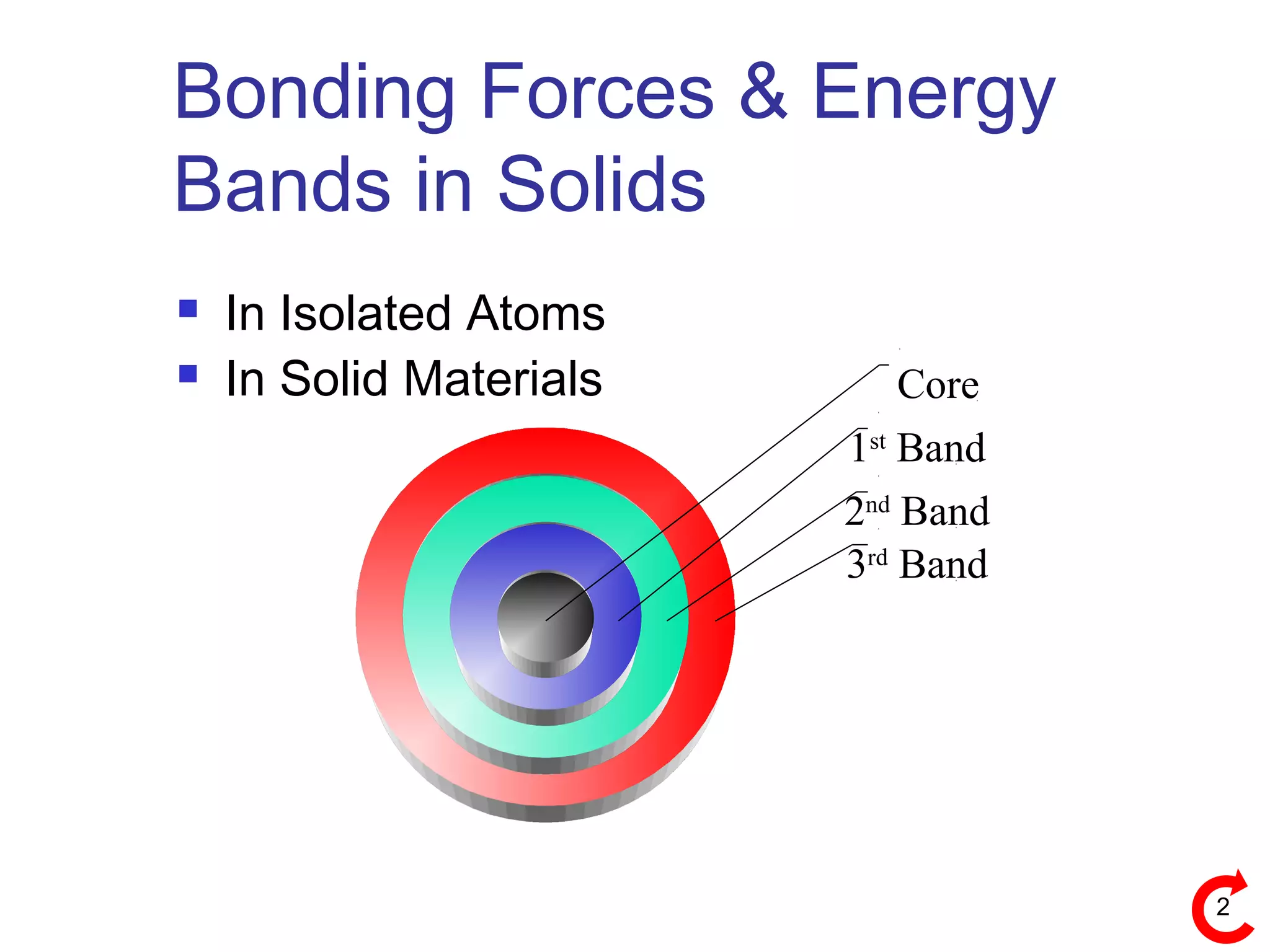
Bonding Forces & Energy
Bands in Solids
 In Isolated Atoms
 In Solid Materials
3rd
Band
2nd
Band
1st
Band
Core
3
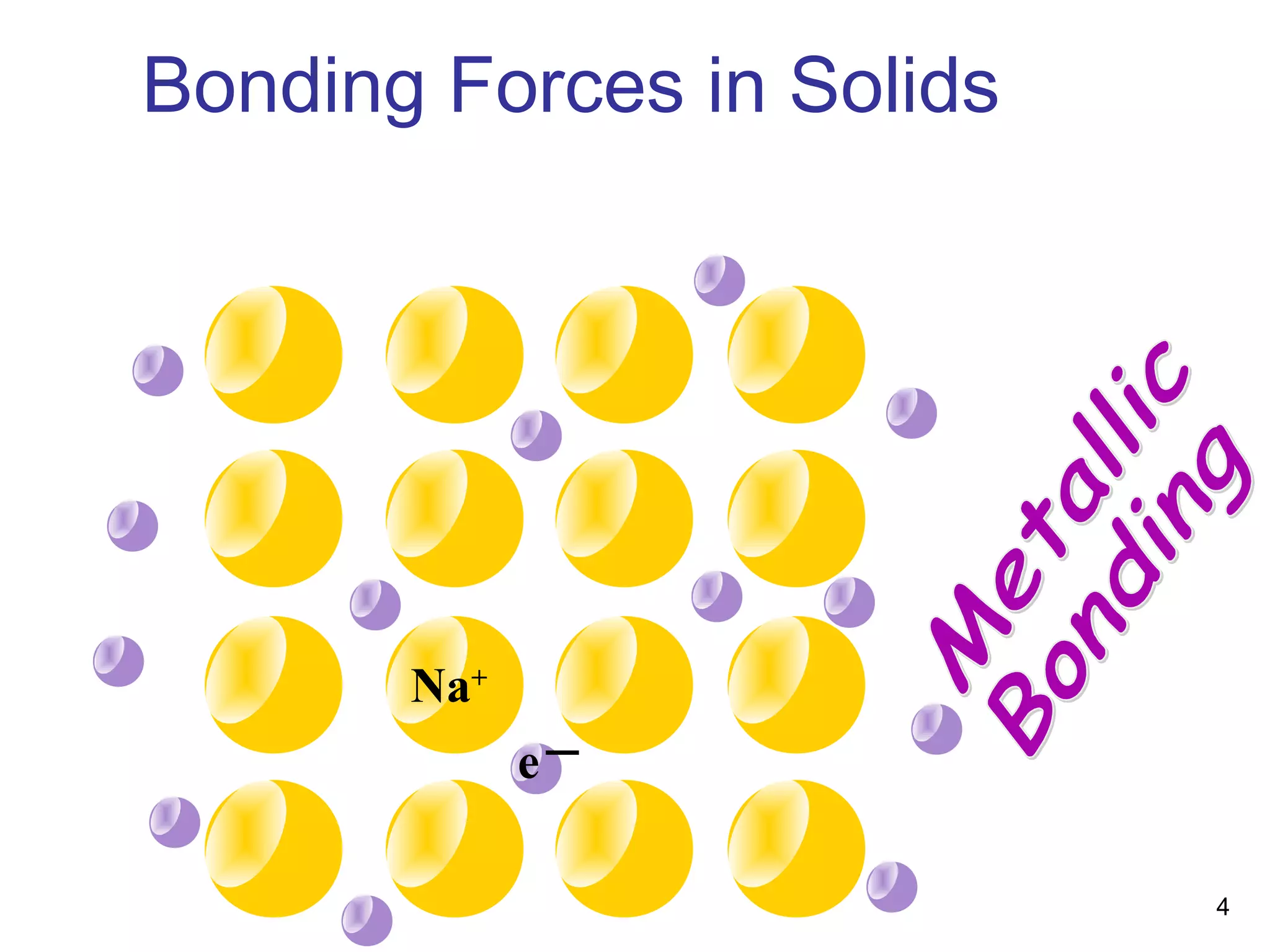
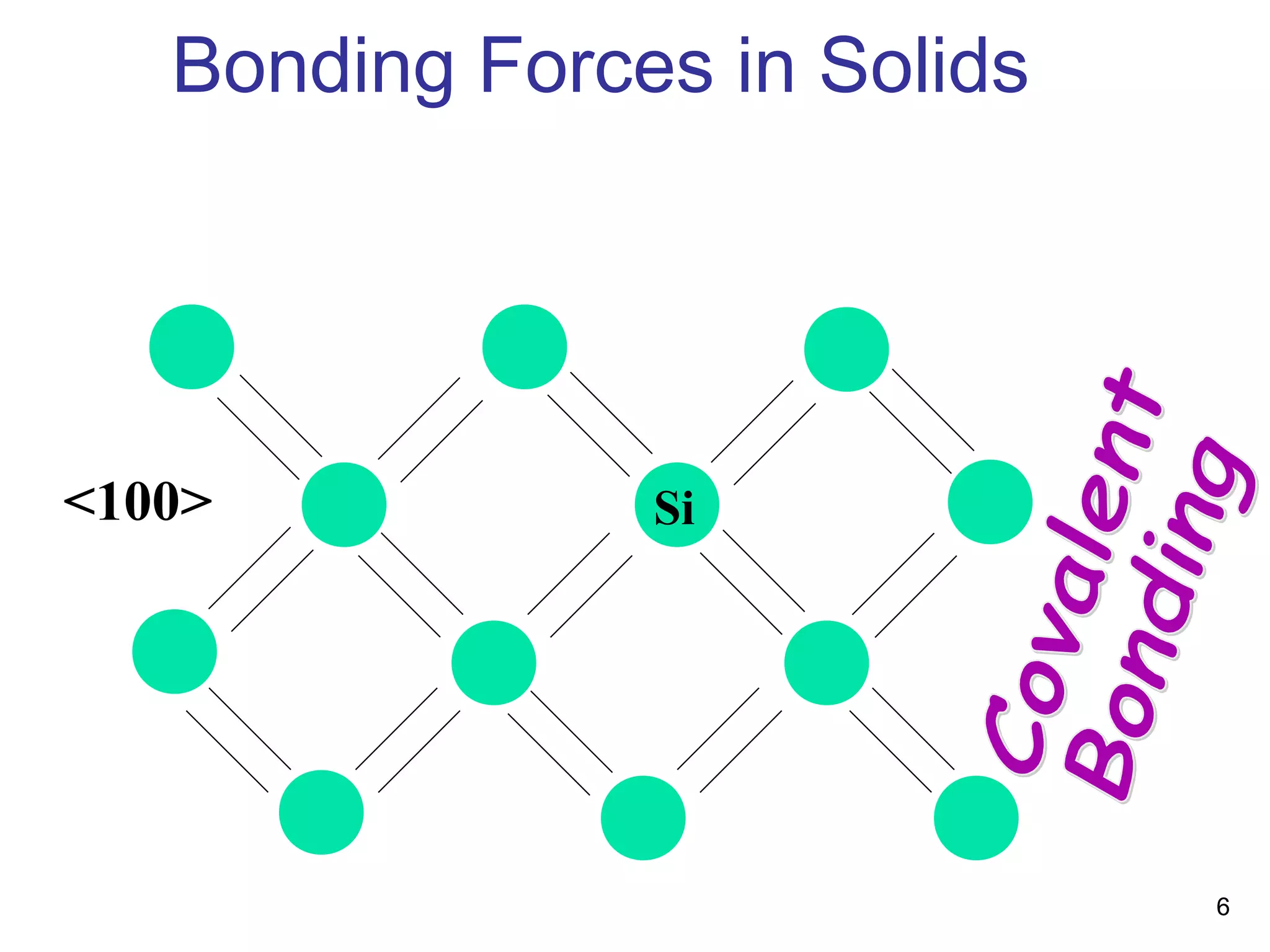
Bonding Forces in Solids
 Na (Z=11) [Ne]3s1
 Cl (Z=17) [Ne]3s1
3p5
Na+ Cl
_
4
Bonding Forces in Solids
e
_
Na+
5
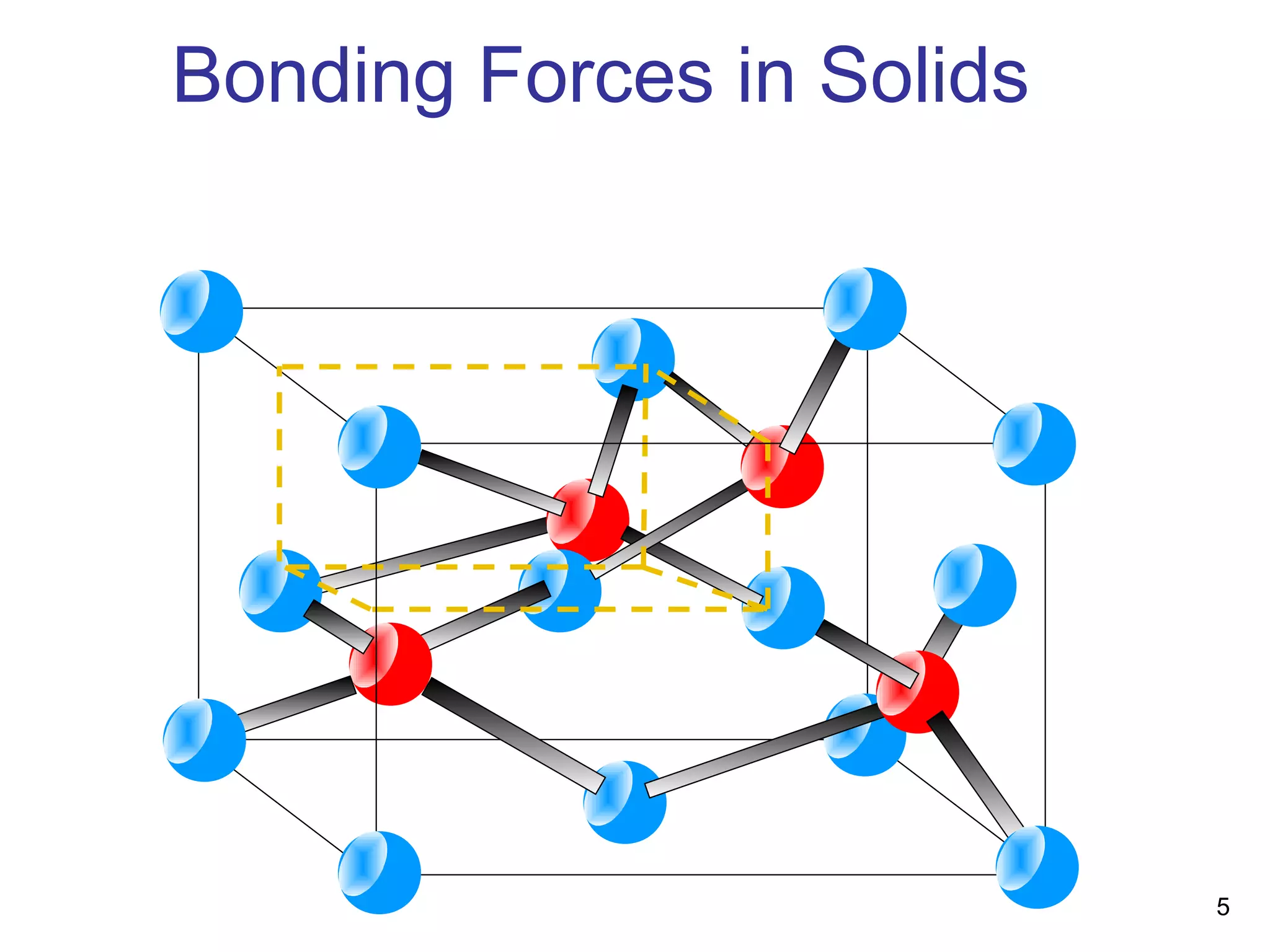
Bonding Forces in Solids
6
Bonding Forces in Solids
Si<100>
7
Energy Bands
 Pauli Exclusion Principle
C (Z=6) 1s2
2s2
2p2
2 states for 1s level
2 states for 2s level
6 states for 2p level
For N atoms, there will be 2N, 2N, and 6N states
of type 1s, 2s, and 2p, respectively.
8
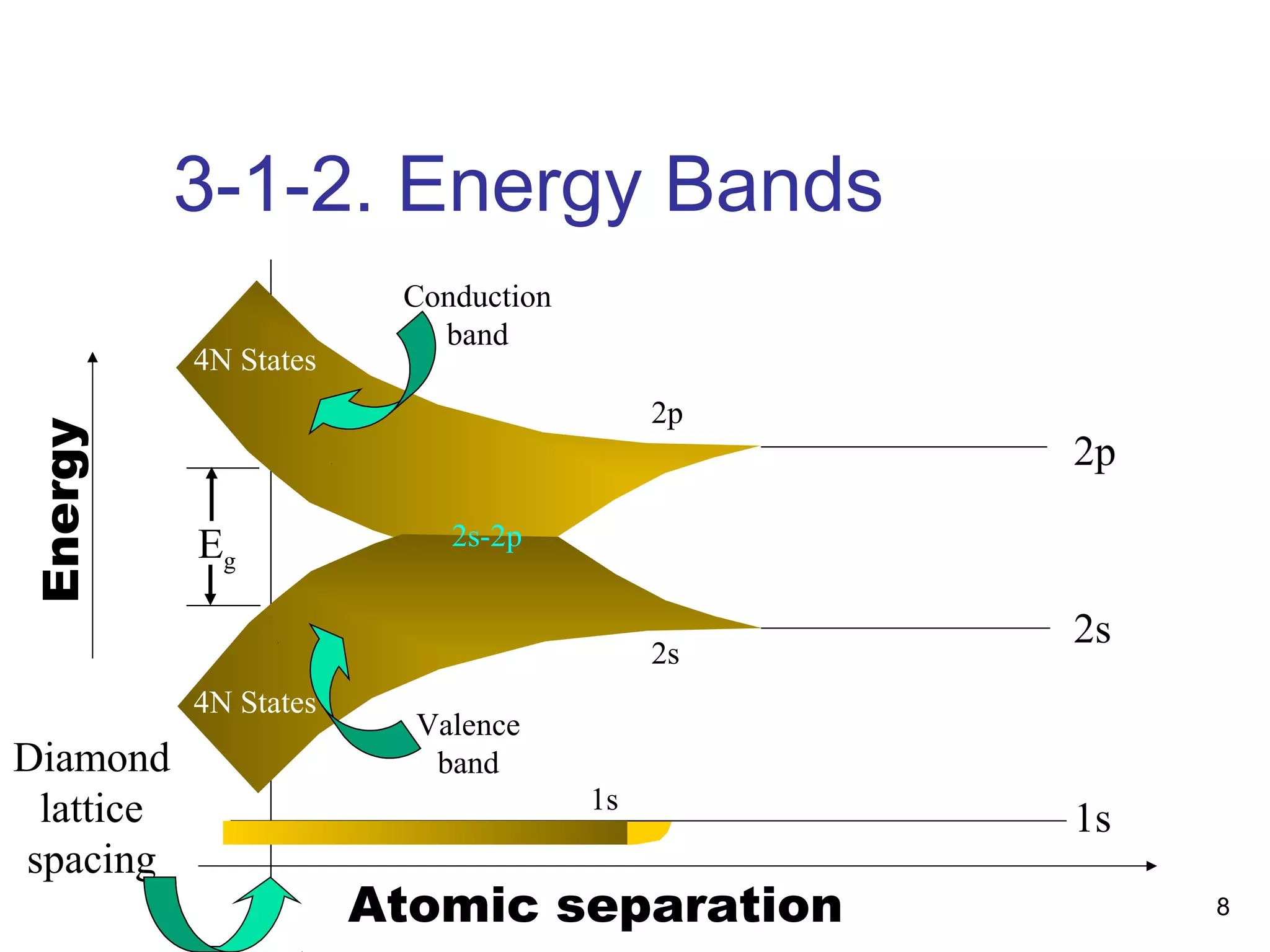
3-1-2. Energy Bands
Atomic separation
Diamond
lattice
spacing
Energy
1s
2s
2p
Valence
band
Conduction
band
2p
2s
2s-2p
4N States
4N States
Eg
1s
9
Metals, Semiconductors &
Insulators
 For electrons to experience acceleration in an
applied electric field, they must be able to
move into new energy states. This implies
there must be empty states (allowed energy
states which are not already occupied by
electrons) available to the electrons.
 The diamond structure is such that the
valence band is completely filled with
electrons at 0ºK
and the conduction band is
empty. There can be no charge transport
within the valence band, since no empty
states are available into which electrons can
move.
10
Metals, Semiconductors &
Insulators
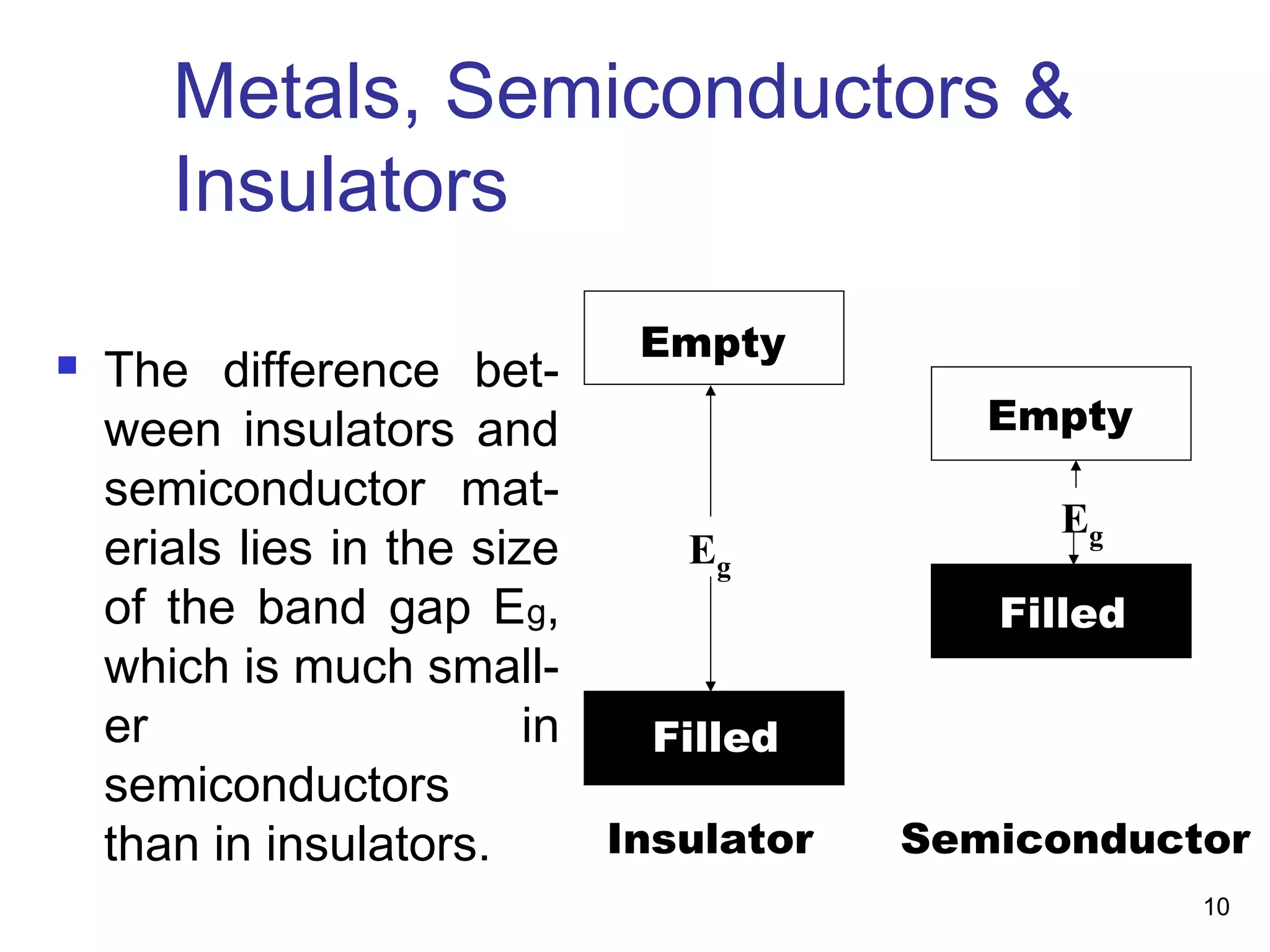
 The difference bet-
ween insulators and
semiconductor mat-
erials lies in the size
of the band gap Eg,
which is much small-
er in
semiconductors
than in insulators. Insulator Semiconductor
Filled
Filled
Empty
Empty
Eg
Eg
11
Metals, Semiconductors &
Insulators
Metal
Filled
Partially
Filled
Overlap
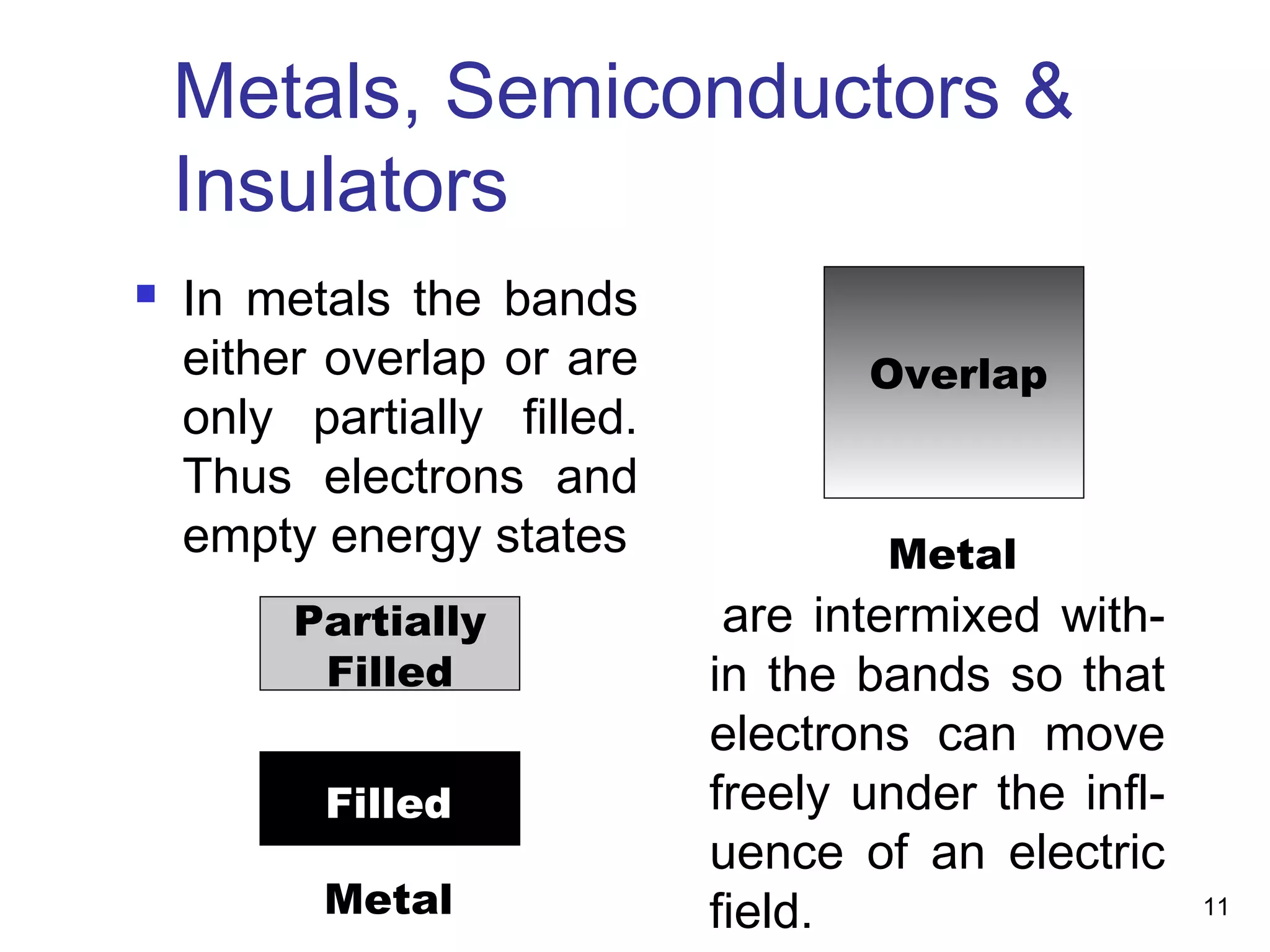
 In metals the bands
either overlap or are
only partially filled.
Thus electrons and
empty energy states Metal
are intermixed with-
in the bands so that
electrons can move
freely under the infl-
uence of an electric
field.
12
3-2-3. Intrinsic Material
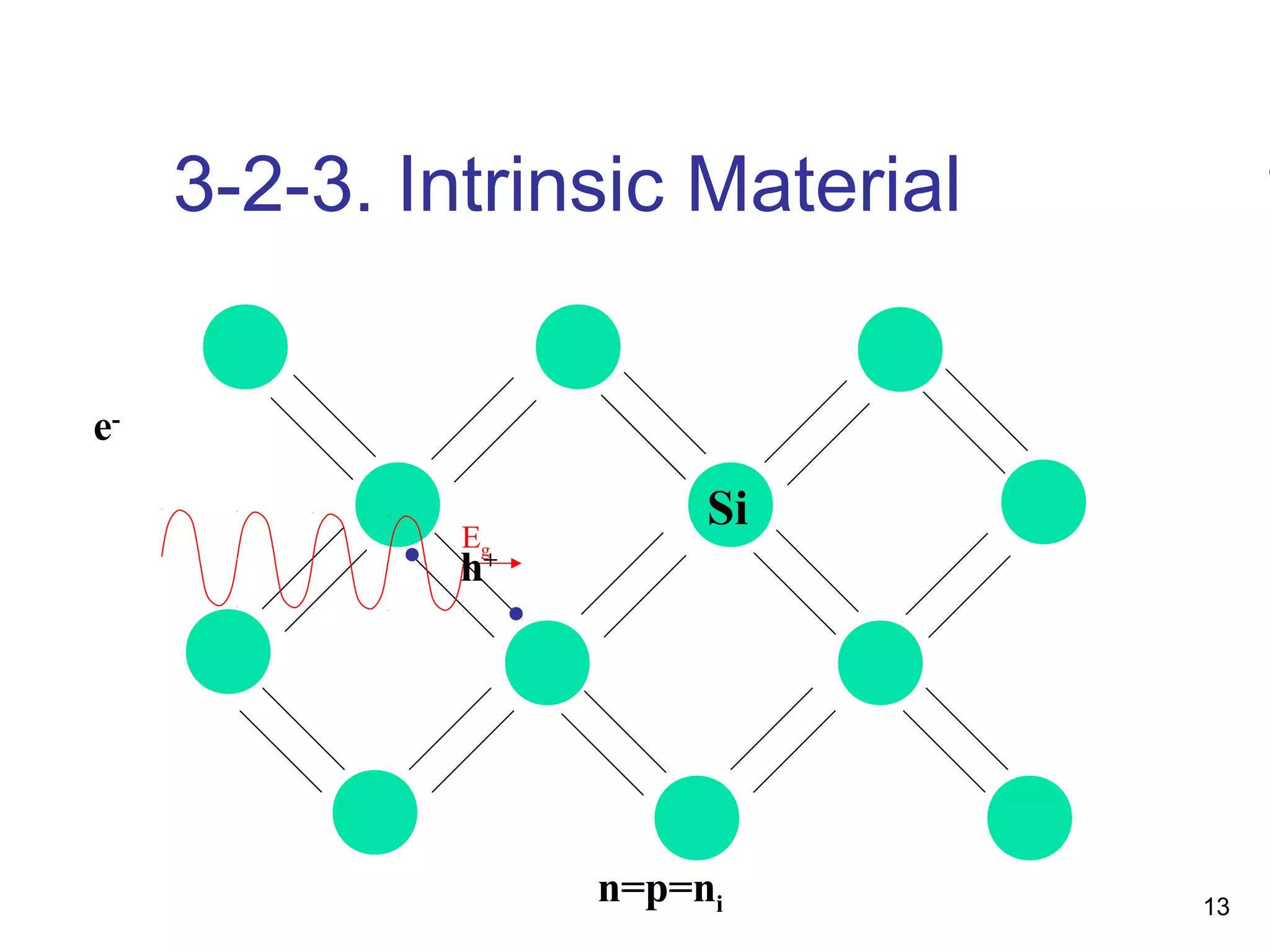
 A perfect semiconductor crystal with no
impurities or lattice defects is called an
Intrinsic semiconductor.
 In such material there are no charge
carriers at 0ºK
, since the valence band is
filled with electrons and the conduction
band is empty.
13
3-2-3. Intrinsic Material
SiEg
h+
e-
n=p=ni
14
3-2-3. Intrinsic Material
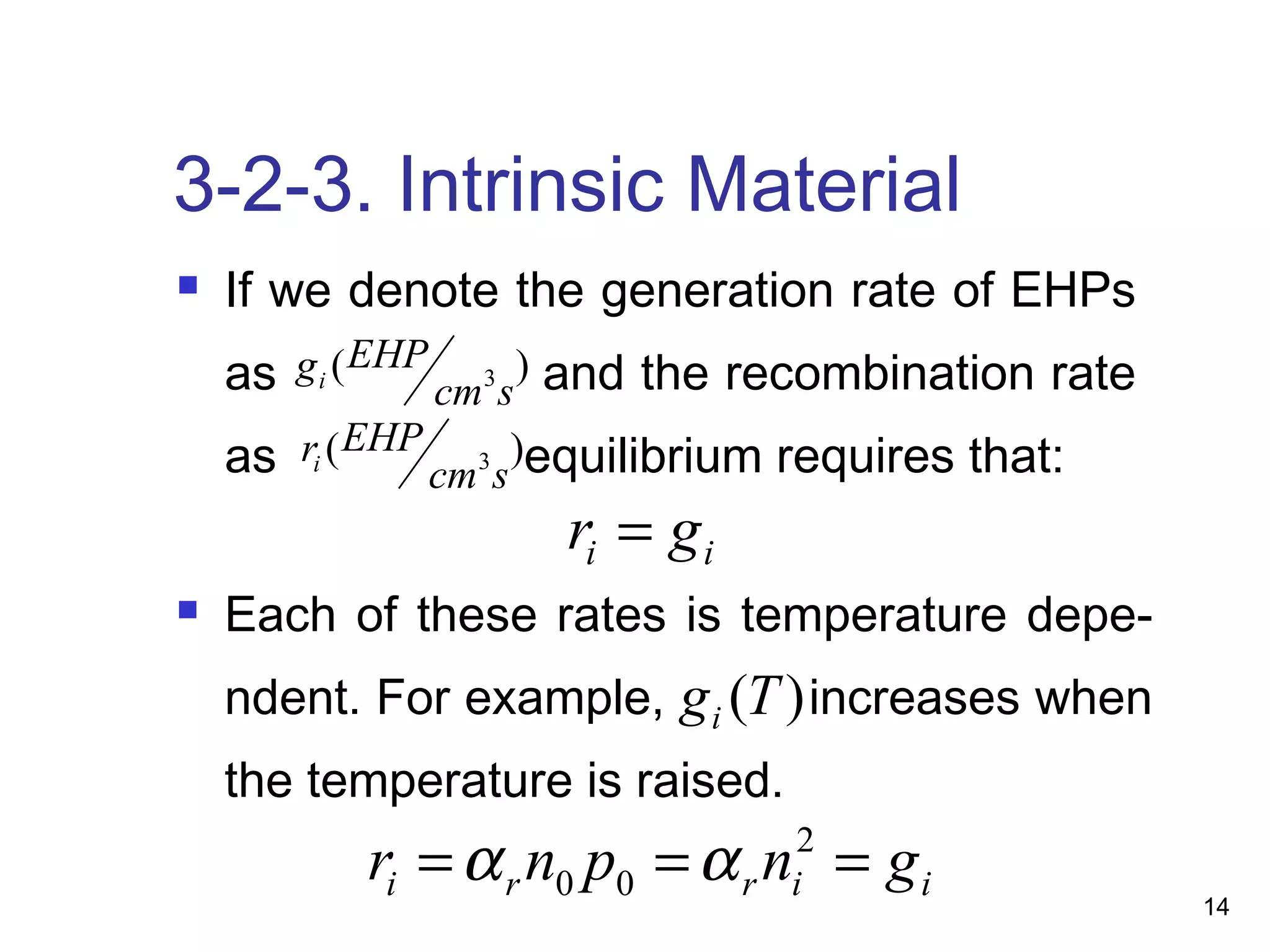
 If we denote the generation rate of EHPs
as and the recombination rate
as equilibrium requires that:
)(Tgi
)( 3
scm
EHPri
ii gr =
 Each of these rates is temperature depe-
ndent. For example, increases when
the temperature is raised.
)( 3
scm
EHPgi
iirri gnpnr === 2
00 αα
15
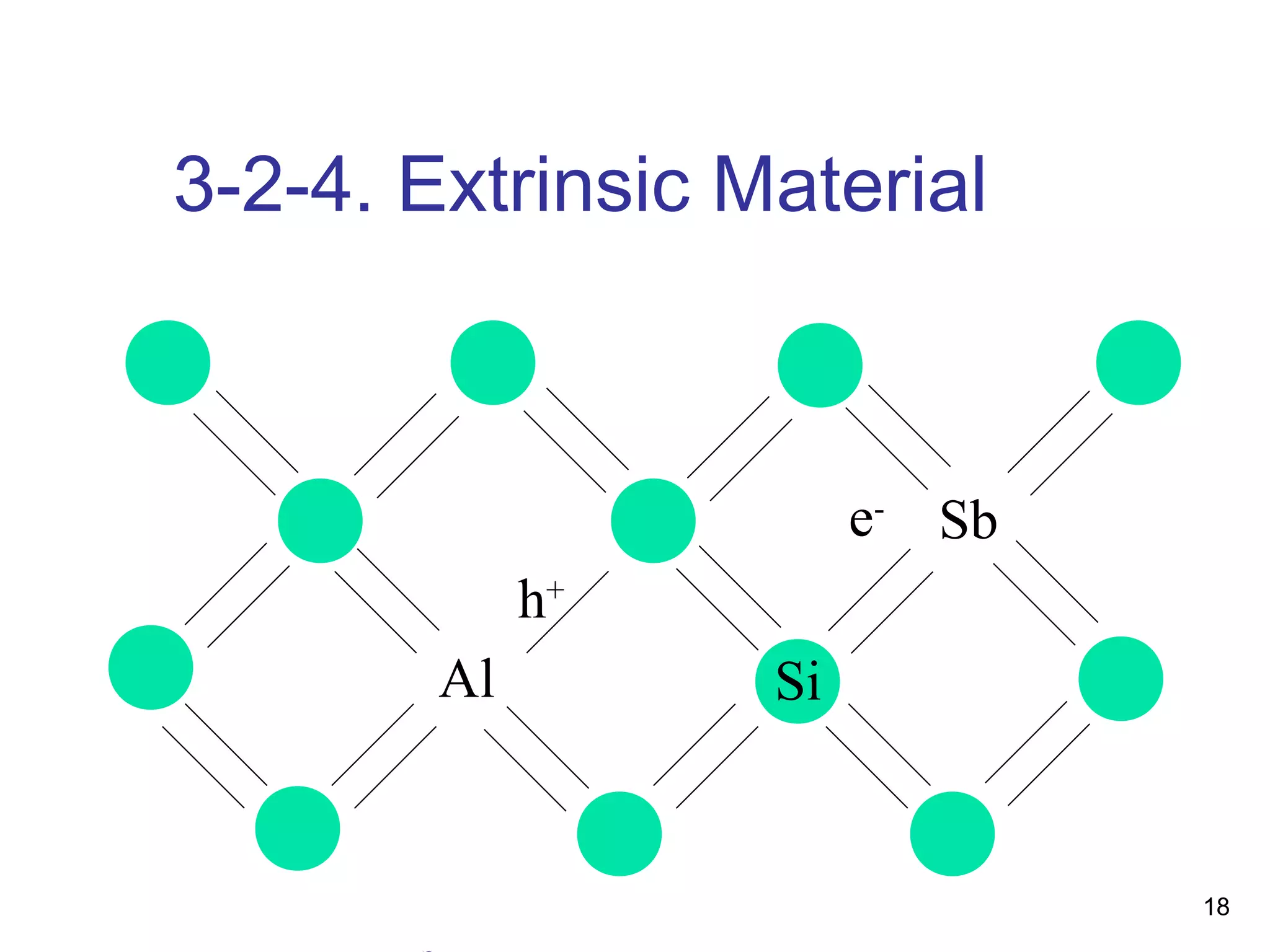
3-2-4. Extrinsic Material
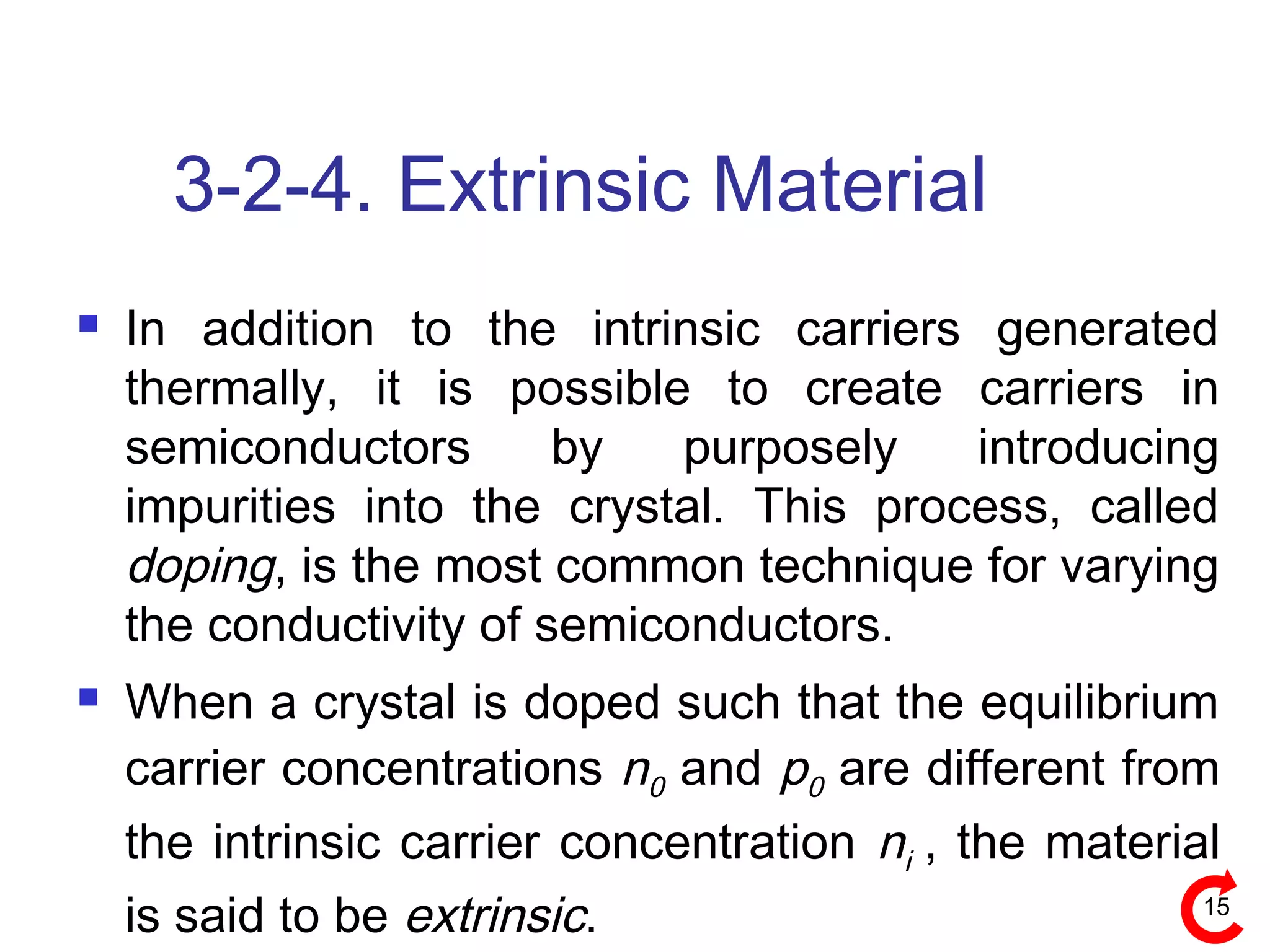
 In addition to the intrinsic carriers generated
thermally, it is possible to create carriers in
semiconductors by purposely introducing
impurities into the crystal. This process, called
doping, is the most common technique for varying
the conductivity of semiconductors.
 When a crystal is doped such that the equilibrium
carrier concentrations n0 and p0 are different from
the intrinsic carrier concentration ni , the material
is said to be extrinsic.
16
3-2-4. Extrinsic Material
0ºK
3ºK
2ºK
4ºK
5ºK
1ºK
6ºK
7ºK
8ºK
9ºK
10ºK
11ºK
12ºK
13ºK
14ºK
50ºK
15ºK
16ºK
17ºK
18ºK
19ºK
20ºK
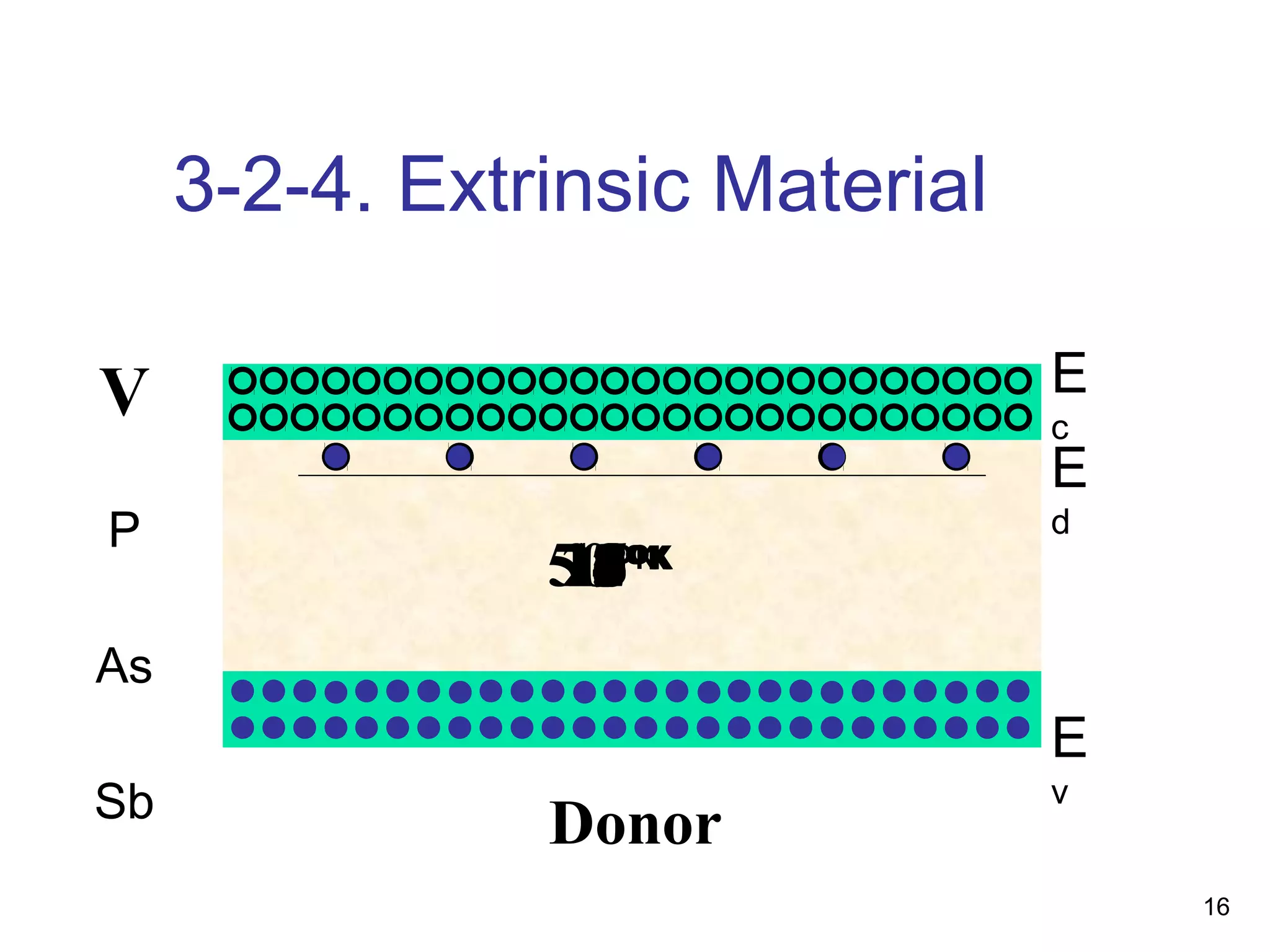
E
c
E
v
E
d
Donor
V
P
As
Sb
17
3-2-4. Extrinsic Material
0ºK
3ºK
2ºK
4ºK
5ºK
1ºK
6ºK
7ºK
8ºK
9ºK
10ºK
11ºK
12ºK
13ºK
14ºK
50ºK
15ºK
16ºK
17ºK
18ºK
19ºK
20ºK
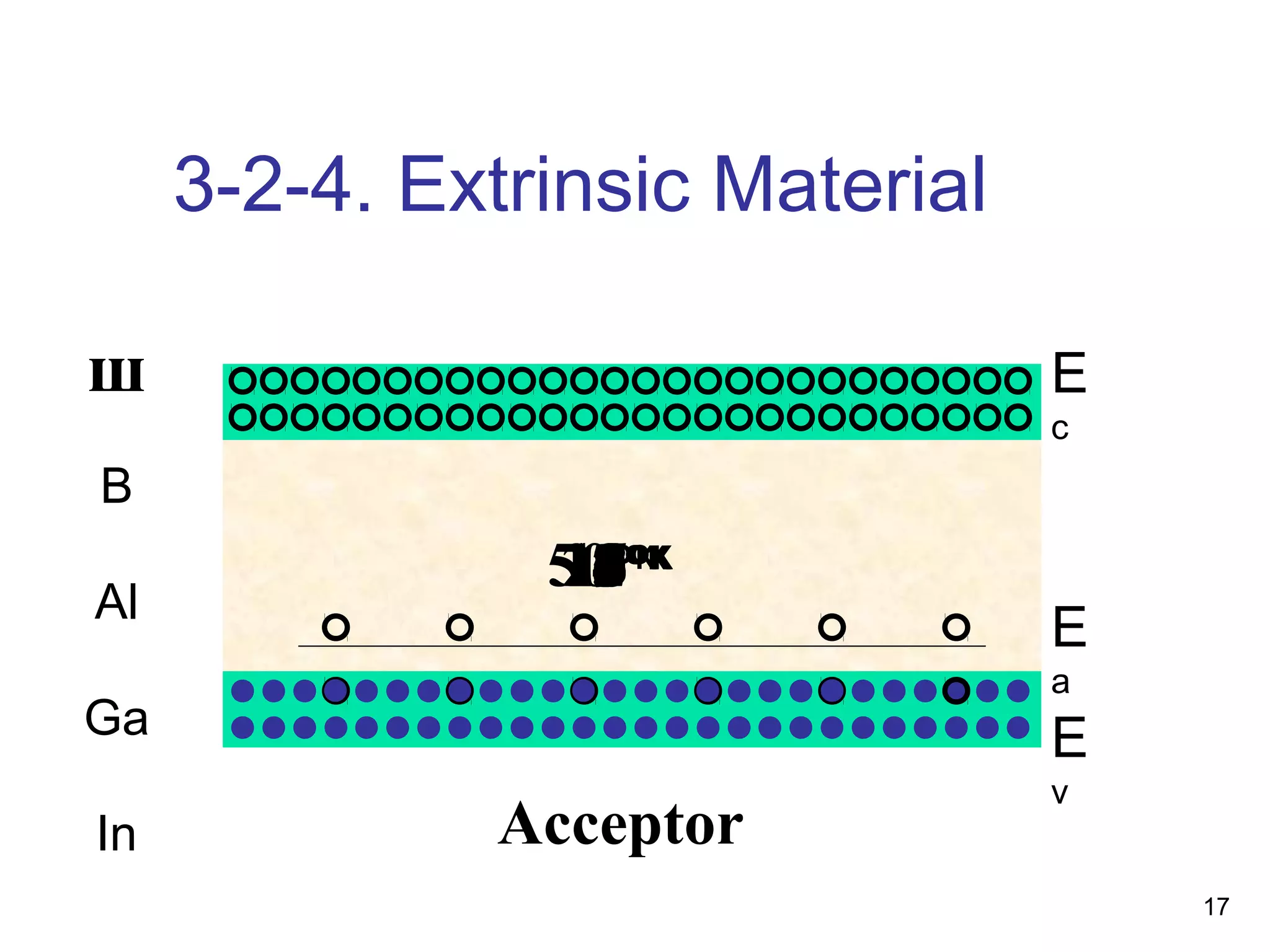
E
c
E
v
E
a
Acceptor
ш
B
Al
Ga
In
18
3-2-4. Extrinsic Material
h+
Al
e-
Sb
Si
19
3-2-4. Extrinsic Material
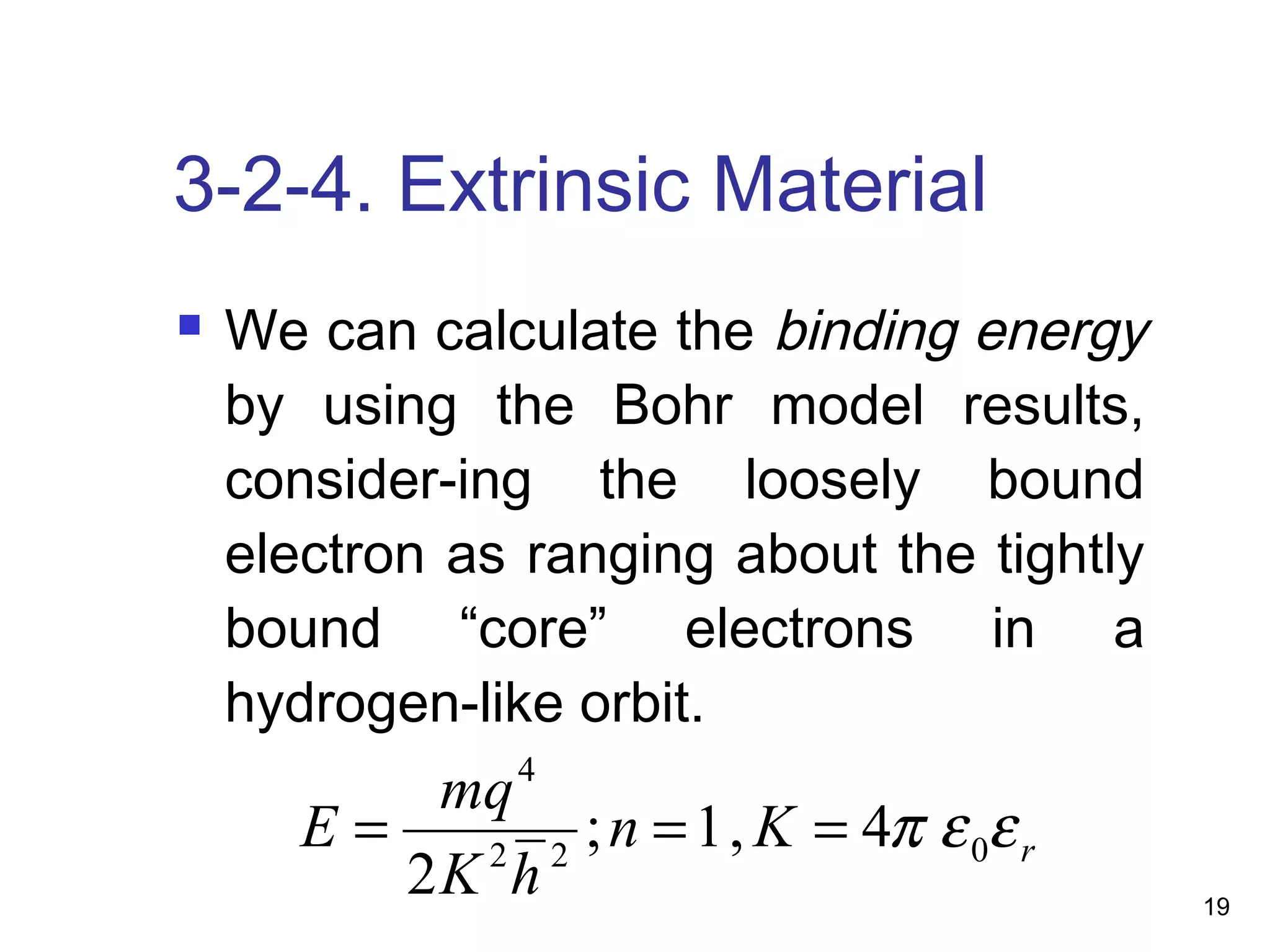
 We can calculate the binding energy
by using the Bohr model results,
consider-ing the loosely bound
electron as ranging about the tightly
bound “core” electrons in a
hydrogen-like orbit.
rKn
hK
mq
E εεπ 022
4
4,1;
2
===
20
3-2-4. Extrinsic Material
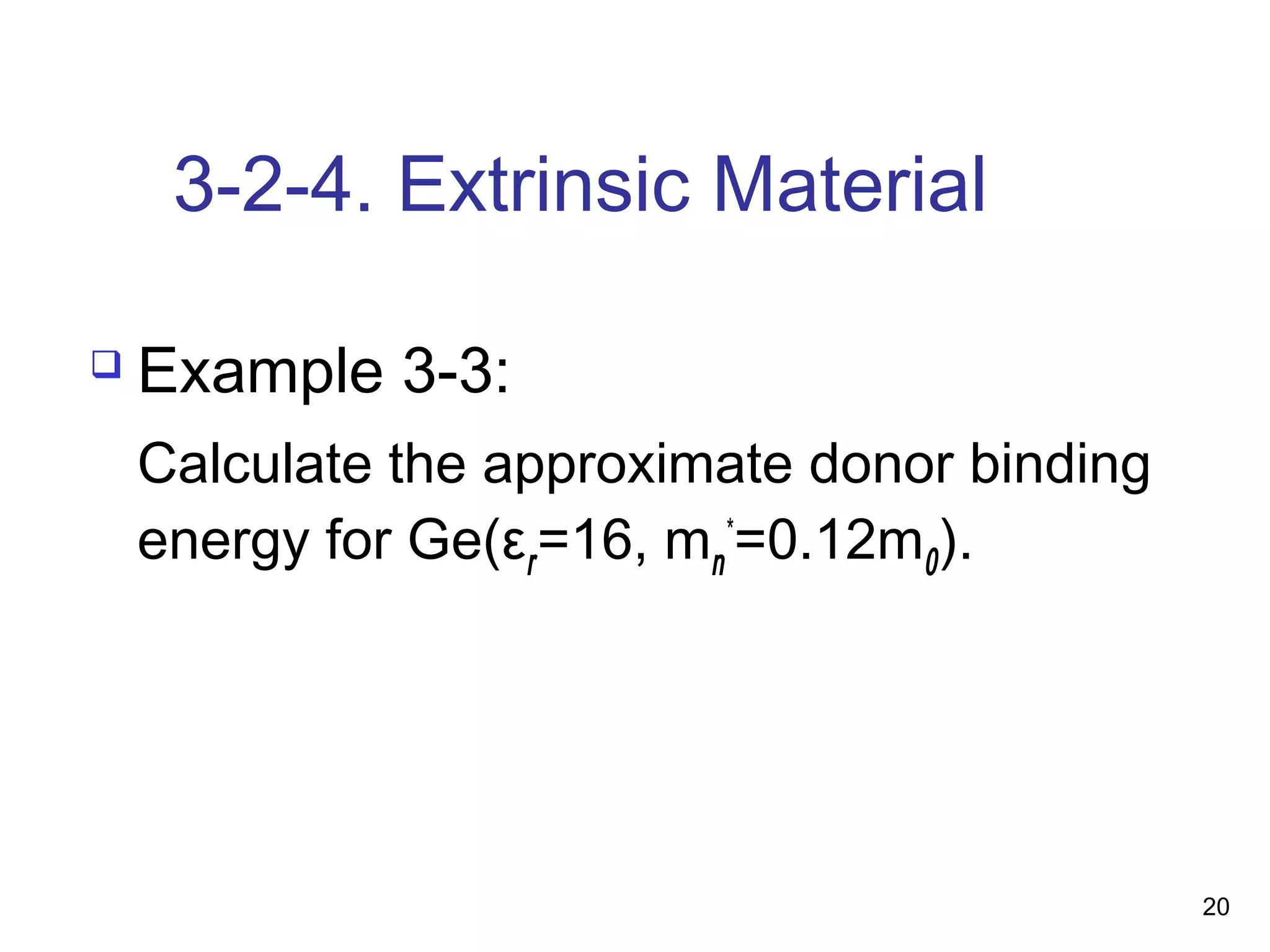
 Example 3-3:
Calculate the approximate donor binding
energy for Ge(εr=16, mn
*
=0.12m0).
21
3-2-4. Extrinsic Material
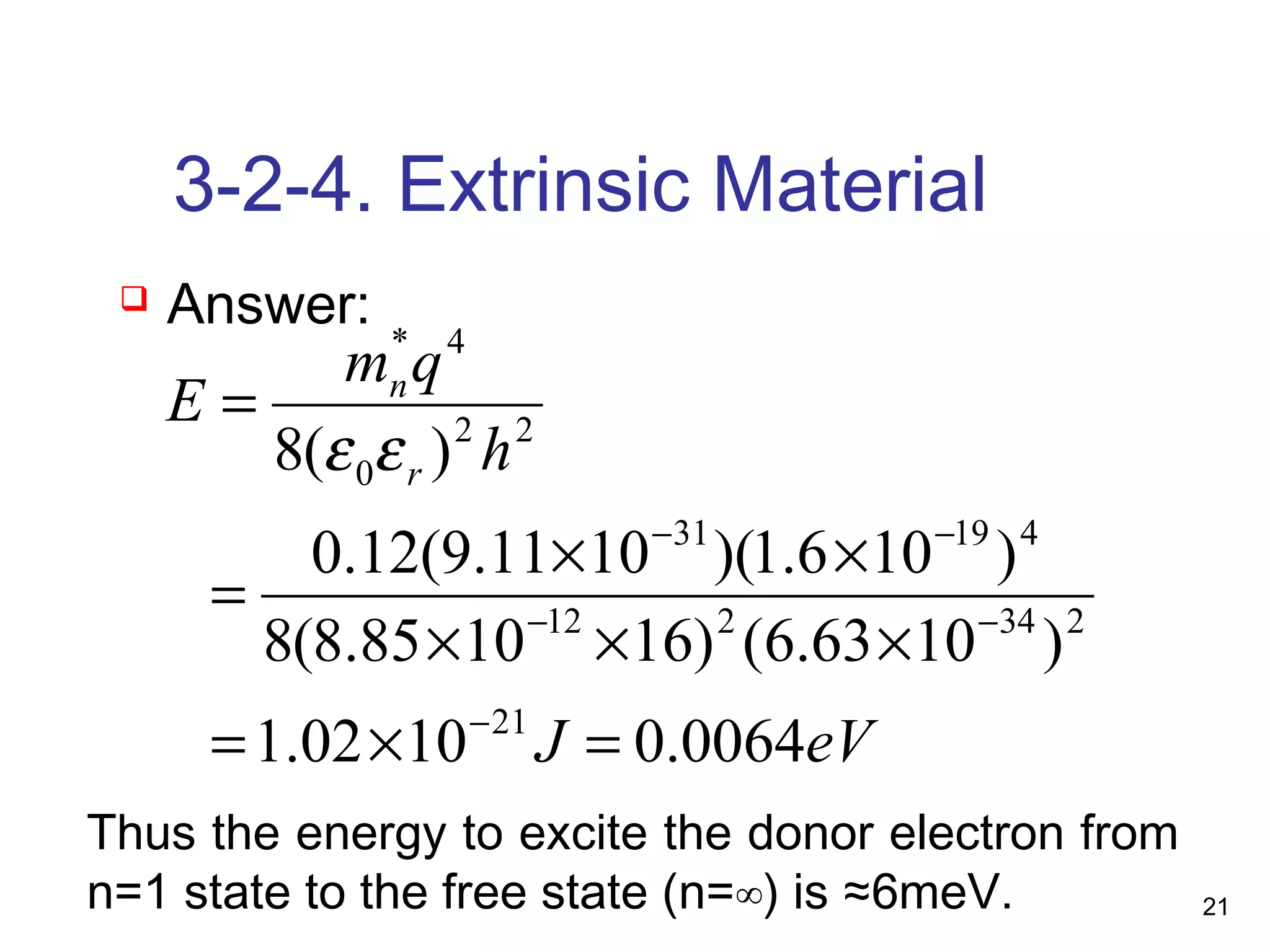
eVJ
h
qm
E
r
n
0064.01002.1
)1063.6()161085.8(8
)106.1)(1011.9(12.0
)(8
21
234212
41931
22
0
4*
=×=
×××
××
=
=
−
−−
−−
εε
 Answer:
Thus the energy to excite the donor electron from
n=1 state to the free state (n=∞) is ≈6meV.
22
3-2-4. Extrinsic Material

When a ш-V material is doped with Si
or Ge, from column IV, these impurities
are called amphoteric.
 In Si, the intrinsic carrier concentration
ni is about 1010
cm-3
at room tempera-ture.
If we dope Si with 1015
Sb Atoms/cm3
, the
conduction electron concentration
changes by five order of magnitude.

Lecture 5 energy bands and charge carriers