A variable output voltage may be
obtained in two ways :
1. By varying the input dc voltage
2. By adjusting the gain of the inverter,
usually done by PWM control.
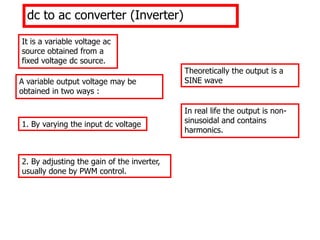
dc to ac converter (Inverter)
It is a variable voltage ac
source obtained from a
fixed voltage dc source.
Theoretically the output is a
SINE wave.
In real life the output is non-
sinusoidal and contains
harmonics.
Single phase half bridge inverter
Vi
t
VS/2
VO
t
VS/2
T/2
T
R
Chopper
VO
+
_
Chopper
2
V
S
2
V
S
T/2
VS/2
























 
 dt
dt
T
2
T
2
s
2
T
0
2
s
s
m
r
2
V
2
V
T
1
V
The output rms
voltage is given by
2
V
V s
o 
Single phase half bridge inverter
VO
t
VS/2
T/2
T
T/2
VS/2
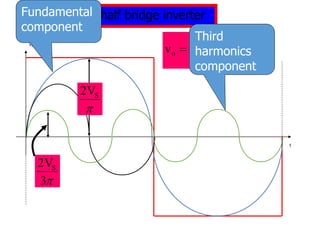
Here we see that the output
voltage wave is not a pure Sine
wave.
It can be represented as sum of n numbers of
sine waves by Fourier’s series.
t
n
n
n


sin
V
2
v
5
,
3
,
1
s
o 


 ,..
4
,
2
for
,
0
vo 
 n
Single phase half bridge inverter
Vo
t
t
n
n
n


sin
V
2
v
5
,
3
,
1
s
o 




S
2V

3
2VS
Fundamental
component
Third
harmonics
component
Single phase half bridge inverter
VO
t
VS/2
T/2
T
T/2
VS/2
t
n
n
n


sin
V
2
v
5
,
3
,
1
s
o 



For n=1, the
fundamental
component is
s
s
1 V
45
.
0
2
V
2
V 



t


sin
V
2
v s
1 
the rms fundamental component is
Single phase half bridge inverter
VO
t
VS/2
T/2
T
T/2
VS/2
In the output the power due
to fundamental component is
the useful power.
s
s
1 V
45
.
0
2
V
2
V 



The power due to harmonic components
is dissipated as heat and increases the
load temperature.
Single phase half bridge inverter
The quality of the inverter output is evaluated
by some parameters.
Harmonic Factor of
nth harmonic, HFn
1
n
n
V
V
HF 
Total Harmonic
distortion, THD




2,3
n
2
n
1
V
V
1
THD
Distortion Factor, DF 



2,3
n
2
2
n
1 n
V
V
1
DF
Single phase half bridge inverter
Numerical Example :
The dc input voltage of a single phase half bridge
rectifier is 48 volt. It is supplying power to a 2.4
resistor. Find (i) output voltage (ii) Fundamental
component of output voltage (iii) output power (iv)
peak and average current in each transistor (iv) peak
reverse blocking voltage of each transistor (v) THD
(vi) DF
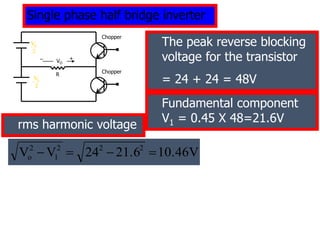
Given VS =48V and RL =2.4 
Output voltage Vo=Vs/2=24V
Output current Io=24/2.4=10A
Output Power VoX Io=24X10=240W
Each transistor conducts for 50% of time
Transistor current = 10X0.5=5A
Single phase half bridge inverter
The peak reverse blocking
voltage for the transistor
= 24 + 24 = 48V
R
Chopper
VO
+
_
Chopper
2
V
S
2
V
S
Fundamental component
V1 = 0.45 X 48=21.6V
rms harmonic voltage
10.46V
21.6
24
V
V 2
2
2
1
2
o 



R
VS
VO
t
V
Q1
Q2
Q3
Q4
VB
t
Q3 and Q4
Single phase bridge inverter
VB
t
Q1 and Q2
Vi
t
VS
H Bridge
Single phase bridge inverter
Vi
t
VS
VO
t
VS
T/2
T
T/2
VS
   












 
 dt
dt
T
2
T
2
s
2
T
0
2
s
s
m
r V
V
T
1
V
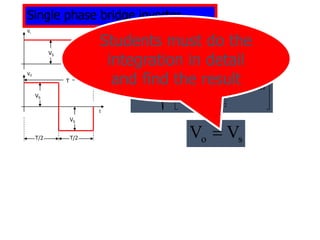
The output rms
voltage is given by
s
o V
V 
Students must do the
integration in detail
and find the result
VS
VO
t
V
Q1
Q2
Q3
Q4
VB
t
Q3 and Q4
Single phase bridge inverter
VB
t
Q1 and Q2
Vi
t
VS
Inductive Load
RL
IL
t
IL
Single phase bridge inverter
Vi
t
VS
VO
t
VS
T/2
T
T/2
VS
The frequency of
the output voltage
is given by
T
1
f 
Frequency can be chosen
from the time period of
the base signal
Single phase bridge inverter
Vi
t
VS
VO
t
VS
T/2
T
T/2
VS
s
o V
V 
Control of output voltage
Single pulse width modulation
Multiple pulse width modulation
Sinusoidal pulse width modulation
Modified Sinusoidal pulse width modulation
Phase displacement control
Single phase bridge inverter
Vi
t
VS
Control of output
voltage
Single pulse width modulation
VO
t
V
VB
t
Q3 and Q4
VB
t
Q1 and Q2
VO
t
Vs
VB
t
VB
t
Q1 and Q2
Q3 and Q4
(-)/2
0  2
The rms output voltage
   












 





dt
dt
2
3
2
3
2
s
2
2
2
s
s
m
r V
V
2
1
V













S
s
m
r V
V 
The output voltage can
be controlled by
controlling the value of 
Single phase bridge inverter
Vi
t
VS
Control of output
voltage
Multiple pulse width modulation
VO
t
Vs
VB
t
VB
t
0  2


p
V
V S
s
m
r 

 Is the width
of single pulse
p Is the number of
pulses per half
cycle
 and p both can be
adjusted to control
the output voltage
Single phase bridge inverter
Vi
t
VS
VO
t
VB
t
VB
t
0  2
Q1 and Q2
Q3 and Q4



3
,
2
,
1
S
s
m
r V
V
m
m


The duration of individual
pulse can be adjusted to
different desired values, so
that the lower order
harmonics are eliminated
and a pure/near sine wave
could be obtained
Modified PWM inververter
VO
t
VB
t
10ms
10ms
50Hz
f 
Suppose
Carrier
frequency
=20kHz
No of pulses per
10ms = 200
VB
t
VB
t
All the pulses
are present
11111111
Alternate pulses
are present
1010101010
pulses at
desired pattern
1011011101101
Keep on trying with
different patterns of pulses
until a (i)sine wave of
desired (ii)frequency and
(iii)voltage magnitude is
obtained.
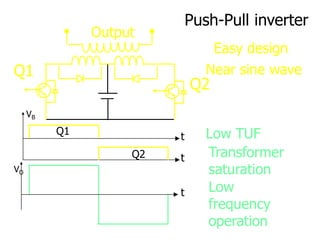
Push-Pull inverter
Q1
Q2
Q1
t
Q2
t
VB
Output
Easy design
Near sine wave
t
VO
Low TUF
Transformer
saturation
Low
frequency
operation
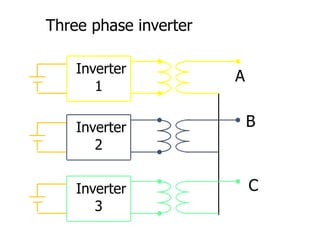
Three phase inverter
Inverter
1
Inverter
2
Inverter
3
A
B
C
Three phase inverter
Q1
Q2
Q3
Q4
Primary A
Primary B
Primary C
Q5
Q6
Q7
Q8
Q9
Q10
Q11
Q12
Three phase inverter firing sequence
0 1800 3600
T
t
t
t
t
t
t
VB
t
Q3 and Q4
1200
1200
Q5 and Q6
Q9 and Q10
Q7 and Q8
Q11 and Q12
Q11 and Q12
600
Q1 and Q2
Sequence :
Q1 and Q2
Q11 and Q12
Q5 and Q6
Q3 and Q4
Q9 and Q10
Q7 and Q8
Three phase inverter output voltage
Primary side
0 1800 3600
T
t
t
t
VP
t
Phase A
Phase B
Phase C
1200
1200

dc ac inverters

  • 1.
    A variable outputvoltage may be obtained in two ways : 1. By varying the input dc voltage 2. By adjusting the gain of the inverter, usually done by PWM control. dc to ac converter (Inverter) It is a variable voltage ac source obtained from a fixed voltage dc source. Theoretically the output is a SINE wave. In real life the output is non- sinusoidal and contains harmonics.
  • 2.
    Single phase halfbridge inverter Vi t VS/2 VO t VS/2 T/2 T R Chopper VO + _ Chopper 2 V S 2 V S T/2 VS/2                            dt dt T 2 T 2 s 2 T 0 2 s s m r 2 V 2 V T 1 V The output rms voltage is given by 2 V V s o 
  • 3.
    Single phase halfbridge inverter VO t VS/2 T/2 T T/2 VS/2 Here we see that the output voltage wave is not a pure Sine wave. It can be represented as sum of n numbers of sine waves by Fourier’s series. t n n n   sin V 2 v 5 , 3 , 1 s o     ,.. 4 , 2 for , 0 vo   n
  • 4.
    Single phase halfbridge inverter Vo t t n n n   sin V 2 v 5 , 3 , 1 s o      S 2V  3 2VS Fundamental component Third harmonics component
  • 5.
    Single phase halfbridge inverter VO t VS/2 T/2 T T/2 VS/2 t n n n   sin V 2 v 5 , 3 , 1 s o     For n=1, the fundamental component is s s 1 V 45 . 0 2 V 2 V     t   sin V 2 v s 1  the rms fundamental component is
  • 6.
    Single phase halfbridge inverter VO t VS/2 T/2 T T/2 VS/2 In the output the power due to fundamental component is the useful power. s s 1 V 45 . 0 2 V 2 V     The power due to harmonic components is dissipated as heat and increases the load temperature.
  • 7.
    Single phase halfbridge inverter The quality of the inverter output is evaluated by some parameters. Harmonic Factor of nth harmonic, HFn 1 n n V V HF  Total Harmonic distortion, THD     2,3 n 2 n 1 V V 1 THD Distortion Factor, DF     2,3 n 2 2 n 1 n V V 1 DF
  • 8.
    Single phase halfbridge inverter Numerical Example : The dc input voltage of a single phase half bridge rectifier is 48 volt. It is supplying power to a 2.4 resistor. Find (i) output voltage (ii) Fundamental component of output voltage (iii) output power (iv) peak and average current in each transistor (iv) peak reverse blocking voltage of each transistor (v) THD (vi) DF Given VS =48V and RL =2.4  Output voltage Vo=Vs/2=24V Output current Io=24/2.4=10A Output Power VoX Io=24X10=240W Each transistor conducts for 50% of time Transistor current = 10X0.5=5A
  • 9.
    Single phase halfbridge inverter The peak reverse blocking voltage for the transistor = 24 + 24 = 48V R Chopper VO + _ Chopper 2 V S 2 V S Fundamental component V1 = 0.45 X 48=21.6V rms harmonic voltage 10.46V 21.6 24 V V 2 2 2 1 2 o    
  • 10.
    R VS VO t V Q1 Q2 Q3 Q4 VB t Q3 and Q4 Singlephase bridge inverter VB t Q1 and Q2 Vi t VS H Bridge
  • 11.
    Single phase bridgeinverter Vi t VS VO t VS T/2 T T/2 VS                    dt dt T 2 T 2 s 2 T 0 2 s s m r V V T 1 V The output rms voltage is given by s o V V  Students must do the integration in detail and find the result
  • 12.
    VS VO t V Q1 Q2 Q3 Q4 VB t Q3 and Q4 Singlephase bridge inverter VB t Q1 and Q2 Vi t VS Inductive Load RL IL t IL
  • 13.
    Single phase bridgeinverter Vi t VS VO t VS T/2 T T/2 VS The frequency of the output voltage is given by T 1 f  Frequency can be chosen from the time period of the base signal
  • 14.
    Single phase bridgeinverter Vi t VS VO t VS T/2 T T/2 VS s o V V  Control of output voltage Single pulse width modulation Multiple pulse width modulation Sinusoidal pulse width modulation Modified Sinusoidal pulse width modulation Phase displacement control
  • 15.
    Single phase bridgeinverter Vi t VS Control of output voltage Single pulse width modulation VO t V VB t Q3 and Q4 VB t Q1 and Q2 VO t Vs VB t VB t Q1 and Q2 Q3 and Q4 (-)/2 0  2 The rms output voltage                        dt dt 2 3 2 3 2 s 2 2 2 s s m r V V 2 1 V              S s m r V V  The output voltage can be controlled by controlling the value of 
  • 16.
    Single phase bridgeinverter Vi t VS Control of output voltage Multiple pulse width modulation VO t Vs VB t VB t 0  2   p V V S s m r    Is the width of single pulse p Is the number of pulses per half cycle  and p both can be adjusted to control the output voltage
  • 17.
    Single phase bridgeinverter Vi t VS VO t VB t VB t 0  2 Q1 and Q2 Q3 and Q4    3 , 2 , 1 S s m r V V m m   The duration of individual pulse can be adjusted to different desired values, so that the lower order harmonics are eliminated and a pure/near sine wave could be obtained
  • 18.
    Modified PWM inververter VO t VB t 10ms 10ms 50Hz f Suppose Carrier frequency =20kHz No of pulses per 10ms = 200 VB t VB t All the pulses are present 11111111 Alternate pulses are present 1010101010 pulses at desired pattern 1011011101101 Keep on trying with different patterns of pulses until a (i)sine wave of desired (ii)frequency and (iii)voltage magnitude is obtained.
  • 19.
    Push-Pull inverter Q1 Q2 Q1 t Q2 t VB Output Easy design Nearsine wave t VO Low TUF Transformer saturation Low frequency operation
  • 20.
  • 21.
    Three phase inverter Q1 Q2 Q3 Q4 PrimaryA Primary B Primary C Q5 Q6 Q7 Q8 Q9 Q10 Q11 Q12
  • 22.
    Three phase inverterfiring sequence 0 1800 3600 T t t t t t t VB t Q3 and Q4 1200 1200 Q5 and Q6 Q9 and Q10 Q7 and Q8 Q11 and Q12 Q11 and Q12 600 Q1 and Q2 Sequence : Q1 and Q2 Q11 and Q12 Q5 and Q6 Q3 and Q4 Q9 and Q10 Q7 and Q8
  • 23.
    Three phase inverteroutput voltage Primary side 0 1800 3600 T t t t VP t Phase A Phase B Phase C 1200 1200