1
3-1-4. Direct & Indirect
Semiconductors
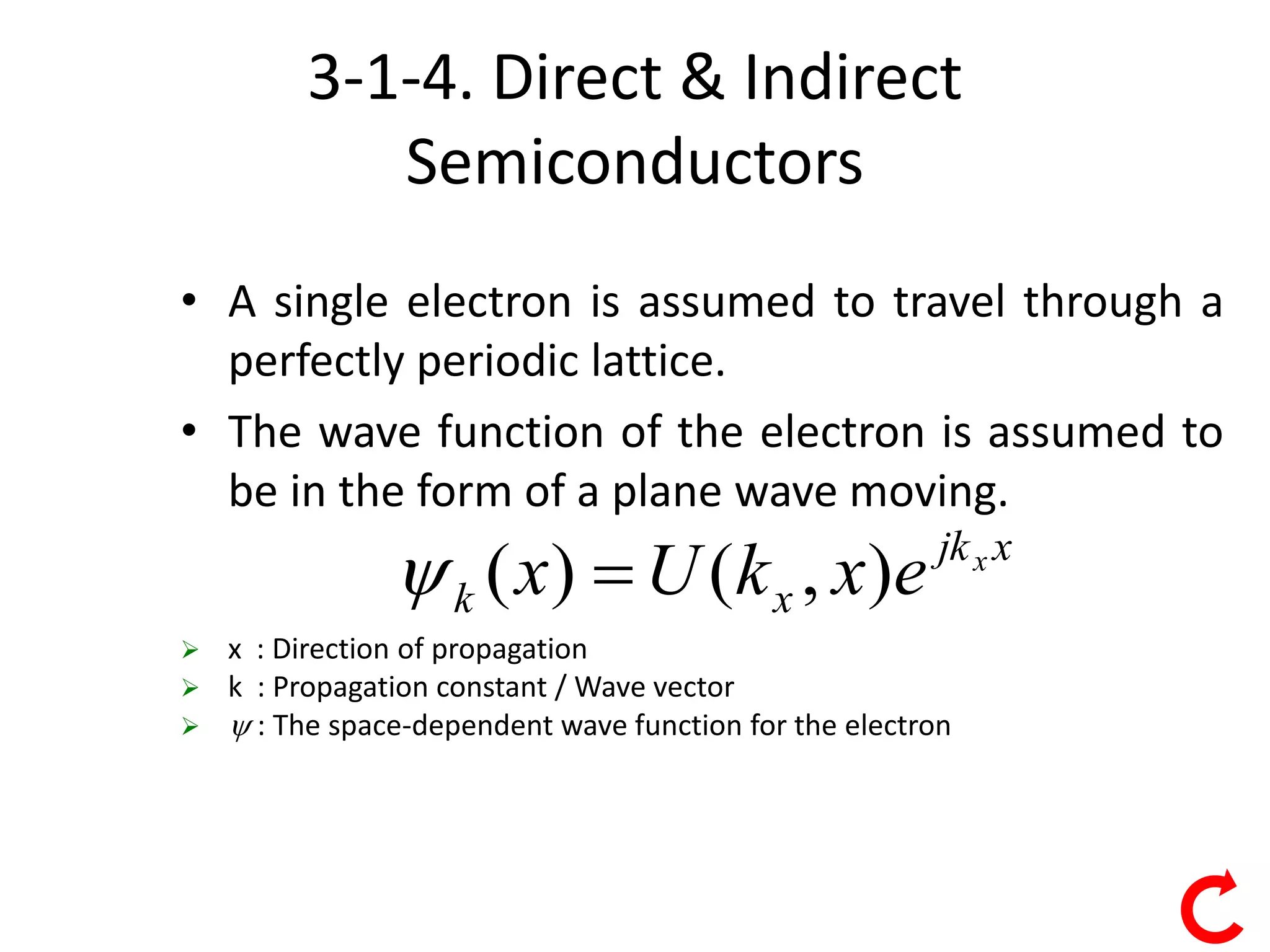
• A single electron is assumed to travel through a
perfectly periodic lattice.
• The wave function of the electron is assumed to
be in the form of a plane wave moving.
xjk
xk
x
exkUx ),()( 
 x : Direction of propagation
 k : Propagation constant / Wave vector
  : The space-dependent wave function for the electron
2
3-1-4. Direct & Indirect
Semiconductors
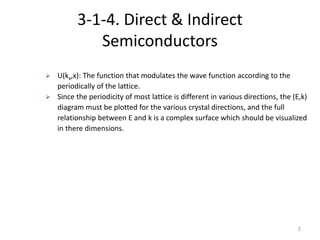
 U(kx,x): The function that modulates the wave function according to the
periodically of the lattice.
 Since the periodicity of most lattice is different in various directions, the (E,k)
diagram must be plotted for the various crystal directions, and the full
relationship between E and k is a complex surface which should be visualized
in there dimensions.
3
3-1-4. Direct & Indirect
Semiconductors
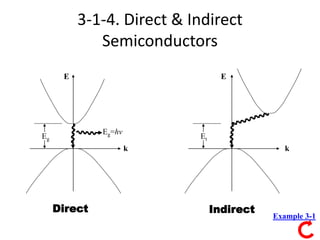
Eg=hν
Eg Et
k k
EE
Direct Indirect
Example 3-1
4
3-1-4. Direct & Indirect
Semiconductors
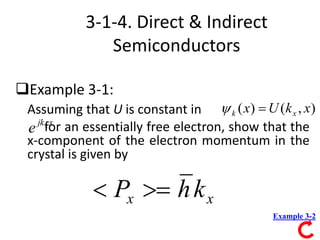
Example 3-1:
Assuming that U is constant in
for an essentially free electron, show that the
x-component of the electron momentum in the
crystal is given by
xx khP 
Example 3-2
),()( xkUx xk 
xjkx
e
5
3-1-4. Direct & Indirect
Semiconductors
x
x
xjkxjk
x
kh
dxU
dxUkh
dxU
dxe
xj
h
eU
P
xx

















2
2
2
2
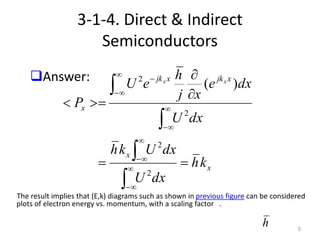
)(Answer:
The result implies that (E,k) diagrams such as shown in previous figure can be considered
plots of electron energy vs. momentum, with a scaling factor .
h
6
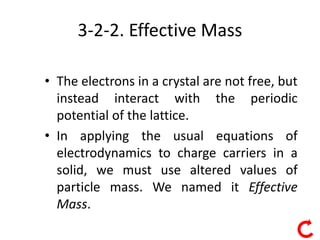
3-2-2. Effective Mass
• The electrons in a crystal are not free, but
instead interact with the periodic
potential of the lattice.
• In applying the usual equations of
electrodynamics to charge carriers in a
solid, we must use altered values of
particle mass. We named it Effective
Mass.
7
3-2-2. Effective Mass
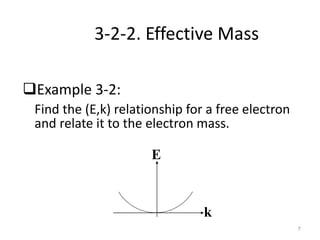
Example 3-2:
Find the (E,k) relationship for a free electron
and relate it to the electron mass.
E
k
8
3-2-2. Effective Mass
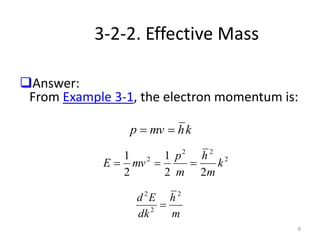
khmvp 
2
22
2
22
1
2
1
k
m
h
m
p
mvE 
Answer:
From Example 3-1, the electron momentum is:
m
h
dk
Ed 2
2
2

9
3-2-2. Effective Mass
Answer (Continue):
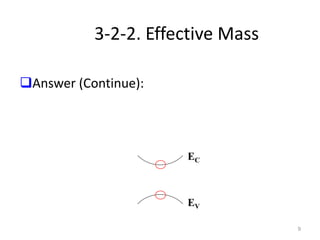
Most energy bands are close to parabolic at their
minima (for conduction bands) or maxima (for
valence bands).
EC
EV
10
3-2-2. Effective Mass
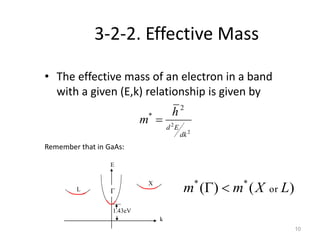
• The effective mass of an electron in a band
with a given (E,k) relationship is given by
2
2
2
*
dk
Ed
h
m 

X
L
k
E
1.43eV
)()( or
**
LXmm 
Remember that in GaAs:
11
3-2-2. Effective Mass
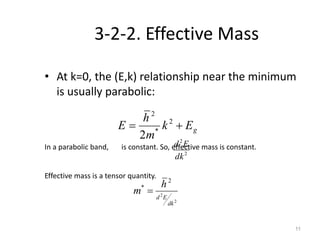
• At k=0, the (E,k) relationship near the minimum
is usually parabolic:
gEk
m
h
E  2
*
2
2
In a parabolic band, is constant. So, effective mass is constant.
Effective mass is a tensor quantity.
2
2
dk
Ed
2
2
2
*
dk
Ed
h
m 
12
3-2-2. Effective Mass
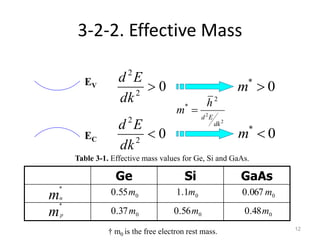
EV
EC
02
2

dk
Ed
02
2

dk
Ed
0*
m
0*
m
2
2
2
*
dk
Ed
h
m 
Ge Si GaAs
† m0 is the free electron rest mass.
Table 3-1. Effective mass values for Ge, Si and GaAs.
mn
*
mp
*
055.0 m 01.1 m 0067.0 m
037.0 m 056.0 m 048.0 m
13
3-2-5. Electrons and Holes in Quantum
Wells
• One of most useful applications of MBE or
OMVPE growth of multilayer compou-nd
semiconductors is the fact that a
continuous single crystal can be grown in
which adjacent layer have different band
gaps.
• A consequence of confining electrons and
holes in a very thin layer is that
14
3-2-5. Electrons and Holes in Quantum
Wells
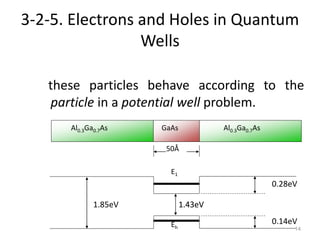
these particles behave according to the
particle in a potential well problem.
GaAs Al0.3Ga0.7AsAl0.3Ga0.7As
50Å
E1
Eh
1.43eV1.85eV
0.28eV
0.14eV
1.43eV
15
3-2-5. Electrons and Holes in
Quantum Wells
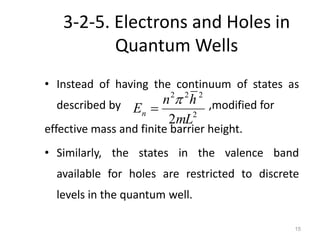
• Instead of having the continuum of states as
described by ,modified for
effective mass and finite barrier height.
• Similarly, the states in the valence band
available for holes are restricted to discrete
levels in the quantum well.
2
222
2mL
hn
En


16
3-2-5. Electrons and Holes in
Quantum Wells
• An electron on one of the discrete condu-ction
band states (E1) can make a transition to an
empty discrete valance band state in the GaAs
quantum well (such as Eh), giving off a photon
of energy Eg+E1+Eh, greater than the GaAs band
gap.

Mics. print

  • 1.
    1 3-1-4. Direct &Indirect Semiconductors • A single electron is assumed to travel through a perfectly periodic lattice. • The wave function of the electron is assumed to be in the form of a plane wave moving. xjk xk x exkUx ),()(   x : Direction of propagation  k : Propagation constant / Wave vector   : The space-dependent wave function for the electron
  • 2.
    2 3-1-4. Direct &Indirect Semiconductors  U(kx,x): The function that modulates the wave function according to the periodically of the lattice.  Since the periodicity of most lattice is different in various directions, the (E,k) diagram must be plotted for the various crystal directions, and the full relationship between E and k is a complex surface which should be visualized in there dimensions.
  • 3.
    3 3-1-4. Direct &Indirect Semiconductors Eg=hν Eg Et k k EE Direct Indirect Example 3-1
  • 4.
    4 3-1-4. Direct &Indirect Semiconductors Example 3-1: Assuming that U is constant in for an essentially free electron, show that the x-component of the electron momentum in the crystal is given by xx khP  Example 3-2 ),()( xkUx xk  xjkx e
  • 5.
    5 3-1-4. Direct &Indirect Semiconductors x x xjkxjk x kh dxU dxUkh dxU dxe xj h eU P xx                  2 2 2 2 )(Answer: The result implies that (E,k) diagrams such as shown in previous figure can be considered plots of electron energy vs. momentum, with a scaling factor . h
  • 6.
    6 3-2-2. Effective Mass •The electrons in a crystal are not free, but instead interact with the periodic potential of the lattice. • In applying the usual equations of electrodynamics to charge carriers in a solid, we must use altered values of particle mass. We named it Effective Mass.
  • 7.
    7 3-2-2. Effective Mass Example3-2: Find the (E,k) relationship for a free electron and relate it to the electron mass. E k
  • 8.
    8 3-2-2. Effective Mass khmvp 2 22 2 22 1 2 1 k m h m p mvE  Answer: From Example 3-1, the electron momentum is: m h dk Ed 2 2 2 
  • 9.
    9 3-2-2. Effective Mass Answer(Continue): Most energy bands are close to parabolic at their minima (for conduction bands) or maxima (for valence bands). EC EV
  • 10.
    10 3-2-2. Effective Mass •The effective mass of an electron in a band with a given (E,k) relationship is given by 2 2 2 * dk Ed h m   X L k E 1.43eV )()( or ** LXmm  Remember that in GaAs:
  • 11.
    11 3-2-2. Effective Mass •At k=0, the (E,k) relationship near the minimum is usually parabolic: gEk m h E  2 * 2 2 In a parabolic band, is constant. So, effective mass is constant. Effective mass is a tensor quantity. 2 2 dk Ed 2 2 2 * dk Ed h m 
  • 12.
    12 3-2-2. Effective Mass EV EC 02 2  dk Ed 02 2  dk Ed 0* m 0* m 2 2 2 * dk Ed h m Ge Si GaAs † m0 is the free electron rest mass. Table 3-1. Effective mass values for Ge, Si and GaAs. mn * mp * 055.0 m 01.1 m 0067.0 m 037.0 m 056.0 m 048.0 m
  • 13.
    13 3-2-5. Electrons andHoles in Quantum Wells • One of most useful applications of MBE or OMVPE growth of multilayer compou-nd semiconductors is the fact that a continuous single crystal can be grown in which adjacent layer have different band gaps. • A consequence of confining electrons and holes in a very thin layer is that
  • 14.
    14 3-2-5. Electrons andHoles in Quantum Wells these particles behave according to the particle in a potential well problem. GaAs Al0.3Ga0.7AsAl0.3Ga0.7As 50Å E1 Eh 1.43eV1.85eV 0.28eV 0.14eV 1.43eV
  • 15.
    15 3-2-5. Electrons andHoles in Quantum Wells • Instead of having the continuum of states as described by ,modified for effective mass and finite barrier height. • Similarly, the states in the valence band available for holes are restricted to discrete levels in the quantum well. 2 222 2mL hn En  
  • 16.
    16 3-2-5. Electrons andHoles in Quantum Wells • An electron on one of the discrete condu-ction band states (E1) can make a transition to an empty discrete valance band state in the GaAs quantum well (such as Eh), giving off a photon of energy Eg+E1+Eh, greater than the GaAs band gap.