Contents:
What is Transformer
Principle of Transformer
Construction/Structure of Transformer
Working of Transformer
Types of Transformer
Efficiency of Transformer
Energy losses of Transformer
Uses of Transformer
About Transformer
What is Transformer ?
Electric device
Static device
The heart of Alternating Current System
Transform electrical energy from one circuit to another
without direct electrical connection.
Frequency remain fixed while voltage changes
Electromagnetic Induction.
Mutual Induction.
Principle of Transformer
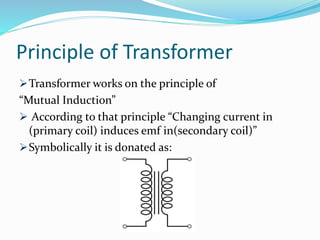
Transformer works on the principle of
“Mutual Induction”
 According to that principle “Changing current in
(primary coil) induces emf in(secondary coil)”
Symbolically it is donated as:
Construction
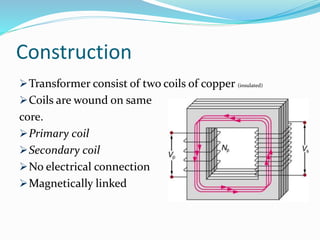
Transformer consist of two coils of copper (insulated)
Coils are wound on same
core.
Primary coil
Secondary coil
No electrical connection
Magnetically linked
Working
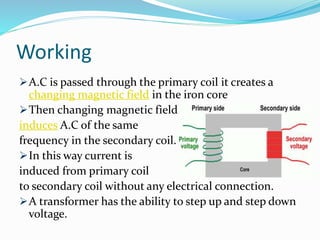
A.C is passed through the primary coil it creates a
changing magnetic field in the iron core
Then changing magnetic field
induces A.C of the same
frequency in the secondary coil.
In this way current is
induced from primary coil
to secondary coil without any electrical connection.
A transformer has the ability to step up and step down
voltage.
Types of Transformer
A transformer has the ability to step up and step down
voltage. On these basis transformer are of two types:
Step up Transformer
Step down Transformer
Step up Transformer
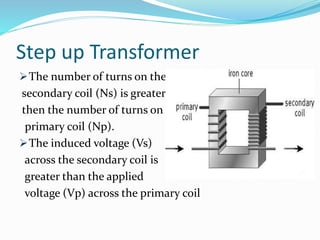
The number of turns on the
secondary coil (Ns) is greater
then the number of turns on
primary coil (Np).
The induced voltage (Vs)
across the secondary coil is
greater than the applied
voltage (Vp) across the primary coil
Step down transformer
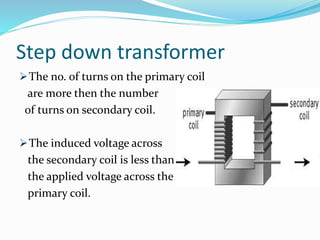
The no. of turns on the primary coil
are more then the number
of turns on secondary coil.
The induced voltage across
the secondary coil is less than
the applied voltage across the
primary coil.
Efficiency of Transformer
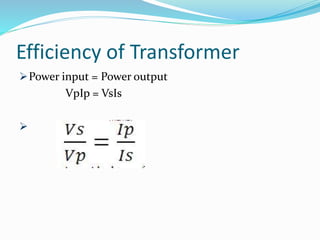
Power input = Power output
VpIp = VsIs

Energy losses in Transformer
Copper loss
Iron loss
Leakage of magnetic flux
Hysteretic loss
Magneto striation
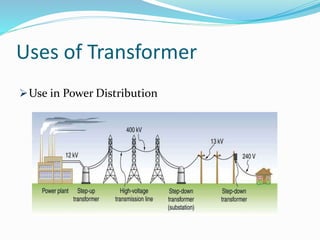
Uses of Transformer
Use in Power Distribution
….continues
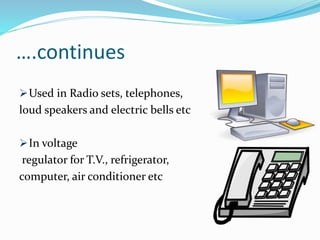
Used in Radio sets, telephones,
loud speakers and electric bells etc
In voltage
regulator for T.V., refrigerator,
computer, air conditioner etc
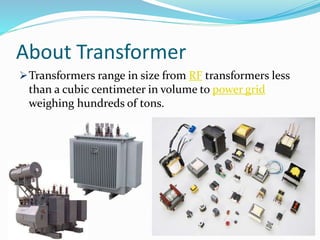
About Transformer
Transformers range in size from RF transformers less
than a cubic centimeter in volume to power grid
weighing hundreds of tons.
Any Queries ??
Thank you

What is Transformer, Introduction to Transformers (Brief)

  • 2.
    Contents: What is Transformer Principleof Transformer Construction/Structure of Transformer Working of Transformer Types of Transformer Efficiency of Transformer Energy losses of Transformer Uses of Transformer About Transformer
  • 3.
    What is Transformer? Electric device Static device The heart of Alternating Current System
  • 4.
    Transform electrical energyfrom one circuit to another without direct electrical connection. Frequency remain fixed while voltage changes Electromagnetic Induction. Mutual Induction.
  • 5.
    Principle of Transformer Transformerworks on the principle of “Mutual Induction”  According to that principle “Changing current in (primary coil) induces emf in(secondary coil)” Symbolically it is donated as:
  • 6.
    Construction Transformer consist oftwo coils of copper (insulated) Coils are wound on same core. Primary coil Secondary coil No electrical connection Magnetically linked
  • 7.
    Working A.C is passedthrough the primary coil it creates a changing magnetic field in the iron core Then changing magnetic field induces A.C of the same frequency in the secondary coil. In this way current is induced from primary coil to secondary coil without any electrical connection. A transformer has the ability to step up and step down voltage.
  • 8.
    Types of Transformer Atransformer has the ability to step up and step down voltage. On these basis transformer are of two types: Step up Transformer Step down Transformer
  • 9.
    Step up Transformer Thenumber of turns on the secondary coil (Ns) is greater then the number of turns on primary coil (Np). The induced voltage (Vs) across the secondary coil is greater than the applied voltage (Vp) across the primary coil
  • 10.
    Step down transformer Theno. of turns on the primary coil are more then the number of turns on secondary coil. The induced voltage across the secondary coil is less than the applied voltage across the primary coil.
  • 11.
    Efficiency of Transformer Powerinput = Power output VpIp = VsIs 
  • 12.
    Energy losses inTransformer Copper loss Iron loss Leakage of magnetic flux Hysteretic loss Magneto striation
  • 13.
    Uses of Transformer Usein Power Distribution
  • 14.
    ….continues Used in Radiosets, telephones, loud speakers and electric bells etc In voltage regulator for T.V., refrigerator, computer, air conditioner etc
  • 15.
    About Transformer Transformers rangein size from RF transformers less than a cubic centimeter in volume to power grid weighing hundreds of tons.
  • 16.
  • 17.