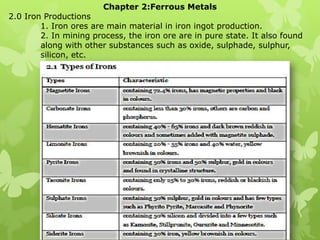
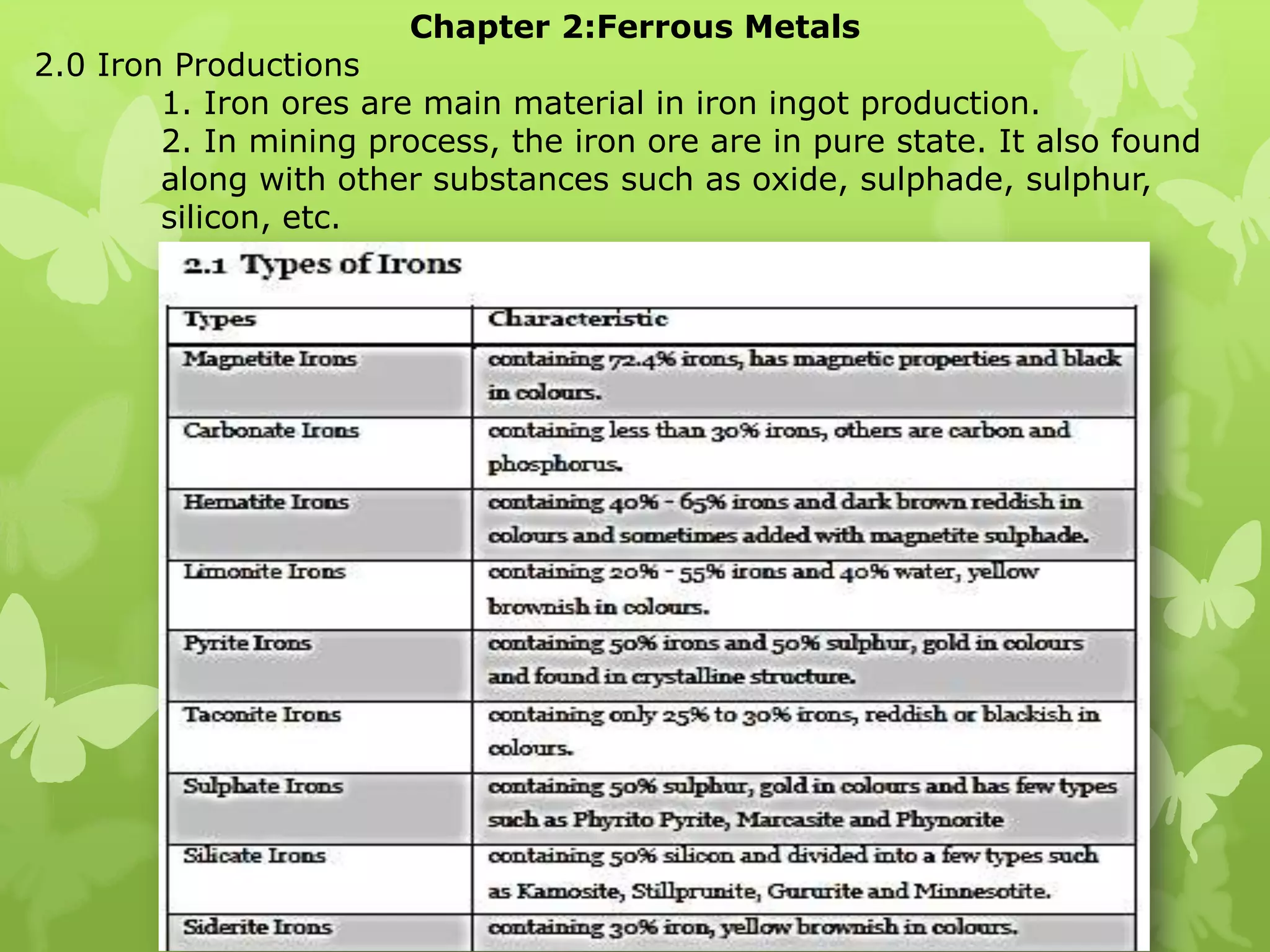
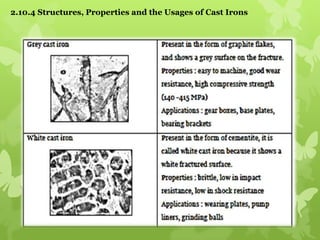
Chapter 2:Ferrous Metals2.0 Iron Productions	1. Iron ores are main material in iron ingot production.	2. In mining process, the iron ore are in pure state. It also found 	along with other substances such as oxide, sulphade, sulphur, 	silicon, etc.
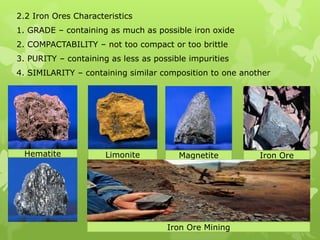
2.2 Iron Ores Characteristics1. GRADE – containing as much as possible iron oxide2. COMPACTABILITY – not too compact or too brittle3. PURITY – containing as less as possible impurities4. SIMILARITY – containing similar composition to one anotherLimoniteHematiteMagnetiteIron OreIron Ore Mining
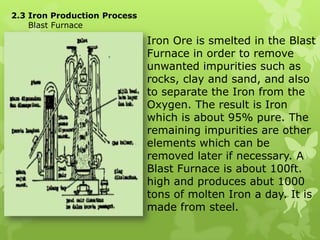
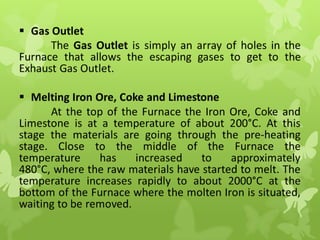
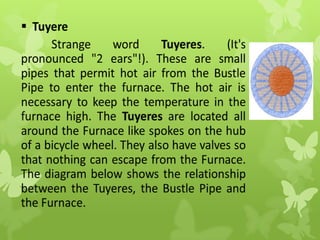
2.3 Iron Production Process     Blast FurnaceIron Ore is smelted in the Blast Furnace in order to remove unwanted impurities such as rocks, clay and sand, and also to separate the Iron from the Oxygen. The result is Iron which is about 95% pure. The remaining impurities are other elements which can be removed later if necessary. A Blast Furnace is about 100ft. high and produces abut 1000 tons of molten Iron a day. It is made from steel.
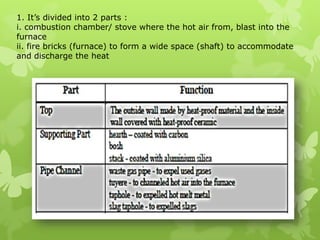
1. It’s divided into 2 parts :i. combustion chamber/ stove where the hot air from, blast into the furnaceii. fire bricks (furnace) to form a wide space (shaft) to accommodate and discharge the heat
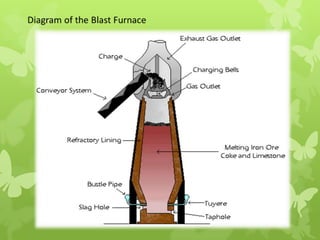
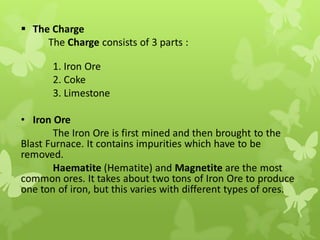
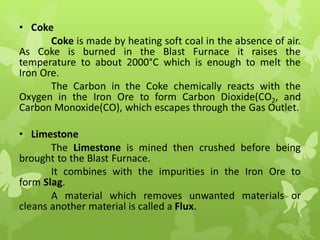
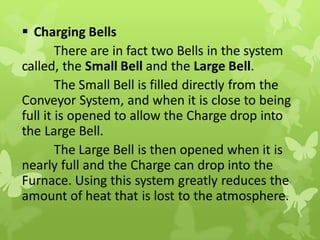
The Blast Furnace Process1.   The Iron Ore, Coke and Limestone, (the Charge), is conveyed to the top of the Furnace.2.   The Charge is stored in Bells until the timing is right for the charge to be dropped into the Furnace.3.   Hot air is then blown through pipes called Tuyeres, to fire the mixture.4.   The Coke burns to increase the temperature in the Furnace.
The Blast Furnace Process5.   The Limestone attracts the impurities in the Iron Ore and forms Slag. This Slag is lighter than the molten Iron and so floats on top of it.6.   As the Furnace fills, the molten Iron is Tapped off. The Slag is also tapped off at regular intervals.Most Iron is taken straight from the Blast Furnace to the Steel Mill, but some is poured into buckets called Pigs. This Iron is called Pig Iron and is used to make Cast Iron.
Three important chemical processes in the blast furnace :i. carbon from the coke burning with oxygen in the air blastii. oxide reduction to the ironsiii. flushing the gauge and ashes from the iron ores using the limestoneThe disadvantages:i. high in cost and capital for operationii. controlling iron composition are weakiii. small furnace using coke are incompetent, huge production from bigger furnace are no necessity.The output (products) of the blast furnace :i. the iron ingots contains 93% of basic irons, 3% - 5% of carbon, silica, sulphur, phosphorus and manganese.ii. besides, slags also can be used when separated from melting irons in the furnace such as road ways and building blocks
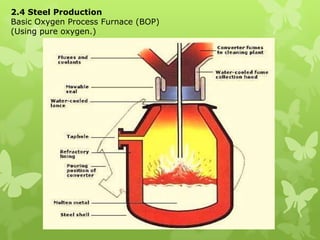
2.4 Steel ProductionBasic Oxygen Process Furnace (BOP)(Using pure oxygen.)
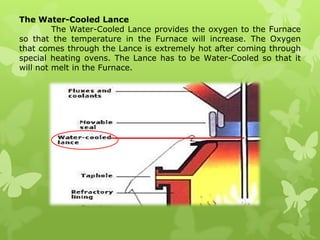
The Water-Cooled Lance	The Water-CooledLance provides the oxygen to the Furnace so that the temperature in the Furnace will increase. The Oxygen that comes through the Lance is extremely hot after coming through special heating ovens. The Lance has to be Water-Cooled so that it will not melt in the Furnace.
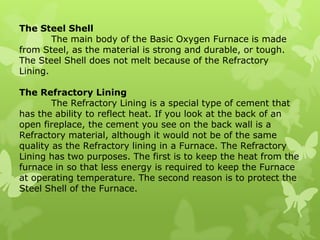
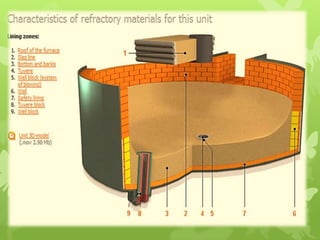
The Steel Shell	The main body of the Basic Oxygen Furnace is made from Steel, as the material is strong and durable, or tough. The Steel Shell does not melt because of the Refractory Lining.The Refractory Lining	The Refractory Lining is a special type of cement that has the ability to reflect heat. If you look at the back of an open fireplace, the cement you see on the back wall is a Refractory material, although it would not be of the same quality as the Refractory lining in a Furnace. The Refractory Lining has two purposes. The first is to keep the heat from the furnace in so that less energy is required to keep the Furnace at operating temperature. The second reason is to protect the Steel Shell of the Furnace.
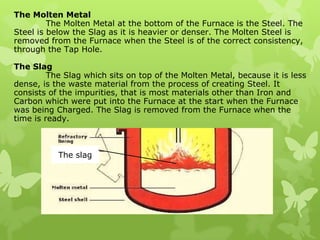
The Molten Metal	The Molten Metal at the bottom of the Furnace is the Steel. The Steel is below the Slag as it is heavier or denser. The Molten Steel is removed from the Furnace when the Steel is of the correct consistency, through the Tap Hole.The Slag	The Slag which sits on top of the Molten Metal, because it is less dense, is the waste material from the process of creating Steel. It consists of the impurities, that is most materials other than Iron and Carbon which were put into the Furnace at the start when the Furnace was being Charged. The Slag is removed from the Furnace when the time is ready.The slag
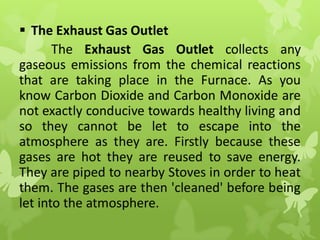
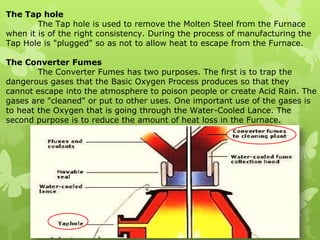
The Tap hole	The Tap hole is used to remove the Molten Steel from the Furnace when it is of the right consistency. During the process of manufacturing the Tap Hole is "plugged" so as not to allow heat to escape from the Furnace.The Converter Fumes 	The Converter Fumes has two purposes. The first is to trap the dangerous gases that the Basic Oxygen Process produces so that they cannot escape into the atmosphere to poison people or create Acid Rain. The gases are "cleaned" or put to other uses. One important use of the gases is to heat the Oxygen that is going through the Water-Cooled Lance. The second purpose is to reduce the amount of heat loss in the Furnace.
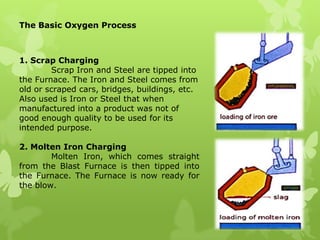
The Basic Oxygen Process1. Scrap ChargingScrap Iron and Steel are tipped into the Furnace. The Iron and Steel comes from old or scraped cars, bridges, buildings, etc. Also used is Iron or Steel that when manufactured into a product was not of good enough quality to be used for its intended purpose.2. Molten Iron Charging	Molten Iron, which comes straight from the Blast Furnace is then tipped into the Furnace. The Furnace is now ready for the blow.
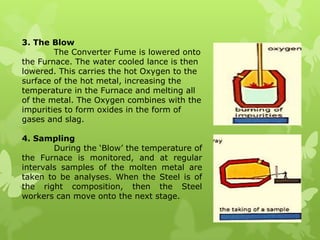
3. The Blow	The Converter Fume is lowered onto the Furnace. The water cooled lanceis then lowered. This carries the hot Oxygen to the surface of the hot metal, increasing the temperature in the Furnace and melting all of the metal. The Oxygen combines with the impurities to form oxides in the form of gases and slag.4. Sampling	During the ‘Blow’ the temperature of the Furnace is monitored, and at regular intervals samples of the molten metal are taken to be analyses. When the Steel is of the right composition, then the Steel workers can move onto the next stage.
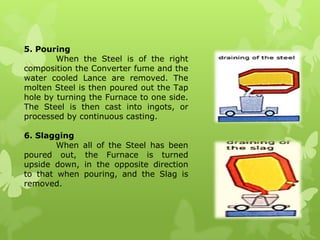
5. Pouring	When the Steel is of the right composition the Converter fume and the water cooled Lance are removed. The molten Steel is then poured out the Tap hole by turning the Furnace to one side. The Steel is then cast into ingots, or processed by continuous casting.6. Slagging	When all of the Steel has been poured out, the Furnace is turned upside down, in the opposite direction to that when pouring, and the Slag is removed.
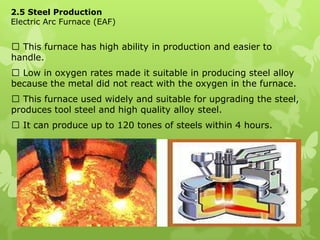
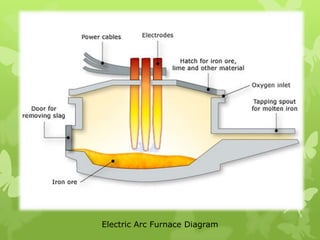
2.5 Steel ProductionElectric Arc Furnace (EAF) This furnace has high ability in production and easier to handle.  Low in oxygen rates made it suitable in producing steel alloy because the metal did not react with the oxygen in the furnace.  This furnace used widely and suitable for upgrading the steel, produces tool steel and high quality alloy steel.  It can produce up to 120 tones of steels within 4 hours.
Electric Arc Furnace Diagram
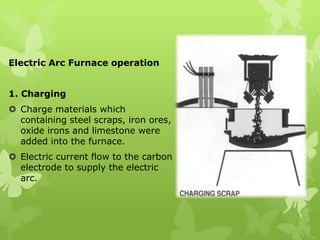
Electric Arc Furnace operation 1. Charging Charge materials which containing steel scraps, iron ores, oxide irons and limestone were added into the furnace. Electric current flow to the carbon electrode to supply the electric arc.
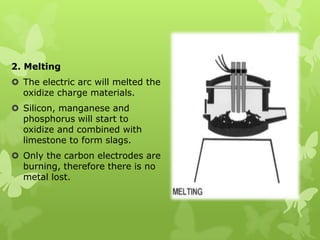
2. Melting The electric arc will melted the oxidize charge materials. Silicon, manganese and phosphorus will start to oxidize and combined with limestone to form slags. Only the carbon electrodes are burning, therefore there is no metal lost.
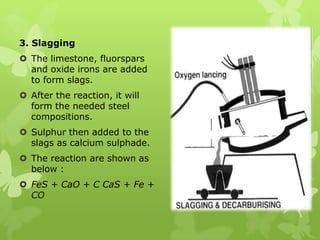
3. Slagging The limestone, fluorspars and oxide irons are added to form slags. After the reaction, it will form the needed steel compositions. Sulphur then added to the slags as calcium sulphade. The reaction are shown as below : FeS + CaO + C CaS + Fe + CO
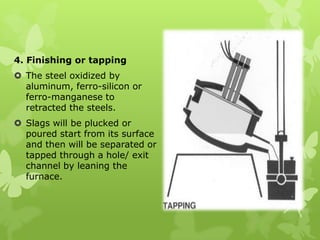
4. Finishing or tapping The steel oxidized by aluminum, ferro-silicon or ferro-manganese to retracted the steels. Slags will be plucked or poured start from its surface and then will be separated or tapped through a hole/ exit channel by leaning the furnace.
The advantages of electric arc furnace : i. blazing process can be controlled and arranged efficiently ii. no oxidation gases, so can produce high quality steels iii. the temperature can be control accurately iv. free from soils and smokes
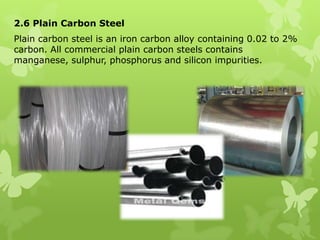
2.6 Plain Carbon Steel Plain carbon steel is an iron carbon alloy containing 0.02 to 2% carbon. All commercial plain carbon steels contains manganese, sulphur, phosphorus and silicon impurities.
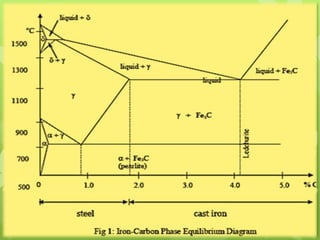
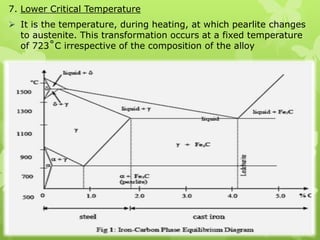
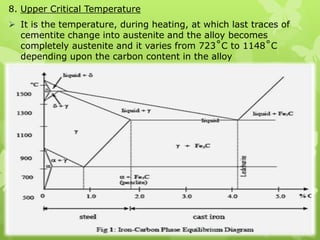
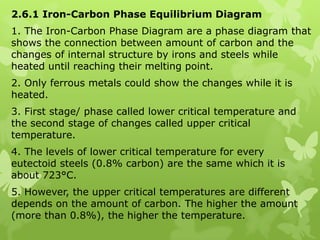
2.6.1 Iron-Carbon Phase Equilibrium Diagram 1. The Iron-Carbon Phase Diagram are a phase diagram that shows the connection between amount of carbon and the changes of internal structure by irons and steels while heated until reaching their melting point. 2. Only ferrous metals could show the changes while it is heated. 3. First stage/ phase called lower critical temperature and the second stage of changes called upper critical temperature. 4. The levels of lower critical temperature for every eutectoid steels (0.8% carbon) are the same which it is about 723°C. 5. However, the upper critical temperatures are different depends on the amount of carbon. The higher the amount (more than 0.8%), the higher the temperature.
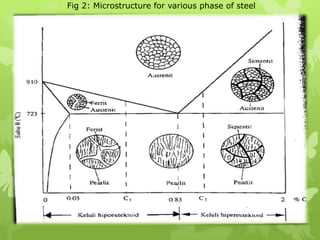
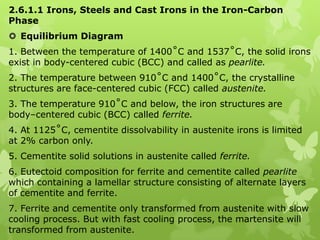
2.6.1.1 Irons, Steels and Cast Irons in the Iron-Carbon Phase Equilibrium Diagram 1. Between the temperature of 1400˚C and 1537˚C, the solid irons exist in body-centered cubic (BCC) and called as pearlite. 2. The temperature between 910˚C and 1400˚C, the crystalline structures are face-centered cubic (FCC) called austenite. 3. The temperature 910˚C and below, the iron structures are body–centered cubic (BCC) called ferrite. 4. At 1125˚C, cementite dissolvability in austenite irons is limited at 2% carbon only. 5. Cementite solid solutions in austenite called ferrite. 6. Eutectoid composition for ferrite and cementite called pearlite which containing a lamellar structure consisting of alternate layers of cementite and ferrite. 7. Ferrite and cementite only transformed from austenite with slow cooling process. But with fast cooling process, the martensite will transformed from austenite.
Fig 2: Microstructure for various phase of steel
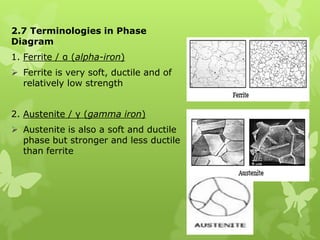
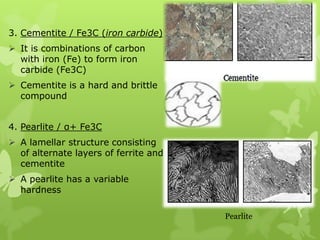
2.7 Terminologies in Phase Diagram 1. Ferrite / α (alpha-iron) Ferrite is very soft, ductile and of relatively low strength 2. Austenite / γ (gamma iron) Austenite is also a soft and ductile phase but stronger and less ductile than ferrite 3. Cementite / Fe3C (iron carbide) It is combinations of carbon with iron (Fe) to form iron carbide (Fe3C)
Cementite is a hard and brittle compound 4. Pearlite / α+ Fe3C A lamellar structure consisting of alternate layers of ferrite and cementite
A pearlite has a variable hardnessPearlite
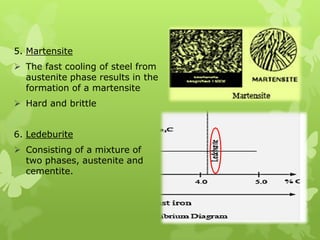
5. MartensiteThe fast cooling of steel from austenite phase results in the formation of a martensite
Hard and brittle 6. LedeburiteConsisting of a mixture of two phases, austenite and cementite. 7. Lower Critical Temperature It is the temperature, during heating, at which pearlite changes to austenite. This transformation occurs at a fixed temperature of 723˚C irrespective of the composition of the alloy 8. Upper Critical Temperature It is the temperature, during heating, at which last traces of cementite change into austenite and the alloy becomes completely austenite and it varies from 723˚C to 1148˚C depending upon the carbon content in the alloy2.8 Types of Carbon Steels Low carbon steel Contains less than 0.3% carbon (<0.3% C) Low strength, good machinability, high ductility, formability and weld ability Applications : bridge structures, buildings, ships, vehicles, nails, rivets Good fabrication ductility characteristic and usually used in annealing and normalizing conditions
Medium carbon steel Contains 0.3 – 0.8% carbon High strength and ductility after heat treatment, stability, tough and tensile strength Applications : railways, wheels, shafts, gears, bolts It can be quenched to form martensite and bainite if using media for quenching such as water and brine
High carbon steel Contains more than 0.8% carbon (>0.8% C) Low in strength, high in hardness and wear resistance after heat treatment Applications : moulds, hammers, knives, milling cutters Also known as tool steel Tempering process can accelerate martensite formation and maintain the low strength properties
2.9 Alloy Steels 1. Alloy steel may be defined as carbon steel to which one or more elements are added to get some beneficial effects. 2. Main purposes : i. to improve the quality of steels ii. to improve steel characteristics iii. to make it suitable for engineering works iv. to make it easier for heat treatment process
3. The commonly added elements to achieve these properties : i. increase tensile strength ii. increase hardness and toughness iii. higher hardenability iv. changeability for critical temperature v. increase wear and abrasive resistance vi. higher corrosion and oxidation resistance vii. maintaining higher hardness (red hardness) at temperatures up to 600 ˚C, due to the presence of alloy carbides viii. higher temperability, and maintain the hardness and strength at elevated temperatures (creep strength)
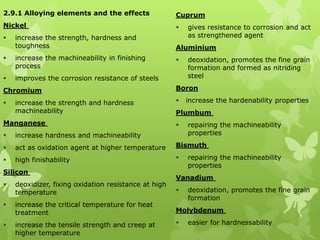
Cuprumgives resistance to corrosion and act as strengthened agent Aluminiumdeoxidation, promotes the fine grain formation and formed as nitriding steel Boronincrease the hardenability propertiesPlumbumrepairing the machineability properties Bismuth repairing the machineabilitypropertiesVanadium deoxidation, promotes the fine grain formationMolybdenum easier for hardnessability2.9.1 Alloying elements and the effectsNickel increase the strength, hardness and toughness
increase the machineability in finishing process
improves the corrosion resistance of steels Chromiumincrease the strength and hardnessmachineabilityManganese increase hardness and machineability
act as oxidation agent at higher temperature
high finishabilitySilicon deoxidizer, fixing oxidation resistance at high temperature
increase the critical temperature for heat treatment
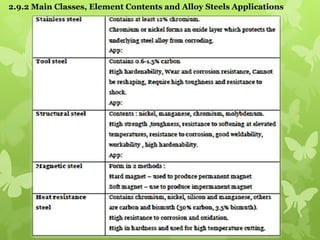
increase the tensile strength and creep at higher temperature 2.9.2 Main Classes, Element Contents and Alloy Steels Applications

Chapter2 (JF302)

  • 1.
    Chapter 2:Ferrous Metals2.0Iron Productions 1. Iron ores are main material in iron ingot production. 2. In mining process, the iron ore are in pure state. It also found along with other substances such as oxide, sulphade, sulphur, silicon, etc.
  • 2.
    2.2 Iron OresCharacteristics1. GRADE – containing as much as possible iron oxide2. COMPACTABILITY – not too compact or too brittle3. PURITY – containing as less as possible impurities4. SIMILARITY – containing similar composition to one anotherLimoniteHematiteMagnetiteIron OreIron Ore Mining
  • 3.
    2.3 Iron ProductionProcess Blast FurnaceIron Ore is smelted in the Blast Furnace in order to remove unwanted impurities such as rocks, clay and sand, and also to separate the Iron from the Oxygen. The result is Iron which is about 95% pure. The remaining impurities are other elements which can be removed later if necessary. A Blast Furnace is about 100ft. high and produces abut 1000 tons of molten Iron a day. It is made from steel.
  • 4.
    1. It’s dividedinto 2 parts :i. combustion chamber/ stove where the hot air from, blast into the furnaceii. fire bricks (furnace) to form a wide space (shaft) to accommodate and discharge the heat
  • 16.
    The Blast FurnaceProcess1.   The Iron Ore, Coke and Limestone, (the Charge), is conveyed to the top of the Furnace.2.   The Charge is stored in Bells until the timing is right for the charge to be dropped into the Furnace.3.   Hot air is then blown through pipes called Tuyeres, to fire the mixture.4.   The Coke burns to increase the temperature in the Furnace.
  • 17.
    The Blast FurnaceProcess5.   The Limestone attracts the impurities in the Iron Ore and forms Slag. This Slag is lighter than the molten Iron and so floats on top of it.6.   As the Furnace fills, the molten Iron is Tapped off. The Slag is also tapped off at regular intervals.Most Iron is taken straight from the Blast Furnace to the Steel Mill, but some is poured into buckets called Pigs. This Iron is called Pig Iron and is used to make Cast Iron.
  • 18.
    Three important chemicalprocesses in the blast furnace :i. carbon from the coke burning with oxygen in the air blastii. oxide reduction to the ironsiii. flushing the gauge and ashes from the iron ores using the limestoneThe disadvantages:i. high in cost and capital for operationii. controlling iron composition are weakiii. small furnace using coke are incompetent, huge production from bigger furnace are no necessity.The output (products) of the blast furnace :i. the iron ingots contains 93% of basic irons, 3% - 5% of carbon, silica, sulphur, phosphorus and manganese.ii. besides, slags also can be used when separated from melting irons in the furnace such as road ways and building blocks
  • 19.
    2.4 Steel ProductionBasicOxygen Process Furnace (BOP)(Using pure oxygen.)
  • 20.
    The Water-Cooled Lance TheWater-CooledLance provides the oxygen to the Furnace so that the temperature in the Furnace will increase. The Oxygen that comes through the Lance is extremely hot after coming through special heating ovens. The Lance has to be Water-Cooled so that it will not melt in the Furnace.
  • 21.
    The Steel Shell Themain body of the Basic Oxygen Furnace is made from Steel, as the material is strong and durable, or tough. The Steel Shell does not melt because of the Refractory Lining.The Refractory Lining The Refractory Lining is a special type of cement that has the ability to reflect heat. If you look at the back of an open fireplace, the cement you see on the back wall is a Refractory material, although it would not be of the same quality as the Refractory lining in a Furnace. The Refractory Lining has two purposes. The first is to keep the heat from the furnace in so that less energy is required to keep the Furnace at operating temperature. The second reason is to protect the Steel Shell of the Furnace.
  • 22.
    The Molten Metal TheMolten Metal at the bottom of the Furnace is the Steel. The Steel is below the Slag as it is heavier or denser. The Molten Steel is removed from the Furnace when the Steel is of the correct consistency, through the Tap Hole.The Slag The Slag which sits on top of the Molten Metal, because it is less dense, is the waste material from the process of creating Steel. It consists of the impurities, that is most materials other than Iron and Carbon which were put into the Furnace at the start when the Furnace was being Charged. The Slag is removed from the Furnace when the time is ready.The slag
  • 23.
    The Tap hole TheTap hole is used to remove the Molten Steel from the Furnace when it is of the right consistency. During the process of manufacturing the Tap Hole is "plugged" so as not to allow heat to escape from the Furnace.The Converter Fumes The Converter Fumes has two purposes. The first is to trap the dangerous gases that the Basic Oxygen Process produces so that they cannot escape into the atmosphere to poison people or create Acid Rain. The gases are "cleaned" or put to other uses. One important use of the gases is to heat the Oxygen that is going through the Water-Cooled Lance. The second purpose is to reduce the amount of heat loss in the Furnace.
  • 24.
    The Basic OxygenProcess1. Scrap ChargingScrap Iron and Steel are tipped into the Furnace. The Iron and Steel comes from old or scraped cars, bridges, buildings, etc. Also used is Iron or Steel that when manufactured into a product was not of good enough quality to be used for its intended purpose.2. Molten Iron Charging Molten Iron, which comes straight from the Blast Furnace is then tipped into the Furnace. The Furnace is now ready for the blow.
  • 25.
    3. The Blow TheConverter Fume is lowered onto the Furnace. The water cooled lanceis then lowered. This carries the hot Oxygen to the surface of the hot metal, increasing the temperature in the Furnace and melting all of the metal. The Oxygen combines with the impurities to form oxides in the form of gases and slag.4. Sampling During the ‘Blow’ the temperature of the Furnace is monitored, and at regular intervals samples of the molten metal are taken to be analyses. When the Steel is of the right composition, then the Steel workers can move onto the next stage.
  • 26.
    5. Pouring When theSteel is of the right composition the Converter fume and the water cooled Lance are removed. The molten Steel is then poured out the Tap hole by turning the Furnace to one side. The Steel is then cast into ingots, or processed by continuous casting.6. Slagging When all of the Steel has been poured out, the Furnace is turned upside down, in the opposite direction to that when pouring, and the Slag is removed.
  • 27.
    2.5 Steel ProductionElectricArc Furnace (EAF) This furnace has high ability in production and easier to handle.  Low in oxygen rates made it suitable in producing steel alloy because the metal did not react with the oxygen in the furnace.  This furnace used widely and suitable for upgrading the steel, produces tool steel and high quality alloy steel.  It can produce up to 120 tones of steels within 4 hours.
  • 28.
  • 30.
    Electric Arc Furnaceoperation 1. Charging Charge materials which containing steel scraps, iron ores, oxide irons and limestone were added into the furnace. Electric current flow to the carbon electrode to supply the electric arc.
  • 31.
    2. Melting Theelectric arc will melted the oxidize charge materials. Silicon, manganese and phosphorus will start to oxidize and combined with limestone to form slags. Only the carbon electrodes are burning, therefore there is no metal lost.
  • 32.
    3. Slagging Thelimestone, fluorspars and oxide irons are added to form slags. After the reaction, it will form the needed steel compositions. Sulphur then added to the slags as calcium sulphade. The reaction are shown as below : FeS + CaO + C CaS + Fe + CO
  • 33.
    4. Finishing ortapping The steel oxidized by aluminum, ferro-silicon or ferro-manganese to retracted the steels. Slags will be plucked or poured start from its surface and then will be separated or tapped through a hole/ exit channel by leaning the furnace.
  • 34.
    The advantages ofelectric arc furnace : i. blazing process can be controlled and arranged efficiently ii. no oxidation gases, so can produce high quality steels iii. the temperature can be control accurately iv. free from soils and smokes
  • 36.
    2.6 Plain CarbonSteel Plain carbon steel is an iron carbon alloy containing 0.02 to 2% carbon. All commercial plain carbon steels contains manganese, sulphur, phosphorus and silicon impurities.
  • 37.
    2.6.1 Iron-Carbon PhaseEquilibrium Diagram 1. The Iron-Carbon Phase Diagram are a phase diagram that shows the connection between amount of carbon and the changes of internal structure by irons and steels while heated until reaching their melting point. 2. Only ferrous metals could show the changes while it is heated. 3. First stage/ phase called lower critical temperature and the second stage of changes called upper critical temperature. 4. The levels of lower critical temperature for every eutectoid steels (0.8% carbon) are the same which it is about 723°C. 5. However, the upper critical temperatures are different depends on the amount of carbon. The higher the amount (more than 0.8%), the higher the temperature.
  • 38.
    2.6.1.1 Irons, Steelsand Cast Irons in the Iron-Carbon Phase Equilibrium Diagram 1. Between the temperature of 1400˚C and 1537˚C, the solid irons exist in body-centered cubic (BCC) and called as pearlite. 2. The temperature between 910˚C and 1400˚C, the crystalline structures are face-centered cubic (FCC) called austenite. 3. The temperature 910˚C and below, the iron structures are body–centered cubic (BCC) called ferrite. 4. At 1125˚C, cementite dissolvability in austenite irons is limited at 2% carbon only. 5. Cementite solid solutions in austenite called ferrite. 6. Eutectoid composition for ferrite and cementite called pearlite which containing a lamellar structure consisting of alternate layers of cementite and ferrite. 7. Ferrite and cementite only transformed from austenite with slow cooling process. But with fast cooling process, the martensite will transformed from austenite.
  • 40.
    Fig 2: Microstructurefor various phase of steel
  • 41.
    2.7 Terminologies inPhase Diagram 1. Ferrite / α (alpha-iron) Ferrite is very soft, ductile and of relatively low strength 2. Austenite / γ (gamma iron) Austenite is also a soft and ductile phase but stronger and less ductile than ferrite 3. Cementite / Fe3C (iron carbide) It is combinations of carbon with iron (Fe) to form iron carbide (Fe3C)
  • 42.
    Cementite is ahard and brittle compound 4. Pearlite / α+ Fe3C A lamellar structure consisting of alternate layers of ferrite and cementite
  • 43.
    A pearlite hasa variable hardnessPearlite
  • 44.
    5. MartensiteThe fastcooling of steel from austenite phase results in the formation of a martensite
  • 45.
    Hard and brittle6. LedeburiteConsisting of a mixture of two phases, austenite and cementite. 7. Lower Critical Temperature It is the temperature, during heating, at which pearlite changes to austenite. This transformation occurs at a fixed temperature of 723˚C irrespective of the composition of the alloy 8. Upper Critical Temperature It is the temperature, during heating, at which last traces of cementite change into austenite and the alloy becomes completely austenite and it varies from 723˚C to 1148˚C depending upon the carbon content in the alloy2.8 Types of Carbon Steels Low carbon steel Contains less than 0.3% carbon (<0.3% C) Low strength, good machinability, high ductility, formability and weld ability Applications : bridge structures, buildings, ships, vehicles, nails, rivets Good fabrication ductility characteristic and usually used in annealing and normalizing conditions
  • 46.
    Medium carbon steelContains 0.3 – 0.8% carbon High strength and ductility after heat treatment, stability, tough and tensile strength Applications : railways, wheels, shafts, gears, bolts It can be quenched to form martensite and bainite if using media for quenching such as water and brine
  • 47.
    High carbon steelContains more than 0.8% carbon (>0.8% C) Low in strength, high in hardness and wear resistance after heat treatment Applications : moulds, hammers, knives, milling cutters Also known as tool steel Tempering process can accelerate martensite formation and maintain the low strength properties
  • 48.
    2.9 Alloy Steels1. Alloy steel may be defined as carbon steel to which one or more elements are added to get some beneficial effects. 2. Main purposes : i. to improve the quality of steels ii. to improve steel characteristics iii. to make it suitable for engineering works iv. to make it easier for heat treatment process
  • 49.
    3. The commonlyadded elements to achieve these properties : i. increase tensile strength ii. increase hardness and toughness iii. higher hardenability iv. changeability for critical temperature v. increase wear and abrasive resistance vi. higher corrosion and oxidation resistance vii. maintaining higher hardness (red hardness) at temperatures up to 600 ˚C, due to the presence of alloy carbides viii. higher temperability, and maintain the hardness and strength at elevated temperatures (creep strength)
  • 50.
    Cuprumgives resistance tocorrosion and act as strengthened agent Aluminiumdeoxidation, promotes the fine grain formation and formed as nitriding steel Boronincrease the hardenability propertiesPlumbumrepairing the machineability properties Bismuth repairing the machineabilitypropertiesVanadium deoxidation, promotes the fine grain formationMolybdenum easier for hardnessability2.9.1 Alloying elements and the effectsNickel increase the strength, hardness and toughness
  • 51.
    increase the machineabilityin finishing process
  • 52.
    improves the corrosionresistance of steels Chromiumincrease the strength and hardnessmachineabilityManganese increase hardness and machineability
  • 53.
    act as oxidationagent at higher temperature
  • 54.
    high finishabilitySilicon deoxidizer,fixing oxidation resistance at high temperature
  • 55.
    increase the criticaltemperature for heat treatment
  • 56.
    increase the tensilestrength and creep at higher temperature 2.9.2 Main Classes, Element Contents and Alloy Steels Applications