Single Phase Transformer
Prepared By:
RITU K.R.
Assistant Professor (EE)
SISTec-E
1
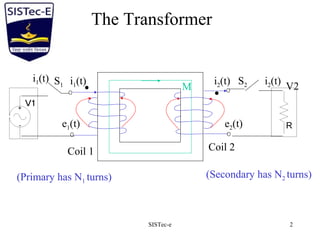
SISTec-e 2
Coil 1
i1(t) i2(t)
Coil 2
M
e1(t) e2(t)
S1 S2
i1(t) i2(t)
The Transformer
(Primary has N1 turns) (Secondary has N2 turns)
V2
SISTec-e 3
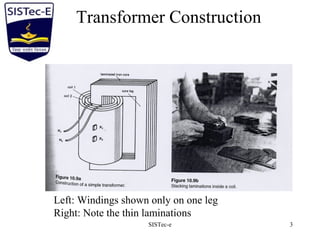
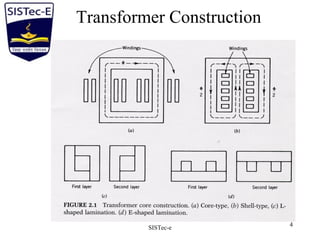
Transformer Construction
Left: Windings shown only on one leg
Right: Note the thin laminations
SISTec-e 4
Transformer Construction
SISTec-e 5
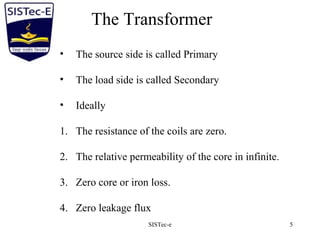
• The source side is called Primary
• The load side is called Secondary
• Ideally
1. The resistance of the coils are zero.
2. The relative permeability of the core in infinite.
3. Zero core or iron loss.
4. Zero leakage flux
The Transformer
SISTec-e 6
The Transformer
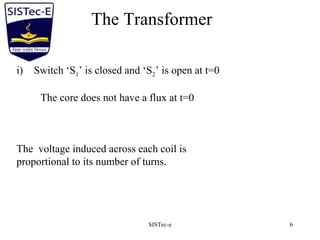
i) Switch ‘S1’ is closed and ‘S2’ is open at t=0
The core does not have a flux at t=0
The voltage induced across each coil is
proportional to its number of turns.
SISTec-e 7
The Transformer
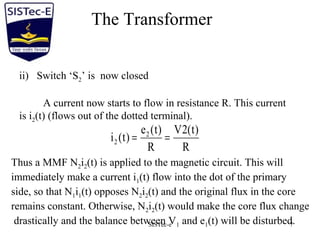
ii) Switch ‘S2’ is now closed
A current now starts to flow in resistance R. This current
is i2(t) (flows out of the dotted terminal).
R
)t(2V
R
)t(e
)t(i 2
2 ==
Thus a MMF N2i2(t) is applied to the magnetic circuit. This will
immediately make a current i1(t) flow into the dot of the primary
side, so that N1i1(t) opposes N2i2(t) and the original flux in the core
remains constant. Otherwise, N2i2(t) would make the core flux change
drastically and the balance between V1 and e1(t) will be disturbed.
8
The Transformer
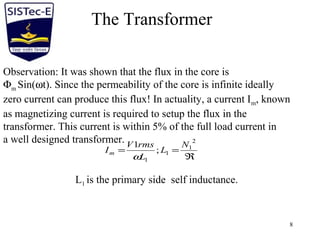
Observation: It was shown that the flux in the core is
Φm Sin(ωt). Since the permeability of the core is infinite ideally
zero current can produce this flux! In actuality, a current Im, known
as magnetizing current is required to setup the flux in the
transformer. This current is within 5% of the full load current in
a well designed transformer.
ℜ
==
2
1
1
1
;
1 N
L
L
rmsV
Im
ω
L1 is the primary side self inductance.
SISTec-e 9
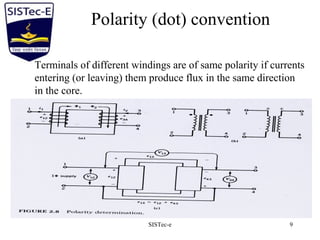
Polarity (dot) convention
Terminals of different windings are of same polarity if currents
entering (or leaving) them produce flux in the same direction
in the core.
SISTec-e 10
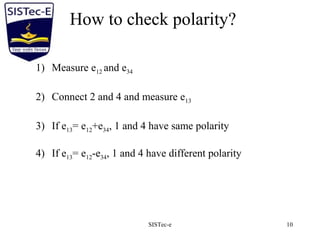
How to check polarity?
1) Measure e12 and e34
2) Connect 2 and 4 and measure e13
3) If e13= e12+e34, 1 and 4 have same polarity
4) If e13= e12-e34, 1 and 4 have different polarity
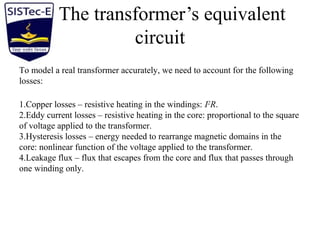
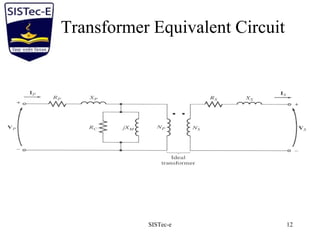
The transformer’s equivalent
circuit
To model a real transformer accurately, we need to account for the following
losses:
1.Copper losses – resistive heating in the windings: I2
R.
2.Eddy current losses – resistive heating in the core: proportional to the square
of voltage applied to the transformer.
3.Hysteresis losses – energy needed to rearrange magnetic domains in the
core: nonlinear function of the voltage applied to the transformer.
4.Leakage flux – flux that escapes from the core and flux that passes through
one winding only.
SISTec-e 12
Transformer Equivalent Circuit
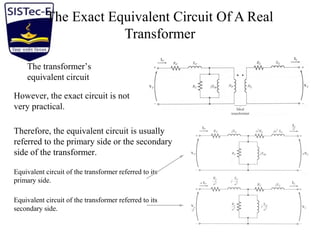
The Exact Equivalent Circuit Of A Real
Transformer
The transformer’s
equivalent circuit
However, the exact circuit is not
very practical.
Therefore, the equivalent circuit is usually
referred to the primary side or the secondary
side of the transformer.
Equivalent circuit of the transformer referred to its
primary side.
Equivalent circuit of the transformer referred to its
secondary side.
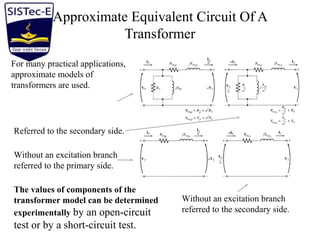
Approximate Equivalent Circuit Of A
Transformer
For many practical applications,
approximate models of
transformers are used.
Referred to the primary
side.
Without an excitation branch
referred to the primary side.
Referred to the secondary side.
Without an excitation branch
referred to the secondary side.
The values of components of the
transformer model can be determined
experimentally by an open-circuit
test or by a short-circuit test.
SISTec-e 15
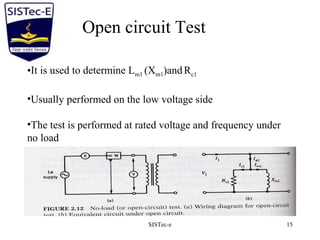
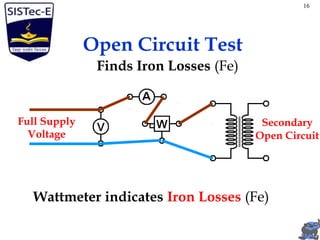
Open circuit Test
•It is used to determine Lm1 (Xm1)andRc1
•Usually performed on the low voltage side
•The test is performed at rated voltage and frequency under
no load
Open Circuit Test
Finds Iron Losses (Fe)
Full Supply
Voltage
Secondary
Open Circuit
Wattmeter indicates Iron Losses (Fe)
16
SISTec-e 17
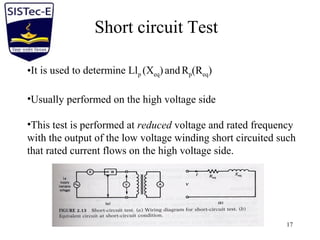
Short circuit Test
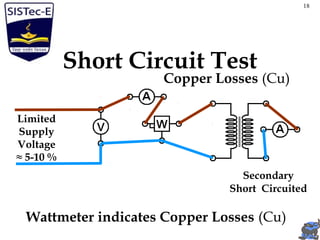
•It is used to determine Llp (Xeq)andRp(Req)
•Usually performed on the high voltage side
•This test is performed at reduced voltage and rated frequency
with the output of the low voltage winding short circuited such
that rated current flows on the high voltage side.
Short Circuit Test
Copper Losses (Cu)
Secondary
Short Circuited
Limited
Supply
Voltage
≈ 5-10 %
Wattmeter indicates Copper Losses (Cu)
18
SISTec-e 19
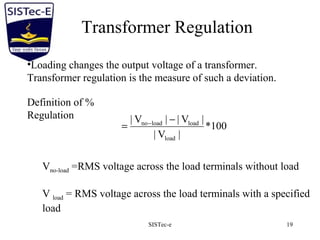
Transformer Regulation
•Loading changes the output voltage of a transformer.
Transformer regulation is the measure of such a deviation.
Definition of %
Regulation
100*
|V|
|V||V|
load
loadloadno −
= −
Vno-load =RMS voltage across the load terminals without load
V load = RMS voltage across the load terminals with a specified
load
SISTec-e 20
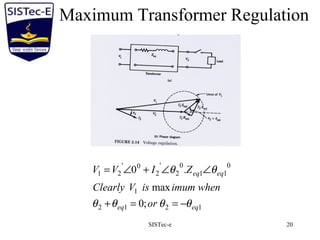
Maximum Transformer Regulation
1212
1
0
11
0
2
'
2
0'
21
;0
max
.0
eqeq
eqeq
or
whenimumisVClearly
ZIVV
θθθθ
θθ
−==+
∠∠+∠=
SISTec-e 21
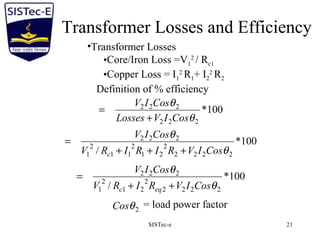
Transformer Losses and Efficiency
•Transformer Losses
•Core/Iron Loss =V1
2
/ Rc1
•Copper Loss = I1
2
R1+ I2
2
R2
Definition of % efficiency
100*
222
222
θ
θ
CosIVLosses
CosIV
+
=
100*
/ 2222
2
21
2
11
2
1
222
θ
θ
CosIVRIRIRV
CosIV
c +++
=
2θCos = load power factor
100*
/ 2222
2
21
2
1
222
θ
θ
CosIVRIRV
CosIV
eqc ++
=
Transformer Losses
Copper Losses (Cu)
•Varies with load current
•Produces HEAT
•Created by resistance of windings
•Short circuit test supplies copper losses
22
Transformer Losses
Iron Losses (Fe)•Fixed
•Always present
•Related to transformers construction
Eddy Currents
Reduced by laminations
Produces HEAT
Hysteresis
Reduced by using special
steels in laminations
23
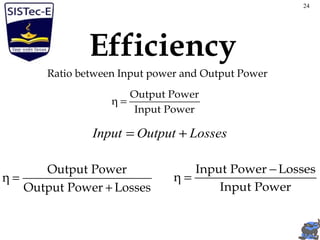
Efficiency
PowerInput
PowerOutput
η =
LossesOutputInput +=
LossesPowerOutput
PowerOutput
η
+
=
Ratio between Input power and Output Power
PowerInput
LossesPowerInput
η
−
=
24
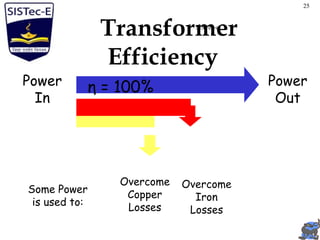
Transformer
Efficiency
Power
In
Power
Out
Overcome
Iron
Losses
Overcome
Copper
Losses
Some Power
is used to:
η = 100%
25
SISTec-e
SISTec-e 26
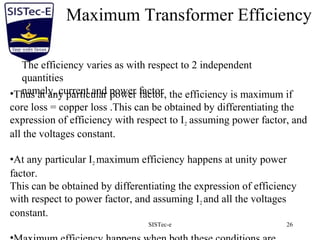
Maximum Transformer Efficiency
The efficiency varies as with respect to 2 independent
quantities
namely, current and power factor•Thus at any particular power factor, the efficiency is maximum if
core loss = copper loss .This can be obtained by differentiating the
expression of efficiency with respect to I2 assuming power factor, and
all the voltages constant.
•At any particular I2 maximum efficiency happens at unity power
factor.
This can be obtained by differentiating the expression of efficiency
with respect to power factor, and assuming I2 and all the voltages
constant.
SISTec-e 27
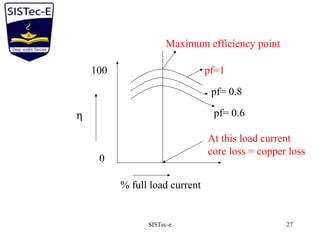
100
0
% full load current
pf=1
pf= 0.8
pf= 0.6
At this load current
core loss = copper loss
Maximum efficiency point
η
All Day Efficiency
• Most Transformers are connected permanently
• The time that the transformer has to be calculated when
determining efficiency
• Able to determine the best transformer for the application by its
efficiency
28SISTec-e
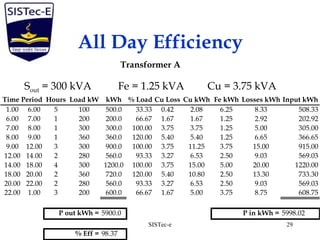
All Day Efficiency
Transformer A
Sout = 300 kVA Fe = 1.25 kVA Cu = 3.75 kVA
Hours Load kW kWh % Load Cu Loss Cu kWh Fe kWh Losses kWh Input kWh
1.00 6.00 5 100 500.0 33.33 0.42 2.08 6.25 8.33 508.33
6.00 7.00 1 200 200.0 66.67 1.67 1.67 1.25 2.92 202.92
7.00 8.00 1 300 300.0 100.00 3.75 3.75 1.25 5.00 305.00
8.00 9.00 1 360 360.0 120.00 5.40 5.40 1.25 6.65 366.65
9.00 12.00 3 300 900.0 100.00 3.75 11.25 3.75 15.00 915.00
12.00 14.00 2 280 560.0 93.33 3.27 6.53 2.50 9.03 569.03
14.00 18.00 4 300 1200.0 100.00 3.75 15.00 5.00 20.00 1220.00
18.00 20.00 2 360 720.0 120.00 5.40 10.80 2.50 13.30 733.30
20.00 22.00 2 280 560.0 93.33 3.27 6.53 2.50 9.03 569.03
22.00 1.00 3 200 600.0 66.67 1.67 5.00 3.75 8.75 608.75
5900.0 5998.02
98.37
Time Period
P out kWh = P in kWh =
% Eff =
29SISTec-e
Thank You
30

Single phase transformer

  • 1.
    Single Phase Transformer PreparedBy: RITU K.R. Assistant Professor (EE) SISTec-E 1
  • 2.
    SISTec-e 2 Coil 1 i1(t)i2(t) Coil 2 M e1(t) e2(t) S1 S2 i1(t) i2(t) The Transformer (Primary has N1 turns) (Secondary has N2 turns) V2
  • 3.
    SISTec-e 3 Transformer Construction Left:Windings shown only on one leg Right: Note the thin laminations
  • 4.
  • 5.
    SISTec-e 5 • Thesource side is called Primary • The load side is called Secondary • Ideally 1. The resistance of the coils are zero. 2. The relative permeability of the core in infinite. 3. Zero core or iron loss. 4. Zero leakage flux The Transformer
  • 6.
    SISTec-e 6 The Transformer i)Switch ‘S1’ is closed and ‘S2’ is open at t=0 The core does not have a flux at t=0 The voltage induced across each coil is proportional to its number of turns.
  • 7.
    SISTec-e 7 The Transformer ii)Switch ‘S2’ is now closed A current now starts to flow in resistance R. This current is i2(t) (flows out of the dotted terminal). R )t(2V R )t(e )t(i 2 2 == Thus a MMF N2i2(t) is applied to the magnetic circuit. This will immediately make a current i1(t) flow into the dot of the primary side, so that N1i1(t) opposes N2i2(t) and the original flux in the core remains constant. Otherwise, N2i2(t) would make the core flux change drastically and the balance between V1 and e1(t) will be disturbed.
  • 8.
    8 The Transformer Observation: Itwas shown that the flux in the core is Φm Sin(ωt). Since the permeability of the core is infinite ideally zero current can produce this flux! In actuality, a current Im, known as magnetizing current is required to setup the flux in the transformer. This current is within 5% of the full load current in a well designed transformer. ℜ == 2 1 1 1 ; 1 N L L rmsV Im ω L1 is the primary side self inductance.
  • 9.
    SISTec-e 9 Polarity (dot)convention Terminals of different windings are of same polarity if currents entering (or leaving) them produce flux in the same direction in the core.
  • 10.
    SISTec-e 10 How tocheck polarity? 1) Measure e12 and e34 2) Connect 2 and 4 and measure e13 3) If e13= e12+e34, 1 and 4 have same polarity 4) If e13= e12-e34, 1 and 4 have different polarity
  • 11.
    The transformer’s equivalent circuit Tomodel a real transformer accurately, we need to account for the following losses: 1.Copper losses – resistive heating in the windings: I2 R. 2.Eddy current losses – resistive heating in the core: proportional to the square of voltage applied to the transformer. 3.Hysteresis losses – energy needed to rearrange magnetic domains in the core: nonlinear function of the voltage applied to the transformer. 4.Leakage flux – flux that escapes from the core and flux that passes through one winding only.
  • 12.
  • 13.
    The Exact EquivalentCircuit Of A Real Transformer The transformer’s equivalent circuit However, the exact circuit is not very practical. Therefore, the equivalent circuit is usually referred to the primary side or the secondary side of the transformer. Equivalent circuit of the transformer referred to its primary side. Equivalent circuit of the transformer referred to its secondary side.
  • 14.
    Approximate Equivalent CircuitOf A Transformer For many practical applications, approximate models of transformers are used. Referred to the primary side. Without an excitation branch referred to the primary side. Referred to the secondary side. Without an excitation branch referred to the secondary side. The values of components of the transformer model can be determined experimentally by an open-circuit test or by a short-circuit test.
  • 15.
    SISTec-e 15 Open circuitTest •It is used to determine Lm1 (Xm1)andRc1 •Usually performed on the low voltage side •The test is performed at rated voltage and frequency under no load
  • 16.
    Open Circuit Test FindsIron Losses (Fe) Full Supply Voltage Secondary Open Circuit Wattmeter indicates Iron Losses (Fe) 16
  • 17.
    SISTec-e 17 Short circuitTest •It is used to determine Llp (Xeq)andRp(Req) •Usually performed on the high voltage side •This test is performed at reduced voltage and rated frequency with the output of the low voltage winding short circuited such that rated current flows on the high voltage side.
  • 18.
    Short Circuit Test CopperLosses (Cu) Secondary Short Circuited Limited Supply Voltage ≈ 5-10 % Wattmeter indicates Copper Losses (Cu) 18
  • 19.
    SISTec-e 19 Transformer Regulation •Loadingchanges the output voltage of a transformer. Transformer regulation is the measure of such a deviation. Definition of % Regulation 100* |V| |V||V| load loadloadno − = − Vno-load =RMS voltage across the load terminals without load V load = RMS voltage across the load terminals with a specified load
  • 20.
    SISTec-e 20 Maximum TransformerRegulation 1212 1 0 11 0 2 ' 2 0' 21 ;0 max .0 eqeq eqeq or whenimumisVClearly ZIVV θθθθ θθ −==+ ∠∠+∠=
  • 21.
    SISTec-e 21 Transformer Lossesand Efficiency •Transformer Losses •Core/Iron Loss =V1 2 / Rc1 •Copper Loss = I1 2 R1+ I2 2 R2 Definition of % efficiency 100* 222 222 θ θ CosIVLosses CosIV + = 100* / 2222 2 21 2 11 2 1 222 θ θ CosIVRIRIRV CosIV c +++ = 2θCos = load power factor 100* / 2222 2 21 2 1 222 θ θ CosIVRIRV CosIV eqc ++ =
  • 22.
    Transformer Losses Copper Losses(Cu) •Varies with load current •Produces HEAT •Created by resistance of windings •Short circuit test supplies copper losses 22
  • 23.
    Transformer Losses Iron Losses(Fe)•Fixed •Always present •Related to transformers construction Eddy Currents Reduced by laminations Produces HEAT Hysteresis Reduced by using special steels in laminations 23
  • 24.
    Efficiency PowerInput PowerOutput η = LossesOutputInput += LossesPowerOutput PowerOutput η + = Ratiobetween Input power and Output Power PowerInput LossesPowerInput η − = 24
  • 25.
  • 26.
    SISTec-e 26 Maximum TransformerEfficiency The efficiency varies as with respect to 2 independent quantities namely, current and power factor•Thus at any particular power factor, the efficiency is maximum if core loss = copper loss .This can be obtained by differentiating the expression of efficiency with respect to I2 assuming power factor, and all the voltages constant. •At any particular I2 maximum efficiency happens at unity power factor. This can be obtained by differentiating the expression of efficiency with respect to power factor, and assuming I2 and all the voltages constant.
  • 27.
    SISTec-e 27 100 0 % fullload current pf=1 pf= 0.8 pf= 0.6 At this load current core loss = copper loss Maximum efficiency point η
  • 28.
    All Day Efficiency •Most Transformers are connected permanently • The time that the transformer has to be calculated when determining efficiency • Able to determine the best transformer for the application by its efficiency 28SISTec-e
  • 29.
    All Day Efficiency TransformerA Sout = 300 kVA Fe = 1.25 kVA Cu = 3.75 kVA Hours Load kW kWh % Load Cu Loss Cu kWh Fe kWh Losses kWh Input kWh 1.00 6.00 5 100 500.0 33.33 0.42 2.08 6.25 8.33 508.33 6.00 7.00 1 200 200.0 66.67 1.67 1.67 1.25 2.92 202.92 7.00 8.00 1 300 300.0 100.00 3.75 3.75 1.25 5.00 305.00 8.00 9.00 1 360 360.0 120.00 5.40 5.40 1.25 6.65 366.65 9.00 12.00 3 300 900.0 100.00 3.75 11.25 3.75 15.00 915.00 12.00 14.00 2 280 560.0 93.33 3.27 6.53 2.50 9.03 569.03 14.00 18.00 4 300 1200.0 100.00 3.75 15.00 5.00 20.00 1220.00 18.00 20.00 2 360 720.0 120.00 5.40 10.80 2.50 13.30 733.30 20.00 22.00 2 280 560.0 93.33 3.27 6.53 2.50 9.03 569.03 22.00 1.00 3 200 600.0 66.67 1.67 5.00 3.75 8.75 608.75 5900.0 5998.02 98.37 Time Period P out kWh = P in kWh = % Eff = 29SISTec-e
  • 30.