
Sharad Institute of Technology College of
Engineering, Yadrav (Ichalkarnji)
A
Presentation On
PROTECTIVE RELAYS
Presented By,
Mr. Chetan Patil.
Assistant Professor
Department of Electrical Engineering

 Introduction
 Working
 Qualities Of Protection Relays
 Classification of relay
Content

Relay:
Relay is a device which detects the fault & initiates the operation of
C.B to isolate the defective part of system from healthy part of
system.
Introduction
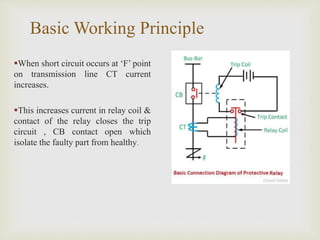
Basic Working Principle
When short circuit occurs at ‘F’ point
on transmission line CT current
increases.
This increases current in relay coil &
contact of the relay closes the trip
circuit , CB contact open which
isolate the faulty part from healthy.

 Reliability : Reliability refers to the ability of the relay to operate under
predermine condition .
 Sensitivity : Sensitivity refers to the characteristic of the relay to act when
the actual fault conditions occur. Sensitivity is usually represented in terms
of the minimum volt-amperes required for the relay operation.
 Selectivity : Selectivity refers to the ability of the relay to discriminate
between faults in protected section . The system should able to operate with
low value of actuating quantity.
 Speed : The relay should act according to the present time delay. It should
be fast enough to isolate the faulty element of system.
Qualities Of Relays

1. Electromagnet attraction armature type relay
 Attracted armature type relay
 Solenoid type relay
 Balanced beam type relay
2. Electromagnet induction type relay
 Induction disc type relay
 Induction cup type relay
Classification Of Relay
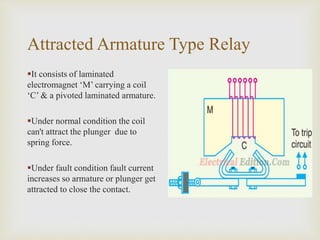
Attracted Armature Type Relay
It consists of laminated
electromagnet ‘M’ carrying a coil
‘C’ & a pivoted laminated armature.
Under normal condition the coil
can't attract the plunger due to
spring force.
Under fault condition fault current
increases so armature or plunger get
attracted to close the contact.
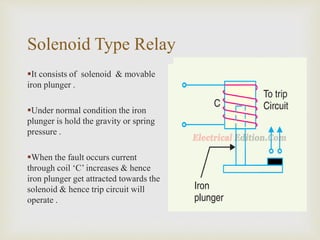
Solenoid Type Relay
It consists of solenoid & movable
iron plunger .
Under normal condition the iron
plunger is hold the gravity or spring
pressure .
When the fault occurs current
through coil ‘C’ increases & hence
iron plunger get attracted towards the
solenoid & hence trip circuit will
operate .
Balanced Beam Type Relay
• It consists of horizontal beam
pivoted centrally.
• There are two coils on both sides ,one
is known as restraining coil & another
is operating coil.
• When fault is occur the current in
operating coil increases hence,
operating force become more than
restraining Force ,the beam tilts &
contact of relay will closed .
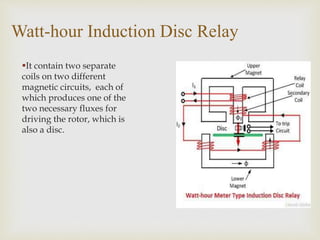
Watt-hour Induction Disc Relay
It contain two separate
coils on two different
magnetic circuits, each of
which produces one of the
two necessary fluxes for
driving the rotor, which is
also a disc.
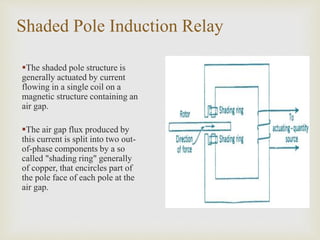
Shaded Pole Induction Relay
The shaded pole structure is
generally actuated by current
flowing in a single coil on a
magnetic structure containing an
air gap.
The air gap flux produced by
this current is split into two out-
of-phase components by a so
called "shading ring" generally
of copper, that encircles part of
the pole face of each pole at the
air gap.
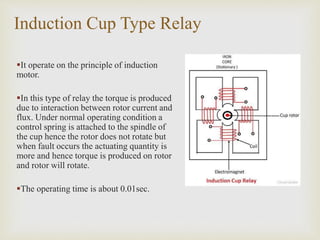
Induction Cup Type Relay
It operate on the principle of induction
motor.
In this type of relay the torque is produced
due to interaction between rotor current and
flux. Under normal operating condition a
control spring is attached to the spindle of
the cup hence the rotor does not rotate but
when fault occurs the actuating quantity is
more and hence torque is produced on rotor
and rotor will rotate.
The operating time is about 0.01sec.

 Relay is a device which detects the fault & initiates the operation of
C.B to isolate the defective part of system from healthy part of system.
 Selection of relay for particular application is based on properties like
sensitivity, reliability, selectivity, speed.
Conclusion

Thank You

 Power system protection & Switchgear: B.Ram &
B.N. Vishwakarma.
 Switchgear & Protection: Sunil S.Rao, Khanna
Publications.
References

Protective relays

  • 1.
    Sharad Institute ofTechnology College of Engineering, Yadrav (Ichalkarnji) A Presentation On PROTECTIVE RELAYS Presented By, Mr. Chetan Patil. Assistant Professor Department of Electrical Engineering
  • 2.
      Introduction  Working Qualities Of Protection Relays  Classification of relay Content
  • 3.
     Relay: Relay is adevice which detects the fault & initiates the operation of C.B to isolate the defective part of system from healthy part of system. Introduction
  • 4.
    Basic Working Principle Whenshort circuit occurs at ‘F’ point on transmission line CT current increases. This increases current in relay coil & contact of the relay closes the trip circuit , CB contact open which isolate the faulty part from healthy.
  • 5.
      Reliability :Reliability refers to the ability of the relay to operate under predermine condition .  Sensitivity : Sensitivity refers to the characteristic of the relay to act when the actual fault conditions occur. Sensitivity is usually represented in terms of the minimum volt-amperes required for the relay operation.  Selectivity : Selectivity refers to the ability of the relay to discriminate between faults in protected section . The system should able to operate with low value of actuating quantity.  Speed : The relay should act according to the present time delay. It should be fast enough to isolate the faulty element of system. Qualities Of Relays
  • 6.
     1. Electromagnet attractionarmature type relay  Attracted armature type relay  Solenoid type relay  Balanced beam type relay 2. Electromagnet induction type relay  Induction disc type relay  Induction cup type relay Classification Of Relay
  • 7.
    Attracted Armature TypeRelay It consists of laminated electromagnet ‘M’ carrying a coil ‘C’ & a pivoted laminated armature. Under normal condition the coil can't attract the plunger due to spring force. Under fault condition fault current increases so armature or plunger get attracted to close the contact.
  • 8.
    Solenoid Type Relay Itconsists of solenoid & movable iron plunger . Under normal condition the iron plunger is hold the gravity or spring pressure . When the fault occurs current through coil ‘C’ increases & hence iron plunger get attracted towards the solenoid & hence trip circuit will operate .
  • 9.
    Balanced Beam TypeRelay • It consists of horizontal beam pivoted centrally. • There are two coils on both sides ,one is known as restraining coil & another is operating coil. • When fault is occur the current in operating coil increases hence, operating force become more than restraining Force ,the beam tilts & contact of relay will closed .
  • 10.
    Watt-hour Induction DiscRelay It contain two separate coils on two different magnetic circuits, each of which produces one of the two necessary fluxes for driving the rotor, which is also a disc.
  • 11.
    Shaded Pole InductionRelay The shaded pole structure is generally actuated by current flowing in a single coil on a magnetic structure containing an air gap. The air gap flux produced by this current is split into two out- of-phase components by a so called "shading ring" generally of copper, that encircles part of the pole face of each pole at the air gap.
  • 12.
    Induction Cup TypeRelay It operate on the principle of induction motor. In this type of relay the torque is produced due to interaction between rotor current and flux. Under normal operating condition a control spring is attached to the spindle of the cup hence the rotor does not rotate but when fault occurs the actuating quantity is more and hence torque is produced on rotor and rotor will rotate. The operating time is about 0.01sec.
  • 13.
      Relay isa device which detects the fault & initiates the operation of C.B to isolate the defective part of system from healthy part of system.  Selection of relay for particular application is based on properties like sensitivity, reliability, selectivity, speed. Conclusion
  • 14.
  • 15.
      Power systemprotection & Switchgear: B.Ram & B.N. Vishwakarma.  Switchgear & Protection: Sunil S.Rao, Khanna Publications. References