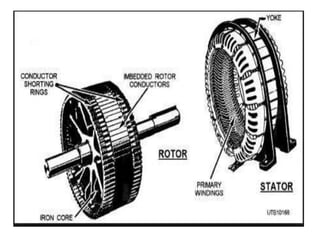
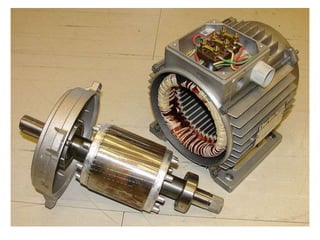
Motor construction
• Rotor
• Stator
• Air gap
• Windings
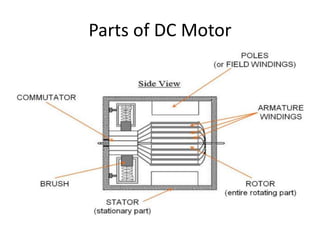
Parts of DC Motor
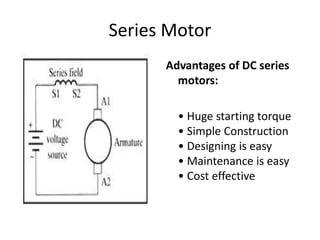
Series Motor
Advantages of DC series
motors:
• Huge starting torque
• Simple Construction
• Designing is easy
• Maintenance is easy
• Cost effective
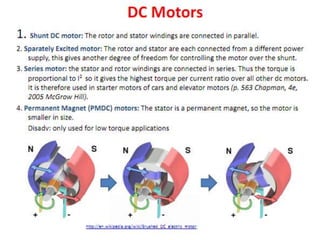
Permanent Magnet DC Motor
• Higher efficiency since no electrical energy is used or losses
incurred for developing or maintaining the motor’s magnetic
field.
• Higher torque and power density.
• Linear torque speed charcteristics. that are more predictable.
• Better dynamic performance due to higher magnetic flux
density in air gap.
• Simplified construction and essentially maintenance-free.
• More compact size.
http://www.ohioelectricmotors.com/permanent-magnet-dc-motors-649#ixzz2sttph8bA
Advantages
simple torque and speed control without
sophisticated electronics
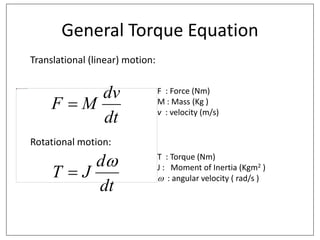
General Torque Equation
Translational (linear) motion:
dt
d
JT


Rotational motion:
dt
dv
MF 
F : Force (Nm)
M : Mass (Kg )
v : velocity (m/s)
T : Torque (Nm)
J : Moment of Inertia (Kgm2 )
 : angular velocity ( rad/s )
Synchronous Machines
• Above a certain size, synchronous motors are
not self-starting motors. This property is due
to the inertia of the rotor; it cannot instantly
follow the rotation of the magnetic field of the
stator.
• synchronous motor produces no inherent
average torque at standstill, it cannot
accelerate to synchronous speed without
some supplemental mechanism.
Applications
• Synchronous motors are especially useful in applications
requiring precise speed and/or position control.
• Speed is independent of the load over the operating range
of the motor.
• Speed and position may be accurately controlled using
open loop controls, e.g. stepper motors.
• Low-power applications include positioning machines,
where high precision is required, and robot actuators.
• They will hold their position when a DC current is applied to
both the stator and the rotor windings.
• Increased efficiency in low-speed applications (e.g. ball
mills).
Induction Motor
• Asynchronous motor
• AC electric motor
Introduction
• Three-phase induction motors are the most
common and frequently encountered
machines in industry
Induction Motor
• The electric current in the rotor needed to
produce torque is induced by electromagnetic
induction from the magnetic field of the stator
winding.
• Does not require mechanical commutation
– simple design, rugged, low-price, easy maintenance
– wide range of power ratings: fractional horsepower to
10 MW
– run essentially as constant speed from no-load to full
load
– Its speed depends on the frequency of the power
source
• not easy to have variable speed control
• requires a variable-frequency power-electronic drive for
optimal speed control

Introduction to motors

  • 2.
    Motor construction • Rotor •Stator • Air gap • Windings
  • 3.
  • 7.
    Series Motor Advantages ofDC series motors: • Huge starting torque • Simple Construction • Designing is easy • Maintenance is easy • Cost effective
  • 8.
    Permanent Magnet DCMotor • Higher efficiency since no electrical energy is used or losses incurred for developing or maintaining the motor’s magnetic field. • Higher torque and power density. • Linear torque speed charcteristics. that are more predictable. • Better dynamic performance due to higher magnetic flux density in air gap. • Simplified construction and essentially maintenance-free. • More compact size. http://www.ohioelectricmotors.com/permanent-magnet-dc-motors-649#ixzz2sttph8bA
  • 9.
    Advantages simple torque andspeed control without sophisticated electronics
  • 10.
    General Torque Equation Translational(linear) motion: dt d JT   Rotational motion: dt dv MF  F : Force (Nm) M : Mass (Kg ) v : velocity (m/s) T : Torque (Nm) J : Moment of Inertia (Kgm2 )  : angular velocity ( rad/s )
  • 12.
  • 15.
    • Above acertain size, synchronous motors are not self-starting motors. This property is due to the inertia of the rotor; it cannot instantly follow the rotation of the magnetic field of the stator.
  • 16.
    • synchronous motorproduces no inherent average torque at standstill, it cannot accelerate to synchronous speed without some supplemental mechanism.
  • 17.
    Applications • Synchronous motorsare especially useful in applications requiring precise speed and/or position control. • Speed is independent of the load over the operating range of the motor. • Speed and position may be accurately controlled using open loop controls, e.g. stepper motors. • Low-power applications include positioning machines, where high precision is required, and robot actuators. • They will hold their position when a DC current is applied to both the stator and the rotor windings. • Increased efficiency in low-speed applications (e.g. ball mills).
  • 18.
    Induction Motor • Asynchronousmotor • AC electric motor
  • 19.
    Introduction • Three-phase inductionmotors are the most common and frequently encountered machines in industry
  • 20.
    Induction Motor • Theelectric current in the rotor needed to produce torque is induced by electromagnetic induction from the magnetic field of the stator winding. • Does not require mechanical commutation
  • 21.
    – simple design,rugged, low-price, easy maintenance – wide range of power ratings: fractional horsepower to 10 MW – run essentially as constant speed from no-load to full load – Its speed depends on the frequency of the power source • not easy to have variable speed control • requires a variable-frequency power-electronic drive for optimal speed control