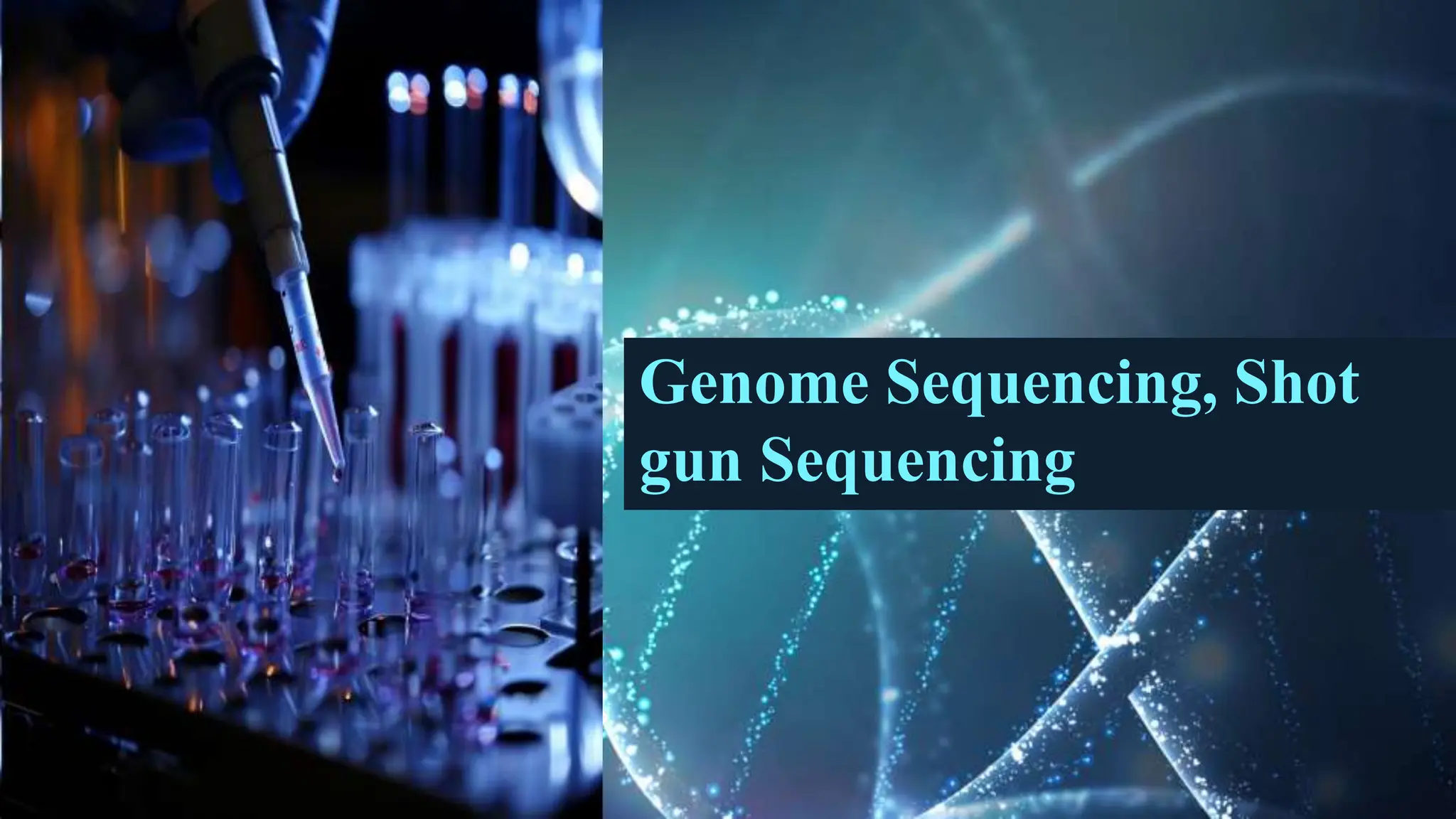
Genome Sequencing, Shot
gun Sequencing
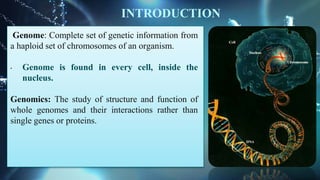
Genome: Complete set of genetic information from
a haploid set of chromosomes of an organism.
• Genome is found in every cell, inside the
nucleus.
Genomics: The study of structure and function of
whole genomes and their interactions rather than
single genes or proteins.
INTRODUCTION
The sequence information of genome will show
• The position of every gene along the chromosome
• The regulatory regions that flank each gene
• The coding sequence that determines the protein produced by each gene
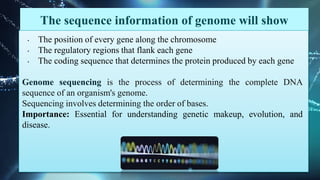
Genome sequencing is the process of determining the complete DNA
sequence of an organism's genome.
Sequencing involves determining the order of bases.
Importance: Essential for understanding genetic makeup, evolution, and
disease.
Collecting a sample containing the DNA of interest. This
could be a blood sample, tissue biopsy, saliva, or any
other biological material depending on the organism
being studied.
DNA Shearing
Sample Collection: DNA Extraction:
Scientists cut the DNA into short fragments of known
length, either by using enzymes or mechanical
disruption
DNA Library Preparation
Scientists make many copies of each DNA fragment
using a process called polymerase chain reaction
(PCR)
This is typically done using various biochemical
methods that break open the cells and separate the
DNA from other cellular components such as proteins
and lipids.
Basic steps in genome sequencing
Sequencing
The prepared DNA fragments are then loaded
onto a sequencing platform where they undergo a
series of biochemical reactions to determine their
nucleotide sequence. There are several sequencing
technologies available, including Sanger
sequencing, Illumina sequencing
Genome Annotation
After the genome sequence is assembled, it needs
to be annotated to other functional elements
within the genome. This involves predicting gene
locations, identifying coding and non-coding
regions such as promoters, enhancers, and
repetitive sequences.
DNA Sequence Analysis
The sequencer produces millions of DNA reads, and
specialized computer programs are used to put them
together in the correct order.
Validation
This can be done using various experimental
techniques such as polymerase chain reaction
(PCR), Sanger sequencing, and functional
assays to confirm the presence and
functionality of predicted genes and regulatory
elements.
Determining the sequence of DNA
Methods
• Maxam and Gilbert chemical degradation method
• Chain termination or deoxy method Frederick Sanger method
Genome sequencing method:
• Shotgun sequencing
Second generation sequencing methods:
• Pyro sequencing
• Nanopore sequencing
• Illumina sequencing
Factors determining sequencing strategy
• Genome size
• Chromosomal structure
• Repeat condensed character
• Desired end product
Shotgun sequencing
• It is a method used in molecular biology to determine the DNA sequence
of an organism's genome.
• It is called "shotgun" sequencing because it involves randomly breaking
up DNA sequences into lots of small pieces and then reassembling the
sequence by looking for regions of overlap.
• Originally used by Sanger and his colleagues to sequence small genomes
such as those of viruses and bacteria.
History
1970s: Early DNA Sequencing Techniques (Frederick Sanger)
1980s: Initial Concepts of Shotgun Sequencing
1990s: Shotgun Sequencing of Small Genomes (Bacteria, Virus)
Notable achievements include the sequencing of the bacterium
Haemophilus influenzae in 1995, the first complete genome sequence of
a free-living organism.
2000s: Human Genome Project and Next-Generation Sequencing
2005: Rapid Advances in NGS Technologies
Principle of shotgun sequencing
• The chain termination method of DNA
sequencing can only be used for fairly short
strands of 100 to 1000 base pairs.
• The principle of shotgun sequencing involves
breaking the genome into small, random
fragments, sequencing these fragments, and
then assembling them back together to
reconstruct the original genome sequence.
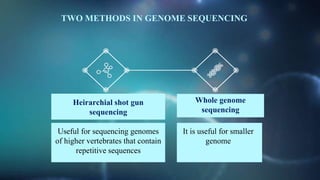
TWO METHODS IN GENOME SEQUENCING
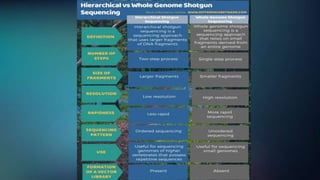
Heirarchial shot gun
sequencing
Useful for sequencing genomes
of higher vertebrates that contain
repetitive sequences
Whole genome
sequencing
It is useful for smaller
genome
Hierarchical shotgun
sequencing
Imagine a jigsaw puzzle with
billions of tiny pieces, that's the
challenge of sequencing DNA.
Hierarchical shotgun sequencing
breaks down this complexity by
breaking DNA into manageable
fragments
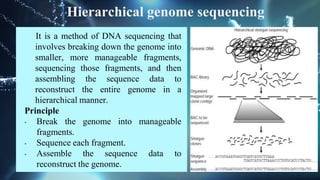
Hierarchical genome sequencing
It is a method of DNA sequencing that
involves breaking down the genome into
smaller, more manageable fragments,
sequencing those fragments, and then
assembling the sequence data to
reconstruct the entire genome in a
hierarchical manner.
Principle
• Break the genome into manageable
fragments.
• Sequence each fragment.
• Assemble the sequence data to
reconstruct the genome.
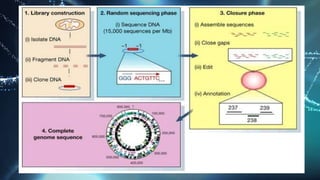
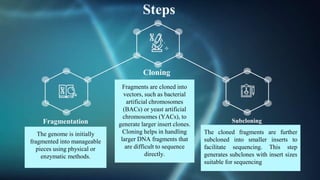
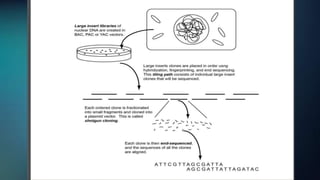
The genome is initially
fragmented into manageable
pieces using physical or
enzymatic methods.
Fragments are cloned into
vectors, such as bacterial
artificial chromosomes
(BACs) or yeast artificial
chromosomes (YACs), to
generate larger insert clones.
Cloning helps in handling
larger DNA fragments that
are difficult to sequence
directly.
The cloned fragments are further
subcloned into smaller inserts to
facilitate sequencing. This step
generates subclones with insert sizes
suitable for sequencing
Fragmentation
Cloning
Subcloning
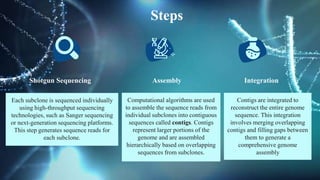
Steps
Steps
Shotgun Sequencing
Each subclone is sequenced individually
using high-throughput sequencing
technologies, such as Sanger sequencing
or next-generation sequencing platforms.
This step generates sequence reads for
each subclone.
Integration
Contigs are integrated to
reconstruct the entire genome
sequence. This integration
involves merging overlapping
contigs and filling gaps between
them to generate a
comprehensive genome
assembly
Assembly
Computational algorithms are used
to assemble the sequence reads from
individual subclones into contiguous
sequences called contigs. Contigs
represent larger portions of the
genome and are assembled
hierarchically based on overlapping
sequences from subclones.
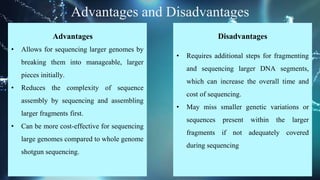
Advantages and Disadvantages
• Allows for sequencing larger genomes by
breaking them into manageable, larger
pieces initially.
• Reduces the complexity of sequence
assembly by sequencing and assembling
larger fragments first.
• Can be more cost-effective for sequencing
large genomes compared to whole genome
shotgun sequencing.
Advantages
• Requires additional steps for fragmenting
and sequencing larger DNA segments,
which can increase the overall time and
cost of sequencing.
• May miss smaller genetic variations or
sequences present within the larger
fragments if not adequately covered
during sequencing
Disadvantages
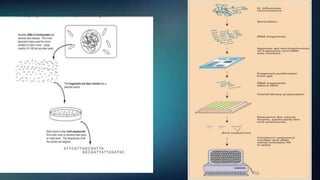
Whole genome Sequencing
• In this approach, the genome is decomposed
directly into individual random reads.
• Then attempts to assemble the genome as a
whole.
Principle:
• Randomly fragment the genomic DNA into
small, overlapping fragments.
• Sequence the fragments using high-throughput
sequencing technologies.
• Assemble the sequence reads into contiguous
sequences using computational algorithms.
Steps
• Isolation of Genomic DNA: The process begins with the isolation of
genomic DNA from the organism of interest.
• Random Fragmentation of Genomic DNA: The isolated genomic DNA is
then randomly fragmented into small pieces. This can be achieved through
methods such as sonication or nebulization.
• Size Selection Using Electrophoresis: The fragmented DNA is subjected
to size selection using electrophoresis, which allows for the isolation of
DNA fragments of the desired size range.
Steps
• Library Construction: This involves the ligation of sequencing adapters to
the DNA fragments, which are essential for the subsequent steps of the
sequencing process.
• Paired-End Sequencing (PE Sequencing): The DNA library is subjected to
paired-end sequencing, which involves sequencing both ends of the DNA
fragments. This step provides crucial information about the relative positions
and orientations of the DNA fragments within the genome.
• Genome Assembly: This process involves using specialized computer
programs to align and merge the individual DNA reads to reconstruct the
original genome sequence. The overlapping sequences are used to piece
together the complete genome.
Advantages
• Provides a comprehensive and unbiased view
of the entire genome, including smaller genetic
variations and sequences.
• Can be more suitable for sequencing smaller
genomes or genomes with less repetitive regions.
• Offers flexibility in sample preparation and
sequencing, allowing for faster turnaround times
and lower costs compared to hierarchical
shotgun sequencing
Disadvantages
• Requires more computational
resources and sophisticated
algorithms for assembling the
fragmented sequences accurately.
• May encounter challenges in
assembling repetitive regions or
resolving complex genomic
structures.
Applications
• Large Genome sequencing : Used in sequencing large and complex genomes.
Example: Sequencing of maize genome , Human genome project
• Metagenomics: Used to study microbial communities in environmental sample
Example: Global ocean sampling expedition.
• Cancer Genomics: Used to identify genetic mutations and alterations in cancer cells
Example: The Cancer Genome Atlas project
• Ancient DNA Studies: Shotgun sequencing has been crucial in studying ancient DNA from
archaeological samples.
References
• Ranjan, R., Rani, A., Metwally, A., McGee, H. S., & Perkins, D. L. (2016). Analysis
of the microbiome: Advantages of whole genome shotgun versus 16S amplicon
sequencing. Biochemical and Biophysical Research Communications, 469(4), 967–
977.
• Marra, M. (2024). Whole genome sequencing, genetics. The Editors of Encyclopaedia
Britannica.
• Waterston, R. H., Lander, E. S., & Sulston, J. E. (2002). On the sequencing of the
human genome. Proceedings of the National Academy of Sciences, 99(6), 3712-3716.
• Koskinen, V. R., Emery, P. A., Creasy, D. M., & Cottrell, J. S. (2011). Hierarchical
clustering of shotgun proteomics data. Molecular & Cellular Proteomics, 10(6).
• https://www.bio.davidson.edu/courses/genomics/method/shotgun.html
• https://www.news-medical.net/life-sciences/Shotgun-Sequencing.aspx

Genome sequencing,shotgun sequencing.pptx

  • 1.
  • 2.
    Genome: Complete setof genetic information from a haploid set of chromosomes of an organism. • Genome is found in every cell, inside the nucleus. Genomics: The study of structure and function of whole genomes and their interactions rather than single genes or proteins. INTRODUCTION
  • 3.
    The sequence informationof genome will show • The position of every gene along the chromosome • The regulatory regions that flank each gene • The coding sequence that determines the protein produced by each gene Genome sequencing is the process of determining the complete DNA sequence of an organism's genome. Sequencing involves determining the order of bases. Importance: Essential for understanding genetic makeup, evolution, and disease.
  • 4.
    Collecting a samplecontaining the DNA of interest. This could be a blood sample, tissue biopsy, saliva, or any other biological material depending on the organism being studied. DNA Shearing Sample Collection: DNA Extraction: Scientists cut the DNA into short fragments of known length, either by using enzymes or mechanical disruption DNA Library Preparation Scientists make many copies of each DNA fragment using a process called polymerase chain reaction (PCR) This is typically done using various biochemical methods that break open the cells and separate the DNA from other cellular components such as proteins and lipids. Basic steps in genome sequencing
  • 5.
    Basic steps ingenome sequencing Sequencing The prepared DNA fragments are then loaded onto a sequencing platform where they undergo a series of biochemical reactions to determine their nucleotide sequence. There are several sequencing technologies available, including Sanger sequencing, Illumina sequencing Genome Annotation After the genome sequence is assembled, it needs to be annotated to other functional elements within the genome. This involves predicting gene locations, identifying coding and non-coding regions such as promoters, enhancers, and repetitive sequences. DNA Sequence Analysis The sequencer produces millions of DNA reads, and specialized computer programs are used to put them together in the correct order. Validation This can be done using various experimental techniques such as polymerase chain reaction (PCR), Sanger sequencing, and functional assays to confirm the presence and functionality of predicted genes and regulatory elements.
  • 7.
    Determining the sequenceof DNA Methods • Maxam and Gilbert chemical degradation method • Chain termination or deoxy method Frederick Sanger method Genome sequencing method: • Shotgun sequencing Second generation sequencing methods: • Pyro sequencing • Nanopore sequencing • Illumina sequencing
  • 8.
    Factors determining sequencingstrategy • Genome size • Chromosomal structure • Repeat condensed character • Desired end product
  • 9.
    Shotgun sequencing • Itis a method used in molecular biology to determine the DNA sequence of an organism's genome. • It is called "shotgun" sequencing because it involves randomly breaking up DNA sequences into lots of small pieces and then reassembling the sequence by looking for regions of overlap. • Originally used by Sanger and his colleagues to sequence small genomes such as those of viruses and bacteria.
  • 10.
    History 1970s: Early DNASequencing Techniques (Frederick Sanger) 1980s: Initial Concepts of Shotgun Sequencing 1990s: Shotgun Sequencing of Small Genomes (Bacteria, Virus) Notable achievements include the sequencing of the bacterium Haemophilus influenzae in 1995, the first complete genome sequence of a free-living organism. 2000s: Human Genome Project and Next-Generation Sequencing 2005: Rapid Advances in NGS Technologies
  • 11.
    Principle of shotgunsequencing • The chain termination method of DNA sequencing can only be used for fairly short strands of 100 to 1000 base pairs. • The principle of shotgun sequencing involves breaking the genome into small, random fragments, sequencing these fragments, and then assembling them back together to reconstruct the original genome sequence.
  • 12.
    TWO METHODS INGENOME SEQUENCING Heirarchial shot gun sequencing Useful for sequencing genomes of higher vertebrates that contain repetitive sequences Whole genome sequencing It is useful for smaller genome
  • 13.
    Hierarchical shotgun sequencing Imagine ajigsaw puzzle with billions of tiny pieces, that's the challenge of sequencing DNA. Hierarchical shotgun sequencing breaks down this complexity by breaking DNA into manageable fragments
  • 14.
    Hierarchical genome sequencing Itis a method of DNA sequencing that involves breaking down the genome into smaller, more manageable fragments, sequencing those fragments, and then assembling the sequence data to reconstruct the entire genome in a hierarchical manner. Principle • Break the genome into manageable fragments. • Sequence each fragment. • Assemble the sequence data to reconstruct the genome.
  • 15.
    The genome isinitially fragmented into manageable pieces using physical or enzymatic methods. Fragments are cloned into vectors, such as bacterial artificial chromosomes (BACs) or yeast artificial chromosomes (YACs), to generate larger insert clones. Cloning helps in handling larger DNA fragments that are difficult to sequence directly. The cloned fragments are further subcloned into smaller inserts to facilitate sequencing. This step generates subclones with insert sizes suitable for sequencing Fragmentation Cloning Subcloning Steps
  • 16.
    Steps Shotgun Sequencing Each subcloneis sequenced individually using high-throughput sequencing technologies, such as Sanger sequencing or next-generation sequencing platforms. This step generates sequence reads for each subclone. Integration Contigs are integrated to reconstruct the entire genome sequence. This integration involves merging overlapping contigs and filling gaps between them to generate a comprehensive genome assembly Assembly Computational algorithms are used to assemble the sequence reads from individual subclones into contiguous sequences called contigs. Contigs represent larger portions of the genome and are assembled hierarchically based on overlapping sequences from subclones.
  • 17.
    Advantages and Disadvantages •Allows for sequencing larger genomes by breaking them into manageable, larger pieces initially. • Reduces the complexity of sequence assembly by sequencing and assembling larger fragments first. • Can be more cost-effective for sequencing large genomes compared to whole genome shotgun sequencing. Advantages • Requires additional steps for fragmenting and sequencing larger DNA segments, which can increase the overall time and cost of sequencing. • May miss smaller genetic variations or sequences present within the larger fragments if not adequately covered during sequencing Disadvantages
  • 19.
    Whole genome Sequencing •In this approach, the genome is decomposed directly into individual random reads. • Then attempts to assemble the genome as a whole. Principle: • Randomly fragment the genomic DNA into small, overlapping fragments. • Sequence the fragments using high-throughput sequencing technologies. • Assemble the sequence reads into contiguous sequences using computational algorithms.
  • 20.
    Steps • Isolation ofGenomic DNA: The process begins with the isolation of genomic DNA from the organism of interest. • Random Fragmentation of Genomic DNA: The isolated genomic DNA is then randomly fragmented into small pieces. This can be achieved through methods such as sonication or nebulization. • Size Selection Using Electrophoresis: The fragmented DNA is subjected to size selection using electrophoresis, which allows for the isolation of DNA fragments of the desired size range.
  • 21.
    Steps • Library Construction:This involves the ligation of sequencing adapters to the DNA fragments, which are essential for the subsequent steps of the sequencing process. • Paired-End Sequencing (PE Sequencing): The DNA library is subjected to paired-end sequencing, which involves sequencing both ends of the DNA fragments. This step provides crucial information about the relative positions and orientations of the DNA fragments within the genome. • Genome Assembly: This process involves using specialized computer programs to align and merge the individual DNA reads to reconstruct the original genome sequence. The overlapping sequences are used to piece together the complete genome.
  • 23.
    Advantages • Provides acomprehensive and unbiased view of the entire genome, including smaller genetic variations and sequences. • Can be more suitable for sequencing smaller genomes or genomes with less repetitive regions. • Offers flexibility in sample preparation and sequencing, allowing for faster turnaround times and lower costs compared to hierarchical shotgun sequencing Disadvantages • Requires more computational resources and sophisticated algorithms for assembling the fragmented sequences accurately. • May encounter challenges in assembling repetitive regions or resolving complex genomic structures.
  • 25.
    Applications • Large Genomesequencing : Used in sequencing large and complex genomes. Example: Sequencing of maize genome , Human genome project • Metagenomics: Used to study microbial communities in environmental sample Example: Global ocean sampling expedition. • Cancer Genomics: Used to identify genetic mutations and alterations in cancer cells Example: The Cancer Genome Atlas project • Ancient DNA Studies: Shotgun sequencing has been crucial in studying ancient DNA from archaeological samples.
  • 26.
    References • Ranjan, R.,Rani, A., Metwally, A., McGee, H. S., & Perkins, D. L. (2016). Analysis of the microbiome: Advantages of whole genome shotgun versus 16S amplicon sequencing. Biochemical and Biophysical Research Communications, 469(4), 967– 977. • Marra, M. (2024). Whole genome sequencing, genetics. The Editors of Encyclopaedia Britannica. • Waterston, R. H., Lander, E. S., & Sulston, J. E. (2002). On the sequencing of the human genome. Proceedings of the National Academy of Sciences, 99(6), 3712-3716. • Koskinen, V. R., Emery, P. A., Creasy, D. M., & Cottrell, J. S. (2011). Hierarchical clustering of shotgun proteomics data. Molecular & Cellular Proteomics, 10(6). • https://www.bio.davidson.edu/courses/genomics/method/shotgun.html • https://www.news-medical.net/life-sciences/Shotgun-Sequencing.aspx