Lab.10 methods for estimating nitrification process
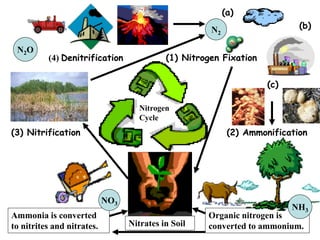
Nitrification is the two-step process by which ammonia is oxidized to nitrite and then to nitrate by autotrophic bacteria. In the first step, ammonia is oxidized to nitrite by bacteria like Nitrosomonas. In the second step, nitrite is oxidized to nitrate by bacteria like Nitrobacter. This process occurs in aerobic environments in soil and water and makes nitrogen available to plants. The summary demonstrates the key steps in nitrification and the bacteria involved in converting ammonia to nitrates through nitrites in two steps.
Lab.10 methods for estimating nitrification process
2.
Subject objective: Eachstudent should be able
to
– What are the important and how Nitrification take
place in the nature?
– Obtaining an evolution of (Nitrification) in different
soil sources.
– Practical Detection of nitrite and nitrate
compounds, through using broth medium inoculated
by standard bacteria or different garden soil
samples.
– Identification of nitrifier bacteria
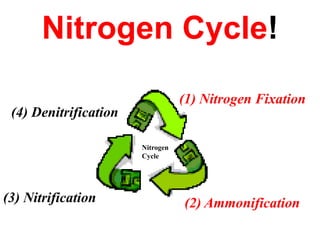
(a)
N2 (b)
N2 O
(4) Denitrification (1) Nitrogen Fixation
(c)
Nitrogen
Cycle
(3) Nitrification (2) Ammonification
NO3
NH3
Ammonia is converted Organic nitrogen is
to nitrites and nitrates. Nitrates in Soil converted to ammonium.
7.
Now we will
take a
“closer
look” at the
Nitrification
Process
8.
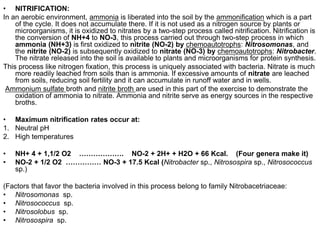
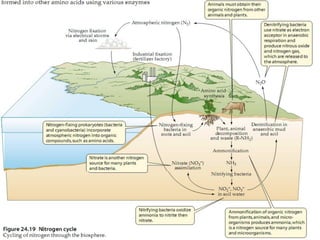
• NITRIFICATION:
In anaerobic environment, ammonia is liberated into the soil by the ammonification which is a part
of the cycle. It does not accumulate there. If it is not used as a nitrogen source by plants or
microorganisms, it is oxidized to nitrates by a two-step process called nitrification. Nitrification is
the conversion of NH+4 to NO-3, this process carried out through two-step process in which
ammonia (NH+3) is first oxidized to nitrite (NO-2) by chemoautotrophs: Nitrosomonas, and
the nitrite (NO-2) is subsequently oxidized to nitrate (NO-3) by chemoautotrophs: Nitrobacter.
The nitrate released into the soil is available to plants and microorganisms for protein synthesis.
This process like nitrogen fixation, this process is uniquely associated with bacteria. Nitrate is much
more readily leached from soils than is ammonia. If excessive amounts of nitrate are leached
from soils, reducing soil fertility and it can accumulate in runoff water and in wells.
Ammonium sulfate broth and nitrite broth are used in this part of the exercise to demonstrate the
oxidation of ammonia to nitrate. Ammonia and nitrite serve as energy sources in the respective
broths.
• Maximum nitrification rates occur at:
1. Neutral pH
2. High temperatures
• NH+ 4 + 1,1/2 O2 ………………. NO-2 + 2H+ + H2O + 66 Kcal. (Four genera make it)
• NO-2 + 1/2 O2 …………… NO-3 + 17.5 Kcal (Nitrobacter sp., Nitrosospira sp., Nitrosococcus
sp.)
(Factors that favor the bacteria involved in this process belong to family Nitrobacetriaceae:
• Nitrosomonas sp.
• Nitrosococcus sp.
• Nitrosolobus sp.
• Nitrosospira sp.
10.
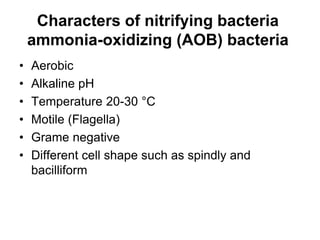
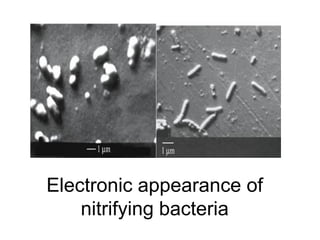
Characters of nitrifyingbacteria
ammonia-oxidizing (AOB) bacteria
• Aerobic
• Alkaline pH
• Temperature 20-30 °C
• Motile (Flagella)
• Grame negative
• Different cell shape such as spindly and
bacilliform
Materials for Nitrification:
• Garden soil
• 1 x ammonium sulfate broth (20ml)
• 1 x nitrite broth (20ml)
• Nesslers reagent
• Trommdorfs reagent
• Diphenylamine
• Spot plate
• Sulfuric acid (1 part conc. Sulfuric acid to 3 parts
water)
13.
• Method:
1. Inoculate the ammonium sulfate and nitrite broth bottles with pinches of
soil (1g). Label the bottles and shake vigorously for 5 minutes.
2. Shake the bottles for 7 days at room temperature.
3. Place a drop of sulfuric acid and 3 drops of Trommsdorf’s reagent in a
well on a spot plate. Add a drop of culture from the ammonium broth and
mix. Use a Pasteur pipette and not an inoculating loop. A blue – black
color indicates the presence of nitrite.
4. Test the ammonium broth for ammonia with Nessler’s reagent (see
ammonification).
5. Test the nitrite broth for residual nitrite.
6. If no blue black color was present, test for nitrate. Add 1 drop of
diphenylamine, 2 drops of sulfuric acid and 1 drop of nitrite broth culture
in a well on the spot plate and mix. A blue black color indicates the
presence of nitrate.
7. Grams stain the organisms in the broth cultures. Record your results.