DNA SEQUENCING METHOD
By
OLAGBAYE, Babakayode Abel
Dept. of Anatomy
University of Ilorin, Ilorin (Jan, 2017)
Future
Who and when it was practiced first?
How it is performed?
•Summary
What is DNA Sequencing method?
How does it revolutionize biological sciences?
How long will it give benefits?
Introduction
History
The Method
Advantages
2
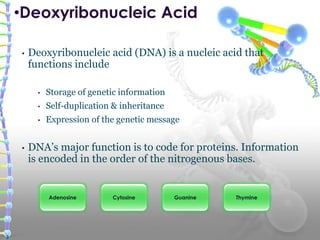
• Deoxyribonucleic acid (DNA) is a nucleic acid that
functions include
• Storage of genetic information
• Self-duplication & inheritance
• Expression of the genetic message
• DNA’s major function is to code for proteins. Information
is encoded in the order of the nitrogenous bases.
•Deoxyribonucleic Acid
ThymineGuanineCytosineAdenosine
3
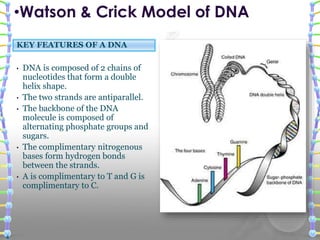
KEY FEATURES OF A DNA
• DNA is composed of 2 chains of
nucleotides that form a double
helix shape.
• The two strands are antiparallel.
• The backbone of the DNA
molecule is composed of
alternating phosphate groups and
sugars.
• The complimentary nitrogenous
bases form hydrogen bonds
between the strands.
• A is complimentary to T and G is
complimentary to C.
•Watson & Crick Model of DNA
4
•DNA SEQUENCING
• Determining the order of bases in a
section of DNA
• To analyze gene structure and its
relation to gene expression as well as
protein conformation
5
•PURPOSE
• Deciphering “code of life”
• Detecting mutations
• Typing microorganisms
• Identifying human halotypes
• Designating polymorphisms
6
•DNA SEQUENCING METHODS
•Historically there are two main methods of
DNA sequencing
1. Maxam and Gilbert method
2. Sanger method
Modern sequencing equipment uses the
principles of the Sanger technique.
7
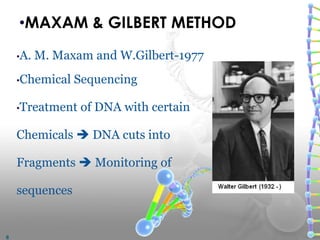
•A. M. Maxam and W.Gilbert-1977
•Chemical Sequencing
•Treatment of DNA with certain
Chemicals  DNA cuts into
Fragments  Monitoring of
sequences
•MAXAM & GILBERT METHOD
8
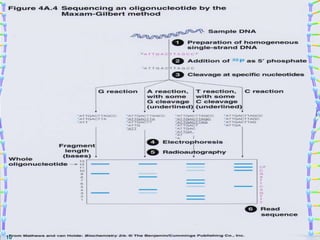
• Radioactive labelling
at one end
• Purification of the
DNA fragment to be
sequenced.
• This leads to
breakage of small
proportions of 1 or 2 of
the 4nucleotide base
in each reaction (G,
A+G, C, C+T)
•Maxam & Gilbert method
• Then the fragment in the
four reactions are arranged
side by side in gel
electrophoresis for size
separation
• To visualize- thegel is
exposed to x-ray film for
autoradiography.
• The dark band generated
can now be checked with
a corresponding
radiolabelled fragment
from which the sequence
may be read.
9
•Principle
A graphical demonstration
10
• Most common approach used for
DNA sequencing .
• Invented by Frederick Sanger - 1977
• Nobel prize - 1980
• Also termed as Chain Termination or
Dideoxy method
•SANGER METHOD
11
•“Normal” DNA synthesis:
DNA strand as template
Primer
Deoxynucleotides
Polymerase enzyme
Use several cycles to amplify
-to make different template of the DNA strand
•Process involved in Sanger’s method
12
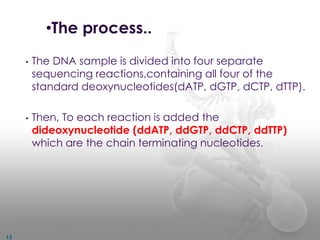
•The process..
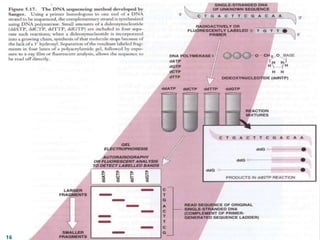
• The DNA sample is divided into four separate
sequencing reactions,containing all four of the
standard deoxynucleotides(dATP, dGTP, dCTP, dTTP).
• Then, To each reaction is added the
dideoxynucleotide (ddATP, ddGTP, ddCTP, ddTTP)
which are the chain terminating nucleotides.
13
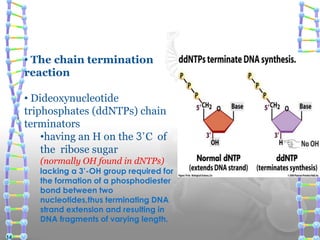
• The chain termination
reaction
• Dideoxynucleotide
triphosphates (ddNTPs) chain
terminators
•having an H on the 3’C of
the ribose sugar
(normally OH found in dNTPs)
lacking a 3’-OH group required for
the formation of a phosphodiester
bond between two
nucleotides,thus terminating DNA
strand extension and resulting in
DNA fragments of varying length.
14
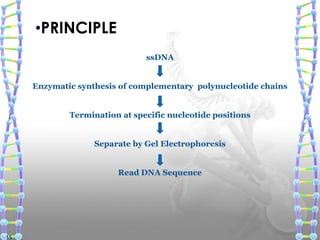
•PRINCIPLE
ssDNA
Enzymatic synthesis of complementary polynucleotide chains
Termination at specific nucleotide positions
Separate by Gel Electrophoresis
Read DNA Sequence
15
16
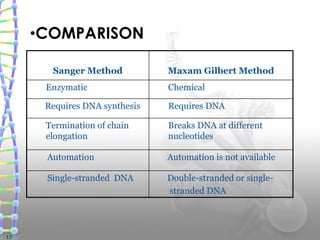
•COMPARISON
Sanger Method Maxam Gilbert Method
Enzymatic Chemical
Requires DNA synthesis Requires DNA
Termination of chain
elongation
Breaks DNA at different
nucleotides
Automation Automation is not available
Single-stranded DNA Double-stranded or single-
stranded DNA
17
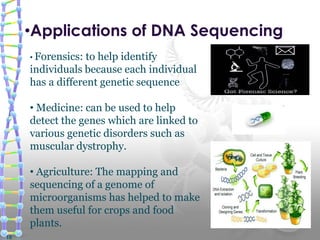
•Applications of DNA Sequencing
• Forensics: to help identify
individuals because each individual
has a different genetic sequence
• Medicine: can be used to help
detect the genes which are linked to
various genetic disorders such as
muscular dystrophy.
• Agriculture: The mapping and
sequencing of a genome of
microorganisms has helped to make
them useful for crops and food
plants.
18
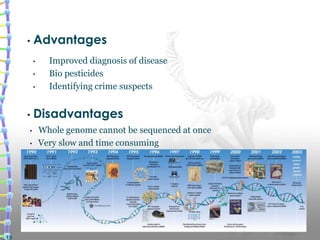
• Advantages
• Improved diagnosis of disease
• Bio pesticides
• Identifying crime suspects
• Disadvantages
• Whole genome cannot be sequenced at once
• Very slow and time consuming
19
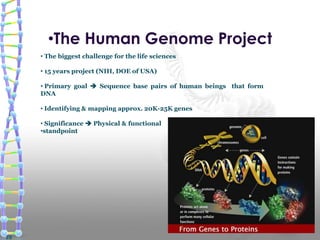
•The Human Genome Project
• The biggest challenge for the life sciences
• 15 years project (NIH, DOE of USA)
• Primary goal  Sequence base pairs of human beings that form
DNA
• Identifying & mapping approx. 20K-25K genes
• Significance  Physical & functional
•standpoint
20
21

DNA sequencing by OLAGBAYE B.ABEL

  • 1.
    DNA SEQUENCING METHOD By OLAGBAYE,Babakayode Abel Dept. of Anatomy University of Ilorin, Ilorin (Jan, 2017)
  • 2.
    Future Who and whenit was practiced first? How it is performed? •Summary What is DNA Sequencing method? How does it revolutionize biological sciences? How long will it give benefits? Introduction History The Method Advantages 2
  • 3.
    • Deoxyribonucleic acid(DNA) is a nucleic acid that functions include • Storage of genetic information • Self-duplication & inheritance • Expression of the genetic message • DNA’s major function is to code for proteins. Information is encoded in the order of the nitrogenous bases. •Deoxyribonucleic Acid ThymineGuanineCytosineAdenosine 3
  • 4.
    KEY FEATURES OFA DNA • DNA is composed of 2 chains of nucleotides that form a double helix shape. • The two strands are antiparallel. • The backbone of the DNA molecule is composed of alternating phosphate groups and sugars. • The complimentary nitrogenous bases form hydrogen bonds between the strands. • A is complimentary to T and G is complimentary to C. •Watson & Crick Model of DNA 4
  • 5.
    •DNA SEQUENCING • Determiningthe order of bases in a section of DNA • To analyze gene structure and its relation to gene expression as well as protein conformation 5
  • 6.
    •PURPOSE • Deciphering “codeof life” • Detecting mutations • Typing microorganisms • Identifying human halotypes • Designating polymorphisms 6
  • 7.
    •DNA SEQUENCING METHODS •Historicallythere are two main methods of DNA sequencing 1. Maxam and Gilbert method 2. Sanger method Modern sequencing equipment uses the principles of the Sanger technique. 7
  • 8.
    •A. M. Maxamand W.Gilbert-1977 •Chemical Sequencing •Treatment of DNA with certain Chemicals  DNA cuts into Fragments  Monitoring of sequences •MAXAM & GILBERT METHOD 8
  • 9.
    • Radioactive labelling atone end • Purification of the DNA fragment to be sequenced. • This leads to breakage of small proportions of 1 or 2 of the 4nucleotide base in each reaction (G, A+G, C, C+T) •Maxam & Gilbert method • Then the fragment in the four reactions are arranged side by side in gel electrophoresis for size separation • To visualize- thegel is exposed to x-ray film for autoradiography. • The dark band generated can now be checked with a corresponding radiolabelled fragment from which the sequence may be read. 9
  • 10.
  • 11.
    • Most commonapproach used for DNA sequencing . • Invented by Frederick Sanger - 1977 • Nobel prize - 1980 • Also termed as Chain Termination or Dideoxy method •SANGER METHOD 11
  • 12.
    •“Normal” DNA synthesis: DNAstrand as template Primer Deoxynucleotides Polymerase enzyme Use several cycles to amplify -to make different template of the DNA strand •Process involved in Sanger’s method 12
  • 13.
    •The process.. • TheDNA sample is divided into four separate sequencing reactions,containing all four of the standard deoxynucleotides(dATP, dGTP, dCTP, dTTP). • Then, To each reaction is added the dideoxynucleotide (ddATP, ddGTP, ddCTP, ddTTP) which are the chain terminating nucleotides. 13
  • 14.
    • The chaintermination reaction • Dideoxynucleotide triphosphates (ddNTPs) chain terminators •having an H on the 3’C of the ribose sugar (normally OH found in dNTPs) lacking a 3’-OH group required for the formation of a phosphodiester bond between two nucleotides,thus terminating DNA strand extension and resulting in DNA fragments of varying length. 14
  • 15.
    •PRINCIPLE ssDNA Enzymatic synthesis ofcomplementary polynucleotide chains Termination at specific nucleotide positions Separate by Gel Electrophoresis Read DNA Sequence 15
  • 16.
  • 17.
    •COMPARISON Sanger Method MaxamGilbert Method Enzymatic Chemical Requires DNA synthesis Requires DNA Termination of chain elongation Breaks DNA at different nucleotides Automation Automation is not available Single-stranded DNA Double-stranded or single- stranded DNA 17
  • 18.
    •Applications of DNASequencing • Forensics: to help identify individuals because each individual has a different genetic sequence • Medicine: can be used to help detect the genes which are linked to various genetic disorders such as muscular dystrophy. • Agriculture: The mapping and sequencing of a genome of microorganisms has helped to make them useful for crops and food plants. 18
  • 19.
    • Advantages • Improveddiagnosis of disease • Bio pesticides • Identifying crime suspects • Disadvantages • Whole genome cannot be sequenced at once • Very slow and time consuming 19
  • 20.
    •The Human GenomeProject • The biggest challenge for the life sciences • 15 years project (NIH, DOE of USA) • Primary goal  Sequence base pairs of human beings that form DNA • Identifying & mapping approx. 20K-25K genes • Significance  Physical & functional •standpoint 20
  • 21.

Editor's Notes

  • #4 DNA Deoxyribonucleic acid (DNA) is a nucleic acid that functions include Storage of genetic information Self-duplication & inheritance. Expression of the genetic message . DNA’s major function is to code for proteins. Information is encoded in the order of the nitrogenous bases.
  • #5 Watson & Crick Model   DNA is composed of 2 chains of nucleotides that form a double helix shape. The two strands are antiparallel. The backbone of the DNA molecule is composed of alternating phosphate groups and sugars. The complimentary nitrogenous bases form hydrogen bonds between the strands. A is complimentary to T and G is complimentary to C.
  • #6 DNA SEQUENCING Determining the order of bases in a section of DNA. To analyze gene structure and its relation to gene expression as well as protein conformation.
  • #7 Deciphering “code of life” Detecting mutations Typing microorganisms Identifying human halotypes Designating polymorphisms