University of Sulaimania
School of Science
Department of Biology
2nd Class Year


                                 14th Lab.
An Introduction to Insect Classification
 Apterygota: Orders Zygentoma and
           Microcoryphia

                           Lecturer: Farhad A. Khudhur
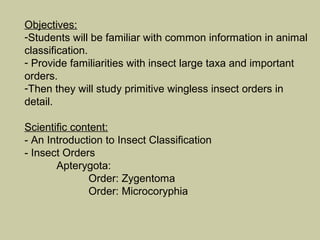
Objectives:
-Students will be familiar with common information in animal
classification.
- Provide familiarities with insect large taxa and important
orders.
-Then they will study primitive wingless insect orders in
detail.

Scientific content:
- An Introduction to Insect Classification
- Insect Orders
       Apterygota:
              Order: Zygentoma
              Order: Microcoryphia
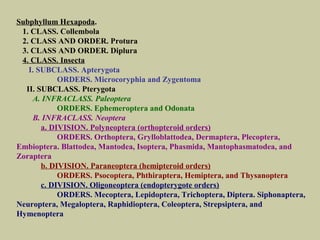
Subphyllum Hexapoda.
 1. CLASS. Collembola
 2. CLASS AND ORDER. Protura
 3. CLASS AND ORDER. Diplura
 4. CLASS. Insecta
   I. SUBCLASS. Apterygota
            ORDERS. Microcoryphia and Zygentoma
  II. SUBCLASS. Pterygota
    A. INFRACLASS. Paleoptera
            ORDERS. Ephemeroptera and Odonata
    B. INFRACLASS. Neoptera
       a. DIVISION. Polyneoptera (orthopteroid orders)
            ORDERS. Orthoptera, Grylloblattodea, Dermaptera, Plecoptera,
Embioptera. Blattodea, Mantodea, Isoptera, Phasmida, Mantophasmatodea, and
Zoraptera
       b. DIVISION. Paraneoptera (hemipteroid orders)
            ORDERS. Psocoptera, Phthiraptera, Hemiptera, and Thysanoptera
       c. DIVISION. Oligoneoptera (endopterygote orders)
            ORDERS. Mecoptera, Lepidoptera, Trichoptera, Diptera. Siphonaptera,
Neuroptera, Megaloptera, Raphidioptera, Coleoptera, Strepsiptera, and
Hymenoptera
Order: Zygentoma
         Family: Lepismatidae
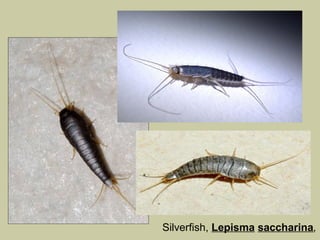
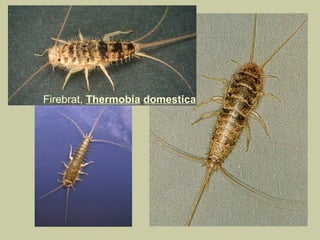
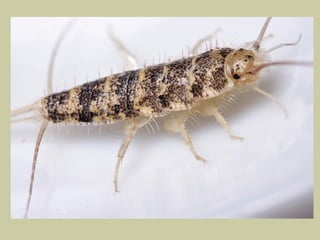
• This family includes the familiar silverfish and
  firebrats
• They are common in both natural and domestic
  habitats.
• Outdoor species occur in caves, under stones and
  debris, and some species are associated with the nests
  of ants.
• The domestic species occupy a variety of habitats,
  and feed on starchy substances and plant material.
Common silverfish, Lepisma saccharina
• Adults are about 12 mm long.
• They are silver-gray, with a metallic sheen.
• This species is cosmopolitan and a domiciliary pest in
  most regions of the world.
• Development and reproduction indoors require high
  temperatures and humidity.
• Development from larva to adult takes 90-120 days at
  27 â—¦C.
• They damage paper products
• Paper with high cellulose content is preferred.
• Cotton and silk fabrics are also attacked.t
Firebrat, Thermobia domestica
• Adults are about 14 mm long.
• They are silver-gray.
• Firebrats prefer indoor locations with temperatures
  above 32 â—¦C; optimum development occurs between 37
  and 39 â—¦C.
• Firebrats are pests in commercial locations that maintain
  high temperatures.
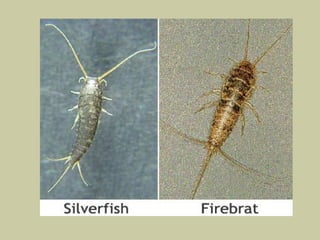
Silverfish, Lepisma saccharina,
Firebrat, Thermobia domestica
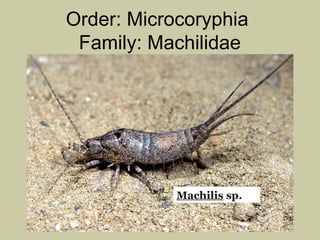
Order: Microcoryphia
 Family: Machilidae


            Machilis sp.
References:
•David, B. V. and Ananthakrishnan, T. N. (2004). General and Applied
Entomology. 2nd ed. Tata McGraw-hill Publishing Co. Ltd. New Delhi.
India. 1184 p.
•Elzinga, Richard J. (1997). Fundamentals of Entomology. 4th ed.
New Jersey, Prentice-Hall, Inc. 475 pp.
•Gillot, Cedric. (2005). Entomology. 3rd ed. Springer, Dordrecht. The
Netherlands. 831 pp.
•Grzimek’s Animal Life Encyclopedia, 2nd edition. Volume 3, Insects,
edited by Michael Hutchins, Arthur V. Evans, Rosser W. Garrison,
•Resh, Vincent H. & Cardé, Ring T. (2003). Encyclopedia of Insects.
USA. Academic Press, Elsevier Science, 1266 pp.

Insect classification lab14

  • 1.
    University of Sulaimania Schoolof Science Department of Biology 2nd Class Year 14th Lab. An Introduction to Insect Classification Apterygota: Orders Zygentoma and Microcoryphia Lecturer: Farhad A. Khudhur
  • 2.
    Objectives: -Students will befamiliar with common information in animal classification. - Provide familiarities with insect large taxa and important orders. -Then they will study primitive wingless insect orders in detail. Scientific content: - An Introduction to Insect Classification - Insect Orders Apterygota: Order: Zygentoma Order: Microcoryphia
  • 3.
    Subphyllum Hexapoda. 1.CLASS. Collembola 2. CLASS AND ORDER. Protura 3. CLASS AND ORDER. Diplura 4. CLASS. Insecta I. SUBCLASS. Apterygota ORDERS. Microcoryphia and Zygentoma II. SUBCLASS. Pterygota A. INFRACLASS. Paleoptera ORDERS. Ephemeroptera and Odonata B. INFRACLASS. Neoptera a. DIVISION. Polyneoptera (orthopteroid orders) ORDERS. Orthoptera, Grylloblattodea, Dermaptera, Plecoptera, Embioptera. Blattodea, Mantodea, Isoptera, Phasmida, Mantophasmatodea, and Zoraptera b. DIVISION. Paraneoptera (hemipteroid orders) ORDERS. Psocoptera, Phthiraptera, Hemiptera, and Thysanoptera c. DIVISION. Oligoneoptera (endopterygote orders) ORDERS. Mecoptera, Lepidoptera, Trichoptera, Diptera. Siphonaptera, Neuroptera, Megaloptera, Raphidioptera, Coleoptera, Strepsiptera, and Hymenoptera
  • 4.
    Order: Zygentoma Family: Lepismatidae • This family includes the familiar silverfish and firebrats • They are common in both natural and domestic habitats. • Outdoor species occur in caves, under stones and debris, and some species are associated with the nests of ants. • The domestic species occupy a variety of habitats, and feed on starchy substances and plant material.
  • 5.
    Common silverfish, Lepismasaccharina • Adults are about 12 mm long. • They are silver-gray, with a metallic sheen. • This species is cosmopolitan and a domiciliary pest in most regions of the world. • Development and reproduction indoors require high temperatures and humidity. • Development from larva to adult takes 90-120 days at 27 ◦C. • They damage paper products • Paper with high cellulose content is preferred. • Cotton and silk fabrics are also attacked.t
  • 6.
    Firebrat, Thermobia domestica •Adults are about 14 mm long. • They are silver-gray. • Firebrats prefer indoor locations with temperatures above 32 ◦C; optimum development occurs between 37 and 39 ◦C. • Firebrats are pests in commercial locations that maintain high temperatures.
  • 8.
  • 9.
  • 11.
    Order: Microcoryphia Family:Machilidae Machilis sp.
  • 12.
    References: •David, B. V.and Ananthakrishnan, T. N. (2004). General and Applied Entomology. 2nd ed. Tata McGraw-hill Publishing Co. Ltd. New Delhi. India. 1184 p. •Elzinga, Richard J. (1997). Fundamentals of Entomology. 4th ed. New Jersey, Prentice-Hall, Inc. 475 pp. •Gillot, Cedric. (2005). Entomology. 3rd ed. Springer, Dordrecht. The Netherlands. 831 pp. •Grzimek’s Animal Life Encyclopedia, 2nd edition. Volume 3, Insects, edited by Michael Hutchins, Arthur V. Evans, Rosser W. Garrison, •Resh, Vincent H. & Cardé, Ring T. (2003). Encyclopedia of Insects. USA. Academic Press, Elsevier Science, 1266 pp.