Next Generation Sequencing
Illumina Sequencing
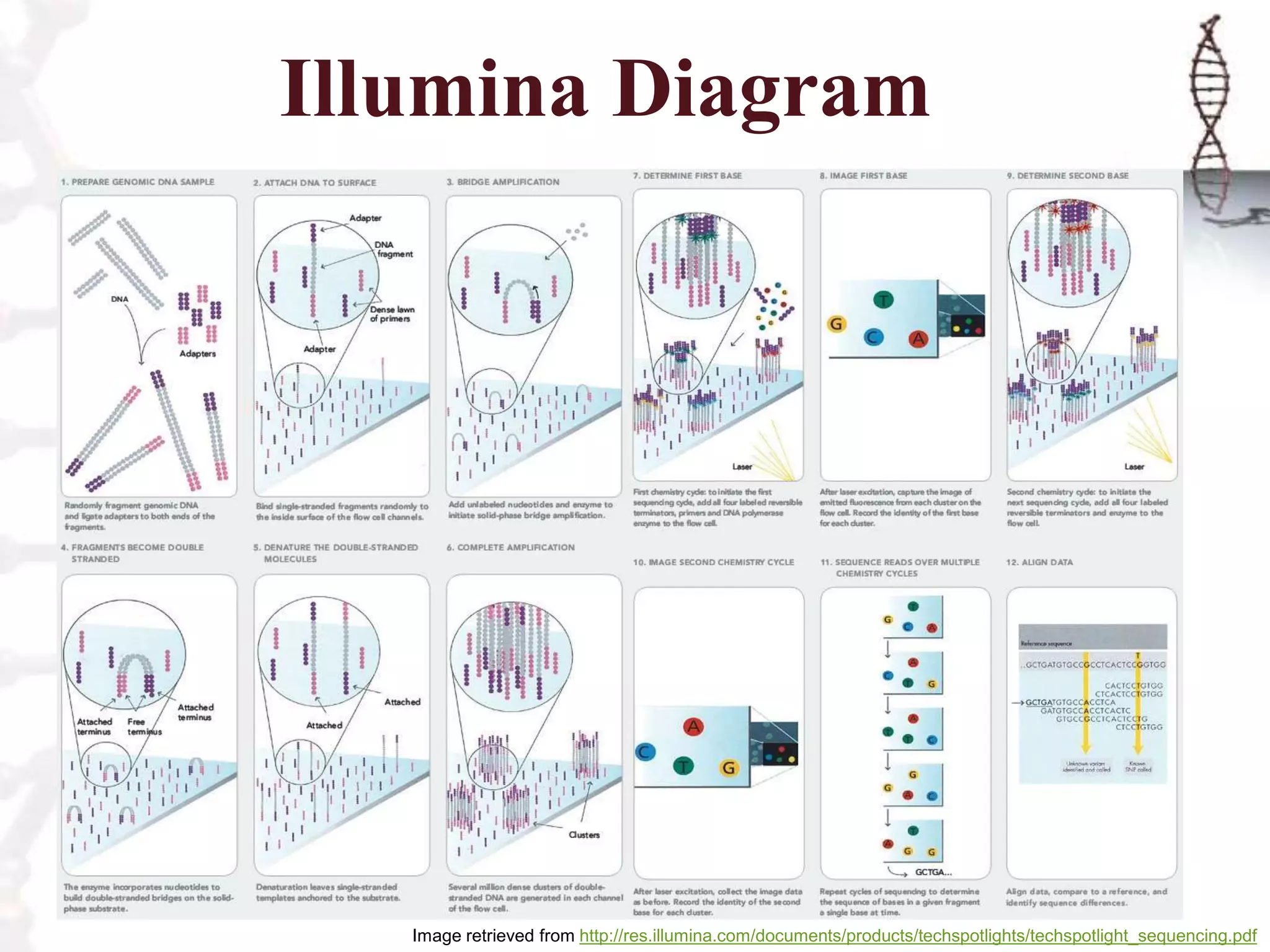
Illumina Diagram
Image retrieved from http://res.illumina.com/documents/products/techspotlights/techspotlight_sequencing.pdf
Prepare Genomic DNA
Sample
• Fragment DNA of interest into
smaller strands that are able to
be sequenced
• Sonication
• Nebulization
• Enzyme digestion
• Ligate Adapters
• Denature dsDNA into ssDNA
by heating to 95° C
Image retrieved from
http://res.illumina.com/documents/products/techsp
otlights/techspotlight_sequencing.pdf
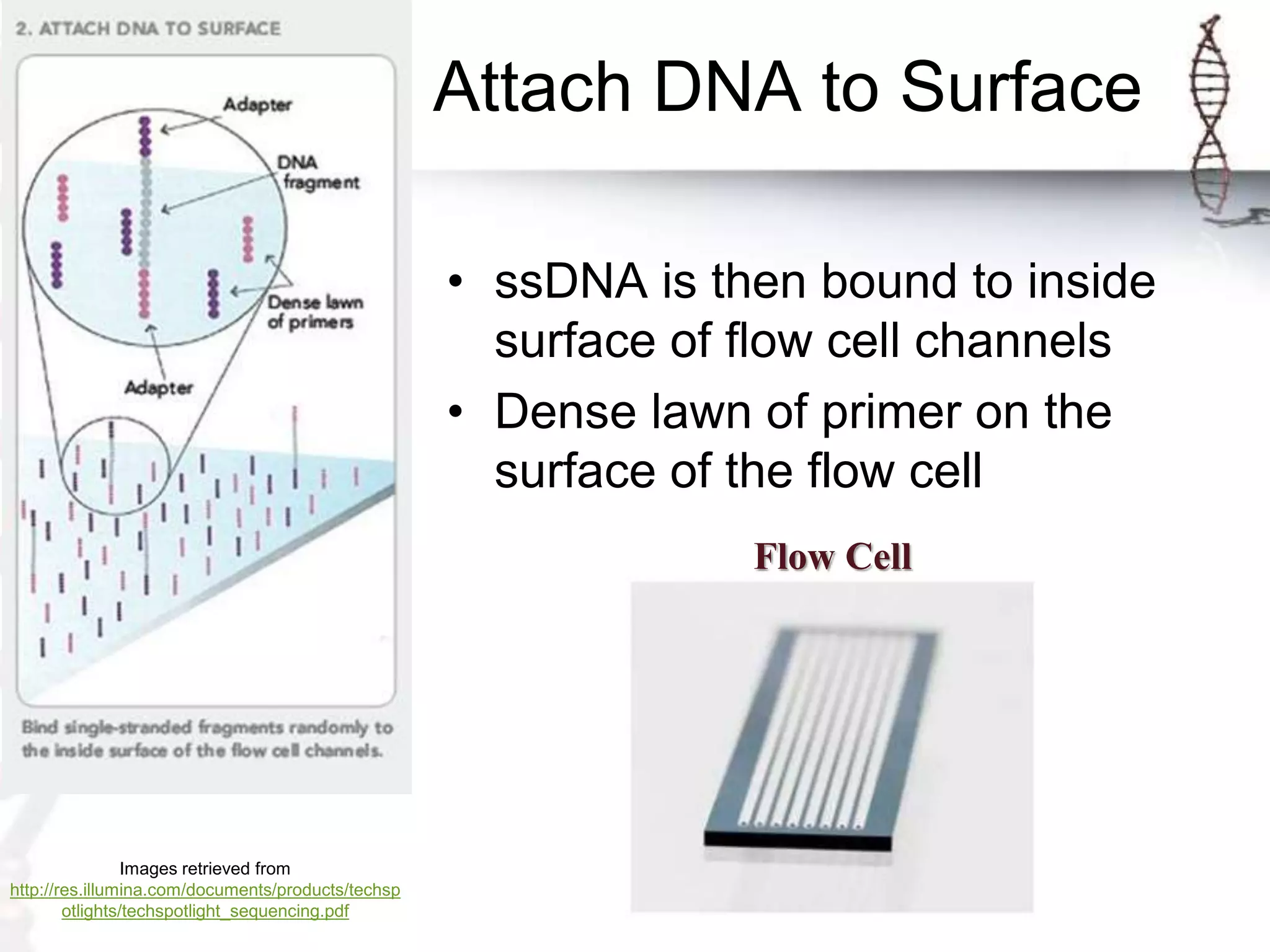
Attach DNA to Surface
• ssDNA is then bound to inside
surface of flow cell channels
• Dense lawn of primer on the
surface of the flow cell
Images retrieved from
http://res.illumina.com/documents/products/techsp
otlights/techspotlight_sequencing.pdf
Flow Cell
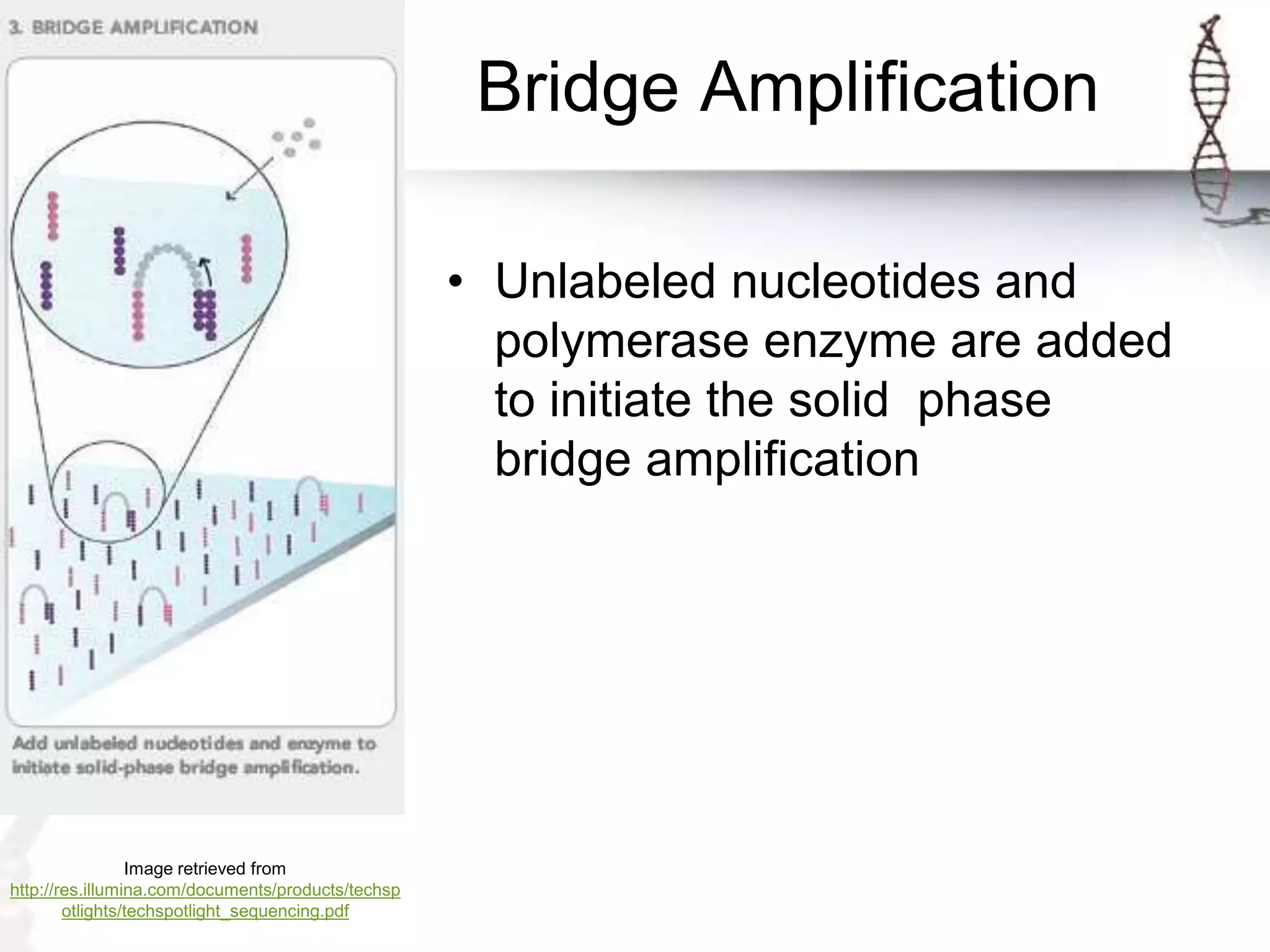
Bridge Amplification
• Unlabeled nucleotides and
polymerase enzyme are added
to initiate the solid phase
bridge amplification
Image retrieved from
http://res.illumina.com/documents/products/techsp
otlights/techspotlight_sequencing.pdf
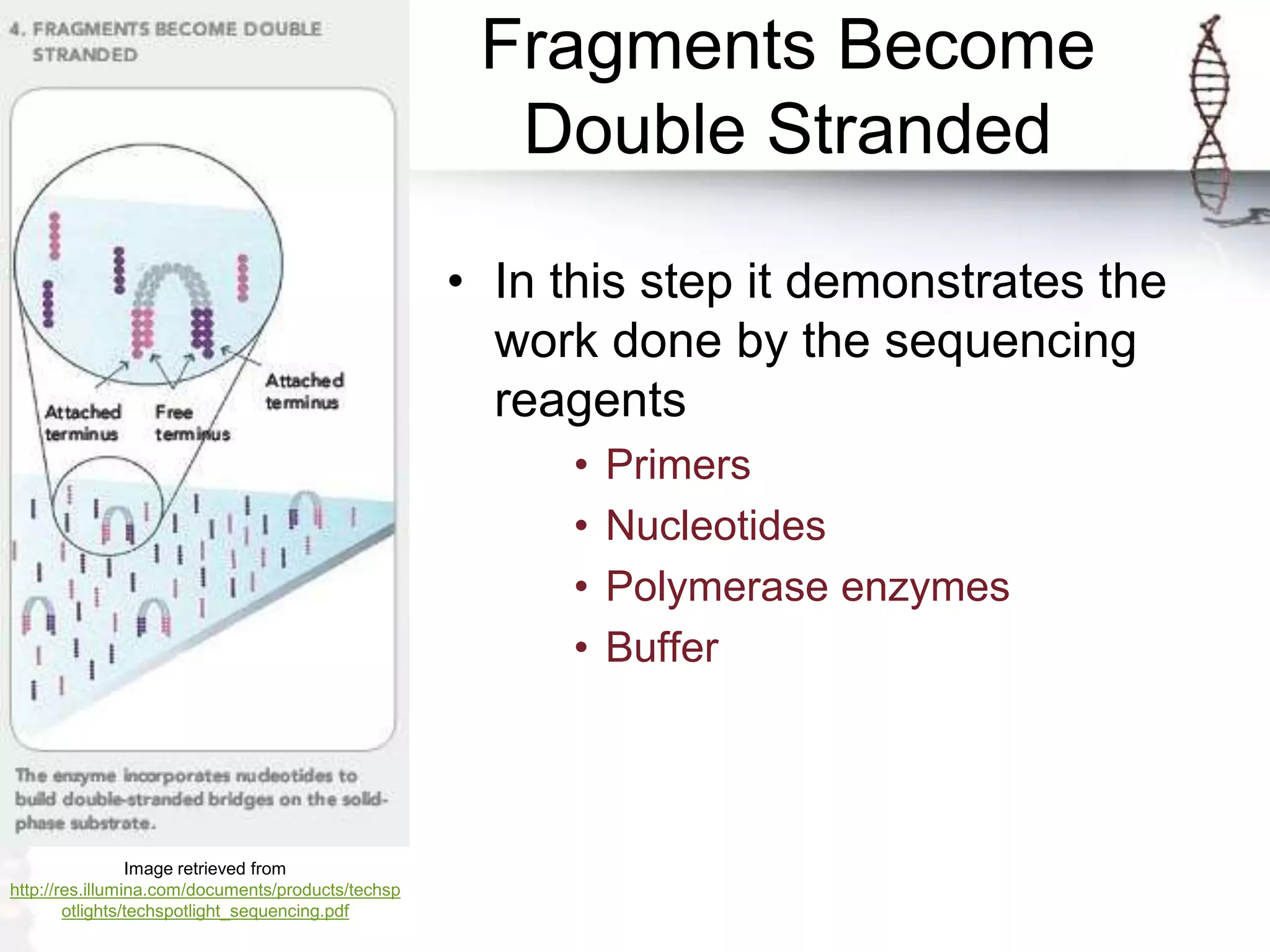
Fragments Become
Double Stranded
• In this step it demonstrates the
work done by the sequencing
reagents
• Primers
• Nucleotides
• Polymerase enzymes
• Buffer
Image retrieved from
http://res.illumina.com/documents/products/techsp
otlights/techspotlight_sequencing.pdf
Denature the Double
Stranded Molecules
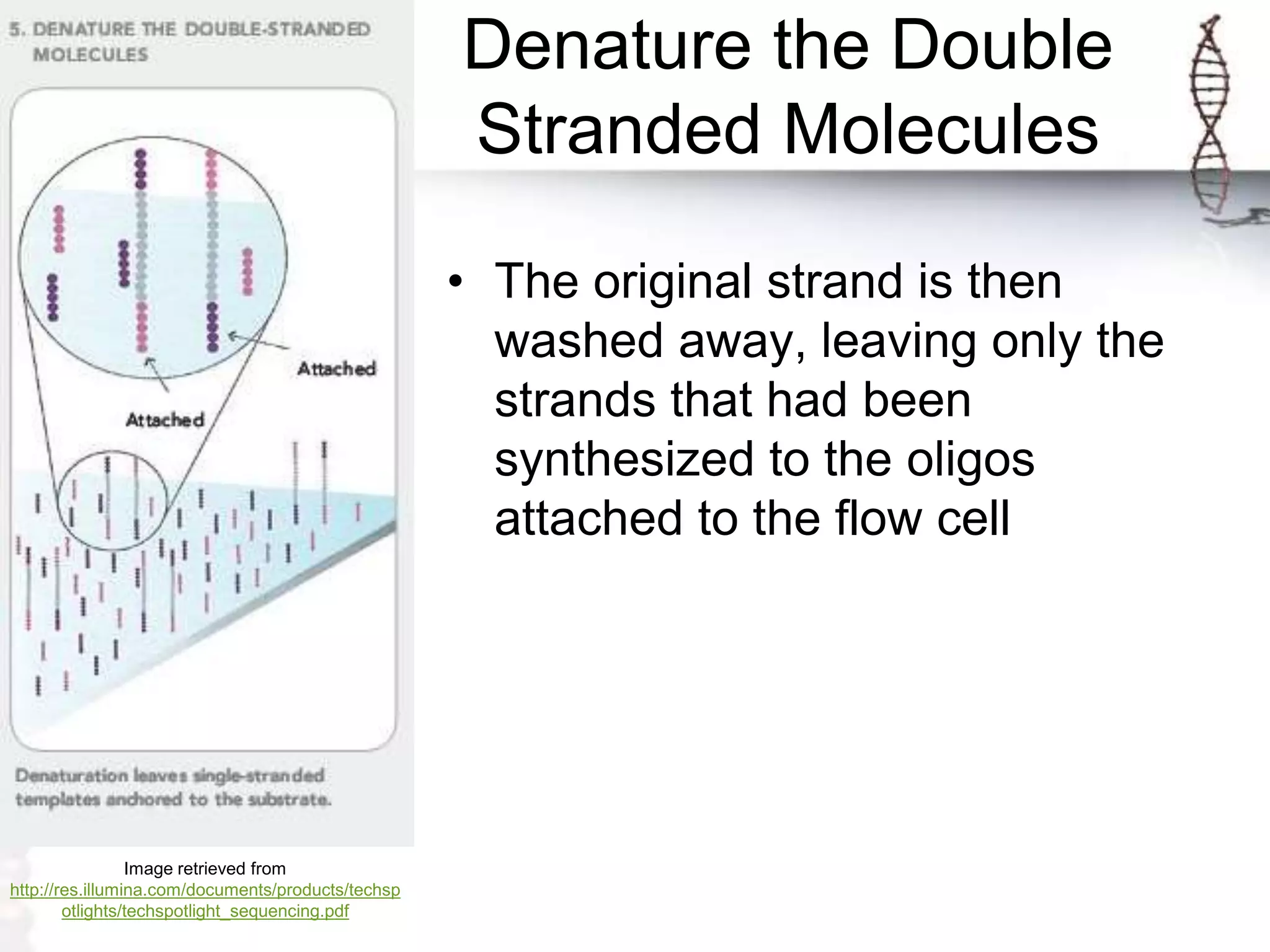
• The original strand is then
washed away, leaving only the
strands that had been
synthesized to the oligos
attached to the flow cell
Image retrieved from
http://res.illumina.com/documents/products/techsp
otlights/techspotlight_sequencing.pdf
Steps 5-7 Repeats
• Cycle of new strand synthesis
and Denaturation to make
multiple copies of the same
sequence (amplification)
• Fragments Become Double Stranded
• Denature the Double Strand
Molecules
Image retrieved from
http://res.illumina.com/documents/products/techsp
otlights/techspotlight_sequencing.pdf
Determine First Base
• The P5 region is cleaved
• Add sequencing reagents
• Primers
• Polymerase
• Fluorescently labeled nucleotides
• Buffer
• First base incorporated
Image retrieved from
http://res.illumina.com/documents/products/techsp
otlights/techspotlight_sequencing.pdf
Image First Base
• Remove unincorporated bases
• Detect Signal
• Deblock and remove the
fluorescent signal  new cycle
Image retrieved from
http://res.illumina.com/documents/products/techsp
otlights/techspotlight_sequencing.pdf
Image retrieved from http://research.stowers-
institute.org/microscopy/external/PowerpointPresentations/ppt/Methods_Technology/
KSH_Tech&Methods_012808Final.pdf
Determine Second
Base
• Add sequencing reagents
• Primers
• Polymerase
• Fluorescently labeled nucleotides
• Buffer
• Second base incorporated
Image retrieved from
http://res.illumina.com/documents/products/techsp
otlights/techspotlight_sequencing.pdf
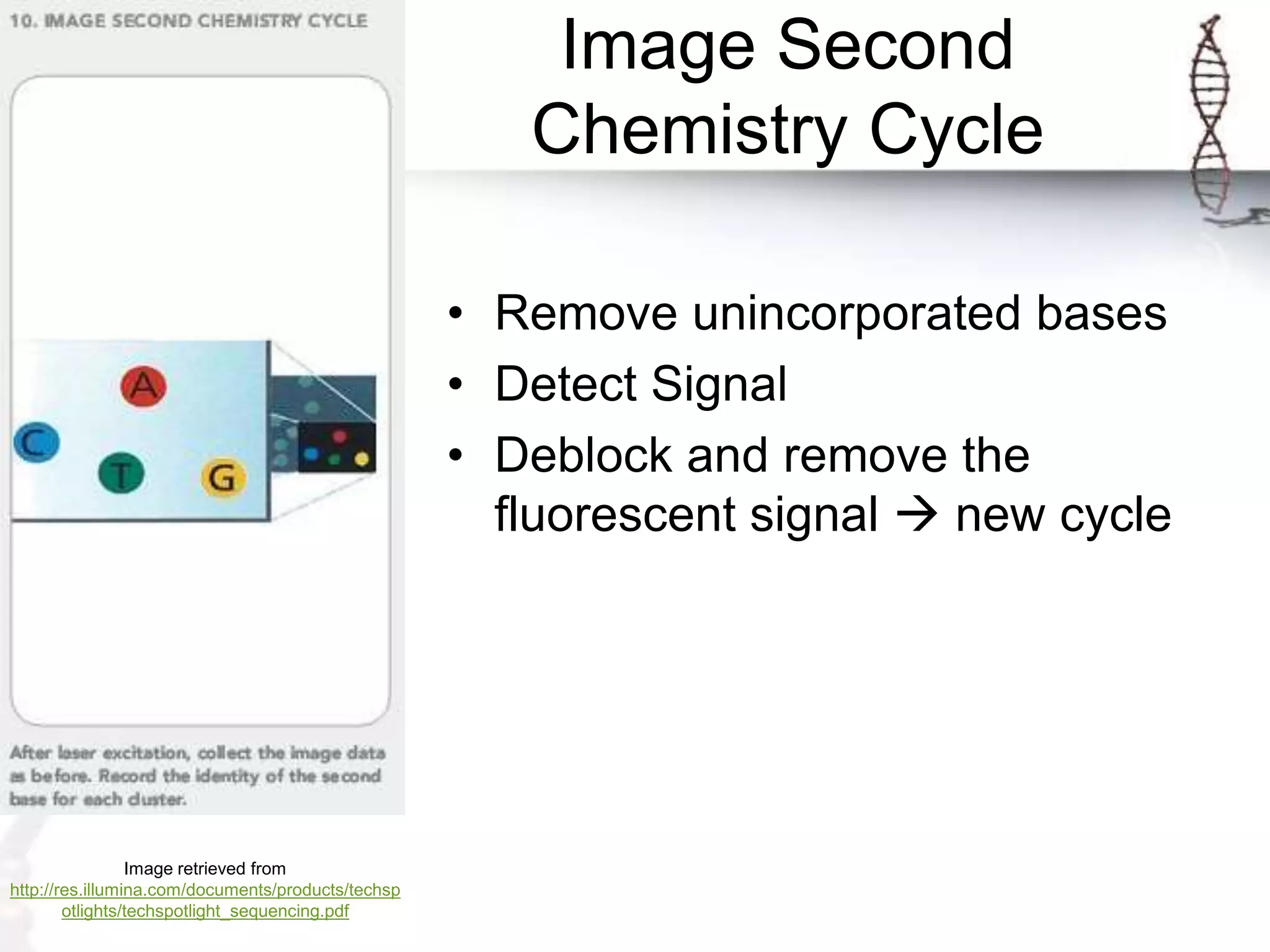
Image Second
Chemistry Cycle
• Remove unincorporated bases
• Detect Signal
• Deblock and remove the
fluorescent signal  new cycle
Image retrieved from
http://res.illumina.com/documents/products/techsp
otlights/techspotlight_sequencing.pdf
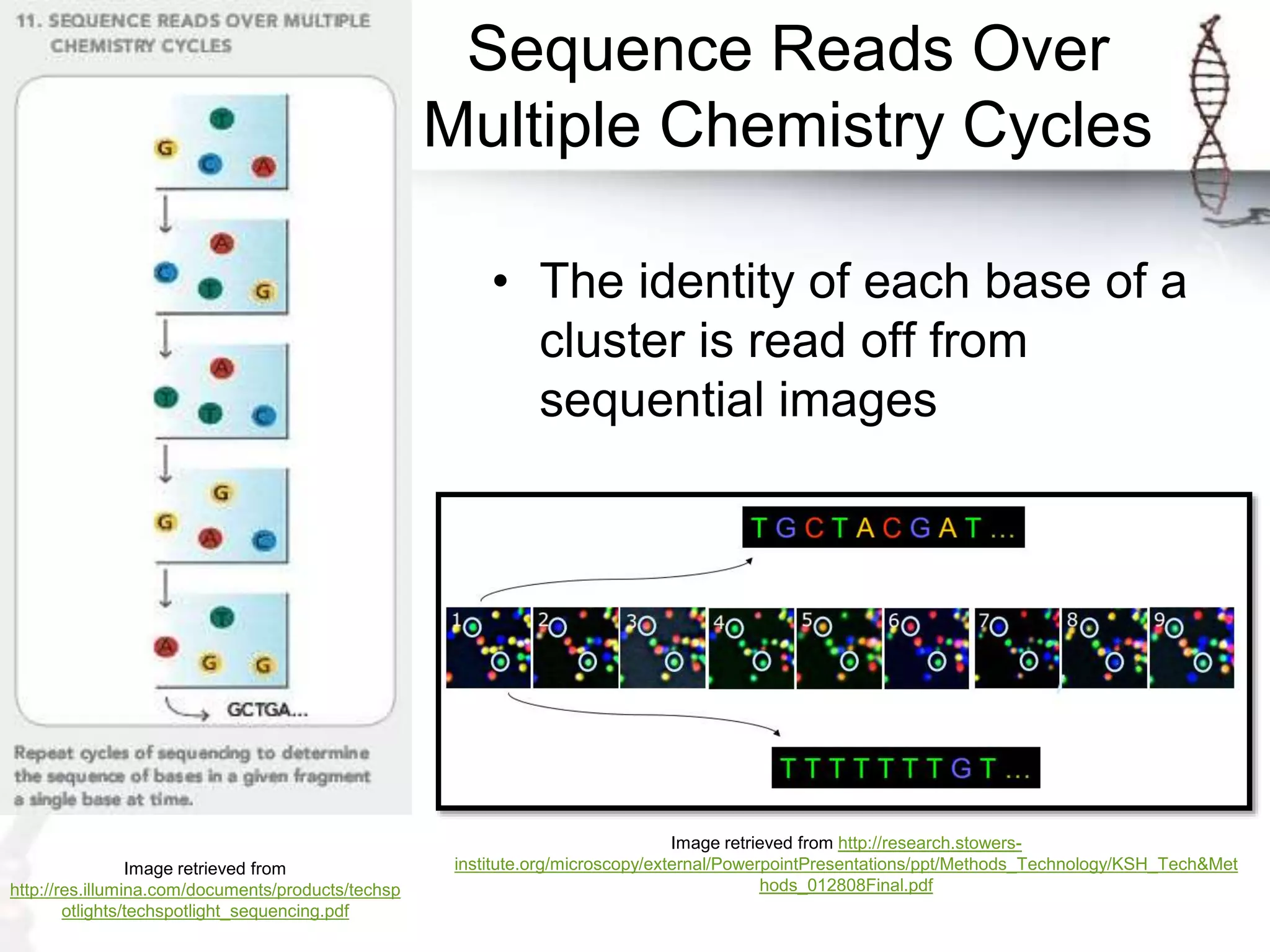
Sequence Reads Over
Multiple Chemistry Cycles
• The identity of each base of a
cluster is read off from
sequential images
Image retrieved from
http://res.illumina.com/documents/products/techsp
otlights/techspotlight_sequencing.pdf
Image retrieved from http://research.stowers-
institute.org/microscopy/external/PowerpointPresentations/ppt/Methods_Technology/KSH_Tech&Met
hods_012808Final.pdf
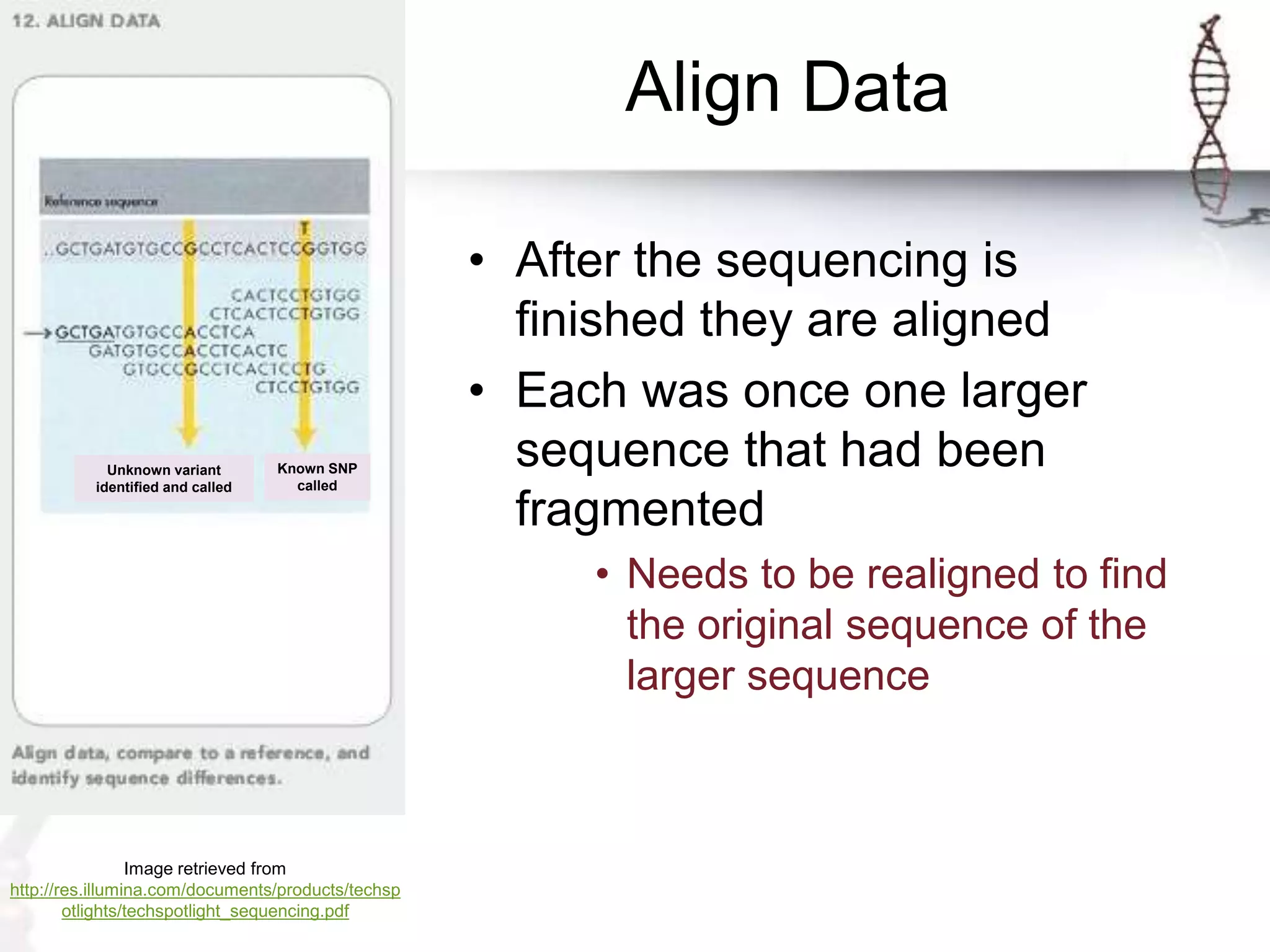
Align Data
• After the sequencing is
finished they are aligned
• Each was once one larger
sequence that had been
fragmented
• Needs to be realigned to find
the original sequence of the
larger sequence
Image retrieved from
http://res.illumina.com/documents/products/techsp
otlights/techspotlight_sequencing.pdf
Unknown variant
identified and called
Known SNP
called
Work Cited
• Illumina Sequencing Technology. (2010). In Techonlogy Spotlight: Illumina Sequencing.
Retreived July 30, 2014, from
http://res.illumina.com/documents/products/techspotlights/techspotlight_sequencing.pdf
• Illumina Solexa Sequencing. (Jan 22, 2010). On YouTube uploaded by Draven1983101.
Retrieved July 30, 2014, from https://www.youtube.com/watch?v=77r5p8IBwJk
• Overview of Illumina Chemistry. In Massachusetts General Hospital. Retreived July 30,
2014, from http://nextgen.mgh.harvard.edu/IlluminaChemistry.html
• Introduction to Next Generation Sequencing Using the Illumina 1G Genome Analyzer
(Solexa). (Jan 31, 2008). Retrieved July 30, 2014, from http://research.stowers-
institute.org/microscopy/external/PowerpointPresentations/ppt/Methods_Technology/KSH_
Tech&Methods_012808Final.pdf
• Sequencing technology – Past, Present and Future. (2013). Wei Chen. Berlin Institute for
Medical Systems Biology. Max-Delbrueck-Center for Molecular Medicine Retrieved July 30,
2014, from http://www.molgen.mpg.de/899148/OWS2013_NGS.pdf
• DNA barcoding. (2014, July 30). In Wikipedia, The Free Encyclopedia. Retrieved July 30,
2014, from http://en.wikipedia.org/w/index.php?title=DNA_barcoding&oldid=619163634
• Reference genome. (2014, June 22). In Wikipedia, The Free Encyclopedia. Retrieved
19:54, August 4, 2014, from
http://en.wikipedia.org/w/index.php?title=Reference_genome&oldid=613984719
Next Generation Sequencing
Helicos – True Single Molecule Sequencing (tSMS)

Illumina Sequencing

  • 1.
  • 2.
    Illumina Diagram Image retrievedfrom http://res.illumina.com/documents/products/techspotlights/techspotlight_sequencing.pdf
  • 3.
    Prepare Genomic DNA Sample •Fragment DNA of interest into smaller strands that are able to be sequenced • Sonication • Nebulization • Enzyme digestion • Ligate Adapters • Denature dsDNA into ssDNA by heating to 95° C Image retrieved from http://res.illumina.com/documents/products/techsp otlights/techspotlight_sequencing.pdf
  • 4.
    Attach DNA toSurface • ssDNA is then bound to inside surface of flow cell channels • Dense lawn of primer on the surface of the flow cell Images retrieved from http://res.illumina.com/documents/products/techsp otlights/techspotlight_sequencing.pdf Flow Cell
  • 5.
    Bridge Amplification • Unlabelednucleotides and polymerase enzyme are added to initiate the solid phase bridge amplification Image retrieved from http://res.illumina.com/documents/products/techsp otlights/techspotlight_sequencing.pdf
  • 6.
    Fragments Become Double Stranded •In this step it demonstrates the work done by the sequencing reagents • Primers • Nucleotides • Polymerase enzymes • Buffer Image retrieved from http://res.illumina.com/documents/products/techsp otlights/techspotlight_sequencing.pdf
  • 7.
    Denature the Double StrandedMolecules • The original strand is then washed away, leaving only the strands that had been synthesized to the oligos attached to the flow cell Image retrieved from http://res.illumina.com/documents/products/techsp otlights/techspotlight_sequencing.pdf
  • 8.
    Steps 5-7 Repeats •Cycle of new strand synthesis and Denaturation to make multiple copies of the same sequence (amplification) • Fragments Become Double Stranded • Denature the Double Strand Molecules Image retrieved from http://res.illumina.com/documents/products/techsp otlights/techspotlight_sequencing.pdf
  • 9.
    Determine First Base •The P5 region is cleaved • Add sequencing reagents • Primers • Polymerase • Fluorescently labeled nucleotides • Buffer • First base incorporated Image retrieved from http://res.illumina.com/documents/products/techsp otlights/techspotlight_sequencing.pdf
  • 10.
    Image First Base •Remove unincorporated bases • Detect Signal • Deblock and remove the fluorescent signal  new cycle Image retrieved from http://res.illumina.com/documents/products/techsp otlights/techspotlight_sequencing.pdf Image retrieved from http://research.stowers- institute.org/microscopy/external/PowerpointPresentations/ppt/Methods_Technology/ KSH_Tech&Methods_012808Final.pdf
  • 11.
    Determine Second Base • Addsequencing reagents • Primers • Polymerase • Fluorescently labeled nucleotides • Buffer • Second base incorporated Image retrieved from http://res.illumina.com/documents/products/techsp otlights/techspotlight_sequencing.pdf
  • 12.
    Image Second Chemistry Cycle •Remove unincorporated bases • Detect Signal • Deblock and remove the fluorescent signal  new cycle Image retrieved from http://res.illumina.com/documents/products/techsp otlights/techspotlight_sequencing.pdf
  • 13.
    Sequence Reads Over MultipleChemistry Cycles • The identity of each base of a cluster is read off from sequential images Image retrieved from http://res.illumina.com/documents/products/techsp otlights/techspotlight_sequencing.pdf Image retrieved from http://research.stowers- institute.org/microscopy/external/PowerpointPresentations/ppt/Methods_Technology/KSH_Tech&Met hods_012808Final.pdf
  • 14.
    Align Data • Afterthe sequencing is finished they are aligned • Each was once one larger sequence that had been fragmented • Needs to be realigned to find the original sequence of the larger sequence Image retrieved from http://res.illumina.com/documents/products/techsp otlights/techspotlight_sequencing.pdf Unknown variant identified and called Known SNP called
  • 15.
    Work Cited • IlluminaSequencing Technology. (2010). In Techonlogy Spotlight: Illumina Sequencing. Retreived July 30, 2014, from http://res.illumina.com/documents/products/techspotlights/techspotlight_sequencing.pdf • Illumina Solexa Sequencing. (Jan 22, 2010). On YouTube uploaded by Draven1983101. Retrieved July 30, 2014, from https://www.youtube.com/watch?v=77r5p8IBwJk • Overview of Illumina Chemistry. In Massachusetts General Hospital. Retreived July 30, 2014, from http://nextgen.mgh.harvard.edu/IlluminaChemistry.html • Introduction to Next Generation Sequencing Using the Illumina 1G Genome Analyzer (Solexa). (Jan 31, 2008). Retrieved July 30, 2014, from http://research.stowers- institute.org/microscopy/external/PowerpointPresentations/ppt/Methods_Technology/KSH_ Tech&Methods_012808Final.pdf • Sequencing technology – Past, Present and Future. (2013). Wei Chen. Berlin Institute for Medical Systems Biology. Max-Delbrueck-Center for Molecular Medicine Retrieved July 30, 2014, from http://www.molgen.mpg.de/899148/OWS2013_NGS.pdf • DNA barcoding. (2014, July 30). In Wikipedia, The Free Encyclopedia. Retrieved July 30, 2014, from http://en.wikipedia.org/w/index.php?title=DNA_barcoding&oldid=619163634 • Reference genome. (2014, June 22). In Wikipedia, The Free Encyclopedia. Retrieved 19:54, August 4, 2014, from http://en.wikipedia.org/w/index.php?title=Reference_genome&oldid=613984719
  • 16.
    Next Generation Sequencing Helicos– True Single Molecule Sequencing (tSMS)

Editor's Notes

  • #2 This video will be going over how Illumina Sequencing, a type of Next Generational Sequencing, works.
  • #3 This is the diagram produced by Illumina that will be used at a guide for this video
  • #4 These basic first steps are found in all sequencing methods because a strand cannot be sequenced if it is to large or if it is double stranded already. Therefore the DNA is fragmented into between 300 and 800 bps long and denatured at 95° C. If a large piece of DNA, such as when sequencing a genome, the fragments of the DNA are aligned by bioinformatics tools after the sequencing. This is discussed further in other videos on Nest Generational Sequencing. Adapters are needed to be ligated on the ends of the fragments in order to get the sequence to anneal to where the DNA sequence can be determined by the sequencing machine.
  • #5 In bridge amplification the adapter constructs added to the DNA sequence of interest have flow cell binding sites, P5 and P7, which allow the P5 and P7 regions of the single-stranded library fragments to anneal to their complimentary oligos on the flow cell surface. This means if one of the DNA fragments P5 anneals to the flow cell, it will anneal by attaching to a P7 oligos that is attached to the flow cell, and vise versa. Several samples can be loaded one the 8 lane flow cell for simultaneous analysis.
  • #6 In this step the sequence makes a kind of bridge shape when it is being copied. Unlabeled nucleotides and polymerase enzyme are added to initiate the solid phase bridge amplification
  • #7 The reagents needed to sequence are added such as primers to start the sequencing, nucleotides to form the new sequence, polymerase to actually sequence the nucleotides together, and buffer to keep the pH at an optimal level for the enzymatic reaction. The flow cell oligos act as primers and a strand complimentary to the library fragment is synthesized.
  • #8 The original strand is washed away, leaving behind fragment copies that are covalently bonded to the flow cell surface in a mixture of orientations.
  • #9 The steps 5 through 7 of the addition of the sequencing reagents, creation of double stranded DNA, and the denaturation are repeated multiple times to create thousands of identical copies of the same sequence in each cluster. In other words each cluster is made of up thousands of the identical sequence and each cluster is a different fragment of the original larger sequence of interest.
  • #10 The P5 region is cleaved, resulting in clusters containing only fragments which are attached by the P7 region. This ensures that all copies are sequenced in the same direction. The sequencing primer anneals to the P5 end of the fragment, and begins the sequencing by synthesis process. The reagents needed to sequence are added such as primers to start the sequencing, fluorescently labeled nucleotides to form and detect the base added to each cluster, polymerase to actually add the nucleotides to the forming strand, and buffer to keep the pH at an optimal level for the enzymatic reaction.
  • #11 Each nucleotide base, Adenine, Thymine, Guanidine, and Cytosine , have a unique fluorescent color attached to them. These nucleotides where also modified so that there is a molecule on the 3 prime end of the sugar; this means that the polymerase can only add one nucleotide to each of the newly forming sequence and is blocked from adding more. The unincorporated bases, which are the bases that were not attached by a polymerase to one of newly forming sequences in the clusters, are washed away. Then the machine can clearly detect the fluorescent signals that are left and record the base that was added to each of the clusters. After that the block on the newly added base’s 3 prime part of the sugar is removed so that another base will be able to added to it by polymerase. The fluorescent is also removed so that only the new base’s fluorescent is detected in the new cycle.
  • #12 Once again the sequencing reagents are added and another fluorescently labeled nucleotide is added.
  • #13 Again the image is detected by first washing away the unincorporated bases. Then the flow cell is prepared for the next cycle by removing the fluorescent and deblocking the newly added base so that polymerase can add another base to it.
  • #14 This image helps to demonstrate the sequence of images the machine processes for the sequencing data.
  • #15 Remember that the various sequences that are being read by the machine are all from the same larger sequence of interest. Only shorter strands of DNA can be sequenced, therefore they had to be fragmented. After the reads have been collected by the sequencing machine it then needs to be aligned to find the sequence of that larger sequence of interest. Bioinformatics tools are used to do this using a reference sequence. A reference sequence is a digital nucleic acid sequence database, assembled by scientists as a representative example of a species' set of genes. Using this variations in the new sequence can be found. SNPs are also call by the alignment tools as well. SNPs stands for Single Nucleotide Polymorphism are DNA sequence variation occurring commonly within a population in which a Single Nucleotide — A, T, C or G — in the genome differs between members of a biological species or paired chromosomes.
  • #17 In the next video we will be covering Helicos – True Single Molecule Sequencing (tSMS)