Transposone Presented by: Salar Bakhtiyari
They are discrete sequence in the genome that are mobile  they are able to transport themselves to other location. Other names:  Jumping genes  Selfish DNAs Molecular parasites Controlling elements TEs are present in the genome all species of three domains  Transposable Elements
What do we want to know about mobile genetics elements? 1 – The history of mobile genetic elements 2 – The classification of TEs 3 – The structure of TEs 4 – The mechanism of transposition  5 – The effects of TEs on gene and genome 6 – The use of TEs as molecular tools
Why study mobile genetic elements? They are the major forces driving evolution They can cause genome rearrangement (mutation , deletion and insertion ) They have wide range of application potentials
The discovery of mobile genetic elements Transposable elements  Phage Plasmid DNA
The discovery of transposable elements Barbara Mc Clintock discovered TEs in maize (1983) Her work on chromosome breakage began by investigating genetic instability (1983) Observing variegated patterns of pigmentation in maize plant and kernels New kinds of genetic instability She spent the next tree decades for this genetic elements Controlling elements (1956)
Barbara Mc Clintock  1902   1980 ( noble in 1984)
Plasmid , phage Cell to cell conjugation  Bactriophage mediated transduction Bill Hayes ( 1952 ) Ellin Wollman and Francois Jancob , 1961 Alan Campbell
Classification of transposable elements  DNA transposons Retrotransposons
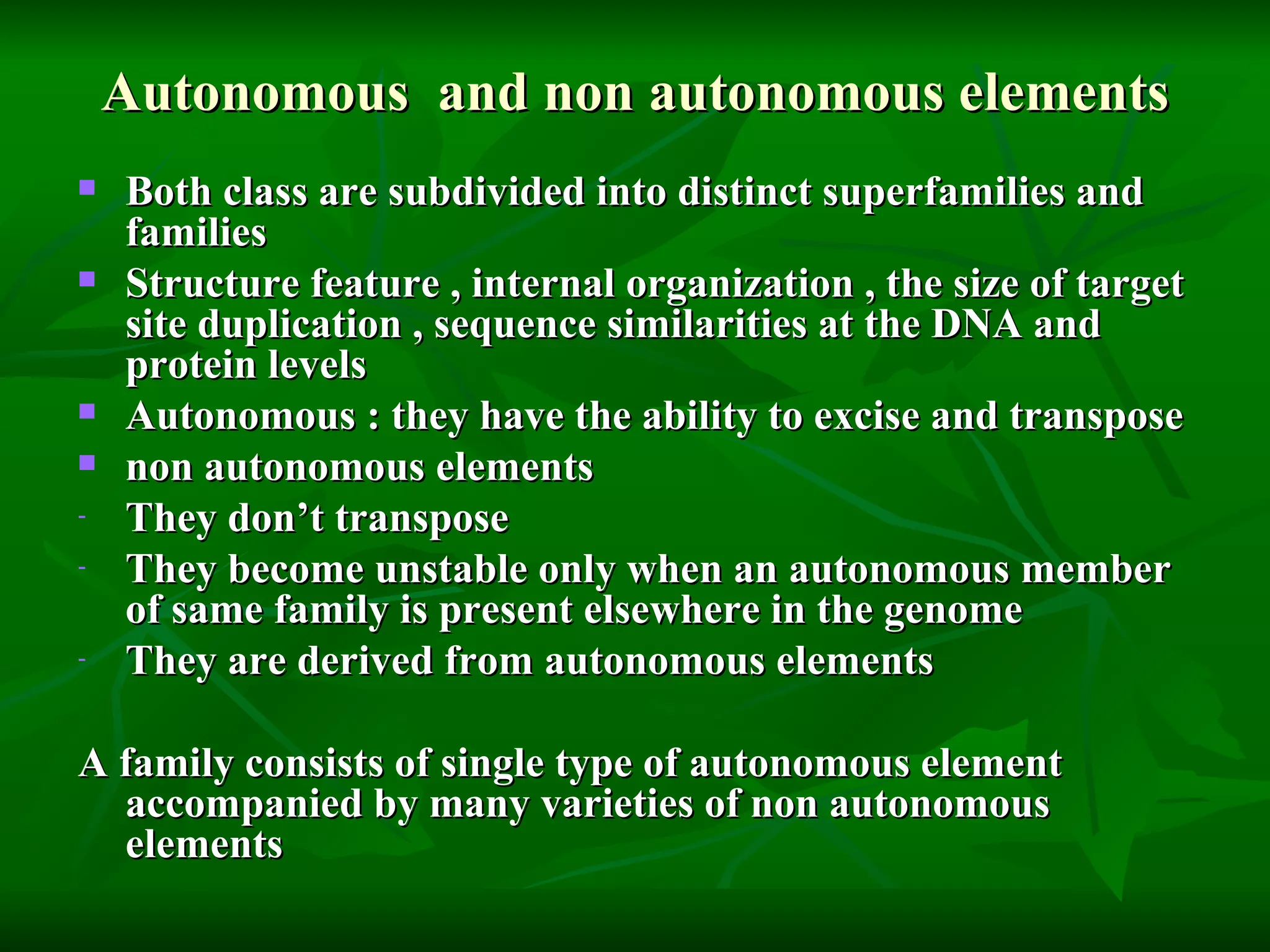
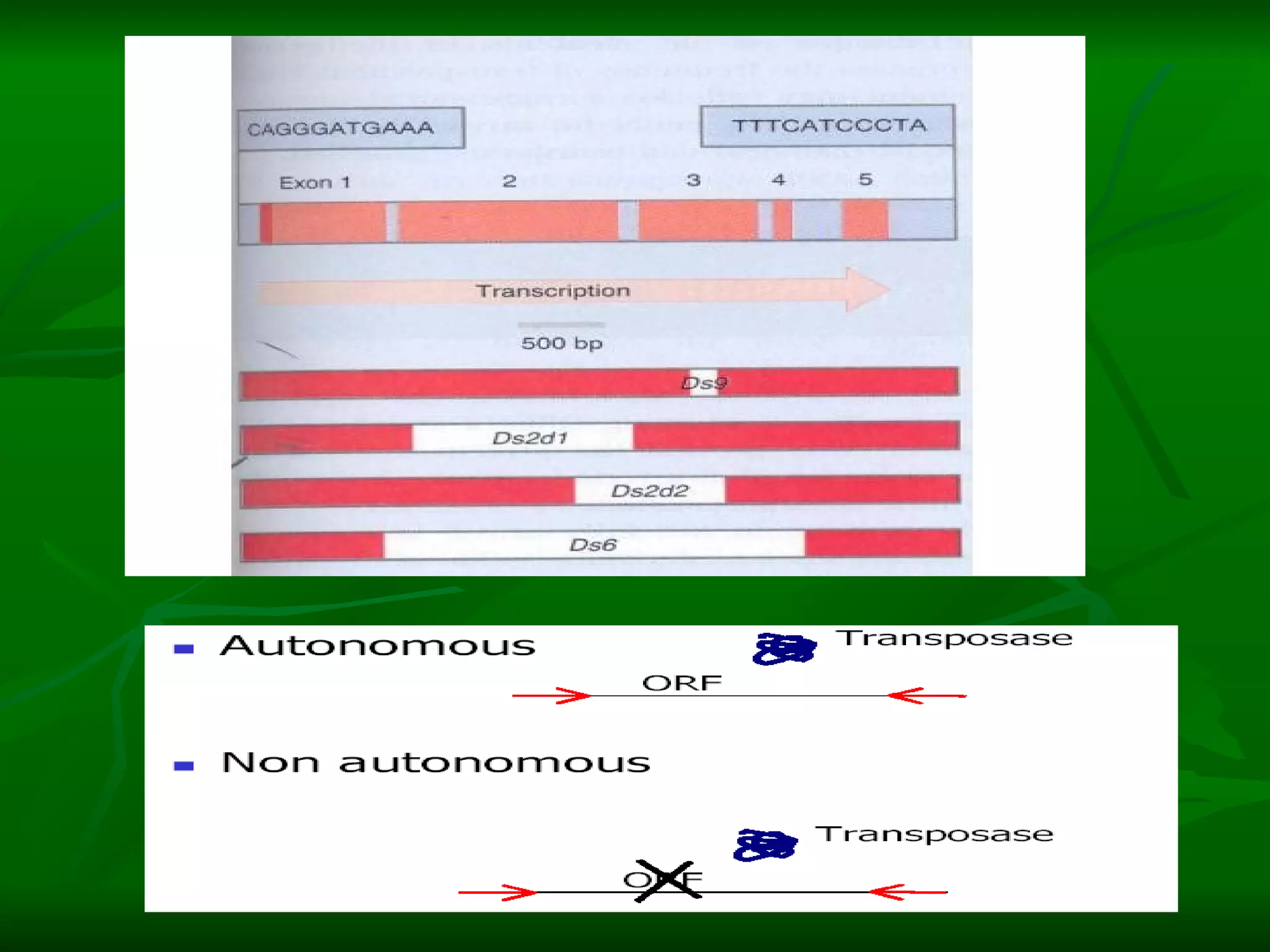
Autonomous  and non autonomous elements Both class are subdivided into distinct superfamilies and families Structure feature , internal organization , the size of target site duplication , sequence similarities at the DNA and protein levels Autonomous : they have the ability to excise and transpose  non autonomous elements  They don’t transpose  They become unstable only when an autonomous member of same family is present elsewhere in the genome They are derived from autonomous elements  A family consists of single type of autonomous element accompanied by many varieties of non autonomous elements
 
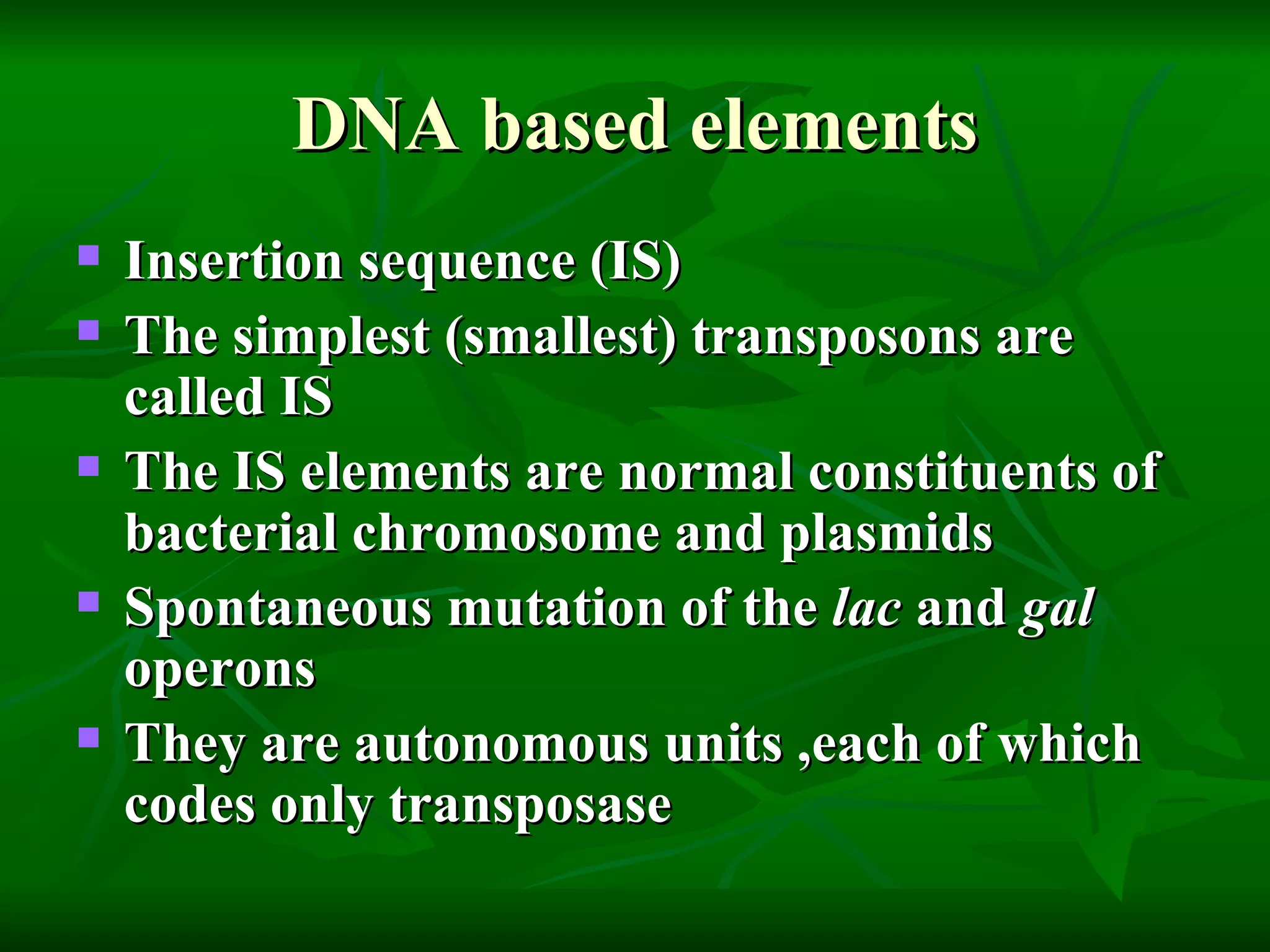
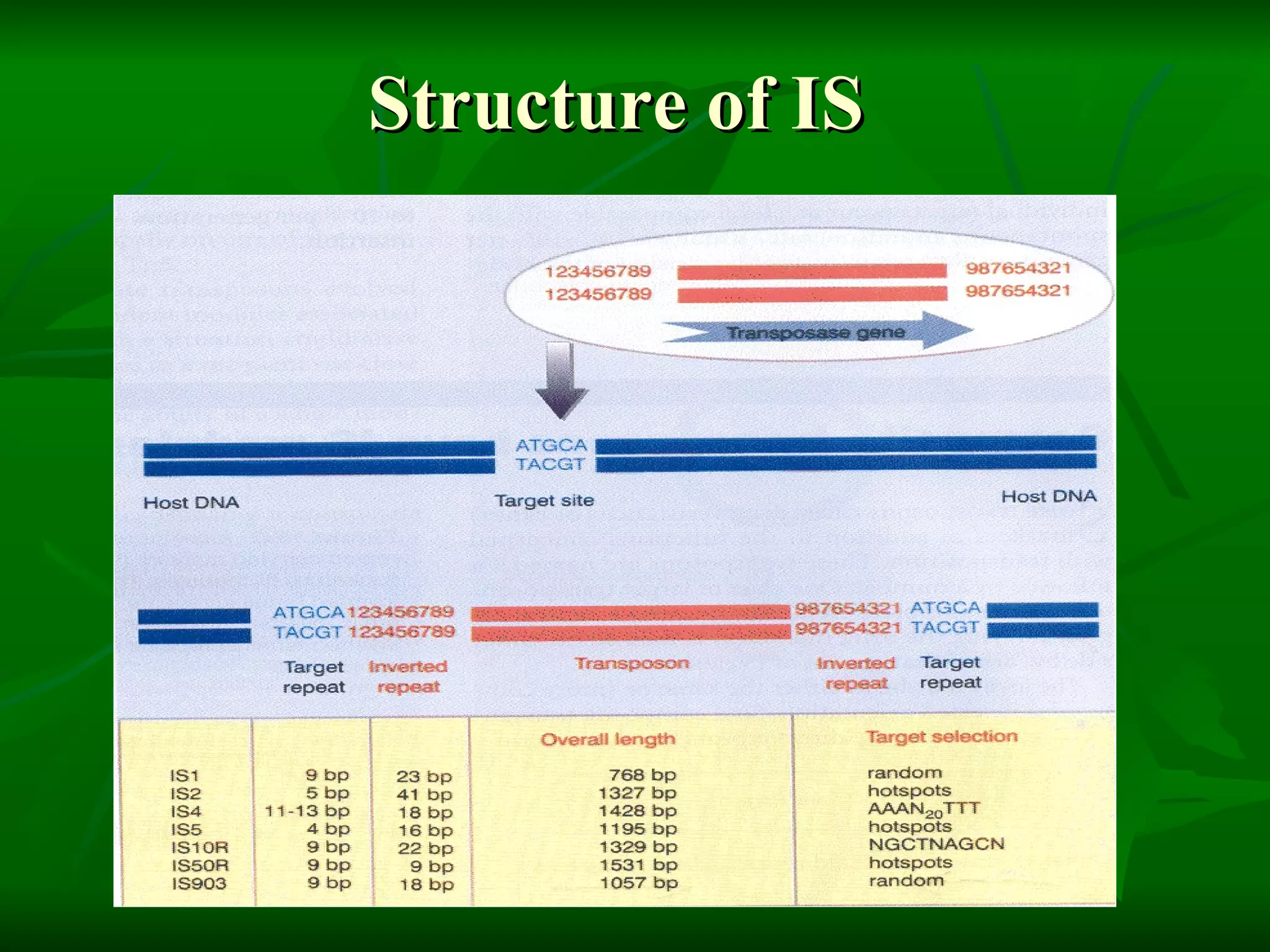
DNA based elements Insertion sequence (IS) The simplest (smallest) transposons are called IS  The IS elements are normal constituents of bacterial chromosome and plasmids Spontaneous mutation of the  lac  and  gal  operons They are autonomous units ,each of which codes only transposase
Structure of IS
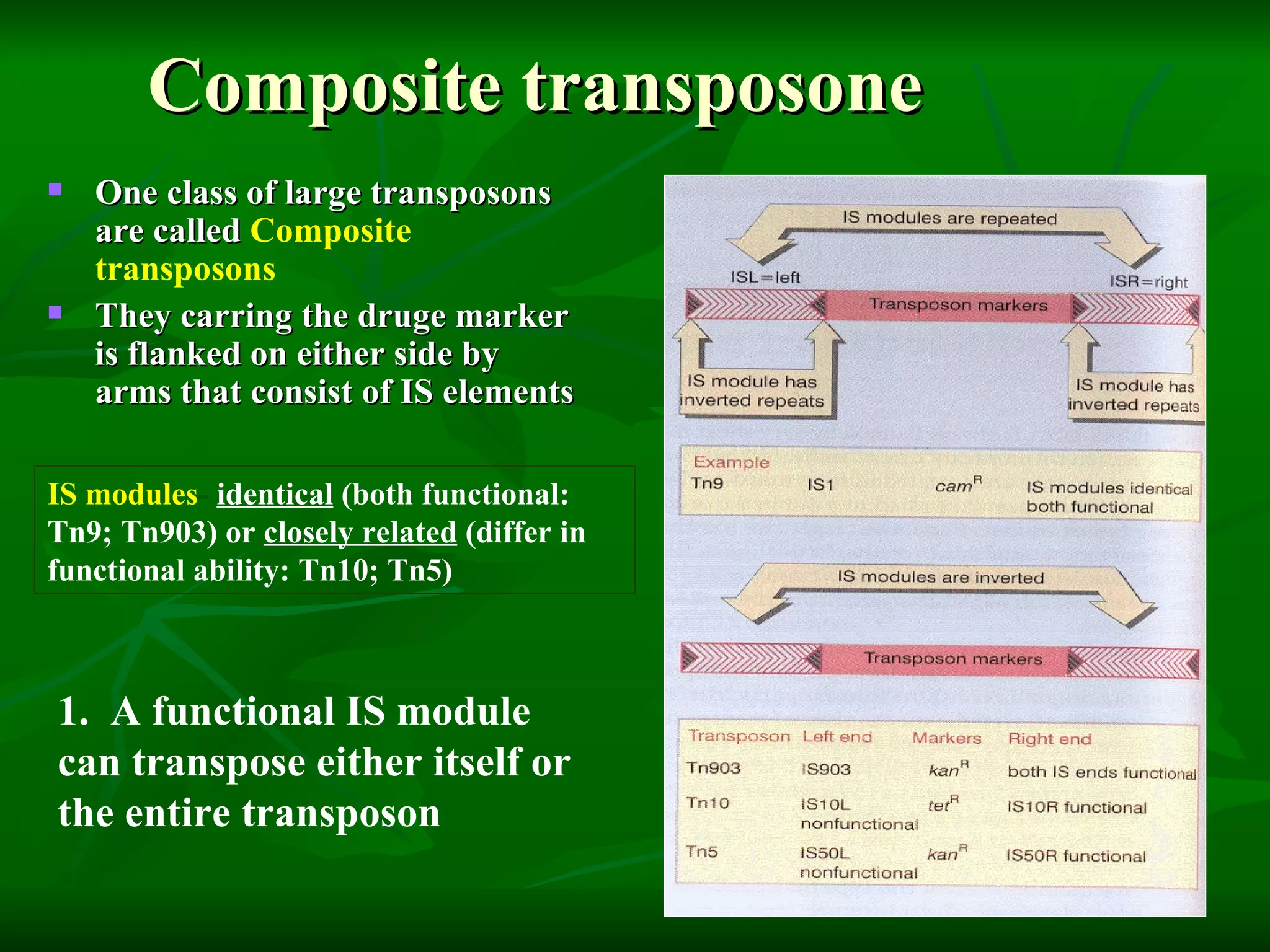
Composite transposone One class of large transposons are called  Composite transposons They carring the druge marker is flanked on either side by arms that consist of IS elements IS modules -  identical  (both functional: Tn9; Tn903) or  closely related  (differ in functional ability: Tn10; Tn5) 1.  A functional IS module can transpose either itself or the entire transposon
Mechanism of transposition The stugger between the cuts determines the length of the direct repeats. The target repeat is characteristic of each transposon; reflects the geometry of the cutting enzyme  Direct repeats   are generated by introduction of staggered cuts whose protruding ends are linked to the transposon .
Mechanism of transposition 1-  Replicative transpositon Replicative  :  Transposon is duplicated ; a copy of the original element is made at a recipient site(TnA); donor keeps original copy Transposition- an increase in the number of Tn copies  ENZs: transposase (acts on the ends of original Tn) and  resolvase  (acts on the duplicated copies)
Mechanism of transposition 2 - Nonreplicative Nonreplicative : Transposon moves from one site to another and is conserved; breaks in donor repaired b)  IS and Tn10 and Tn5 use this mechanism;  no Tn copy increase c)  ENZs: only transposase
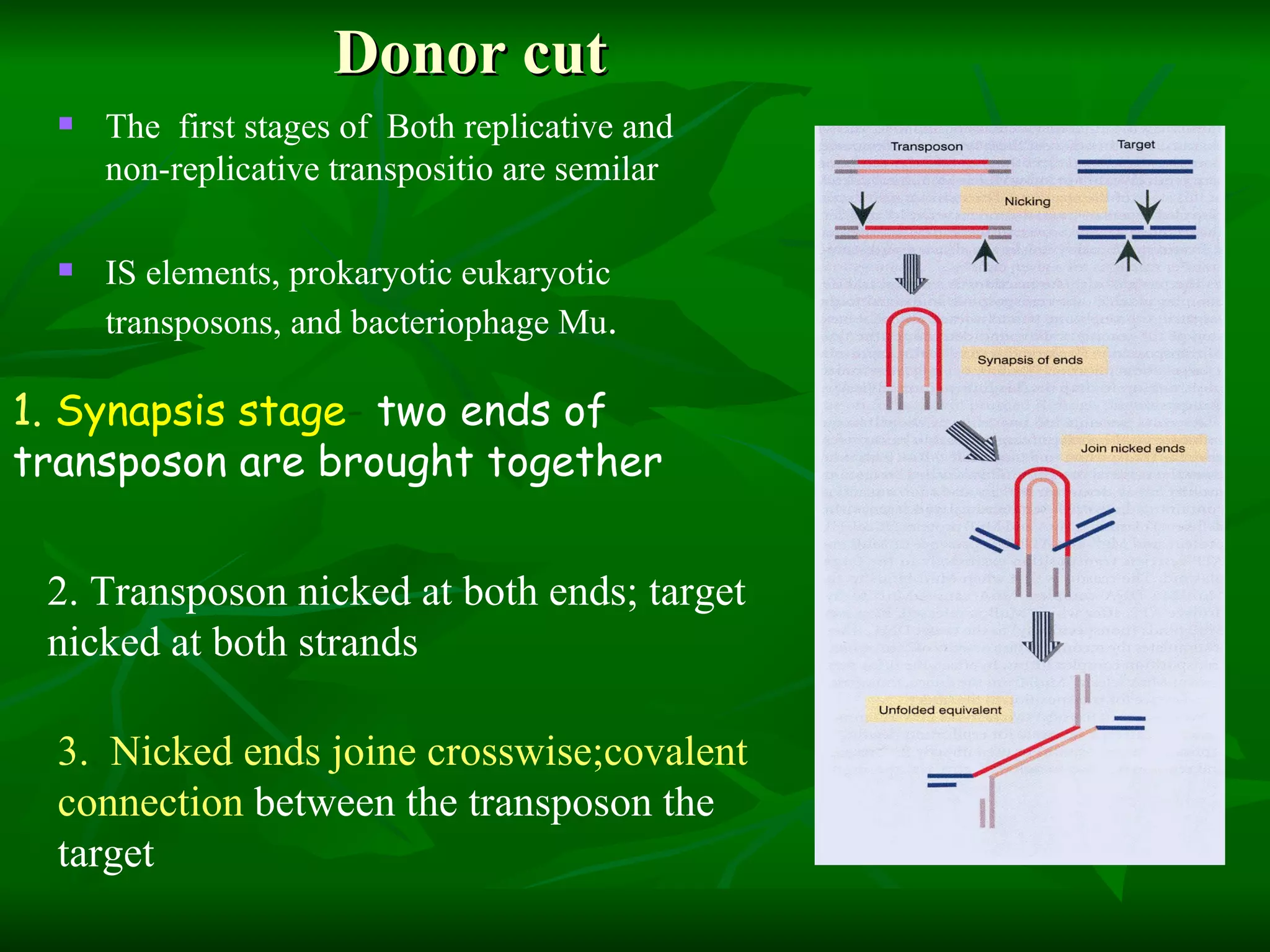
The  first stages of  Both replicative and non-replicative transpositio are semilar  IS elements, prokaryotic eukaryotic transposons, and bacteriophage Mu .   Donor cut 1.   Synapsis stage -  two ends of transposon are brought together   3. .  Nicked ends joine crosswise;covalent connection  between the transposon the target 2. Transposon nicked at both ends; target nicked at both strands
cuts in  trans transfers in  trans 22 bp Mu integrates by nonreplicative transposition; during lytic cycle- number of copies amplified by replicative transposition -  MuA binds to ends as   tetramer   forming a   synapsis . - MuA subunits act in  trans  to   cut   next to   R1   and   L1  (coordinately; two   active sites to manipulate DNA). - MuA acts in  trans  to   cut   the  target site   DNA and mediate   in  trans   strand transfer
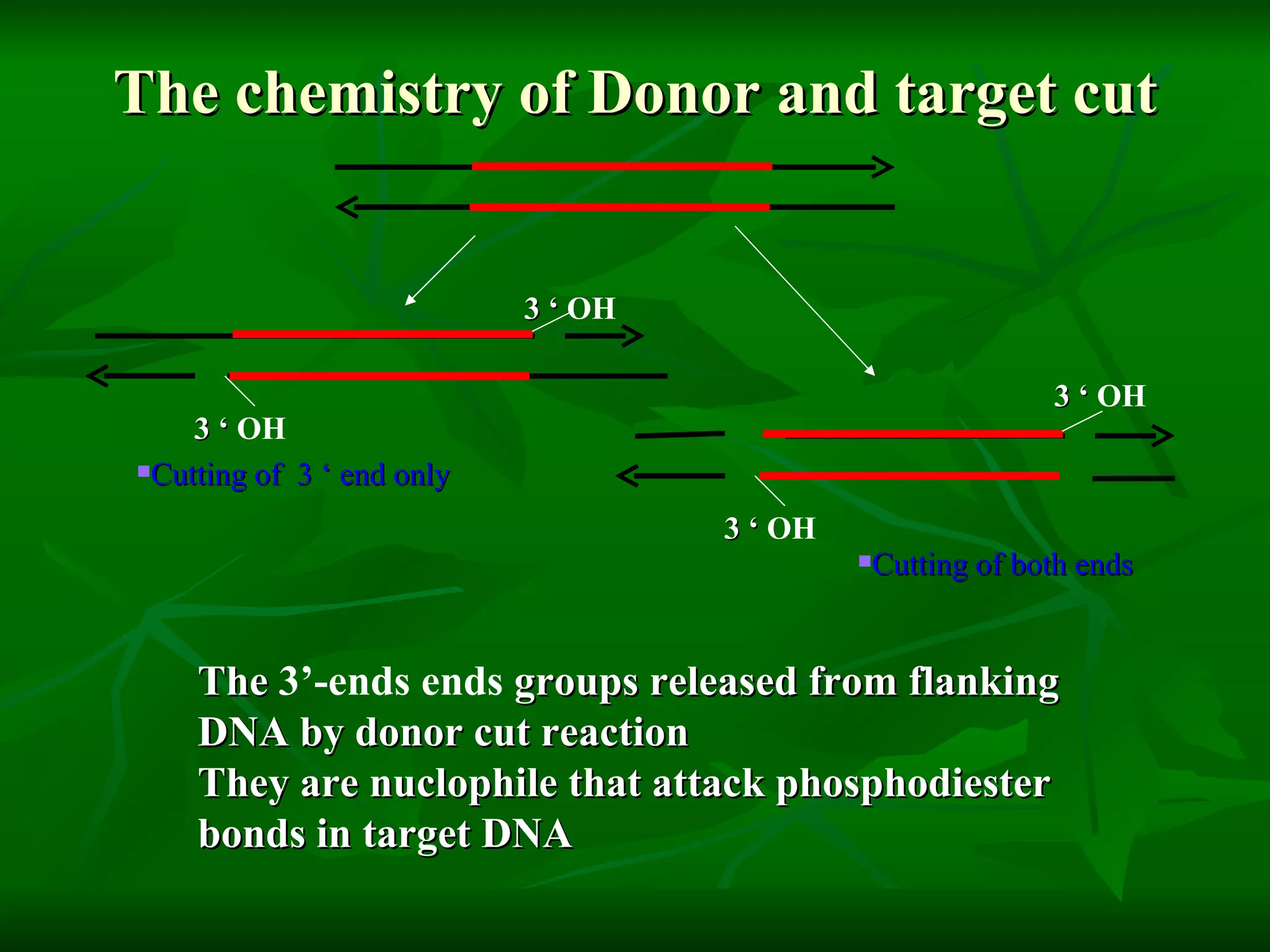
The chemistry of Donor and target cut The  3’-ends   ends  groups released from flanking DNA by donor cut reaction They are nuclophile that attack phosphodiester bonds in target DNA Cutting of both ends 3   ‘  OH 3   ‘  OH 3   ‘  OH 3   ‘  OH Cutting of  3   ‘  end only
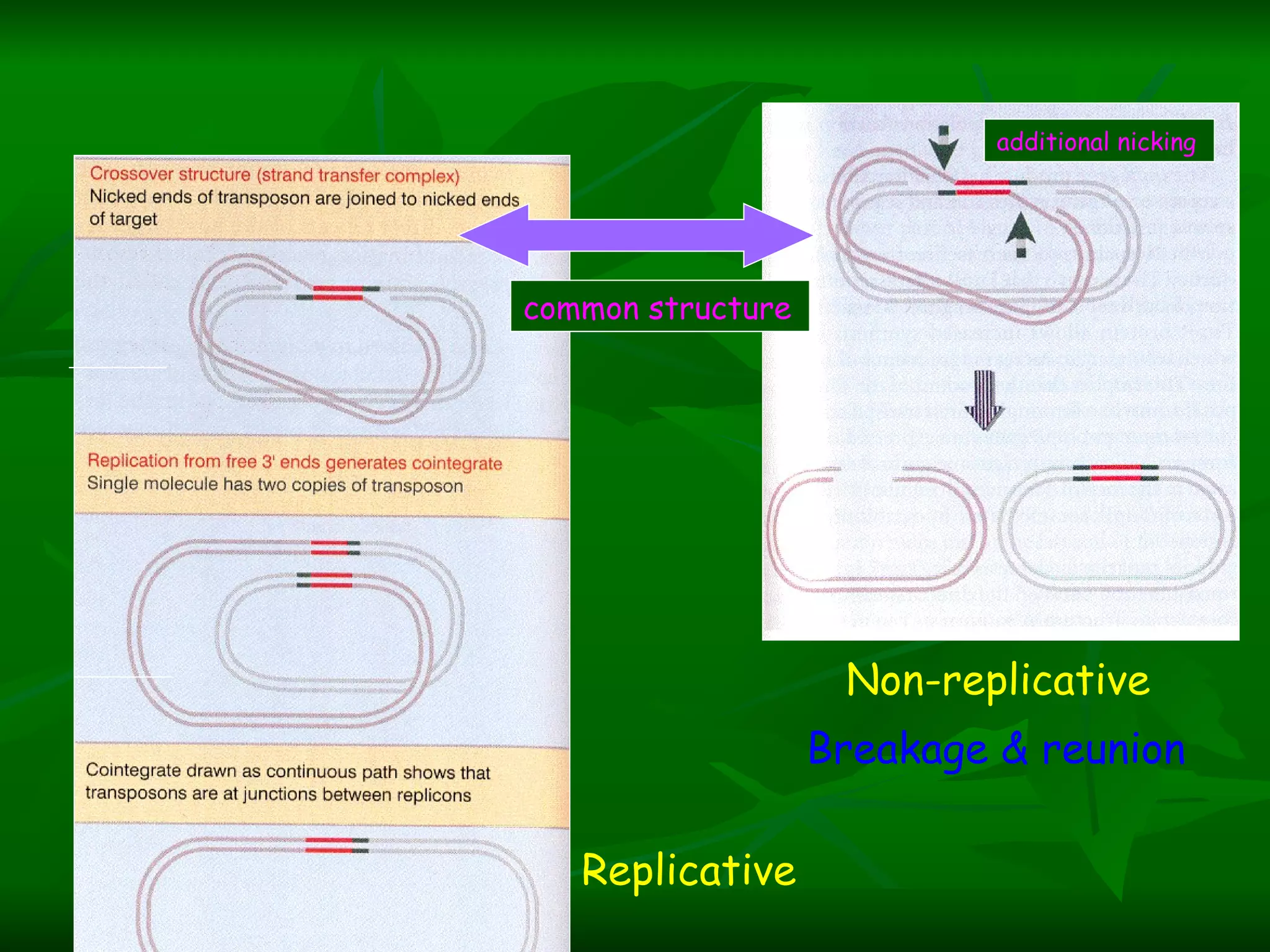
The product of these reaction is strand transfer complex  In  strand transfer complex  transposon is connected to the target site through one strand at each end Next step differs and determines the type of transposition: Strand transfer complex   can be target for   replication   (replicative transposition) or for   repair   (nonreplicative   transposition;  breakage & reunion ) transposon target Strand transfer complex
Molecular mechanism of transposition (I) Replicative transposition   Replicative transposition   proceeds through a   cointegrate . Transposition may fuse a donor and recipient replicon into a cointegrate.  Resolution releases two replicons-each has copy of the transposon
Replicative transposition   Ligation to target ends 3. 3’-ends prime replication The crossover structure contains a single stranded region at each of the staggered ends= pseudoreplication forks that provide template for DNA synthesis Donor and target cut cointegrate .
Non-replicative Replicative additional nicking common structure Breakage & reunion
Retrotransposon ( retroposons ) Use of an RNA Intermediate element is transcribed reverse transcriptase produces a double-stranded DNA copy for insertion at another site they as other elements generating short direct repeat
Types of Retrotransposons 1 – viral superfamily  (autonomousretrotransposon) retrovirus   LTR- retrotransposon  LINES 2 – nonviral  superfamily  (non autonomous retransposons)  SINES  non LTR- retrotransposon
retrovirus RNA reverstranscriptase Liner DNA   Integration  provirus Transcription RNA
LTR - retrotrasposon pol Reverse transcriptase (RT) Integrase (IN) Ribonuclease H (RH) gag env ?
mechanism of transposition Integrase acts on both the retrotransposon line DNA and target DNA The integrase bring the ends of the linear DNA together Generate 2 base recessed  3’   -ends and staggered end in target DNA   3’-ends 5’-ends
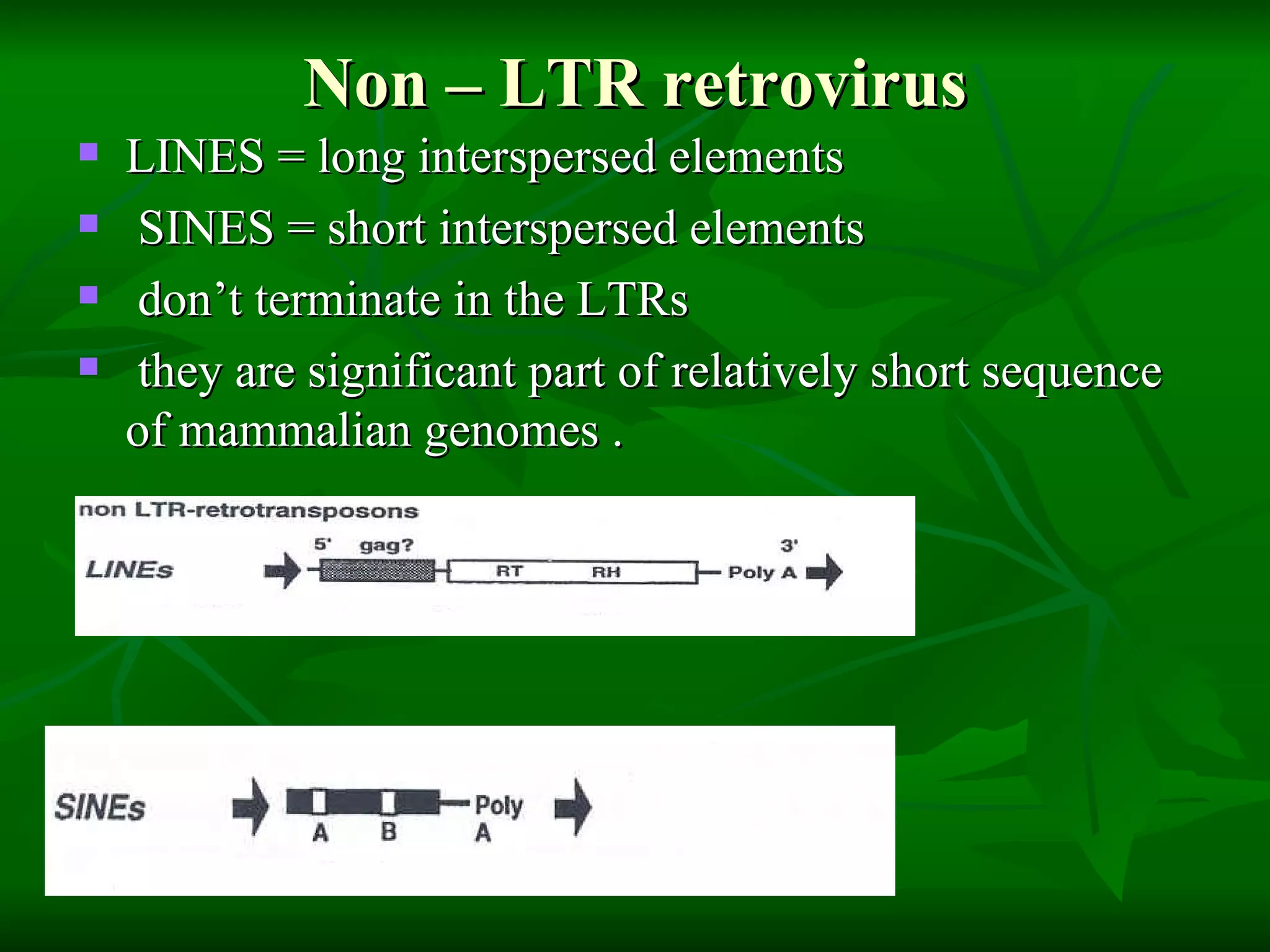
Non – LTR retrovirus LINES = long interspersed elements SINES = short interspersed elements don’t terminate in the LTRs  they are significant part of relatively short sequence of mammalian genomes .
Effect of transposabli elements on gene and genome  TEs cause a varity of change in the genome of their hosts  this ability to induce mutation depend on their of capability of transposing  some arrangement can be beneficial  they can advantageous for adaptation to new environment  play important role in evolution . they have the ability to rearrange genomic information in several ways  1 – Modification of gene expression  2 – Alternation gene sequence  3 – Chromosomal structural changes
Modification of gene expression  insertion of a TE within or adjacent to a gene  the element blocks or alters the pattern of transcription .  i nsertion of   Fot1   in a intron of  niad   ( F . oxysporum  ) different mutant transcripts all were shorter  They result from:  - presence of termination signal  - presence of an alternative promotor
Alternation gene sequence  cut and pate mechanism often produce variation when they excise . the excision process may result in addition of a few base pair ( footprint ) at donor site . these footprint cause diversification of nucleotide sequence and new functional alleles Example : Fot1  and  Impala  generally leave 4 bp – ( 108 ) or 5 – ( 63 ) foot prints excision  of the  Asco - 1  transposon in  A .immersus   Deletions of a a few to up to 1713 nucleotide in  b2  gene   larger deletion led to  variety of phenotypes  in spore coloration
Chromosomal structural changes TEs can produce a series of genome rearrangment through ectopic recombination  deletion , duplication , inversion and translucation mediate by TEs ( Drosophila , Yeast , human ) karyoptypic variation in natural isolate in fungai  high level of chromosome – length polymorphism ( Magnoporthe grisea  ,  F.   oxysporum ) translocation  tox1  of  Cochliobolus heterostrophus appearance of new virulence alleles in  M . grisea
Use as strain specific diagnostic tools TEs are often restricted to specific strains  identify specific pathogen in plant pathology  Fot1  (  F. oxysporum  f sp.   albedians  )  provide PCR targets  a sensitive detection thechnique to prevent the introduction of pathogenic form  -  race of  F. oxysporum   responsible of carnation wilt  - date palm pathogen  Use of TEs as molecular tools
Use of TEs as molecular tools   MGR 586  (  Magneporthe grisea  )  oryza : 30 – 50 wheat and other ( 1 – 2 ) they have used to distinguish genetically divergent population  fingerprinting of isolates pathogenic to oil palm tree. (  F. oxysporum ,  palm ) Tools for the analysis of population structure
Gene tagging with transposable elements   arise  mutant phenotype Disrupt target gene Use of TEs as molecular tools   jumping into coding region   Target gene can easily determined by PCR methods
Thanks for attention

Transposone And Retrotransposone

  • 1.
  • 2.
    Transposone Presented by:Salar Bakhtiyari
  • 3.
    They are discretesequence in the genome that are mobile they are able to transport themselves to other location. Other names: Jumping genes Selfish DNAs Molecular parasites Controlling elements TEs are present in the genome all species of three domains Transposable Elements
  • 4.
    What do wewant to know about mobile genetics elements? 1 – The history of mobile genetic elements 2 – The classification of TEs 3 – The structure of TEs 4 – The mechanism of transposition 5 – The effects of TEs on gene and genome 6 – The use of TEs as molecular tools
  • 5.
    Why study mobilegenetic elements? They are the major forces driving evolution They can cause genome rearrangement (mutation , deletion and insertion ) They have wide range of application potentials
  • 6.
    The discovery ofmobile genetic elements Transposable elements Phage Plasmid DNA
  • 7.
    The discovery oftransposable elements Barbara Mc Clintock discovered TEs in maize (1983) Her work on chromosome breakage began by investigating genetic instability (1983) Observing variegated patterns of pigmentation in maize plant and kernels New kinds of genetic instability She spent the next tree decades for this genetic elements Controlling elements (1956)
  • 8.
    Barbara Mc Clintock 1902  1980 ( noble in 1984)
  • 9.
    Plasmid , phageCell to cell conjugation Bactriophage mediated transduction Bill Hayes ( 1952 ) Ellin Wollman and Francois Jancob , 1961 Alan Campbell
  • 10.
    Classification of transposableelements DNA transposons Retrotransposons
  • 11.
    Autonomous andnon autonomous elements Both class are subdivided into distinct superfamilies and families Structure feature , internal organization , the size of target site duplication , sequence similarities at the DNA and protein levels Autonomous : they have the ability to excise and transpose non autonomous elements They don’t transpose They become unstable only when an autonomous member of same family is present elsewhere in the genome They are derived from autonomous elements A family consists of single type of autonomous element accompanied by many varieties of non autonomous elements
  • 12.
  • 13.
    DNA based elementsInsertion sequence (IS) The simplest (smallest) transposons are called IS The IS elements are normal constituents of bacterial chromosome and plasmids Spontaneous mutation of the lac and gal operons They are autonomous units ,each of which codes only transposase
  • 14.
  • 15.
    Composite transposone Oneclass of large transposons are called Composite transposons They carring the druge marker is flanked on either side by arms that consist of IS elements IS modules - identical (both functional: Tn9; Tn903) or closely related (differ in functional ability: Tn10; Tn5) 1. A functional IS module can transpose either itself or the entire transposon
  • 16.
    Mechanism of transpositionThe stugger between the cuts determines the length of the direct repeats. The target repeat is characteristic of each transposon; reflects the geometry of the cutting enzyme Direct repeats are generated by introduction of staggered cuts whose protruding ends are linked to the transposon .
  • 17.
    Mechanism of transposition1- Replicative transpositon Replicative : Transposon is duplicated ; a copy of the original element is made at a recipient site(TnA); donor keeps original copy Transposition- an increase in the number of Tn copies ENZs: transposase (acts on the ends of original Tn) and resolvase (acts on the duplicated copies)
  • 18.
    Mechanism of transposition2 - Nonreplicative Nonreplicative : Transposon moves from one site to another and is conserved; breaks in donor repaired b) IS and Tn10 and Tn5 use this mechanism; no Tn copy increase c) ENZs: only transposase
  • 19.
    The firststages of Both replicative and non-replicative transpositio are semilar IS elements, prokaryotic eukaryotic transposons, and bacteriophage Mu . Donor cut 1. Synapsis stage - two ends of transposon are brought together 3. . Nicked ends joine crosswise;covalent connection between the transposon the target 2. Transposon nicked at both ends; target nicked at both strands
  • 20.
    cuts in trans transfers in trans 22 bp Mu integrates by nonreplicative transposition; during lytic cycle- number of copies amplified by replicative transposition - MuA binds to ends as tetramer forming a synapsis . - MuA subunits act in trans to cut next to R1 and L1 (coordinately; two active sites to manipulate DNA). - MuA acts in trans to cut the target site DNA and mediate in trans strand transfer
  • 21.
    The chemistry ofDonor and target cut The 3’-ends ends groups released from flanking DNA by donor cut reaction They are nuclophile that attack phosphodiester bonds in target DNA Cutting of both ends 3 ‘ OH 3 ‘ OH 3 ‘ OH 3 ‘ OH Cutting of 3 ‘ end only
  • 22.
    The product ofthese reaction is strand transfer complex In strand transfer complex transposon is connected to the target site through one strand at each end Next step differs and determines the type of transposition: Strand transfer complex can be target for replication (replicative transposition) or for repair (nonreplicative transposition; breakage & reunion ) transposon target Strand transfer complex
  • 23.
    Molecular mechanism oftransposition (I) Replicative transposition Replicative transposition proceeds through a cointegrate . Transposition may fuse a donor and recipient replicon into a cointegrate. Resolution releases two replicons-each has copy of the transposon
  • 24.
    Replicative transposition Ligation to target ends 3. 3’-ends prime replication The crossover structure contains a single stranded region at each of the staggered ends= pseudoreplication forks that provide template for DNA synthesis Donor and target cut cointegrate .
  • 25.
    Non-replicative Replicative additionalnicking common structure Breakage & reunion
  • 26.
    Retrotransposon ( retroposons) Use of an RNA Intermediate element is transcribed reverse transcriptase produces a double-stranded DNA copy for insertion at another site they as other elements generating short direct repeat
  • 27.
    Types of Retrotransposons1 – viral superfamily (autonomousretrotransposon) retrovirus LTR- retrotransposon LINES 2 – nonviral superfamily (non autonomous retransposons) SINES non LTR- retrotransposon
  • 28.
    retrovirus RNA reverstranscriptaseLiner DNA Integration provirus Transcription RNA
  • 29.
    LTR - retrotrasposonpol Reverse transcriptase (RT) Integrase (IN) Ribonuclease H (RH) gag env ?
  • 30.
    mechanism of transpositionIntegrase acts on both the retrotransposon line DNA and target DNA The integrase bring the ends of the linear DNA together Generate 2 base recessed 3’ -ends and staggered end in target DNA 3’-ends 5’-ends
  • 31.
    Non – LTRretrovirus LINES = long interspersed elements SINES = short interspersed elements don’t terminate in the LTRs they are significant part of relatively short sequence of mammalian genomes .
  • 32.
    Effect of transposablielements on gene and genome TEs cause a varity of change in the genome of their hosts this ability to induce mutation depend on their of capability of transposing some arrangement can be beneficial they can advantageous for adaptation to new environment play important role in evolution . they have the ability to rearrange genomic information in several ways 1 – Modification of gene expression 2 – Alternation gene sequence 3 – Chromosomal structural changes
  • 33.
    Modification of geneexpression insertion of a TE within or adjacent to a gene the element blocks or alters the pattern of transcription . i nsertion of Fot1 in a intron of niad ( F . oxysporum ) different mutant transcripts all were shorter They result from: - presence of termination signal - presence of an alternative promotor
  • 34.
    Alternation gene sequence cut and pate mechanism often produce variation when they excise . the excision process may result in addition of a few base pair ( footprint ) at donor site . these footprint cause diversification of nucleotide sequence and new functional alleles Example : Fot1 and Impala generally leave 4 bp – ( 108 ) or 5 – ( 63 ) foot prints excision of the Asco - 1 transposon in A .immersus Deletions of a a few to up to 1713 nucleotide in b2 gene larger deletion led to variety of phenotypes in spore coloration
  • 35.
    Chromosomal structural changesTEs can produce a series of genome rearrangment through ectopic recombination deletion , duplication , inversion and translucation mediate by TEs ( Drosophila , Yeast , human ) karyoptypic variation in natural isolate in fungai high level of chromosome – length polymorphism ( Magnoporthe grisea , F. oxysporum ) translocation tox1 of Cochliobolus heterostrophus appearance of new virulence alleles in M . grisea
  • 36.
    Use as strainspecific diagnostic tools TEs are often restricted to specific strains identify specific pathogen in plant pathology Fot1 ( F. oxysporum f sp. albedians ) provide PCR targets a sensitive detection thechnique to prevent the introduction of pathogenic form - race of F. oxysporum responsible of carnation wilt - date palm pathogen Use of TEs as molecular tools
  • 37.
    Use of TEsas molecular tools MGR 586 ( Magneporthe grisea ) oryza : 30 – 50 wheat and other ( 1 – 2 ) they have used to distinguish genetically divergent population fingerprinting of isolates pathogenic to oil palm tree. ( F. oxysporum , palm ) Tools for the analysis of population structure
  • 38.
    Gene tagging withtransposable elements arise mutant phenotype Disrupt target gene Use of TEs as molecular tools jumping into coding region Target gene can easily determined by PCR methods
  • 39.