LACRIMAL
SAC SURGERIES
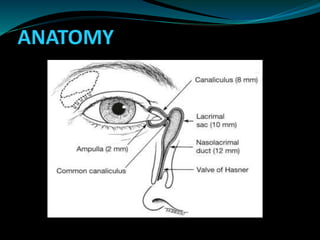
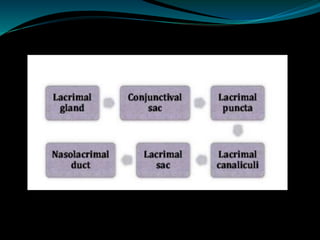
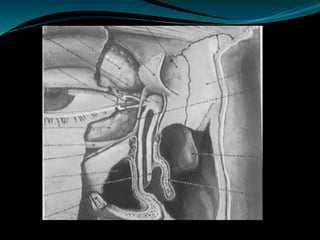
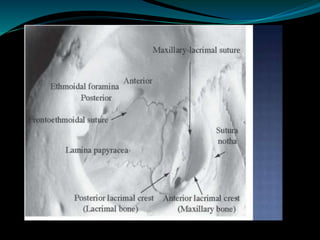
ANATOMY
CONVENTIONAL
DACRYOCYSTORHINOSTOMY
 DCR is indicated for obstruction beyond the medial
opening of the common canaliculus
 In principle the operation involves anastomosing the
lacrimal sac to the nasal mucosa of the middle nasal
meatus.
SURGICAL INDICATIONS
 Persistent congenital lacrimal duct obstructions
unresponsive to previous therapies.
 Congenital lacrimal duct obstructions associated with
mucocele, dacryocystitis, and not responsive to other
treatments.
 Primary acquired nasolacrimal duct obstructions
(PANDO).
 Secondary acquired nasolacrimal duct obstructions
(SALDO).
Preoperative requisites
 Confirmation of the diagnosis and clinical findings.
 Hemoglobin levels.
 Bleeding and clotting times.
 Blood pressure measurement.
 Random blood sugars.
 ENT evaluation
 Additional general anesthesia investigations when
required.
Pre-operative medications
 Nasal decongestant such as otrivin drops should be
given to reduce nasal congestion
 Patient is kept nil by mouth for ease of sedation
STEPS
 NASAL PACKING
It is done to keep the mucosa taut and reduce bleeding.
Nasal packing should be explained to the patient.
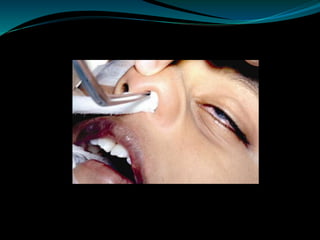
 Few drops of 4% topical lignocaine should be instilled first
in the ipsilateral nostril, then nasal pack (roller gauze
soaked in 2% lignocaine-adrenaline jelly) inserted in the
ipsilateral nostril with the help of nasal packing forceps in
the direction of middle meatus, insinuated and negotiated
as deep as possible
 The direction of nasal packing is superior, then
posterior, then inferior.
 ANAESTHESIA – General anaesthesia is preferred ,
however it may be performed with local anaesthesia in
adults
 Local anesthesia is given by both infiltration as well as
topical application. For infiltration 2% lignocaine with
0.5% Bupivacaine with or without adrenaline is used.
Infratrochlear nerve that supplies the lacrimal
apparatus is blocked first. The nondominant hand
marks the supraorbital notch and the needle is
inserted into the medial third of the eyebrow and
advanced to just medial to medial canthus and 2cc of
the drug is injected.
 The tissues along the anterior lacrimal crest is
infiltrated subcutaneously and the needle enters
deeper at about 3 mm medial to medial canthus, and
without withdrawing the needle the drug is injected
into deeper tissues up to periosteum both superiorly
and inferiorly.
POSITION
 Patient should be comfortably supine with head high 10-20
degree.
 Surgeon should be at the head-end, as it provides easy
access to both sides of the head.
 The table height should be adjusted depending upon
whether the surgeon is operating in standing or sitting
position.
 The light in operating room should be an overhead,
shadowless light, which must reach the depth of surgical
field (usually between surgeon's and assistant's head).
 Light should have adequate illumination because of small
field of illumination.
SKIN
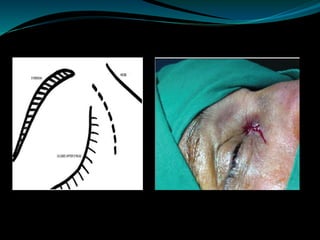
 Either a curved incision along lacrimal crest or a
straight incision 8-11 mm medial to medial canthus is
made
 Orbicularis is split in the line of incision and and a
lacrimal retractor inserted so as to retract it with skin
 Angular vessels should be avoided
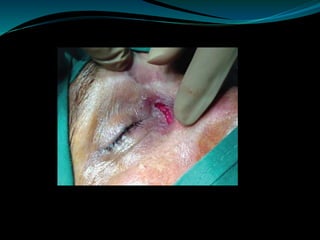
EXPOSURE OF MPL AND ANTERIOR
LACRIMAL CREST
 Identification and exposure of MPL is a very important
step in DCR surgery
 Once MPL is exposed, the orbicularis fibers are
separated along the entire length of the incision.
 Dis-insertion (not dividing) of MPL is done at the
anterior lacrimal crest by cutting on the bone at
insertion with 11 number blade.
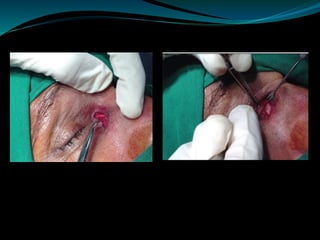
EXPOSURE OF BONE
 Dis-insertion of MPL automatically opens up the
periosteum, which is now separated along the entire
length of the incision with sharp dissector or
periosteum elevator.
 Lacrimal sac is retracted with periosteum elevator.
Baring of periosteum is done to decrease pain and to
aid bone punching.
 Periosteum is elevated posteriorly till the lamina
papyracea. Lamina papyracea is a thin bone with
consistency and color different from lacrimal bone.
Periosteum also elevated anteriorly, inferiorly and
superiorly as much as reasonably possible
EXPOSURE OF NASAL MUCOSA
 Bone removal is started with a small punch and then
with a big punch.
 The correct method of using bone punch is as follows:
insinuate, engage the bone with the punch, support
with left thumb, hitch back, crush properly and then
gentle rocking movement to remove the bone.
 Bone punch should always be perpendicular to the
punching surface. Clear the punch of bone pieces with
20G needle.
 Osteotomy should be as large as possible and should
be of size of thumbnail.
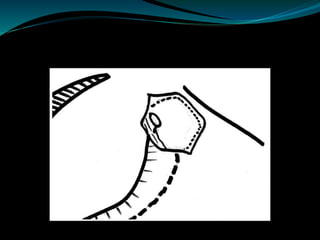
 Extent of osteotomy should be as follows:
Posteriorly: Till lamina papyracea.
Superiorly: At or slightly above level of MPL.
Anteriorly and inferiorly: As much as possible
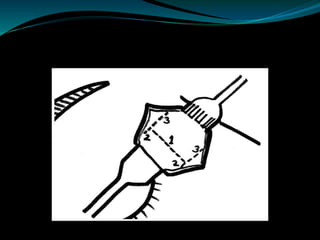
PREPARARTION OF FLAPS OF SAC
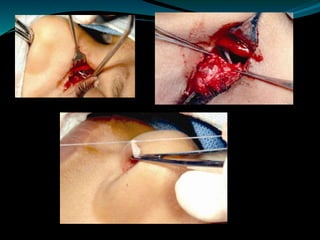
A probe is introduced into the sac through the lower
canaliculus and the sac is incised vertically .
To prepare anterior and posterior flaps the incision is
converted into H shape
FASHIONING OF NASAL MUCOSAL
FLAPS
 It is also done by vertical incision converted into H
shape
SUTURING OF FLAPS
 Posterior flaps are sutured so that the posterior sac
flap does not block common canalicular ostium in sac.
 One suture usually is sufficient for posterior flap.
 Care should be taken to avoid nasal pack in the suture
Anterior nasal flap is now sutured to the anterior sac
flap with minimum two 6-0 vicryl sutures (sometimes
three). Inserting lacrimal probe helps to confirm
proper flap suturing.
 . MPL re-attachment is done with periosteum using deep
down to the bone bite of 6-0 vicryl on the medial incision
edge at MPL level.
 Movement of the head when suture is pulled confirms the
firm suture attachment to periosteum.
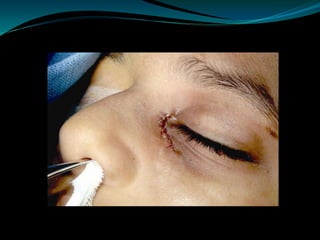
 Additional 3-4 orbicularis closure stitches are taken.
 Skin closure can be achieved with either interrupted or
continuous sub-cuticular sutures..
 Quarter folded pad on the wound and half-folded pad on
the eye should be applied.
 . Minimum 4-5 micropore tapes in a criss-cross fashion
with one tape to secure the nasal pack in position should
be applied
Adjunctive measures (use of
mitomycin C and intubation)
 Mitomycin C in a concentration of 0.04% is used if
there are intra-sac synechiae, soft tissue scarring like
in failed DCR's and in the presence of a complicated
surgery.
 Intubation is also advisable for similar indications but
in addition it is also used in the presence of canalicular
problems and inadequate flaps
Post-operative care
 Complete bed rest in propped up position and chin
extension is recommended for 24 hours.
 Patients should be told to avoid blowing of nose.
 Oral antibiotics, non-steroidal anti-inflammatory
drug (NSAID) - should be given routinely for five days.
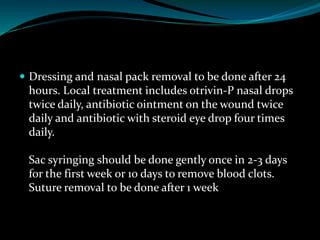
 Dressing and nasal pack removal to be done after 24
hours. Local treatment includes otrivin-P nasal drops
twice daily, antibiotic ointment on the wound twice
daily and antibiotic with steroid eye drop four times
daily.
Sac syringing should be done gently once in 2-3 days
for the first week or 10 days to remove blood clots.
Suture removal to be done after 1 week
CAUSES OF FAILURE
 Inadequate size and position of the ostium,
 Unrecognized common canalicular obstruction
 Scarring
 ‘Sump syndrome’, in which the surgical opening in the
lacrimal bone is too small and too high. There is thus a
dilated lacrimal sac lateral to and below the level of
the inferior margin of the ostium, in which secretions
collect, unable to gain access to the ostium and thence
the nasal cavity.
Complications
Complications following DCR surgery can be divided as
early (1-4 weeks),
intermediate (1-3 months) and
late (>3 months).
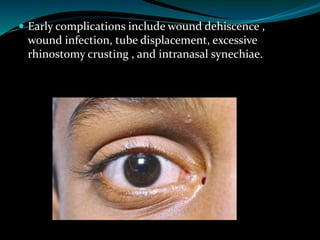
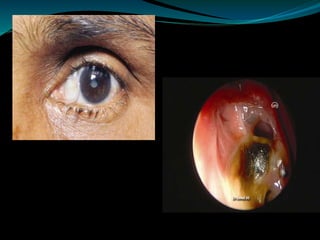
 Early complications include wound dehiscence ,
wound infection, tube displacement, excessive
rhinostomy crusting , and intranasal synechiae.
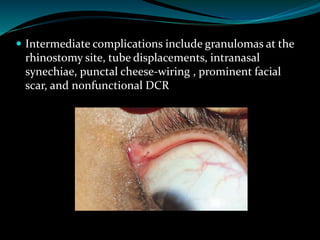
 Intermediate complications include granulomas at the
rhinostomy site, tube displacements, intranasal
synechiae, punctal cheese-wiring , prominent facial
scar, and nonfunctional DCR
 Late complications include rhinostomy fibrosis,
webbed facial scar, medial canthal distortion, and
failed DCR.
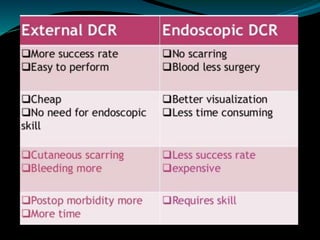
Endoscopic surgery
Endoscopic DCR is performed under general
anaesthesia.
Advantages over conventional DCR include the lack of
a skin incision, shorter operating time, minimal blood
loss and less risk of cerebrospinal fluid leakage.
Disadvantages include lower success rates, difficulty in
examining the common canalicular opening and
reverse probing of the canaliculus in cases with
proximal canalicular obstruction.
 1 Technique. A slender light pipe is passed through the
lacrimal puncta and canaliculi into the lacrimal sac and
viewed from within the nasal cavity with an endoscope.
The remainder of the procedure is performed via the
nose.
 a The mucosa over the frontal process of the maxilla is
stripped.
b A part of the nasal process of the maxilla is removed.
c The lacrimal bone is broken off piecemeal.
d The lacrimal sac is opened.
e Silicone tubes are passed through the upper and lower
puncta, pulled out through the ostium and tied within the
nose.
2 Results. The success rate is up to 90%.
Endolaser DCR
Performed with a Holmium:YAG or KTP laser, this is a
relatively rapid procedure which can be carried out
under local anaesthesia. It is therefore particularly
suitable for elderly patients.
Laser is used to ablate the mucosa and thin the
lacrimal bone.
The bony opening is 4-6mm in size which is smalller
than in conventional DCR and is one major reason for
lower success rate (70%)
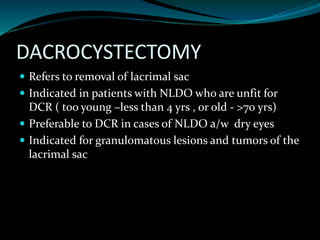
DACROCYSTECTOMY
 Refers to removal of lacrimal sac
 Indicated in patients with NLDO who are unfit for
DCR ( too young –less than 4 yrs , or old - >70 yrs)
 Preferable to DCR in cases of NLDO a/w dry eyes
 Indicated for granulomatous lesions and tumors of the
lacrimal sac
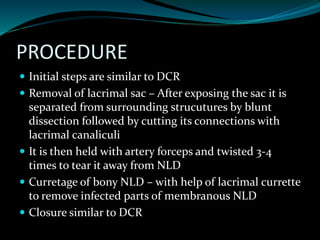
PROCEDURE
 Initial steps are similar to DCR
 Removal of lacrimal sac – After exposing the sac it is
separated from surrounding strucutures by blunt
dissection followed by cutting its connections with
lacrimal canaliculi
 It is then held with artery forceps and twisted 3-4
times to tear it away from NLD
 Curretage of bony NLD – with help of lacrimal currette
to remove infected parts of membranous NLD
 Closure similar to DCR
Lacrimal sac surgery

Lacrimal sac surgery

  • 1.
  • 2.
  • 4.
    CONVENTIONAL DACRYOCYSTORHINOSTOMY  DCR isindicated for obstruction beyond the medial opening of the common canaliculus  In principle the operation involves anastomosing the lacrimal sac to the nasal mucosa of the middle nasal meatus.
  • 7.
    SURGICAL INDICATIONS  Persistentcongenital lacrimal duct obstructions unresponsive to previous therapies.  Congenital lacrimal duct obstructions associated with mucocele, dacryocystitis, and not responsive to other treatments.  Primary acquired nasolacrimal duct obstructions (PANDO).  Secondary acquired nasolacrimal duct obstructions (SALDO).
  • 8.
    Preoperative requisites  Confirmationof the diagnosis and clinical findings.  Hemoglobin levels.  Bleeding and clotting times.  Blood pressure measurement.  Random blood sugars.  ENT evaluation  Additional general anesthesia investigations when required.
  • 9.
    Pre-operative medications  Nasaldecongestant such as otrivin drops should be given to reduce nasal congestion  Patient is kept nil by mouth for ease of sedation
  • 10.
    STEPS  NASAL PACKING Itis done to keep the mucosa taut and reduce bleeding. Nasal packing should be explained to the patient.  Few drops of 4% topical lignocaine should be instilled first in the ipsilateral nostril, then nasal pack (roller gauze soaked in 2% lignocaine-adrenaline jelly) inserted in the ipsilateral nostril with the help of nasal packing forceps in the direction of middle meatus, insinuated and negotiated as deep as possible  The direction of nasal packing is superior, then posterior, then inferior.
  • 12.
     ANAESTHESIA –General anaesthesia is preferred , however it may be performed with local anaesthesia in adults  Local anesthesia is given by both infiltration as well as topical application. For infiltration 2% lignocaine with 0.5% Bupivacaine with or without adrenaline is used. Infratrochlear nerve that supplies the lacrimal apparatus is blocked first. The nondominant hand marks the supraorbital notch and the needle is inserted into the medial third of the eyebrow and advanced to just medial to medial canthus and 2cc of the drug is injected.
  • 13.
     The tissuesalong the anterior lacrimal crest is infiltrated subcutaneously and the needle enters deeper at about 3 mm medial to medial canthus, and without withdrawing the needle the drug is injected into deeper tissues up to periosteum both superiorly and inferiorly.
  • 14.
    POSITION  Patient shouldbe comfortably supine with head high 10-20 degree.  Surgeon should be at the head-end, as it provides easy access to both sides of the head.  The table height should be adjusted depending upon whether the surgeon is operating in standing or sitting position.  The light in operating room should be an overhead, shadowless light, which must reach the depth of surgical field (usually between surgeon's and assistant's head).  Light should have adequate illumination because of small field of illumination.
  • 15.
    SKIN  Either acurved incision along lacrimal crest or a straight incision 8-11 mm medial to medial canthus is made  Orbicularis is split in the line of incision and and a lacrimal retractor inserted so as to retract it with skin  Angular vessels should be avoided
  • 18.
    EXPOSURE OF MPLAND ANTERIOR LACRIMAL CREST  Identification and exposure of MPL is a very important step in DCR surgery  Once MPL is exposed, the orbicularis fibers are separated along the entire length of the incision.  Dis-insertion (not dividing) of MPL is done at the anterior lacrimal crest by cutting on the bone at insertion with 11 number blade.
  • 20.
    EXPOSURE OF BONE Dis-insertion of MPL automatically opens up the periosteum, which is now separated along the entire length of the incision with sharp dissector or periosteum elevator.  Lacrimal sac is retracted with periosteum elevator. Baring of periosteum is done to decrease pain and to aid bone punching.  Periosteum is elevated posteriorly till the lamina papyracea. Lamina papyracea is a thin bone with consistency and color different from lacrimal bone. Periosteum also elevated anteriorly, inferiorly and superiorly as much as reasonably possible
  • 21.
    EXPOSURE OF NASALMUCOSA  Bone removal is started with a small punch and then with a big punch.  The correct method of using bone punch is as follows: insinuate, engage the bone with the punch, support with left thumb, hitch back, crush properly and then gentle rocking movement to remove the bone.  Bone punch should always be perpendicular to the punching surface. Clear the punch of bone pieces with 20G needle.  Osteotomy should be as large as possible and should be of size of thumbnail.
  • 22.
     Extent ofosteotomy should be as follows: Posteriorly: Till lamina papyracea. Superiorly: At or slightly above level of MPL. Anteriorly and inferiorly: As much as possible
  • 24.
    PREPARARTION OF FLAPSOF SAC A probe is introduced into the sac through the lower canaliculus and the sac is incised vertically . To prepare anterior and posterior flaps the incision is converted into H shape
  • 26.
    FASHIONING OF NASALMUCOSAL FLAPS  It is also done by vertical incision converted into H shape
  • 27.
    SUTURING OF FLAPS Posterior flaps are sutured so that the posterior sac flap does not block common canalicular ostium in sac.  One suture usually is sufficient for posterior flap.  Care should be taken to avoid nasal pack in the suture Anterior nasal flap is now sutured to the anterior sac flap with minimum two 6-0 vicryl sutures (sometimes three). Inserting lacrimal probe helps to confirm proper flap suturing.
  • 28.
     . MPLre-attachment is done with periosteum using deep down to the bone bite of 6-0 vicryl on the medial incision edge at MPL level.  Movement of the head when suture is pulled confirms the firm suture attachment to periosteum.  Additional 3-4 orbicularis closure stitches are taken.  Skin closure can be achieved with either interrupted or continuous sub-cuticular sutures..  Quarter folded pad on the wound and half-folded pad on the eye should be applied.  . Minimum 4-5 micropore tapes in a criss-cross fashion with one tape to secure the nasal pack in position should be applied
  • 30.
    Adjunctive measures (useof mitomycin C and intubation)  Mitomycin C in a concentration of 0.04% is used if there are intra-sac synechiae, soft tissue scarring like in failed DCR's and in the presence of a complicated surgery.  Intubation is also advisable for similar indications but in addition it is also used in the presence of canalicular problems and inadequate flaps
  • 32.
    Post-operative care  Completebed rest in propped up position and chin extension is recommended for 24 hours.  Patients should be told to avoid blowing of nose.  Oral antibiotics, non-steroidal anti-inflammatory drug (NSAID) - should be given routinely for five days.
  • 33.
     Dressing andnasal pack removal to be done after 24 hours. Local treatment includes otrivin-P nasal drops twice daily, antibiotic ointment on the wound twice daily and antibiotic with steroid eye drop four times daily. Sac syringing should be done gently once in 2-3 days for the first week or 10 days to remove blood clots. Suture removal to be done after 1 week
  • 34.
    CAUSES OF FAILURE Inadequate size and position of the ostium,  Unrecognized common canalicular obstruction  Scarring  ‘Sump syndrome’, in which the surgical opening in the lacrimal bone is too small and too high. There is thus a dilated lacrimal sac lateral to and below the level of the inferior margin of the ostium, in which secretions collect, unable to gain access to the ostium and thence the nasal cavity.
  • 35.
    Complications Complications following DCRsurgery can be divided as early (1-4 weeks), intermediate (1-3 months) and late (>3 months).
  • 36.
     Early complicationsinclude wound dehiscence , wound infection, tube displacement, excessive rhinostomy crusting , and intranasal synechiae.
  • 38.
     Intermediate complicationsinclude granulomas at the rhinostomy site, tube displacements, intranasal synechiae, punctal cheese-wiring , prominent facial scar, and nonfunctional DCR
  • 39.
     Late complicationsinclude rhinostomy fibrosis, webbed facial scar, medial canthal distortion, and failed DCR.
  • 40.
    Endoscopic surgery Endoscopic DCRis performed under general anaesthesia. Advantages over conventional DCR include the lack of a skin incision, shorter operating time, minimal blood loss and less risk of cerebrospinal fluid leakage. Disadvantages include lower success rates, difficulty in examining the common canalicular opening and reverse probing of the canaliculus in cases with proximal canalicular obstruction.
  • 41.
     1 Technique.A slender light pipe is passed through the lacrimal puncta and canaliculi into the lacrimal sac and viewed from within the nasal cavity with an endoscope. The remainder of the procedure is performed via the nose.  a The mucosa over the frontal process of the maxilla is stripped. b A part of the nasal process of the maxilla is removed. c The lacrimal bone is broken off piecemeal. d The lacrimal sac is opened. e Silicone tubes are passed through the upper and lower puncta, pulled out through the ostium and tied within the nose. 2 Results. The success rate is up to 90%.
  • 42.
    Endolaser DCR Performed witha Holmium:YAG or KTP laser, this is a relatively rapid procedure which can be carried out under local anaesthesia. It is therefore particularly suitable for elderly patients. Laser is used to ablate the mucosa and thin the lacrimal bone. The bony opening is 4-6mm in size which is smalller than in conventional DCR and is one major reason for lower success rate (70%)
  • 44.
    DACROCYSTECTOMY  Refers toremoval of lacrimal sac  Indicated in patients with NLDO who are unfit for DCR ( too young –less than 4 yrs , or old - >70 yrs)  Preferable to DCR in cases of NLDO a/w dry eyes  Indicated for granulomatous lesions and tumors of the lacrimal sac
  • 45.
    PROCEDURE  Initial stepsare similar to DCR  Removal of lacrimal sac – After exposing the sac it is separated from surrounding strucutures by blunt dissection followed by cutting its connections with lacrimal canaliculi  It is then held with artery forceps and twisted 3-4 times to tear it away from NLD  Curretage of bony NLD – with help of lacrimal currette to remove infected parts of membranous NLD  Closure similar to DCR