DACROCYSTITIS
19/MAY/2021
Dr Shayri Pillai
2ND Year Ophthalmology Resident
Liberia Eye Centre
JFK Memorial Medical Center
L V Prasad Eye Institute
INTRODUCTION
 Infection of the lacrimal sac
 Usually secondary to obstruction of the
nasolacrimal duct
 Acute or chronic
 Most commonly staphylococcal or streptococcal
Clinical findings include
Edema and erythema with distention of the lacrimal sac
Degree of discomfort ranges from none to severe pain
Complications include
Dacryocystocele formation
Chronic conjunctivitis, and spread to adjacent structures
(orbital or facial cellulitis)
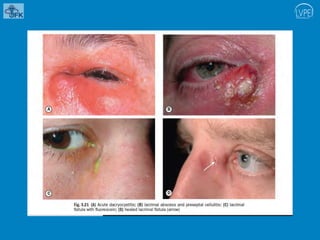
Acute dacryocystitis
Presentation -subacute onset of pain in the medial
canthal area-Associated with epiphora
A very tender, tense red swelling develops at the
medial canthus
Progresses to abscess formation -associated
preseptal cellulitis
Treatment
Initial treatment -application of warm
compresses
Oral antibiotics such as flucloxacillin or co-amoxiclav
Irrigation and probing should not be performed
Incision and drainage -if pus points and an abscess is
about to drain spontaneously-this carries the risk of a
persistent sac–skin fistula
Dacryocystorhinostomy
Chronic dacryocystitis
Presentation-
chronic epiphora,
Associated with Chronic or recurrent unilateral
conjunctivitis
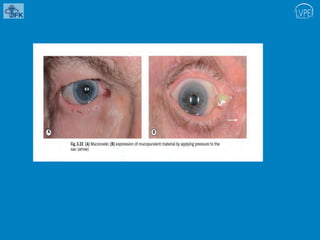
Mucocoele
Treatment- dacryocystorhinostomy
Conventional (external approach) dacryocystorhinostomy
(DCR)
indicated for obstruction distal to the medial
opening of the common canaliculus and consists of
anastomosis of the lacrimal sac to the mucosa of the
middle nasal meatus
The procedure is usually performed under
hypotensive general anaesthesia
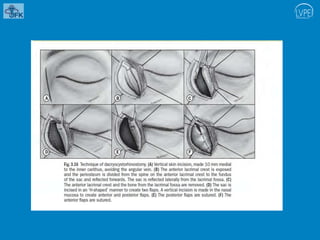
A vertical skin incision is made 10 mm medial to the inner
canthus, the medial canthal tendon and lacrimal sac
exposed and reflected
After removal of the intervening bone the sac is incised
Attached to an opening created in the nasal mucosa
The success rate is over 90%
Causes of failure include
inadequate size and position of the ostium, unrecognized common
canalicular obstruction, scarring and the ‘sump syndrome’,
in which the surgical opening in the lacrimal bone is too small and too high
Complications
include cutaneous scarring, injury to medial canthal
structures, haemorrhage, infection and cerebrospinal fluid
rhinorrhoea if the subarachnoid space is inadvertently
entered
Endoscopic DCR encompasses several techniques
A light pipe can be passed through the canalicular
system into the lacrimal sac to guide an endoscopic
approach
Within the nose, or a microendoscopic transcanalicular
procedure -can be performed using a drill or laser to
establish communication with the nasal cavity
Advantages over conventional DCR include
Less marked systemic disturbance with minimal
blood loss and a lower risk of cerebrospinal
fluid leakage, the avoidance of a skin incision and
Generally a shorter operating time
Disadvantages include
a slightly lower success rate and visualization difficulties,
meaning that additional procedures are sometimes
needed
Other procedures, often reserved for partial nasolacrimal
duct obstruction, include
- Probing
- Intubation
- Stent
- Insertion and balloon dacryocystoplasty
Dacryocystectomy
Dacryocystectomy is useful in the management of two
types of patients:
the elderly patient with chronic dacryocystitis without
epiphora and the patient with a lacrimal sac tumor
Dacryocystectomy with isolation and excision of the
nasolacrimal sac may be performed -under either local or
general anesthesia
If tumor is suspected, general anesthesia is preferred
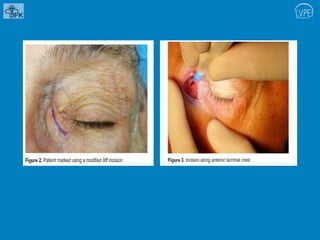
Skin marking uses an Iliff type incision starting at
the superior border of the medial canthal tendon
and curving downward along the anterior lacrimal
crest
--Better aesthetic results are obtained by aligning
this incision with the patient's natural relaxed skin
tension lines
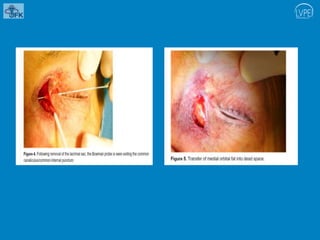
Incision can be made with a 15 blade
--CO2 laser, monopolar needle tip, radiofrequency
wire, or other devices are preferred sometimes
Dissect down to the anterior lacrimal crest
--Incise the periosteum using a monopolar cautery
with needle tip
Use a Freer periosteal elevator to elevate the
lacrimal sac from the lacrimal fossa
Insert a Bowman probe and visualize in the sac
Free the lacrimal sac superiorly
Take care not to enter the nasal cavity, particularly if
there is concern for a lesion
The posterior portion of the dissection encounters the
ethmoid bone, which is very thin
Isolate the anterior crus of the medial canthal tendon
and cut using Westcott scissors to improve
visualization
Removal of the lacrimal sac
If a tumor is present and contained within the lacrimal
sac, it is recommended to leave the sac intact to the
best extent possible
If a tumor has eroded through the lacrimal sac,
biopsy with frozen section analysis may be indicated
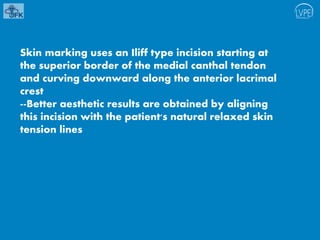
The lacrimal sac is then amputated from the
nasolacrimal duct as inferiorly as possible
•In setting of dacryocystitis-copious irrigation of the
fossa with saline or antibiotic solution is indicated
Confirm the sac has been removed by placing a
Bowman probe in the lower punctum and
visualizing it exiting the common canaliculus
The superior opening of the nasolacrimal duct, now
exposed, should be sealed to prevent reflux of nasal
contents into the lacrimal sac fossa
Repair the medial canthal tendon using a 5-0
polyglactin or polypropylene suture in a horizontal
mattress fashion
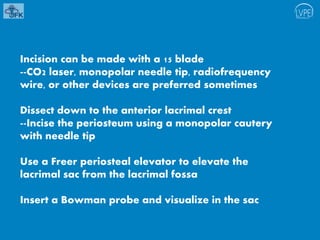
Medial orbital fat can be mobilized and secured to the
periosteum using 6-0 polyglactin suture to fill the
lacrimal sac fossa and reduce or eliminate dead space
Orbicularis is closed using buried 6-0 polyglactin
suture
Skin is closed using 6-0 plain gut or polypropylene
suture in a running or interrupted fashion
Thank you!
Excellence Equity Efficiency
L V Prasad Eye Institute

dacrocystitis.pptx

  • 1.
    DACROCYSTITIS 19/MAY/2021 Dr Shayri Pillai 2NDYear Ophthalmology Resident Liberia Eye Centre JFK Memorial Medical Center L V Prasad Eye Institute
  • 2.
    INTRODUCTION  Infection ofthe lacrimal sac  Usually secondary to obstruction of the nasolacrimal duct  Acute or chronic  Most commonly staphylococcal or streptococcal
  • 3.
    Clinical findings include Edemaand erythema with distention of the lacrimal sac Degree of discomfort ranges from none to severe pain Complications include Dacryocystocele formation Chronic conjunctivitis, and spread to adjacent structures (orbital or facial cellulitis)
  • 4.
    Acute dacryocystitis Presentation -subacuteonset of pain in the medial canthal area-Associated with epiphora A very tender, tense red swelling develops at the medial canthus Progresses to abscess formation -associated preseptal cellulitis
  • 5.
    Treatment Initial treatment -applicationof warm compresses Oral antibiotics such as flucloxacillin or co-amoxiclav Irrigation and probing should not be performed Incision and drainage -if pus points and an abscess is about to drain spontaneously-this carries the risk of a persistent sac–skin fistula Dacryocystorhinostomy
  • 7.
    Chronic dacryocystitis Presentation- chronic epiphora, Associatedwith Chronic or recurrent unilateral conjunctivitis Mucocoele Treatment- dacryocystorhinostomy
  • 9.
    Conventional (external approach)dacryocystorhinostomy (DCR) indicated for obstruction distal to the medial opening of the common canaliculus and consists of anastomosis of the lacrimal sac to the mucosa of the middle nasal meatus
  • 11.
    The procedure isusually performed under hypotensive general anaesthesia A vertical skin incision is made 10 mm medial to the inner canthus, the medial canthal tendon and lacrimal sac exposed and reflected After removal of the intervening bone the sac is incised Attached to an opening created in the nasal mucosa The success rate is over 90%
  • 12.
    Causes of failureinclude inadequate size and position of the ostium, unrecognized common canalicular obstruction, scarring and the ‘sump syndrome’, in which the surgical opening in the lacrimal bone is too small and too high Complications include cutaneous scarring, injury to medial canthal structures, haemorrhage, infection and cerebrospinal fluid rhinorrhoea if the subarachnoid space is inadvertently entered
  • 13.
    Endoscopic DCR encompassesseveral techniques A light pipe can be passed through the canalicular system into the lacrimal sac to guide an endoscopic approach Within the nose, or a microendoscopic transcanalicular procedure -can be performed using a drill or laser to establish communication with the nasal cavity
  • 14.
    Advantages over conventionalDCR include Less marked systemic disturbance with minimal blood loss and a lower risk of cerebrospinal fluid leakage, the avoidance of a skin incision and Generally a shorter operating time Disadvantages include a slightly lower success rate and visualization difficulties, meaning that additional procedures are sometimes needed
  • 15.
    Other procedures, oftenreserved for partial nasolacrimal duct obstruction, include - Probing - Intubation - Stent - Insertion and balloon dacryocystoplasty
  • 16.
    Dacryocystectomy Dacryocystectomy is usefulin the management of two types of patients: the elderly patient with chronic dacryocystitis without epiphora and the patient with a lacrimal sac tumor Dacryocystectomy with isolation and excision of the nasolacrimal sac may be performed -under either local or general anesthesia If tumor is suspected, general anesthesia is preferred
  • 19.
    Skin marking usesan Iliff type incision starting at the superior border of the medial canthal tendon and curving downward along the anterior lacrimal crest --Better aesthetic results are obtained by aligning this incision with the patient's natural relaxed skin tension lines
  • 20.
    Incision can bemade with a 15 blade --CO2 laser, monopolar needle tip, radiofrequency wire, or other devices are preferred sometimes Dissect down to the anterior lacrimal crest --Incise the periosteum using a monopolar cautery with needle tip Use a Freer periosteal elevator to elevate the lacrimal sac from the lacrimal fossa Insert a Bowman probe and visualize in the sac
  • 21.
    Free the lacrimalsac superiorly Take care not to enter the nasal cavity, particularly if there is concern for a lesion The posterior portion of the dissection encounters the ethmoid bone, which is very thin Isolate the anterior crus of the medial canthal tendon and cut using Westcott scissors to improve visualization Removal of the lacrimal sac
  • 22.
    If a tumoris present and contained within the lacrimal sac, it is recommended to leave the sac intact to the best extent possible If a tumor has eroded through the lacrimal sac, biopsy with frozen section analysis may be indicated The lacrimal sac is then amputated from the nasolacrimal duct as inferiorly as possible
  • 23.
    •In setting ofdacryocystitis-copious irrigation of the fossa with saline or antibiotic solution is indicated Confirm the sac has been removed by placing a Bowman probe in the lower punctum and visualizing it exiting the common canaliculus The superior opening of the nasolacrimal duct, now exposed, should be sealed to prevent reflux of nasal contents into the lacrimal sac fossa
  • 24.
    Repair the medialcanthal tendon using a 5-0 polyglactin or polypropylene suture in a horizontal mattress fashion Medial orbital fat can be mobilized and secured to the periosteum using 6-0 polyglactin suture to fill the lacrimal sac fossa and reduce or eliminate dead space Orbicularis is closed using buried 6-0 polyglactin suture Skin is closed using 6-0 plain gut or polypropylene suture in a running or interrupted fashion
  • 25.
    Thank you! Excellence EquityEfficiency L V Prasad Eye Institute

Editor's Notes

  • #6 Dacryocystorhinostomy is commonly required -after the acute infection has been controlled and may reduce therisk of recurrent infection and can result in closure of a fistula
  • #7 D healed fistula after DCR
  • #8 A mucocoele is usually evident as a painless swelling at the inner canthus (Fig. 3.22A), but if an obvious swelling is absent pressure over the sac commonly still results in mucopurulent canalicular reflux