EVALUATION OF A
CASE OF
PROPTOSIS
DR ARPITA
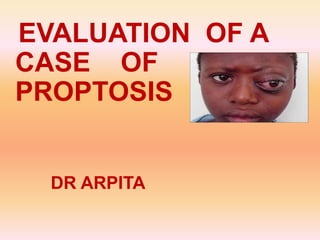
• PROPTOSIS is defined as forward
protrusion of the eyeball
• Proptosis of more than 21mm or more
than 2mm asymmetry between the two
eyes is abnormal
• EXOPHTHALMOS is specifically used to
describe the proptosis of eyes a/w Thyroid
eye disease
• ENOPHTHALMOS is defined as
retrodisplacement of eye into orbit
PSEUDOPROPTOSIS
• It is the false impression of proptosis
• Seen in conditions like
1. Buphthalmos
2. High myopia
3. Contralateral ptosis
4. Contralateral enophthalmos
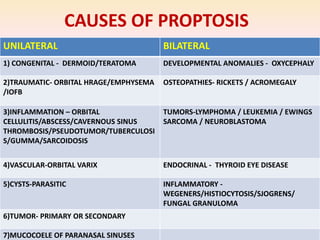
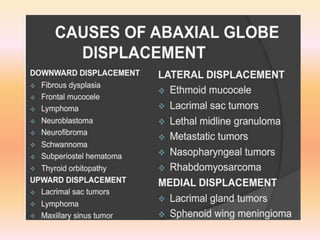
CAUSES OF PROPTOSIS
UNILATERAL BILATERAL
1) CONGENITAL - DERMOID/TERATOMA DEVELOPMENTAL ANOMALIES - OXYCEPHALY
2)TRAUMATIC- ORBITAL HRAGE/EMPHYSEMA
/IOFB
OSTEOPATHIES- RICKETS / ACROMEGALY
3)INFLAMMATION – ORBITAL
CELLULITIS/ABSCESS/CAVERNOUS SINUS
THROMBOSIS/PSEUDOTUMOR/TUBERCULOSI
S/GUMMA/SARCOIDOSIS
TUMORS-LYMPHOMA / LEUKEMIA / EWINGS
SARCOMA / NEUROBLASTOMA
4)VASCULAR-ORBITAL VARIX ENDOCRINAL - THYROID EYE DISEASE
5)CYSTS-PARASITIC INFLAMMATORY -
WEGENERS/HISTIOCYTOSIS/SJOGRENS/
FUNGAL GRANULOMA
6)TUMOR- PRIMARY OR SECONDARY
7)MUCOCOELE OF PARANASAL SINUSES
• Acute proptosis - Orbital emphysema /
orbital hemorrhage
• Intermittent proptosis – Orbital varix ,
periodic orbital edema , recurrent orbital
hemorrhage
• Pulsating proptosis – caroticocavernous
fistula , saccular aneurysm of ophthalmic
artery , congenital meningocoele ,
meningoencephalocoele , traumatic or
operative hiatus in orbital roof
APPROACH
HISTORY
LOCAL
EXAMN
SYSTEM
EXAMN
INVESTIG
ATIONS
IMAGING
HISTORY TAKING
• Protrusion of eyeball - Age of Onset ,
duration , progression
• Constant or intermittent
• Variation with posture / strain
• Decreased vision – preceded/followed
• Stationary/progressive
• Associated field defects
• h/o Pain
• h/o Double vision
• h/o Trauma
• h/o fever , chills ,systemic symptoms
• h/o cancer
• h/s/o thyroid disease ,TB , DM ,HTN ,HIV ,
Syphilis
• The patterns of orbital involvement can be divided into four
basic categories.
• INFLAMMATORY EFFECT: inflammation may be either
infectious or noninfectious in nature and is associated with
signs and symptoms of redness, swelling, pain, heat, and
loss of function. There is often a mass effect present.
MASS EFFECT: displacement with or without signs of
involvement of sensory or neuromuscular structure.
Displacement points to the location of the diseases and may
help to characterize its nature.
VASCULAR CHANGE: features suggesting vascular disease
include venous dilation, pulsation, expansion with straining
(Valsalva), and hemorrhage.
INFILTRATIVE CHANGE: infiltrative diseases are usually
associated with evidence of destruction, entrapment, or
both. These include effects on ocular movement or
neurosensory function (e.g., optic neuropathy, pain, or
paresthesia).
• Sudden dramatic proptosis in a child with recent
upper resp tract infetion – hemorrhage into a
lymphangioma
• Gaze evoked amaurosis – orbital apex tumor
• Pain a/w short h/o mass in region of lacrimal
gland – adenoid cystic Ca
• Long h/o painless mass – pleomorphic adenoma
• h/o tinnitus – AV shunt
• Proptosis increasing on straining – orbital varix
• Spontaneous unilateral periorbital bruising –
amyloidosis
• Spontaneous B/L bruising - neuroblastoma
LOCAL EXAMINATION
• 1) INSPECTION –
• Proptosis or pseudoproptosis
• Unilateral or bilateral
• Axial or eccentric
• 2) PALPATION – size ,shape,surface,margins
consistency , tenderness , compressibility
Thrill /increase with valsalva/ orbital rims /
regional lymph nodes
• 3)AUSCULTATION - bruit
• 7) ADNEXA –
• Dilated episcleral vessels – AV shunt
• Optociliary shunt vessels- optic nerve sheath
meningioma
• Salmon patch beneath upper eyelid – orbital
lymphoma
• Eversion of upper lid – waxy yellow infiltrate
with tortuous vessels- amyloid
• S shaped deformity of upper lid – plexiform
neurofibroma
• Lid retraction or lidlag - thyroid ophthalmopathy
4) EOM MOTILITY – decreased in thyroid
orbitopathy,extensive tumor growths and
neurological deficit
5) VISUAL ACUITY – maybe decreased due to
Refractive changes due to pressure on
eyeball
Optic nerve compresssion
Exposure keratopathy
6) PUPIL REACTION – RAPD suggests optic
nerve compression
7) COLOR VISION , VISUAL FIELDS
8)FUNDOSCOPY – may reveal hemorrhages ,
papilloedema , optic atrophy , choroidal folds
MEASUREMENT OF PROPTOSIS
• Measured by a group of instruments called
exophthalmometer or proptometer
• All instruments are meant to measure the
distance b/w thw apex of cornea and lateral
wall of orbit
• OPTICAL- Lueddes scale and Hertels
exophthalmometer
• MECHANICAL – Gormaz exophthalmometer
SYSTEMIC EXAMINATION
• Thyroid examination
• Primary tumors elsewhere in the body –
CVS/RS/Abdomen/PV/Rectal
• ENT examination
LAB INVESTIGATIONS
• Hematological - CBC , ESR, VDRL
• Thyroid function tests
• Serum ANA , c- ANCA , ACE
• BUN , Creatinine
• C-XRAY , Mantoux test
• Casonis test – r/o hydatid cyst
• Stool examination – cysts /ova
• Urine analysis – bence jones proteins - MM
IMAGING
• XRAY –
• Calcification/hyperostosis – Meningiomas
• Waters view – blow out fractures
• Rhese view – optic foramen and SOF
• CT- SCAN Size , position and shape of
• USG lesion
• MRI
• ORBITAL VENOGRAPHY – Orbital varix
• CAROTID ANGIOGRAPHY – Aneurysms /AV
communications
HISTOPATHOLOGICAL STUDIES
• FNAB
• Incisional biopsy
• Excisional biopsy
• Proptosis with white reflex – retinoblastoma
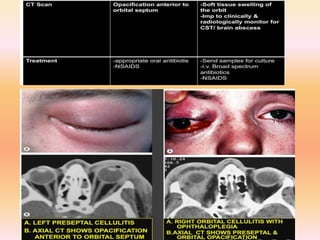
• U/L fast progressing proptosis , fever , toxic
child , pain – orbital cellulitis
• U/L axial proptosis with early vision loss –
optic nerve glioma
• B/L proptosis , fever and toxemia – cavernous
sinus thrombosis
• Pale child , bleeding from gums , U/L or B/L
proptosis – leukemia
• U/L proptosis ,pain ,fever,hazy cornea and
loss of vision - panophthalmitis
Proptosis

Proptosis

  • 1.
    EVALUATION OF A CASEOF PROPTOSIS DR ARPITA
  • 2.
    • PROPTOSIS isdefined as forward protrusion of the eyeball • Proptosis of more than 21mm or more than 2mm asymmetry between the two eyes is abnormal • EXOPHTHALMOS is specifically used to describe the proptosis of eyes a/w Thyroid eye disease • ENOPHTHALMOS is defined as retrodisplacement of eye into orbit
  • 3.
    PSEUDOPROPTOSIS • It isthe false impression of proptosis • Seen in conditions like 1. Buphthalmos 2. High myopia 3. Contralateral ptosis 4. Contralateral enophthalmos
  • 4.
    CAUSES OF PROPTOSIS UNILATERALBILATERAL 1) CONGENITAL - DERMOID/TERATOMA DEVELOPMENTAL ANOMALIES - OXYCEPHALY 2)TRAUMATIC- ORBITAL HRAGE/EMPHYSEMA /IOFB OSTEOPATHIES- RICKETS / ACROMEGALY 3)INFLAMMATION – ORBITAL CELLULITIS/ABSCESS/CAVERNOUS SINUS THROMBOSIS/PSEUDOTUMOR/TUBERCULOSI S/GUMMA/SARCOIDOSIS TUMORS-LYMPHOMA / LEUKEMIA / EWINGS SARCOMA / NEUROBLASTOMA 4)VASCULAR-ORBITAL VARIX ENDOCRINAL - THYROID EYE DISEASE 5)CYSTS-PARASITIC INFLAMMATORY - WEGENERS/HISTIOCYTOSIS/SJOGRENS/ FUNGAL GRANULOMA 6)TUMOR- PRIMARY OR SECONDARY 7)MUCOCOELE OF PARANASAL SINUSES
  • 5.
    • Acute proptosis- Orbital emphysema / orbital hemorrhage • Intermittent proptosis – Orbital varix , periodic orbital edema , recurrent orbital hemorrhage • Pulsating proptosis – caroticocavernous fistula , saccular aneurysm of ophthalmic artery , congenital meningocoele , meningoencephalocoele , traumatic or operative hiatus in orbital roof
  • 7.
  • 8.
    HISTORY TAKING • Protrusionof eyeball - Age of Onset , duration , progression • Constant or intermittent • Variation with posture / strain • Decreased vision – preceded/followed • Stationary/progressive • Associated field defects
  • 9.
    • h/o Pain •h/o Double vision • h/o Trauma • h/o fever , chills ,systemic symptoms • h/o cancer • h/s/o thyroid disease ,TB , DM ,HTN ,HIV , Syphilis
  • 12.
    • The patternsof orbital involvement can be divided into four basic categories. • INFLAMMATORY EFFECT: inflammation may be either infectious or noninfectious in nature and is associated with signs and symptoms of redness, swelling, pain, heat, and loss of function. There is often a mass effect present. MASS EFFECT: displacement with or without signs of involvement of sensory or neuromuscular structure. Displacement points to the location of the diseases and may help to characterize its nature. VASCULAR CHANGE: features suggesting vascular disease include venous dilation, pulsation, expansion with straining (Valsalva), and hemorrhage. INFILTRATIVE CHANGE: infiltrative diseases are usually associated with evidence of destruction, entrapment, or both. These include effects on ocular movement or neurosensory function (e.g., optic neuropathy, pain, or paresthesia).
  • 13.
    • Sudden dramaticproptosis in a child with recent upper resp tract infetion – hemorrhage into a lymphangioma • Gaze evoked amaurosis – orbital apex tumor • Pain a/w short h/o mass in region of lacrimal gland – adenoid cystic Ca • Long h/o painless mass – pleomorphic adenoma • h/o tinnitus – AV shunt • Proptosis increasing on straining – orbital varix • Spontaneous unilateral periorbital bruising – amyloidosis • Spontaneous B/L bruising - neuroblastoma
  • 14.
    LOCAL EXAMINATION • 1)INSPECTION – • Proptosis or pseudoproptosis • Unilateral or bilateral • Axial or eccentric • 2) PALPATION – size ,shape,surface,margins consistency , tenderness , compressibility Thrill /increase with valsalva/ orbital rims / regional lymph nodes • 3)AUSCULTATION - bruit
  • 17.
    • 7) ADNEXA– • Dilated episcleral vessels – AV shunt • Optociliary shunt vessels- optic nerve sheath meningioma • Salmon patch beneath upper eyelid – orbital lymphoma • Eversion of upper lid – waxy yellow infiltrate with tortuous vessels- amyloid • S shaped deformity of upper lid – plexiform neurofibroma • Lid retraction or lidlag - thyroid ophthalmopathy
  • 19.
    4) EOM MOTILITY– decreased in thyroid orbitopathy,extensive tumor growths and neurological deficit 5) VISUAL ACUITY – maybe decreased due to Refractive changes due to pressure on eyeball Optic nerve compresssion Exposure keratopathy 6) PUPIL REACTION – RAPD suggests optic nerve compression
  • 20.
    7) COLOR VISION, VISUAL FIELDS 8)FUNDOSCOPY – may reveal hemorrhages , papilloedema , optic atrophy , choroidal folds
  • 21.
    MEASUREMENT OF PROPTOSIS •Measured by a group of instruments called exophthalmometer or proptometer • All instruments are meant to measure the distance b/w thw apex of cornea and lateral wall of orbit • OPTICAL- Lueddes scale and Hertels exophthalmometer • MECHANICAL – Gormaz exophthalmometer
  • 28.
    SYSTEMIC EXAMINATION • Thyroidexamination • Primary tumors elsewhere in the body – CVS/RS/Abdomen/PV/Rectal • ENT examination
  • 29.
    LAB INVESTIGATIONS • Hematological- CBC , ESR, VDRL • Thyroid function tests • Serum ANA , c- ANCA , ACE • BUN , Creatinine • C-XRAY , Mantoux test • Casonis test – r/o hydatid cyst • Stool examination – cysts /ova • Urine analysis – bence jones proteins - MM
  • 30.
    IMAGING • XRAY – •Calcification/hyperostosis – Meningiomas • Waters view – blow out fractures • Rhese view – optic foramen and SOF • CT- SCAN Size , position and shape of • USG lesion • MRI
  • 31.
    • ORBITAL VENOGRAPHY– Orbital varix • CAROTID ANGIOGRAPHY – Aneurysms /AV communications
  • 32.
    HISTOPATHOLOGICAL STUDIES • FNAB •Incisional biopsy • Excisional biopsy
  • 39.
    • Proptosis withwhite reflex – retinoblastoma • U/L fast progressing proptosis , fever , toxic child , pain – orbital cellulitis • U/L axial proptosis with early vision loss – optic nerve glioma • B/L proptosis , fever and toxemia – cavernous sinus thrombosis • Pale child , bleeding from gums , U/L or B/L proptosis – leukemia • U/L proptosis ,pain ,fever,hazy cornea and loss of vision - panophthalmitis