BA 320 Operations Management
Chapter 11Chapter 11
Just-In-Time andJust-In-Time and
Lean ProductionLean Production
BA 320 Operations Management
 Producing only what is needed,Producing only what is needed,
when it is neededwhen it is needed
 A philosophyA philosophy
 An integrated management systemAn integrated management system
 JIT’s mandate:JIT’s mandate:
Eliminate all wasteEliminate all waste
What is JIT ?What is JIT ?
BA 320 Operations Management
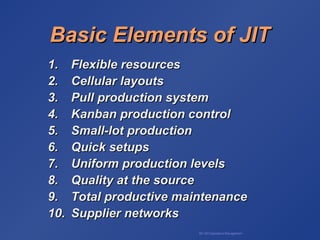
Basic Elements of JITBasic Elements of JIT
1.1. Flexible resourcesFlexible resources
2.2. Cellular layoutsCellular layouts
3.3. Pull production systemPull production system
4.4. Kanban production controlKanban production control
5.5. Small-lot productionSmall-lot production
6.6. Quick setupsQuick setups
7.7. Uniform production levelsUniform production levels
8.8. Quality at the sourceQuality at the source
9.9. Total productive maintenanceTotal productive maintenance
10.10. Supplier networksSupplier networks
BA 320 Operations Management
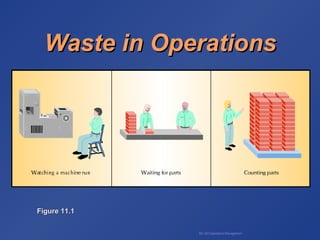
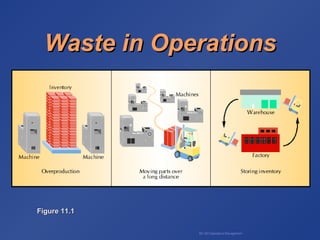
Figure 11.1Figure 11.1
Waste in OperationsWaste in Operations
BA 320 Operations Management
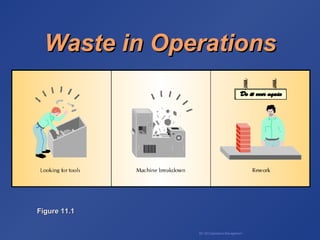
Figure 11.1Figure 11.1
Waste in OperationsWaste in Operations
BA 320 Operations Management
Figure 11.1Figure 11.1
Waste in OperationsWaste in Operations
BA 320 Operations Management
Flexible ResourcesFlexible Resources
 Multifunctional workersMultifunctional workers
 General purpose machinesGeneral purpose machines
 Study operators & improveStudy operators & improve
operationsoperations
BA 320 Operations Management
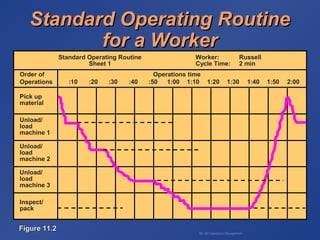
Standard Operating RoutineStandard Operating Routine
for a Workerfor a Worker
Standard Operating Routine
Sheet 1
Worker: Russell
Cycle Time: 2 min
Order of Operations time
Operations :10 :20 :30 :40 :50 1:00 1:10 1:20 1:30 1:40 1:50 2:00
Pick up
material
Unload/
load
machine 1
Unload/
load
machine 2
Unload/
load
machine 3
Inspect/
pack
Figure 11.2Figure 11.2
BA 320 Operations Management
Cellular LayoutsCellular Layouts
 Group dissimilar machines inGroup dissimilar machines in
manufacturing cell to producemanufacturing cell to produce
family of partsfamily of parts
 Work flows in one directionWork flows in one direction
through cellthrough cell
 Cycle time adjusted by changingCycle time adjusted by changing
worker pathsworker paths
BA 320 Operations Management
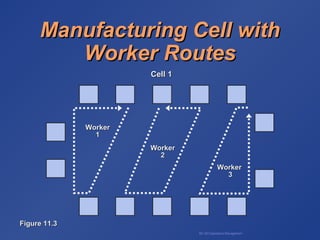
Manufacturing Cell withManufacturing Cell with
Worker RoutesWorker Routes
WorkerWorker
11
WorkerWorker
22
WorkerWorker
33
Cell 1Cell 1
Figure 11.3Figure 11.3
BA 320 Operations Management
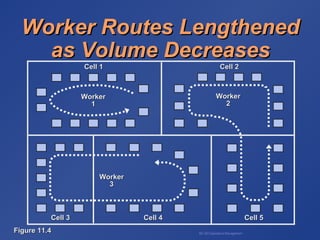
Worker Routes LengthenedWorker Routes Lengthened
as Volume Decreasesas Volume Decreases
Cell 5Cell 5
WorkerWorker
22
Cell 2Cell 2
WorkerWorker
11
Cell 1Cell 1
WorkerWorker
33
Cell 3Cell 3 Cell 4Cell 4
Figure 11.4Figure 11.4
BA 320 Operations Management
The Pull SystemThe Pull System
 Material is pulled through theMaterial is pulled through the
system when neededsystem when needed
 Reversal of traditional push systemReversal of traditional push system
where material is pushed accordingwhere material is pushed according
to a scheduleto a schedule
 Forces cooperationForces cooperation
 Prevent over and underproductionPrevent over and underproduction
BA 320 Operations Management
Kanban ProductionKanban Production
Control SystemControl System
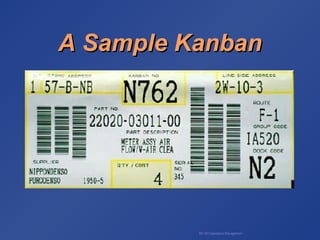
 Kanban card indicates standard quantityKanban card indicates standard quantity
of productionof production
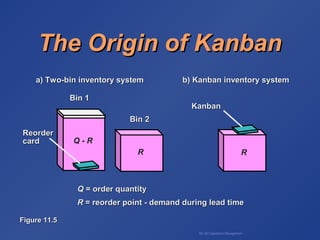
 Derived from two-bin inventory systemDerived from two-bin inventory system
 Kanban maintains discipline of pullKanban maintains discipline of pull
productionproduction
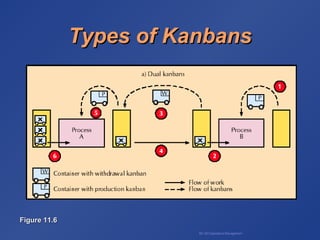
 Production kanban authorizes productionProduction kanban authorizes production
 Withdrawal kanban authorizes movementWithdrawal kanban authorizes movement
of goodsof goods
BA 320 Operations Management
A Sample KanbanA Sample Kanban
BA 320 Operations Management
The Origin of KanbanThe Origin of Kanban
a) Two-bin inventory systema) Two-bin inventory system b) Kanban inventory systemb) Kanban inventory system
ReorderReorder
cardcard
Bin 1Bin 1
Bin 2Bin 2
Q - R
KanbanKanban
RR
QQ = order quantity= order quantity
RR = reorder point - demand during lead time= reorder point - demand during lead time
Figure 11.5Figure 11.5
BA 320 Operations Management
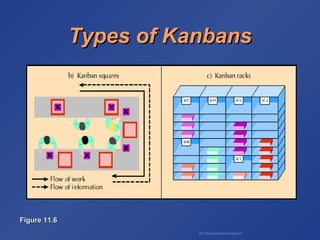
Types of KanbansTypes of Kanbans
Figure 11.6Figure 11.6
BA 320 Operations Management
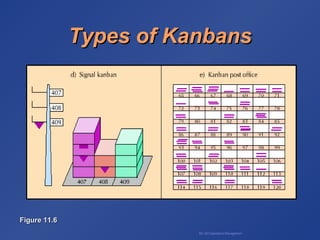
Types of KanbansTypes of Kanbans
Figure 11.6Figure 11.6
BA 320 Operations Management
Types of KanbansTypes of Kanbans
Figure 11.6Figure 11.6
BA 320 Operations Management
Types of KanbansTypes of Kanbans
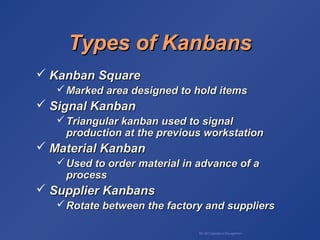
 Kanban SquareKanban Square
Marked area designed to hold itemsMarked area designed to hold items
 Signal KanbanSignal Kanban
Triangular kanban used to signalTriangular kanban used to signal
production at the previous workstationproduction at the previous workstation
 Material KanbanMaterial Kanban
Used to order material in advance of aUsed to order material in advance of a
processprocess
 Supplier KanbansSupplier Kanbans
Rotate between the factory and suppliersRotate between the factory and suppliers
BA 320 Operations Management
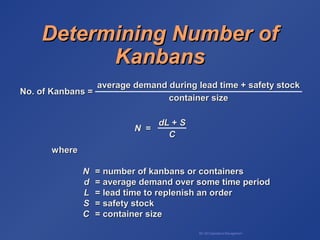
Determining Number ofDetermining Number of
KanbansKanbans
wherewhere
NN = number of kanbans or containers= number of kanbans or containers
dd = average demand over some time period= average demand over some time period
LL = lead time to replenish an order= lead time to replenish an order
SS = safety stock= safety stock
CC = container size= container size
No. of Kanbans =No. of Kanbans =
average demand during lead time + safety stockaverage demand during lead time + safety stock
container sizecontainer size
NN ==
dLdL ++ SS
CC
BA 320 Operations Management
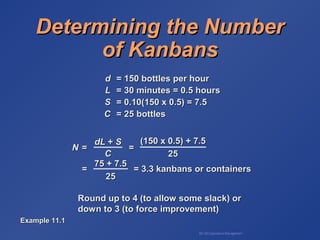
Determining the NumberDetermining the Number
of Kanbansof Kanbans
dd = 150 bottles per hour= 150 bottles per hour
LL = 30 minutes = 0.5 hours= 30 minutes = 0.5 hours
SS = 0.10(150 x 0.5) = 7.5= 0.10(150 x 0.5) = 7.5
CC = 25 bottles= 25 bottles
Round up to 4 (to allow some slack) orRound up to 4 (to allow some slack) or
down to 3 (to force improvement)down to 3 (to force improvement)
NN = == =
= = 3.3 kanbans or containers= = 3.3 kanbans or containers
dLdL ++ SS
CC
(150 x 0.5) + 7.5(150 x 0.5) + 7.5
2525
75 + 7.575 + 7.5
2525
Example 11.1Example 11.1
BA 320 Operations Management
Small-Lot ProductionSmall-Lot Production
 Requires less space & capitalRequires less space & capital
investmentinvestment
 Moves processes closer togetherMoves processes closer together
 Makes quality problems easier toMakes quality problems easier to
detectdetect
 Makes processes more dependentMakes processes more dependent
on each otheron each other
BA 320 Operations Management
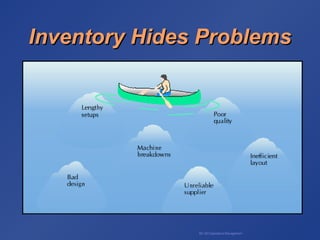
Inventory Hides ProblemsInventory Hides Problems
BA 320 Operations Management
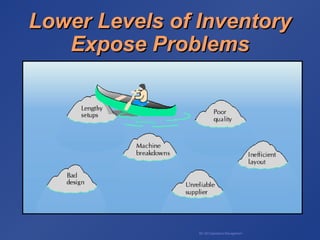
Lower Levels of InventoryLower Levels of Inventory
Expose ProblemsExpose Problems
BA 320 Operations Management
Components of Lead TimeComponents of Lead Time
 Processing timeProcessing time
 Reduce number of items or improveReduce number of items or improve
efficiencyefficiency
 Move timeMove time
 Reduce distances, simplifyReduce distances, simplify
movements, standardizemovements, standardize routingsroutings
 Waiting timeWaiting time
 Better scheduling, sufficient capacityBetter scheduling, sufficient capacity
 Setup timeSetup time
 Generally the biggest bottleneckGenerally the biggest bottleneck
BA 320 Operations Management
SMED PrinciplesSMED Principles
1.1. Separate internal setup fromSeparate internal setup from
external setupexternal setup
2.2. Convert internal setup to externalConvert internal setup to external
setupsetup
3.3. Streamline all aspects of setupStreamline all aspects of setup
4.4. Perform setup activities inPerform setup activities in
parallel or eliminate them entirelyparallel or eliminate them entirely
BA 320 Operations Management
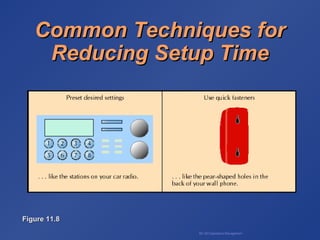
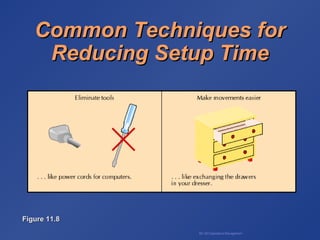
Common Techniques forCommon Techniques for
Reducing Setup TimeReducing Setup Time
Figure 11.8Figure 11.8
BA 320 Operations Management
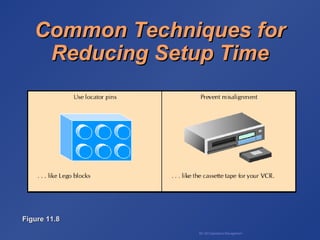
Common Techniques forCommon Techniques for
Reducing Setup TimeReducing Setup Time
Figure 11.8Figure 11.8
BA 320 Operations Management
Common Techniques forCommon Techniques for
Reducing Setup TimeReducing Setup Time
Figure 11.8Figure 11.8
BA 320 Operations Management
Uniform ProductionUniform Production
 Results from smoothing productionResults from smoothing production
requirementsrequirements
 Kanban systems can handle +/- 10%Kanban systems can handle +/- 10%
demand changesdemand changes
 Smooths demand across planningSmooths demand across planning
horizonhorizon
 Mixed-model assembly steadiesMixed-model assembly steadies
component productioncomponent production
BA 320 Operations Management
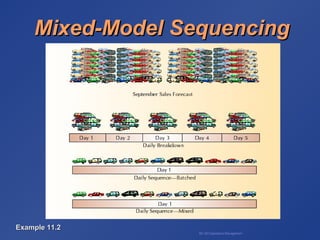
Mixed-Model SequencingMixed-Model Sequencing
Example 11.2Example 11.2
BA 320 Operations Management
Quality at the SourceQuality at the Source
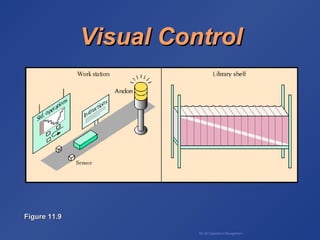
 Jidoka is authority to stop productionJidoka is authority to stop production
lineline
 Andon lights signal quality problemsAndon lights signal quality problems
 Undercapacity scheduling allows forUndercapacity scheduling allows for
planning, problem solving &planning, problem solving &
maintenancemaintenance
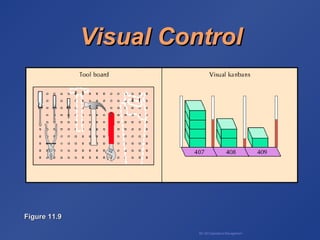
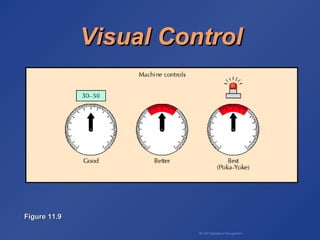
 Visual control makes problems visibleVisual control makes problems visible
 Poka-yoke prevents defectsPoka-yoke prevents defects
BA 320 Operations Management
Visual ControlVisual Control
Figure 11.9Figure 11.9
BA 320 Operations Management
Visual ControlVisual Control
Figure 11.9Figure 11.9
BA 320 Operations Management
Visual ControlVisual Control
Figure 11.9Figure 11.9
BA 320 Operations Management
KaizenKaizen
 Continuous improvementContinuous improvement
 Requires total employmentRequires total employment
involvementinvolvement
 Essence of JIT is willingness ofEssence of JIT is willingness of
workers toworkers to
Spot quality problemsSpot quality problems
Halt production when necessaryHalt production when necessary
Generate ideas for improvementGenerate ideas for improvement
Analyze problemsAnalyze problems
Perform different functionsPerform different functions
BA 320 Operations Management
Total ProductiveTotal Productive
Maintenance (TPM)Maintenance (TPM)
 Breakdown maintenanceBreakdown maintenance
 Repairs to make failed machine operationalRepairs to make failed machine operational
 Preventive maintenancePreventive maintenance
 System of periodic inspection & maintenanceSystem of periodic inspection & maintenance
to keep machines operatingto keep machines operating
 TPM combines preventive maintenance &TPM combines preventive maintenance &
total quality conceptstotal quality concepts
BA 320 Operations Management
TPM RequiresTPM Requires
Management to:Management to:
 Design products that can be easily producedDesign products that can be easily produced
on existing machineson existing machines
 Design machines for easier operation,Design machines for easier operation,
changeover, maintenancechangeover, maintenance
 Train & retrain workers to operate machinesTrain & retrain workers to operate machines
 Purchase machines that maximizePurchase machines that maximize
productive potentialproductive potential
 Design preventive maintenance planDesign preventive maintenance plan
spanning life of machinespanning life of machine
BA 320 Operations Management
Supplier PoliciesSupplier Policies
1. Locate near to the customer
2. Use small, side loaded trucks and ship
mixed loads
3. Consider establishing small warehouses
near to the customer or consolidating
warehouses with other suppliers
4. Use standardized containers and make
deliveries according to a precise delivery
schedule
5. Become a certified supplier and accept
payment at regular intervals rather than
upon delivery
BA 320 Operations Management
Benefits of JITBenefits of JIT
1.1. ReducedReduced
inventoryinventory
2.2. Improved qualityImproved quality
3.3. Lower costsLower costs
4.4. Reduced spaceReduced space
requirementsrequirements
5.5. Shorter lead timeShorter lead time
6.6. IncreasedIncreased
productivityproductivity
7.7. Greater flexibilityGreater flexibility
8.8. Better relationsBetter relations
with supplierswith suppliers
9.9. SimplifiedSimplified
scheduling andscheduling and
control activitiescontrol activities
10.10. Increased capacityIncreased capacity
11.11. Better use ofBetter use of
human resourceshuman resources
12.12. More productMore product
varietyvariety
BA 320 Operations Management
 Use JIT to finely tune anUse JIT to finely tune an
operating systemoperating system
 Somewhat different inSomewhat different in
USA than JapanUSA than Japan
 JIT is still evolvingJIT is still evolving
 JIT isn’t for everyoneJIT isn’t for everyone
JIT ImplementationJIT Implementation
BA 320 Operations Management
JIT In ServicesJIT In Services
 Competition on speed & qualityCompetition on speed & quality
 Multifunctional department storeMultifunctional department store
workersworkers
 Work cells at fast-food restaurantsWork cells at fast-food restaurants
 Just-in-time publishing forJust-in-time publishing for
textbookstextbooks
 Construction firms receivingConstruction firms receiving
material just as neededmaterial just as needed

Just in-time and lean production

  • 1.
    BA 320 OperationsManagement Chapter 11Chapter 11 Just-In-Time andJust-In-Time and Lean ProductionLean Production
  • 2.
    BA 320 OperationsManagement  Producing only what is needed,Producing only what is needed, when it is neededwhen it is needed  A philosophyA philosophy  An integrated management systemAn integrated management system  JIT’s mandate:JIT’s mandate: Eliminate all wasteEliminate all waste What is JIT ?What is JIT ?
  • 3.
    BA 320 OperationsManagement Basic Elements of JITBasic Elements of JIT 1.1. Flexible resourcesFlexible resources 2.2. Cellular layoutsCellular layouts 3.3. Pull production systemPull production system 4.4. Kanban production controlKanban production control 5.5. Small-lot productionSmall-lot production 6.6. Quick setupsQuick setups 7.7. Uniform production levelsUniform production levels 8.8. Quality at the sourceQuality at the source 9.9. Total productive maintenanceTotal productive maintenance 10.10. Supplier networksSupplier networks
  • 4.
    BA 320 OperationsManagement Figure 11.1Figure 11.1 Waste in OperationsWaste in Operations
  • 5.
    BA 320 OperationsManagement Figure 11.1Figure 11.1 Waste in OperationsWaste in Operations
  • 6.
    BA 320 OperationsManagement Figure 11.1Figure 11.1 Waste in OperationsWaste in Operations
  • 7.
    BA 320 OperationsManagement Flexible ResourcesFlexible Resources  Multifunctional workersMultifunctional workers  General purpose machinesGeneral purpose machines  Study operators & improveStudy operators & improve operationsoperations
  • 8.
    BA 320 OperationsManagement Standard Operating RoutineStandard Operating Routine for a Workerfor a Worker Standard Operating Routine Sheet 1 Worker: Russell Cycle Time: 2 min Order of Operations time Operations :10 :20 :30 :40 :50 1:00 1:10 1:20 1:30 1:40 1:50 2:00 Pick up material Unload/ load machine 1 Unload/ load machine 2 Unload/ load machine 3 Inspect/ pack Figure 11.2Figure 11.2
  • 9.
    BA 320 OperationsManagement Cellular LayoutsCellular Layouts  Group dissimilar machines inGroup dissimilar machines in manufacturing cell to producemanufacturing cell to produce family of partsfamily of parts  Work flows in one directionWork flows in one direction through cellthrough cell  Cycle time adjusted by changingCycle time adjusted by changing worker pathsworker paths
  • 10.
    BA 320 OperationsManagement Manufacturing Cell withManufacturing Cell with Worker RoutesWorker Routes WorkerWorker 11 WorkerWorker 22 WorkerWorker 33 Cell 1Cell 1 Figure 11.3Figure 11.3
  • 11.
    BA 320 OperationsManagement Worker Routes LengthenedWorker Routes Lengthened as Volume Decreasesas Volume Decreases Cell 5Cell 5 WorkerWorker 22 Cell 2Cell 2 WorkerWorker 11 Cell 1Cell 1 WorkerWorker 33 Cell 3Cell 3 Cell 4Cell 4 Figure 11.4Figure 11.4
  • 12.
    BA 320 OperationsManagement The Pull SystemThe Pull System  Material is pulled through theMaterial is pulled through the system when neededsystem when needed  Reversal of traditional push systemReversal of traditional push system where material is pushed accordingwhere material is pushed according to a scheduleto a schedule  Forces cooperationForces cooperation  Prevent over and underproductionPrevent over and underproduction
  • 13.
    BA 320 OperationsManagement Kanban ProductionKanban Production Control SystemControl System  Kanban card indicates standard quantityKanban card indicates standard quantity of productionof production  Derived from two-bin inventory systemDerived from two-bin inventory system  Kanban maintains discipline of pullKanban maintains discipline of pull productionproduction  Production kanban authorizes productionProduction kanban authorizes production  Withdrawal kanban authorizes movementWithdrawal kanban authorizes movement of goodsof goods
  • 14.
    BA 320 OperationsManagement A Sample KanbanA Sample Kanban
  • 15.
    BA 320 OperationsManagement The Origin of KanbanThe Origin of Kanban a) Two-bin inventory systema) Two-bin inventory system b) Kanban inventory systemb) Kanban inventory system ReorderReorder cardcard Bin 1Bin 1 Bin 2Bin 2 Q - R KanbanKanban RR QQ = order quantity= order quantity RR = reorder point - demand during lead time= reorder point - demand during lead time Figure 11.5Figure 11.5
  • 16.
    BA 320 OperationsManagement Types of KanbansTypes of Kanbans Figure 11.6Figure 11.6
  • 17.
    BA 320 OperationsManagement Types of KanbansTypes of Kanbans Figure 11.6Figure 11.6
  • 18.
    BA 320 OperationsManagement Types of KanbansTypes of Kanbans Figure 11.6Figure 11.6
  • 19.
    BA 320 OperationsManagement Types of KanbansTypes of Kanbans  Kanban SquareKanban Square Marked area designed to hold itemsMarked area designed to hold items  Signal KanbanSignal Kanban Triangular kanban used to signalTriangular kanban used to signal production at the previous workstationproduction at the previous workstation  Material KanbanMaterial Kanban Used to order material in advance of aUsed to order material in advance of a processprocess  Supplier KanbansSupplier Kanbans Rotate between the factory and suppliersRotate between the factory and suppliers
  • 20.
    BA 320 OperationsManagement Determining Number ofDetermining Number of KanbansKanbans wherewhere NN = number of kanbans or containers= number of kanbans or containers dd = average demand over some time period= average demand over some time period LL = lead time to replenish an order= lead time to replenish an order SS = safety stock= safety stock CC = container size= container size No. of Kanbans =No. of Kanbans = average demand during lead time + safety stockaverage demand during lead time + safety stock container sizecontainer size NN == dLdL ++ SS CC
  • 21.
    BA 320 OperationsManagement Determining the NumberDetermining the Number of Kanbansof Kanbans dd = 150 bottles per hour= 150 bottles per hour LL = 30 minutes = 0.5 hours= 30 minutes = 0.5 hours SS = 0.10(150 x 0.5) = 7.5= 0.10(150 x 0.5) = 7.5 CC = 25 bottles= 25 bottles Round up to 4 (to allow some slack) orRound up to 4 (to allow some slack) or down to 3 (to force improvement)down to 3 (to force improvement) NN = == = = = 3.3 kanbans or containers= = 3.3 kanbans or containers dLdL ++ SS CC (150 x 0.5) + 7.5(150 x 0.5) + 7.5 2525 75 + 7.575 + 7.5 2525 Example 11.1Example 11.1
  • 22.
    BA 320 OperationsManagement Small-Lot ProductionSmall-Lot Production  Requires less space & capitalRequires less space & capital investmentinvestment  Moves processes closer togetherMoves processes closer together  Makes quality problems easier toMakes quality problems easier to detectdetect  Makes processes more dependentMakes processes more dependent on each otheron each other
  • 23.
    BA 320 OperationsManagement Inventory Hides ProblemsInventory Hides Problems
  • 24.
    BA 320 OperationsManagement Lower Levels of InventoryLower Levels of Inventory Expose ProblemsExpose Problems
  • 25.
    BA 320 OperationsManagement Components of Lead TimeComponents of Lead Time  Processing timeProcessing time  Reduce number of items or improveReduce number of items or improve efficiencyefficiency  Move timeMove time  Reduce distances, simplifyReduce distances, simplify movements, standardizemovements, standardize routingsroutings  Waiting timeWaiting time  Better scheduling, sufficient capacityBetter scheduling, sufficient capacity  Setup timeSetup time  Generally the biggest bottleneckGenerally the biggest bottleneck
  • 26.
    BA 320 OperationsManagement SMED PrinciplesSMED Principles 1.1. Separate internal setup fromSeparate internal setup from external setupexternal setup 2.2. Convert internal setup to externalConvert internal setup to external setupsetup 3.3. Streamline all aspects of setupStreamline all aspects of setup 4.4. Perform setup activities inPerform setup activities in parallel or eliminate them entirelyparallel or eliminate them entirely
  • 27.
    BA 320 OperationsManagement Common Techniques forCommon Techniques for Reducing Setup TimeReducing Setup Time Figure 11.8Figure 11.8
  • 28.
    BA 320 OperationsManagement Common Techniques forCommon Techniques for Reducing Setup TimeReducing Setup Time Figure 11.8Figure 11.8
  • 29.
    BA 320 OperationsManagement Common Techniques forCommon Techniques for Reducing Setup TimeReducing Setup Time Figure 11.8Figure 11.8
  • 30.
    BA 320 OperationsManagement Uniform ProductionUniform Production  Results from smoothing productionResults from smoothing production requirementsrequirements  Kanban systems can handle +/- 10%Kanban systems can handle +/- 10% demand changesdemand changes  Smooths demand across planningSmooths demand across planning horizonhorizon  Mixed-model assembly steadiesMixed-model assembly steadies component productioncomponent production
  • 31.
    BA 320 OperationsManagement Mixed-Model SequencingMixed-Model Sequencing Example 11.2Example 11.2
  • 32.
    BA 320 OperationsManagement Quality at the SourceQuality at the Source  Jidoka is authority to stop productionJidoka is authority to stop production lineline  Andon lights signal quality problemsAndon lights signal quality problems  Undercapacity scheduling allows forUndercapacity scheduling allows for planning, problem solving &planning, problem solving & maintenancemaintenance  Visual control makes problems visibleVisual control makes problems visible  Poka-yoke prevents defectsPoka-yoke prevents defects
  • 33.
    BA 320 OperationsManagement Visual ControlVisual Control Figure 11.9Figure 11.9
  • 34.
    BA 320 OperationsManagement Visual ControlVisual Control Figure 11.9Figure 11.9
  • 35.
    BA 320 OperationsManagement Visual ControlVisual Control Figure 11.9Figure 11.9
  • 36.
    BA 320 OperationsManagement KaizenKaizen  Continuous improvementContinuous improvement  Requires total employmentRequires total employment involvementinvolvement  Essence of JIT is willingness ofEssence of JIT is willingness of workers toworkers to Spot quality problemsSpot quality problems Halt production when necessaryHalt production when necessary Generate ideas for improvementGenerate ideas for improvement Analyze problemsAnalyze problems Perform different functionsPerform different functions
  • 37.
    BA 320 OperationsManagement Total ProductiveTotal Productive Maintenance (TPM)Maintenance (TPM)  Breakdown maintenanceBreakdown maintenance  Repairs to make failed machine operationalRepairs to make failed machine operational  Preventive maintenancePreventive maintenance  System of periodic inspection & maintenanceSystem of periodic inspection & maintenance to keep machines operatingto keep machines operating  TPM combines preventive maintenance &TPM combines preventive maintenance & total quality conceptstotal quality concepts
  • 38.
    BA 320 OperationsManagement TPM RequiresTPM Requires Management to:Management to:  Design products that can be easily producedDesign products that can be easily produced on existing machineson existing machines  Design machines for easier operation,Design machines for easier operation, changeover, maintenancechangeover, maintenance  Train & retrain workers to operate machinesTrain & retrain workers to operate machines  Purchase machines that maximizePurchase machines that maximize productive potentialproductive potential  Design preventive maintenance planDesign preventive maintenance plan spanning life of machinespanning life of machine
  • 39.
    BA 320 OperationsManagement Supplier PoliciesSupplier Policies 1. Locate near to the customer 2. Use small, side loaded trucks and ship mixed loads 3. Consider establishing small warehouses near to the customer or consolidating warehouses with other suppliers 4. Use standardized containers and make deliveries according to a precise delivery schedule 5. Become a certified supplier and accept payment at regular intervals rather than upon delivery
  • 40.
    BA 320 OperationsManagement Benefits of JITBenefits of JIT 1.1. ReducedReduced inventoryinventory 2.2. Improved qualityImproved quality 3.3. Lower costsLower costs 4.4. Reduced spaceReduced space requirementsrequirements 5.5. Shorter lead timeShorter lead time 6.6. IncreasedIncreased productivityproductivity 7.7. Greater flexibilityGreater flexibility 8.8. Better relationsBetter relations with supplierswith suppliers 9.9. SimplifiedSimplified scheduling andscheduling and control activitiescontrol activities 10.10. Increased capacityIncreased capacity 11.11. Better use ofBetter use of human resourceshuman resources 12.12. More productMore product varietyvariety
  • 41.
    BA 320 OperationsManagement  Use JIT to finely tune anUse JIT to finely tune an operating systemoperating system  Somewhat different inSomewhat different in USA than JapanUSA than Japan  JIT is still evolvingJIT is still evolving  JIT isn’t for everyoneJIT isn’t for everyone JIT ImplementationJIT Implementation
  • 42.
    BA 320 OperationsManagement JIT In ServicesJIT In Services  Competition on speed & qualityCompetition on speed & quality  Multifunctional department storeMultifunctional department store workersworkers  Work cells at fast-food restaurantsWork cells at fast-food restaurants  Just-in-time publishing forJust-in-time publishing for textbookstextbooks  Construction firms receivingConstruction firms receiving material just as neededmaterial just as needed

Editor's Notes

  • #2 <number>
  • #3 <number>
  • #4 <number>
  • #5 <number>
  • #6 <number>
  • #7 <number>
  • #8 <number>
  • #9 <number>
  • #10 <number>
  • #11 <number>
  • #12 <number>
  • #14 <number>
  • #15 <number>
  • #16 <number>
  • #17 <number>
  • #18 <number>
  • #19 <number>
  • #20 <number>
  • #21 <number>
  • #22 <number>
  • #23 <number>
  • #24 <number>
  • #25 <number>
  • #27 <number>
  • #31 <number>
  • #32 <number>
  • #33 <number>
  • #34 <number>
  • #35 <number>
  • #36 <number>
  • #37 <number>
  • #38 <number>
  • #39 <number>
  • #40 <number>
  • #41 <number>
  • #42 <number>
  • #43 <number>