by Shivam Kumar
40925511116
• Identifies need of education and training.
• Maintains fairness in salary, promotions
and other benefits to workers.
• Helps in assigning workers the job they
can excel in.
• Provides a feedback to the worker and
helps them to work more effectively.
Performance rating is a step in the work
measurement in which the analyst observes the
worker's performance and records a value
representing that performance relative to the
analyst's concept of standard performance.
• Pace Rating
• Westinghouse System of Rating
• Objective Rating
• Synthetic Rating
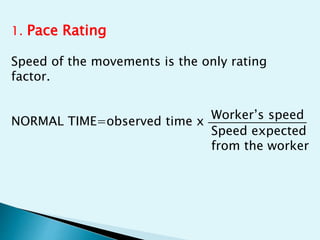
1. Pace Rating
Speed of the movements is the only rating
factor.
NORMAL TIME=observed time x
Worker’s speed
Speed expected
from the worker
2. Westinghouse System of Rating
This method considers four factors:
• Skill
• Effort
• Conditions
• Consistency
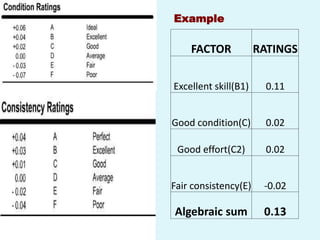
FACTOR RATINGS
Excellent skill(B1) 0.11
Good condition(C) 0.02
Good effort(C2) 0.02
Fair consistency(E) -0.02
Algebraic sum 0.13
Example
Ques. Let the time observed for an operation be 0.6
minutes and a worker while being observed, is
estimated as give in the table. What is the normal
time?
Ans. The algebraic sum indicates that worker is 13%
above average or his pace is 113%.
So, Rating factor = 1.13
NORMAL TIME = 0.6*1.13 = 0.678 min
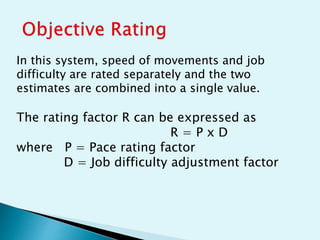
In this system, speed of movements and job
difficulty are rated separately and the two
estimates are combined into a single value.
The rating factor R can be expressed as
R = P x D
where P = Pace rating factor
D = Job difficulty adjustment factor
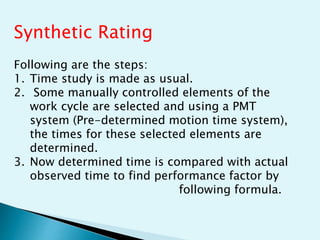
Synthetic Rating
Following are the steps:
1. Time study is made as usual.
2. Some manually controlled elements of the
work cycle are selected and using a PMT
system (Pre-determined motion time system),
the times for these selected elements are
determined.
3. Now determined time is compared with actual
observed time to find performance factor by
following formula.
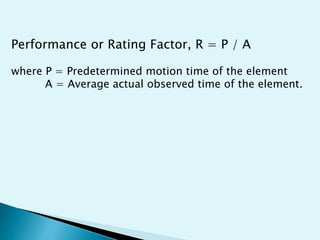
Performance or Rating Factor, R = P / A
where P = Predetermined motion time of the element
A = Average actual observed time of the element.
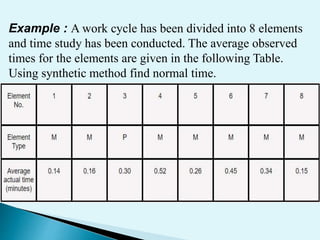
Example : A work cycle has been divided into 8 elements
and time study has been conducted. The average observed
times for the elements are given in the following Table.
Using synthetic method find normal time.
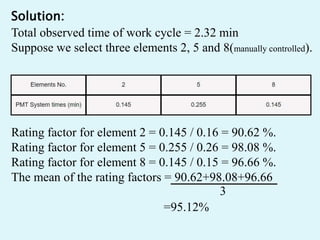
Solution:
Total observed time of work cycle = 2.32 min
Suppose we select three elements 2, 5 and 8(manually controlled).
Rating factor for element 2 = 0.145 / 0.16 = 90.62 %.
Rating factor for element 5 = 0.255 / 0.26 = 98.08 %.
Rating factor for element 8 = 0.145 / 0.15 = 96.66 %.
The mean of the rating factors = 90.62+98.08+96.66
=95.12%
3
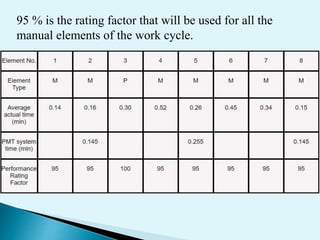
95 % is the rating factor that will be used for all the
manual elements of the work cycle.
Normal Cycle Time
= 0.95(0.14+0.16+0.52+0.26+0.45+0.34+0.15) +1.00(0.30)
=1.92+0.30
=2.22 minutes
Performance rating
Performance rating

Performance rating

  • 1.
  • 2.
    • Identifies needof education and training. • Maintains fairness in salary, promotions and other benefits to workers. • Helps in assigning workers the job they can excel in. • Provides a feedback to the worker and helps them to work more effectively.
  • 3.
    Performance rating isa step in the work measurement in which the analyst observes the worker's performance and records a value representing that performance relative to the analyst's concept of standard performance.
  • 4.
    • Pace Rating •Westinghouse System of Rating • Objective Rating • Synthetic Rating
  • 5.
    1. Pace Rating Speedof the movements is the only rating factor. NORMAL TIME=observed time x Worker’s speed Speed expected from the worker
  • 7.
    2. Westinghouse Systemof Rating This method considers four factors: • Skill • Effort • Conditions • Consistency
  • 8.
    FACTOR RATINGS Excellent skill(B1)0.11 Good condition(C) 0.02 Good effort(C2) 0.02 Fair consistency(E) -0.02 Algebraic sum 0.13 Example
  • 9.
    Ques. Let thetime observed for an operation be 0.6 minutes and a worker while being observed, is estimated as give in the table. What is the normal time? Ans. The algebraic sum indicates that worker is 13% above average or his pace is 113%. So, Rating factor = 1.13 NORMAL TIME = 0.6*1.13 = 0.678 min
  • 10.
    In this system,speed of movements and job difficulty are rated separately and the two estimates are combined into a single value. The rating factor R can be expressed as R = P x D where P = Pace rating factor D = Job difficulty adjustment factor
  • 12.
    Synthetic Rating Following arethe steps: 1. Time study is made as usual. 2. Some manually controlled elements of the work cycle are selected and using a PMT system (Pre-determined motion time system), the times for these selected elements are determined. 3. Now determined time is compared with actual observed time to find performance factor by following formula.
  • 13.
    Performance or RatingFactor, R = P / A where P = Predetermined motion time of the element A = Average actual observed time of the element.
  • 14.
    Example : Awork cycle has been divided into 8 elements and time study has been conducted. The average observed times for the elements are given in the following Table. Using synthetic method find normal time.
  • 15.
    Solution: Total observed timeof work cycle = 2.32 min Suppose we select three elements 2, 5 and 8(manually controlled). Rating factor for element 2 = 0.145 / 0.16 = 90.62 %. Rating factor for element 5 = 0.255 / 0.26 = 98.08 %. Rating factor for element 8 = 0.145 / 0.15 = 96.66 %. The mean of the rating factors = 90.62+98.08+96.66 =95.12% 3
  • 16.
    95 % isthe rating factor that will be used for all the manual elements of the work cycle.
  • 17.
    Normal Cycle Time =0.95(0.14+0.16+0.52+0.26+0.45+0.34+0.15) +1.00(0.30) =1.92+0.30 =2.22 minutes

Editor's Notes

  • #6 The time study personnel observes the speed of movements of worker against a standard expected pace and notes the relationship b/w them as a rating factor. this is also called the speed rating method, the time study person judges the operator’s speed of movements, i.e. the rate at which he is applying himself, or in other words "how fast" the operator performs the motions involved. Skill:It is demonstrated by co-ordination of mind and hands. A person's skill in a given operation increases with his experience on the job, because increased familiarity with work brings speed, smoothness of motions and freedom from hesitations.
  • #9 By algebraically combining the ratings with respect to each of the four factors, the final performance-rating factor is estimated.
  • #10 If a worker gets a negative value, he is considered below average.
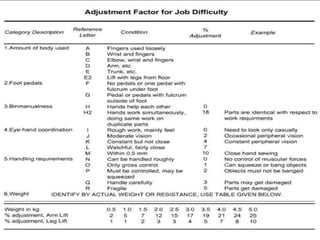
  • #11 The rating of job difficulty is done by selecting adjustment factors corresponding to following characteristics of operation.
  • #13 This system has advantages over other as it does not rely on the judgment of time study person and gives consistent results.
  • #14 The overall rating factor is the mean of rating factors determined for the selected elements. This is applied uniformly to all the manually controlled elements of the work cycle.