The Need for a
Balanced Measurement
SystemUsing Different Perspectives to Create
Meaningful Measures
Bill Rabung and Brad Sickles
U.S. Department of Labor
ETA Performance Accountability Team
The Mission of WIA…
“…“…increase the employment,increase the employment,
retention, and earnings ofretention, and earnings of
participants, and, as a result, improve the quality ofparticipants, and, as a result, improve the quality of
the workforce, reduce welfare dependency, andthe workforce, reduce welfare dependency, and
enhance the productivity and competitiveness ofenhance the productivity and competitiveness of
the Nation" - Sec. 106the Nation" - Sec. 106
National Core and Customer
Satisfaction Measures…
 17 core and customer satisfaction measures
 Selection of measures driven by law
 The measures focus on program impacts, not on
operations or strategies
 Apply separately to States and local WIBs
 Performance is assessed annually
 Performance levels are negotiated
Incentives and sanctions based on performance
The Need for a Balanced Measurement
Approach to Manage Performance…
 The national measures focus on “bottom line”
results, not the drivers of performance
 The need for timely results
 There is a need for measures that focus on program
business operations and outputs
 Customer impact measures provide a limited picture
of organizational health
 Customer impact measures alone are insufficient to
assess continuous improvement
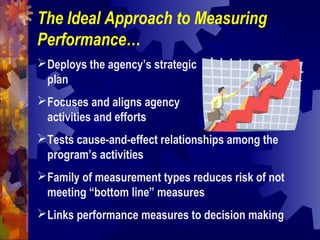
The Ideal Approach to Measuring
Performance…
Deploys the agency’s strategic
plan
Focuses and aligns agency
activities and efforts
Tests cause-and-effect relationships among the
program’s activities
Family of measurement types reduces risk of not
meeting “bottom line” measures
Links performance measures to decision making
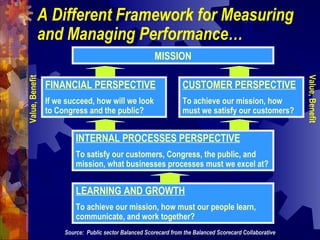
A Different Framework for Measuring
and Managing Performance…
MISSION
CUSTOMER PERSPECTIVE
To achieve our mission, how
must we satisfy our customers?
FINANCIAL PERSPECTIVE
If we succeed, how will we look
to Congress and the public?
INTERNAL PROCESSES PERSPECTIVE
To satisfy our customers, Congress, the public, and
mission, what businesses processes must we excel at?
LEARNING AND GROWTH
To achieve our mission, how must our people learn,
communicate, and work together?
Value,Benefit
Value,Benefit
Source: Public sector Balanced Scorecard from the Balanced Scorecard Collaborative
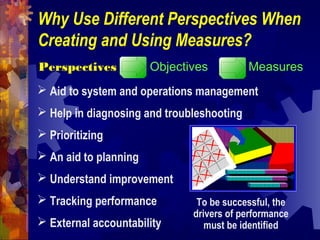
Why Use Different Perspectives When
Creating and Using Measures?
 Aid to system and operations management
 Help in diagnosing and troubleshooting
 Prioritizing
 An aid to planning
 Understand improvement
 Tracking performance
 External accountability
To be successful, the
drivers of performance
must be identified
Perspectives Objectives Measures
Use a Strategy Map to Develop Objectives
 Identify strategic themes and group them under the
appropriate perspective
 Create a strategy map to visualize the interaction of
individual activities in the larger system
For each identified strategic theme, identify what you
are trying to achieve and the obstacles you face
Develop measurable objectives that specify numeric
target levels, where appropriate
Limit objectives to major program elements
Perspectives Objectives Measures
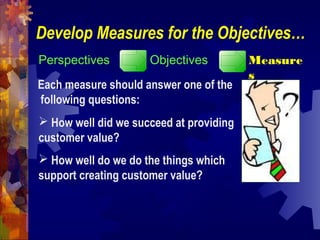
Develop Measures for the Objectives…
 How well did we succeed at providing
customer value?
 How well do we do the things which
support creating customer value?
Each measure should answer one of the
following questions:
Perspectives Objectives Measure
s
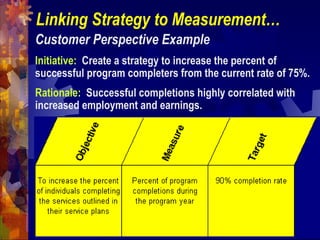
Linking Strategy to Measurement…
Customer Perspective Example
Initiative: Create a strategy to increase the percent of
successful program completers from the current rate of 75%.
Rationale: Successful completions highly correlated with
increased employment and earnings.
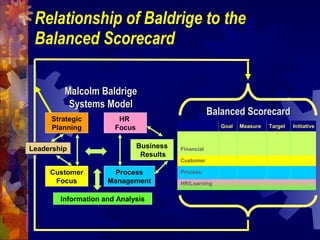
Goal Measure Target Initiative
Financial
Customer
Process
HR/Learning
Leadership Business
Results
Strategic
Planning
Customer
Focus
HR
Focus
Process
Management
Information and Analysis
Relationship of Baldrige to the
Balanced Scorecard
Malcolm BaldrigeMalcolm Baldrige
Systems ModelSystems Model
Balanced ScorecardBalanced Scorecard
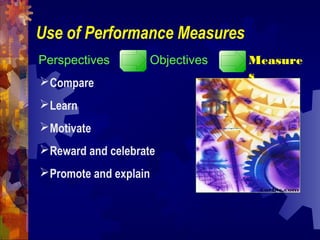
Compare
Learn
Motivate
Reward and celebrate
Promote and explain
Perspectives Objectives Measure
s
Use of Performance Measures
Wherever the product of a public organization has not
been monitored in a way that ties performance to
reward, the introduction of an effective monitoring
system will yield a fifty percent improvement in the
product in the short run.
Chase’s Law on Measurement…
In otherwords…
Whatgets measuredgets done
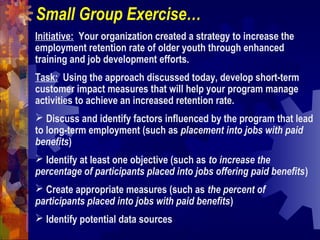
Small Group Exercise
Small Group Exercise…
Initiative: Your organization created a strategy to increase the
employment retention rate of older youth through enhanced
training and job development efforts.
Task: Using the approach discussed today, develop short-term
customer impact measures that will help your program manage
activities to achieve an increased retention rate.
 Discuss and identify factors influenced by the program that lead
to long-term employment (such as placement into jobs with paid
benefits)
 Identify at least one objective (such as to increase the
percentage of participants placed into jobs offering paid benefits)
 Create appropriate measures (such as the percent of
participants placed into jobs with paid benefits)
 Identify potential data sources
For More Information…For More Information…
Balanced Scorecard Collaborative
Phone: 781.259.3737
www.bscol.com
Workforce Excellence Network
Phone: 202.693.2990
www.workforce-excellence.net

The need for a balanced measurement system

  • 1.
    The Need fora Balanced Measurement SystemUsing Different Perspectives to Create Meaningful Measures Bill Rabung and Brad Sickles U.S. Department of Labor ETA Performance Accountability Team
  • 2.
    The Mission ofWIA… “…“…increase the employment,increase the employment, retention, and earnings ofretention, and earnings of participants, and, as a result, improve the quality ofparticipants, and, as a result, improve the quality of the workforce, reduce welfare dependency, andthe workforce, reduce welfare dependency, and enhance the productivity and competitiveness ofenhance the productivity and competitiveness of the Nation" - Sec. 106the Nation" - Sec. 106
  • 3.
    National Core andCustomer Satisfaction Measures…  17 core and customer satisfaction measures  Selection of measures driven by law  The measures focus on program impacts, not on operations or strategies  Apply separately to States and local WIBs  Performance is assessed annually  Performance levels are negotiated Incentives and sanctions based on performance
  • 4.
    The Need fora Balanced Measurement Approach to Manage Performance…  The national measures focus on “bottom line” results, not the drivers of performance  The need for timely results  There is a need for measures that focus on program business operations and outputs  Customer impact measures provide a limited picture of organizational health  Customer impact measures alone are insufficient to assess continuous improvement
  • 5.
    The Ideal Approachto Measuring Performance… Deploys the agency’s strategic plan Focuses and aligns agency activities and efforts Tests cause-and-effect relationships among the program’s activities Family of measurement types reduces risk of not meeting “bottom line” measures Links performance measures to decision making
  • 6.
    A Different Frameworkfor Measuring and Managing Performance… MISSION CUSTOMER PERSPECTIVE To achieve our mission, how must we satisfy our customers? FINANCIAL PERSPECTIVE If we succeed, how will we look to Congress and the public? INTERNAL PROCESSES PERSPECTIVE To satisfy our customers, Congress, the public, and mission, what businesses processes must we excel at? LEARNING AND GROWTH To achieve our mission, how must our people learn, communicate, and work together? Value,Benefit Value,Benefit Source: Public sector Balanced Scorecard from the Balanced Scorecard Collaborative
  • 7.
    Why Use DifferentPerspectives When Creating and Using Measures?  Aid to system and operations management  Help in diagnosing and troubleshooting  Prioritizing  An aid to planning  Understand improvement  Tracking performance  External accountability To be successful, the drivers of performance must be identified Perspectives Objectives Measures
  • 8.
    Use a StrategyMap to Develop Objectives  Identify strategic themes and group them under the appropriate perspective  Create a strategy map to visualize the interaction of individual activities in the larger system For each identified strategic theme, identify what you are trying to achieve and the obstacles you face Develop measurable objectives that specify numeric target levels, where appropriate Limit objectives to major program elements Perspectives Objectives Measures
  • 9.
    Develop Measures forthe Objectives…  How well did we succeed at providing customer value?  How well do we do the things which support creating customer value? Each measure should answer one of the following questions: Perspectives Objectives Measure s
  • 10.
    Linking Strategy toMeasurement… Customer Perspective Example Initiative: Create a strategy to increase the percent of successful program completers from the current rate of 75%. Rationale: Successful completions highly correlated with increased employment and earnings.
  • 11.
    Goal Measure TargetInitiative Financial Customer Process HR/Learning Leadership Business Results Strategic Planning Customer Focus HR Focus Process Management Information and Analysis Relationship of Baldrige to the Balanced Scorecard Malcolm BaldrigeMalcolm Baldrige Systems ModelSystems Model Balanced ScorecardBalanced Scorecard
  • 12.
    Compare Learn Motivate Reward and celebrate Promoteand explain Perspectives Objectives Measure s Use of Performance Measures
  • 13.
    Wherever the productof a public organization has not been monitored in a way that ties performance to reward, the introduction of an effective monitoring system will yield a fifty percent improvement in the product in the short run. Chase’s Law on Measurement… In otherwords… Whatgets measuredgets done
  • 14.
  • 15.
    Small Group Exercise… Initiative:Your organization created a strategy to increase the employment retention rate of older youth through enhanced training and job development efforts. Task: Using the approach discussed today, develop short-term customer impact measures that will help your program manage activities to achieve an increased retention rate.  Discuss and identify factors influenced by the program that lead to long-term employment (such as placement into jobs with paid benefits)  Identify at least one objective (such as to increase the percentage of participants placed into jobs offering paid benefits)  Create appropriate measures (such as the percent of participants placed into jobs with paid benefits)  Identify potential data sources
  • 16.
    For More Information…ForMore Information… Balanced Scorecard Collaborative Phone: 781.259.3737 www.bscol.com Workforce Excellence Network Phone: 202.693.2990 www.workforce-excellence.net

Editor's Notes

  • #6 Since that time, there has been a flurry of activity and learning as we discover what the Balanced Scorecard is, and what it means for what we do in state government. The Balanced Scorecard is a performance management system that: Aligns and focuses the efforts and resources of the organization Builds on existing performance management practices that we are already using To create long-term value. The scorecard is not just a different way of displaying performance measures -- it’s all about using them for decision making. The Balanced Scorecard was originally developed for the private sector by Bob Kaplan and David Norton at Harvard University. Bob Kaplan, and another Harvard professor, Dutch Leonard, led study sessions on the Balanced Scorecard for Executive Cabinet directors this past July. They are sharing their expertise with us as we implement the Balanced Scorecard, and, in return, we are their next Harvard Business School case study.
  • #7 Since that time, there has been a flurry of activity and learning as we discover what the Balanced Scorecard is, and what it means for what we do in state government. The Balanced Scorecard is a performance management system that: Aligns and focuses the efforts and resources of the organization Builds on existing performance management practices that we are already using To create long-term value. The scorecard is not just a different way of displaying performance measures -- it’s all about using them for decision making. The Balanced Scorecard was originally developed for the private sector by Bob Kaplan and David Norton at Harvard University. Bob Kaplan, and another Harvard professor, Dutch Leonard, led study sessions on the Balanced Scorecard for Executive Cabinet directors this past July. They are sharing their expertise with us as we implement the Balanced Scorecard, and, in return, we are their next Harvard Business School case study.
  • #12 Our state’s quality initiative is based on the Malcolm Baldrige National Quality Award model, so you may be wondering about the relationship between the Balanced Scorecard and quality management. This slide puts the two models side by side to show the relationships and strong compatibilities. Leadership drives the organization. Strategic planning sets the goals, measures, targets, and links to activities and initiatives. The Business Results category of the Baldrige corresponds to both the Value and Benefit and Financial and Social Cost perspectives of the Scorecard. Measures from the Customer Focus section of the Baldrige correspond to the Customers and Constituents perspectives of the Scorecard. Measures from the Process Management section of the Baldrige correspond to the Internal Business Process perspective of the Scorecard. Finally, measures from the the Information and Analysis and Human Resource Focus sections of the Baldrige correspond to the Learning and Growth perspective of the Scorecard. While the roles played by the Baldrige criteria and the Balanced Scorecard differ, you can see that they have drawn similar conclusions about what factors contribute to a well functioning organization.