By-  Shashank kulshrestha
What is JIT ? “ A philosophy of manufacturing based on planned elimination of waste and continuous improvement of productivity ……”
Emergence of JIT Evolved in Japan after World War II, as a result of their diminishing market share in the auto industry.  Toyota Motor Company - first to implement fully functioning and successful JIT system, in 1970’s. Japanese Manufacturers looked for a way to gain the most efficient use of limited resources. They worked on "optimal cost/quality relationship.
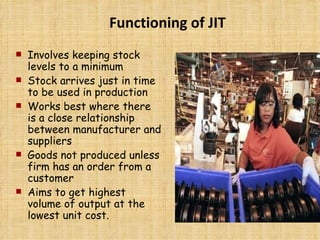
Involves keeping stock levels to a minimum Stock arrives just in time to be used in production Works best where there is a close relationship between manufacturer and suppliers Goods not produced unless firm has an order from a customer Aims to get highest volume of output at the lowest unit cost. Functioning of JIT
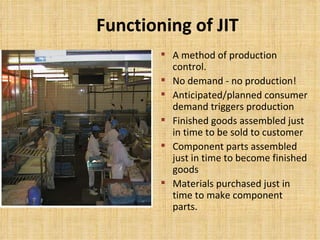
Functioning of JIT A method of production control. No demand - no production! Anticipated/planned consumer demand triggers production Finished goods assembled just in time to be sold to customer Component parts assembled just in time to become finished goods Materials purchased just in time to make component parts.
JIT Purchasing Just In Time (JIT) Purchasing Is Directed Toward The Reduction of  Waste (That Is Present At Incoming Inspection, Excess Inventory and Poor Quality) Delay
Objectives of JIT Purchasing To Reduce All Non-Value-Added Activities. Elimination Of In-Plant Inventory. Elimination Of In-Transit Inventory Quality And Reliability Improvement
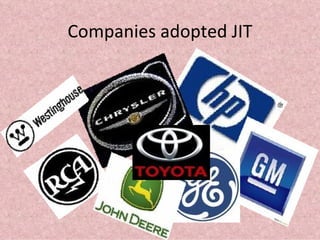
Companies adopted JIT
Some companies, benefited by adopting JIT
Dell  do not have to tie up capital in stock  which means they can invest it in other areas of the business, such as R&D or promotion, to increase sales. Dell require  less space for stock  which means they save money on storage facilities which will increase their profit margins.  Dell have a  high dependence on their suppliers  and should the suppliers fail them, it is Dell’s reputation and sales which would suffer if they were unable to meet demand from their customers. Dell may be  unable to benefit from bulk-buy discounts  which leaves them with an option of increasing the price to the customer or reducing their own profit margin.
Advantages of JIT Capital not tied up in stocks Less space required for stock Closer relationships with suppliers Reduced deterioration Less vulnerability to fashion and technology changes Reduction in stockholding costs Increase in cash flow
Disadvantages of JIT Danger of disrupted production due to non-arrival of supplies Danger of lost sales High dependence on suppliers Less time for quality control on arrival of materials Increased ordering and admin costs May lose bulk-buying discounts

Just In Time

  • 1.
    By- Shashankkulshrestha
  • 2.
    What is JIT? “ A philosophy of manufacturing based on planned elimination of waste and continuous improvement of productivity ……”
  • 3.
    Emergence of JITEvolved in Japan after World War II, as a result of their diminishing market share in the auto industry. Toyota Motor Company - first to implement fully functioning and successful JIT system, in 1970’s. Japanese Manufacturers looked for a way to gain the most efficient use of limited resources. They worked on "optimal cost/quality relationship.
  • 4.
    Involves keeping stocklevels to a minimum Stock arrives just in time to be used in production Works best where there is a close relationship between manufacturer and suppliers Goods not produced unless firm has an order from a customer Aims to get highest volume of output at the lowest unit cost. Functioning of JIT
  • 5.
    Functioning of JITA method of production control. No demand - no production! Anticipated/planned consumer demand triggers production Finished goods assembled just in time to be sold to customer Component parts assembled just in time to become finished goods Materials purchased just in time to make component parts.
  • 6.
    JIT Purchasing JustIn Time (JIT) Purchasing Is Directed Toward The Reduction of Waste (That Is Present At Incoming Inspection, Excess Inventory and Poor Quality) Delay
  • 7.
    Objectives of JITPurchasing To Reduce All Non-Value-Added Activities. Elimination Of In-Plant Inventory. Elimination Of In-Transit Inventory Quality And Reliability Improvement
  • 8.
  • 9.
  • 10.
    Dell donot have to tie up capital in stock which means they can invest it in other areas of the business, such as R&D or promotion, to increase sales. Dell require less space for stock which means they save money on storage facilities which will increase their profit margins. Dell have a high dependence on their suppliers and should the suppliers fail them, it is Dell’s reputation and sales which would suffer if they were unable to meet demand from their customers. Dell may be unable to benefit from bulk-buy discounts which leaves them with an option of increasing the price to the customer or reducing their own profit margin.
  • 11.
    Advantages of JITCapital not tied up in stocks Less space required for stock Closer relationships with suppliers Reduced deterioration Less vulnerability to fashion and technology changes Reduction in stockholding costs Increase in cash flow
  • 12.
    Disadvantages of JITDanger of disrupted production due to non-arrival of supplies Danger of lost sales High dependence on suppliers Less time for quality control on arrival of materials Increased ordering and admin costs May lose bulk-buying discounts