• used to detect/identify assignable causes.
always has a central line for the average, an
upper line.
• for the upper control limit and a lower line for the
lower control limit.
• also known as Shewhart charts or processbehavior charts

Target charts

MA–MR chart

• used to determine if a manufacturing or
business process is in a state of statistical
control

X-bar and S chart

Introduction

X-bar and R chart

Control Chart
• charts applied to data that follow a continuous distribution.

• Are typically used used in pairs:
• monitors process average
• monitors the variation in the process
• A quality characteristic that is measured on a
numerical scale is called a variable.
• dimension
• length, width
• weight
• temperature
• volume

Target charts

Variable Control Charts

MA–MR chart

• charts applied to data that follow a discrete distribution.

X-bar and S chart

Attributes Control Charts

X-bar and R chart

Control Chart
• Moving average–moving range chart
(also called MA–MR chart)
• Target charts (also called difference
charts, deviation charts and nominal
charts)
• CUSUM (cumulative sum chart)

• EWMA (exponentially weighted moving
average chart)

Target charts

• X-bar and s chart

MA–MR chart

• X-bar and R chart (also called
averages and range chart)

X-bar and S chart

Variable Control Charts

X-bar and R chart

Control Chart
• is advantageous in the following situations:
• The sample size is relatively small (n ≤
10)
• The sample size is constant
• Humans must perform the calculations for
the chart

Target charts

MA–MR chart

• is a type of control chart used to
monitor variables data when samples are
collected atis a type of control chart used to
monitor variables data when samples are
collected at regular intervals from
a business or industrial process.

X-bar and S chart

X Bar and R Chart

Variable Control Chart
R Chart
• is a control chart that is used to monitor
process variation when the variable of interest
is a quantitative measure.
• Range Chart

Target charts

• is used to monitor the average value, or mean,
of a process over time.
• Mean chart or average chart

MA–MR chart

X bar Charts

X-bar and S chart

X Bar and R Chart

Variable Control Chart
• If the R chart indicates the sample
variability is in statistical control, the X bar
chart is examined to determine if the
sample mean is also in statistical control.
• If the sample variability is not in statistical
control, then the entire process is judged to
be not in statistical control regardless of
what the X bar chart indicates.

Target charts

• The R chart is examined first before
the X bar chart

MA–MR chart

Guidelines in X Bar and R Chart:

X-bar and S chart

X Bar and R Chart

Variable Control Chart
Target charts

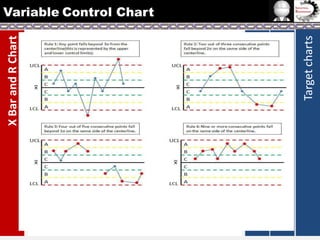
Control chart is out of statistical control if:

MA–MR chart

Reading Control Charts

X-bar and S chart

X Bar and R Chart

Variable Control Chart
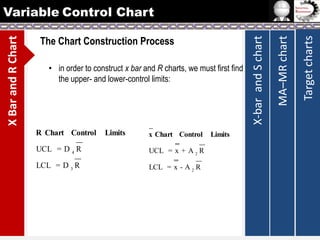
R Chart Control

Limits

x Chart Control

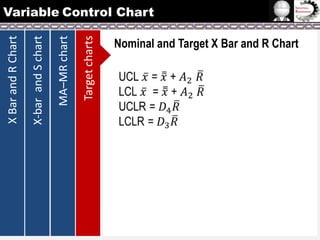
UCL = D 4 R

UCL = x + A 2 R

LCL = D 3 R

LCL = x - A 2 R

Limits

Target charts

• in order to construct x bar and R charts, we must first find
the upper- and lower-control limits:

MA–MR chart

The Chart Construction Process

X-bar and S chart

X Bar and R Chart

Variable Control Chart
X Bar and R Chart
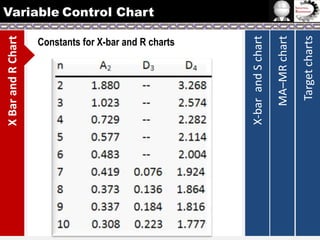
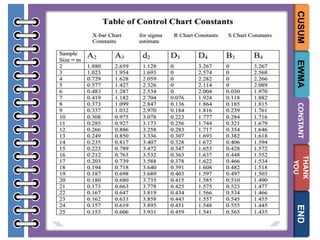
Constants for X-bar and R charts

Target charts

MA–MR chart

X-bar and S chart

Variable Control Chart
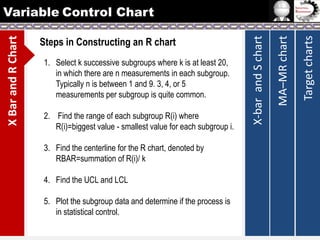
2. Find the range of each subgroup R(i) where
R(i)=biggest value - smallest value for each subgroup i.
3. Find the centerline for the R chart, denoted by
RBAR=summation of R(i)/ k
4. Find the UCL and LCL
5. Plot the subgroup data and determine if the process is
in statistical control.

Target charts

1. Select k successive subgroups where k is at least 20,
in which there are n measurements in each subgroup.
Typically n is between 1 and 9. 3, 4, or 5
measurements per subgroup is quite common.

MA–MR chart

Steps in Constructing an R chart

X-bar and S chart

X Bar and R Chart

Variable Control Chart
Observation (xi)

Average

1

11.90

11.92

12.09

11.91

12.01

2

12.03

12.03

11.92

11.97

12.07

3

11.92

12.02

11.93

12.01

12.07

4

11.96

12.06

12.00

11.91

11.98

5

11.95

12.10

12.03

12.07

12.00

6

11.99

11.98

11.94

12.06

12.06

7

12.00

12.04

11.92

12.00

12.07

8

12.02

12.06

11.94

12.07

12.00

9

12.01

12.06

11.94

11.91

11.94

10

11.92

12.05

11.92

12.09

12.07

Range
(R)

Target charts

Sample

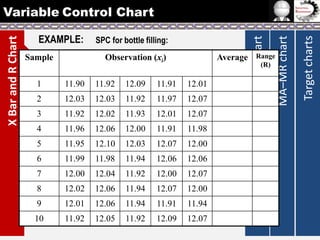
SPC for bottle filling:

MA–MR chart

EXAMPLE:

X-bar and S chart

X Bar and R Chart

Variable Control Chart
Observation (xi)

Average

Range (R)

1

11.90

11.92

12.09

11.91

12.01

11.97

2

12.03

12.03

11.92

11.97

12.07

12.00

3

11.92

12.02

11.93

12.01

12.07

11.99

4

11.96

12.06

12.00

11.91

11.98

11.98

5

11.95

12.10

12.03

12.07

12.00

12.03

0.15

6

11.99

11.98

11.94

12.06

12.06

12.01

0.12

7

12.00

12.04

11.92

12.00

12.07

12.01

0.15

8

12.02

12.06

11.94

12.07

12.00

12.02

0.13

9

12.01

12.06

11.94

11.91

11.94

11.97

0.15

10

11.92

12.05

11.92

12.09

12.07

12.01

0.17

R

0 . 15

0.19

0.15
0.15
0.15

Target charts

Sample

MA–MR chart

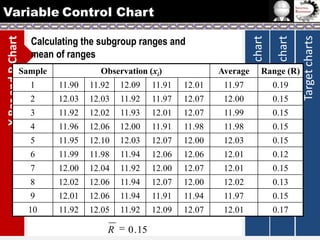
Calculating the subgroup ranges and
mean of ranges

X-bar and S chart

X Bar and R Chart

Variable Control Chart
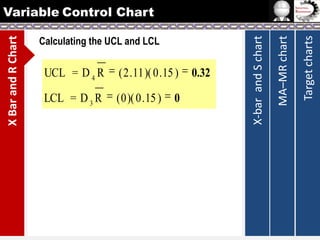
( 2 . 11 )( 0 . 15 )

LCL = D 3 R

( 0 )( 0 . 15 )

0

0.32

Target charts

UCL = D 4 R

MA–MR chart

Calculating the UCL and LCL

X-bar and S chart

X Bar and R Chart

Variable Control Chart
X Bar and R Chart
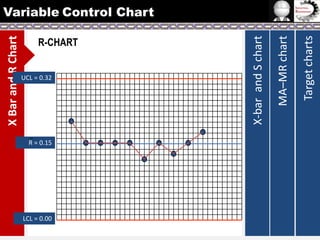
R-CHART

UCL = 0.32

R = 0.15

LCL = 0.00

Target charts

MA–MR chart

X-bar and S chart

Variable Control Chart
Target charts

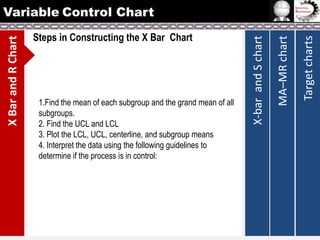
1.Find the mean of each subgroup and the grand mean of all
subgroups.
2. Find the UCL and LCL
3. Plot the LCL, UCL, centerline, and subgroup means
4. Interpret the data using the following guidelines to
determine if the process is in control:

MA–MR chart

Steps in Constructing the X Bar Chart

X-bar and S chart

X Bar and R Chart

Variable Control Chart
Average

Range (R)
0.19

1

11.90

11.92

12.09

11.91

12.01

11.97

2

12.03

12.03

11.92

11.97

12.07

12.00

3

11.92

12.02

11.93

12.01

12.07

11.99

4

11.96

12.06

12.00

11.91

11.98

11.98

5

11.95

12.10

12.03

12.07

12.00

12.03

0.15

6

11.99

11.98

11.94

12.06

12.06

12.01

0.12

7

12.00

12.04

11.92

12.00

12.07

12.01

0.15

8

12.02

12.06

11.94

12.07

12.00

12.02

0.13

9

12.01

12.06

11.94

11.91

11.94

11.97

0.15

10

11.92

12.05

11.92

12.09

12.07

12.01

0.17

X

12 . 00

Target charts

i

MA–MR chart

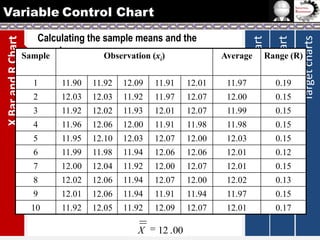
Calculating the sample means and the
grand mean
Sample
Observation (x )

X-bar and S chart

X Bar and R Chart

Variable Control Chart

0.15
0.15
0.15
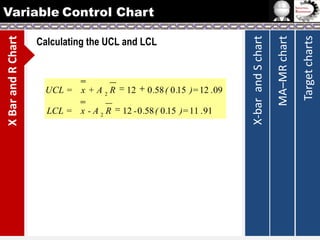
LCL = x - A 2 R

12

0 .58 ( 0 .15 )= 12 . 09

12 - 0 .58 ( 0 .15 )= 11 . 91

Target charts

UCL = x + A 2 R

MA–MR chart

Calculating the UCL and LCL

X-bar and S chart

X Bar and R Chart

Variable Control Chart
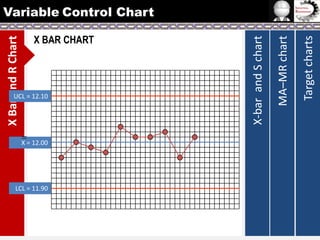
X = 12.00

LCL = 11.90

Target charts

UCL = 12.10

MA–MR chart

X BAR CHART

X-bar and S chart

X Bar and R Chart

Variable Control Chart
1. The sample size n is moderately large,
n > 10 or 12
2. The sample size n is variable
The Construction of X-bar and S Chart
Setting up and operating control charts for Xbar and S requires about the same sequence of step
as those for the X-bar and R charts, except that for
each sample we must calculate the average X-bar
and sample standard deviation S.

Target charts

X-bar and S Chart

MA–MR chart

X-bar and S chart

X Bar and R Chart

Variable Control Chart
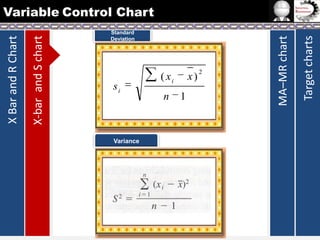
si

Variance

( xi
n

x)
1

2

Target charts

Standard
Deviation

MA–MR chart

X-bar and S chart

X Bar and R Chart

Variable Control Chart
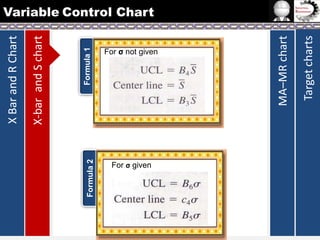
Formula 2

Formula 1

X-bar and S chart

X Bar and R Chart

For σ not given

For σ given

Target charts

MA–MR chart

Variable Control Chart
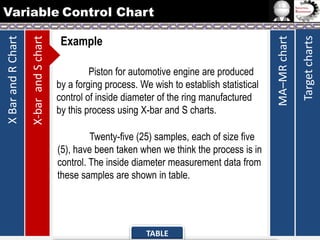
Piston for automotive engine are produced
by a forging process. We wish to establish statistical
control of inside diameter of the ring manufactured
by this process using X-bar and S charts.
Twenty-five (25) samples, each of size five
(5), have been taken when we think the process is in
control. The inside diameter measurement data from
these samples are shown in table.

TABLE

Target charts

Example

MA–MR chart

X-bar and S chart

X Bar and R Chart

Variable Control Chart
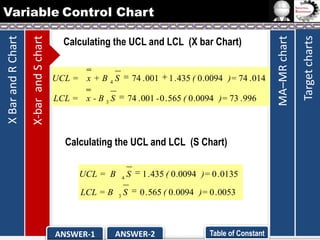
UCL = x + B 4 S

74 . 001

LCL = x - B 3 S

1 . 435 ( 0 .0094 )= 74 . 014

74 . 001 - 0 . 565 ( 0 .0094 )= 73 . 996

Calculating the UCL and LCL (S Chart)
UCL = B
LCL = B

ANSWER-1

4

3

S

S

1 . 435 ( 0 .0094 )= 0 . 0135
0 . 565 ( 0 .0094 )= 0 . 0053

ANSWER-2

Table of Constant

Target charts

Calculating the UCL and LCL (X bar Chart)

MA–MR chart

X-bar and S chart

X Bar and R Chart

Variable Control Chart
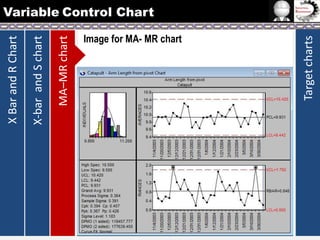
MA-MR charts

• In situations where data are collected slowly over a period
of time, or where data are expensive to collect, moving
average charts are beneficial.

• Moving Average / Range Charts are a set of control charts
for variables data (data that is both quantitative and
continuous in measurement, such as a measured
dimension or time). The Moving Average chart monitors
the process location over time, based on the average of
the current subgroup and one or more prior subgroups.
The Moving Range chart monitors the variation between
the subgroups over time.

Target charts

MA–MR chart

X-bar and S chart

X Bar and R Chart

Variable Control Chart
MA–MR chart

X-bar and S chart

X Bar and R Chart

Image for MA- MR chart

Target charts

Variable Control Chart
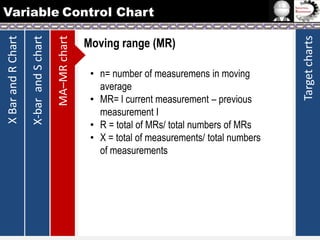
Moving range (MR)
• n= number of measuremens in moving
average
• MR= l current measurement – previous
measurement I
• R = total of MRs/ total numbers of MRs
• X = total of measurements/ total numbers
of measurements

Target charts

MA–MR chart

X-bar and S chart

X Bar and R Chart

Variable Control Chart
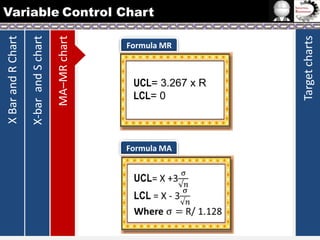
Formula MR

UCL= 3.267 x R
LCL= 0

Formula MA

Target charts

MA–MR chart

X-bar and S chart

X Bar and R Chart

Variable Control Chart
Target charts

MA–MR chart

X-bar and S chart

X Bar and R Chart

Variable Control Chart
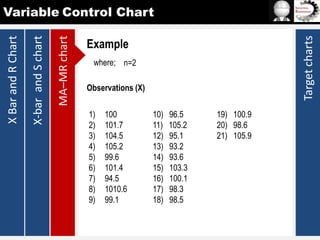
Example
where; n=2

Observations (X)
1)
2)
3)
4)
5)
6)
7)
8)
9)

100
101.7
104.5
105.2
99.6
101.4
94.5
1010.6
99.1

10)
11)
12)
13)
14)
15)
16)
17)
18)

96.5
105.2
95.1
93.2
93.6
103.3
100.1
98.3
98.5

19) 100.9
20) 98.6
21) 105.9
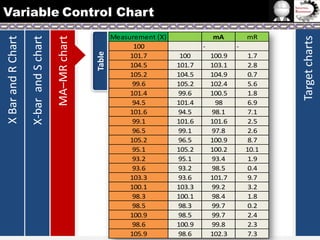
Measurement (X)
100
101.7
104.5
105.2
99.6
101.4
94.5
101.6
99.1
96.5
105.2
95.1
93.2
93.6
103.3
100.1
98.3
98.5
100.9
98.6
105.9

mA
100
101.7
104.5
105.2
99.6
101.4
94.5
101.6
99.1
96.5
105.2
95.1
93.2
93.6
103.3
100.1
98.3
98.5
100.9
98.6

mR
-

100.9
103.1
104.9
102.4
100.5
98
98.1
101.6
97.8
100.9
100.2
93.4
98.5
101.7
99.2
98.4
99.7
99.7
99.8
102.3

1.7
2.8
0.7
5.6
1.8
6.9
7.1
2.5
2.6
8.7
10.1
1.9
0.4
9.7
3.2
1.8
0.2
2.4
2.3
7.3

Target charts

Table

MA–MR chart

X-bar and S chart

X Bar and R Chart

Variable Control Chart
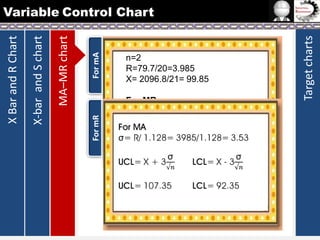
UCL= 3.267 x R
LCL= 0
= 3.267 X 3.985
= 13.02

Target charts

For mA

n=2
R=79.7/20=3.985
X= 2096.8/21= 99.85
For MR

For mR

MA–MR chart

X-bar and S chart

X Bar and R Chart

Variable Control Chart
Target charts

MA–MR chart

X-bar and S chart

X Bar and R Chart

Variable Control Chart
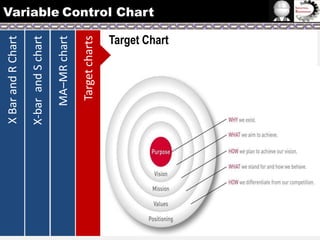
Target Chart
Target charts

MA–MR chart

X-bar and S chart

X Bar and R Chart

Variable Control Chart
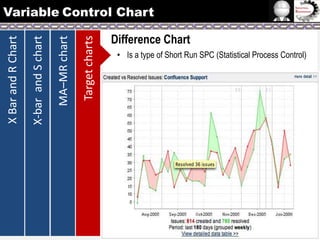
Difference Chart
• Is a type of Short Run SPC (Statistical Process Control)
Target charts

MA–MR chart

X-bar and S chart

X Bar and R Chart

Variable Control Chart

Difference Chart
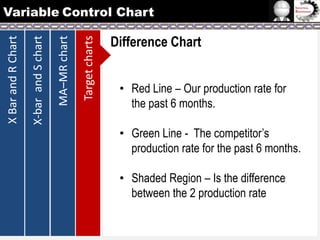
• Red Line – Our production rate for
the past 6 months.
• Green Line - The competitor’s
production rate for the past 6 months.
• Shaded Region – Is the difference
between the 2 production rate
Target charts

MA–MR chart

X-bar and S chart

X Bar and R Chart

Variable Control Chart
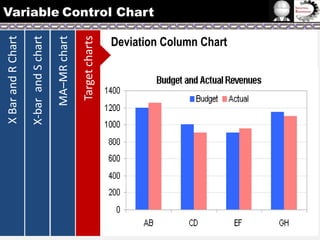
Deviation Column Chart
A
1
2

B

C

D

E

F

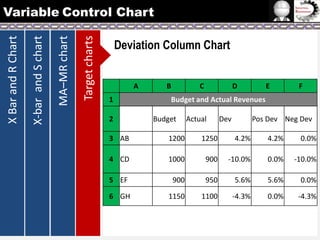
Budget and Actual Revenues
Budget

Actual

Dev

Pos Dev Neg Dev

3 AB

1200

1250

4.2%

4.2%

0.0%

4 CD

1000

900

-10.0%

0.0%

-10.0%

5 EF

900

950

5.6%

5.6%

0.0%

6 GH

1150

1100

-4.3%

0.0%

-4.3%
Target charts

MA–MR chart

X-bar and S chart

X Bar and R Chart

Variable Control Chart
Deviation Column Chart
Target charts

MA–MR chart

X-bar and S chart

X Bar and R Chart

Variable Control Chart
• Computation
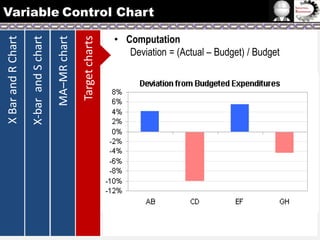
Deviation = (Actual – Budget) / Budget
Target charts

MA–MR chart

X-bar and S chart

X Bar and R Chart

Variable Control Chart
Short Run SPC Approaches

• Nominal Short Run SPC
• Target Short Run SPC
Target charts

MA–MR chart

X-bar and S chart

X Bar and R Chart

Variable Control Chart
Short Run Nominal X Bar and R Chart

• The nominal x bar and R chart is used to
monitor the behavior of a process running
different part numbers and still retain the
ability to assess control.
• This is done by coding the actual measured
readings in a subgroup as a variation from a
common reference point, in this case the
nominal print specification.
Target charts

MA–MR chart

X-bar and S chart

X Bar and R Chart

Variable Control Chart
Nominal and Target X Bar and R Chart
Target charts

MA–MR chart

X-bar and S chart

X Bar and R Chart

Variable Control Chart
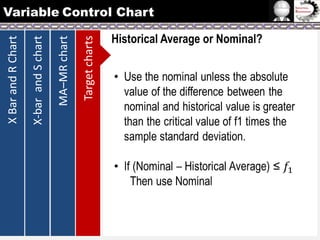
Historical Average or Nominal?
Target charts

MA–MR chart

X-bar and S chart

X Bar and R Chart

Variable Control Chart
Target charts

MA–MR chart

X-bar and S chart

X Bar and R Chart

Variable Control Chart
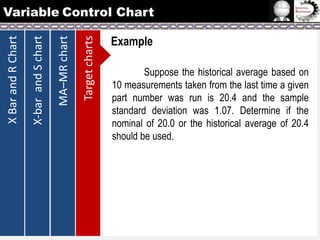
Example
Suppose the historical average based on
10 measurements taken from the last time a given
part number was run is 20.4 and the sample
standard deviation was 1.07. Determine if the
nominal of 20.0 or the historical average of 20.4
should be used.
Target charts

MA–MR chart

X-bar and S chart

X Bar and R Chart

Variable Control Chart
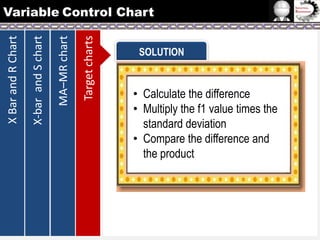
SOLUTION

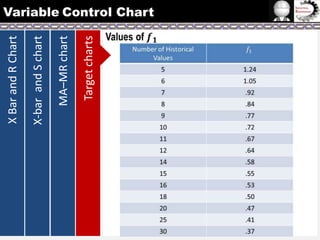
• Calculate the difference
• Multiply the f1 value times the
standard deviation
• Compare the difference and
the product
CUSUM

EWMA

CONSTANT

THANK
YOU

END
EWMA
CONSTANT

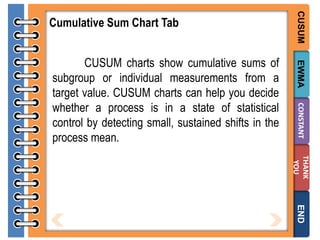
CUSUM charts show cumulative sums of
subgroup or individual measurements from a
target value. CUSUM charts can help you decide
whether a process is in a state of statistical
control by detecting small, sustained shifts in the
process mean.

CUSUM

Cumulative Sum Chart Tab

THANK
YOU

END
EWMA
CONSTANT
THANK
YOU

END

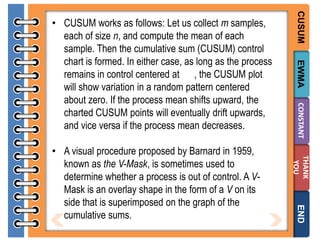
• A visual procedure proposed by Barnard in 1959,
known as the V-Mask, is sometimes used to
determine whether a process is out of control. A VMask is an overlay shape in the form of a V on its
side that is superimposed on the graph of the
cumulative sums.

CUSUM

• CUSUM works as follows: Let us collect m samples,
each of size n, and compute the mean of each
sample. Then the cumulative sum (CUSUM) control
chart is formed. In either case, as long as the process
remains in control centered at , the CUSUM plot
will show variation in a random pattern centered
about zero. If the process mean shifts upward, the
charted CUSUM points will eventually drift upwards,
and vice versa if the process mean decreases.
CUSUM
EWMA

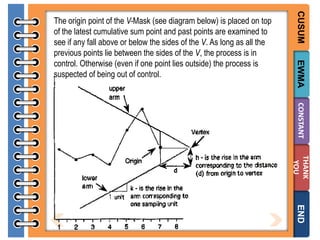
The origin point of the V-Mask (see diagram below) is placed on top
of the latest cumulative sum point and past points are examined to
see if any fall above or below the sides of the V. As long as all the
previous points lie between the sides of the V, the process is in
control. Otherwise (even if one point lies outside) the process is
suspected of being out of control.

CONSTANT
THANK
YOU

END
THANK
YOU

END

• We can design a V-Mask using h and k or we can use an alpha
and beta design approach. For the latter approach we must specify.

CONSTANT

• Are each the average of samples of size 4 taken from a process that
has an estimated mean of 325. Based on process data, the process
standard deviation is 1.27 and therefore the sample means have a
standard deviation of 1.27/(41/2) = 0.635.

EWMA

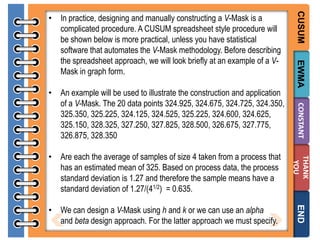
• An example will be used to illustrate the construction and application
of a V-Mask. The 20 data points 324.925, 324.675, 324.725, 324.350,
325.350, 325.225, 324.125, 324.525, 325.225, 324.600, 324.625,
325.150, 328.325, 327.250, 327.825, 328.500, 326.675, 327.775,
326.875, 328.350

CUSUM

• In practice, designing and manually constructing a V-Mask is a
complicated procedure. A CUSUM spreadsheet style procedure will
be shown below is more practical, unless you have statistical
software that automates the V-Mask methodology. Before describing
the spreadsheet approach, we will look briefly at an example of a VMask in graph form.
CUSUM

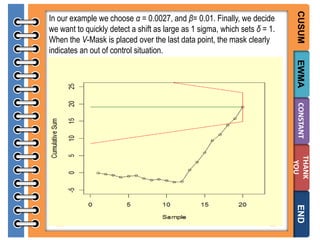
In our example we choose α = 0.0027, and β= 0.01. Finally, we decide
we want to quickly detect a shift as large as 1 sigma, which sets δ = 1.
When the V-Mask is placed over the last data point, the mask clearly
indicates an out of control situation.

EWMA
CONSTANT
THANK
YOU

END
EWMA
CONSTANT
THANK
YOU

END

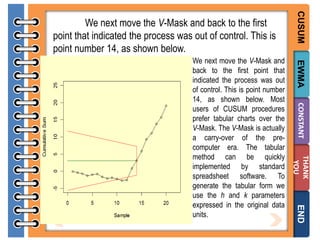
We next move the V-Mask and
back to the first point that
indicated the process was out
of control. This is point number
14, as shown below. Most
users of CUSUM procedures
prefer tabular charts over the
V-Mask. The V-Mask is actually
a carry-over of the precomputer era. The tabular
method can be quickly
implemented by standard
spreadsheet software. To
generate the tabular form we
use the h and k parameters
expressed in the original data
units.

CUSUM

We next move the V-Mask and back to the first
point that indicated the process was out of control. This is
point number 14, as shown below.
Increase
in mean

Decrease
in mean
Shi

325-k-x

Slo

CUSUM

1

324.93

-0.07

-0.39

0.00

-0.24

0.00

-0.007

2

324.68

-0.32

-0.64

0.00

0.01

0.01

-0.40

3

324.73

-0.27

-0.59

0.00

-0.04

0.00

-0.67

4

324.35

-0.65

-0.97

0.00

0.33

0.33

-1.32

5

325.35

0.35

0.03

0.03

-0.67

0.00

-0.97

6

325.23

0.23

-0.09

0.00

-0.54

0.00

-0.75

7

324.13

-0.88

-1.19

0.00

0.56

0.56

-1.62

8

324.53

-0.48

-0.79

0.00

0.16

0.72

-2.10

9

325.23

0.23

-0.09

0.00

0.54

0.17

-1.87

10

324.60

-0.40

-0.72

0.00

0.08

0.25

-2.27

11

324.63

-0.38

-0.69

0.00

0.06

0.31

-2.65

12

325.15

0.15

-0.17

0.00

0.47

0.00

-2.50

13

328.33

3.32

3.01

3.01

-3.64

0.00

0.83

14

327.25

2.25

1.93

4.94*

-0.57

0.00

3.08

15

327.83

2.82

2.51

7.45*

-3.14

0.00

5.90

16

328.50

3.50

3.18

10.63*

-3.82

0.00

9.40

17

326.68

1.68

1.36

11.99*

-1.99

0.00

11.08

18

327.78

2.77

2.46

14.44*

-3.09

0.00

13.85

19

326.88

1.88

1.56

16.00*

-2.19

0.00

15.73

20

328.35

3.35

3.03

19.04*

-3.67

0.00

19.08

END

x-325-k

THANK
YOU

x-325

CONSTANT

x

EWMA

Group

CUSUM

h
k
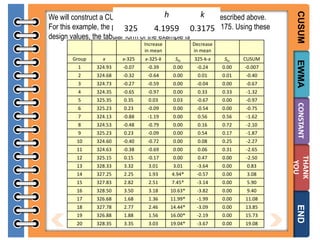
We will construct a CUSUM tabular chart for the example described above.
For this example, the parameter are 4.1959 and k = 0.3175. Using these
h = 4.1959 0.3175
325
design values, the tabular form of the example is
Definition

CONSTANT
THANK
YOU

END

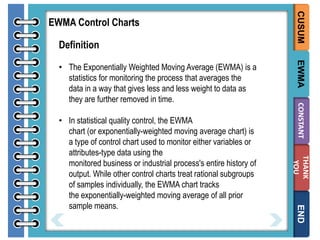
• In statistical quality control, the EWMA
chart (or exponentially-weighted moving average chart) is
a type of control chart used to monitor either variables or
attributes-type data using the
monitored business or industrial process's entire history of
output. While other control charts treat rational subgroups
of samples individually, the EWMA chart tracks
the exponentially-weighted moving average of all prior
sample means.

EWMA

• The Exponentially Weighted Moving Average (EWMA) is a
statistics for monitoring the process that averages the
data in a way that gives less and less weight to data as
they are further removed in time.

CUSUM

EWMA Control Charts
Where:

THANK
YOU

END

The equation is due to Roberts (1959).

CONSTANT

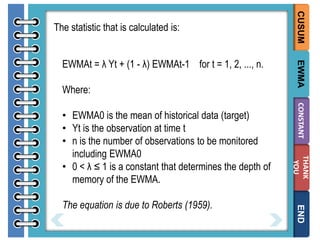
• EWMA0 is the mean of historical data (target)
• Yt is the observation at time t
• n is the number of observations to be monitored
including EWMA0
• 0 < λ ≤ 1 is a constant that determines the depth of
memory of the EWMA.

EWMA

EWMAt = λ Yt + (1 - λ) EWMAt-1 for t = 1, 2, ..., n.

CUSUM

The statistic that is calculated is:
THANK
YOU

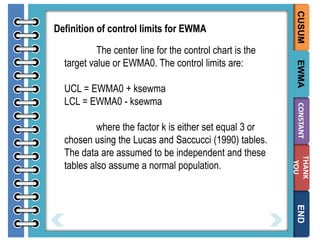
where the factor k is either set equal 3 or
chosen using the Lucas and Saccucci (1990) tables.
The data are assumed to be independent and these
tables also assume a normal population.

CONSTANT

UCL = EWMA0 + ksewma
LCL = EWMA0 - ksewma

EWMA

The center line for the control chart is the
target value or EWMA0. The control limits are:

CUSUM

Definition of control limits for EWMA

END
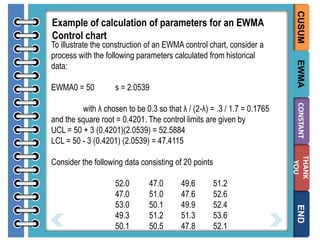
Example of calculation of parameters for an EWMA
Control chart

CUSUM

EWMA0 = 50

EWMA

To illustrate the construction of an EWMA control chart, consider a
process with the following parameters calculated from historical
data:
s = 2.0539

47.0
51.0
50.1
51.2
50.5

49.6
47.6
49.9
51.3
47.8

51.2
52.6
52.4
53.6
52.1

END

52.0
47.0
53.0
49.3
50.1

THANK
YOU

Consider the following data consisting of 20 points

CONSTANT

with λ chosen to be 0.3 so that λ / (2-λ) = .3 / 1.7 = 0.1765
and the square root = 0.4201. The control limits are given by
UCL = 50 + 3 (0.4201)(2.0539) = 52.5884
LCL = 50 - 3 (0.4201) (2.0539) = 47.4115
49.92

49.75 49.36 50.73

50.56

49.85 49.52 51.23

50.18

50.26 50.05 51.94

50.16

50.33 49.38 51.99

END

49.52

THANK
YOU

49.21 50.11

CONSTANT

50.60

EWMA

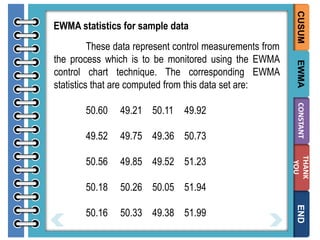
These data represent control measurements from
the process which is to be monitored using the EWMA
control chart technique. The corresponding EWMA
statistics that are computed from this data set are:

CUSUM

EWMA statistics for sample data
CUSUM

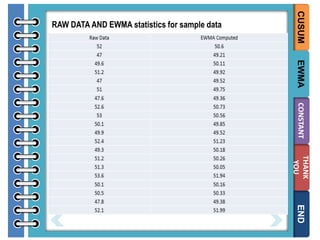
RAW DATA AND EWMA statistics for sample data

EWMA
CONSTANT
THANK
YOU

END
CUSUM

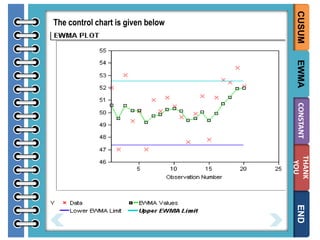
The control chart is given below

EWMA
CONSTANT
THANK
YOU

END
EWMA
CONSTANT

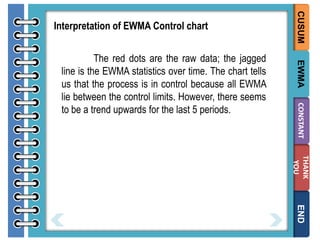
The red dots are the raw data; the jagged
line is the EWMA statistics over time. The chart tells
us that the process is in control because all EWMA
lie between the control limits. However, there seems
to be a trend upwards for the last 5 periods.

CUSUM

Interpretation of EWMA Control chart

THANK
YOU

END
CUSUM
EWMA

CONSTANT

THANK
YOU

END
CONSTANT
THANK
YOU

Alina, Jassfer D.
Alvarez, Son Robert C.
Bautista, Billy Joe
Calosa Gilbert
Cristobal, Arnel Mark John
Mercado, Kim Nath

EWMA

Group 5 QCT

CUSUM

THANK YOU

END
CUSUM

EWMA

Group 5 QCT

CONSTANT

END

THANK
YOU
END

Variable control chart

  • 1.
    • used todetect/identify assignable causes. always has a central line for the average, an upper line. • for the upper control limit and a lower line for the lower control limit. • also known as Shewhart charts or processbehavior charts Target charts MA–MR chart • used to determine if a manufacturing or business process is in a state of statistical control X-bar and S chart Introduction X-bar and R chart Control Chart
  • 2.
    • charts appliedto data that follow a continuous distribution. • Are typically used used in pairs: • monitors process average • monitors the variation in the process • A quality characteristic that is measured on a numerical scale is called a variable. • dimension • length, width • weight • temperature • volume Target charts Variable Control Charts MA–MR chart • charts applied to data that follow a discrete distribution. X-bar and S chart Attributes Control Charts X-bar and R chart Control Chart
  • 3.
    • Moving average–movingrange chart (also called MA–MR chart) • Target charts (also called difference charts, deviation charts and nominal charts) • CUSUM (cumulative sum chart) • EWMA (exponentially weighted moving average chart) Target charts • X-bar and s chart MA–MR chart • X-bar and R chart (also called averages and range chart) X-bar and S chart Variable Control Charts X-bar and R chart Control Chart
  • 4.
    • is advantageousin the following situations: • The sample size is relatively small (n ≤ 10) • The sample size is constant • Humans must perform the calculations for the chart Target charts MA–MR chart • is a type of control chart used to monitor variables data when samples are collected atis a type of control chart used to monitor variables data when samples are collected at regular intervals from a business or industrial process. X-bar and S chart X Bar and R Chart Variable Control Chart
  • 5.
    R Chart • isa control chart that is used to monitor process variation when the variable of interest is a quantitative measure. • Range Chart Target charts • is used to monitor the average value, or mean, of a process over time. • Mean chart or average chart MA–MR chart X bar Charts X-bar and S chart X Bar and R Chart Variable Control Chart
  • 6.
    • If theR chart indicates the sample variability is in statistical control, the X bar chart is examined to determine if the sample mean is also in statistical control. • If the sample variability is not in statistical control, then the entire process is judged to be not in statistical control regardless of what the X bar chart indicates. Target charts • The R chart is examined first before the X bar chart MA–MR chart Guidelines in X Bar and R Chart: X-bar and S chart X Bar and R Chart Variable Control Chart
  • 7.
    Target charts Control chartis out of statistical control if: MA–MR chart Reading Control Charts X-bar and S chart X Bar and R Chart Variable Control Chart
  • 8.
    R Chart Control Limits xChart Control UCL = D 4 R UCL = x + A 2 R LCL = D 3 R LCL = x - A 2 R Limits Target charts • in order to construct x bar and R charts, we must first find the upper- and lower-control limits: MA–MR chart The Chart Construction Process X-bar and S chart X Bar and R Chart Variable Control Chart
  • 9.
    X Bar andR Chart Constants for X-bar and R charts Target charts MA–MR chart X-bar and S chart Variable Control Chart
  • 10.
    2. Find therange of each subgroup R(i) where R(i)=biggest value - smallest value for each subgroup i. 3. Find the centerline for the R chart, denoted by RBAR=summation of R(i)/ k 4. Find the UCL and LCL 5. Plot the subgroup data and determine if the process is in statistical control. Target charts 1. Select k successive subgroups where k is at least 20, in which there are n measurements in each subgroup. Typically n is between 1 and 9. 3, 4, or 5 measurements per subgroup is quite common. MA–MR chart Steps in Constructing an R chart X-bar and S chart X Bar and R Chart Variable Control Chart
  • 11.
  • 12.
  • 13.
    ( 2 .11 )( 0 . 15 ) LCL = D 3 R ( 0 )( 0 . 15 ) 0 0.32 Target charts UCL = D 4 R MA–MR chart Calculating the UCL and LCL X-bar and S chart X Bar and R Chart Variable Control Chart
  • 14.
    X Bar andR Chart R-CHART UCL = 0.32 R = 0.15 LCL = 0.00 Target charts MA–MR chart X-bar and S chart Variable Control Chart
  • 15.
    Target charts 1.Find themean of each subgroup and the grand mean of all subgroups. 2. Find the UCL and LCL 3. Plot the LCL, UCL, centerline, and subgroup means 4. Interpret the data using the following guidelines to determine if the process is in control: MA–MR chart Steps in Constructing the X Bar Chart X-bar and S chart X Bar and R Chart Variable Control Chart
  • 16.
  • 17.
    LCL = x- A 2 R 12 0 .58 ( 0 .15 )= 12 . 09 12 - 0 .58 ( 0 .15 )= 11 . 91 Target charts UCL = x + A 2 R MA–MR chart Calculating the UCL and LCL X-bar and S chart X Bar and R Chart Variable Control Chart
  • 18.
    X = 12.00 LCL= 11.90 Target charts UCL = 12.10 MA–MR chart X BAR CHART X-bar and S chart X Bar and R Chart Variable Control Chart
  • 19.
    1. The samplesize n is moderately large, n > 10 or 12 2. The sample size n is variable The Construction of X-bar and S Chart Setting up and operating control charts for Xbar and S requires about the same sequence of step as those for the X-bar and R charts, except that for each sample we must calculate the average X-bar and sample standard deviation S. Target charts X-bar and S Chart MA–MR chart X-bar and S chart X Bar and R Chart Variable Control Chart
  • 20.
    si Variance ( xi n x) 1 2 Target charts Standard Deviation MA–MRchart X-bar and S chart X Bar and R Chart Variable Control Chart
  • 21.
    Formula 2 Formula 1 X-barand S chart X Bar and R Chart For σ not given For σ given Target charts MA–MR chart Variable Control Chart
  • 22.
    Piston for automotiveengine are produced by a forging process. We wish to establish statistical control of inside diameter of the ring manufactured by this process using X-bar and S charts. Twenty-five (25) samples, each of size five (5), have been taken when we think the process is in control. The inside diameter measurement data from these samples are shown in table. TABLE Target charts Example MA–MR chart X-bar and S chart X Bar and R Chart Variable Control Chart
  • 23.
    UCL = x+ B 4 S 74 . 001 LCL = x - B 3 S 1 . 435 ( 0 .0094 )= 74 . 014 74 . 001 - 0 . 565 ( 0 .0094 )= 73 . 996 Calculating the UCL and LCL (S Chart) UCL = B LCL = B ANSWER-1 4 3 S S 1 . 435 ( 0 .0094 )= 0 . 0135 0 . 565 ( 0 .0094 )= 0 . 0053 ANSWER-2 Table of Constant Target charts Calculating the UCL and LCL (X bar Chart) MA–MR chart X-bar and S chart X Bar and R Chart Variable Control Chart
  • 24.
    MA-MR charts • Insituations where data are collected slowly over a period of time, or where data are expensive to collect, moving average charts are beneficial. • Moving Average / Range Charts are a set of control charts for variables data (data that is both quantitative and continuous in measurement, such as a measured dimension or time). The Moving Average chart monitors the process location over time, based on the average of the current subgroup and one or more prior subgroups. The Moving Range chart monitors the variation between the subgroups over time. Target charts MA–MR chart X-bar and S chart X Bar and R Chart Variable Control Chart
  • 25.
    MA–MR chart X-bar andS chart X Bar and R Chart Image for MA- MR chart Target charts Variable Control Chart
  • 26.
    Moving range (MR) •n= number of measuremens in moving average • MR= l current measurement – previous measurement I • R = total of MRs/ total numbers of MRs • X = total of measurements/ total numbers of measurements Target charts MA–MR chart X-bar and S chart X Bar and R Chart Variable Control Chart
  • 27.
    Formula MR UCL= 3.267x R LCL= 0 Formula MA Target charts MA–MR chart X-bar and S chart X Bar and R Chart Variable Control Chart
  • 28.
    Target charts MA–MR chart X-barand S chart X Bar and R Chart Variable Control Chart Example where; n=2 Observations (X) 1) 2) 3) 4) 5) 6) 7) 8) 9) 100 101.7 104.5 105.2 99.6 101.4 94.5 1010.6 99.1 10) 11) 12) 13) 14) 15) 16) 17) 18) 96.5 105.2 95.1 93.2 93.6 103.3 100.1 98.3 98.5 19) 100.9 20) 98.6 21) 105.9
  • 29.
  • 30.
    UCL= 3.267 xR LCL= 0 = 3.267 X 3.985 = 13.02 Target charts For mA n=2 R=79.7/20=3.985 X= 2096.8/21= 99.85 For MR For mR MA–MR chart X-bar and S chart X Bar and R Chart Variable Control Chart
  • 31.
    Target charts MA–MR chart X-barand S chart X Bar and R Chart Variable Control Chart Target Chart
  • 32.
    Target charts MA–MR chart X-barand S chart X Bar and R Chart Variable Control Chart Difference Chart • Is a type of Short Run SPC (Statistical Process Control)
  • 33.
    Target charts MA–MR chart X-barand S chart X Bar and R Chart Variable Control Chart Difference Chart • Red Line – Our production rate for the past 6 months. • Green Line - The competitor’s production rate for the past 6 months. • Shaded Region – Is the difference between the 2 production rate
  • 34.
    Target charts MA–MR chart X-barand S chart X Bar and R Chart Variable Control Chart Deviation Column Chart A 1 2 B C D E F Budget and Actual Revenues Budget Actual Dev Pos Dev Neg Dev 3 AB 1200 1250 4.2% 4.2% 0.0% 4 CD 1000 900 -10.0% 0.0% -10.0% 5 EF 900 950 5.6% 5.6% 0.0% 6 GH 1150 1100 -4.3% 0.0% -4.3%
  • 35.
    Target charts MA–MR chart X-barand S chart X Bar and R Chart Variable Control Chart Deviation Column Chart
  • 36.
    Target charts MA–MR chart X-barand S chart X Bar and R Chart Variable Control Chart • Computation Deviation = (Actual – Budget) / Budget
  • 37.
    Target charts MA–MR chart X-barand S chart X Bar and R Chart Variable Control Chart Short Run SPC Approaches • Nominal Short Run SPC • Target Short Run SPC
  • 38.
    Target charts MA–MR chart X-barand S chart X Bar and R Chart Variable Control Chart Short Run Nominal X Bar and R Chart • The nominal x bar and R chart is used to monitor the behavior of a process running different part numbers and still retain the ability to assess control. • This is done by coding the actual measured readings in a subgroup as a variation from a common reference point, in this case the nominal print specification.
  • 39.
    Target charts MA–MR chart X-barand S chart X Bar and R Chart Variable Control Chart Nominal and Target X Bar and R Chart
  • 40.
    Target charts MA–MR chart X-barand S chart X Bar and R Chart Variable Control Chart Historical Average or Nominal?
  • 41.
    Target charts MA–MR chart X-barand S chart X Bar and R Chart Variable Control Chart
  • 42.
    Target charts MA–MR chart X-barand S chart X Bar and R Chart Variable Control Chart Example Suppose the historical average based on 10 measurements taken from the last time a given part number was run is 20.4 and the sample standard deviation was 1.07. Determine if the nominal of 20.0 or the historical average of 20.4 should be used.
  • 43.
    Target charts MA–MR chart X-barand S chart X Bar and R Chart Variable Control Chart SOLUTION • Calculate the difference • Multiply the f1 value times the standard deviation • Compare the difference and the product
  • 44.
  • 45.
    EWMA CONSTANT CUSUM charts showcumulative sums of subgroup or individual measurements from a target value. CUSUM charts can help you decide whether a process is in a state of statistical control by detecting small, sustained shifts in the process mean. CUSUM Cumulative Sum Chart Tab THANK YOU END
  • 46.
    EWMA CONSTANT THANK YOU END • A visualprocedure proposed by Barnard in 1959, known as the V-Mask, is sometimes used to determine whether a process is out of control. A VMask is an overlay shape in the form of a V on its side that is superimposed on the graph of the cumulative sums. CUSUM • CUSUM works as follows: Let us collect m samples, each of size n, and compute the mean of each sample. Then the cumulative sum (CUSUM) control chart is formed. In either case, as long as the process remains in control centered at , the CUSUM plot will show variation in a random pattern centered about zero. If the process mean shifts upward, the charted CUSUM points will eventually drift upwards, and vice versa if the process mean decreases.
  • 47.
    CUSUM EWMA The origin pointof the V-Mask (see diagram below) is placed on top of the latest cumulative sum point and past points are examined to see if any fall above or below the sides of the V. As long as all the previous points lie between the sides of the V, the process is in control. Otherwise (even if one point lies outside) the process is suspected of being out of control. CONSTANT THANK YOU END
  • 48.
    THANK YOU END • We candesign a V-Mask using h and k or we can use an alpha and beta design approach. For the latter approach we must specify. CONSTANT • Are each the average of samples of size 4 taken from a process that has an estimated mean of 325. Based on process data, the process standard deviation is 1.27 and therefore the sample means have a standard deviation of 1.27/(41/2) = 0.635. EWMA • An example will be used to illustrate the construction and application of a V-Mask. The 20 data points 324.925, 324.675, 324.725, 324.350, 325.350, 325.225, 324.125, 324.525, 325.225, 324.600, 324.625, 325.150, 328.325, 327.250, 327.825, 328.500, 326.675, 327.775, 326.875, 328.350 CUSUM • In practice, designing and manually constructing a V-Mask is a complicated procedure. A CUSUM spreadsheet style procedure will be shown below is more practical, unless you have statistical software that automates the V-Mask methodology. Before describing the spreadsheet approach, we will look briefly at an example of a VMask in graph form.
  • 49.
    CUSUM In our examplewe choose α = 0.0027, and β= 0.01. Finally, we decide we want to quickly detect a shift as large as 1 sigma, which sets δ = 1. When the V-Mask is placed over the last data point, the mask clearly indicates an out of control situation. EWMA CONSTANT THANK YOU END
  • 50.
    EWMA CONSTANT THANK YOU END We next movethe V-Mask and back to the first point that indicated the process was out of control. This is point number 14, as shown below. Most users of CUSUM procedures prefer tabular charts over the V-Mask. The V-Mask is actually a carry-over of the precomputer era. The tabular method can be quickly implemented by standard spreadsheet software. To generate the tabular form we use the h and k parameters expressed in the original data units. CUSUM We next move the V-Mask and back to the first point that indicated the process was out of control. This is point number 14, as shown below.
  • 51.
    Increase in mean Decrease in mean Shi 325-k-x Slo CUSUM 1 324.93 -0.07 -0.39 0.00 -0.24 0.00 -0.007 2 324.68 -0.32 -0.64 0.00 0.01 0.01 -0.40 3 324.73 -0.27 -0.59 0.00 -0.04 0.00 -0.67 4 324.35 -0.65 -0.97 0.00 0.33 0.33 -1.32 5 325.35 0.35 0.03 0.03 -0.67 0.00 -0.97 6 325.23 0.23 -0.09 0.00 -0.54 0.00 -0.75 7 324.13 -0.88 -1.19 0.00 0.56 0.56 -1.62 8 324.53 -0.48 -0.79 0.00 0.16 0.72 -2.10 9 325.23 0.23 -0.09 0.00 0.54 0.17 -1.87 10 324.60 -0.40 -0.72 0.00 0.08 0.25 -2.27 11 324.63 -0.38 -0.69 0.00 0.06 0.31 -2.65 12 325.15 0.15 -0.17 0.00 0.47 0.00 -2.50 13 328.33 3.32 3.01 3.01 -3.64 0.00 0.83 14 327.25 2.25 1.93 4.94* -0.57 0.00 3.08 15 327.83 2.82 2.51 7.45* -3.14 0.00 5.90 16 328.50 3.50 3.18 10.63* -3.82 0.00 9.40 17 326.68 1.68 1.36 11.99* -1.99 0.00 11.08 18 327.78 2.77 2.46 14.44* -3.09 0.00 13.85 19 326.88 1.88 1.56 16.00* -2.19 0.00 15.73 20 328.35 3.35 3.03 19.04* -3.67 0.00 19.08 END x-325-k THANK YOU x-325 CONSTANT x EWMA Group CUSUM h k Wewill construct a CUSUM tabular chart for the example described above. For this example, the parameter are 4.1959 and k = 0.3175. Using these h = 4.1959 0.3175 325 design values, the tabular form of the example is
  • 52.
    Definition CONSTANT THANK YOU END • In statisticalquality control, the EWMA chart (or exponentially-weighted moving average chart) is a type of control chart used to monitor either variables or attributes-type data using the monitored business or industrial process's entire history of output. While other control charts treat rational subgroups of samples individually, the EWMA chart tracks the exponentially-weighted moving average of all prior sample means. EWMA • The Exponentially Weighted Moving Average (EWMA) is a statistics for monitoring the process that averages the data in a way that gives less and less weight to data as they are further removed in time. CUSUM EWMA Control Charts
  • 53.
    Where: THANK YOU END The equation isdue to Roberts (1959). CONSTANT • EWMA0 is the mean of historical data (target) • Yt is the observation at time t • n is the number of observations to be monitored including EWMA0 • 0 < λ ≤ 1 is a constant that determines the depth of memory of the EWMA. EWMA EWMAt = λ Yt + (1 - λ) EWMAt-1 for t = 1, 2, ..., n. CUSUM The statistic that is calculated is:
  • 54.
    THANK YOU where the factork is either set equal 3 or chosen using the Lucas and Saccucci (1990) tables. The data are assumed to be independent and these tables also assume a normal population. CONSTANT UCL = EWMA0 + ksewma LCL = EWMA0 - ksewma EWMA The center line for the control chart is the target value or EWMA0. The control limits are: CUSUM Definition of control limits for EWMA END
  • 55.
    Example of calculationof parameters for an EWMA Control chart CUSUM EWMA0 = 50 EWMA To illustrate the construction of an EWMA control chart, consider a process with the following parameters calculated from historical data: s = 2.0539 47.0 51.0 50.1 51.2 50.5 49.6 47.6 49.9 51.3 47.8 51.2 52.6 52.4 53.6 52.1 END 52.0 47.0 53.0 49.3 50.1 THANK YOU Consider the following data consisting of 20 points CONSTANT with λ chosen to be 0.3 so that λ / (2-λ) = .3 / 1.7 = 0.1765 and the square root = 0.4201. The control limits are given by UCL = 50 + 3 (0.4201)(2.0539) = 52.5884 LCL = 50 - 3 (0.4201) (2.0539) = 47.4115
  • 56.
    49.92 49.75 49.36 50.73 50.56 49.8549.52 51.23 50.18 50.26 50.05 51.94 50.16 50.33 49.38 51.99 END 49.52 THANK YOU 49.21 50.11 CONSTANT 50.60 EWMA These data represent control measurements from the process which is to be monitored using the EWMA control chart technique. The corresponding EWMA statistics that are computed from this data set are: CUSUM EWMA statistics for sample data
  • 57.
    CUSUM RAW DATA ANDEWMA statistics for sample data EWMA CONSTANT THANK YOU END
  • 58.
    CUSUM The control chartis given below EWMA CONSTANT THANK YOU END
  • 59.
    EWMA CONSTANT The red dotsare the raw data; the jagged line is the EWMA statistics over time. The chart tells us that the process is in control because all EWMA lie between the control limits. However, there seems to be a trend upwards for the last 5 periods. CUSUM Interpretation of EWMA Control chart THANK YOU END
  • 60.
  • 61.
    CONSTANT THANK YOU Alina, Jassfer D. Alvarez,Son Robert C. Bautista, Billy Joe Calosa Gilbert Cristobal, Arnel Mark John Mercado, Kim Nath EWMA Group 5 QCT CUSUM THANK YOU END
  • 62.