Aggregate Planning


             Created by Dianne H. Rivera
   Email: spunkyneadi62@yahoo.com.ph
Definition:

Aggregate planning is concerned with matching supply
and demand of output over the medium time range, up
to approximately 12 months into the future.
The term “aggregate” implies that the planning is done
for a single overall measure of output.
It determines not only the output levels planned but
also the appropriate resource input mix to be used.
Combines appropriate resources into general terms.
Role of Aggregate Planning

Integral to part of the business planning
process
Supports the strategic plan
Also known as the production plan
Identifies resources required for operations for
the next 6 -18 months
Details the aggregate production rate and size
of work force required
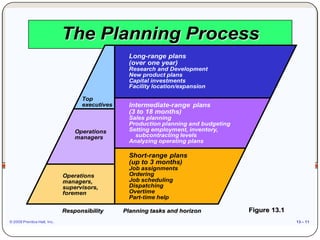
The Planning Process
                                                 Long-range plans
                                                 (over one year)
                                                 Research and Development
                                                 New product plans
                                                 Capital investments
                                                 Facility location/expansion

                                   Top
                                   executives    Intermediate-range plans
                                                 (3 to 18 months)
                                                 Sales planning
                                                 Production planning and budgeting
                                 Operations      Setting employment, inventory,
                                 managers          subcontracting levels
                                                 Analyzing operating plans

                                                 Short-range plans
                                                 (up to 3 months)
                                                 Job assignments
                             Operations          Ordering
                             managers,           Job scheduling
                             supervisors,        Dispatching
                             foremen             Overtime
                                                 Part-time help

                             Responsibility     Planning tasks and horizon           Figure 13.1
© 2008 Prentice Hall, Inc.                                                                         13 – 11
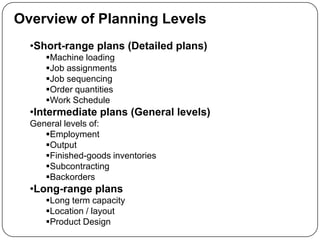
Overview of Planning Levels
  •Short-range plans (Detailed plans)
     Machine loading
     Job assignments
     Job sequencing
     Order quantities
     Work Schedule
  •Intermediate plans (General levels)
  General levels of:
     Employment
     Output
     Finished-goods inventories
     Subcontracting
     Backorders
  •Long-range plans
     Long term capacity
     Location / layout
     Product Design
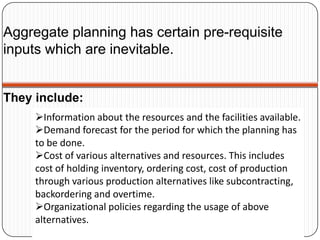
Aggregate planning has certain pre-requisite
inputs which are inevitable.


They include:
     Information about the resources and the facilities available.
     Demand forecast for the period for which the planning has
     to be done.
     Cost of various alternatives and resources. This includes
     cost of holding inventory, ordering cost, cost of production
     through various production alternatives like subcontracting,
     backordering and overtime.
     Organizational policies regarding the usage of above
     alternatives.
Aggregate Planning Inputs and Outputs
             Input                     Output
          Resources               Total cost of plan
  -Workforce/production rates
   -Facilities and equipment
             Cost                Projected levels of:
    -Inventory carrying cost         Inventory
           -Backorders                Output
           -Hiring/firing           Employment
            -Overtime              Subcontracting
       -Inventory changes           Backordering
         -Subcontracting
       Demand forecast
 Policies on workforce changes
        Subcontracting
           Overtime
   Inventory levels/changes
          Backorders
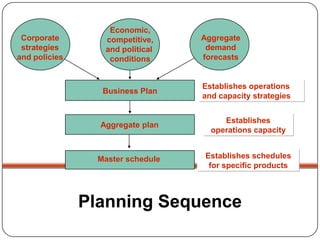
Economic,
 Corporate        competitive,     Aggregate
 strategies       and political     demand
and policies       conditions      forecasts


                                   Establishes operations
                  Business Plan
                                   and capacity strategies


                                        Establishes
                 Aggregate plan
                                     operations capacity


                 Master schedule   Establishes schedules
                                    for specific products


               Planning Sequence
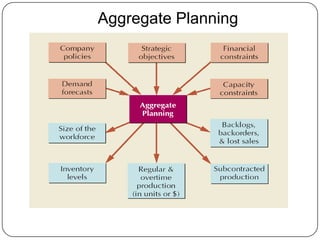
Aggregate Planning
Aggregate Operations Plan

Is concerned with setting production rates by product group or other broad
categories for the intermediate term (2 to 18 months).
The main purpose of the aggregate operations plan is to specify the
optimal combination of production rate, work-force level and inventory on
hand.
          Production rate – refers to the number of units completed per unit of time.
          Workforce level – is the number of workers needed for production.
          Inventory on hand – is unused inventory carried over from the previous
period.
Demand and Capacity Options

 Aggregate planning strategies can be described as:

 Proactive – it involves demand options. It attempts to
                 alter demand so that it matches capacity.
 Reactive – it involves capacity options. It attempts to alter
                 capacity so that it matches demand.
 Mixed – involves an element of each of the above
                 approaches
Demand Options
  Options for situations in which demand needs to be
  increased in order to match capacity include:


Pricing – Differential pricing is often used to reduce peak
demand or to build up demand in off-peak periods.
Advertising and Promotion – Advertising, direct marketing,
and other forms of promotion are used to shift demand.
Backlog and Reservations – In some cases, demand is
influenced by asking customers to wait for their orders
(backlog) or by reserving capacity in advance (reservations).
Development of complementary products – Firms with
highly seasonal demands may try to develop products that
have counter cyclic seasonal trends.
Capacity Options
  Options which can be used to increase or decrease
  capacity to match current demand include:

Hiring and Layoff of employees – The use of this variable not
only affect costs but also labor relations, productivity, and worker
morale.
Using overtime and undertime – Overtime is sometimes used
for short or medium-range labor adjustments in lieu of hiring and
layoffs, especially if the change in demand is considered
temporary. Undertime refers to planned utilization of the
workforce rather than layoffs or shortened workweek.
Using part-time or temporary labor – In some cases, it is
possible to hire part-time or temporary employees to meet peak
or seasonal demand.
Capacity Options

Carrying inventory – In manufacturing companies, inventory can
be used as a buffer between supply and demand. Inventories for
later use can be built up during periods of slack demand.
Subcontracting – This option, which involves the use of other
firms, is sometimes an effective way to increase or decrease
supply. The subcontractor may supply the entire product or only
some of the components.
Making Cooperative Arrangements – These arrangements are
very similar to subcontracting in that other sources of supply are
used.
Strategies for Meeting Uneven Demand


Aggregate planners might adopt a number of
strategies. Some of the more prominent ones
are the following:
Maintain a level of workforce
Maintain a steady output rate
Match demand period by period
Use combination of decision variables
Basic Strategies for Aggregate
Planning

1.Level capacity strategy:
Maintaining a steady rate of regular-time output while
meeting variations in demand by a combination of options.

     Advantages                  Disadvantages
       Stable output rates         Greater inventory
        and workforce                costs
                                    Increased overtime
                                     and idle time
                                    Resource utilizations
                                     vary over time
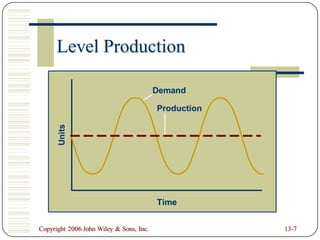
Level Production

                                         Demand

                                         Production
      Units


                                         Time


Copyright 2006 John Wiley & Sons, Inc.                13-7
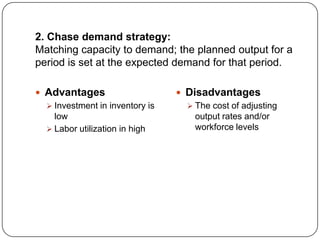
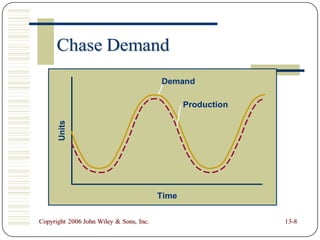
2. Chase demand strategy:
Matching capacity to demand; the planned output for a
period is set at the expected demand for that period.

 Advantages                      Disadvantages
   Investment in inventory is      The cost of adjusting
    low                              output rates and/or
   Labor utilization in high        workforce levels
Chase Demand
                                         Demand

                                                Production
      Units


                                         Time


Copyright 2006 John Wiley & Sons, Inc.                       13-8
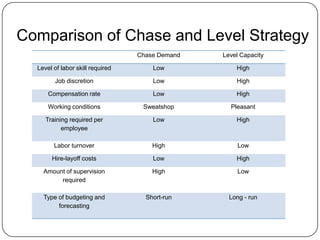
Comparison of Chase and Level Strategy
                                  Chase Demand   Level Capacity

  Level of labor skill required       Low            High

        Job discretion                Low            High

      Compensation rate               Low            High

      Working conditions           Sweatshop       Pleasant

     Training required per            Low            High
           employee

        Labor turnover                High            Low

       Hire-layoff costs              Low            High

    Amount of supervision             High            Low
         required

    Type of budgeting and           Short-run      Long - run
         forecasting
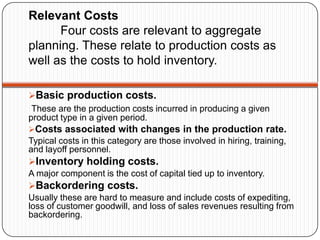
Relevant Costs
      Four costs are relevant to aggregate
planning. These relate to production costs as
well as the costs to hold inventory.

Basic production costs.
 These are the production costs incurred in producing a given
product type in a given period.
Costs associated with changes in the production rate.
Typical costs in this category are those involved in hiring, training,
and layoff personnel.
Inventory holding costs.
A major component is the cost of capital tied up to inventory.
Backordering costs.
Usually these are hard to measure and include costs of expediting,
loss of customer goodwill, and loss of sales revenues resulting from
backordering.
Developing the Aggregate Plan

Step 1- Choose strategy:
       level, chase, or Hybrid (combination)
Step 2- Determine the aggregate production rate
Step 3- Calculate the size of the workforce
Step 4- Test the plan as follows:
      Calculate Inventory, expected hiring/firing, overtime needs
      Calculate total cost of plan
Step 5- Evaluate performance:
      cost, service, human resources, and operations
Key Consideration for Aggregate Planning

  The Aggregate plan must balance several perspectives
  Costs are important but so are:

  Customer service
  Operational effectiveness
  Workforce morale

  A successful AP considers each of these factors
Techniques for Aggregate Planning


A Cut-and-Try Approach
Linear Programming
Simulation Approach
A general procedure for aggregate planning
consists of the following steps:


  1.Determine demand for each period
  2.Determine capacities for each period
  3.Identify policies that are pertinent
  4.Determine units costs
  5.Develop alternative plans and costs
  6.Select the best plan that satisfies objectives.
        Otherwise return to step 5.
Numerous techniques are available to help
with the task of aggregate planning.
Generally, they fall into three categories:

1.A Cut-and-Try Approach
Involves costing out various productions planning alternatives and selecting
the one that is best. Elaborate spreadsheets are developed to facilitate the
decision process. Sophisticated approaches involving linear programming
and simulation are often incorporated into these spreadsheets.
2.Linear Programming Approach
This makes it possible to evaluate an infinite number of production strategies and
find the minimum-cost alternative. It provides a powerful methodology for not only
solving the problem but evaluating other solutions that might be suggested,
relative to the best one.
3.Simulation Approach
This technique can be used to rapidly evaluate a large number of different
decision rules or production choices.
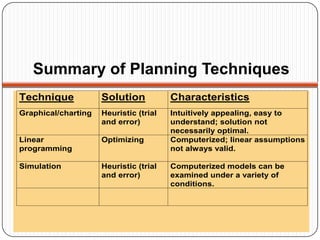
Summary of Planning Techniques
Technique            Solution           Characteristics
Graphical/charting   Heuristic (trial   Intuitively appealing, easy to
                     and error)         understand; solution not
                                        necessarily optimal.
Linear               Optimizing         Computerized; linear assumptions
programming                             not always valid.

Simulation           Heuristic (trial   Computerized models can be
                     and error)         examined under a variety of
                                        conditions.
Aggregate Planning in Services
Services occur when they are rendered.
Demand for service can be difficult to predict.
Capacity availability can be difficult to predict
Labor flexibility can be an advantage in services.
Most services can’t be inventoried
Service capacity must be provided at the appropriate place
and time.
Aggregate Yield Management
It is defined as the process of allocating the right type of
capacity, to the right type of customer, at the right price and time
to maximize revenue.
It can be a powerful approach to make demand more
predictable, which is important to aggregate planning.
It is the process of understanding, anticipating and
influencing      consumer        behaviour       in     order      to
maximize yield or profits from a fixed, perishable resource (such
as airline seats or hotel room reservations).
The application of pricing strategies to allocate capacity among
various categories of demand.
Aggregate Yield Management
From an operational perspective, yield management is
most effective when:
In a hotel setting:

Demand can be segmented by customers
Fixed costs are high and variable costs are low
Products can be sold in advance
Disaggregating the Aggregate
               Plan
This means breaking down the aggregate plan into
specific product requirements in order to determine
labor    requirements,   materials,  and    inventory
requirements.
The result of disaggregating the aggregate plan is a
master budget.
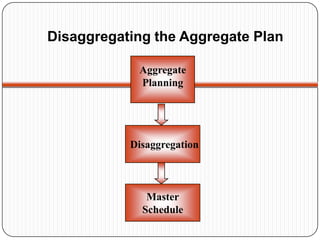
Disaggregating the Aggregate Plan

            Aggregate
            Planning


           Disaggregation


              Master
             Schedule
Master Schedule
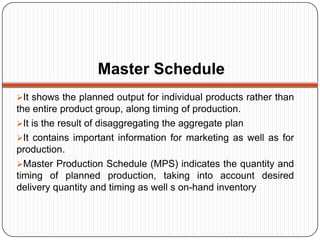
It shows the planned output for individual products rather than
the entire product group, along timing of production.
It is the result of disaggregating the aggregate plan
It contains important information for marketing as well as for
production.
Master Production Schedule (MPS) indicates the quantity and
timing of planned production, taking into account desired
delivery quantity and timing as well s on-hand inventory
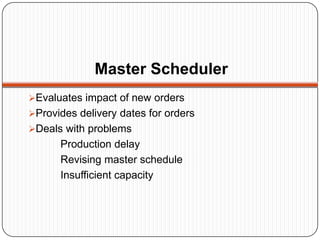
Master Scheduler
Evaluates impact of new orders
Provides delivery dates for orders
Deals with problems
      Production delay
      Revising master schedule
      Insufficient capacity
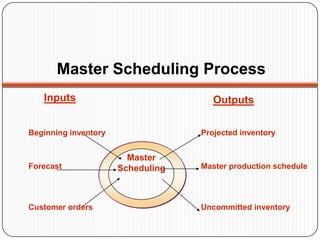
Master Scheduling Process
   Inputs                             Outputs

Beginning inventory                Projected inventory


                        Master
Forecast              Scheduling   Master production schedule


Customer orders                    Uncommitted inventory
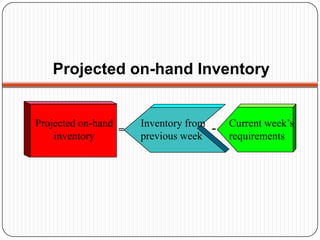
Projected on-hand Inventory


Projected on-hand     Inventory from       Current week’s
    inventory
                  =
                      previous week
                                       -   requirements
Available-to-Promise (ATP)
•Quantity of items that can be promised to the
customer
Difference between planned production and
customer orders already received
References:
 Operations Management,       Chase, R.B.,Jacobs, R.,
  5th Edition                   Aquilano, N.J.
  Roberta Russell &             Operations Management
  Bernard W. Taylor, III        for Competitive
  Copyright 2006 John           Advantages with Global
  Wiley & Sons, Inc.            Cases, 11th Edition, 2007
 Operations Management        Schoeder, R.G.,
   R. Dan Reid & Nada R.        Operations Management,
  Sanders
   4th Edition © Wiley 2010
                                Contemporary Concepts
                                and Cases. 3rd Edition,
 Operations Management
                                2007
  9th Edition, 2007
  William J. Stevenson

Aggregate Planning Report

  • 1.
    Aggregate Planning Created by Dianne H. Rivera Email: spunkyneadi62@yahoo.com.ph
  • 2.
    Definition: Aggregate planning isconcerned with matching supply and demand of output over the medium time range, up to approximately 12 months into the future. The term “aggregate” implies that the planning is done for a single overall measure of output. It determines not only the output levels planned but also the appropriate resource input mix to be used. Combines appropriate resources into general terms.
  • 3.
    Role of AggregatePlanning Integral to part of the business planning process Supports the strategic plan Also known as the production plan Identifies resources required for operations for the next 6 -18 months Details the aggregate production rate and size of work force required
  • 4.
    The Planning Process Long-range plans (over one year) Research and Development New product plans Capital investments Facility location/expansion Top executives Intermediate-range plans (3 to 18 months) Sales planning Production planning and budgeting Operations Setting employment, inventory, managers subcontracting levels Analyzing operating plans Short-range plans (up to 3 months) Job assignments Operations Ordering managers, Job scheduling supervisors, Dispatching foremen Overtime Part-time help Responsibility Planning tasks and horizon Figure 13.1 © 2008 Prentice Hall, Inc. 13 – 11
  • 5.
    Overview of PlanningLevels •Short-range plans (Detailed plans) Machine loading Job assignments Job sequencing Order quantities Work Schedule •Intermediate plans (General levels) General levels of: Employment Output Finished-goods inventories Subcontracting Backorders •Long-range plans Long term capacity Location / layout Product Design
  • 6.
    Aggregate planning hascertain pre-requisite inputs which are inevitable. They include: Information about the resources and the facilities available. Demand forecast for the period for which the planning has to be done. Cost of various alternatives and resources. This includes cost of holding inventory, ordering cost, cost of production through various production alternatives like subcontracting, backordering and overtime. Organizational policies regarding the usage of above alternatives.
  • 7.
    Aggregate Planning Inputsand Outputs Input Output Resources Total cost of plan -Workforce/production rates -Facilities and equipment Cost Projected levels of: -Inventory carrying cost Inventory -Backorders Output -Hiring/firing Employment -Overtime Subcontracting -Inventory changes Backordering -Subcontracting Demand forecast Policies on workforce changes Subcontracting Overtime Inventory levels/changes Backorders
  • 8.
    Economic, Corporate competitive, Aggregate strategies and political demand and policies conditions forecasts Establishes operations Business Plan and capacity strategies Establishes Aggregate plan operations capacity Master schedule Establishes schedules for specific products Planning Sequence
  • 9.
  • 10.
  • 11.
    Aggregate Operations Plan Isconcerned with setting production rates by product group or other broad categories for the intermediate term (2 to 18 months). The main purpose of the aggregate operations plan is to specify the optimal combination of production rate, work-force level and inventory on hand. Production rate – refers to the number of units completed per unit of time. Workforce level – is the number of workers needed for production. Inventory on hand – is unused inventory carried over from the previous period.
  • 12.
    Demand and CapacityOptions Aggregate planning strategies can be described as: Proactive – it involves demand options. It attempts to alter demand so that it matches capacity. Reactive – it involves capacity options. It attempts to alter capacity so that it matches demand. Mixed – involves an element of each of the above approaches
  • 13.
    Demand Options Options for situations in which demand needs to be increased in order to match capacity include: Pricing – Differential pricing is often used to reduce peak demand or to build up demand in off-peak periods. Advertising and Promotion – Advertising, direct marketing, and other forms of promotion are used to shift demand. Backlog and Reservations – In some cases, demand is influenced by asking customers to wait for their orders (backlog) or by reserving capacity in advance (reservations). Development of complementary products – Firms with highly seasonal demands may try to develop products that have counter cyclic seasonal trends.
  • 14.
    Capacity Options Options which can be used to increase or decrease capacity to match current demand include: Hiring and Layoff of employees – The use of this variable not only affect costs but also labor relations, productivity, and worker morale. Using overtime and undertime – Overtime is sometimes used for short or medium-range labor adjustments in lieu of hiring and layoffs, especially if the change in demand is considered temporary. Undertime refers to planned utilization of the workforce rather than layoffs or shortened workweek. Using part-time or temporary labor – In some cases, it is possible to hire part-time or temporary employees to meet peak or seasonal demand.
  • 15.
    Capacity Options Carrying inventory– In manufacturing companies, inventory can be used as a buffer between supply and demand. Inventories for later use can be built up during periods of slack demand. Subcontracting – This option, which involves the use of other firms, is sometimes an effective way to increase or decrease supply. The subcontractor may supply the entire product or only some of the components. Making Cooperative Arrangements – These arrangements are very similar to subcontracting in that other sources of supply are used.
  • 16.
    Strategies for MeetingUneven Demand Aggregate planners might adopt a number of strategies. Some of the more prominent ones are the following: Maintain a level of workforce Maintain a steady output rate Match demand period by period Use combination of decision variables
  • 17.
    Basic Strategies forAggregate Planning 1.Level capacity strategy: Maintaining a steady rate of regular-time output while meeting variations in demand by a combination of options.  Advantages  Disadvantages  Stable output rates  Greater inventory and workforce costs  Increased overtime and idle time  Resource utilizations vary over time
  • 18.
    Level Production Demand Production Units Time Copyright 2006 John Wiley & Sons, Inc. 13-7
  • 19.
    2. Chase demandstrategy: Matching capacity to demand; the planned output for a period is set at the expected demand for that period.  Advantages  Disadvantages  Investment in inventory is  The cost of adjusting low output rates and/or  Labor utilization in high workforce levels
  • 20.
    Chase Demand Demand Production Units Time Copyright 2006 John Wiley & Sons, Inc. 13-8
  • 21.
    Comparison of Chaseand Level Strategy Chase Demand Level Capacity Level of labor skill required Low High Job discretion Low High Compensation rate Low High Working conditions Sweatshop Pleasant Training required per Low High employee Labor turnover High Low Hire-layoff costs Low High Amount of supervision High Low required Type of budgeting and Short-run Long - run forecasting
  • 22.
    Relevant Costs Four costs are relevant to aggregate planning. These relate to production costs as well as the costs to hold inventory. Basic production costs. These are the production costs incurred in producing a given product type in a given period. Costs associated with changes in the production rate. Typical costs in this category are those involved in hiring, training, and layoff personnel. Inventory holding costs. A major component is the cost of capital tied up to inventory. Backordering costs. Usually these are hard to measure and include costs of expediting, loss of customer goodwill, and loss of sales revenues resulting from backordering.
  • 23.
    Developing the AggregatePlan Step 1- Choose strategy: level, chase, or Hybrid (combination) Step 2- Determine the aggregate production rate Step 3- Calculate the size of the workforce Step 4- Test the plan as follows: Calculate Inventory, expected hiring/firing, overtime needs Calculate total cost of plan Step 5- Evaluate performance: cost, service, human resources, and operations
  • 24.
    Key Consideration forAggregate Planning The Aggregate plan must balance several perspectives Costs are important but so are: Customer service Operational effectiveness Workforce morale A successful AP considers each of these factors
  • 25.
    Techniques for AggregatePlanning A Cut-and-Try Approach Linear Programming Simulation Approach
  • 26.
    A general procedurefor aggregate planning consists of the following steps: 1.Determine demand for each period 2.Determine capacities for each period 3.Identify policies that are pertinent 4.Determine units costs 5.Develop alternative plans and costs 6.Select the best plan that satisfies objectives. Otherwise return to step 5.
  • 27.
    Numerous techniques areavailable to help with the task of aggregate planning. Generally, they fall into three categories: 1.A Cut-and-Try Approach Involves costing out various productions planning alternatives and selecting the one that is best. Elaborate spreadsheets are developed to facilitate the decision process. Sophisticated approaches involving linear programming and simulation are often incorporated into these spreadsheets. 2.Linear Programming Approach This makes it possible to evaluate an infinite number of production strategies and find the minimum-cost alternative. It provides a powerful methodology for not only solving the problem but evaluating other solutions that might be suggested, relative to the best one. 3.Simulation Approach This technique can be used to rapidly evaluate a large number of different decision rules or production choices.
  • 28.
    Summary of PlanningTechniques Technique Solution Characteristics Graphical/charting Heuristic (trial Intuitively appealing, easy to and error) understand; solution not necessarily optimal. Linear Optimizing Computerized; linear assumptions programming not always valid. Simulation Heuristic (trial Computerized models can be and error) examined under a variety of conditions.
  • 29.
    Aggregate Planning inServices Services occur when they are rendered. Demand for service can be difficult to predict. Capacity availability can be difficult to predict Labor flexibility can be an advantage in services. Most services can’t be inventoried Service capacity must be provided at the appropriate place and time.
  • 30.
    Aggregate Yield Management Itis defined as the process of allocating the right type of capacity, to the right type of customer, at the right price and time to maximize revenue. It can be a powerful approach to make demand more predictable, which is important to aggregate planning. It is the process of understanding, anticipating and influencing consumer behaviour in order to maximize yield or profits from a fixed, perishable resource (such as airline seats or hotel room reservations). The application of pricing strategies to allocate capacity among various categories of demand.
  • 31.
    Aggregate Yield Management Froman operational perspective, yield management is most effective when: In a hotel setting: Demand can be segmented by customers Fixed costs are high and variable costs are low Products can be sold in advance
  • 32.
    Disaggregating the Aggregate Plan This means breaking down the aggregate plan into specific product requirements in order to determine labor requirements, materials, and inventory requirements. The result of disaggregating the aggregate plan is a master budget.
  • 33.
    Disaggregating the AggregatePlan Aggregate Planning Disaggregation Master Schedule
  • 34.
    Master Schedule It showsthe planned output for individual products rather than the entire product group, along timing of production. It is the result of disaggregating the aggregate plan It contains important information for marketing as well as for production. Master Production Schedule (MPS) indicates the quantity and timing of planned production, taking into account desired delivery quantity and timing as well s on-hand inventory
  • 35.
    Master Scheduler Evaluates impactof new orders Provides delivery dates for orders Deals with problems Production delay Revising master schedule Insufficient capacity
  • 36.
    Master Scheduling Process Inputs Outputs Beginning inventory Projected inventory Master Forecast Scheduling Master production schedule Customer orders Uncommitted inventory
  • 37.
    Projected on-hand Inventory Projectedon-hand Inventory from Current week’s inventory = previous week - requirements
  • 38.
    Available-to-Promise (ATP) •Quantity ofitems that can be promised to the customer Difference between planned production and customer orders already received
  • 39.
    References:  Operations Management,  Chase, R.B.,Jacobs, R., 5th Edition Aquilano, N.J. Roberta Russell & Operations Management Bernard W. Taylor, III for Competitive Copyright 2006 John Advantages with Global Wiley & Sons, Inc. Cases, 11th Edition, 2007  Operations Management  Schoeder, R.G., R. Dan Reid & Nada R. Operations Management, Sanders 4th Edition © Wiley 2010 Contemporary Concepts and Cases. 3rd Edition,  Operations Management 2007 9th Edition, 2007 William J. Stevenson