Copyright 2009 John Wiley & Sons, Inc.
Beni Asllani
University of Tennessee at Chattanooga
Lean Systems
Operations Management - 6th Edition
Chapter 16
Roberta Russell & Bernard W. Taylor, III
Copyright 2009 John Wiley & Sons, Inc. 16-2
Lean Production
 Doing more with less inventory, fewer
workers, less space
 Just-in-time (JIT)
 smoothing the flow of material to arrive
just as it is needed
 “JIT” and “Lean Production” are used
interchangeably
 Muda
 waste, anything other than that which
adds value to product or service
Copyright 2009 John Wiley & Sons, Inc. 16-3
Waste in Operations
Copyright 2009 John Wiley & Sons, Inc. 16-4
Waste in Operations (cont.)
Copyright 2009 John Wiley & Sons, Inc. 16-5
Waste in Operations (cont.)
Copyright 2009 John Wiley & Sons, Inc. 16-6
Basic Elements
1. Flexible resources
2. Cellular layouts
3. Pull system
4. Kanbans
5. Small lots
6. Quick setups
7. Uniform production levels
8. Quality at the source
9. Total productive
maintenance
10. Supplier networks
Copyright 2009 John Wiley & Sons, Inc. 16-7
Flexible Resources
 Multifunctional workers
 perform more than one job
 general-purpose machines perform
several basic functions
 Cycle time
 time required for the worker to complete
one pass through the operations
assigned
 Takt time
 paces production to customer demand
Copyright 2009 John Wiley & Sons, Inc. 16-8
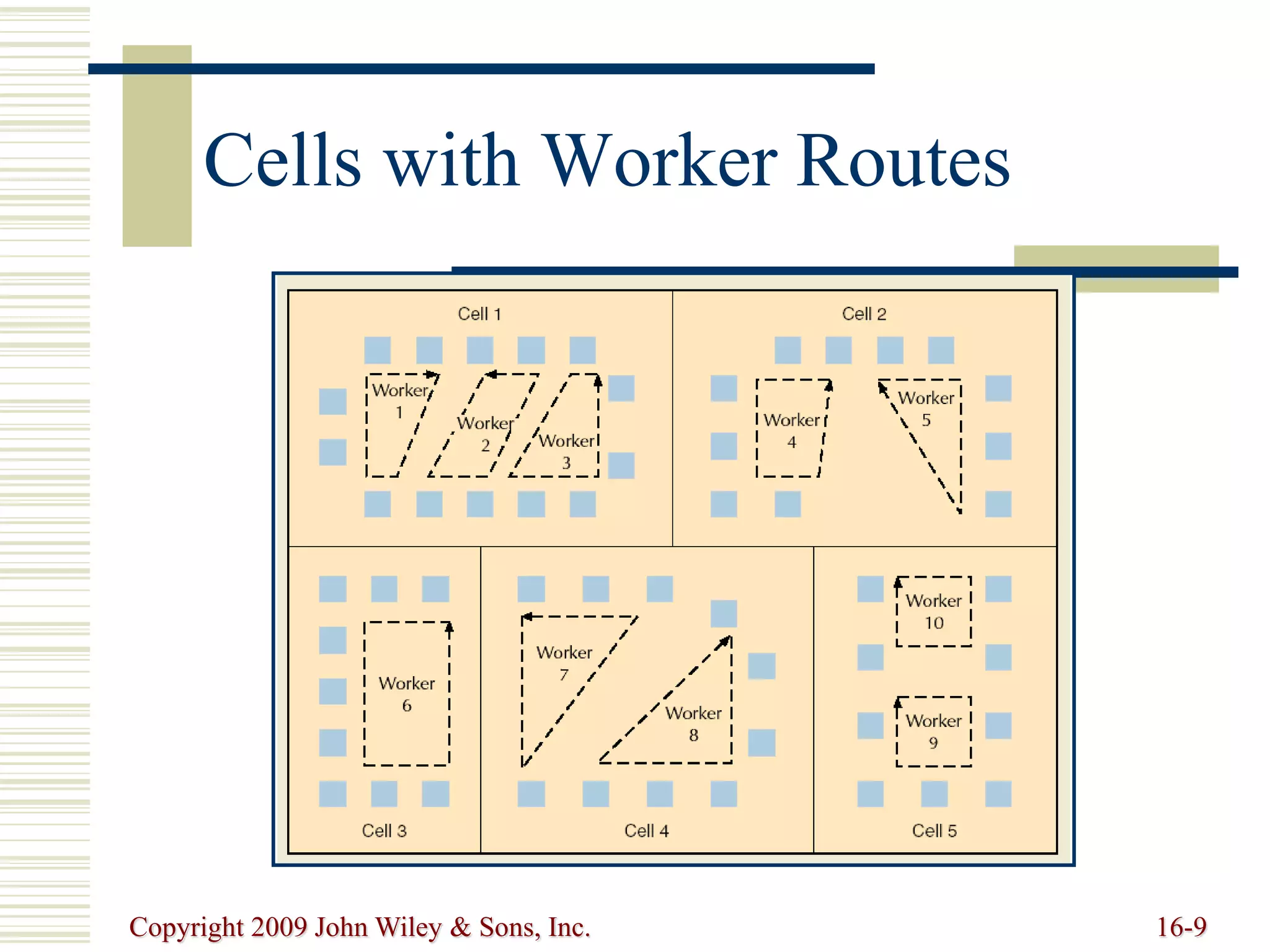
Cellular Layouts
 Manufacturing cells
 comprised of dissimilar machines brought
together to manufacture a family of parts
 Cycle time is adjusted to match takt time
by changing worker paths
Copyright 2009 John Wiley & Sons, Inc. 16-9
Cells with Worker Routes
Copyright 2009 John Wiley & Sons, Inc. 16-10
Pull System
 Material is pulled through the system when
needed
 Reversal of traditional push system where
material is pushed according to a schedule
 Forces cooperation
 Prevent over and underproduction
 While push systems rely on a predetermined
schedule, pull systems rely on customer
requests
Copyright 2009 John Wiley & Sons, Inc. 16-11
Kanbans
 Card which indicates standard quantity
of production
 Derived from two-bin inventory system
 Maintain discipline of pull production
 Authorize production and movement of
goods
Copyright 2009 John Wiley & Sons, Inc. 16-12
Sample Kanban
Copyright 2009 John Wiley & Sons, Inc. 16-13
Origin of Kanban
a) Two-bin inventory system b) Kanban inventory system
Reorder
card
Bin 1
Bin 2
Q - R
Kanban
R
R
Q = order quantity
R = reorder point - demand during lead time
Copyright 2009 John Wiley & Sons, Inc. 16-14
Types of Kanban
 Production kanban
 authorizes production of
goods
 Withdrawal kanban
 authorizes movement of
goods
 Kanban square
 a marked area designated
to hold items
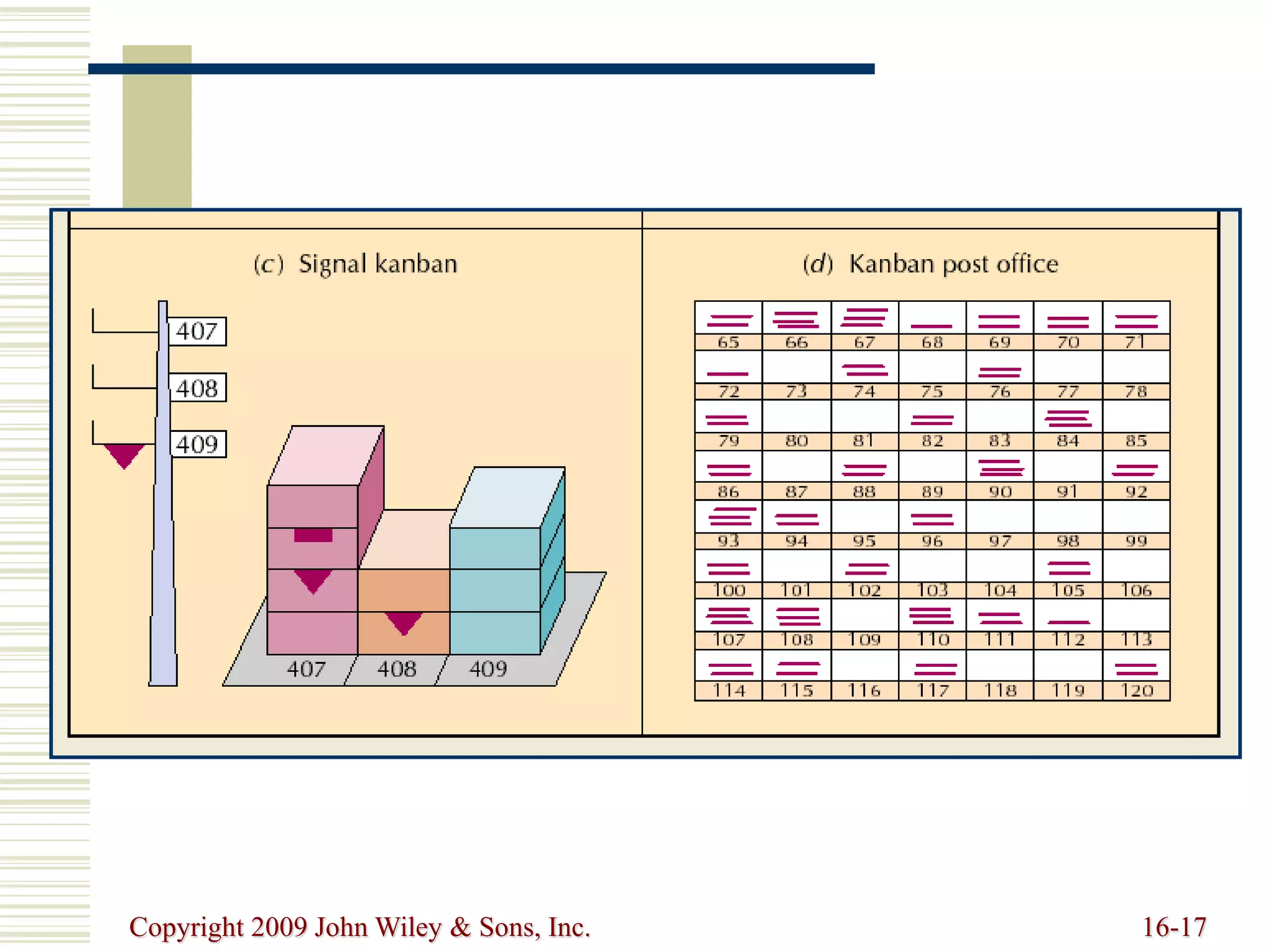
 Signal kanban
 a triangular kanban
used to signal
production at the
previous workstation
 Material kanban
 used to order material in
advance of a process
 Supplier kanban
 rotates between the
factory and suppliers
Copyright 2009 John Wiley & Sons, Inc. 16-15
Copyright 2009 John Wiley & Sons, Inc. 16-16
Copyright 2009 John Wiley & Sons, Inc. 16-17
Copyright 2009 John Wiley & Sons, Inc. 16-18
Determining Number of
Kanbans
where
N = number of kanbans or containers
d = average demand over some time period
L = lead time to replenish an order
S = safety stock
C = container size
No. of Kanbans =
average demand during lead time + safety stock
container size
N =
dL + S
C
Copyright 2009 John Wiley & Sons, Inc. 16-19
Determining Number of
Kanbans: Example
d = 150 bottles per hour
L = 30 minutes = 0.5 hours
S = 0.10(150 x 0.5) = 7.5
C = 25 bottles
Round up to 4 (to allow some slack) or
down to 3 (to force improvement)
N = =
= = 3.3 kanbans or containers
dL + S
C
(150 x 0.5) + 7.5
25
75 + 7.5
25
Copyright 2009 John Wiley & Sons, Inc. 16-20
Small Lots
 Require less space and capital
investment
 Move processes closer together
 Make quality problems easier to
detect
 Make processes more dependent
on each other
Copyright 2009 John Wiley & Sons, Inc. 16-21
Inventory Hides Problems
Copyright 2009 John Wiley & Sons, Inc. 16-22
Less Inventory Exposes Problems
Copyright 2009 John Wiley & Sons, Inc. 16-23
Components of Lead Time
 Processing time
 Reduce number of items or improve efficiency
 Move time
 Reduce distances, simplify movements, standardize
routings
 Waiting time
 Better scheduling, sufficient capacity
 Setup time
 Generally the biggest bottleneck
Copyright 2009 John Wiley & Sons, Inc. 16-24
Quick Setups
 Internal setup
 Can be performed
only when a
process is stopped
 External setup
 Can be performed
in advance
 SMED Principles
 Separate internal setup from
external setup
 Convert internal setup to external
setup
 Streamline all aspects of setup
 Perform setup activities in
parallel or eliminate them entirely
Copyright 2009 John Wiley & Sons, Inc. 16-25
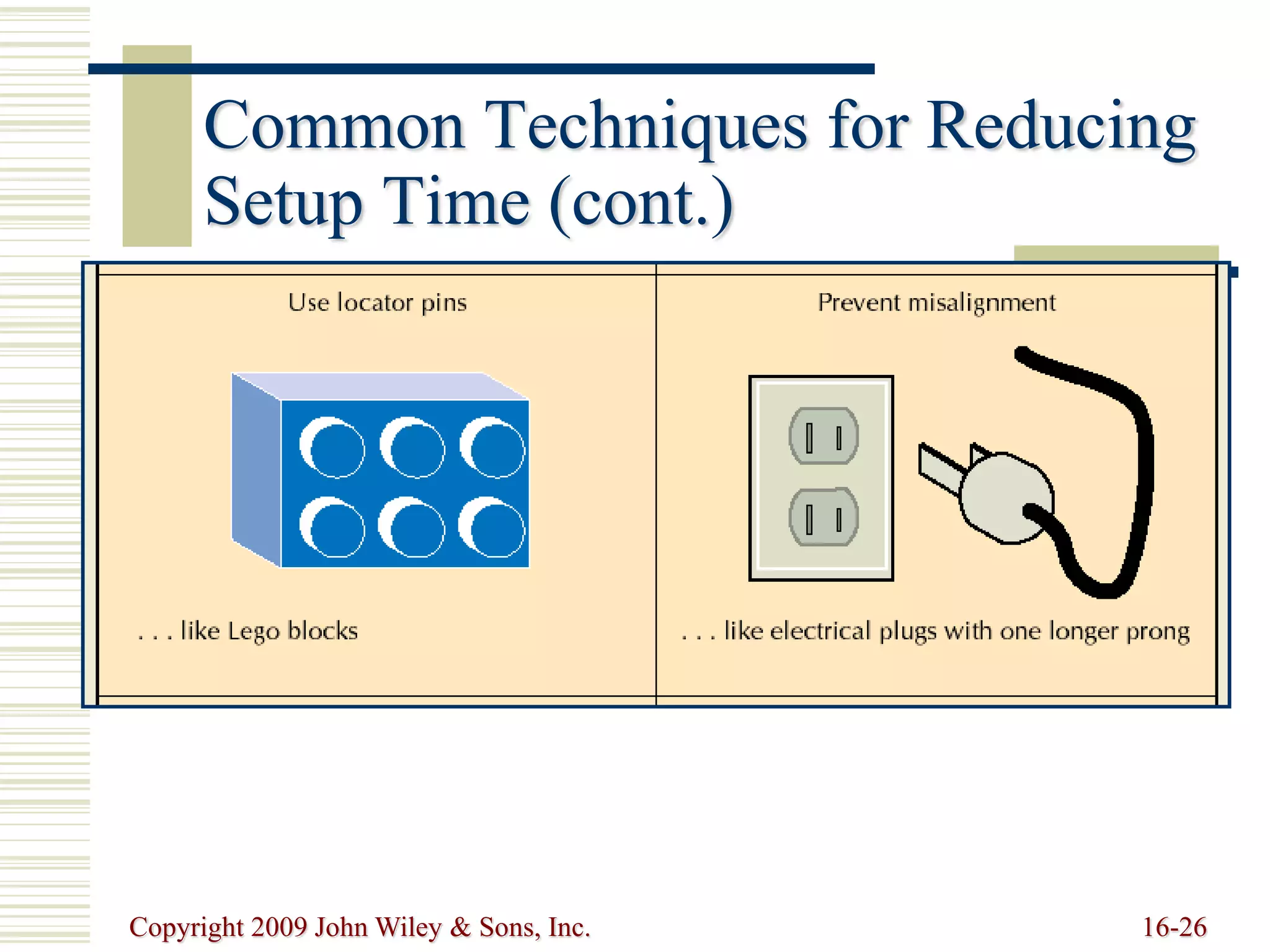
Common Techniques for Reducing
Setup Time
Copyright 2009 John Wiley & Sons, Inc. 16-26
Common Techniques for Reducing
Setup Time (cont.)
Copyright 2009 John Wiley & Sons, Inc. 16-27
Common Techniques for Reducing
Setup Time (cont.)
Copyright 2009 John Wiley & Sons, Inc. 16-28
Uniform Production Levels
 Result from smoothing production
requirements on final assembly line
 Kanban systems can handle +/- 10%
demand changes
 Reduce variability with more accurate
forecasts
 Smooth demand across planning
horizon
 Mixed-model assembly steadies
component production
Copyright 2009 John Wiley & Sons, Inc. 16-29
Quality at the Source
 Visual control
 makes problems visible
 Poka-yokes
 prevent defects from
occurring
 Kaizen
 a system of continuous
improvement; “change for
the good of all”
 Jidoka
 authority to stop the
production line
 Andons
 call lights that signal
quality problems
 Under-capacity
scheduling
 leaves time for planning,
problem solving, and
maintenance
Copyright 2009 John Wiley & Sons, Inc. 16-30
Examples of Visual
Control
Copyright 2009 John Wiley & Sons, Inc. 16-31
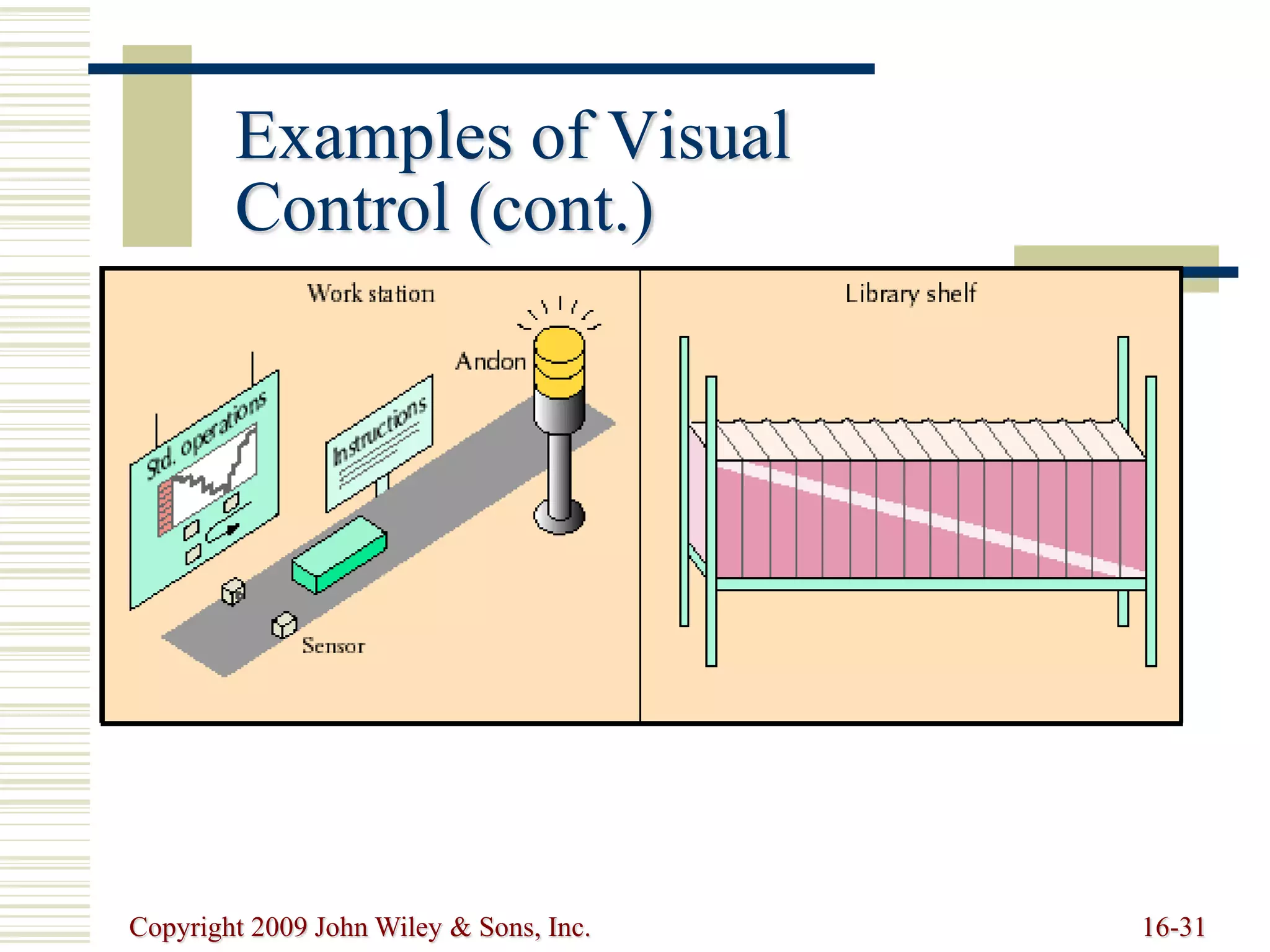
Examples of Visual
Control (cont.)
Copyright 2009 John Wiley & Sons, Inc. 16-32
Examples of Visual
Control (cont.)
Copyright 2009 John Wiley & Sons, Inc. 16-33
5 Whys
 One of the keys to an effective Kaizen is
finding the root cause of a problem and
eliminating it
 A practice of asking “why?” repeatedly
until the underlying cause is identified
(usually requiring five questions)
 Simple, yet powerful technique for finding
the root cause of a problem
Copyright 2009 John Wiley & Sons, Inc. 16-34
Total Productive
Maintenance (TPM)
 Breakdown maintenance
 Repairs to make failed machine operational
 Preventive maintenance
 System of periodic inspection and
maintenance to keep machines operating
 TPM combines preventive maintenance
and total quality concepts
Copyright 2009 John Wiley & Sons, Inc. 16-35
TPM Requirements
 Design products that can be easily produced
on existing machines
 Design machines for easier operation,
changeover, maintenance
 Train and retrain workers to operate machines
 Purchase machines that maximize productive
potential
 Design preventive maintenance plan spanning
life of machine
Copyright 2009 John Wiley & Sons, Inc. 16-36
Unneeded equipment, tools, furniture;
unneeded items on walls, bulletins; items
blocking aisles or stacked in corners;
unneeded inventory, supplies, parts; safety
hazards
Items not in their correct places; correct
places not obvious; aisles, workstations, &
equipment locations not indicated; items not
put away immediately after use
Floors, walls, stairs, equipment, & surfaces
not clean; cleaning materials not easily
accessible; lines, labels, signs broken or
unclean; other cleaning problems
Necessary information not visible; standards
not known; checklists missing; quantities and
limits not easily recognizable; items can’t be
located within 30 seconds
Number of workers without 5S training;
number of daily 5S inspections not performed;
number of personal items not stored; number
of times job aids not available or up-to-date
Keep only what you
need
A place for
everything and
everything in its
place
Cleaning, and
looking for ways to
keep clean and
organized
Maintaining and
monitoring the first
three categories
Sticking to the rules
Seiri(sort)
Seiton(set in order)
Seisou (shine)
Seiketsu
(standardize)
Shisuke (sustain)
5S Scan Goal Eliminate or Correct
Copyright 2009 John Wiley & Sons, Inc. 16-37
Supplier Networks
 Long-term supplier contracts
 Synchronized production
 Supplier certification
 Mixed loads and frequent deliveries
 Precise delivery schedules
 Standardized, sequenced delivery
 Locating in close proximity to the customer
Copyright 2009 John Wiley & Sons, Inc. 16-38
Benefits of Lean
Production
 Reduced inventory
 Improved quality
 Lower costs
 Reduced space requirements
 Shorter lead time
 Increased productivity
Copyright 2009 John Wiley & Sons, Inc. 16-39
Benefits of Lean
Production (cont.)
 Greater flexibility
 Better relations with suppliers
 Simplified scheduling and control activities
 Increased capacity
 Better use of human resources
 More product variety

JIT.ppt

  • 1.
    Copyright 2009 JohnWiley & Sons, Inc. Beni Asllani University of Tennessee at Chattanooga Lean Systems Operations Management - 6th Edition Chapter 16 Roberta Russell & Bernard W. Taylor, III
  • 2.
    Copyright 2009 JohnWiley & Sons, Inc. 16-2 Lean Production  Doing more with less inventory, fewer workers, less space  Just-in-time (JIT)  smoothing the flow of material to arrive just as it is needed  “JIT” and “Lean Production” are used interchangeably  Muda  waste, anything other than that which adds value to product or service
  • 3.
    Copyright 2009 JohnWiley & Sons, Inc. 16-3 Waste in Operations
  • 4.
    Copyright 2009 JohnWiley & Sons, Inc. 16-4 Waste in Operations (cont.)
  • 5.
    Copyright 2009 JohnWiley & Sons, Inc. 16-5 Waste in Operations (cont.)
  • 6.
    Copyright 2009 JohnWiley & Sons, Inc. 16-6 Basic Elements 1. Flexible resources 2. Cellular layouts 3. Pull system 4. Kanbans 5. Small lots 6. Quick setups 7. Uniform production levels 8. Quality at the source 9. Total productive maintenance 10. Supplier networks
  • 7.
    Copyright 2009 JohnWiley & Sons, Inc. 16-7 Flexible Resources  Multifunctional workers  perform more than one job  general-purpose machines perform several basic functions  Cycle time  time required for the worker to complete one pass through the operations assigned  Takt time  paces production to customer demand
  • 8.
    Copyright 2009 JohnWiley & Sons, Inc. 16-8 Cellular Layouts  Manufacturing cells  comprised of dissimilar machines brought together to manufacture a family of parts  Cycle time is adjusted to match takt time by changing worker paths
  • 9.
    Copyright 2009 JohnWiley & Sons, Inc. 16-9 Cells with Worker Routes
  • 10.
    Copyright 2009 JohnWiley & Sons, Inc. 16-10 Pull System  Material is pulled through the system when needed  Reversal of traditional push system where material is pushed according to a schedule  Forces cooperation  Prevent over and underproduction  While push systems rely on a predetermined schedule, pull systems rely on customer requests
  • 11.
    Copyright 2009 JohnWiley & Sons, Inc. 16-11 Kanbans  Card which indicates standard quantity of production  Derived from two-bin inventory system  Maintain discipline of pull production  Authorize production and movement of goods
  • 12.
    Copyright 2009 JohnWiley & Sons, Inc. 16-12 Sample Kanban
  • 13.
    Copyright 2009 JohnWiley & Sons, Inc. 16-13 Origin of Kanban a) Two-bin inventory system b) Kanban inventory system Reorder card Bin 1 Bin 2 Q - R Kanban R R Q = order quantity R = reorder point - demand during lead time
  • 14.
    Copyright 2009 JohnWiley & Sons, Inc. 16-14 Types of Kanban  Production kanban  authorizes production of goods  Withdrawal kanban  authorizes movement of goods  Kanban square  a marked area designated to hold items  Signal kanban  a triangular kanban used to signal production at the previous workstation  Material kanban  used to order material in advance of a process  Supplier kanban  rotates between the factory and suppliers
  • 15.
    Copyright 2009 JohnWiley & Sons, Inc. 16-15
  • 16.
    Copyright 2009 JohnWiley & Sons, Inc. 16-16
  • 17.
    Copyright 2009 JohnWiley & Sons, Inc. 16-17
  • 18.
    Copyright 2009 JohnWiley & Sons, Inc. 16-18 Determining Number of Kanbans where N = number of kanbans or containers d = average demand over some time period L = lead time to replenish an order S = safety stock C = container size No. of Kanbans = average demand during lead time + safety stock container size N = dL + S C
  • 19.
    Copyright 2009 JohnWiley & Sons, Inc. 16-19 Determining Number of Kanbans: Example d = 150 bottles per hour L = 30 minutes = 0.5 hours S = 0.10(150 x 0.5) = 7.5 C = 25 bottles Round up to 4 (to allow some slack) or down to 3 (to force improvement) N = = = = 3.3 kanbans or containers dL + S C (150 x 0.5) + 7.5 25 75 + 7.5 25
  • 20.
    Copyright 2009 JohnWiley & Sons, Inc. 16-20 Small Lots  Require less space and capital investment  Move processes closer together  Make quality problems easier to detect  Make processes more dependent on each other
  • 21.
    Copyright 2009 JohnWiley & Sons, Inc. 16-21 Inventory Hides Problems
  • 22.
    Copyright 2009 JohnWiley & Sons, Inc. 16-22 Less Inventory Exposes Problems
  • 23.
    Copyright 2009 JohnWiley & Sons, Inc. 16-23 Components of Lead Time  Processing time  Reduce number of items or improve efficiency  Move time  Reduce distances, simplify movements, standardize routings  Waiting time  Better scheduling, sufficient capacity  Setup time  Generally the biggest bottleneck
  • 24.
    Copyright 2009 JohnWiley & Sons, Inc. 16-24 Quick Setups  Internal setup  Can be performed only when a process is stopped  External setup  Can be performed in advance  SMED Principles  Separate internal setup from external setup  Convert internal setup to external setup  Streamline all aspects of setup  Perform setup activities in parallel or eliminate them entirely
  • 25.
    Copyright 2009 JohnWiley & Sons, Inc. 16-25 Common Techniques for Reducing Setup Time
  • 26.
    Copyright 2009 JohnWiley & Sons, Inc. 16-26 Common Techniques for Reducing Setup Time (cont.)
  • 27.
    Copyright 2009 JohnWiley & Sons, Inc. 16-27 Common Techniques for Reducing Setup Time (cont.)
  • 28.
    Copyright 2009 JohnWiley & Sons, Inc. 16-28 Uniform Production Levels  Result from smoothing production requirements on final assembly line  Kanban systems can handle +/- 10% demand changes  Reduce variability with more accurate forecasts  Smooth demand across planning horizon  Mixed-model assembly steadies component production
  • 29.
    Copyright 2009 JohnWiley & Sons, Inc. 16-29 Quality at the Source  Visual control  makes problems visible  Poka-yokes  prevent defects from occurring  Kaizen  a system of continuous improvement; “change for the good of all”  Jidoka  authority to stop the production line  Andons  call lights that signal quality problems  Under-capacity scheduling  leaves time for planning, problem solving, and maintenance
  • 30.
    Copyright 2009 JohnWiley & Sons, Inc. 16-30 Examples of Visual Control
  • 31.
    Copyright 2009 JohnWiley & Sons, Inc. 16-31 Examples of Visual Control (cont.)
  • 32.
    Copyright 2009 JohnWiley & Sons, Inc. 16-32 Examples of Visual Control (cont.)
  • 33.
    Copyright 2009 JohnWiley & Sons, Inc. 16-33 5 Whys  One of the keys to an effective Kaizen is finding the root cause of a problem and eliminating it  A practice of asking “why?” repeatedly until the underlying cause is identified (usually requiring five questions)  Simple, yet powerful technique for finding the root cause of a problem
  • 34.
    Copyright 2009 JohnWiley & Sons, Inc. 16-34 Total Productive Maintenance (TPM)  Breakdown maintenance  Repairs to make failed machine operational  Preventive maintenance  System of periodic inspection and maintenance to keep machines operating  TPM combines preventive maintenance and total quality concepts
  • 35.
    Copyright 2009 JohnWiley & Sons, Inc. 16-35 TPM Requirements  Design products that can be easily produced on existing machines  Design machines for easier operation, changeover, maintenance  Train and retrain workers to operate machines  Purchase machines that maximize productive potential  Design preventive maintenance plan spanning life of machine
  • 36.
    Copyright 2009 JohnWiley & Sons, Inc. 16-36 Unneeded equipment, tools, furniture; unneeded items on walls, bulletins; items blocking aisles or stacked in corners; unneeded inventory, supplies, parts; safety hazards Items not in their correct places; correct places not obvious; aisles, workstations, & equipment locations not indicated; items not put away immediately after use Floors, walls, stairs, equipment, & surfaces not clean; cleaning materials not easily accessible; lines, labels, signs broken or unclean; other cleaning problems Necessary information not visible; standards not known; checklists missing; quantities and limits not easily recognizable; items can’t be located within 30 seconds Number of workers without 5S training; number of daily 5S inspections not performed; number of personal items not stored; number of times job aids not available or up-to-date Keep only what you need A place for everything and everything in its place Cleaning, and looking for ways to keep clean and organized Maintaining and monitoring the first three categories Sticking to the rules Seiri(sort) Seiton(set in order) Seisou (shine) Seiketsu (standardize) Shisuke (sustain) 5S Scan Goal Eliminate or Correct
  • 37.
    Copyright 2009 JohnWiley & Sons, Inc. 16-37 Supplier Networks  Long-term supplier contracts  Synchronized production  Supplier certification  Mixed loads and frequent deliveries  Precise delivery schedules  Standardized, sequenced delivery  Locating in close proximity to the customer
  • 38.
    Copyright 2009 JohnWiley & Sons, Inc. 16-38 Benefits of Lean Production  Reduced inventory  Improved quality  Lower costs  Reduced space requirements  Shorter lead time  Increased productivity
  • 39.
    Copyright 2009 JohnWiley & Sons, Inc. 16-39 Benefits of Lean Production (cont.)  Greater flexibility  Better relations with suppliers  Simplified scheduling and control activities  Increased capacity  Better use of human resources  More product variety