A PRESENTATION ON 
JIT(JUST-IN-TIME) 
By: Ankit saxena
“A philosophy of manufacturing 
based on planned elimination of 
waste and continuous 
improvement of productivity 
……” 
JIT?
Bottlenecks in 
implementing 
JIT in an 
Industry 
JIT improvement won`t do any good. 
Its sounds like a good thing but we still don’t want to do it 
Look good on paper but….. 
Costs are already as low as that can possibly get 
But we already been doing things that way 
We can`t lower costs any more without lowering quality 
Everything is going just fine now ,Why change it? 
That`s a lousy idea! We already tried that 20 years ago 
Look we understand this stuff better than anybody(so don’t tell us 
what to do)
 Evolved in Japan after World War II, as 
a result of their diminishing market 
share in the auto industry. 
 Toyota Motor Company- first to 
implement fully functioning and 
successful JIT system, in 1970’s. 
 Japanese Manufacturers looked for a 
way to gain the most efficient use of 
limited resources. They worked on 
"optimal cost/quality relationship. 
History 
of JIT
The philosophy of JIT can be traced back to Henry Ford, but formalized JIT 
originated in Japan as the Toyota Production System. W. Edwards Deming’s 
lesson of variability reduction was a huge influence. 
The focus of JIT is to improve the system of production 
by eliminating all forms of waste.
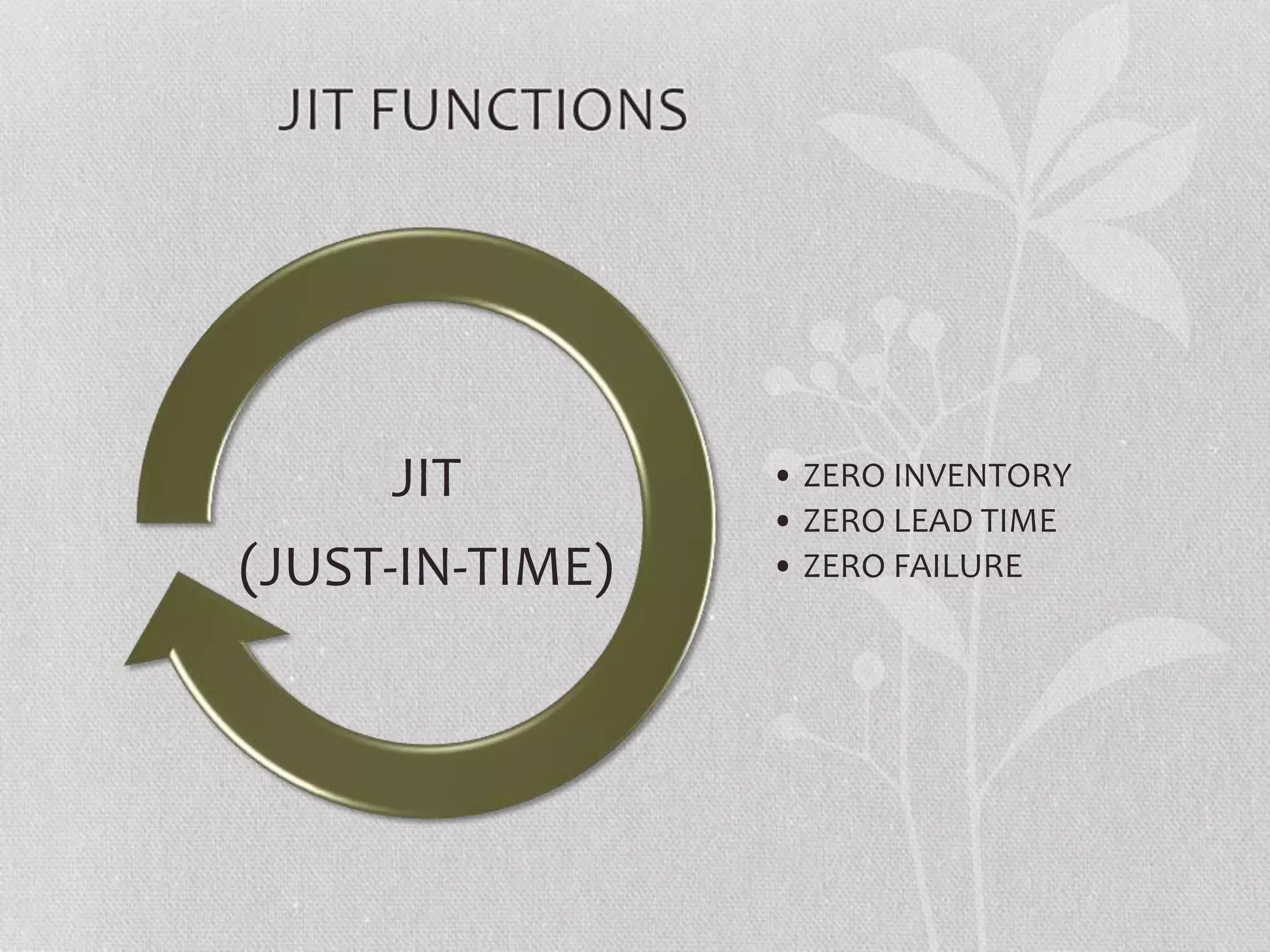
• ZERO INVENTORY 
• ZERO LEAD TIME 
• ZERO FAILURE 
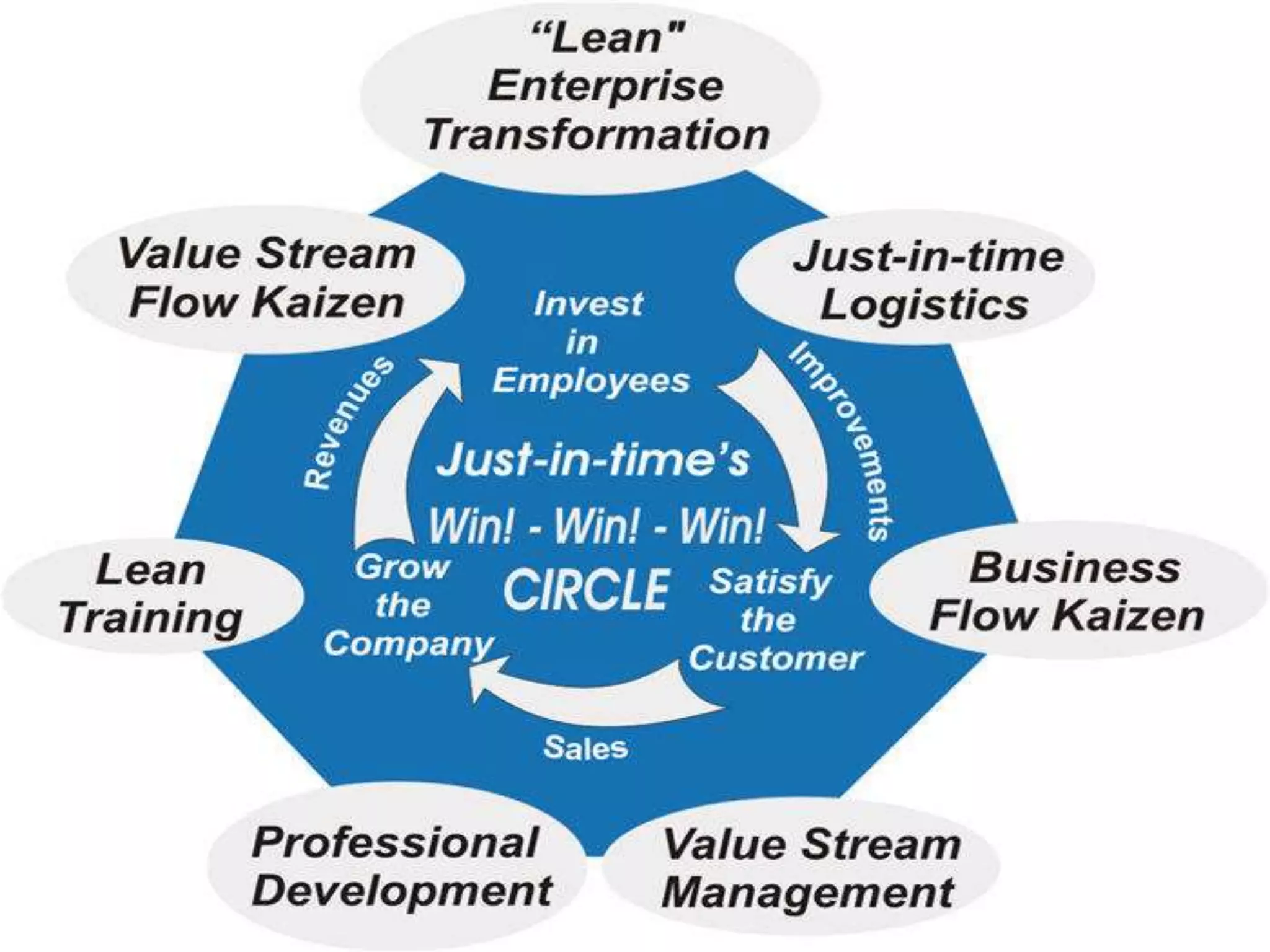
JIT 
(JUST-IN-TIME)
Eliminates waste . 
Achieves streamlined production . 
Eliminate disruptions in production … caused by poor quality, 
schedule changes, late deliveries. 
 Makes the manufacturing delivery system flexible by allowing it to 
handle a variety of products and changes in the level of output. 
Reduces setup and delivery times .
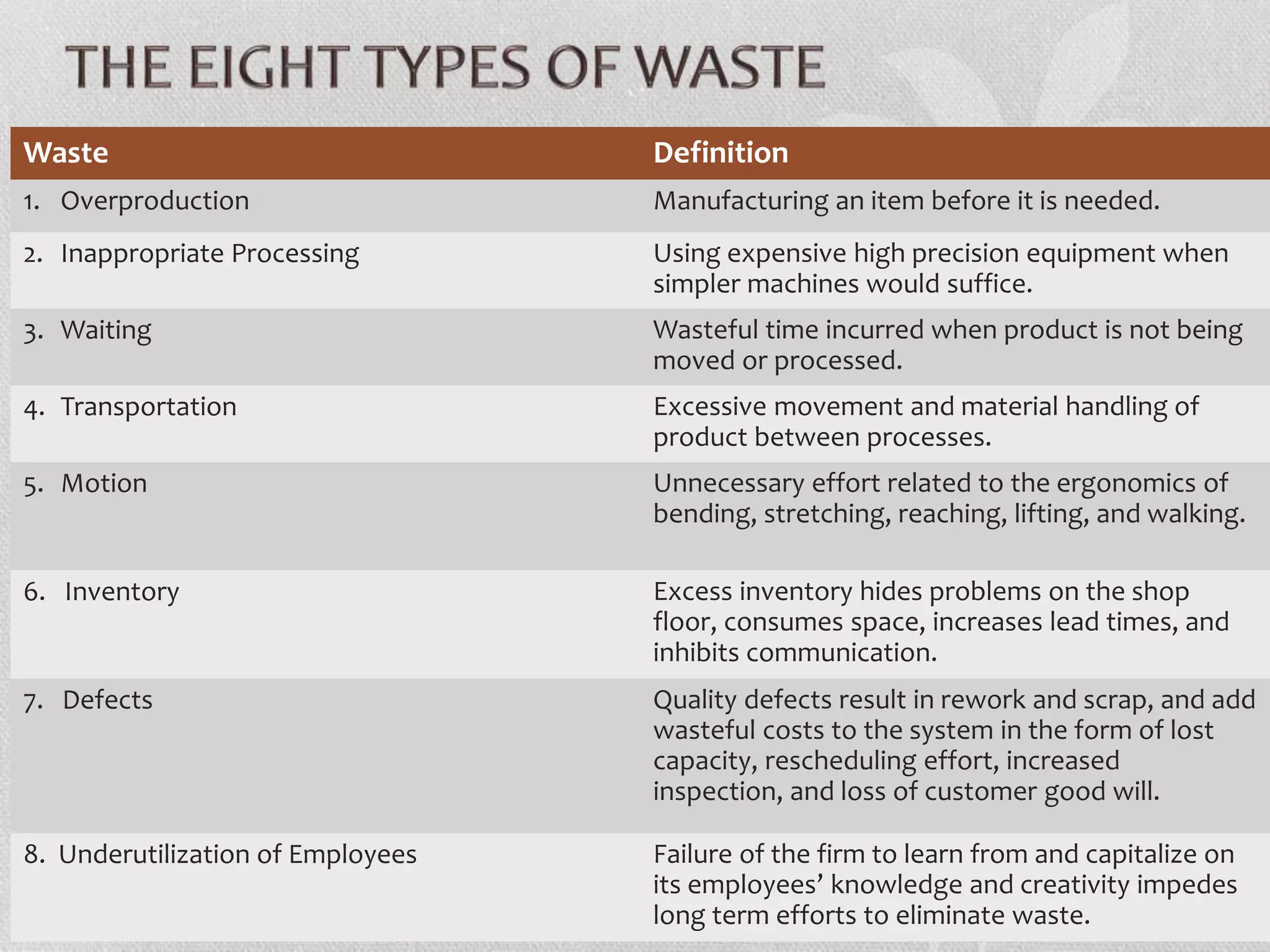
Waste Definition 
1. Overproduction Manufacturing an item before it is needed. 
2. Inappropriate Processing Using expensive high precision equipment when 
simpler machines would suffice. 
3. Waiting Wasteful time incurred when product is not being 
moved or processed. 
4. Transportation Excessive movement and material handling of 
product between processes. 
5. Motion Unnecessary effort related to the ergonomics of 
bending, stretching, reaching, lifting, and walking. 
6. Inventory Excess inventory hides problems on the shop 
floor, consumes space, increases lead times, and 
inhibits communication. 
7. Defects Quality defects result in rework and scrap, and add 
wasteful costs to the system in the form of lost 
capacity, rescheduling effort, increased 
inspection, and loss of customer good will. 
8. Underutilization of Employees Failure of the firm to learn from and capitalize on 
its employees’ knowledge and creativity impedes 
long term efforts to eliminate waste.
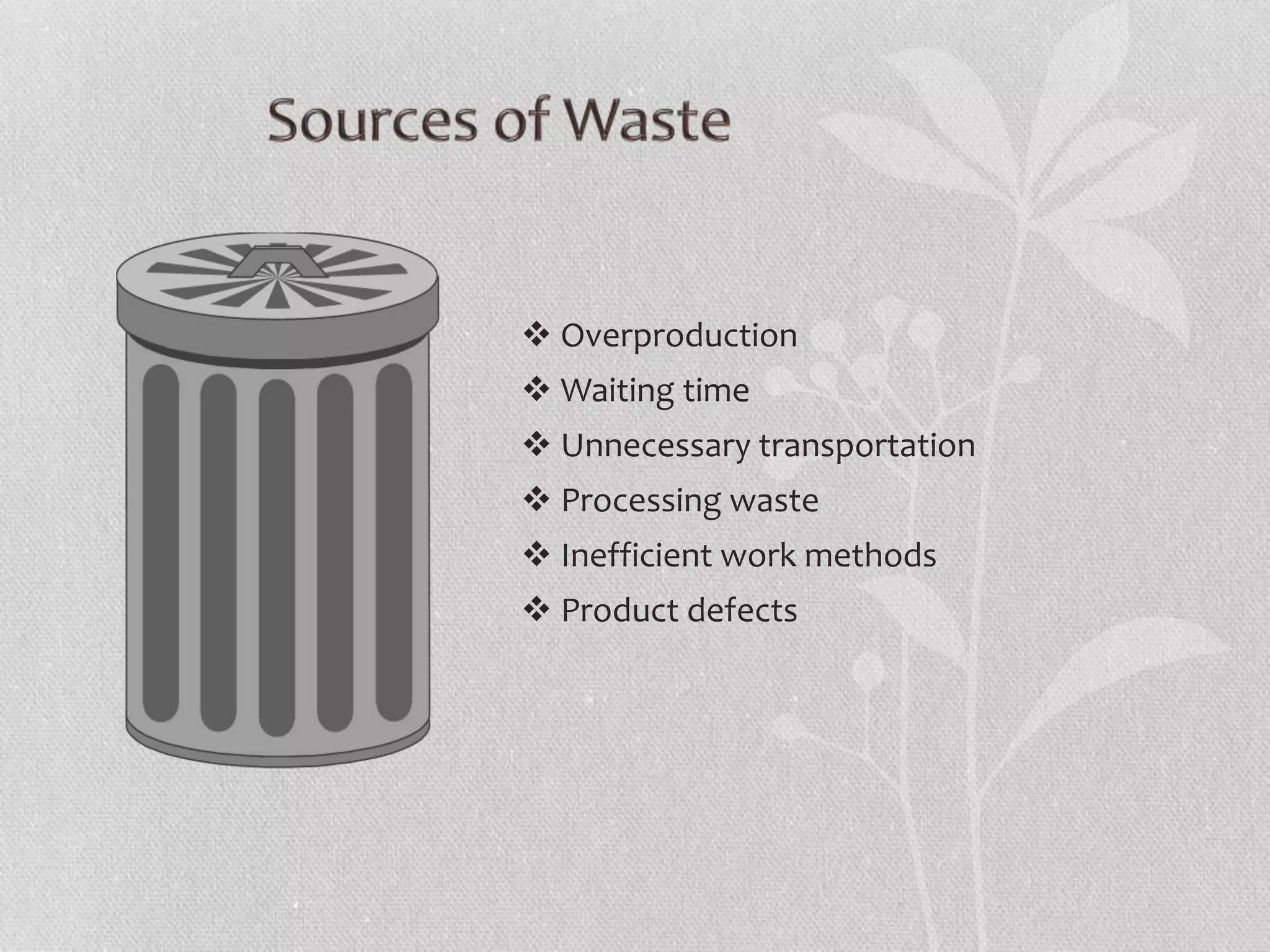
 Overproduction 
 Waiting time 
 Unnecessary transportation 
 Processing waste 
 Inefficient work methods 
 Product defects
Strategies For Minimizing Waste By Using 
JIT 
Manufacturing in smaller lot sizes reduces excess inventory 
Reducing inventory levels allows the problems to be uncovered … 
thus creating opportunities for manufacturing process improvement
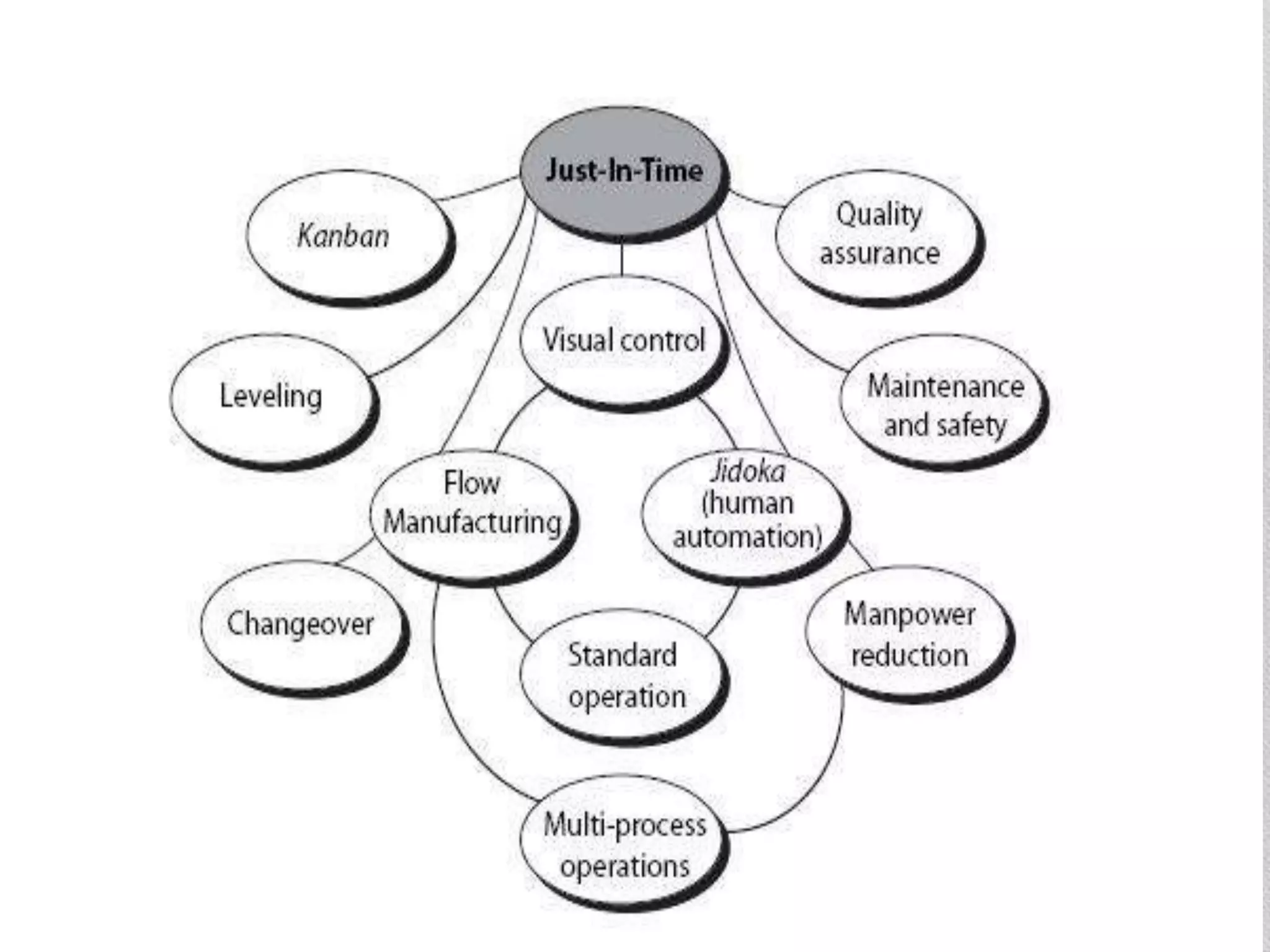
Principles Of JIT Manufacturing 
Total quality Management 
Production Management 
Supplier Management 
Inventory Management 
Human Resource 
Management
JIT Manufacturing Building Blocks 
Product design 
Process design 
Personnel/organizational 
elements 
Manufacturing 
planning and control
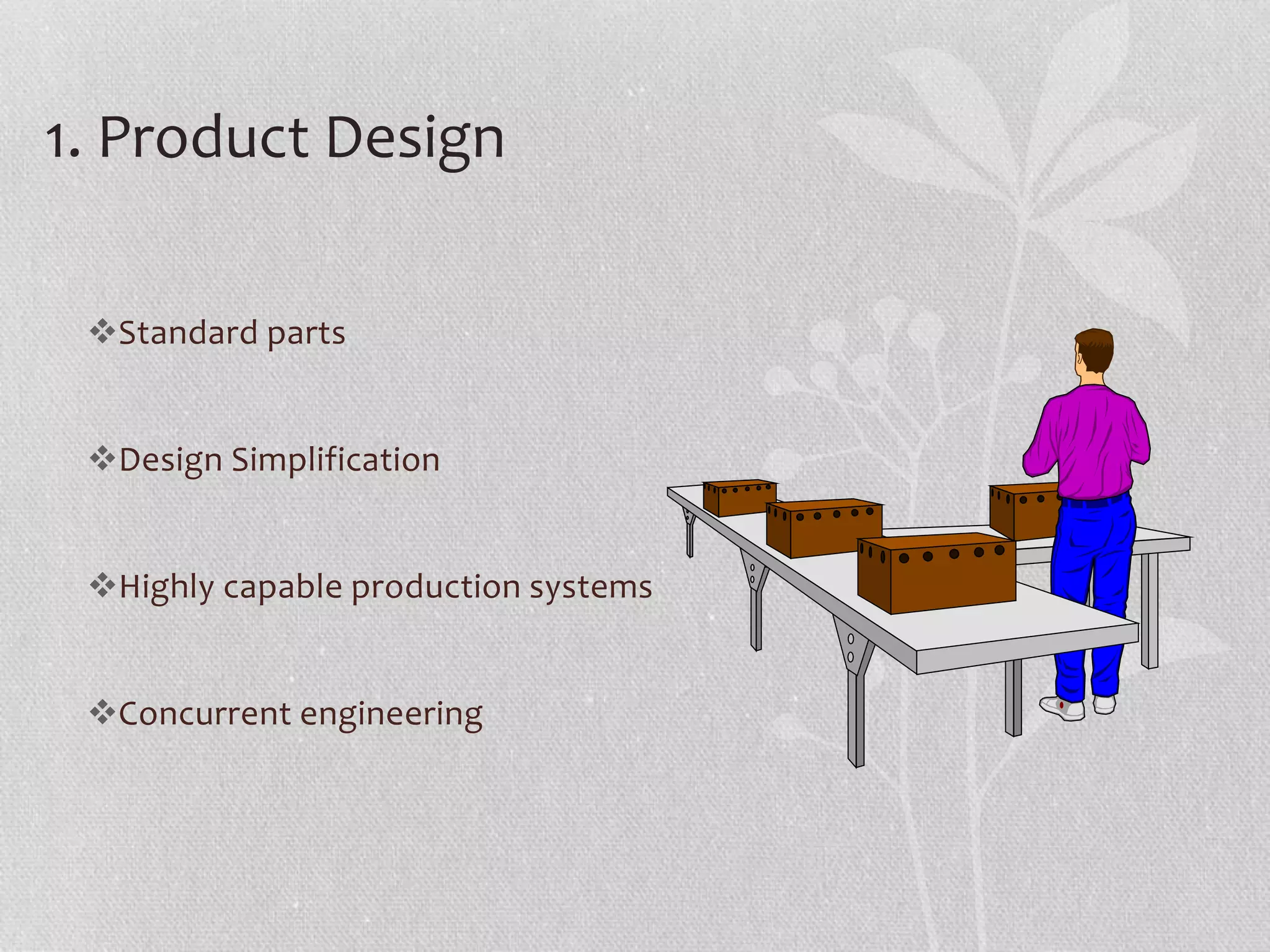
1. Product Design 
Standard parts 
Design Simplification 
Highly capable production systems 
Concurrent engineering
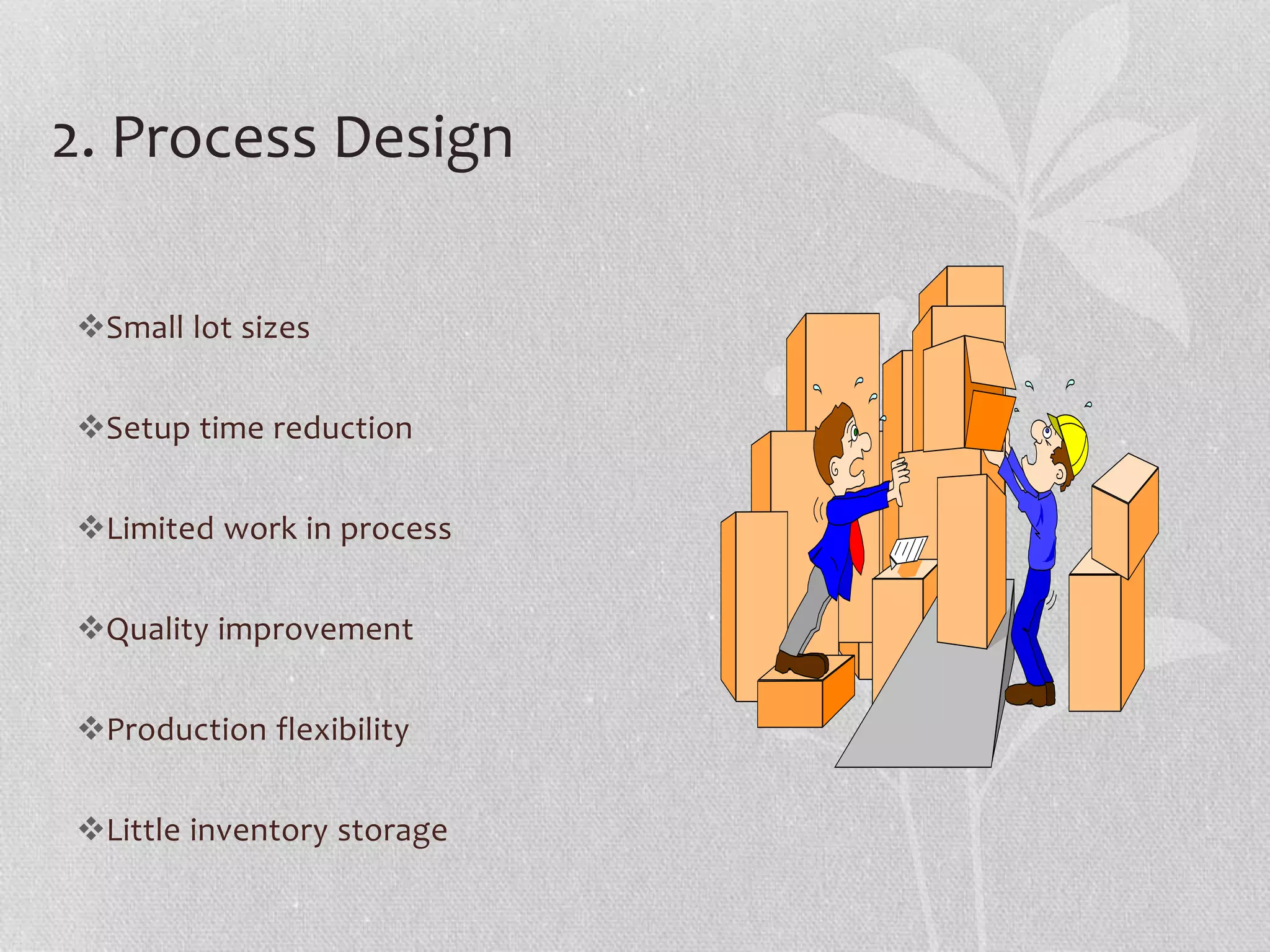
2. Process Design 
Small lot sizes 
Setup time reduction 
Limited work in process 
Quality improvement 
Production flexibility 
Little inventory storage
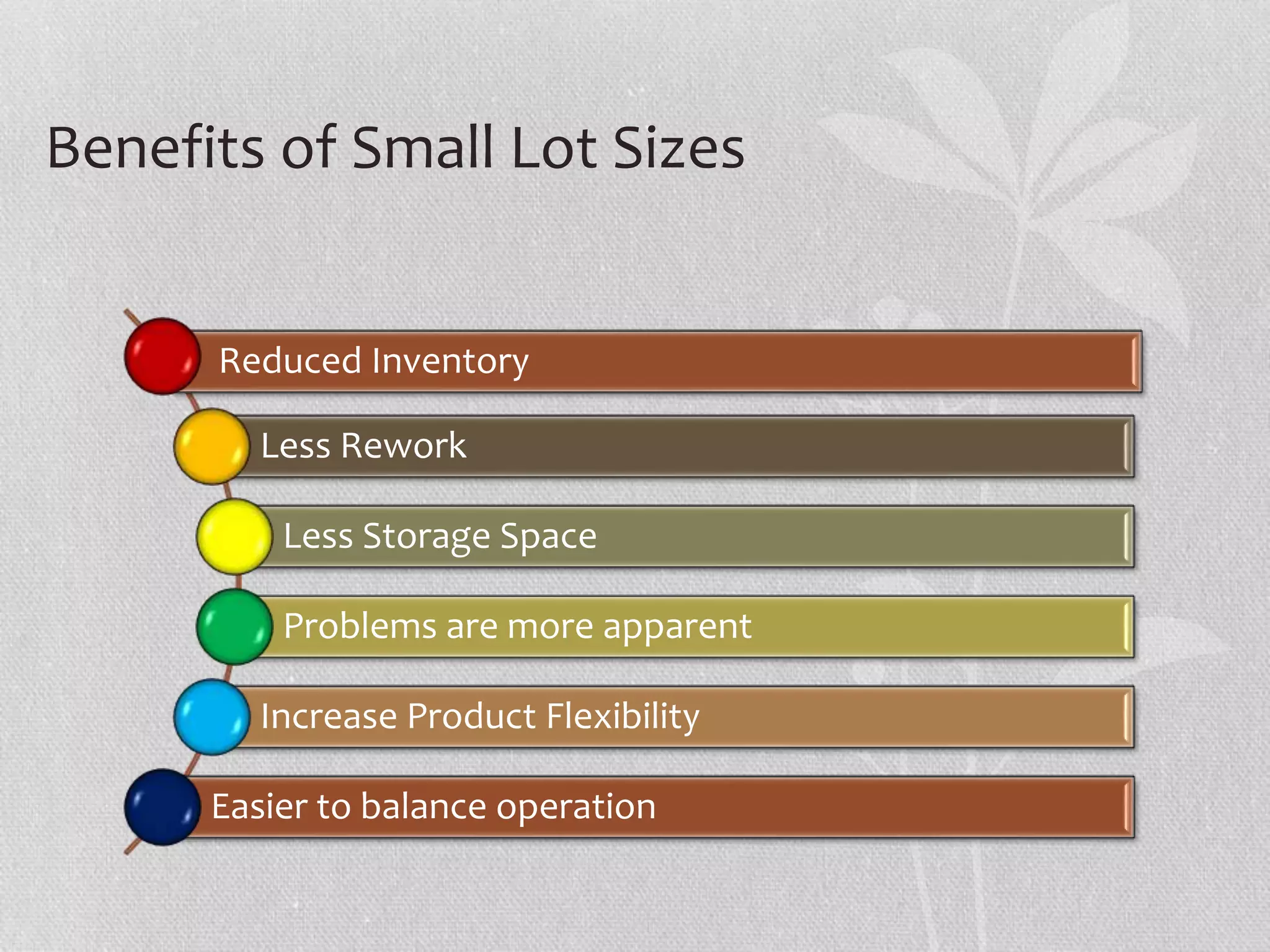
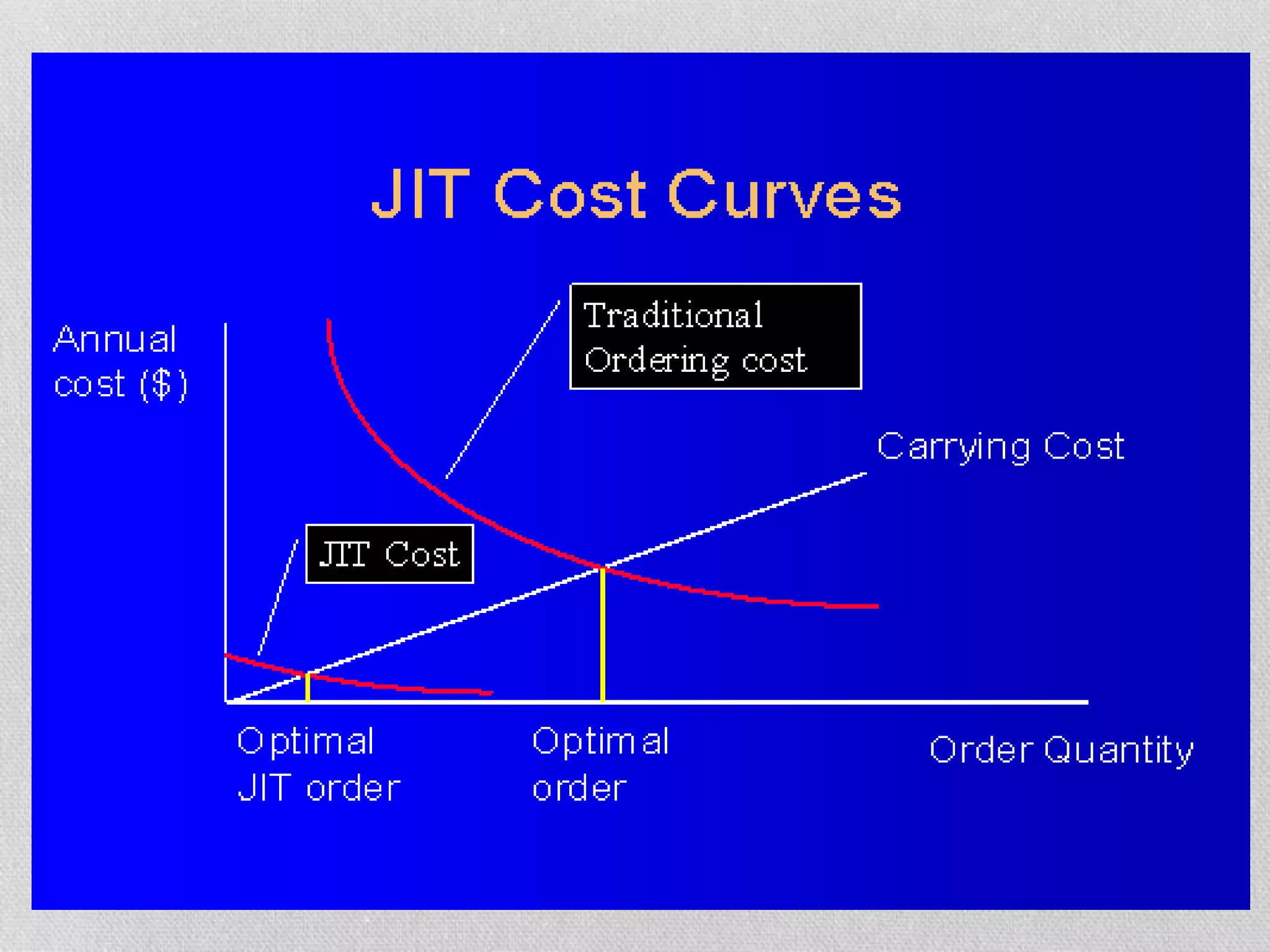
Benefits of Small Lot Sizes 
Reduced Inventory 
Less Rework 
Less Storage Space 
Problems are more apparent 
Increase Product Flexibility 
Easier to balance operation
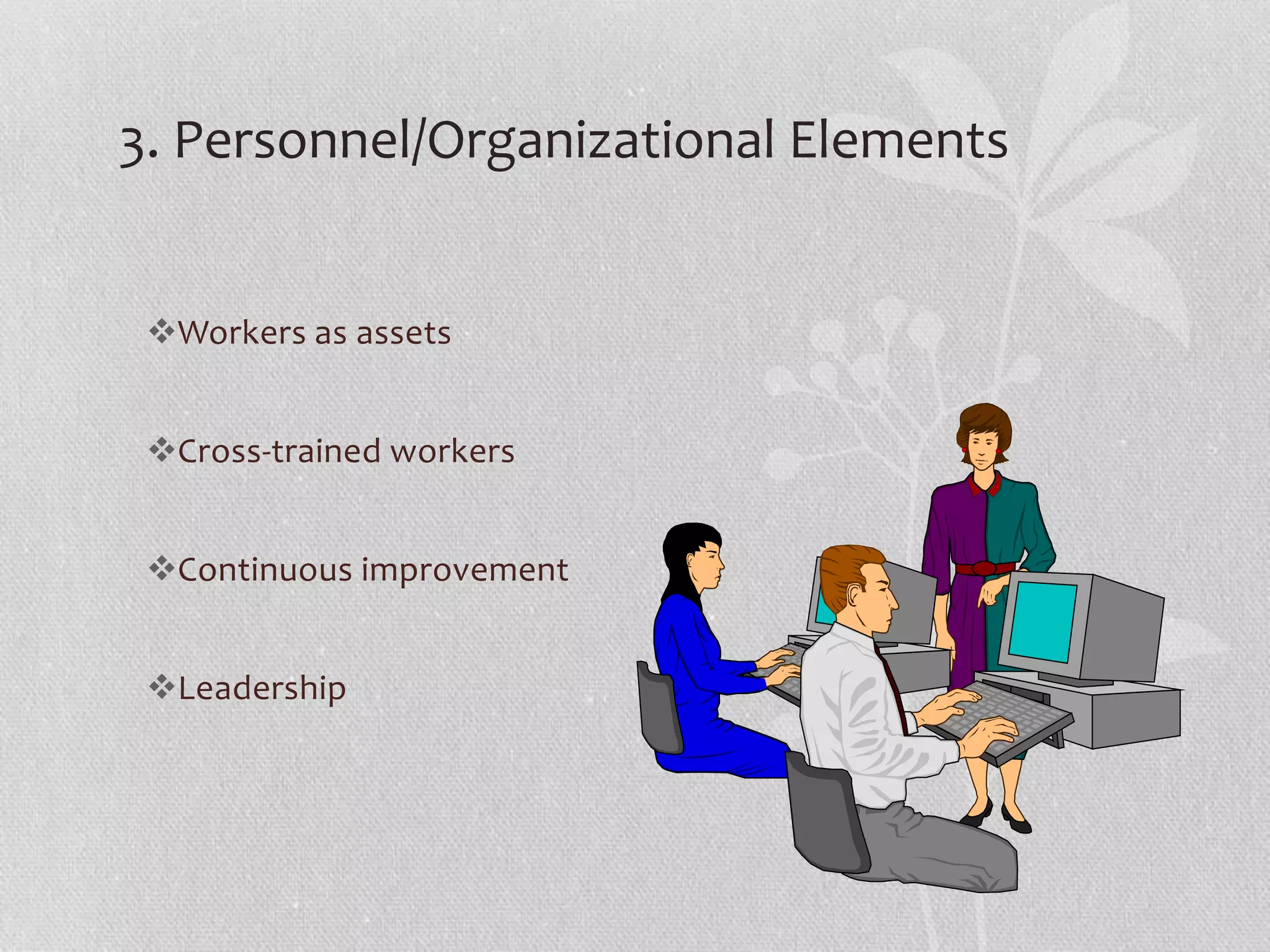
3. Personnel/Organizational Elements 
Workers as assets 
Cross-trained workers 
Continuous improvement 
Leadership
4. Manufacturing Planning and Control 
Pull systems 
Visual systems (kanban) 
Close vendor relationships 
Reduced transaction processing (delays in 
delivery) 
Preventive maintenance
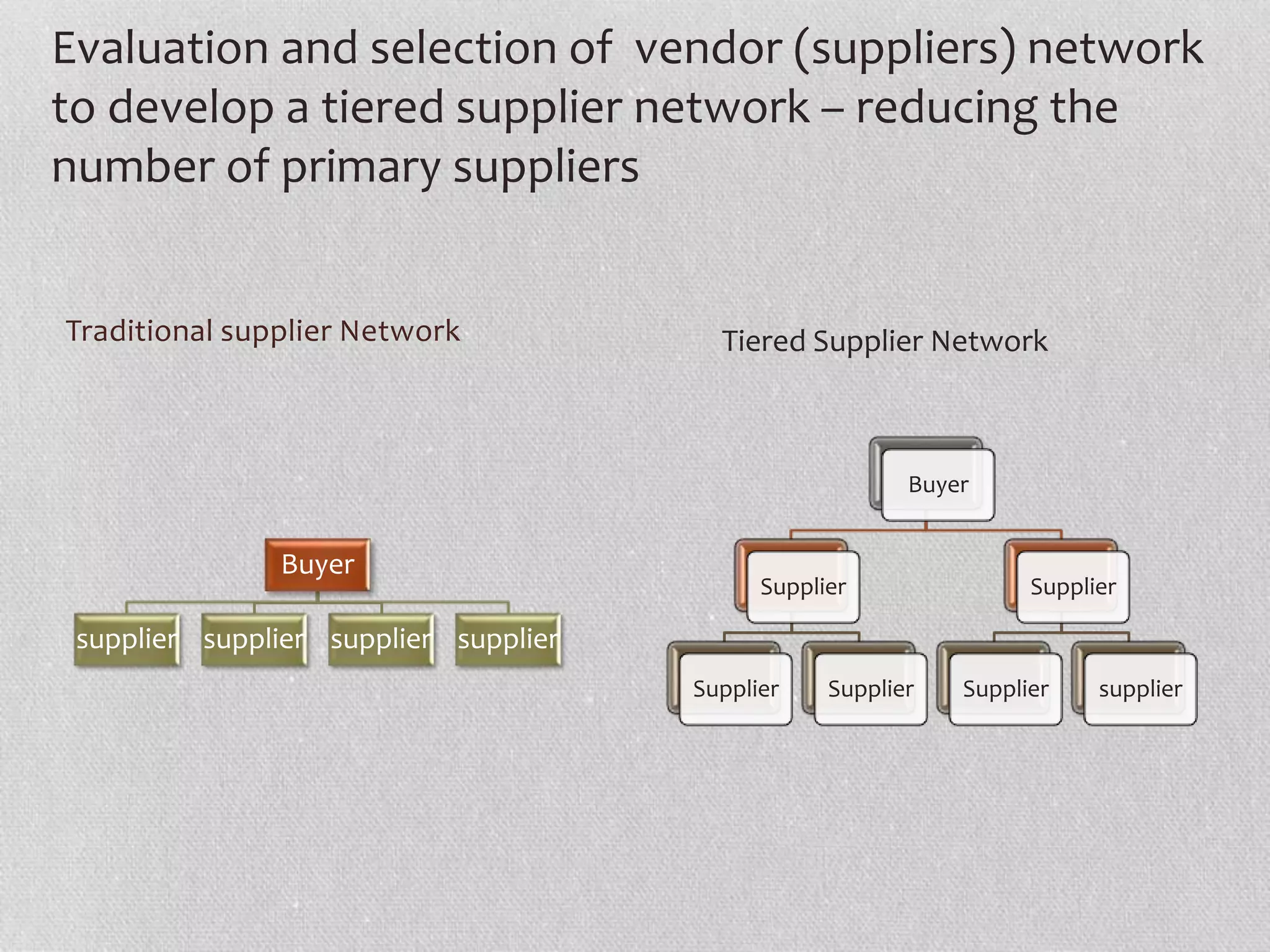
Evaluation and selection of vendor (suppliers) network 
to develop a tiered supplier network – reducing the 
number of primary suppliers 
Traditional supplier Network 
Tiered Supplier Network 
Buyer 
Supplier 
Supplier Supplier 
Supplier 
Supplier supplier 
Buyer 
supplier supplier supplier supplier
In McDonald’s
In McDonald’s 
High holding costs are the nature of the fast 
food industries. 
 Wastage. 
 Time.
In McDonald’s 
JIT system wherein McDonald's doesn't begin to cook 
its orders until a customer has placed a specific order.
Implementation of JIT 
Sophisticated burger-making technology (including a 
record-breaking bun toaster) 
McDonald's is able to make food fast enough to wait until 
it's been ordered. 
Reduction in wastage.
Implementing in JIT 
Production Systems 
Criteria for success 
Service 
Quality 
People 
Food preparation 
Profitability 
.
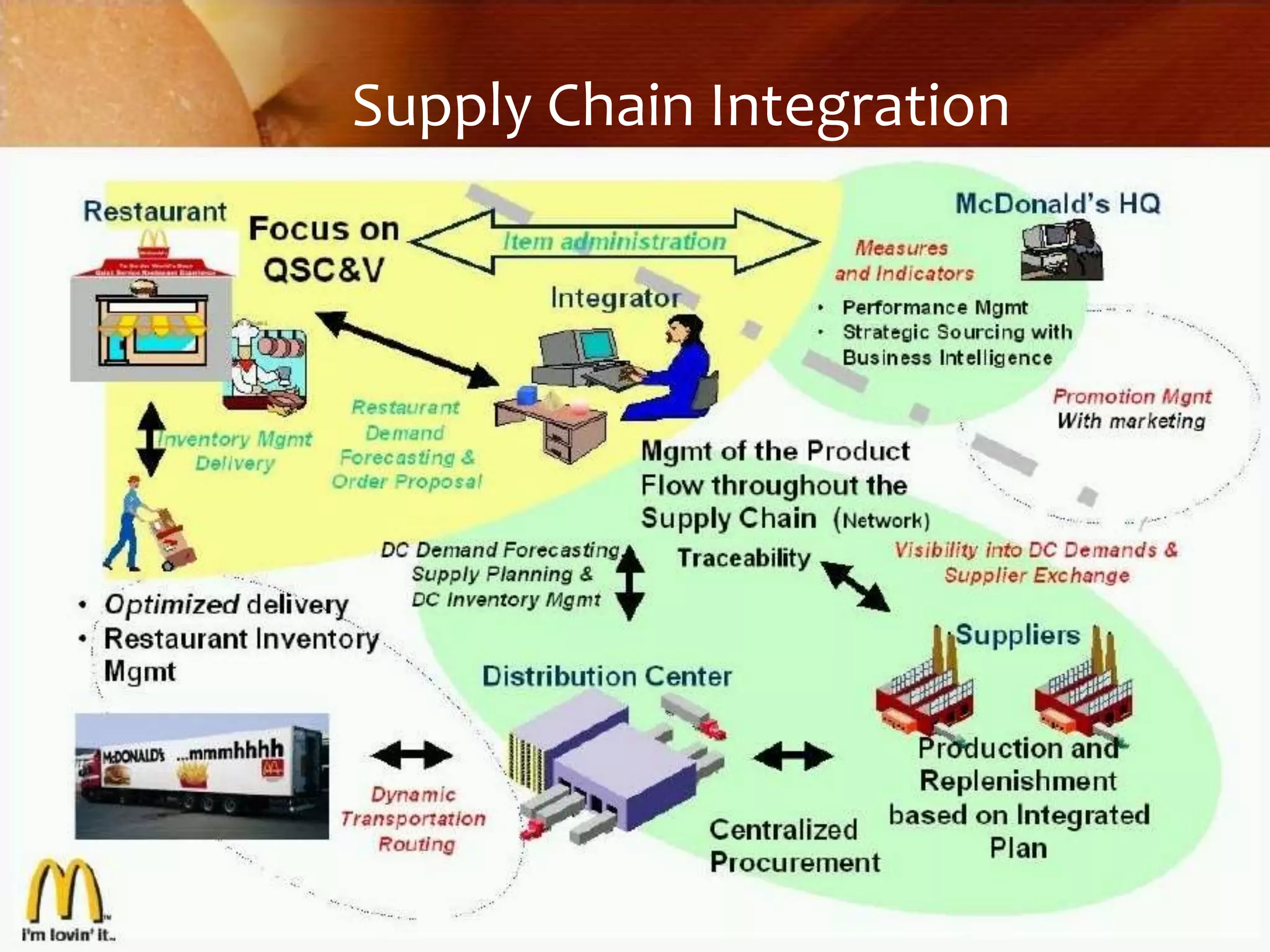
Supply Chain Integration
Benefits 
 Improved Quality – The burgers are prepared freshly and 
hence the quality has improved. 
 Customer service – As the burger is made only after the 
order is placed, making special orders is not an issue. 
 Cost Reduction – Due to significant reduction in wastage 
as uncooked material has a higher shelf life. 
 Reduction in waiting – Customer’s waiting time reduce 11 
min. to just 1 and half min.
Companies adopted JIT
TOYOTA PRODUCTION SYSTEM
Minimizing Waste: 
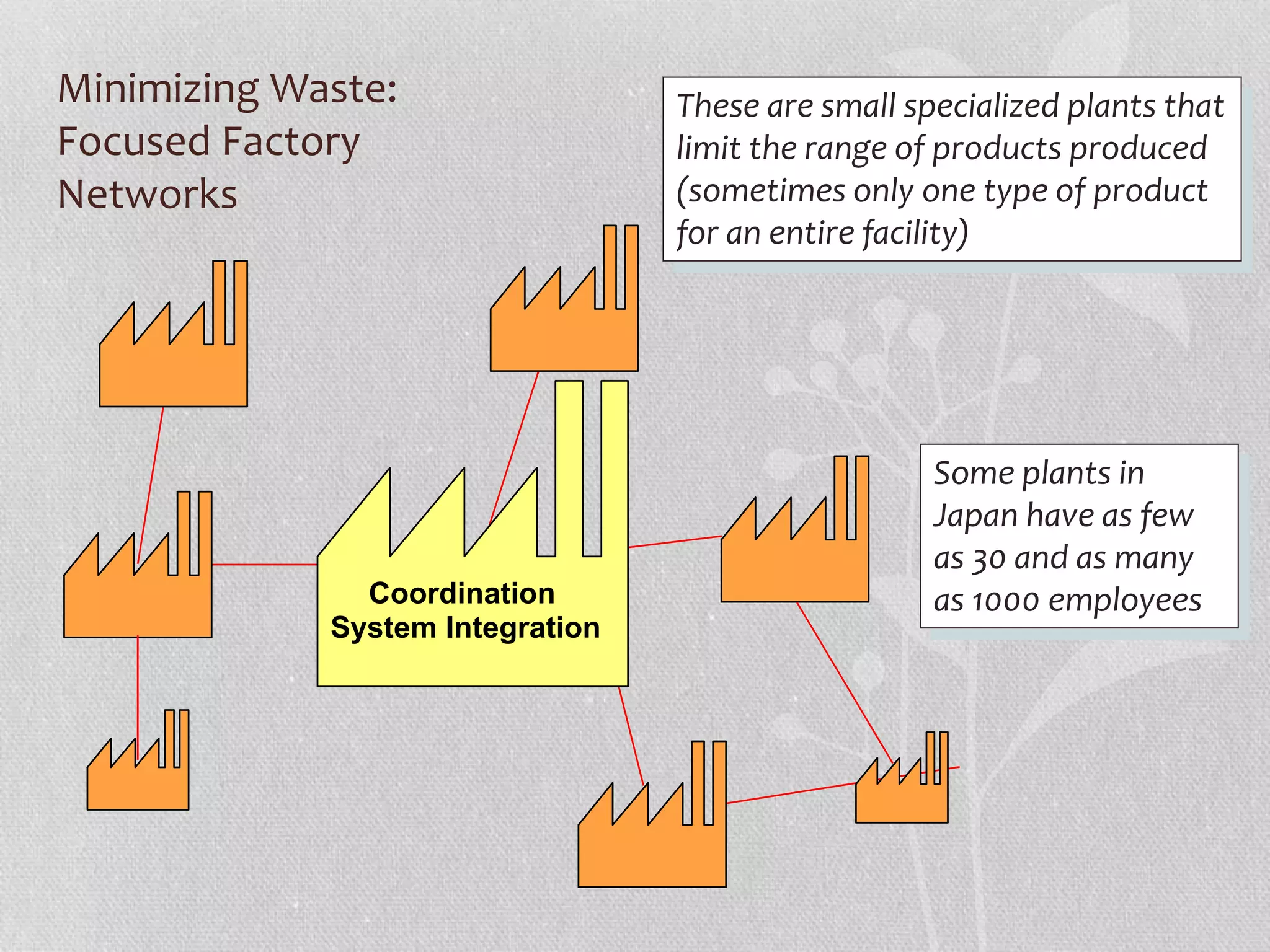
Focused Factory 
Networks 
Coordination 
System Integration 
These are small specialized plants that 
limit the range of products produced 
(sometimes only one type of product 
for an entire facility) 
Some plants in 
Japan have as few 
as 30 and as many 
as 1000 employees
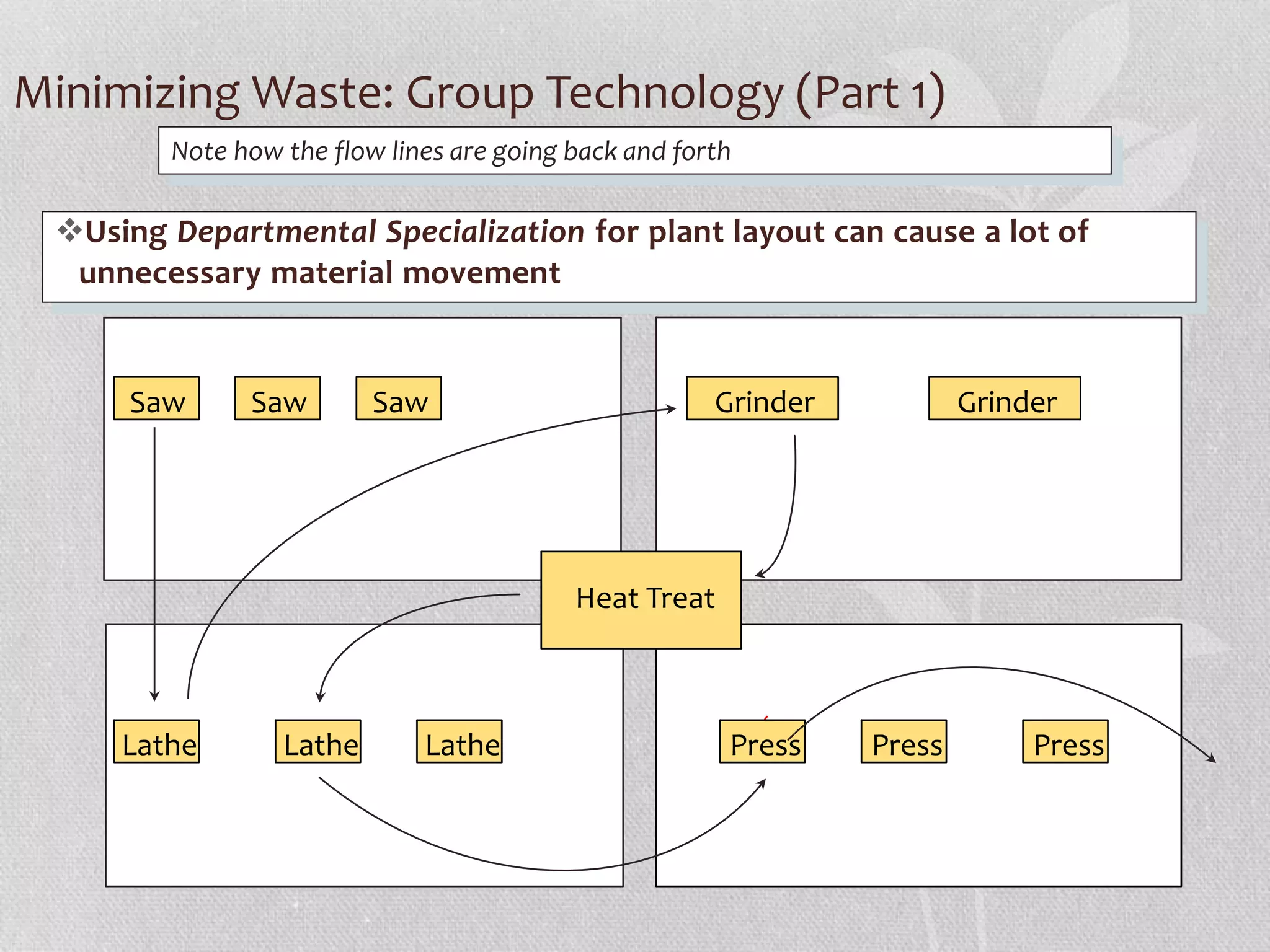
Minimizing Waste: Group Technology (Part 1) 
Note how the flow lines are going back and forth 
Using Departmental Specialization for plant layout can cause a lot of 
unnecessary material movement 
Saw Saw 
Grinder 
Grinder 
Lathe Press Press 
Saw 
Lathe Lathe 
Press 
Heat Treat
Minimizing Waste: 
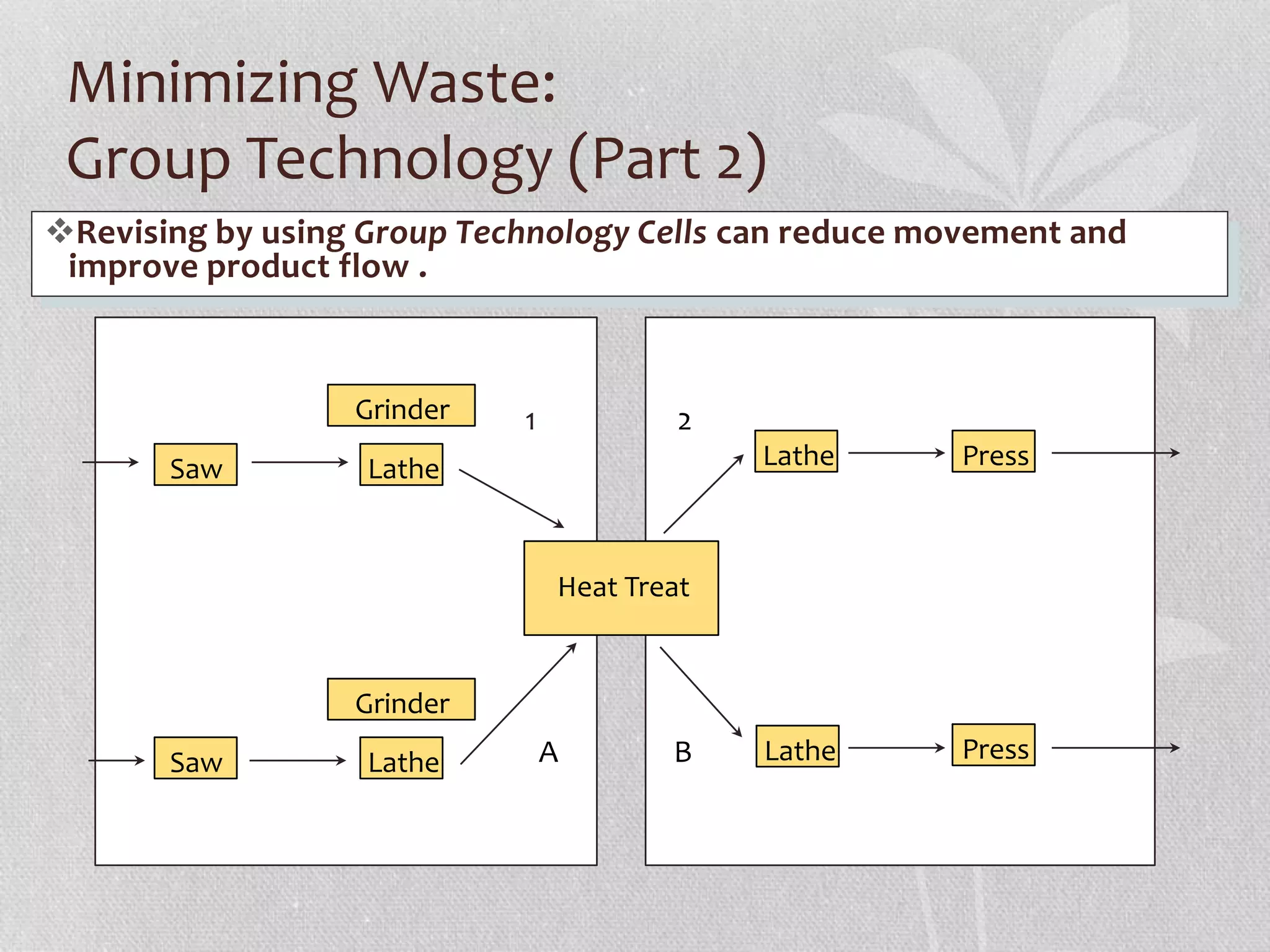
Group Technology (Part 2) 
Revising by using Group Technology Cells can reduce movement and 
improve product flow . 
Press 
Grinder 
Saw Lathe Lathe 
Grinder 
Lathe 
Heat Treat 
A 
2 
Saw B 
Lathe Press 
1
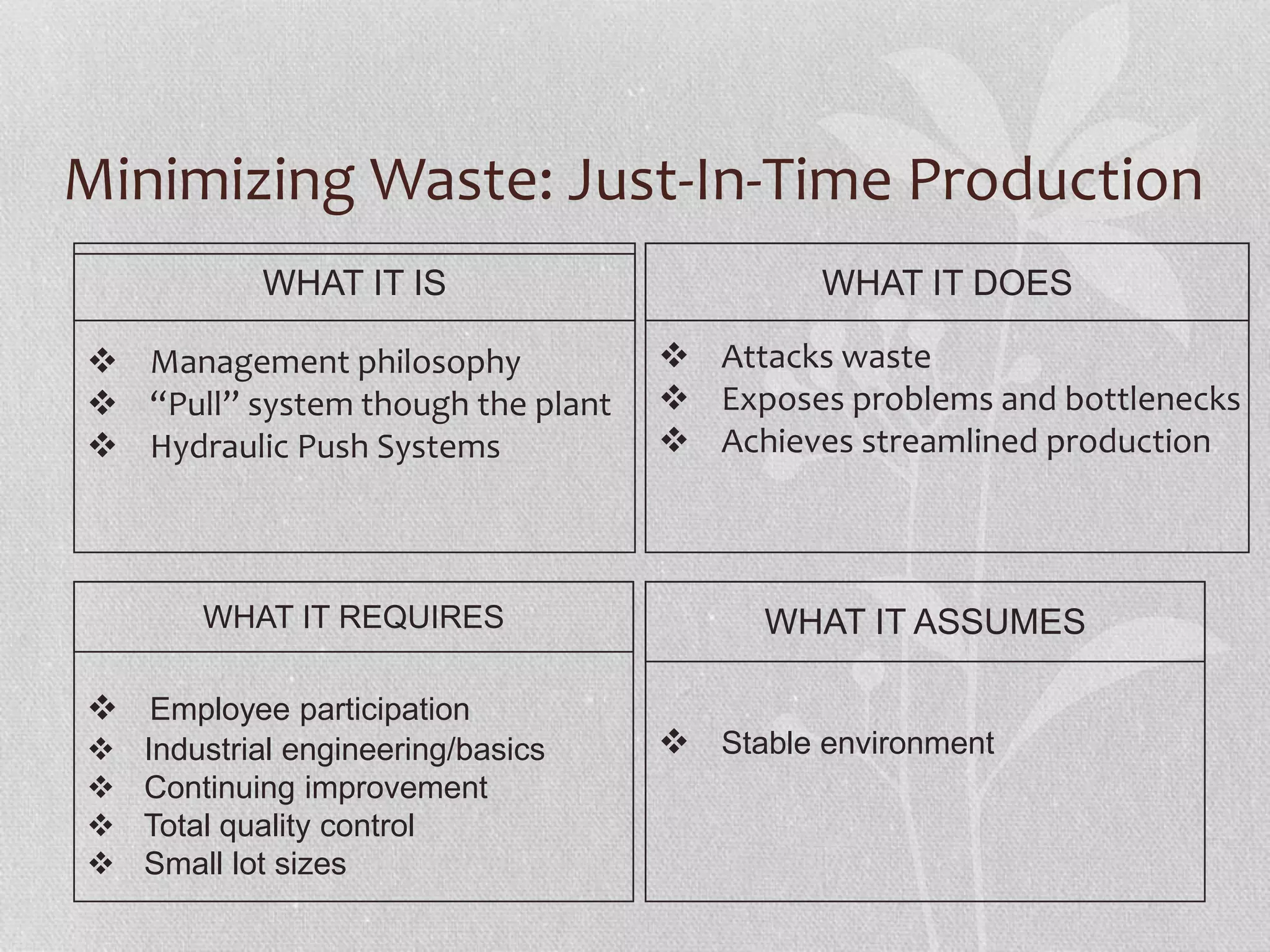
Minimizing Waste: Just-In-Time Production 
WHAT IT IS 
 Management philosophy 
 “Pull” system though the plant 
 Hydraulic Push Systems 
WHAT IT REQUIRES 
 Employee participation 
 Industrial engineering/basics 
 Continuing improvement 
 Total quality control 
 Small lot sizes 
WHAT IT DOES 
 Attacks waste 
 Exposes problems and bottlenecks 
 Achieves streamlined production 
WHAT IT ASSUMES 
 Stable environment
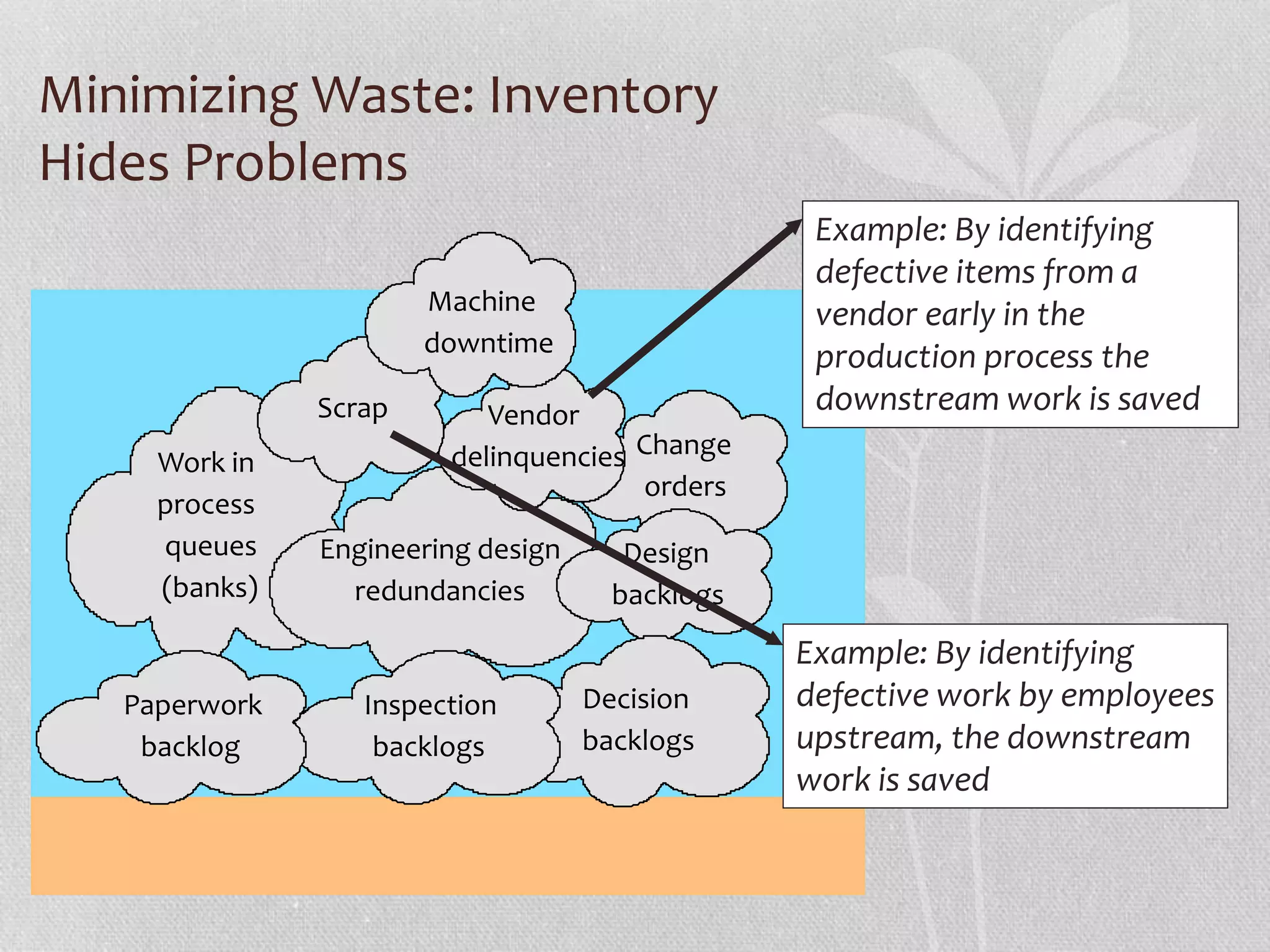
Minimizing Waste: Inventory 
Hides Problems 
Work in 
process 
queues 
(banks) 
Change 
orders 
Vendor 
delinquencies 
Scrap 
Engineering design 
redundancies 
Design 
backlogs 
Machine 
downtime 
Decision 
backlogs 
Inspection 
backlogs 
Paperwork 
backlog 
Example: By identifying 
defective items from a 
vendor early in the 
production process the 
downstream work is saved 
Example: By identifying 
defective work by employees 
upstream, the downstream 
work is saved
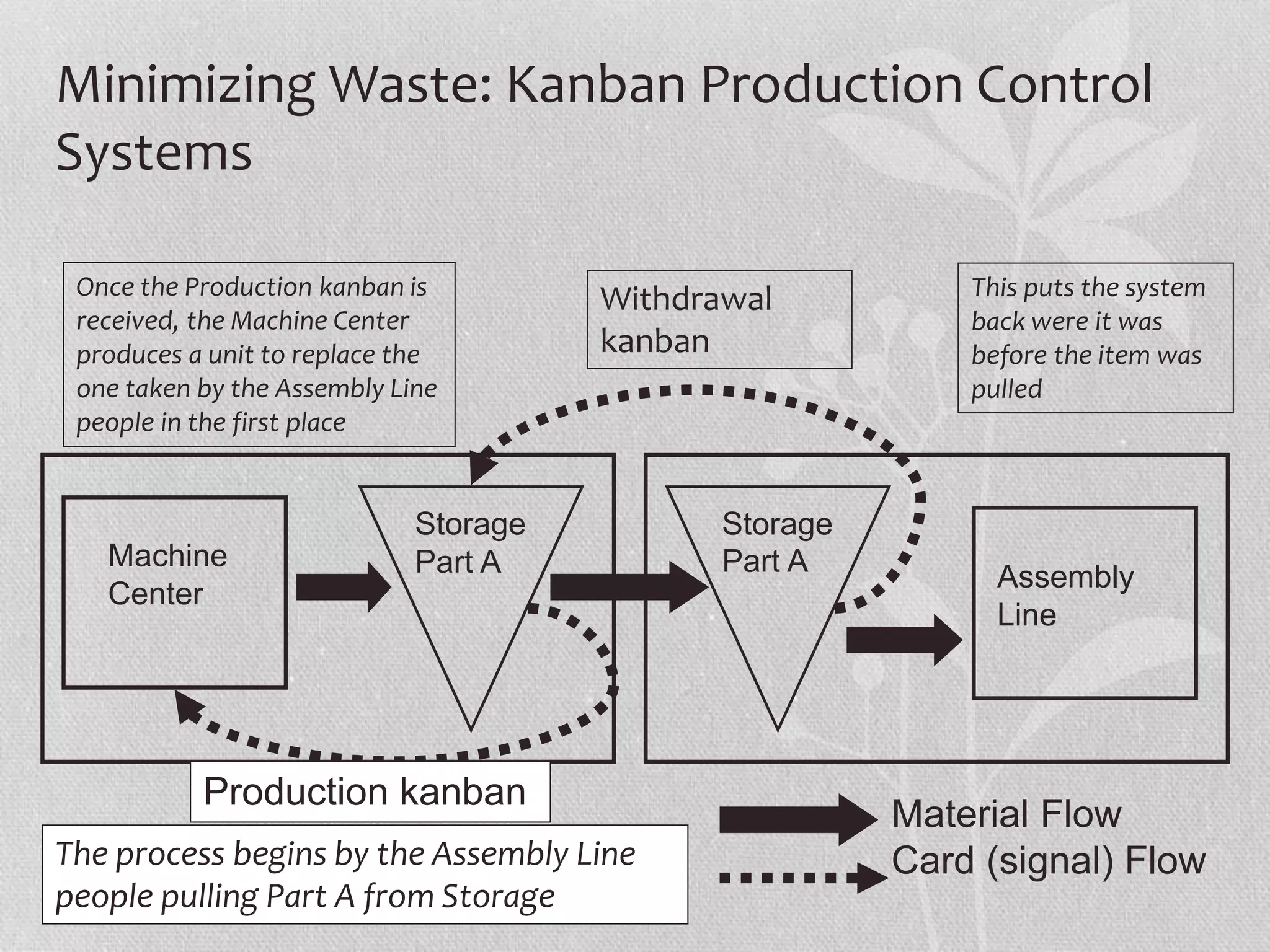
Minimizing Waste: Kanban Production Control 
Systems 
Storage 
Part A 
Storage 
Machine Part A 
Center 
Assembly 
Line 
Material Flow 
Card (signal) Flow 
Withdrawal 
kanban 
Once the Production kanban is 
received, the Machine Center 
produces a unit to replace the 
one taken by the Assembly Line 
people in the first place 
This puts the system 
back were it was 
before the item was 
pulled 
Production kanban 
The process begins by the Assembly Line 
people pulling Part A from Storage
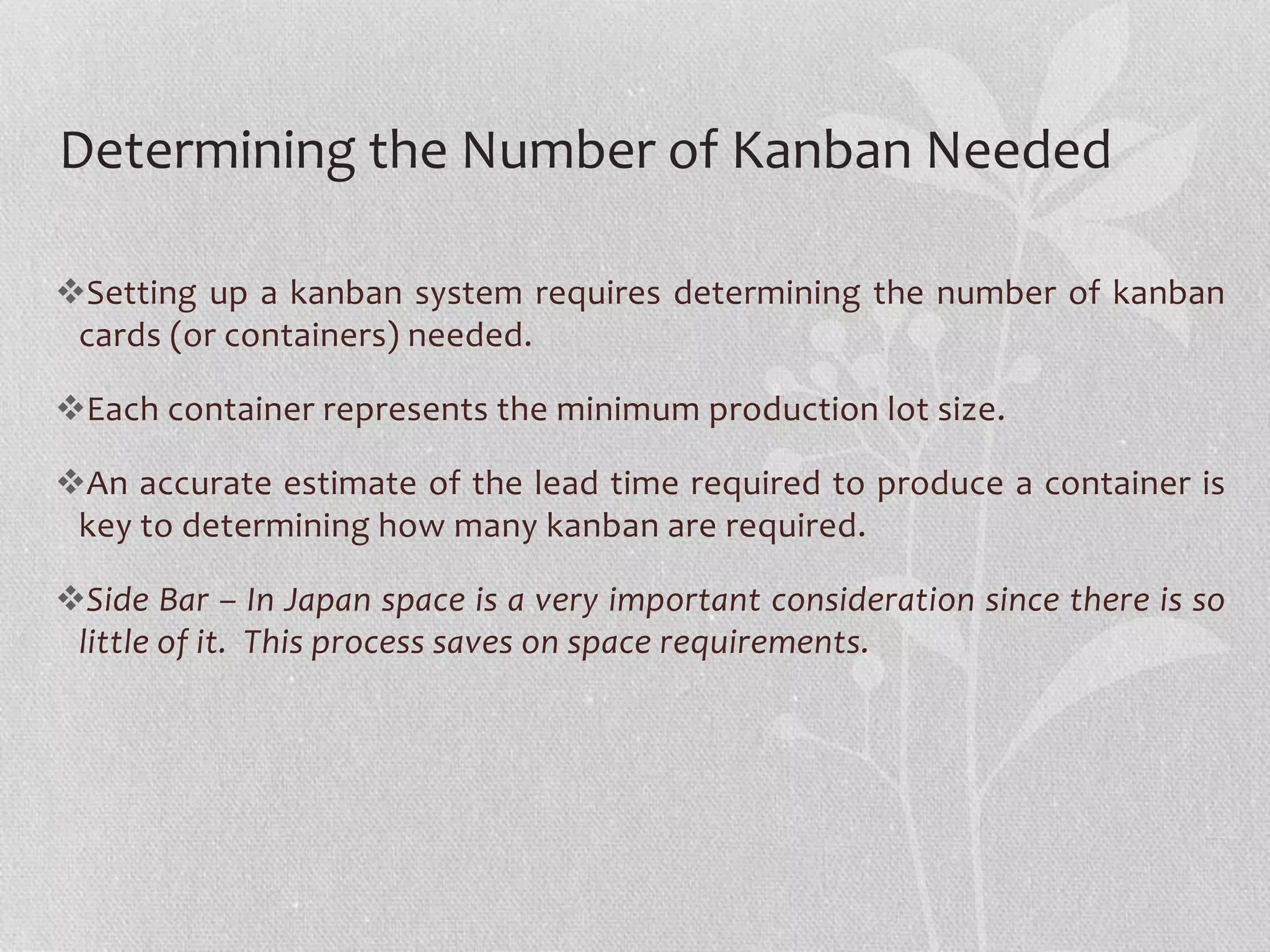
Determining the Number of Kanban Needed 
Setting up a kanban system requires determining the number of kanban 
cards (or containers) needed. 
Each container represents the minimum production lot size. 
An accurate estimate of the lead time required to produce a container is 
key to determining how many kanban are required. 
Side Bar – In Japan space is a very important consideration since there is so 
little of it. This process saves on space requirements.
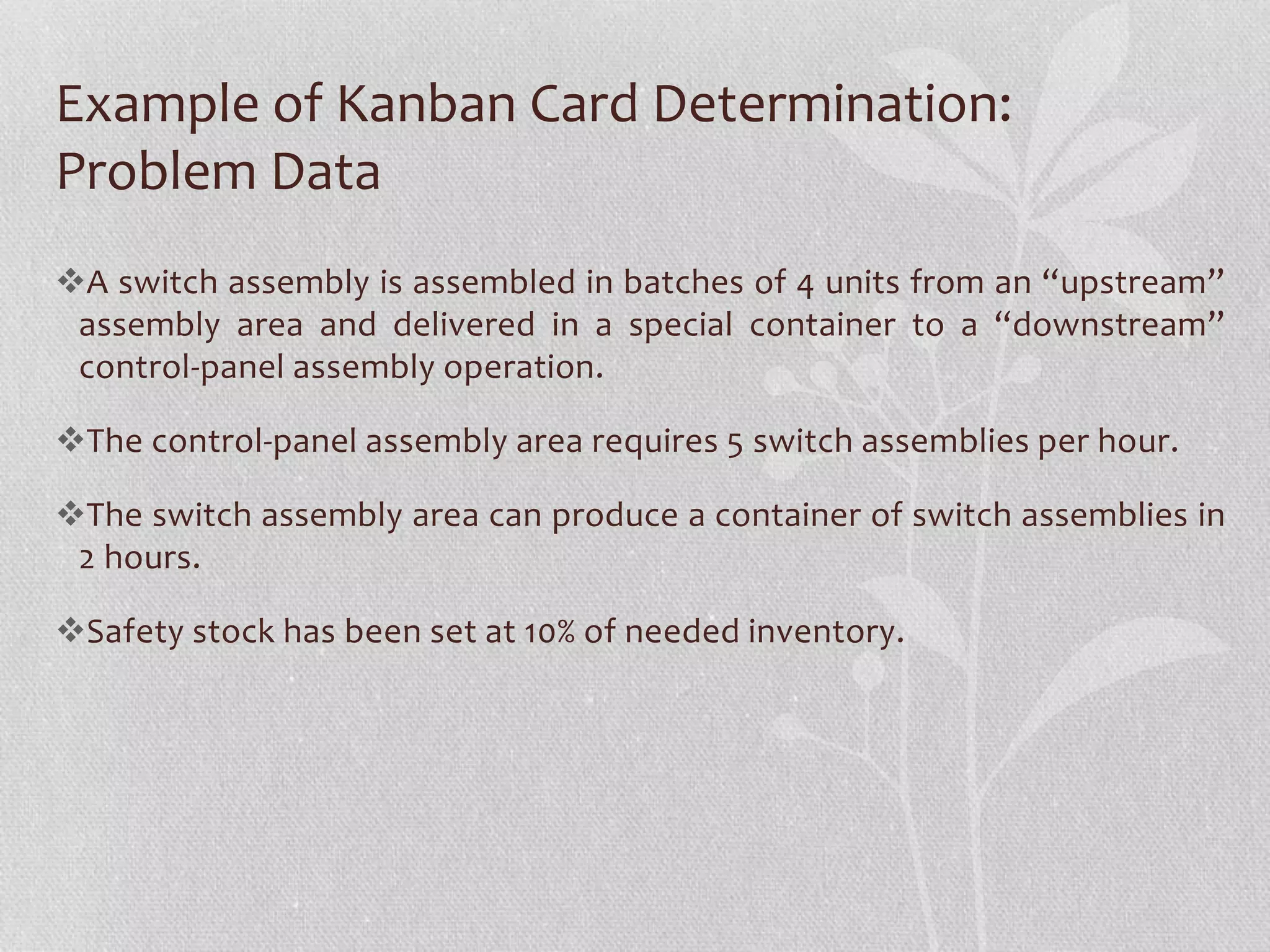
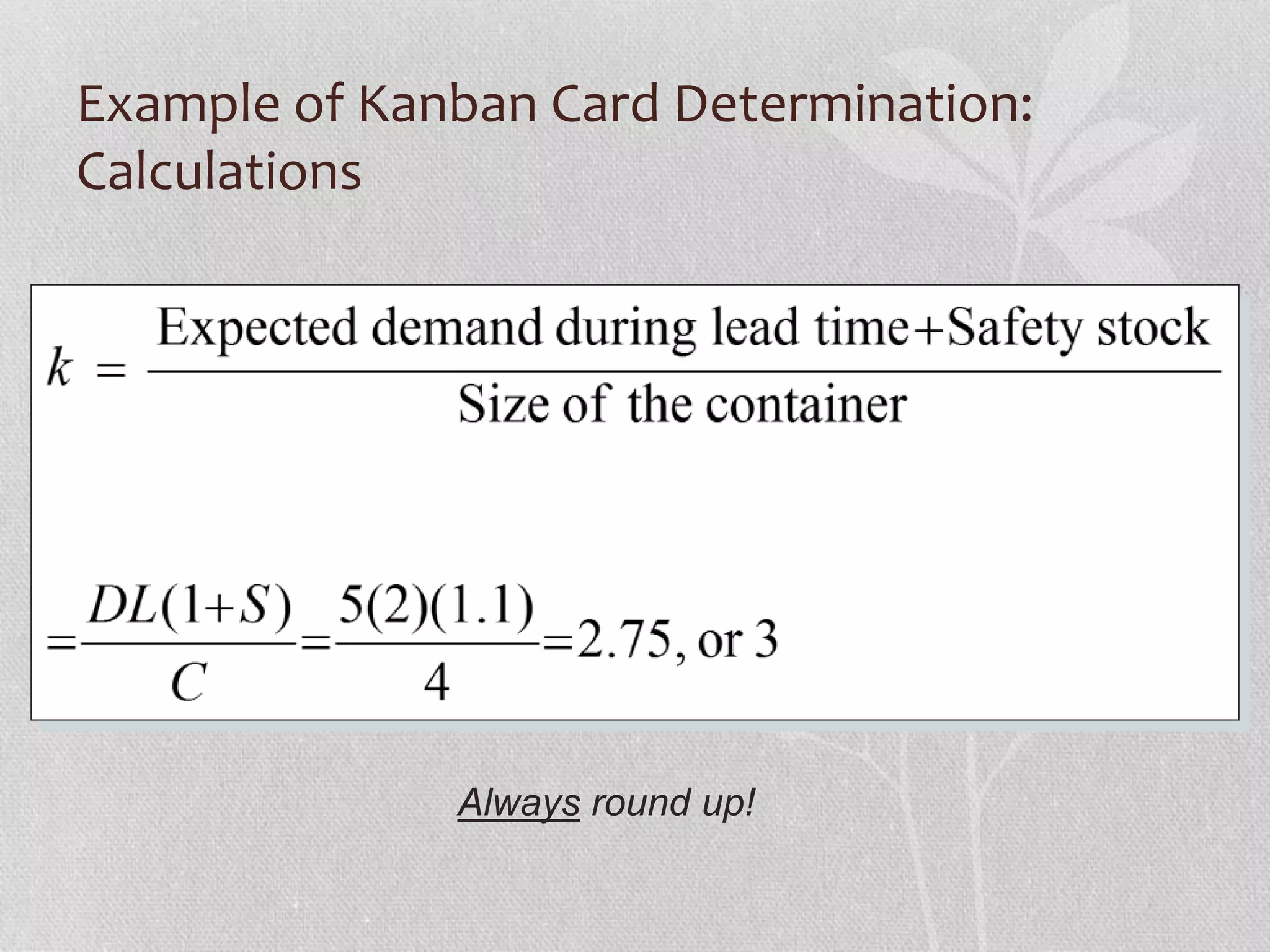
Example of Kanban Card Determination: 
Problem Data 
A switch assembly is assembled in batches of 4 units from an “upstream” 
assembly area and delivered in a special container to a “downstream” 
control-panel assembly operation. 
The control-panel assembly area requires 5 switch assemblies per hour. 
The switch assembly area can produce a container of switch assemblies in 
2 hours. 
Safety stock has been set at 10% of needed inventory.
Example of Kanban Card Determination: 
Calculations 
Always round up!
A.gunasekaran and J.lyu in their research implementation of just-in-time 
in a small company has depicted its advantage in SMEs. he depicted 
that implementation of JIT in SMEs should start with layout revision, 
schedule stability and the development of long-term supplier-customer 
relationships. 
A new purchasing policy supporting frequent purchases of small lot 
sizes may help SMEs in implementing a JIT system. 
Education and training of workers in SMEs about JIT concept and their 
high leverage opportunity would tremendously support the 
implementation of JIT system in SMEs.
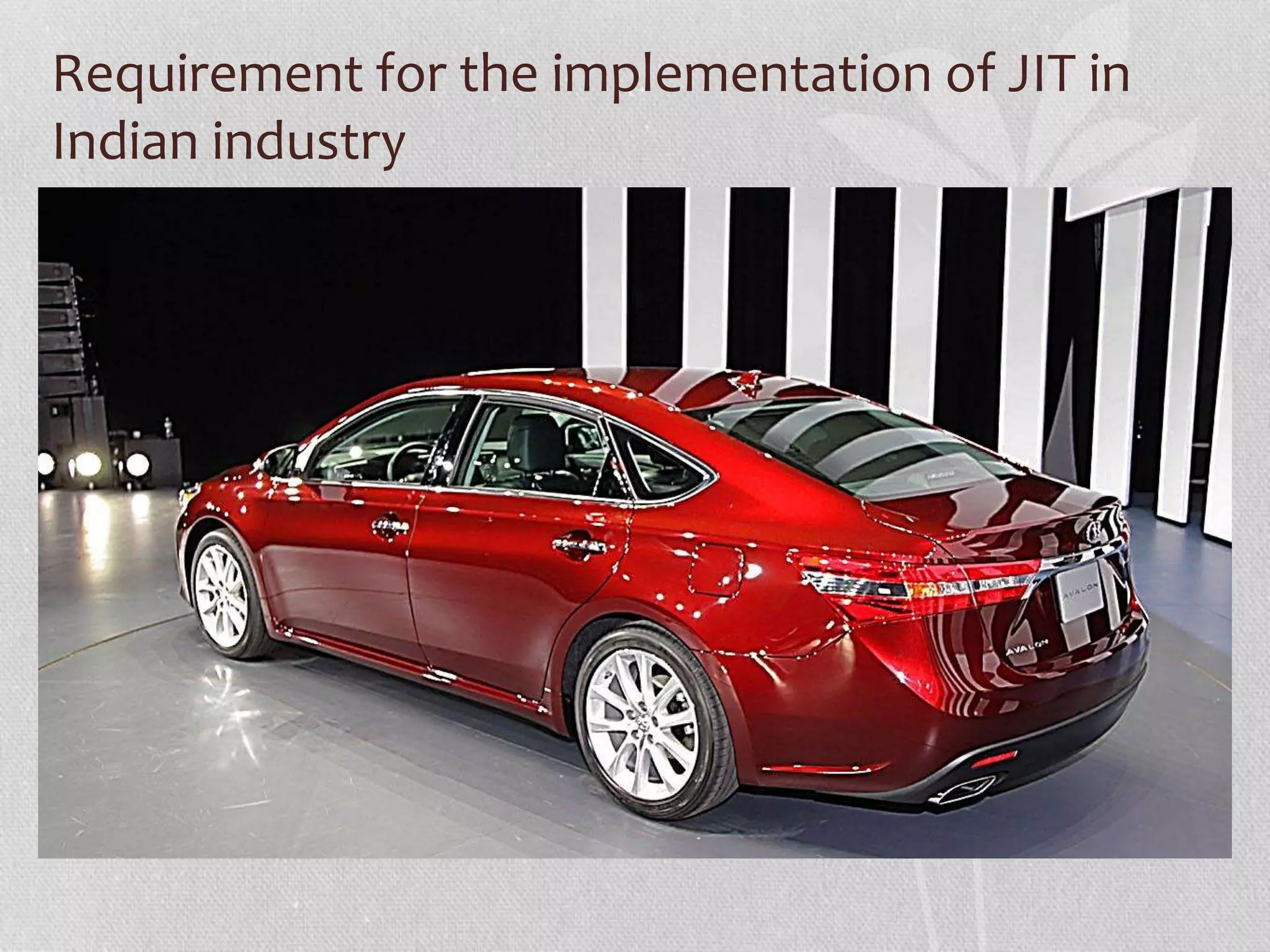
Requirement for the implementation of JIT in 
Indian industry
Management Support And Understanding Of the System. 
Management And Labour Responsibilities. 
Training. 
Supplier Management. 
Production Layout And Work Flow. 
Long‐term Planning. 
Government Support.
JIT Benefits 
Reduced Inventory 
Improved quality 
Lower costs 
Reduced space requirements 
Shorter lead-time 
Increased productivity 
Greater flexibility 
Improved vendor relations
JIT Benefits (contd.) 
Simplified scheduling & control 
Increased capacity 
Better utilization of personnel 
More product variety 
Increased equipment utilization 
Reduced paperwork 
Valid production priorities 
Work force participation
Disadvantages of JIT 
 Danger of disrupted production due to non-arrival of supplies. 
 Danger of lost sales. 
 High dependence on suppliers. 
 Less time for quality control on arrival of materials. 
 Increased ordering and admin costs. 
 May lose bulk-buying discounts.
JIT … Not For Everyone 
JIT concepts work best when goods can be produced in response to 
consumer demand (e.g. automobiles, etc.) 
JIT is less effective for the production of standardized consumer 
goods (e.g. basic clothing, food, soft drinks, toasters, etc.) 
There are cases where JIT concepts apply to sub-processes of a 
make to stock environment. (e.g. computers etc.)
PPT ON Just in time technique (JIT)

PPT ON Just in time technique (JIT)

  • 1.
    A PRESENTATION ON JIT(JUST-IN-TIME) By: Ankit saxena
  • 2.
    “A philosophy ofmanufacturing based on planned elimination of waste and continuous improvement of productivity ……” JIT?
  • 3.
    Bottlenecks in implementing JIT in an Industry JIT improvement won`t do any good. Its sounds like a good thing but we still don’t want to do it Look good on paper but….. Costs are already as low as that can possibly get But we already been doing things that way We can`t lower costs any more without lowering quality Everything is going just fine now ,Why change it? That`s a lousy idea! We already tried that 20 years ago Look we understand this stuff better than anybody(so don’t tell us what to do)
  • 4.
     Evolved inJapan after World War II, as a result of their diminishing market share in the auto industry.  Toyota Motor Company- first to implement fully functioning and successful JIT system, in 1970’s.  Japanese Manufacturers looked for a way to gain the most efficient use of limited resources. They worked on "optimal cost/quality relationship. History of JIT
  • 5.
    The philosophy ofJIT can be traced back to Henry Ford, but formalized JIT originated in Japan as the Toyota Production System. W. Edwards Deming’s lesson of variability reduction was a huge influence. The focus of JIT is to improve the system of production by eliminating all forms of waste.
  • 6.
    • ZERO INVENTORY • ZERO LEAD TIME • ZERO FAILURE JIT (JUST-IN-TIME)
  • 7.
    Eliminates waste . Achieves streamlined production . Eliminate disruptions in production … caused by poor quality, schedule changes, late deliveries.  Makes the manufacturing delivery system flexible by allowing it to handle a variety of products and changes in the level of output. Reduces setup and delivery times .
  • 8.
    Waste Definition 1.Overproduction Manufacturing an item before it is needed. 2. Inappropriate Processing Using expensive high precision equipment when simpler machines would suffice. 3. Waiting Wasteful time incurred when product is not being moved or processed. 4. Transportation Excessive movement and material handling of product between processes. 5. Motion Unnecessary effort related to the ergonomics of bending, stretching, reaching, lifting, and walking. 6. Inventory Excess inventory hides problems on the shop floor, consumes space, increases lead times, and inhibits communication. 7. Defects Quality defects result in rework and scrap, and add wasteful costs to the system in the form of lost capacity, rescheduling effort, increased inspection, and loss of customer good will. 8. Underutilization of Employees Failure of the firm to learn from and capitalize on its employees’ knowledge and creativity impedes long term efforts to eliminate waste.
  • 9.
     Overproduction Waiting time  Unnecessary transportation  Processing waste  Inefficient work methods  Product defects
  • 10.
    Strategies For MinimizingWaste By Using JIT Manufacturing in smaller lot sizes reduces excess inventory Reducing inventory levels allows the problems to be uncovered … thus creating opportunities for manufacturing process improvement
  • 12.
    Principles Of JITManufacturing Total quality Management Production Management Supplier Management Inventory Management Human Resource Management
  • 13.
    JIT Manufacturing BuildingBlocks Product design Process design Personnel/organizational elements Manufacturing planning and control
  • 14.
    1. Product Design Standard parts Design Simplification Highly capable production systems Concurrent engineering
  • 15.
    2. Process Design Small lot sizes Setup time reduction Limited work in process Quality improvement Production flexibility Little inventory storage
  • 16.
    Benefits of SmallLot Sizes Reduced Inventory Less Rework Less Storage Space Problems are more apparent Increase Product Flexibility Easier to balance operation
  • 17.
    3. Personnel/Organizational Elements Workers as assets Cross-trained workers Continuous improvement Leadership
  • 18.
    4. Manufacturing Planningand Control Pull systems Visual systems (kanban) Close vendor relationships Reduced transaction processing (delays in delivery) Preventive maintenance
  • 19.
    Evaluation and selectionof vendor (suppliers) network to develop a tiered supplier network – reducing the number of primary suppliers Traditional supplier Network Tiered Supplier Network Buyer Supplier Supplier Supplier Supplier Supplier supplier Buyer supplier supplier supplier supplier
  • 22.
  • 23.
    In McDonald’s Highholding costs are the nature of the fast food industries.  Wastage.  Time.
  • 24.
    In McDonald’s JITsystem wherein McDonald's doesn't begin to cook its orders until a customer has placed a specific order.
  • 25.
    Implementation of JIT Sophisticated burger-making technology (including a record-breaking bun toaster) McDonald's is able to make food fast enough to wait until it's been ordered. Reduction in wastage.
  • 26.
    Implementing in JIT Production Systems Criteria for success Service Quality People Food preparation Profitability .
  • 27.
  • 28.
    Benefits  ImprovedQuality – The burgers are prepared freshly and hence the quality has improved.  Customer service – As the burger is made only after the order is placed, making special orders is not an issue.  Cost Reduction – Due to significant reduction in wastage as uncooked material has a higher shelf life.  Reduction in waiting – Customer’s waiting time reduce 11 min. to just 1 and half min.
  • 29.
  • 30.
  • 31.
    Minimizing Waste: FocusedFactory Networks Coordination System Integration These are small specialized plants that limit the range of products produced (sometimes only one type of product for an entire facility) Some plants in Japan have as few as 30 and as many as 1000 employees
  • 32.
    Minimizing Waste: GroupTechnology (Part 1) Note how the flow lines are going back and forth Using Departmental Specialization for plant layout can cause a lot of unnecessary material movement Saw Saw Grinder Grinder Lathe Press Press Saw Lathe Lathe Press Heat Treat
  • 33.
    Minimizing Waste: GroupTechnology (Part 2) Revising by using Group Technology Cells can reduce movement and improve product flow . Press Grinder Saw Lathe Lathe Grinder Lathe Heat Treat A 2 Saw B Lathe Press 1
  • 34.
    Minimizing Waste: Just-In-TimeProduction WHAT IT IS  Management philosophy  “Pull” system though the plant  Hydraulic Push Systems WHAT IT REQUIRES  Employee participation  Industrial engineering/basics  Continuing improvement  Total quality control  Small lot sizes WHAT IT DOES  Attacks waste  Exposes problems and bottlenecks  Achieves streamlined production WHAT IT ASSUMES  Stable environment
  • 35.
    Minimizing Waste: Inventory Hides Problems Work in process queues (banks) Change orders Vendor delinquencies Scrap Engineering design redundancies Design backlogs Machine downtime Decision backlogs Inspection backlogs Paperwork backlog Example: By identifying defective items from a vendor early in the production process the downstream work is saved Example: By identifying defective work by employees upstream, the downstream work is saved
  • 36.
    Minimizing Waste: KanbanProduction Control Systems Storage Part A Storage Machine Part A Center Assembly Line Material Flow Card (signal) Flow Withdrawal kanban Once the Production kanban is received, the Machine Center produces a unit to replace the one taken by the Assembly Line people in the first place This puts the system back were it was before the item was pulled Production kanban The process begins by the Assembly Line people pulling Part A from Storage
  • 37.
    Determining the Numberof Kanban Needed Setting up a kanban system requires determining the number of kanban cards (or containers) needed. Each container represents the minimum production lot size. An accurate estimate of the lead time required to produce a container is key to determining how many kanban are required. Side Bar – In Japan space is a very important consideration since there is so little of it. This process saves on space requirements.
  • 38.
    Example of KanbanCard Determination: Problem Data A switch assembly is assembled in batches of 4 units from an “upstream” assembly area and delivered in a special container to a “downstream” control-panel assembly operation. The control-panel assembly area requires 5 switch assemblies per hour. The switch assembly area can produce a container of switch assemblies in 2 hours. Safety stock has been set at 10% of needed inventory.
  • 39.
    Example of KanbanCard Determination: Calculations Always round up!
  • 41.
    A.gunasekaran and J.lyuin their research implementation of just-in-time in a small company has depicted its advantage in SMEs. he depicted that implementation of JIT in SMEs should start with layout revision, schedule stability and the development of long-term supplier-customer relationships. A new purchasing policy supporting frequent purchases of small lot sizes may help SMEs in implementing a JIT system. Education and training of workers in SMEs about JIT concept and their high leverage opportunity would tremendously support the implementation of JIT system in SMEs.
  • 42.
    Requirement for theimplementation of JIT in Indian industry
  • 43.
    Management Support AndUnderstanding Of the System. Management And Labour Responsibilities. Training. Supplier Management. Production Layout And Work Flow. Long‐term Planning. Government Support.
  • 44.
    JIT Benefits ReducedInventory Improved quality Lower costs Reduced space requirements Shorter lead-time Increased productivity Greater flexibility Improved vendor relations
  • 45.
    JIT Benefits (contd.) Simplified scheduling & control Increased capacity Better utilization of personnel More product variety Increased equipment utilization Reduced paperwork Valid production priorities Work force participation
  • 46.
    Disadvantages of JIT  Danger of disrupted production due to non-arrival of supplies.  Danger of lost sales.  High dependence on suppliers.  Less time for quality control on arrival of materials.  Increased ordering and admin costs.  May lose bulk-buying discounts.
  • 47.
    JIT … NotFor Everyone JIT concepts work best when goods can be produced in response to consumer demand (e.g. automobiles, etc.) JIT is less effective for the production of standardized consumer goods (e.g. basic clothing, food, soft drinks, toasters, etc.) There are cases where JIT concepts apply to sub-processes of a make to stock environment. (e.g. computers etc.)

Editor's Notes

  • #2 What is just-in-time manufacturing Jit is philosophy of manufacturing based on planned elimination of all waste and continuous improvement of productivity it encompasses the successful execution of all manufacturing activities required to produce a final product from design engineering to delivery and including all the states of conversion from raw material onward.
  • #3 What is just-in-time manufacturing Jit is philosophy of manufacturing based on planned elimination of all waste and continuous improvement of productivity it encompasses the successful execution of all manufacturing activities required to produce a final product from design engineering to delivery and including all the states of conversion from raw material onward.
  • #32 7
  • #33 8
  • #34 9
  • #35 13
  • #36 14
  • #37 15
  • #38 16
  • #39 18
  • #40 19