WORK
 SAMPLING
              JITENDER KUMAR

Roll No: 14
FLOW OF PRESENTATION
 Brief overview of work measurement
 Work sampling
WORK MEASUREMENT
 Methodology to develop standard times needed to
  perform operations. 
 Time standards have been defined as the time
  required by an average skilled operator, working
  at a normal pace, to perform a specified task
  using a prescribed method, allowing time for
  personal needs, fatigue, and delay.
WORK SAMPLING
 Concept
 Definition

 Principle

 Terms used

 Procedure

 Examples

 Advantages and disadvantages

 Application
CONCEPT
 L.H.C. Tippet in 1934 for studying activities in
  the cotton industry.
 A technique for estimating the proportion of time
  that a worker or machine spends on various
  activities and the idle time.
 Work sampling is a commonly used industrial
  engineering technique designed to measure
  how resources such as people, machines,
  facilities, or equipment are used.
 The work sampling objective is to assess selected
  aspects of an organization's operations. To find
  the frequency of occurrence of every work
  element.
CONTD…
 Brief observations of workers or machines.
 At random intervals.

 To estimate the allocation of time on various
  activities.
 Not the timing but the nature of the activity.

 Then based on the findings in this sample,
  statements can be made about the activity.
 The standards derived from work sampling
  might specify the proportion of time that should
  be devoted to specific activities rather than the
  amount of time required to perform a task.
DEFINITION
 Work Sampling, (also referred to as random
  sampling or activity sampling) is a work
  measurement technique where observations
  about work are collected at discrete time
  intervals, either periodic or random.
 Work sampling is broadly defined as the
  application of statistical sampling techniques to
  the study of work activities.
PRINCIPLE
 Statistically, when a sufficient number of
  discrete samples are observed, the overall
  percentage occurrence of the samples begins to
  approach actual percentage of time that each
  activity takes.
 Work sampling projects were traditionally
  carried out manually using a paper and random
  number tables.
 Issues involved:
     What level of statistical confidence is desired in the results?
     How many observations are necessary?

     When should the observations be made?
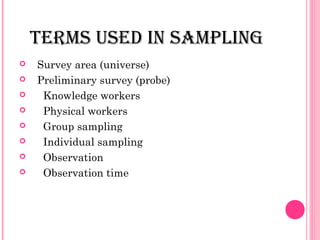
TERMS USED IN SAMPLING
   Survey area (universe)
   Preliminary survey (probe)
    Knowledge workers
    Physical workers
    Group sampling
    Individual sampling
    Observation
    Observation time
CONTD…
   Nonworking activity
   Working activity
   Undesirable working activity
   Confidence level
   Precision range
WORK SAMPLING
  PROCEDURE
WORK SAMPLING
           PROCEDURE

Identify the specific activities or
workers that are the main purpose for
the study:


   The selected worker should be representative
    of the group and should be familiar with
    standardized work methods.
   The workers and supervisors should be
    notified of the purpose of the study.
CONTD….

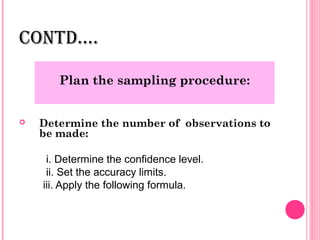
       Plan the sampling procedure:


   Determine the number of observations to
    be made:

     i. Determine the confidence level.
     ii. Set the accuracy limits.
    iii. Apply the following formula.
CONTD…
                            Z 2 p(1 − p)
                     N=
                                    E2
where,

N = Number of observations to be made

Z = Number of standard deviations associated
    with a given confidence level
p = Estimated proportion of time that the activity
    being measured occurs
E =Absolute error that is desired
CONTD…
   Determining the time to make
    observations:
            Random observations
            Use of a random number table. For
       example, a work sampling study is to be
       conducted over a 1- week period of five 8-
       hour workdays, the total number of
       minutes would be (60 x 8 x 5) = 2400
       minutes. A four-digit column of random
       number could be used to select numbers
       between 0000 and 2400.
CONTD…
 In case of few observations, some form of
 alarm watch or other system is used.

 The number of observations to be taken is
 usually divided equally over the study period.
 For example, if 500 observations are to be made
 over a 10 day period, observations are usually
 scheduled at 50 per day.
CONTD…
   Take the observations

   At two or three intervals during the study
    period, recompute the required sample size by
    using the data collected so far. Adjust the
    number of observations if appropriate.
CONTD…
    Convert the work sampling observations
    into proportions and calculate desired
    standard time estimates:


   Compute the normal time per part
       (%of time working) (performance rating)
                number of units produced
   Compute the standard time per part
               normal time + allowances
EXAMPLE
In a work sampling study, a mechanic was
found to be idle for 20% of the time. Find out
the number of observations needed to
conform to the above figures with a
confidence level of 95% and a relative error
level by + 5%.
SOLUTION
 number of observations required:
             N = Z^2p q
                    E^2
Where,
     E = absolute error ( s x p )
     p = percentage of idling
     q = percentage of activity ( 1 – p)
     Z = coefficient of the confidence level
         ( 1.96 for 95% confidence)
CONTD..
Hence,
         N = (1.96)^2 (0.2)(0.8)
                (0.05 x 0.2)^2
           = (3.84)(0.16)
               (0.010)^2
           =    0.61
              0.0001
           = 6100 observations.
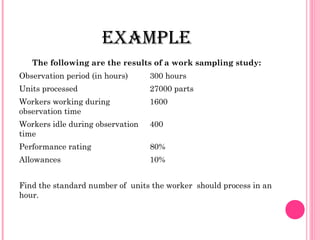
EXAMPLE
   The following are the results of a work sampling study:
Observation period (in hours)     300 hours
Units processed                   27000 parts
Workers working during            1600
observation time
Workers idle during observation   400
time
Performance rating                80%
Allowances                        10%


Find the standard number of units the worker should process in an
hour.
SOLUTION
              State      Number Of     Percentage
                        Observations

      Working workers       1600       1600/2000 = 80

      Idle workers          400        400/2000 = 20

      Total                 2000            100


   Thus, actual working hours out of 300 hours =
              80% of 300 = 240 hours.
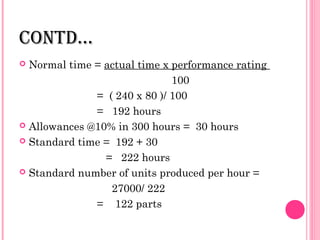
CONTD…
 Normal time = actual time x performance rating
                              100
              = ( 240 x 80 )/ 100
              = 192 hours
 Allowances @10% in 300 hours = 30 hours

 Standard time = 192 + 30

                = 222 hours
 Standard number of units produced per hour =

                 27000/ 222
              = 122 parts
ADVANTAGES

 It is a less expensive procedure.
 Observers with minimal specialized training can
  conduct the sampling.
 It is an effective means of collecting facts that
  would not normally be collected by other means.
 Several operators or machines may be observed
  simultaneously by a single observer.
 No mechanical device needed.
CONTD…
 It results in less anxiety and agitation
  among workers.
 There is minimal interference with the
  worker's normal routine.
 It measures the utilization of people and
  equipment directly.
 A work sampling study may be
  interrupted at any time without affecting
  the results.
DISADVANTAGES
  It is not economical for studying a single
  operator or machine, or for studying
  operators or machines located over wide
  areas.
 It cannot provide a much detailed
  information .
 The operator may change his or her work
  pattern upon sight of the observer.
 It is of little value in helping to improve
  work methods.
CONTD…
A   lot of groundwork is required.
 A work sampling study made of a group
  obviously presents average results, and there
  is no information as to the magnitude of the
  individual differences.
SUITABILITY
 Group activities,
 Non-Repetitive activities with long cycle times
  (example: maintenance operator, support
  personnel, etc.),
 Activities that are not rigidly constrained from
  the time standpoint,
 Heterogeneous activities.
APPLICATIONS
 For ratio delay studies.
 To indicate the nature of the distribution of work
  activities within a gang operation.
 To estimate the percentage of utilization of
  groups of similar machines or equipment.
 To determine the productive and non- productive
  utilization of clerical operations.
 To measure performance.

 To indicate how materials handling equipments
  are being used.
CONTD…
 To provide a basis for indirect labor standards.
 To determine the standard time for a non-
  repetitive operation as an alternative to the stop
  watch period.
 To determine the allowances for inclusion in
  standard times.
CONCLUSION


      “ A work measurement technique whereby
random observations are made for non-repetitive
activities so as to disclose underutilized workers,
poor worker discipline, overstaffing, inadequate
training, inefficient plant layout, excessive delays
(caused by poor planning, material scheduling, or
tooling), or other deficiencies.”
THANK YOU !!!!

Work sample

  • 1.
    WORK SAMPLING JITENDER KUMAR Roll No: 14
  • 2.
    FLOW OF PRESENTATION Brief overview of work measurement  Work sampling
  • 3.
    WORK MEASUREMENT  Methodologyto develop standard times needed to perform operations.   Time standards have been defined as the time required by an average skilled operator, working at a normal pace, to perform a specified task using a prescribed method, allowing time for personal needs, fatigue, and delay.
  • 4.
    WORK SAMPLING  Concept Definition  Principle  Terms used  Procedure  Examples  Advantages and disadvantages  Application
  • 5.
    CONCEPT  L.H.C. Tippetin 1934 for studying activities in the cotton industry.  A technique for estimating the proportion of time that a worker or machine spends on various activities and the idle time.  Work sampling is a commonly used industrial engineering technique designed to measure how resources such as people, machines, facilities, or equipment are used.  The work sampling objective is to assess selected aspects of an organization's operations. To find the frequency of occurrence of every work element.
  • 6.
    CONTD…  Brief observationsof workers or machines.  At random intervals.  To estimate the allocation of time on various activities.  Not the timing but the nature of the activity.  Then based on the findings in this sample, statements can be made about the activity.  The standards derived from work sampling might specify the proportion of time that should be devoted to specific activities rather than the amount of time required to perform a task.
  • 7.
    DEFINITION  Work Sampling,(also referred to as random sampling or activity sampling) is a work measurement technique where observations about work are collected at discrete time intervals, either periodic or random.  Work sampling is broadly defined as the application of statistical sampling techniques to the study of work activities.
  • 8.
    PRINCIPLE  Statistically, whena sufficient number of discrete samples are observed, the overall percentage occurrence of the samples begins to approach actual percentage of time that each activity takes.  Work sampling projects were traditionally carried out manually using a paper and random number tables.  Issues involved:  What level of statistical confidence is desired in the results?  How many observations are necessary?  When should the observations be made?
  • 9.
    TERMS USED INSAMPLING  Survey area (universe)  Preliminary survey (probe)  Knowledge workers  Physical workers  Group sampling  Individual sampling  Observation  Observation time
  • 10.
    CONTD…  Nonworking activity  Working activity  Undesirable working activity  Confidence level  Precision range
  • 11.
    WORK SAMPLING PROCEDURE
  • 12.
    WORK SAMPLING PROCEDURE Identify the specific activities or workers that are the main purpose for the study:  The selected worker should be representative of the group and should be familiar with standardized work methods.  The workers and supervisors should be notified of the purpose of the study.
  • 13.
    CONTD…. Plan the sampling procedure:  Determine the number of observations to be made: i. Determine the confidence level. ii. Set the accuracy limits. iii. Apply the following formula.
  • 14.
    CONTD… Z 2 p(1 − p) N= E2 where, N = Number of observations to be made Z = Number of standard deviations associated with a given confidence level p = Estimated proportion of time that the activity being measured occurs E =Absolute error that is desired
  • 15.
    CONTD…  Determining the time to make observations:  Random observations  Use of a random number table. For example, a work sampling study is to be conducted over a 1- week period of five 8- hour workdays, the total number of minutes would be (60 x 8 x 5) = 2400 minutes. A four-digit column of random number could be used to select numbers between 0000 and 2400.
  • 16.
    CONTD…  In caseof few observations, some form of alarm watch or other system is used.  The number of observations to be taken is usually divided equally over the study period. For example, if 500 observations are to be made over a 10 day period, observations are usually scheduled at 50 per day.
  • 17.
    CONTD…  Take the observations  At two or three intervals during the study period, recompute the required sample size by using the data collected so far. Adjust the number of observations if appropriate.
  • 18.
    CONTD… Convert the work sampling observations into proportions and calculate desired standard time estimates:  Compute the normal time per part (%of time working) (performance rating) number of units produced  Compute the standard time per part normal time + allowances
  • 19.
    EXAMPLE In a worksampling study, a mechanic was found to be idle for 20% of the time. Find out the number of observations needed to conform to the above figures with a confidence level of 95% and a relative error level by + 5%.
  • 20.
    SOLUTION number ofobservations required: N = Z^2p q E^2 Where, E = absolute error ( s x p ) p = percentage of idling q = percentage of activity ( 1 – p) Z = coefficient of the confidence level ( 1.96 for 95% confidence)
  • 21.
    CONTD.. Hence, N = (1.96)^2 (0.2)(0.8) (0.05 x 0.2)^2 = (3.84)(0.16) (0.010)^2 = 0.61 0.0001 = 6100 observations.
  • 22.
    EXAMPLE The following are the results of a work sampling study: Observation period (in hours) 300 hours Units processed 27000 parts Workers working during 1600 observation time Workers idle during observation 400 time Performance rating 80% Allowances 10% Find the standard number of units the worker should process in an hour.
  • 23.
    SOLUTION State Number Of Percentage Observations Working workers 1600 1600/2000 = 80 Idle workers 400 400/2000 = 20 Total 2000 100  Thus, actual working hours out of 300 hours = 80% of 300 = 240 hours.
  • 24.
    CONTD…  Normal time= actual time x performance rating 100 = ( 240 x 80 )/ 100 = 192 hours  Allowances @10% in 300 hours = 30 hours  Standard time = 192 + 30 = 222 hours  Standard number of units produced per hour = 27000/ 222 = 122 parts
  • 25.
    ADVANTAGES  It isa less expensive procedure.  Observers with minimal specialized training can conduct the sampling.  It is an effective means of collecting facts that would not normally be collected by other means.  Several operators or machines may be observed simultaneously by a single observer.  No mechanical device needed.
  • 26.
    CONTD…  It resultsin less anxiety and agitation among workers.  There is minimal interference with the worker's normal routine.  It measures the utilization of people and equipment directly.  A work sampling study may be interrupted at any time without affecting the results.
  • 27.
    DISADVANTAGES  Itis not economical for studying a single operator or machine, or for studying operators or machines located over wide areas.  It cannot provide a much detailed information .  The operator may change his or her work pattern upon sight of the observer.  It is of little value in helping to improve work methods.
  • 28.
    CONTD… A lot of groundwork is required.  A work sampling study made of a group obviously presents average results, and there is no information as to the magnitude of the individual differences.
  • 29.
    SUITABILITY  Group activities, Non-Repetitive activities with long cycle times (example: maintenance operator, support personnel, etc.),  Activities that are not rigidly constrained from the time standpoint,  Heterogeneous activities.
  • 30.
    APPLICATIONS  For ratiodelay studies.  To indicate the nature of the distribution of work activities within a gang operation.  To estimate the percentage of utilization of groups of similar machines or equipment.  To determine the productive and non- productive utilization of clerical operations.  To measure performance.  To indicate how materials handling equipments are being used.
  • 31.
    CONTD…  To providea basis for indirect labor standards.  To determine the standard time for a non- repetitive operation as an alternative to the stop watch period.  To determine the allowances for inclusion in standard times.
  • 32.
    CONCLUSION “ A work measurement technique whereby random observations are made for non-repetitive activities so as to disclose underutilized workers, poor worker discipline, overstaffing, inadequate training, inefficient plant layout, excessive delays (caused by poor planning, material scheduling, or tooling), or other deficiencies.”
  • 33.