Case Study: Creation and Use of a
Simple Process Performance Model
Christian Hertneck
© 2011 by Anywhere.24 GmbH; this material is approved for public release.
SM CMM Integration, IDEAL, and SCAMPI are service marks of Carnegie Mellon University.
® Capability Maturity Model and CMMI are registered in the U.S. Patent and Trademark Office by Carnegie Mellon
University.
Content
» Characteristics of organization
» Breakdown of metrics
» Walk through of creation of process performance model
(PPM)
» Use of the process performance model in project
management
Page 2
© Anywhere.24 GmbH, 2011
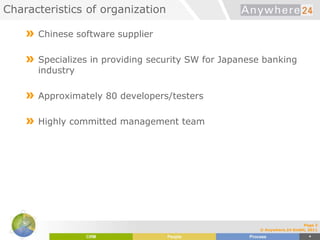
Characteristics of organization
» Chinese software supplier
» Specializes in providing security SW for Japanese banking
industry
» Approximately 80 developers/testers
» Highly committed management team
Page 3
© Anywhere.24 GmbH, 2011
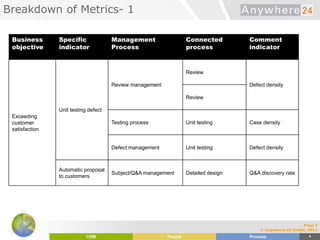
Breakdown of Metrics- 1
Page 4
© Anywhere.24 GmbH, 2011
Business
objective
Specific
indicator
Management
Process
Connected
process
Comment
indicator
Exceeding
customer
satisfaction
Unit testing defect
Review management
Review
Defect density
Review
Testing process Unit testing Case density
Defect management Unit testing Defect density
Automatic proposal
to customers
Subject/Q&A management Detailed design Q&A discovery rate
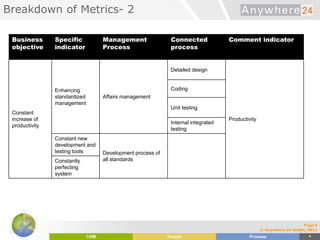
Breakdown of Metrics- 2
Page 5
© Anywhere.24 GmbH, 2011
Business
objective
Specific
indicator
Management
Process
Connected
process
Comment indicator
Constant
increase of
productivity
Enhancing
standardized
management
Affairs management
Detailed design
Productivity
Coding
Unit testing
Internal integrated
testing
Constant new
development and
testing tools Development process of
all standardsConstantly
perfecting
system
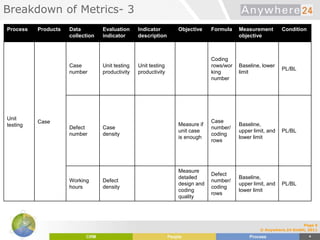
Breakdown of Metrics- 3
Page 6
© Anywhere.24 GmbH, 2011
Process Products Data
collection
Evaluation
indicator
Indicator
description
Objective Formula Measurement
objective
Condition
Unit
testing
Case
Case
number
Unit testing
productivity
Unit testing
productivity
Coding
rows/wor
king
number
Baseline, lower
limit
PL/BL
Defect
number
Case
density
Measure if
unit case
is enough
Case
number/
coding
rows
Baseline,
upper limit, and
lower limit
PL/BL
Working
hours
Defect
density
Measure
detailed
design and
coding
quality
Defect
number/
coding
rows
Baseline,
upper limit, and
lower limit
PL/BL
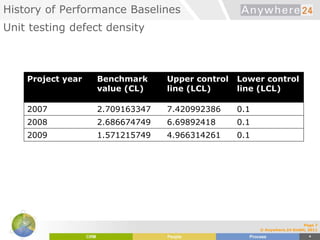
History of Performance Baselines
Unit testing defect density
Page 7
© Anywhere.24 GmbH, 2011
Project year Benchmark
value (CL)
Upper control
line (LCL)
Lower control
line (LCL)
2007 2.709163347 7.420992386 0.1
2008 2.686674749 6.69892418 0.1
2009 1.571215749 4.966314261 0.1
Creation of PPM
Page 8
© Anywhere.24 GmbH, 2011
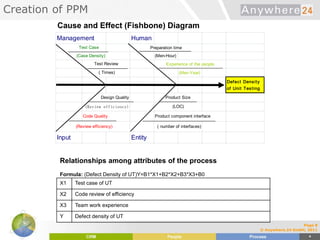
1.Cause-and-effect (fishbone) diagrams原因分析图:
Management Human
Preparation time
(Case Density) (Men-Hour)
Experience of the people
(Men-Year)
Defect Density
of Unit Testing
(Review efficiency) (number of interfaces)
Input Entity
2.Relationships among attributes of the process主要因素列表:
Formula:(Defect Density of UT)Y=B1*X1+B2*X2+B3*X3+B0
X1:
X2:
X3:
Y:
Test Case of UT单体case密度
Code review Efficiency代码指摘率
Team work experience基盘工作年限
Defect Density of UT单体测试障害密度
Code Quality
Test Case
Product Size
(LOC)
Test Review
(Times)
Design Quality
(Review efficiency)
Product component interface
Cause and Effect (Fishbone) Diagram
Relationships among attributes of the process
Formula: (Defect Density of UT)Y=B1*X1+B2*X2+B3*X3+B0
X1 Test case of UT
X2 Code review of efficiency
X3 Team work experience
Y Defect density of UT
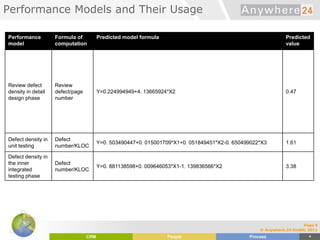
Performance Models and Their Usage
Page 9
© Anywhere.24 GmbH, 2011
Performance
model
Formula of
computation
Predicted model formula Predicted
value
Review defect
density in detail
design phase
Review
defect/page
number
Y=0.224994949+4. 13665924*X2 0.47
Defect density in
unit testing
Defect
number/KLOC
Y=0. 503490447+0. 015001709*X1+0. 051849451*X2-0. 650499022*X3 1.61
Defect density in
the inner
integrated
testing phase
Defect
number/KLOC
Y=0. 881138598+0. 009646053*X1-1. 139836566*X2 3.38
Thank you
Good luck with your process improvement journey!
Christian Hertneck Anywhere.24 GmbH
Lindberghstr. 11
82178 Puchheim
Germany
P: +49 89 800 849 50
F: +49 89 800 849 59
@: c.hertneck@anywhere24.com
www.anywhere24.com & www.ccm.info
® Capability Maturity Model, Carnegie Mellon,
CMM, and CMMI are registered in the U.S.
Patent and Trademark Office by Carnegie
Mellon University.
sm CMM Integration; IDEAL; Personal Software
Process; PSP; SCAMPI; SCAMPI Lead Assessor/
Appraiser; SEPG; Team Software Process; and
TSP are service marks of Carnegie Mellon
University.
Page 10
© Anywhere.24 GmbH, 2011

Creation use-of-simple-model

  • 1.
    Case Study: Creationand Use of a Simple Process Performance Model Christian Hertneck © 2011 by Anywhere.24 GmbH; this material is approved for public release. SM CMM Integration, IDEAL, and SCAMPI are service marks of Carnegie Mellon University. ® Capability Maturity Model and CMMI are registered in the U.S. Patent and Trademark Office by Carnegie Mellon University.
  • 2.
    Content » Characteristics oforganization » Breakdown of metrics » Walk through of creation of process performance model (PPM) » Use of the process performance model in project management Page 2 © Anywhere.24 GmbH, 2011
  • 3.
    Characteristics of organization »Chinese software supplier » Specializes in providing security SW for Japanese banking industry » Approximately 80 developers/testers » Highly committed management team Page 3 © Anywhere.24 GmbH, 2011
  • 4.
    Breakdown of Metrics-1 Page 4 © Anywhere.24 GmbH, 2011 Business objective Specific indicator Management Process Connected process Comment indicator Exceeding customer satisfaction Unit testing defect Review management Review Defect density Review Testing process Unit testing Case density Defect management Unit testing Defect density Automatic proposal to customers Subject/Q&A management Detailed design Q&A discovery rate
  • 5.
    Breakdown of Metrics-2 Page 5 © Anywhere.24 GmbH, 2011 Business objective Specific indicator Management Process Connected process Comment indicator Constant increase of productivity Enhancing standardized management Affairs management Detailed design Productivity Coding Unit testing Internal integrated testing Constant new development and testing tools Development process of all standardsConstantly perfecting system
  • 6.
    Breakdown of Metrics-3 Page 6 © Anywhere.24 GmbH, 2011 Process Products Data collection Evaluation indicator Indicator description Objective Formula Measurement objective Condition Unit testing Case Case number Unit testing productivity Unit testing productivity Coding rows/wor king number Baseline, lower limit PL/BL Defect number Case density Measure if unit case is enough Case number/ coding rows Baseline, upper limit, and lower limit PL/BL Working hours Defect density Measure detailed design and coding quality Defect number/ coding rows Baseline, upper limit, and lower limit PL/BL
  • 7.
    History of PerformanceBaselines Unit testing defect density Page 7 © Anywhere.24 GmbH, 2011 Project year Benchmark value (CL) Upper control line (LCL) Lower control line (LCL) 2007 2.709163347 7.420992386 0.1 2008 2.686674749 6.69892418 0.1 2009 1.571215749 4.966314261 0.1
  • 8.
    Creation of PPM Page8 © Anywhere.24 GmbH, 2011 1.Cause-and-effect (fishbone) diagrams原因分析图: Management Human Preparation time (Case Density) (Men-Hour) Experience of the people (Men-Year) Defect Density of Unit Testing (Review efficiency) (number of interfaces) Input Entity 2.Relationships among attributes of the process主要因素列表: Formula:(Defect Density of UT)Y=B1*X1+B2*X2+B3*X3+B0 X1: X2: X3: Y: Test Case of UT单体case密度 Code review Efficiency代码指摘率 Team work experience基盘工作年限 Defect Density of UT单体测试障害密度 Code Quality Test Case Product Size (LOC) Test Review (Times) Design Quality (Review efficiency) Product component interface Cause and Effect (Fishbone) Diagram Relationships among attributes of the process Formula: (Defect Density of UT)Y=B1*X1+B2*X2+B3*X3+B0 X1 Test case of UT X2 Code review of efficiency X3 Team work experience Y Defect density of UT
  • 9.
    Performance Models andTheir Usage Page 9 © Anywhere.24 GmbH, 2011 Performance model Formula of computation Predicted model formula Predicted value Review defect density in detail design phase Review defect/page number Y=0.224994949+4. 13665924*X2 0.47 Defect density in unit testing Defect number/KLOC Y=0. 503490447+0. 015001709*X1+0. 051849451*X2-0. 650499022*X3 1.61 Defect density in the inner integrated testing phase Defect number/KLOC Y=0. 881138598+0. 009646053*X1-1. 139836566*X2 3.38
  • 10.
    Thank you Good luckwith your process improvement journey! Christian Hertneck Anywhere.24 GmbH Lindberghstr. 11 82178 Puchheim Germany P: +49 89 800 849 50 F: +49 89 800 849 59 @: c.hertneck@anywhere24.com www.anywhere24.com & www.ccm.info ® Capability Maturity Model, Carnegie Mellon, CMM, and CMMI are registered in the U.S. Patent and Trademark Office by Carnegie Mellon University. sm CMM Integration; IDEAL; Personal Software Process; PSP; SCAMPI; SCAMPI Lead Assessor/ Appraiser; SEPG; Team Software Process; and TSP are service marks of Carnegie Mellon University. Page 10 © Anywhere.24 GmbH, 2011