STATISTICAL PROCESS CONTROL(SPC)
BY,
VIVEK B. THORVE
CONTENTS
INTRODUCTION
OBJECTIVE OF SPC
PROCESS CONTROL
VARIATION
CAUSES
STATISITICAL CONTROL
TOOLS FOR STATISTICAL CONTROL
PROCESS CAPABILITY
CONTROL CHART TYPES
CONTROL CHART MEHODOLOGY EVALUATION
ADVANTAGES
LIMITATIONS
APPLICATIONS
CONCLUSION
REFERNECES
STATISTICAL PROCESS CONTROL
INTRODUCTION
Statistics - A way to collect, classify, present and interpret numerical data (information
expressed in numbers).
Process - A combination of machines, equipment, people, raw materials, methods and
environment that produces a product. A process is how something gets done.
Control - Directing or regulating a process so that it behaves the way it is meant to
behave.
So SPC is the use of numerical data to direct or regulate the methods used to
produce a finished product.
SPC is applied in order to monitor and control a process. Monitoring and controlling the
process ensures that it operates at its full potential.
STATISTICAL PROCESS CONTROL BACK
OBJECTIVE OF SPC
Increases customer satisfaction.
Decreases scrap, rework, and inspection costs.
Decreases operating costs.
Improves productivity.
Sets a predictable and consistent level of quality.
Eliminates or reduces the need for inspection by the customer.
STATISTICAL PROCESS CONTROL BACK
PROCESS CONTROL
THREE TYPES OF PROCESS CONTROL
PREVENTION OF DEFECTS
• MISTAKE PROOFING
DETECTION OF CAUSES AND LEAD TO CORRECTIVE ACTION
• VISUAL CONTROL, SPC
DETECTION OF DEFECTS
• INSPECTION
STATISTICAL PROCESS CONTROL BACK
VARIATION
PRINCIPLES OF SPC
VARIATION IS INEVITABLE
VARIATION IS PREDICTABLE
VARIATION IS MEASURABLE
STATISTICAL PROCESS CONTROL BACK
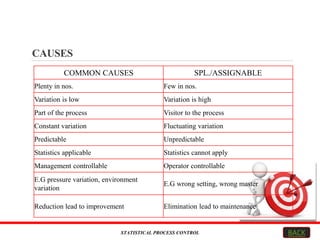
COMMON CAUSES SPL./ASSIGNABLE
Plenty in nos. Few in nos.
Variation is low Variation is high
Part of the process Visitor to the process
Constant variation Fluctuating variation
Predictable Unpredictable
Statistics applicable Statistics cannot apply
Management controllable Operator controllable
E.G pressure variation, environment
variation
E.G wrong setting, wrong master
Reduction lead to improvement Elimination lead to maintenance
STATISTICAL PROCESS CONTROL
CAUSES
BACK
STATISTICAL PROCESS CONTROL
 10 % IS STATISTICS
 90 % IS PRODUCT & PROCESS KNOWLEDGE
STATISTICAL PROCESS CONTROL BACK
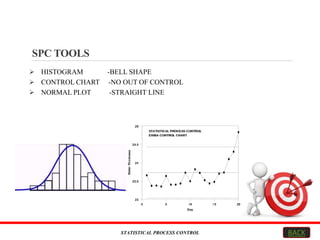
SPC TOOLS
 HISTOGRAM -BELL SHAPE
 CONTROL CHART -NO OUT OF CONTROL
 NORMAL PLOT -STRAIGHT LINE
STATISTICAL PROCESS CONTROL BACK
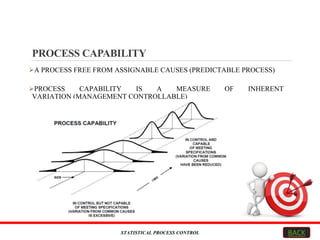
PROCESS CAPABILITY
A PROCESS FREE FROM ASSIGNABLE CAUSES (PREDICTABLE PROCESS)
PROCESS CAPABILITY IS A MEASURE OF INHERENT
VARIATION (MANAGEMENT CONTROLLABLE)
STATISTICAL PROCESS CONTROL BACK
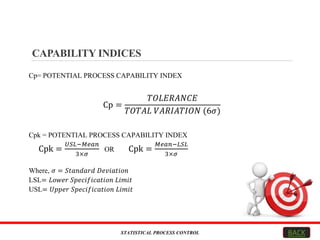
CAPABILITY INDICES
Cp= POTENTIAL PROCESS CAPABILITY INDEX
Cp =
𝑇𝑂𝐿𝐸𝑅𝐴𝑁𝐶𝐸
𝑇𝑂𝑇𝐴𝐿 𝑉𝐴𝑅𝐼𝐴𝑇𝐼𝑂𝑁 (6𝜎)
Cpk = POTENTIAL PROCESS CAPABILITY INDEX
Cpk =
𝑈𝑆𝐿−𝑀𝑒𝑎𝑛
3×𝜎
OR Cpk =
𝑀𝑒𝑎𝑛−𝐿𝑆𝐿
3×𝜎
Where, 𝜎 = 𝑆𝑡𝑎𝑛𝑑𝑎𝑟𝑑 𝐷𝑒𝑣𝑖𝑎𝑡𝑖𝑜𝑛
LSL= 𝐿𝑜𝑤𝑒𝑟 𝑆𝑝𝑒𝑐𝑖𝑓𝑖𝑐𝑎𝑡𝑖𝑜𝑛 𝐿𝑖𝑚𝑖𝑡
USL= 𝑈𝑝𝑝𝑒𝑟 𝑆𝑝𝑒𝑐𝑖𝑓𝑖𝑐𝑎𝑡𝑖𝑜𝑛 𝐿𝑖𝑚𝑖𝑡
STATISTICAL PROCESS CONTROL BACK
CONTROL CHARTS
OBJECTIVES OF CONTROL CHART
 TO DETECT SPECIAL/ASSIGNABLE CAUSES
 TO MAINTAIN THE ACHIEVED PROCESS CAPABILITY
 TO IDENTIFY THE OPPORTUNITY FOR IMPROVEMENT
STATISTICAL PROCESS CONTROL BACK
ADVANTAGES
 Reduces waste
 Lead to a reduction in the time required to produce the product or service from end
to end due to a diminished likelihood that the final product will have to be
reworked, identify bottlenecks, wait times, and other sources of delays within the
process.
 A distinct advantage over other quality methods, such as inspection - its emphasis
on early detection and prevention of problems
 Cost reduction
 Customer satisfaction
STATISTICAL PROCESS CONTROL BACK
LIMITATIONS
SPC is applied to reduce or eliminate process waste. This in turn,
eliminates the need for the process step of post manufacture inspection.
The success of SPC relies not only on the skill with which it is applied,
but also on how suitable or amenable the process is to SPC. In some
cases, it may be difficult to judge when the application of SPC is
appropriate.
STATISTICAL PROCESS CONTROL BACK
APPLICATIONS
In Automotive Industry it is used to reduce waste & improve in production
processes. Also in New product development of the part it is used to validate
the processes.
Healthcare & Pharmaceutical Industry to Monitor the Quality of Medicine
& treatments.
Software Engineering Processes in the Capability Maturity Model (CMM).
The level 4&5 of the Capability Maturity Model Integration use this
concepts.
It is using in Machine setup to study the Machine Capability.
In food industry, to monitor the quality of product.
STATISTICAL PROCESS CONTROL BACK
CONCLUSION
Statistical process control (SPC) is a method of quality control which
uses statistical methods.
SPC is applied in order to monitor and control a process. Monitoring
and controlling the process ensures that it operates at its full potential. At
its full potential, the process can make as much conforming product as
possible with a minimum (if not an elimination) of waste (rework or
scrap).
SPC can be applied to any process where the "conforming product"
(product meeting specifications) output can be measured. Key tools used
in SPC include control charts; a focus on continuous improvement; and
the design of experiments.
STATISTICAL PROCESS CONTROL BACK
REFERENCES
www.wikipedia.com
REFERENCE MANUAL _SPC_2nd_Edition of AIAG, Edition 2005
Nelson, Loyd S. (1985), "Interpreting Shewhart X Control Charts",
Journal of Quality Technology, 17:114-16.
Steel, R. G. D. and J. H. Torrie (1980), Principles and Procedures of
Statistics. New York: McGraw-Hill.
Western Electric Company (1956), Statistical Quality Control
Handbook, available from ATT Technologies, Commercial Sales Clerk,
Select Code 700 444, P.O. Box 19901, Indianapolis, IN 46219, 1-800-
432-6600.
STATISTICAL PROCESS CONTROL BACK
QUESTIONS
STATISTICAL PROCESS CONTROL BACK

STATISTICAL PROCESS CONTROL

  • 1.
  • 2.
    CONTENTS INTRODUCTION OBJECTIVE OF SPC PROCESSCONTROL VARIATION CAUSES STATISITICAL CONTROL TOOLS FOR STATISTICAL CONTROL PROCESS CAPABILITY CONTROL CHART TYPES CONTROL CHART MEHODOLOGY EVALUATION ADVANTAGES LIMITATIONS APPLICATIONS CONCLUSION REFERNECES STATISTICAL PROCESS CONTROL
  • 3.
    INTRODUCTION Statistics - Away to collect, classify, present and interpret numerical data (information expressed in numbers). Process - A combination of machines, equipment, people, raw materials, methods and environment that produces a product. A process is how something gets done. Control - Directing or regulating a process so that it behaves the way it is meant to behave. So SPC is the use of numerical data to direct or regulate the methods used to produce a finished product. SPC is applied in order to monitor and control a process. Monitoring and controlling the process ensures that it operates at its full potential. STATISTICAL PROCESS CONTROL BACK
  • 4.
    OBJECTIVE OF SPC Increasescustomer satisfaction. Decreases scrap, rework, and inspection costs. Decreases operating costs. Improves productivity. Sets a predictable and consistent level of quality. Eliminates or reduces the need for inspection by the customer. STATISTICAL PROCESS CONTROL BACK
  • 5.
    PROCESS CONTROL THREE TYPESOF PROCESS CONTROL PREVENTION OF DEFECTS • MISTAKE PROOFING DETECTION OF CAUSES AND LEAD TO CORRECTIVE ACTION • VISUAL CONTROL, SPC DETECTION OF DEFECTS • INSPECTION STATISTICAL PROCESS CONTROL BACK
  • 6.
    VARIATION PRINCIPLES OF SPC VARIATIONIS INEVITABLE VARIATION IS PREDICTABLE VARIATION IS MEASURABLE STATISTICAL PROCESS CONTROL BACK
  • 7.
    COMMON CAUSES SPL./ASSIGNABLE Plentyin nos. Few in nos. Variation is low Variation is high Part of the process Visitor to the process Constant variation Fluctuating variation Predictable Unpredictable Statistics applicable Statistics cannot apply Management controllable Operator controllable E.G pressure variation, environment variation E.G wrong setting, wrong master Reduction lead to improvement Elimination lead to maintenance STATISTICAL PROCESS CONTROL CAUSES BACK
  • 8.
    STATISTICAL PROCESS CONTROL 10 % IS STATISTICS  90 % IS PRODUCT & PROCESS KNOWLEDGE STATISTICAL PROCESS CONTROL BACK
  • 9.
    SPC TOOLS  HISTOGRAM-BELL SHAPE  CONTROL CHART -NO OUT OF CONTROL  NORMAL PLOT -STRAIGHT LINE STATISTICAL PROCESS CONTROL BACK
  • 10.
    PROCESS CAPABILITY A PROCESSFREE FROM ASSIGNABLE CAUSES (PREDICTABLE PROCESS) PROCESS CAPABILITY IS A MEASURE OF INHERENT VARIATION (MANAGEMENT CONTROLLABLE) STATISTICAL PROCESS CONTROL BACK
  • 11.
    CAPABILITY INDICES Cp= POTENTIALPROCESS CAPABILITY INDEX Cp = 𝑇𝑂𝐿𝐸𝑅𝐴𝑁𝐶𝐸 𝑇𝑂𝑇𝐴𝐿 𝑉𝐴𝑅𝐼𝐴𝑇𝐼𝑂𝑁 (6𝜎) Cpk = POTENTIAL PROCESS CAPABILITY INDEX Cpk = 𝑈𝑆𝐿−𝑀𝑒𝑎𝑛 3×𝜎 OR Cpk = 𝑀𝑒𝑎𝑛−𝐿𝑆𝐿 3×𝜎 Where, 𝜎 = 𝑆𝑡𝑎𝑛𝑑𝑎𝑟𝑑 𝐷𝑒𝑣𝑖𝑎𝑡𝑖𝑜𝑛 LSL= 𝐿𝑜𝑤𝑒𝑟 𝑆𝑝𝑒𝑐𝑖𝑓𝑖𝑐𝑎𝑡𝑖𝑜𝑛 𝐿𝑖𝑚𝑖𝑡 USL= 𝑈𝑝𝑝𝑒𝑟 𝑆𝑝𝑒𝑐𝑖𝑓𝑖𝑐𝑎𝑡𝑖𝑜𝑛 𝐿𝑖𝑚𝑖𝑡 STATISTICAL PROCESS CONTROL BACK
  • 12.
    CONTROL CHARTS OBJECTIVES OFCONTROL CHART  TO DETECT SPECIAL/ASSIGNABLE CAUSES  TO MAINTAIN THE ACHIEVED PROCESS CAPABILITY  TO IDENTIFY THE OPPORTUNITY FOR IMPROVEMENT STATISTICAL PROCESS CONTROL BACK
  • 13.
    ADVANTAGES  Reduces waste Lead to a reduction in the time required to produce the product or service from end to end due to a diminished likelihood that the final product will have to be reworked, identify bottlenecks, wait times, and other sources of delays within the process.  A distinct advantage over other quality methods, such as inspection - its emphasis on early detection and prevention of problems  Cost reduction  Customer satisfaction STATISTICAL PROCESS CONTROL BACK
  • 14.
    LIMITATIONS SPC is appliedto reduce or eliminate process waste. This in turn, eliminates the need for the process step of post manufacture inspection. The success of SPC relies not only on the skill with which it is applied, but also on how suitable or amenable the process is to SPC. In some cases, it may be difficult to judge when the application of SPC is appropriate. STATISTICAL PROCESS CONTROL BACK
  • 15.
    APPLICATIONS In Automotive Industryit is used to reduce waste & improve in production processes. Also in New product development of the part it is used to validate the processes. Healthcare & Pharmaceutical Industry to Monitor the Quality of Medicine & treatments. Software Engineering Processes in the Capability Maturity Model (CMM). The level 4&5 of the Capability Maturity Model Integration use this concepts. It is using in Machine setup to study the Machine Capability. In food industry, to monitor the quality of product. STATISTICAL PROCESS CONTROL BACK
  • 16.
    CONCLUSION Statistical process control(SPC) is a method of quality control which uses statistical methods. SPC is applied in order to monitor and control a process. Monitoring and controlling the process ensures that it operates at its full potential. At its full potential, the process can make as much conforming product as possible with a minimum (if not an elimination) of waste (rework or scrap). SPC can be applied to any process where the "conforming product" (product meeting specifications) output can be measured. Key tools used in SPC include control charts; a focus on continuous improvement; and the design of experiments. STATISTICAL PROCESS CONTROL BACK
  • 17.
    REFERENCES www.wikipedia.com REFERENCE MANUAL _SPC_2nd_Editionof AIAG, Edition 2005 Nelson, Loyd S. (1985), "Interpreting Shewhart X Control Charts", Journal of Quality Technology, 17:114-16. Steel, R. G. D. and J. H. Torrie (1980), Principles and Procedures of Statistics. New York: McGraw-Hill. Western Electric Company (1956), Statistical Quality Control Handbook, available from ATT Technologies, Commercial Sales Clerk, Select Code 700 444, P.O. Box 19901, Indianapolis, IN 46219, 1-800- 432-6600. STATISTICAL PROCESS CONTROL BACK
  • 18.