Joints & Movements
Dr Rishi Pokhrel
Maj
Assistant Professor
NAIHS
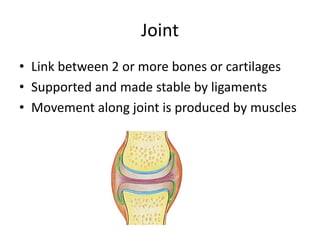
Joint
• Link between 2 or more bones or cartilages
• Supported and made stable by ligaments
• Movement along joint is produced by muscles
Classification of joints
• Non-movable joints - Synarthroses
• Slightly movable joints - Amphiarthroses
• Freely movable joints – (synovial joints)
Diarthroses
Classification of joints
Non-movable joints
• No movement is allowed between bones
• Designed to allow growth of body e.g. sutures
allow growth of brain
• Types are
– Sutures
– Gomphosis
– Syndesmosis
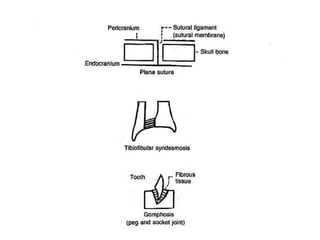
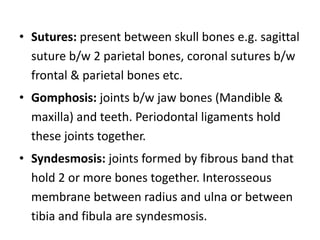
• Sutures: present between skull bones e.g. sagittal
suture b/w 2 parietal bones, coronal sutures b/w
frontal & parietal bones etc.
• Gomphosis: joints b/w jaw bones (Mandible &
maxilla) and teeth. Periodontal ligaments hold
these joints together.
• Syndesmosis: joints formed by fibrous band that
hold 2 or more bones together. Interosseous
membrane between radius and ulna or between
tibia and fibula are syndesmosis.
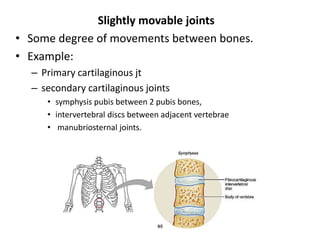
Slightly movable joints
• Some degree of movements between bones.
• Example:
– Primary cartilaginous jt
– secondary cartilaginous joints
• symphysis pubis between 2 pubis bones,
• intervertebral discs between adjacent vertebrae
• manubriosternal joints.
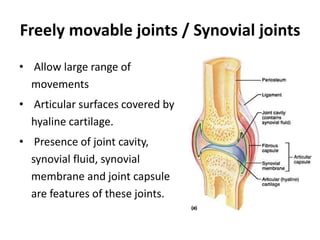
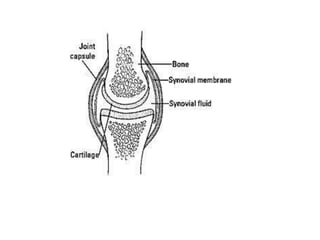
Freely movable joints / Synovial joints
• Allow large range of
movements
• Articular surfaces covered by
hyaline cartilage.
• Presence of joint cavity,
synovial fluid, synovial
membrane and joint capsule
are features of these joints.
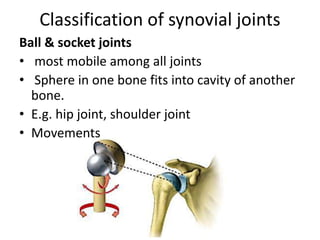
Classification of synovial joints
Ball & socket joints
• most mobile among all joints
• Sphere in one bone fits into cavity of another
bone.
• E.g. hip joint, shoulder joint
• Movements
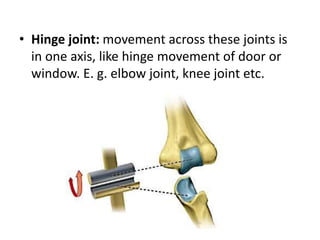
• Hinge joint: movement across these joints is
in one axis, like hinge movement of door or
window. E. g. elbow joint, knee joint etc.
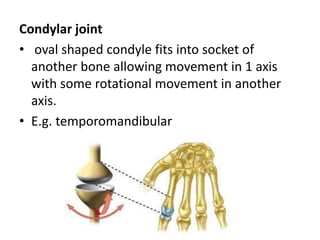
Condylar joint
• oval shaped condyle fits into socket of
another bone allowing movement in 1 axis
with some rotational movement in another
axis.
• E.g. temporomandibular
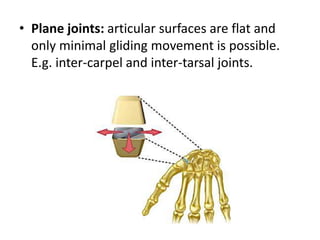
• Plane joints: articular surfaces are flat and
only minimal gliding movement is possible.
E.g. inter-carpel and inter-tarsal joints.
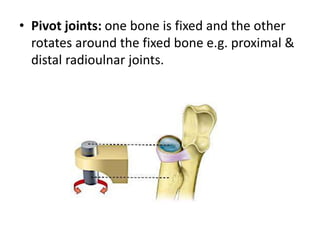
• Pivot joints: one bone is fixed and the other
rotates around the fixed bone e.g. proximal &
distal radioulnar joints.
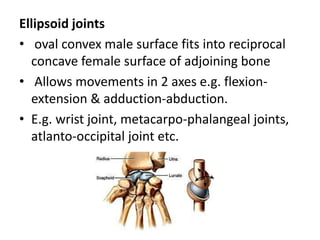
Ellipsoid joints
• oval convex male surface fits into reciprocal
concave female surface of adjoining bone
• Allows movements in 2 axes e.g. flexion-
extension & adduction-abduction.
• E.g. wrist joint, metacarpo-phalangeal joints,
atlanto-occipital joint etc.
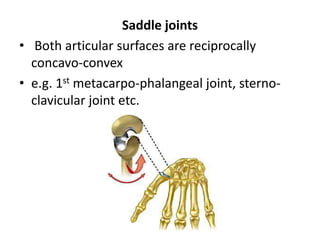
Saddle joints
• Both articular surfaces are reciprocally
concavo-convex
• e.g. 1st metacarpo-phalangeal joint, sterno-
clavicular joint etc.
MOVEMENTS ALLOWED BY SYNOVIAL
JOINTS
• Three basic types of movement
– Gliding – One bone across the surface of another
– Angular movement – Movements change the angle
between bones
– Rotation – Movement around a bone's long axis
17
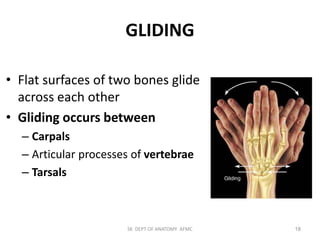
GLIDING
• Flat surfaces of two bones glide
across each other
• Gliding occurs between
– Carpals
– Articular processes of vertebrae
– Tarsals
SK DEPT OF ANATOMY AFMC 18
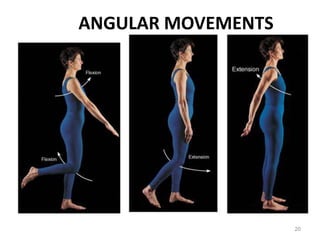
ANGULAR MOVEMENT
• Flexion
• Extension
• Dorsiflexion & Plantar-flexion
• Abduction
• Adduction
• Circumduction
SK DEPT OF ANATOMY AFMC 19
ANGULAR MOVEMENTS
20
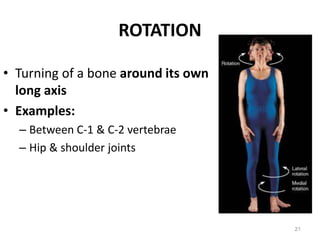
ROTATION
• Turning of a bone around its own
long axis
• Examples:
– Between C-1 & C-2 vertebrae
– Hip & shoulder joints
21
Joints  and movements

Joints and movements

  • 1.
    Joints & Movements DrRishi Pokhrel Maj Assistant Professor NAIHS
  • 2.
    Joint • Link between2 or more bones or cartilages • Supported and made stable by ligaments • Movement along joint is produced by muscles
  • 3.
    Classification of joints •Non-movable joints - Synarthroses • Slightly movable joints - Amphiarthroses • Freely movable joints – (synovial joints) Diarthroses
  • 4.
    Classification of joints Non-movablejoints • No movement is allowed between bones • Designed to allow growth of body e.g. sutures allow growth of brain • Types are – Sutures – Gomphosis – Syndesmosis
  • 6.
    • Sutures: presentbetween skull bones e.g. sagittal suture b/w 2 parietal bones, coronal sutures b/w frontal & parietal bones etc. • Gomphosis: joints b/w jaw bones (Mandible & maxilla) and teeth. Periodontal ligaments hold these joints together. • Syndesmosis: joints formed by fibrous band that hold 2 or more bones together. Interosseous membrane between radius and ulna or between tibia and fibula are syndesmosis.
  • 7.
    Slightly movable joints •Some degree of movements between bones. • Example: – Primary cartilaginous jt – secondary cartilaginous joints • symphysis pubis between 2 pubis bones, • intervertebral discs between adjacent vertebrae • manubriosternal joints.
  • 8.
    Freely movable joints/ Synovial joints • Allow large range of movements • Articular surfaces covered by hyaline cartilage. • Presence of joint cavity, synovial fluid, synovial membrane and joint capsule are features of these joints.
  • 10.
    Classification of synovialjoints Ball & socket joints • most mobile among all joints • Sphere in one bone fits into cavity of another bone. • E.g. hip joint, shoulder joint • Movements
  • 11.
    • Hinge joint:movement across these joints is in one axis, like hinge movement of door or window. E. g. elbow joint, knee joint etc.
  • 12.
    Condylar joint • ovalshaped condyle fits into socket of another bone allowing movement in 1 axis with some rotational movement in another axis. • E.g. temporomandibular
  • 13.
    • Plane joints:articular surfaces are flat and only minimal gliding movement is possible. E.g. inter-carpel and inter-tarsal joints.
  • 14.
    • Pivot joints:one bone is fixed and the other rotates around the fixed bone e.g. proximal & distal radioulnar joints.
  • 15.
    Ellipsoid joints • ovalconvex male surface fits into reciprocal concave female surface of adjoining bone • Allows movements in 2 axes e.g. flexion- extension & adduction-abduction. • E.g. wrist joint, metacarpo-phalangeal joints, atlanto-occipital joint etc.
  • 16.
    Saddle joints • Botharticular surfaces are reciprocally concavo-convex • e.g. 1st metacarpo-phalangeal joint, sterno- clavicular joint etc.
  • 17.
    MOVEMENTS ALLOWED BYSYNOVIAL JOINTS • Three basic types of movement – Gliding – One bone across the surface of another – Angular movement – Movements change the angle between bones – Rotation – Movement around a bone's long axis 17
  • 18.
    GLIDING • Flat surfacesof two bones glide across each other • Gliding occurs between – Carpals – Articular processes of vertebrae – Tarsals SK DEPT OF ANATOMY AFMC 18
  • 19.
    ANGULAR MOVEMENT • Flexion •Extension • Dorsiflexion & Plantar-flexion • Abduction • Adduction • Circumduction SK DEPT OF ANATOMY AFMC 19
  • 20.
  • 21.
    ROTATION • Turning ofa bone around its own long axis • Examples: – Between C-1 & C-2 vertebrae – Hip & shoulder joints 21