RK Goit, Lecturer
Department of Physiology
• muscle refers to a number of muscle fibers bound
together by connective tissue
• differentiation is completed around the time of birth
• differentiated fibers continue to ↑ in size during growth
from infancy to adult
• muscular tissue produces body movements, maintains
posture, & generates heat
• use ATP to generate force
Functions of Muscular Tissue
1. Producing body movements
2. Stabilizing body positions
3. Generating heat
4. Storing & moving substances within the body
1. Producing body movements
– movements of the whole body
– localized movements
2. Stabilizing body positions
– skeletal muscle contractions stabilize joints & maintain body
positions
– postural muscles contract continuously
3. Generating heat
– as muscular tissue contracts, it produces heat, a process
known as thermogenesis
4. Storing & moving substances within the body
– skeletal muscle contractions promote the flow of lymph & aid
the return of blood to the heart
Properties of Muscular Tissue
1. Electrical excitability
– a property of both muscle & nerve cells, is the ability to
respond to certain stimuli by producing electrical signals called
action potentials
– can travel along a cell’s plasma membrane due to the
presence of specific voltage- gated channels
– two main types of stimuli trigger action potentials
• autorhythmic electrical signals arising in the muscular tissue itself
• chemical stimuli, such as neurotransmitters released by neurons,
hormones distributed by the blood
2. Contractility
– is the ability of muscular tissue to contract forcefully when
stimulated by an action potential
3. Extensibility
– is the ability of muscular tissue to stretch without being
damaged
– normally, smooth muscle is subject to the greatest amount of
stretching
4. Elasticity
– is the ability of muscular tissue to return to its original length &
shape after contraction or extension
Classification
1. Depending upon of striations
1. Striated muscle
2. Nonstriated muscle
2. Depending upon the control
1. Voluntary muscle
2. Involuntary muscle
3. Depending upon the function
1. Skeletal muscle
2. Cardiac muscle
3. Smooth muscle
Skeletal Muscle
• about 40 % of the body is skeletal muscle, & 10 % is
smooth & cardiac muscle
• formed by the fusion of a number of undifferentiated,
mononucleated cells (myoblasts) into a single cylindrical,
multinucleated cell
• adult skeletal muscle fibers have diameters between 10
& 100 µm & lengths extend up to 20 cm
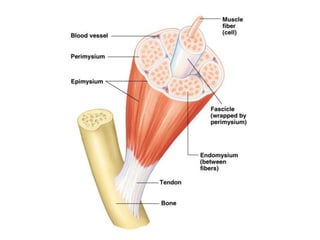
• muscles are linked to bones by bundles of collagen fibers
known as tendons
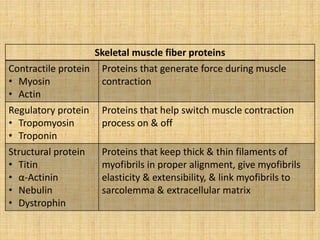
Skeletal muscle fiber proteins
Contractile protein
• Myosin
• Actin
Proteins that generate force during muscle
contraction
Regulatory protein
• Tropomyosin
• Troponin
Proteins that help switch muscle contraction
process on & off
Structural protein
• Titin
• α-Actinin
• Nebulin
• Dystrophin
Proteins that keep thick & thin filaments of
myofibrils in proper alignment, give myofibrils
elasticity & extensibility, & link myofibrils to
sarcolemma & extracellular matrix
Sarcolemma
• cell membrane of the muscle fiber
Myofibrils
• each muscle fiber contains several hundred to several
thousand myofibrils
• each myofibril is composed of about 1500 myosin
filaments (thick) & 3000 actin filaments (thin)
• these are large polymerized protein molecules that are
responsible for the actual muscle contraction
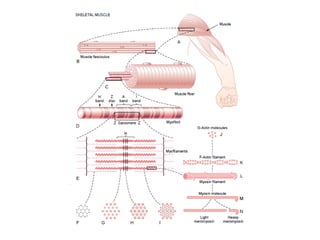
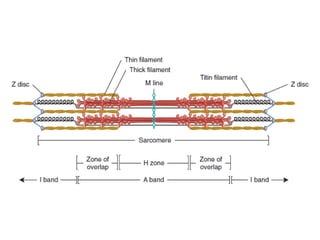
• myofibrils have alternate light & dark bands
• light bands contain only actin filaments & are called I
bands
• dark bands contain myosin filaments, as well as the ends
of the actin filaments where they overlap the myosin, &
are called A bands
• the ends of the actin filaments are attached to Z disc
• Z disc attach the myofibrils to one another all the way
across the muscle fiber
– the entire muscle fiber has light & dark bands
– give skeletal (also cardiac) muscle striated appearance
• portion of the myofibril (or of the whole muscle fiber)
that lies between two successive Z discs is called a
sarcomere
Sarcoplasm
• within the sarcolemma is the sarcoplasm, the cytoplasm
of a muscle fiber
– glycogen, large quantities of potassium, magnesium, &
phosphate, multiple protein enzymes, tremendous numbers of
mitochondria
Sarcoplasmic Reticulum
• has a special organization that is extremely important in
controlling muscle contraction
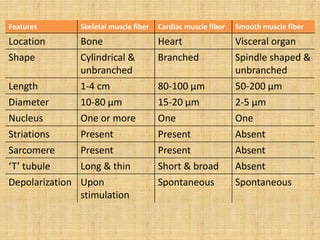
Features Skeletal muscle fiber Cardiac muscle fiber Smooth muscle fiber
Location Bone Heart Visceral organ
Shape Cylindrical &
unbranched
Branched Spindle shaped &
unbranched
Length 1-4 cm 80-100 µm 50-200 µm
Diameter 10-80 µm 15-20 µm 2-5 µm
Nucleus One or more One One
Striations Present Present Absent
Sarcomere Present Present Absent
‘T’ tubule Long & thin Short & broad Absent
Depolarization Upon
stimulation
Spontaneous Spontaneous
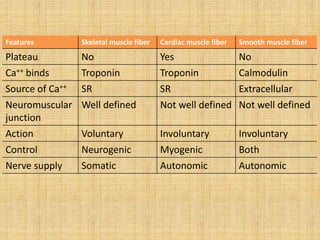
Features Skeletal muscle fiber Cardiac muscle fiber Smooth muscle fiber
Plateau No Yes No
Ca++ binds Troponin Troponin Calmodulin
Source of Ca++ SR SR Extracellular
Neuromuscular
junction
Well defined Not well defined Not well defined
Action Voluntary Involuntary Involuntary
Control Neurogenic Myogenic Both
Nerve supply Somatic Autonomic Autonomic
References
Textbook of Medical Physiology, 12/E Guyton & Hall
Ganong Review of Medical Physiology, 23/E
Essential of Medical Physiology, 5/E Sembulingam
Thank You

Muscles classification

  • 1.
  • 2.
    • muscle refersto a number of muscle fibers bound together by connective tissue • differentiation is completed around the time of birth • differentiated fibers continue to ↑ in size during growth from infancy to adult • muscular tissue produces body movements, maintains posture, & generates heat • use ATP to generate force
  • 3.
    Functions of MuscularTissue 1. Producing body movements 2. Stabilizing body positions 3. Generating heat 4. Storing & moving substances within the body
  • 4.
    1. Producing bodymovements – movements of the whole body – localized movements 2. Stabilizing body positions – skeletal muscle contractions stabilize joints & maintain body positions – postural muscles contract continuously 3. Generating heat – as muscular tissue contracts, it produces heat, a process known as thermogenesis
  • 5.
    4. Storing &moving substances within the body – skeletal muscle contractions promote the flow of lymph & aid the return of blood to the heart
  • 6.
    Properties of MuscularTissue 1. Electrical excitability – a property of both muscle & nerve cells, is the ability to respond to certain stimuli by producing electrical signals called action potentials – can travel along a cell’s plasma membrane due to the presence of specific voltage- gated channels – two main types of stimuli trigger action potentials • autorhythmic electrical signals arising in the muscular tissue itself • chemical stimuli, such as neurotransmitters released by neurons, hormones distributed by the blood 2. Contractility – is the ability of muscular tissue to contract forcefully when stimulated by an action potential
  • 7.
    3. Extensibility – isthe ability of muscular tissue to stretch without being damaged – normally, smooth muscle is subject to the greatest amount of stretching 4. Elasticity – is the ability of muscular tissue to return to its original length & shape after contraction or extension
  • 8.
    Classification 1. Depending uponof striations 1. Striated muscle 2. Nonstriated muscle 2. Depending upon the control 1. Voluntary muscle 2. Involuntary muscle 3. Depending upon the function 1. Skeletal muscle 2. Cardiac muscle 3. Smooth muscle
  • 9.
    Skeletal Muscle • about40 % of the body is skeletal muscle, & 10 % is smooth & cardiac muscle • formed by the fusion of a number of undifferentiated, mononucleated cells (myoblasts) into a single cylindrical, multinucleated cell • adult skeletal muscle fibers have diameters between 10 & 100 µm & lengths extend up to 20 cm • muscles are linked to bones by bundles of collagen fibers known as tendons
  • 11.
    Skeletal muscle fiberproteins Contractile protein • Myosin • Actin Proteins that generate force during muscle contraction Regulatory protein • Tropomyosin • Troponin Proteins that help switch muscle contraction process on & off Structural protein • Titin • α-Actinin • Nebulin • Dystrophin Proteins that keep thick & thin filaments of myofibrils in proper alignment, give myofibrils elasticity & extensibility, & link myofibrils to sarcolemma & extracellular matrix
  • 13.
    Sarcolemma • cell membraneof the muscle fiber Myofibrils • each muscle fiber contains several hundred to several thousand myofibrils • each myofibril is composed of about 1500 myosin filaments (thick) & 3000 actin filaments (thin) • these are large polymerized protein molecules that are responsible for the actual muscle contraction
  • 15.
    • myofibrils havealternate light & dark bands • light bands contain only actin filaments & are called I bands • dark bands contain myosin filaments, as well as the ends of the actin filaments where they overlap the myosin, & are called A bands
  • 16.
    • the endsof the actin filaments are attached to Z disc • Z disc attach the myofibrils to one another all the way across the muscle fiber – the entire muscle fiber has light & dark bands – give skeletal (also cardiac) muscle striated appearance • portion of the myofibril (or of the whole muscle fiber) that lies between two successive Z discs is called a sarcomere
  • 17.
    Sarcoplasm • within thesarcolemma is the sarcoplasm, the cytoplasm of a muscle fiber – glycogen, large quantities of potassium, magnesium, & phosphate, multiple protein enzymes, tremendous numbers of mitochondria Sarcoplasmic Reticulum • has a special organization that is extremely important in controlling muscle contraction
  • 18.
    Features Skeletal musclefiber Cardiac muscle fiber Smooth muscle fiber Location Bone Heart Visceral organ Shape Cylindrical & unbranched Branched Spindle shaped & unbranched Length 1-4 cm 80-100 µm 50-200 µm Diameter 10-80 µm 15-20 µm 2-5 µm Nucleus One or more One One Striations Present Present Absent Sarcomere Present Present Absent ‘T’ tubule Long & thin Short & broad Absent Depolarization Upon stimulation Spontaneous Spontaneous
  • 19.
    Features Skeletal musclefiber Cardiac muscle fiber Smooth muscle fiber Plateau No Yes No Ca++ binds Troponin Troponin Calmodulin Source of Ca++ SR SR Extracellular Neuromuscular junction Well defined Not well defined Not well defined Action Voluntary Involuntary Involuntary Control Neurogenic Myogenic Both Nerve supply Somatic Autonomic Autonomic
  • 20.
    References Textbook of MedicalPhysiology, 12/E Guyton & Hall Ganong Review of Medical Physiology, 23/E Essential of Medical Physiology, 5/E Sembulingam
  • 21.