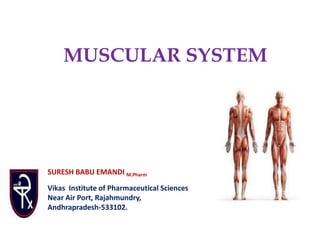
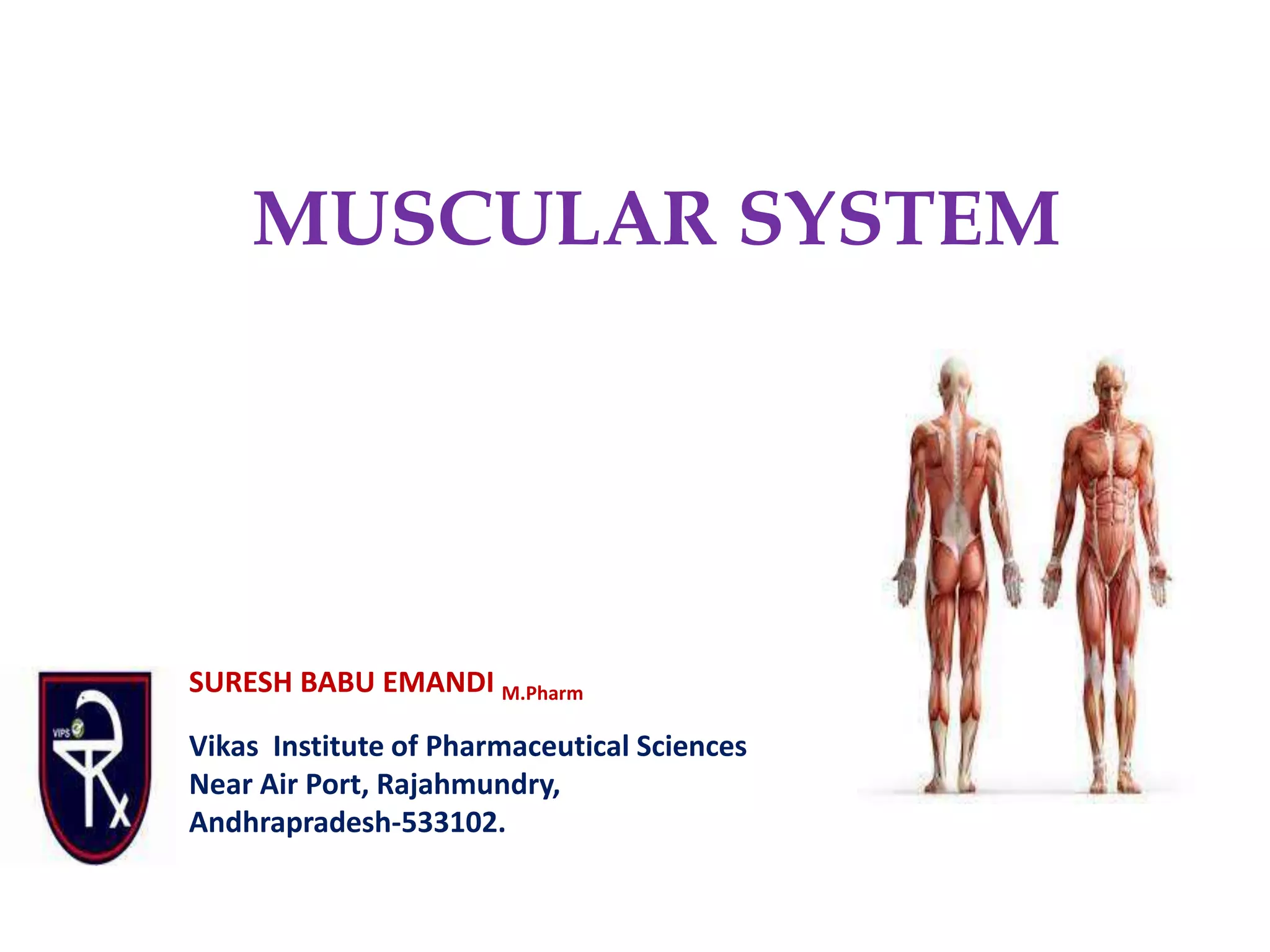
MUSCULAR SYSTEM
SURESH BABU EMANDI M.Pharm
Vikas Institute of Pharmaceutical Sciences
Near Air Port, Rajahmundry,
Andhrapradesh-533102.
• The muscular System is an organ system
consisting of skeletal, smooth, and cardiac
muscle.
• It permits movement of the body, maintains
posture, and circulates blood throughout the
body.
• The muscular systems in vertebrates are
controlled through the nervous system although
some muscles can be completely autonomous.
• The muscular System is an organ system consisting
of
Skeletal
Smooth &
Cardiac muscle.
• It permits movement of the body
• Maintains posture.
• Circulates blood throughout the body.
• The muscular systems in vertebrates are controlled
through the nervous system although some
muscles can be completely autonomous.
Functions of the muscular system
• The 5 main functions of the muscular system
are movement, support, protection, heat
generation, and blood circulation.
• Movement. Skeletal muscles pull on the
bones causing movements at the joints.
• Support. Muscles of the body wall support the
internal organs.
• Protection.
• Heat generation.
• Blood circulation.
• Human body has more than 600 muscles.
• Muscles perform many useful functions and help us
in doing everything in day-to-day life.
• Muscles are classified by three different methods,
based on different factors.
• I. Depending upon the presence or absence of
striations
• II. Depending upon the control
• III. Depending upon the situation. „
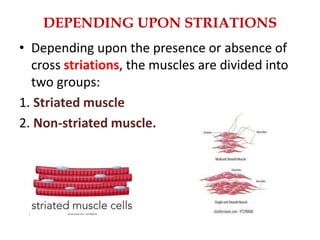
DEPENDING UPON STRIATIONS
• Depending upon the presence or absence of
cross striations, the muscles are divided into
two groups:
1. Striated muscle
2. Non-striated muscle.
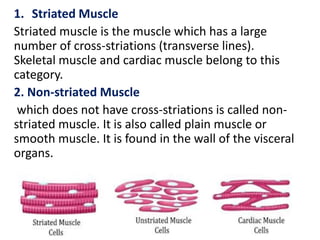
1. Striated Muscle
Striated muscle is the muscle which has a large
number of cross-striations (transverse lines).
Skeletal muscle and cardiac muscle belong to this
category.
2. Non-striated Muscle
which does not have cross-striations is called non-
striated muscle. It is also called plain muscle or
smooth muscle. It is found in the wall of the visceral
organs.
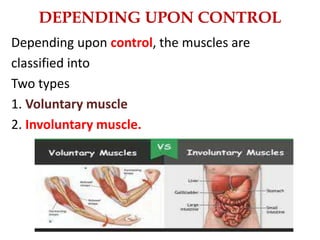
DEPENDING UPON CONTROL
Depending upon control, the muscles are
classified into
Two types
1. Voluntary muscle
2. Involuntary muscle.
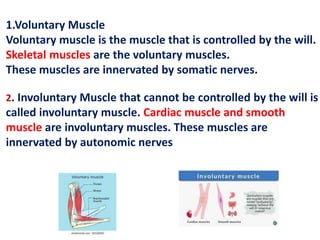
1.Voluntary Muscle
Voluntary muscle is the muscle that is controlled by the will.
Skeletal muscles are the voluntary muscles.
These muscles are innervated by somatic nerves.
2. Involuntary Muscle that cannot be controlled by the will is
called involuntary muscle. Cardiac muscle and smooth
muscle are involuntary muscles. These muscles are
innervated by autonomic nerves
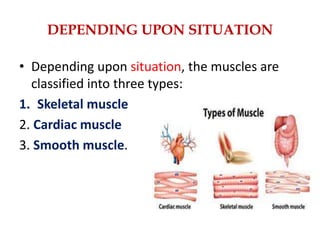
DEPENDING UPON SITUATION
• Depending upon situation, the muscles are
classified into three types:
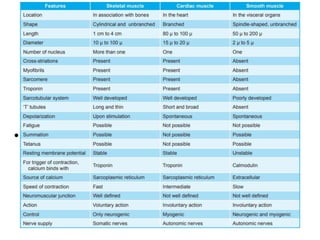
1. Skeletal muscle
2. Cardiac muscle
3. Smooth muscle.
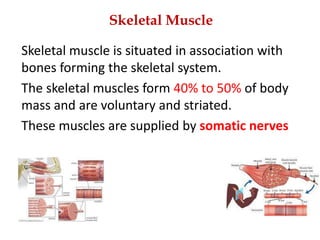
Skeletal Muscle
Skeletal muscle is situated in association with
bones forming the skeletal system.
The skeletal muscles form 40% to 50% of body
mass and are voluntary and striated.
These muscles are supplied by somatic nerves
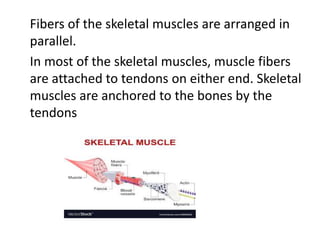
Fibers of the skeletal muscles are arranged in
parallel.
In most of the skeletal muscles, muscle fibers
are attached to tendons on either end. Skeletal
muscles are anchored to the bones by the
tendons
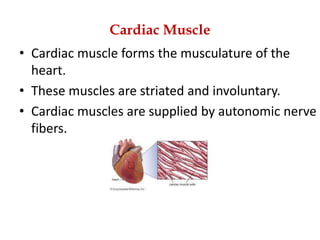
Cardiac Muscle
• Cardiac muscle forms the musculature of the
heart.
• These muscles are striated and involuntary.
• Cardiac muscles are supplied by autonomic nerve
fibers.
Smooth Muscle
• Smooth muscle is situated in association with
viscera. It is also called visceral muscle.
• It is different from skeletal and cardiac muscles
because of the absence of crossstriations, hence
the name smooth muscle.
• Smooth muscle is supplied by autonomic nerve
fibers.
• Smooth muscles form the main contractile units
of wall of the various visceral organs.
•
Structure of muscle
Muscle mass
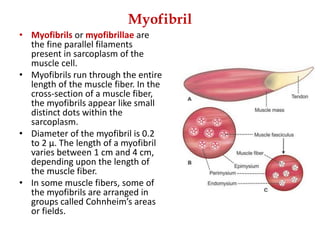
Muscle mass or muscle tissue is made up of a large
number of individual muscle cells or myocytes.
The muscle cells are commonly called muscle
fibers because these cells are long and slender in
appearance.
Skeletal muscle fibers are multinucleated and are
arranged parallel to one another with some
connective tissue in between
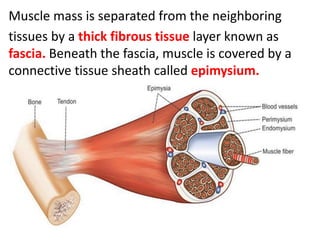
Muscle mass is separated from the neighboring
tissues by a thick fibrous tissue layer known as
fascia. Beneath the fascia, muscle is covered by a
connective tissue sheath called epimysium.
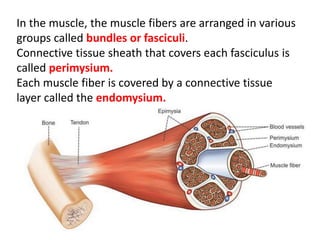
In the muscle, the muscle fibers are arranged in various
groups called bundles or fasciculi.
Connective tissue sheath that covers each fasciculus is
called perimysium.
Each muscle fiber is covered by a connective tissue
layer called the endomysium.
Muscle fiber
• Each muscle cell or muscle fiber is cylindrical in
shape. Average length of the fiber is 3 cm.
• It varies between 1 cm and 4 cm, depending
upon the length of the muscle.
• The diameter of the muscle fiber varies from 10 µ
to 100 µ. The diameter varies in a single muscle.
Muscle fiber
• Muscle fibers are attached to a tough cord of
connective tissue called tendon.
• Tendon is in turn attached to the bone.
• Tendon of some muscles is thin, flat and
stretched but tough. Such type of tendon is
called aponeurosis.
• Each muscle fiber is enclosed by a cell membrane
called plasma membrane, that lies beneath the
endomysium.
• It is also called sarcolemma. Cytoplasm of the
muscle is known as sarcoplasm
Structures embedded within the sarcoplasm
1. Nuclei
2. Myofibril
3. Golgi apparatus
4. Mitochondria
5. Sarcoplasmic reticulum
6. Ribosomes
7. Glycogen droplets
8. Occasional lipid droplets.
• Each muscle fiber has got one or more nuclei.
In long muscle fibers, many nuclei are seen.
• Nuclei are oval or elongated and situated just
beneath the sarcolemma.
• Usually in other cells, the nucleus is in the
interior of the cell.
• All the organelles of muscle fiber have the
same functions as those of other cells.
Myofibril
• Myofibrils or myofibrillae are
the fine parallel filaments
present in sarcoplasm of the
muscle cell.
• Myofibrils run through the entire
length of the muscle fiber. In the
cross-section of a muscle fiber,
the myofibrils appear like small
distinct dots within the
sarcoplasm.
• Diameter of the myofibril is 0.2
to 2 µ. The length of a myofibril
varies between 1 cm and 4 cm,
depending upon the length of
the muscle fiber.
• In some muscle fibers, some of
the myofibrils are arranged in
groups called Cohnheim’s areas
or fields.
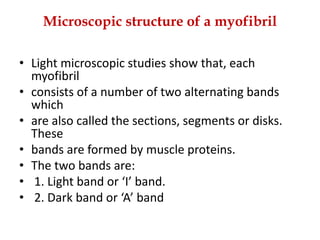
Microscopic structure of a myofibril
• Light microscopic studies show that, each
myofibril
• consists of a number of two alternating bands
which
• are also called the sections, segments or disks.
These
• bands are formed by muscle proteins.
• The two bands are:
• 1. Light band or ‘I’ band.
• 2. Dark band or ‘A’ band
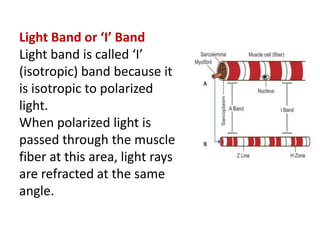
Light Band or ‘I’ Band
Light band is called ‘I’
(isotropic) band because it
is isotropic to polarized
light.
When polarized light is
passed through the muscle
fiber at this area, light rays
are refracted at the same
angle.
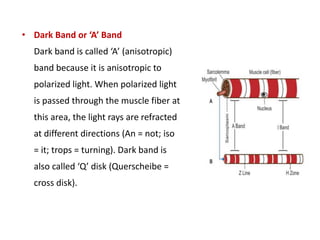
• Dark Band or ‘A’ Band
Dark band is called ‘A’ (anisotropic)
band because it is anisotropic to
polarized light. When polarized light
is passed through the muscle fiber at
this area, the light rays are refracted
at different directions (An = not; iso
= it; trops = turning). Dark band is
also called ‘Q’ disk (Querscheibe =
cross disk).
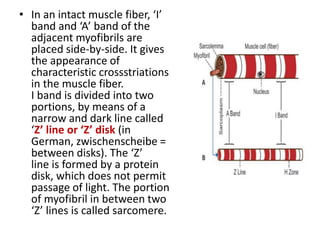
• In an intact muscle fiber, ‘I’
band and ‘A’ band of the
adjacent myofibrils are
placed side-by-side. It gives
the appearance of
characteristic crossstriations
in the muscle fiber.
I band is divided into two
portions, by means of a
narrow and dark line called
‘Z’ line or ‘Z’ disk (in
German, zwischenscheibe =
between disks). The ‘Z’
line is formed by a protein
disk, which does not permit
passage of light. The portion
of myofibril in between two
‘Z’ lines is called sarcomere.
Sarcomere
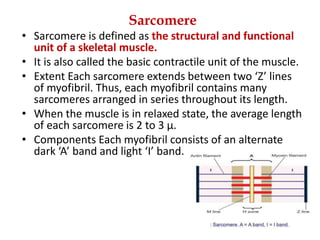
• Sarcomere is defined as the structural and functional
unit of a skeletal muscle.
• It is also called the basic contractile unit of the muscle.
• Extent Each sarcomere extends between two ‘Z’ lines
of myofibril. Thus, each myofibril contains many
sarcomeres arranged in series throughout its length.
• When the muscle is in relaxed state, the average length
of each sarcomere is 2 to 3 µ.
• Components Each myofibril consists of an alternate
dark ‘A’ band and light ‘I’ band.
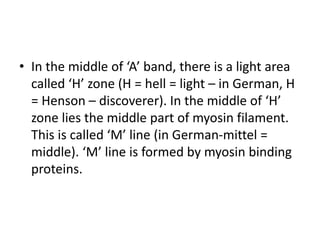
• In the middle of ‘A’ band, there is a light area
called ‘H’ zone (H = hell = light – in German, H
= Henson – discoverer). In the middle of ‘H’
zone lies the middle part of myosin filament.
This is called ‘M’ line (in German-mittel =
middle). ‘M’ line is formed by myosin binding
proteins.
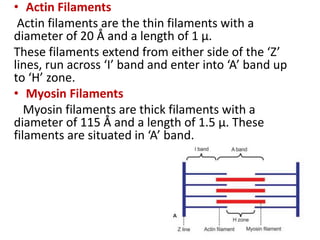
• Actin Filaments
Actin filaments are the thin filaments with a
diameter of 20 Å and a length of 1 µ.
These filaments extend from either side of the ‘Z’
lines, run across ‘I’ band and enter into ‘A’ band up
to ‘H’ zone.
• Myosin Filaments
Myosin filaments are thick filaments with a
diameter of 115 Å and a length of 1.5 µ. These
filaments are situated in ‘A’ band.
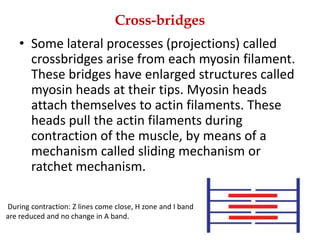
Cross-bridges
• Some lateral processes (projections) called
crossbridges arise from each myosin filament.
These bridges have enlarged structures called
myosin heads at their tips. Myosin heads
attach themselves to actin filaments. These
heads pull the actin filaments during
contraction of the muscle, by means of a
mechanism called sliding mechanism or
ratchet mechanism.
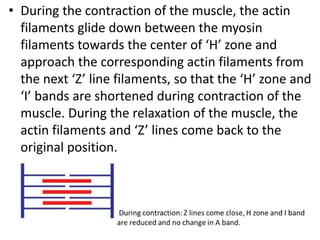
During contraction: Z lines come close, H zone and I band
are reduced and no change in A band.
• During the contraction of the muscle, the actin
filaments glide down between the myosin
filaments towards the center of ‘H’ zone and
approach the corresponding actin filaments from
the next ‘Z’ line filaments, so that the ‘H’ zone and
‘I’ bands are shortened during contraction of the
muscle. During the relaxation of the muscle, the
actin filaments and ‘Z’ lines come back to the
original position.
THANK U

MUSCULAR SYSTEM AND ITS COMPONENTS

  • 1.
    MUSCULAR SYSTEM SURESH BABUEMANDI M.Pharm Vikas Institute of Pharmaceutical Sciences Near Air Port, Rajahmundry, Andhrapradesh-533102.
  • 2.
    • The muscularSystem is an organ system consisting of skeletal, smooth, and cardiac muscle. • It permits movement of the body, maintains posture, and circulates blood throughout the body. • The muscular systems in vertebrates are controlled through the nervous system although some muscles can be completely autonomous.
  • 3.
    • The muscularSystem is an organ system consisting of Skeletal Smooth & Cardiac muscle. • It permits movement of the body • Maintains posture. • Circulates blood throughout the body. • The muscular systems in vertebrates are controlled through the nervous system although some muscles can be completely autonomous.
  • 4.
    Functions of themuscular system • The 5 main functions of the muscular system are movement, support, protection, heat generation, and blood circulation. • Movement. Skeletal muscles pull on the bones causing movements at the joints. • Support. Muscles of the body wall support the internal organs. • Protection. • Heat generation. • Blood circulation.
  • 5.
    • Human bodyhas more than 600 muscles. • Muscles perform many useful functions and help us in doing everything in day-to-day life. • Muscles are classified by three different methods, based on different factors. • I. Depending upon the presence or absence of striations • II. Depending upon the control • III. Depending upon the situation. „
  • 6.
    DEPENDING UPON STRIATIONS •Depending upon the presence or absence of cross striations, the muscles are divided into two groups: 1. Striated muscle 2. Non-striated muscle.
  • 7.
    1. Striated Muscle Striatedmuscle is the muscle which has a large number of cross-striations (transverse lines). Skeletal muscle and cardiac muscle belong to this category. 2. Non-striated Muscle which does not have cross-striations is called non- striated muscle. It is also called plain muscle or smooth muscle. It is found in the wall of the visceral organs.
  • 8.
    DEPENDING UPON CONTROL Dependingupon control, the muscles are classified into Two types 1. Voluntary muscle 2. Involuntary muscle.
  • 9.
    1.Voluntary Muscle Voluntary muscleis the muscle that is controlled by the will. Skeletal muscles are the voluntary muscles. These muscles are innervated by somatic nerves. 2. Involuntary Muscle that cannot be controlled by the will is called involuntary muscle. Cardiac muscle and smooth muscle are involuntary muscles. These muscles are innervated by autonomic nerves
  • 10.
    DEPENDING UPON SITUATION •Depending upon situation, the muscles are classified into three types: 1. Skeletal muscle 2. Cardiac muscle 3. Smooth muscle.
  • 11.
    Skeletal Muscle Skeletal muscleis situated in association with bones forming the skeletal system. The skeletal muscles form 40% to 50% of body mass and are voluntary and striated. These muscles are supplied by somatic nerves
  • 12.
    Fibers of theskeletal muscles are arranged in parallel. In most of the skeletal muscles, muscle fibers are attached to tendons on either end. Skeletal muscles are anchored to the bones by the tendons
  • 13.
    Cardiac Muscle • Cardiacmuscle forms the musculature of the heart. • These muscles are striated and involuntary. • Cardiac muscles are supplied by autonomic nerve fibers.
  • 14.
    Smooth Muscle • Smoothmuscle is situated in association with viscera. It is also called visceral muscle. • It is different from skeletal and cardiac muscles because of the absence of crossstriations, hence the name smooth muscle. • Smooth muscle is supplied by autonomic nerve fibers. • Smooth muscles form the main contractile units of wall of the various visceral organs.
  • 15.
  • 16.
    Structure of muscle Musclemass Muscle mass or muscle tissue is made up of a large number of individual muscle cells or myocytes. The muscle cells are commonly called muscle fibers because these cells are long and slender in appearance. Skeletal muscle fibers are multinucleated and are arranged parallel to one another with some connective tissue in between
  • 17.
    Muscle mass isseparated from the neighboring tissues by a thick fibrous tissue layer known as fascia. Beneath the fascia, muscle is covered by a connective tissue sheath called epimysium.
  • 18.
    In the muscle,the muscle fibers are arranged in various groups called bundles or fasciculi. Connective tissue sheath that covers each fasciculus is called perimysium. Each muscle fiber is covered by a connective tissue layer called the endomysium.
  • 19.
    Muscle fiber • Eachmuscle cell or muscle fiber is cylindrical in shape. Average length of the fiber is 3 cm. • It varies between 1 cm and 4 cm, depending upon the length of the muscle. • The diameter of the muscle fiber varies from 10 µ to 100 µ. The diameter varies in a single muscle.
  • 20.
    Muscle fiber • Musclefibers are attached to a tough cord of connective tissue called tendon. • Tendon is in turn attached to the bone. • Tendon of some muscles is thin, flat and stretched but tough. Such type of tendon is called aponeurosis. • Each muscle fiber is enclosed by a cell membrane called plasma membrane, that lies beneath the endomysium. • It is also called sarcolemma. Cytoplasm of the muscle is known as sarcoplasm
  • 21.
    Structures embedded withinthe sarcoplasm 1. Nuclei 2. Myofibril 3. Golgi apparatus 4. Mitochondria 5. Sarcoplasmic reticulum 6. Ribosomes 7. Glycogen droplets 8. Occasional lipid droplets.
  • 22.
    • Each musclefiber has got one or more nuclei. In long muscle fibers, many nuclei are seen. • Nuclei are oval or elongated and situated just beneath the sarcolemma. • Usually in other cells, the nucleus is in the interior of the cell. • All the organelles of muscle fiber have the same functions as those of other cells.
  • 23.
    Myofibril • Myofibrils ormyofibrillae are the fine parallel filaments present in sarcoplasm of the muscle cell. • Myofibrils run through the entire length of the muscle fiber. In the cross-section of a muscle fiber, the myofibrils appear like small distinct dots within the sarcoplasm. • Diameter of the myofibril is 0.2 to 2 µ. The length of a myofibril varies between 1 cm and 4 cm, depending upon the length of the muscle fiber. • In some muscle fibers, some of the myofibrils are arranged in groups called Cohnheim’s areas or fields.
  • 24.
    Microscopic structure ofa myofibril • Light microscopic studies show that, each myofibril • consists of a number of two alternating bands which • are also called the sections, segments or disks. These • bands are formed by muscle proteins. • The two bands are: • 1. Light band or ‘I’ band. • 2. Dark band or ‘A’ band
  • 25.
    Light Band or‘I’ Band Light band is called ‘I’ (isotropic) band because it is isotropic to polarized light. When polarized light is passed through the muscle fiber at this area, light rays are refracted at the same angle.
  • 26.
    • Dark Bandor ‘A’ Band Dark band is called ‘A’ (anisotropic) band because it is anisotropic to polarized light. When polarized light is passed through the muscle fiber at this area, the light rays are refracted at different directions (An = not; iso = it; trops = turning). Dark band is also called ‘Q’ disk (Querscheibe = cross disk).
  • 27.
    • In anintact muscle fiber, ‘I’ band and ‘A’ band of the adjacent myofibrils are placed side-by-side. It gives the appearance of characteristic crossstriations in the muscle fiber. I band is divided into two portions, by means of a narrow and dark line called ‘Z’ line or ‘Z’ disk (in German, zwischenscheibe = between disks). The ‘Z’ line is formed by a protein disk, which does not permit passage of light. The portion of myofibril in between two ‘Z’ lines is called sarcomere.
  • 28.
    Sarcomere • Sarcomere isdefined as the structural and functional unit of a skeletal muscle. • It is also called the basic contractile unit of the muscle. • Extent Each sarcomere extends between two ‘Z’ lines of myofibril. Thus, each myofibril contains many sarcomeres arranged in series throughout its length. • When the muscle is in relaxed state, the average length of each sarcomere is 2 to 3 µ. • Components Each myofibril consists of an alternate dark ‘A’ band and light ‘I’ band.
  • 29.
    • In themiddle of ‘A’ band, there is a light area called ‘H’ zone (H = hell = light – in German, H = Henson – discoverer). In the middle of ‘H’ zone lies the middle part of myosin filament. This is called ‘M’ line (in German-mittel = middle). ‘M’ line is formed by myosin binding proteins.
  • 30.
    • Actin Filaments Actinfilaments are the thin filaments with a diameter of 20 Å and a length of 1 µ. These filaments extend from either side of the ‘Z’ lines, run across ‘I’ band and enter into ‘A’ band up to ‘H’ zone. • Myosin Filaments Myosin filaments are thick filaments with a diameter of 115 Å and a length of 1.5 µ. These filaments are situated in ‘A’ band.
  • 31.
    Cross-bridges • Some lateralprocesses (projections) called crossbridges arise from each myosin filament. These bridges have enlarged structures called myosin heads at their tips. Myosin heads attach themselves to actin filaments. These heads pull the actin filaments during contraction of the muscle, by means of a mechanism called sliding mechanism or ratchet mechanism. During contraction: Z lines come close, H zone and I band are reduced and no change in A band.
  • 32.
    • During thecontraction of the muscle, the actin filaments glide down between the myosin filaments towards the center of ‘H’ zone and approach the corresponding actin filaments from the next ‘Z’ line filaments, so that the ‘H’ zone and ‘I’ bands are shortened during contraction of the muscle. During the relaxation of the muscle, the actin filaments and ‘Z’ lines come back to the original position.
  • 33.