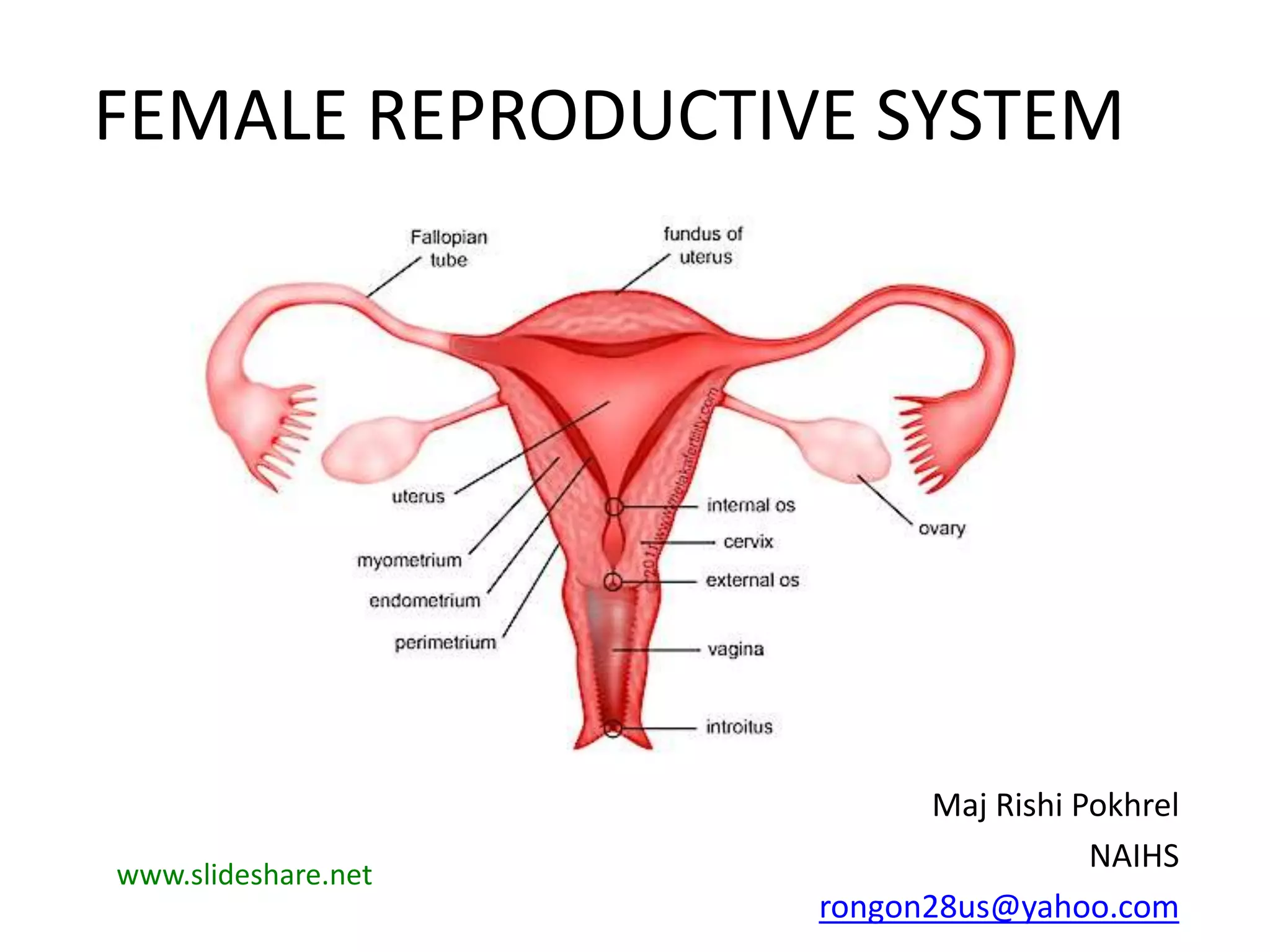
FEMALE REPRODUCTIVE SYSTEM
Maj Rishi Pokhrel
NAIHS
rongon28us@yahoo.com
www.slideshare.net
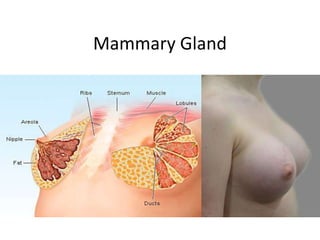
Mammary Gland
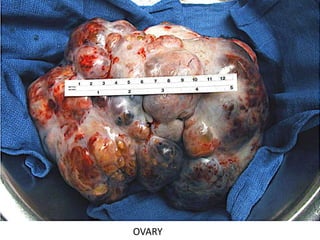
OVARY
4
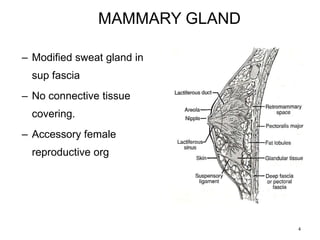
MAMMARY GLAND
– Modified sweat gland in
sup fascia
– No connective tissue
covering.
– Accessory female
reproductive org
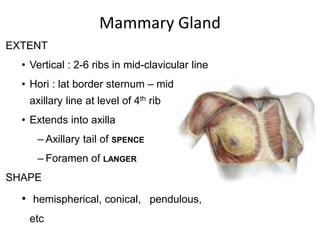
Mammary Gland
EXTENT
• Vertical : 2-6 ribs in mid-clavicular line
• Hori : lat border sternum – mid
axillary line at level of 4th rib
• Extends into axilla
– Axillary tail of SPENCE
– Foramen of LANGER
SHAPE
• hemispherical, conical, pendulous,
etc
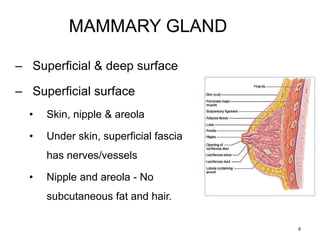
MAMMARY GLAND
– Superficial & deep surface
– Superficial surface
• Skin, nipple & areola
• Under skin, superficial fascia
has nerves/vessels
• Nipple and areola - No
subcutaneous fat and hair.
6
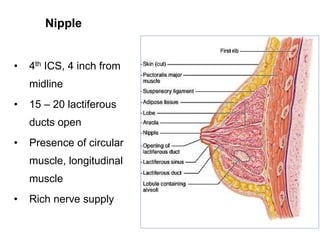
Nipple
• 4th ICS, 4 inch from
midline
• 15 – 20 lactiferous
ducts open
• Presence of circular
muscle, longitudinal
muscle
• Rich nerve supply
8
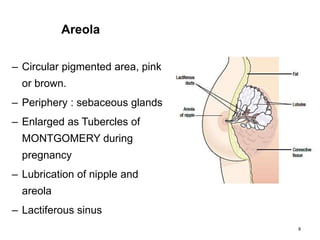
Areola
– Circular pigmented area, pink
or brown.
– Periphery : sebaceous glands
– Enlarged as Tubercles of
MONTGOMERY during
pregnancy
– Lubrication of nipple and
areola
– Lactiferous sinus
9
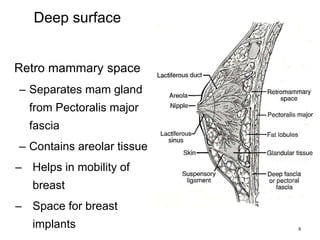
Deep surface
Retro mammary space
– Separates mam gland
from Pectoralis major
fascia
– Contains areolar tissue
– Helps in mobility of
breast
– Space for breast
implants
10
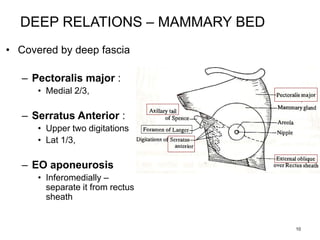
DEEP RELATIONS – MAMMARY BED
• Covered by deep fascia
– Pectoralis major :
• Medial 2/3,
– Serratus Anterior :
• Upper two digitations
• Lat 1/3,
– EO aponeurosis
• Inferomedially –
separate it from rectus
sheath
11
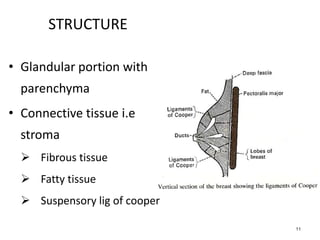
STRUCTURE
• Glandular portion with
parenchyma
• Connective tissue i.e
stroma
 Fibrous tissue
 Fatty tissue
 Suspensory lig of cooper
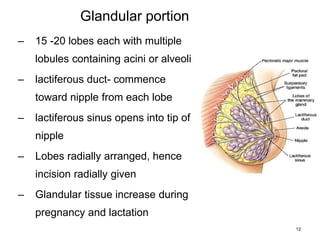
Glandular portion
– 15 -20 lobes each with multiple
lobules containing acini or alveoli
– lactiferous duct- commence
toward nipple from each lobe
– lactiferous sinus opens into tip of
nipple
– Lobes radially arranged, hence
incision radially given
– Glandular tissue increase during
pregnancy and lactation
12
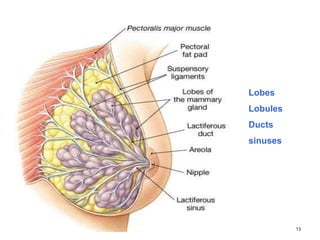
13
Lobes
Lobules
Ducts
sinuses
14
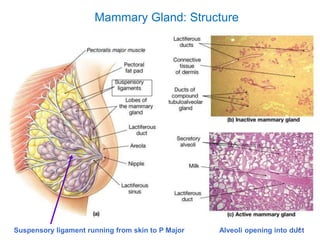
Mammary Gland: Structure
Alveoli opening into ductSuspensory ligament running from skin to P Major
15
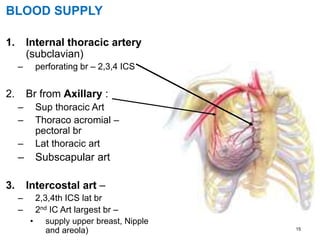
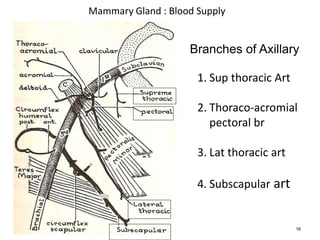
BLOOD SUPPLY
1. Internal thoracic artery
(subclavian)
– perforating br – 2,3,4 ICS
2. Br from Axillary :
– Sup thoracic Art
– Thoraco acromial –
pectoral br
– Lat thoracic art
– Subscapular art
3. Intercostal art –
– 2,3,4th ICS lat br
– 2nd IC Art largest br –
• supply upper breast, Nipple
and areola)
16
Mammary Gland : Blood Supply
Branches of Axillary
1. Sup thoracic Art
2. Thoraco-acromial
pectoral br
3. Lat thoracic art
4. Subscapular art
17
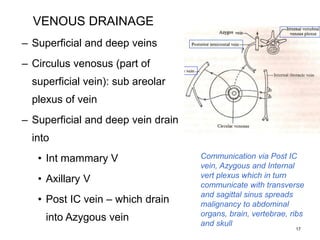
Communication via Post IC
vein, Azygous and Internal
vert plexus which in turn
communicate with transverse
and sagittal sinus spreads
malignancy to abdominal
organs, brain, vertebrae, ribs
and skull
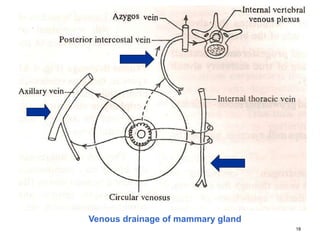
VENOUS DRAINAGE
– Superficial and deep veins
– Circulus venosus (part of
superficial vein): sub areolar
plexus of vein
– Superficial and deep vein drain
into
• Int mammary V
• Axillary V
• Post IC vein – which drain
into Azygous vein
18
Venous drainage of mammary gland
19
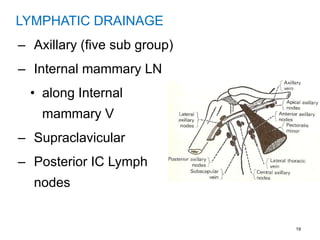
LYMPHATIC DRAINAGE
– Axillary (five sub group)
– Internal mammary LN
• along Internal
mammary V
– Supraclavicular
– Posterior IC Lymph
nodes
20
Summary Lymphatic drainage
– 75 % Parenchyma = Axillary LN
– 20 % Parenchyma = Internal mammary LN
– 5 % parenchyma = Post IC Nodes along Post IC vein
21
• Investigations
– Mammography
• Soft tissue radiographs of breast.
• Cyst (well defined smooth opacity) and carcinomas
(irregular density, distortion of breast tissue, calcification)
– FNAC (fine needle aspiration cytology)
• Used for cell diagnosis
APPLIED ANATOMY
22
• AXILLARY TAIL
– Well developed axillary tail mistaken for enlarged
lymph nodes/Lipoma
• Nipple
– Cracked nipple
• in later pregnancy and lactation.
• Nipple to be washed, and lubricated with lanolin
– Discharges
• management depends upon presence of lump
23
– Infections and inflammations – cause mastitis with
abscess
– Cysts
– Tumors
• Benign – Lipoma, fibro adenoma
• Malignant – carcinoma “more in nulliparous and
bearing child protective”
– Spread by local, lymphatic and blood stream.
– LN involvement shows metastatic potential.
– Advanced disease – involve supraclavicular
24
– Malignant tumours cont,d
• Presentation –
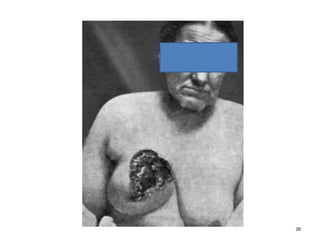
– Hard lump with retracted nipple
– Peau d’ orange (orange like skin) –
involvement of skin of breast due to cutaneous
lymphatic oedema
– Advanced – ulceration, fixation to chest wall,
metastatsis to viscera, bone
• Treatment
– Mastectomy
– Radiotherapy
– Harmone therapy
– chemotherapy
25
Breast Cancer
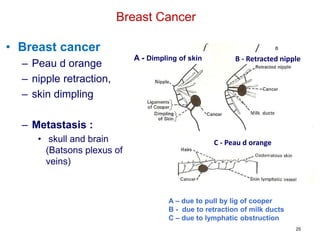
• Breast cancer
– Peau d orange
– nipple retraction,
– skin dimpling
– Metastasis :
• skull and brain
(Batsons plexus of
veins)
A - Dimpling of skin B - Retracted nipple
C - Peau d orange
A – due to pull by lig of cooper
B - due to retraction of milk ducts
C – due to lymphatic obstruction
26
27
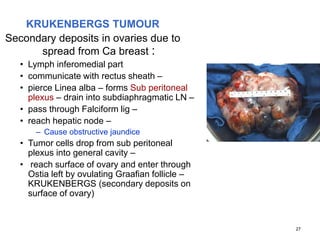
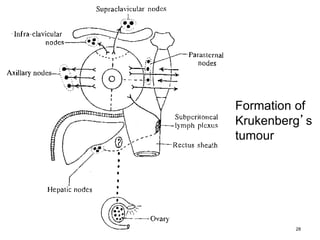
KRUKENBERGS TUMOUR
Secondary deposits in ovaries due to
spread from Ca breast :
• Lymph inferomedial part
• communicate with rectus sheath –
• pierce Linea alba – forms Sub peritoneal
plexus – drain into subdiaphragmatic LN –
• pass through Falciform lig –
• reach hepatic node –
– Cause obstructive jaundice
• Tumor cells drop from sub peritoneal
plexus into general cavity –
• reach surface of ovary and enter through
Ostia left by ovulating Graafian follicle –
KRUKENBERGS (secondary deposits on
surface of ovary)
28
Formation of
Krukenberg’s
tumour
29
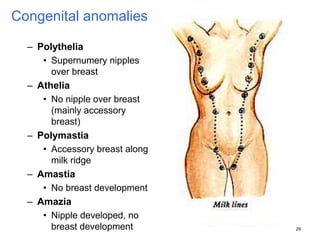
Congenital anomalies
– Polythelia
• Supernumery nipples
over breast
– Athelia
• No nipple over breast
(mainly accessory
breast)
– Polymastia
• Accessory breast along
milk ridge
– Amastia
• No breast development
– Amazia
• Nipple developed, no
breast development
30

Mammary glands

  • 1.
    FEMALE REPRODUCTIVE SYSTEM MajRishi Pokhrel NAIHS rongon28us@yahoo.com www.slideshare.net
  • 2.
  • 3.
  • 4.
    4 MAMMARY GLAND – Modifiedsweat gland in sup fascia – No connective tissue covering. – Accessory female reproductive org
  • 5.
    Mammary Gland EXTENT • Vertical: 2-6 ribs in mid-clavicular line • Hori : lat border sternum – mid axillary line at level of 4th rib • Extends into axilla – Axillary tail of SPENCE – Foramen of LANGER SHAPE • hemispherical, conical, pendulous, etc
  • 6.
    MAMMARY GLAND – Superficial& deep surface – Superficial surface • Skin, nipple & areola • Under skin, superficial fascia has nerves/vessels • Nipple and areola - No subcutaneous fat and hair. 6
  • 7.
    Nipple • 4th ICS,4 inch from midline • 15 – 20 lactiferous ducts open • Presence of circular muscle, longitudinal muscle • Rich nerve supply
  • 8.
    8 Areola – Circular pigmentedarea, pink or brown. – Periphery : sebaceous glands – Enlarged as Tubercles of MONTGOMERY during pregnancy – Lubrication of nipple and areola – Lactiferous sinus
  • 9.
    9 Deep surface Retro mammaryspace – Separates mam gland from Pectoralis major fascia – Contains areolar tissue – Helps in mobility of breast – Space for breast implants
  • 10.
    10 DEEP RELATIONS –MAMMARY BED • Covered by deep fascia – Pectoralis major : • Medial 2/3, – Serratus Anterior : • Upper two digitations • Lat 1/3, – EO aponeurosis • Inferomedially – separate it from rectus sheath
  • 11.
    11 STRUCTURE • Glandular portionwith parenchyma • Connective tissue i.e stroma  Fibrous tissue  Fatty tissue  Suspensory lig of cooper
  • 12.
    Glandular portion – 15-20 lobes each with multiple lobules containing acini or alveoli – lactiferous duct- commence toward nipple from each lobe – lactiferous sinus opens into tip of nipple – Lobes radially arranged, hence incision radially given – Glandular tissue increase during pregnancy and lactation 12
  • 13.
  • 14.
    14 Mammary Gland: Structure Alveoliopening into ductSuspensory ligament running from skin to P Major
  • 15.
    15 BLOOD SUPPLY 1. Internalthoracic artery (subclavian) – perforating br – 2,3,4 ICS 2. Br from Axillary : – Sup thoracic Art – Thoraco acromial – pectoral br – Lat thoracic art – Subscapular art 3. Intercostal art – – 2,3,4th ICS lat br – 2nd IC Art largest br – • supply upper breast, Nipple and areola)
  • 16.
    16 Mammary Gland :Blood Supply Branches of Axillary 1. Sup thoracic Art 2. Thoraco-acromial pectoral br 3. Lat thoracic art 4. Subscapular art
  • 17.
    17 Communication via PostIC vein, Azygous and Internal vert plexus which in turn communicate with transverse and sagittal sinus spreads malignancy to abdominal organs, brain, vertebrae, ribs and skull VENOUS DRAINAGE – Superficial and deep veins – Circulus venosus (part of superficial vein): sub areolar plexus of vein – Superficial and deep vein drain into • Int mammary V • Axillary V • Post IC vein – which drain into Azygous vein
  • 18.
    18 Venous drainage ofmammary gland
  • 19.
    19 LYMPHATIC DRAINAGE – Axillary(five sub group) – Internal mammary LN • along Internal mammary V – Supraclavicular – Posterior IC Lymph nodes
  • 20.
    20 Summary Lymphatic drainage –75 % Parenchyma = Axillary LN – 20 % Parenchyma = Internal mammary LN – 5 % parenchyma = Post IC Nodes along Post IC vein
  • 21.
    21 • Investigations – Mammography •Soft tissue radiographs of breast. • Cyst (well defined smooth opacity) and carcinomas (irregular density, distortion of breast tissue, calcification) – FNAC (fine needle aspiration cytology) • Used for cell diagnosis APPLIED ANATOMY
  • 22.
    22 • AXILLARY TAIL –Well developed axillary tail mistaken for enlarged lymph nodes/Lipoma • Nipple – Cracked nipple • in later pregnancy and lactation. • Nipple to be washed, and lubricated with lanolin – Discharges • management depends upon presence of lump
  • 23.
    23 – Infections andinflammations – cause mastitis with abscess – Cysts – Tumors • Benign – Lipoma, fibro adenoma • Malignant – carcinoma “more in nulliparous and bearing child protective” – Spread by local, lymphatic and blood stream. – LN involvement shows metastatic potential. – Advanced disease – involve supraclavicular
  • 24.
    24 – Malignant tumourscont,d • Presentation – – Hard lump with retracted nipple – Peau d’ orange (orange like skin) – involvement of skin of breast due to cutaneous lymphatic oedema – Advanced – ulceration, fixation to chest wall, metastatsis to viscera, bone • Treatment – Mastectomy – Radiotherapy – Harmone therapy – chemotherapy
  • 25.
    25 Breast Cancer • Breastcancer – Peau d orange – nipple retraction, – skin dimpling – Metastasis : • skull and brain (Batsons plexus of veins) A - Dimpling of skin B - Retracted nipple C - Peau d orange A – due to pull by lig of cooper B - due to retraction of milk ducts C – due to lymphatic obstruction
  • 26.
  • 27.
    27 KRUKENBERGS TUMOUR Secondary depositsin ovaries due to spread from Ca breast : • Lymph inferomedial part • communicate with rectus sheath – • pierce Linea alba – forms Sub peritoneal plexus – drain into subdiaphragmatic LN – • pass through Falciform lig – • reach hepatic node – – Cause obstructive jaundice • Tumor cells drop from sub peritoneal plexus into general cavity – • reach surface of ovary and enter through Ostia left by ovulating Graafian follicle – KRUKENBERGS (secondary deposits on surface of ovary)
  • 28.
  • 29.
    29 Congenital anomalies – Polythelia •Supernumery nipples over breast – Athelia • No nipple over breast (mainly accessory breast) – Polymastia • Accessory breast along milk ridge – Amastia • No breast development – Amazia • Nipple developed, no breast development
  • 30.