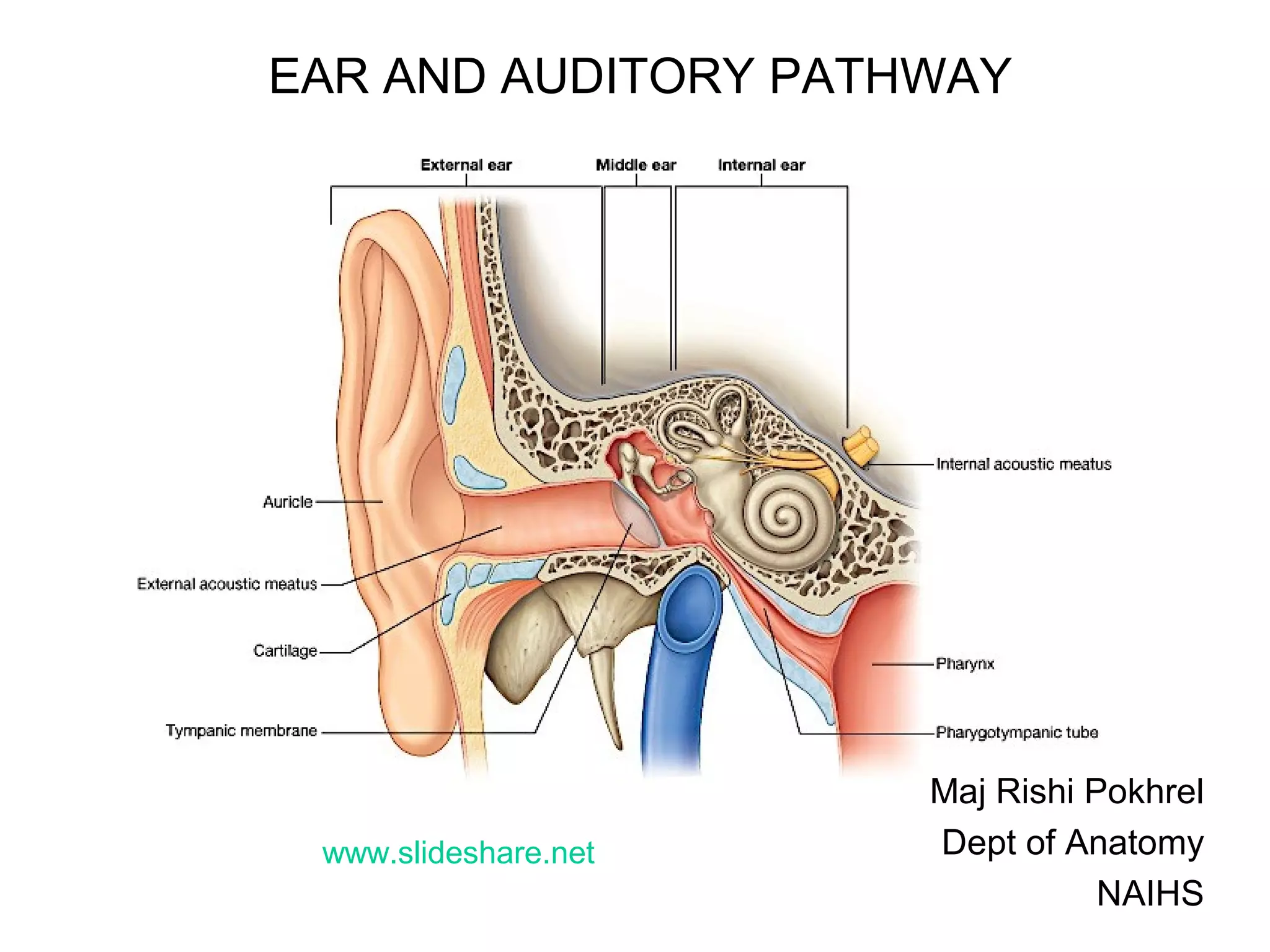
EAR AND AUDITORY PATHWAY
Maj Rishi Pokhrel
Dept of Anatomy
NAIHS
www.slideshare.net
• One structure of human body 0.1 mm
thick and derived from all 3 germ layers?
2
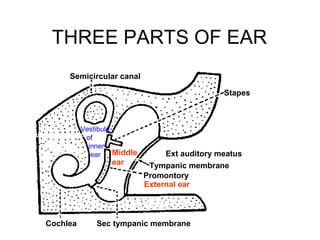
3Cochlea Sec tympanic membrane
Promontory
Middle
ear
Stapes
Semicircular canal
Vestibule
of
inner
ear
THREE PARTS OF EAR
Ext auditory meatus
Tympanic membrane
External ear
EXTERNAL EAR
4
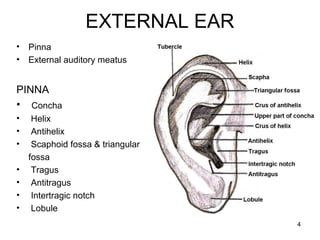
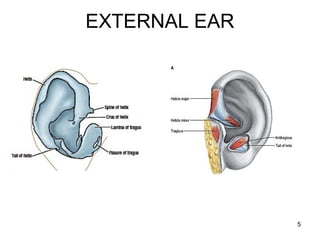
• Pinna
• External auditory meatus
PINNA
• Concha
• Helix
• Antihelix
• Scaphoid fossa & triangular
fossa
• Tragus
• Antitragus
• Intertragic notch
• Lobule
5
EXTERNAL EAR
EXTERNAL AUDITORY MEATUS
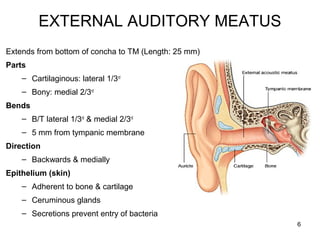
Extends from bottom of concha to TM (Length: 25 mm)
Parts
– Cartilaginous: lateral 1/3rd
– Bony: medial 2/3rd
Bends
– B/T lateral 1/3rd
& medial 2/3rd
– 5 mm from tympanic membrane
Direction
– Backwards & medially
Epithelium (skin)
– Adherent to bone & cartilage
– Ceruminous glands
– Secretions prevent entry of bacteria
6
7
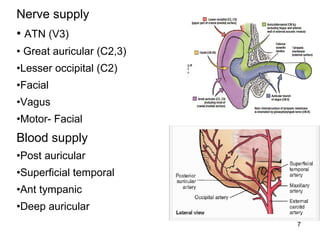
Nerve supply
• ATN (V3)
• Great auricular (C2,3)
•Lesser occipital (C2)
•Facial
•Vagus
•Motor- Facial
Blood supply
•Post auricular
•Superficial temporal
•Ant tympanic
•Deep auricular
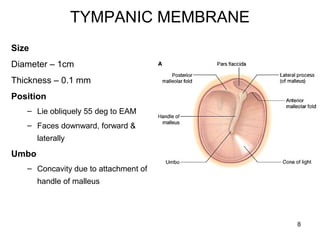
TYMPANIC MEMBRANE
Size
Diameter – 1cm
Thickness – 0.1 mm
Position
– Lie obliquely 55 deg to EAM
– Faces downward, forward &
laterally
Umbo
– Concavity due to attachment of
handle of malleus
8
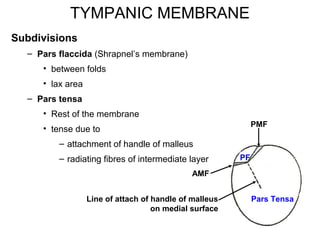
TYMPANIC MEMBRANE
Subdivisions
– Pars flaccida (Shrapnel’s membrane)
• between folds
• lax area
– Pars tensa
• Rest of the membrane
• tense due to
– attachment of handle of malleus
– radiating fibres of intermediate layer
9
PF
Pars Tensa
AMF
PMF
Line of attach of handle of malleus
on medial surface
TYMPANIC MEMBRANE
10
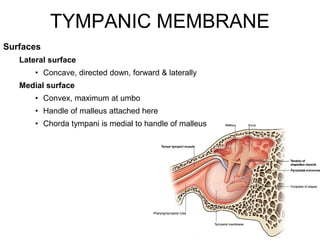
Surfaces
Lateral surface
• Concave, directed down, forward & laterally
Medial surface
• Convex, maximum at umbo
• Handle of malleus attached here
• Chorda tympani is medial to handle of malleus
TYMPANIC MEMBRANE
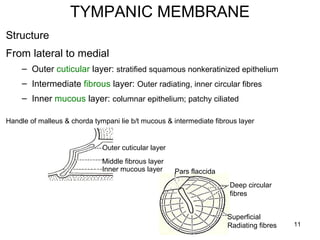
Structure
From lateral to medial
– Outer cuticular layer: stratified squamous nonkeratinized epithelium
– Intermediate fibrous layer: Outer radiating, inner circular fibres
– Inner mucous layer: columnar epithelium; patchy ciliated
Handle of malleus & chorda tympani lie b/t mucous & intermediate fibrous layer
11
Outer cuticular layer
Middle fibrous layer
Inner mucous layer
Deep circular
fibres
Superficial
Radiating fibres
Pars flaccida
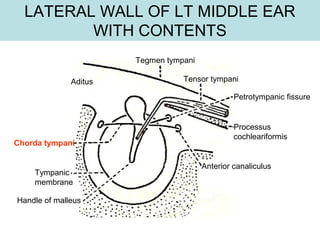
Tegmen tympani
Tensor tympani
Petrotympanic fissure
Anterior canaliculus
Chorda tympani
Tympanic
membrane
Handle of malleus
Processus
cochleariformis
Aditus
LATERAL WALL OF LT MIDDLE EAR
WITH CONTENTS
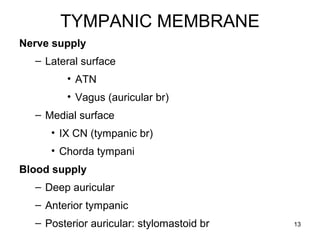
TYMPANIC MEMBRANE
Nerve supply
– Lateral surface
• ATN
• Vagus (auricular br)
– Medial surface
• IX CN (tympanic br)
• Chorda tympani
Blood supply
– Deep auricular
– Anterior tympanic
– Posterior auricular: stylomastoid br 13
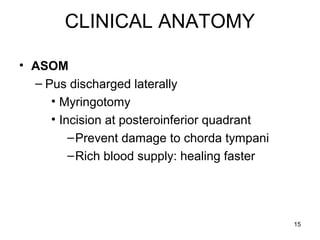
CLINICAL ANATOMY
• ASOM
– Pus discharged laterally
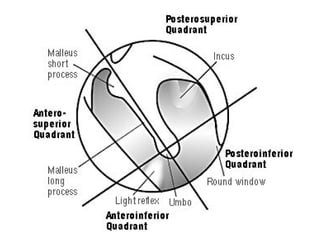
• Myringotomy
• Incision at posteroinferior quadrant
–Prevent damage to chorda tympani
–Rich blood supply: healing faster
15
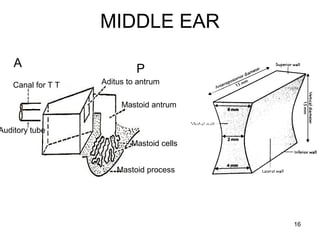
MIDDLE EAR
16
Canal for T T
Auditory tube
Aditus to antrum
Mastoid antrum
Mastoid cells
Mastoid process
A P
17
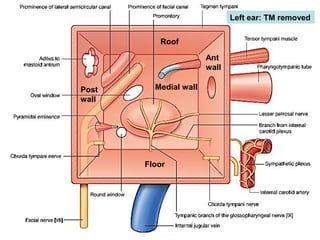
Left ear: TM removed
Roof
Floor
Medial wall
Ant
wall
Post
wall
18
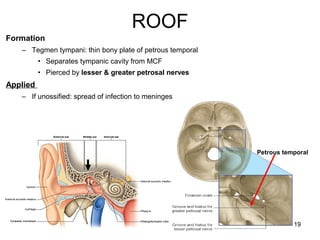
ROOF
19
Petrous temporal
Formation
– Tegmen tympani: thin bony plate of petrous temporal
• Separates tympanic cavity from MCF
• Pierced by lesser & greater petrosal nerves
Applied
– If unossified: spread of infection to meninges
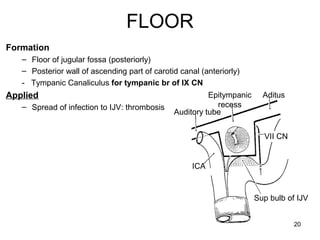
FLOOR
Formation
– Floor of jugular fossa (posteriorly)
– Posterior wall of ascending part of carotid canal (anteriorly)
- Tympanic Canaliculus for tympanic br of IX CN
Applied
– Spread of infection to IJV: thrombosis
20
Epitympanic
recess
Aditus
Auditory tube
ICA
Sup bulb of IJV
VII CN
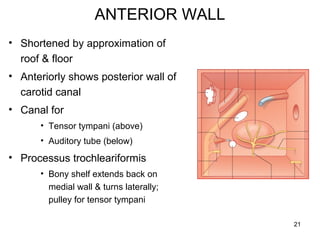
ANTERIOR WALL
• Shortened by approximation of
roof & floor
• Anteriorly shows posterior wall of
carotid canal
• Canal for
• Tensor tympani (above)
• Auditory tube (below)
• Processus trochleariformis
• Bony shelf extends back on
medial wall & turns laterally;
pulley for tensor tympani
21
22
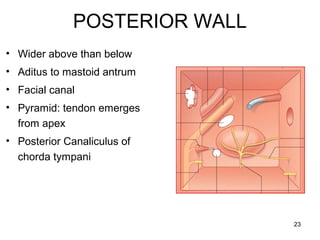
POSTERIOR WALL
• Wider above than below
• Aditus to mastoid antrum
• Facial canal
• Pyramid: tendon emerges
from apex
• Posterior Canaliculus of
chorda tympani
23
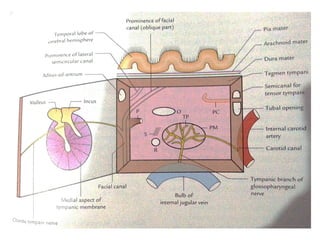
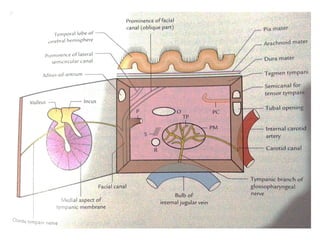
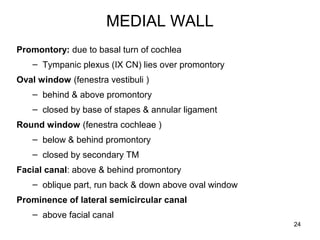
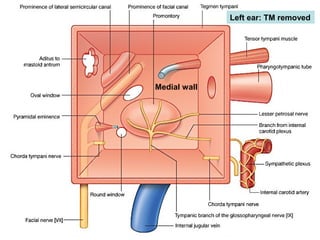
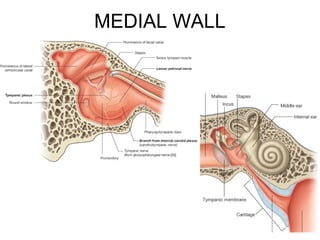
MEDIAL WALL
Promontory: due to basal turn of cochlea
– Tympanic plexus (IX CN) lies over promontory
Oval window (fenestra vestibuli )
– behind & above promontory
– closed by base of stapes & annular ligament
Round window (fenestra cochleae )
– below & behind promontory
– closed by secondary TM
Facial canal: above & behind promontory
– oblique part, run back & down above oval window
Prominence of lateral semicircular canal
– above facial canal
24
25
Left ear: TM removed
Medial wall
26
MEDIAL WALL
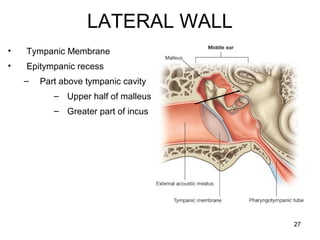
LATERAL WALL
• Tympanic Membrane
• Epitympanic recess
– Part above tympanic cavity
– Upper half of malleus
– Greater part of incus
27
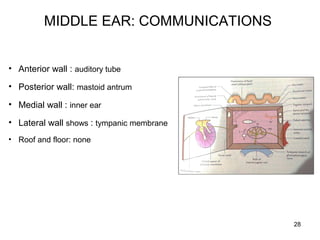
MIDDLE EAR: COMMUNICATIONS
• Anterior wall : auditory tube
• Posterior wall: mastoid antrum
• Medial wall : inner ear
• Lateral wall shows : tympanic membrane
• Roof and floor: none
28
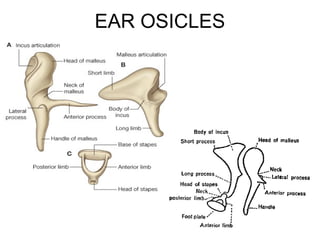
EAR OSICLES
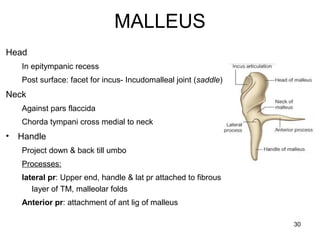
MALLEUS
Head
In epitympanic recess
Post surface: facet for incus- Incudomalleal joint (saddle)
Neck
Against pars flaccida
Chorda tympani cross medial to neck
• Handle
Project down & back till umbo
Processes:
lateral pr: Upper end, handle & lat pr attached to fibrous
layer of TM, malleolar folds
Anterior pr: attachment of ant lig of malleus
30
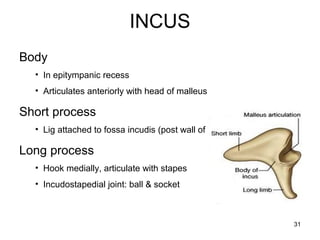
INCUS
Body
• In epitympanic recess
• Articulates anteriorly with head of malleus
Short process
• Lig attached to fossa incudis (post wall of TC)
Long process
• Hook medially, articulate with stapes
• Incudostapedial joint: ball & socket
31
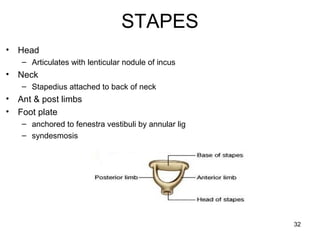
STAPES
• Head
– Articulates with lenticular nodule of incus
• Neck
– Stapedius attached to back of neck
• Ant & post limbs
• Foot plate
– anchored to fenestra vestibuli by annular lig
– syndesmosis
32
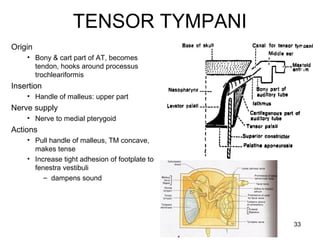
TENSOR TYMPANI
Origin
• Bony & cart part of AT, becomes
tendon, hooks around processus
trochleariformis
Insertion
• Handle of malleus: upper part
Nerve supply
• Nerve to medial pterygoid
Actions
• Pull handle of malleus, TM concave,
makes tense
• Increase tight adhesion of footplate to
fenestra vestibuli
– dampens sound
33
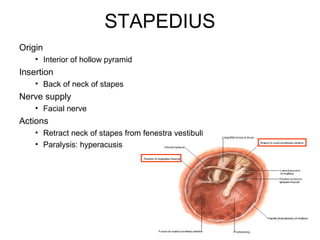
STAPEDIUS
Origin
• Interior of hollow pyramid
Insertion
• Back of neck of stapes
Nerve supply
• Facial nerve
Actions
• Retract neck of stapes from fenestra vestibuli
• Paralysis: hyperacusis
34
35
36
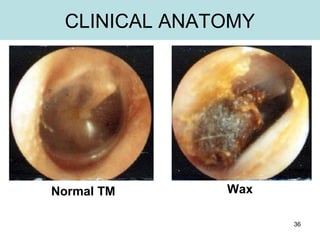
CLINICAL ANATOMY
Normal TM Wax
37
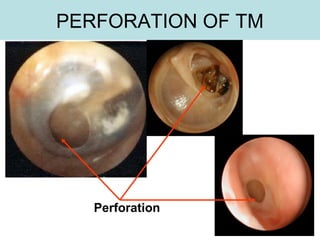
PERFORATION OF TM
Perforation
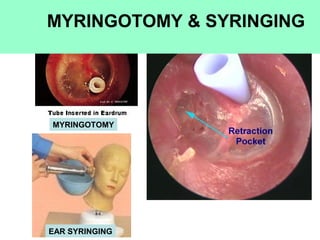
MYRINGOTOMY
MYRINGOTOMY & SYRINGING
EAR SYRINGING
39
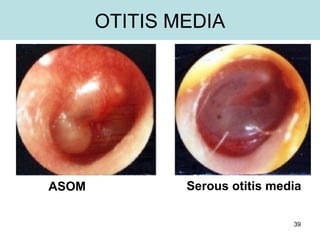
OTITIS MEDIA
Serous otitis mediaASOM
40
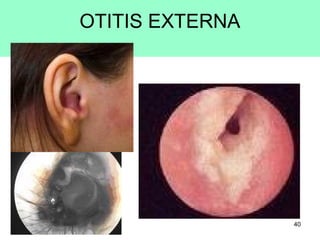
OTITIS EXTERNA
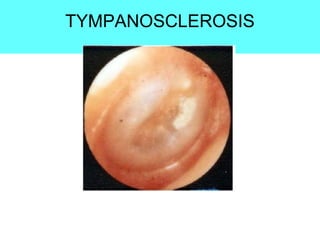
TYMPANOSCLEROSIS
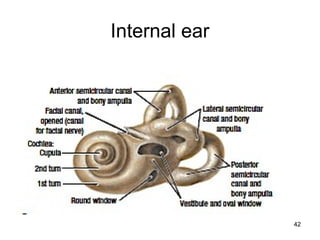
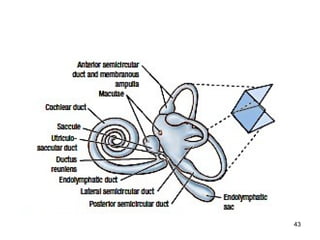
Internal ear
42
43
44
Auditory pathway
45
Auditory pathway
46
47
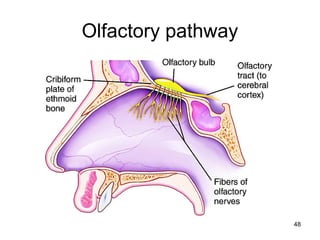
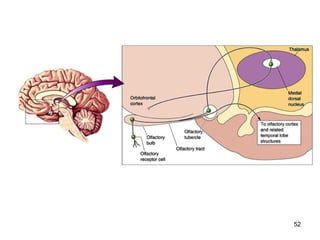
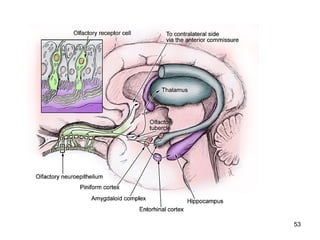
Olfactory pathway
48
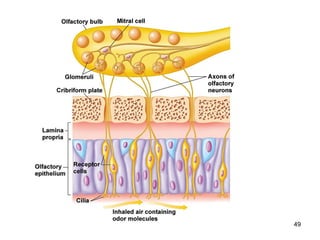
49
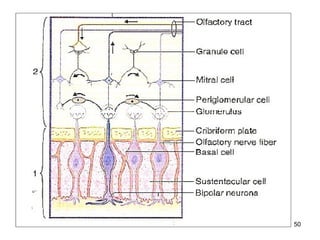
50
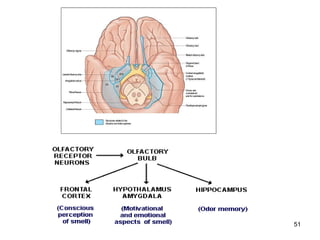
51
52
53
54
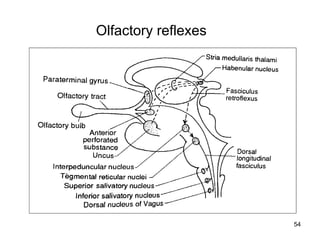
Olfactory reflexes
? 55

The ear. auditory pathway and olfactory pathway

  • 1.
    EAR AND AUDITORYPATHWAY Maj Rishi Pokhrel Dept of Anatomy NAIHS www.slideshare.net
  • 2.
    • One structureof human body 0.1 mm thick and derived from all 3 germ layers? 2
  • 3.
    3Cochlea Sec tympanicmembrane Promontory Middle ear Stapes Semicircular canal Vestibule of inner ear THREE PARTS OF EAR Ext auditory meatus Tympanic membrane External ear
  • 4.
    EXTERNAL EAR 4 • Pinna •External auditory meatus PINNA • Concha • Helix • Antihelix • Scaphoid fossa & triangular fossa • Tragus • Antitragus • Intertragic notch • Lobule
  • 5.
  • 6.
    EXTERNAL AUDITORY MEATUS Extendsfrom bottom of concha to TM (Length: 25 mm) Parts – Cartilaginous: lateral 1/3rd – Bony: medial 2/3rd Bends – B/T lateral 1/3rd & medial 2/3rd – 5 mm from tympanic membrane Direction – Backwards & medially Epithelium (skin) – Adherent to bone & cartilage – Ceruminous glands – Secretions prevent entry of bacteria 6
  • 7.
    7 Nerve supply • ATN(V3) • Great auricular (C2,3) •Lesser occipital (C2) •Facial •Vagus •Motor- Facial Blood supply •Post auricular •Superficial temporal •Ant tympanic •Deep auricular
  • 8.
    TYMPANIC MEMBRANE Size Diameter –1cm Thickness – 0.1 mm Position – Lie obliquely 55 deg to EAM – Faces downward, forward & laterally Umbo – Concavity due to attachment of handle of malleus 8
  • 9.
    TYMPANIC MEMBRANE Subdivisions – Parsflaccida (Shrapnel’s membrane) • between folds • lax area – Pars tensa • Rest of the membrane • tense due to – attachment of handle of malleus – radiating fibres of intermediate layer 9 PF Pars Tensa AMF PMF Line of attach of handle of malleus on medial surface
  • 10.
    TYMPANIC MEMBRANE 10 Surfaces Lateral surface •Concave, directed down, forward & laterally Medial surface • Convex, maximum at umbo • Handle of malleus attached here • Chorda tympani is medial to handle of malleus
  • 11.
    TYMPANIC MEMBRANE Structure From lateralto medial – Outer cuticular layer: stratified squamous nonkeratinized epithelium – Intermediate fibrous layer: Outer radiating, inner circular fibres – Inner mucous layer: columnar epithelium; patchy ciliated Handle of malleus & chorda tympani lie b/t mucous & intermediate fibrous layer 11 Outer cuticular layer Middle fibrous layer Inner mucous layer Deep circular fibres Superficial Radiating fibres Pars flaccida
  • 12.
    Tegmen tympani Tensor tympani Petrotympanicfissure Anterior canaliculus Chorda tympani Tympanic membrane Handle of malleus Processus cochleariformis Aditus LATERAL WALL OF LT MIDDLE EAR WITH CONTENTS
  • 13.
    TYMPANIC MEMBRANE Nerve supply –Lateral surface • ATN • Vagus (auricular br) – Medial surface • IX CN (tympanic br) • Chorda tympani Blood supply – Deep auricular – Anterior tympanic – Posterior auricular: stylomastoid br 13
  • 15.
    CLINICAL ANATOMY • ASOM –Pus discharged laterally • Myringotomy • Incision at posteroinferior quadrant –Prevent damage to chorda tympani –Rich blood supply: healing faster 15
  • 16.
    MIDDLE EAR 16 Canal forT T Auditory tube Aditus to antrum Mastoid antrum Mastoid cells Mastoid process A P
  • 17.
    17 Left ear: TMremoved Roof Floor Medial wall Ant wall Post wall
  • 18.
  • 19.
    ROOF 19 Petrous temporal Formation – Tegmentympani: thin bony plate of petrous temporal • Separates tympanic cavity from MCF • Pierced by lesser & greater petrosal nerves Applied – If unossified: spread of infection to meninges
  • 20.
    FLOOR Formation – Floor ofjugular fossa (posteriorly) – Posterior wall of ascending part of carotid canal (anteriorly) - Tympanic Canaliculus for tympanic br of IX CN Applied – Spread of infection to IJV: thrombosis 20 Epitympanic recess Aditus Auditory tube ICA Sup bulb of IJV VII CN
  • 21.
    ANTERIOR WALL • Shortenedby approximation of roof & floor • Anteriorly shows posterior wall of carotid canal • Canal for • Tensor tympani (above) • Auditory tube (below) • Processus trochleariformis • Bony shelf extends back on medial wall & turns laterally; pulley for tensor tympani 21
  • 22.
  • 23.
    POSTERIOR WALL • Widerabove than below • Aditus to mastoid antrum • Facial canal • Pyramid: tendon emerges from apex • Posterior Canaliculus of chorda tympani 23
  • 24.
    MEDIAL WALL Promontory: dueto basal turn of cochlea – Tympanic plexus (IX CN) lies over promontory Oval window (fenestra vestibuli ) – behind & above promontory – closed by base of stapes & annular ligament Round window (fenestra cochleae ) – below & behind promontory – closed by secondary TM Facial canal: above & behind promontory – oblique part, run back & down above oval window Prominence of lateral semicircular canal – above facial canal 24
  • 25.
    25 Left ear: TMremoved Medial wall
  • 26.
  • 27.
    LATERAL WALL • TympanicMembrane • Epitympanic recess – Part above tympanic cavity – Upper half of malleus – Greater part of incus 27
  • 28.
    MIDDLE EAR: COMMUNICATIONS •Anterior wall : auditory tube • Posterior wall: mastoid antrum • Medial wall : inner ear • Lateral wall shows : tympanic membrane • Roof and floor: none 28
  • 29.
  • 30.
    MALLEUS Head In epitympanic recess Postsurface: facet for incus- Incudomalleal joint (saddle) Neck Against pars flaccida Chorda tympani cross medial to neck • Handle Project down & back till umbo Processes: lateral pr: Upper end, handle & lat pr attached to fibrous layer of TM, malleolar folds Anterior pr: attachment of ant lig of malleus 30
  • 31.
    INCUS Body • In epitympanicrecess • Articulates anteriorly with head of malleus Short process • Lig attached to fossa incudis (post wall of TC) Long process • Hook medially, articulate with stapes • Incudostapedial joint: ball & socket 31
  • 32.
    STAPES • Head – Articulateswith lenticular nodule of incus • Neck – Stapedius attached to back of neck • Ant & post limbs • Foot plate – anchored to fenestra vestibuli by annular lig – syndesmosis 32
  • 33.
    TENSOR TYMPANI Origin • Bony& cart part of AT, becomes tendon, hooks around processus trochleariformis Insertion • Handle of malleus: upper part Nerve supply • Nerve to medial pterygoid Actions • Pull handle of malleus, TM concave, makes tense • Increase tight adhesion of footplate to fenestra vestibuli – dampens sound 33
  • 34.
    STAPEDIUS Origin • Interior ofhollow pyramid Insertion • Back of neck of stapes Nerve supply • Facial nerve Actions • Retract neck of stapes from fenestra vestibuli • Paralysis: hyperacusis 34
  • 35.
  • 36.
  • 37.
  • 38.
  • 39.
  • 40.
  • 41.
  • 42.
  • 43.
  • 44.
  • 45.
  • 46.
  • 47.
  • 48.
  • 49.
  • 50.
  • 51.
  • 52.
  • 53.
  • 54.
  • 55.