LYMPHOID TISSUES
Maj Dr Rishi Pokhrel
MBBS, MD
Lecturer, NAIHS
FAIMER Fellow, USA
2
Lymphatic System-Organs
Lymphatic System
• Not a primary tissue type but a variety of connective
tissue.
• Consists of:
- lymph
- network of vessels
- lymph nodes and nodules, MALT
- tonsils
- spleen
- thymus gland
- bone marrow
CELLS OF LYMPHATIC SYSTEM
Chief cells are lymphocytes-
• B lymphocytes
• T lymphocytes
• Natural killer cells
• Supporting cells-
– interact with lymphocyte
– Present antigens to
Lymphocytes
• OTHER TYPE OF WBC’S
-monocyte
-macrophages
-neutrophils
-eosinophil
-basophils
4
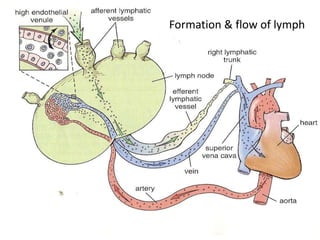
Formation & flow of lymph
7
CLASSIFICATION
I. FUNCTIONAL
LYMPHOID ORGANS
CENTRAL PERIPHERAL
THYMUS
BONE MARROW
LYMPH NODE
SPLEEN
MALT, GALT
8
II. MORPHOLOGICAL
LYMPHOID ORGANS
DISCRETE DIFFUSE
LN, SPLEEN
THYMUS, TONSIL
BM, PEYER’S PATCHES
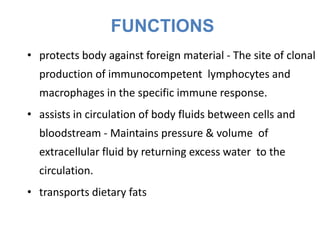
FUNCTIONS
• protects body against foreign material - The site of clonal
production of immunocompetent lymphocytes and
macrophages in the specific immune response.
• assists in circulation of body fluids between cells and
bloodstream - Maintains pressure & volume of
extracellular fluid by returning excess water to the
circulation.
• transports dietary fats
THYMUS
• Introduction
• Gross anatomy
• development
• Histology
-Circulation
-Relation with
immunology
• Functions
• Age changes
• Recent advances
10
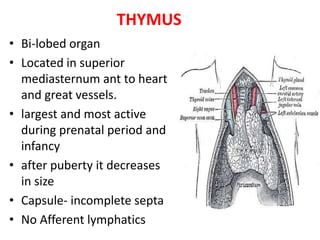
THYMUS
• Bi-lobed organ
• Located in superior
mediasternum ant to heart
and great vessels.
• largest and most active
during prenatal period and
infancy
• after puberty it decreases
in size
• Capsule- incomplete septa
• No Afferent lymphatics
• composed of lymphatic tissue
• subdivided into lobules
• immature T cells originating in the bone
marrow migrate to thymus via blood
• in thymus, cells develop into mature T cells
for release into circulation
• thymic hormones aid in maturation of T cells
THYMUS
Development
14
• 3rd Endodermal pouch
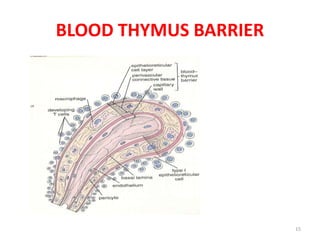
BLOOD THYMUS BARRIER
15
16
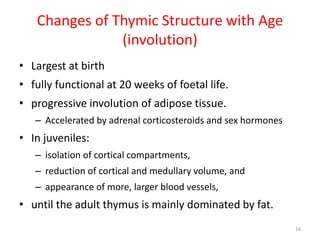
Changes of Thymic Structure with Age
(involution)
• Largest at birth
• fully functional at 20 weeks of foetal life.
• progressive involution of adipose tissue.
– Accelerated by adrenal corticosteroids and sex hormones
• In juveniles:
– isolation of cortical compartments,
– reduction of cortical and medullary volume, and
– appearance of more, larger blood vessels,
• until the adult thymus is mainly dominated by fat.
Applied
• Myasthenia gravis
• DiGeorge syndrome-absent-thymus &
parathyroid ,defect in cardiac outflow tract
17
18
Lymph Nodes
19
20
21
22
• Capsule – Trabeculae, hilus-
collagenous framework
• Lymph flow
– Retculin Meshwork-sinuses
– Subcapsular Sinus
– Cortical Sinuses
– Medullary Sinuses
– Eff Lymph Ch
Location
• Present around large
arteries or veins
– Cervical LN
– Axillary LN
– Coeliac and mesenteric LN
– Inguinal LN
Applied anatomy
• Lymphadenitis
• Metastasis
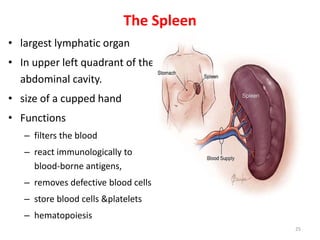
The Spleen
• largest lymphatic organ
• In upper left quadrant of the
abdominal cavity.
• size of a cupped hand
• Functions
– filters the blood
– react immunologically to
blood-borne antigens,
– removes defective blood cells
– store blood cells &platelets
– hematopoiesis
25
The Spleen
• Size: 1 X 3 X 5 inches
• Weight: 7 ounce
• Relation: 9-11 ribs in mid-
axillary line
LIGAMENTS
• Gastrosplenic ligament passes to greater curvature of
stomach (carries short gastric and left gastroepiploic vessels)
• Lienorenal ligament passes to posterior abdominal wall
(contains splenic vessels and tail of pancreas).
RELATIONS
RELATIONS
• Posteriorly- left dome of
diaphragm separating it
from pleura, left lung and
9th, 10th & 11th ribs
• Anteriorly- stomach
• Inferiorly- splenic flexure of
colon
• Medially- left kidney
• Tail of pancreas is related at
the hilum of spleen
BLOOD SUPPLY
• Splenic artery- largest
branch of coeliac axis
• Splenic vein joins
superior mesenteric
vein to form portal
vein
31
STRUCTURE
• It has a thin fibrous capsule, to which peritoneum adheres.
• The fibrous septae of capsule extends into spleen as
trabeculae between which lies splenic pulp.
• Red pulp
– This has large numbers of red blood cells (RBCs).
– It consists of splenic sinuses, separated by splenic cords (of
Billroth)
• White pulp
– WBC, mainly lymphocytes around the central artery in a
cylindrical fashion -periarterial lymphatic sheath (PALS) of the
artery.
32
STRUCTURE
CLINICAL ANATOMY
• During splenectomy, close relation of pancreatic tail to
the hilum and splenic pedicle must be remembered; it
is easily wounded.
• Stab wound of posterior left chest may penetrate
diaphragm and damage the spleen. Spleen is the
commonest organ ruptured by blunt trauma.
• Accessory spleens may occur near the hilum, in the tail
of pancreas, omentum, mesentery, ovary and even
testis.
Lymphoid tissue

Lymphoid tissue

  • 1.
    LYMPHOID TISSUES Maj DrRishi Pokhrel MBBS, MD Lecturer, NAIHS FAIMER Fellow, USA
  • 2.
  • 3.
    Lymphatic System • Nota primary tissue type but a variety of connective tissue. • Consists of: - lymph - network of vessels - lymph nodes and nodules, MALT - tonsils - spleen - thymus gland - bone marrow
  • 4.
    CELLS OF LYMPHATICSYSTEM Chief cells are lymphocytes- • B lymphocytes • T lymphocytes • Natural killer cells • Supporting cells- – interact with lymphocyte – Present antigens to Lymphocytes • OTHER TYPE OF WBC’S -monocyte -macrophages -neutrophils -eosinophil -basophils 4
  • 5.
  • 7.
    7 CLASSIFICATION I. FUNCTIONAL LYMPHOID ORGANS CENTRALPERIPHERAL THYMUS BONE MARROW LYMPH NODE SPLEEN MALT, GALT
  • 8.
    8 II. MORPHOLOGICAL LYMPHOID ORGANS DISCRETEDIFFUSE LN, SPLEEN THYMUS, TONSIL BM, PEYER’S PATCHES
  • 9.
    FUNCTIONS • protects bodyagainst foreign material - The site of clonal production of immunocompetent lymphocytes and macrophages in the specific immune response. • assists in circulation of body fluids between cells and bloodstream - Maintains pressure & volume of extracellular fluid by returning excess water to the circulation. • transports dietary fats
  • 10.
    THYMUS • Introduction • Grossanatomy • development • Histology -Circulation -Relation with immunology • Functions • Age changes • Recent advances 10
  • 11.
    THYMUS • Bi-lobed organ •Located in superior mediasternum ant to heart and great vessels. • largest and most active during prenatal period and infancy • after puberty it decreases in size • Capsule- incomplete septa • No Afferent lymphatics
  • 12.
    • composed oflymphatic tissue • subdivided into lobules • immature T cells originating in the bone marrow migrate to thymus via blood • in thymus, cells develop into mature T cells for release into circulation • thymic hormones aid in maturation of T cells THYMUS
  • 14.
  • 15.
  • 16.
    16 Changes of ThymicStructure with Age (involution) • Largest at birth • fully functional at 20 weeks of foetal life. • progressive involution of adipose tissue. – Accelerated by adrenal corticosteroids and sex hormones • In juveniles: – isolation of cortical compartments, – reduction of cortical and medullary volume, and – appearance of more, larger blood vessels, • until the adult thymus is mainly dominated by fat.
  • 17.
    Applied • Myasthenia gravis •DiGeorge syndrome-absent-thymus & parathyroid ,defect in cardiac outflow tract 17
  • 18.
  • 19.
  • 20.
  • 21.
  • 22.
    22 • Capsule –Trabeculae, hilus- collagenous framework • Lymph flow – Retculin Meshwork-sinuses – Subcapsular Sinus – Cortical Sinuses – Medullary Sinuses – Eff Lymph Ch
  • 23.
    Location • Present aroundlarge arteries or veins – Cervical LN – Axillary LN – Coeliac and mesenteric LN – Inguinal LN
  • 24.
  • 25.
    The Spleen • largestlymphatic organ • In upper left quadrant of the abdominal cavity. • size of a cupped hand • Functions – filters the blood – react immunologically to blood-borne antigens, – removes defective blood cells – store blood cells &platelets – hematopoiesis 25
  • 26.
    The Spleen • Size:1 X 3 X 5 inches • Weight: 7 ounce • Relation: 9-11 ribs in mid- axillary line
  • 27.
    LIGAMENTS • Gastrosplenic ligamentpasses to greater curvature of stomach (carries short gastric and left gastroepiploic vessels) • Lienorenal ligament passes to posterior abdominal wall (contains splenic vessels and tail of pancreas).
  • 28.
  • 29.
    RELATIONS • Posteriorly- leftdome of diaphragm separating it from pleura, left lung and 9th, 10th & 11th ribs • Anteriorly- stomach • Inferiorly- splenic flexure of colon • Medially- left kidney • Tail of pancreas is related at the hilum of spleen
  • 30.
    BLOOD SUPPLY • Splenicartery- largest branch of coeliac axis • Splenic vein joins superior mesenteric vein to form portal vein
  • 31.
    31 STRUCTURE • It hasa thin fibrous capsule, to which peritoneum adheres. • The fibrous septae of capsule extends into spleen as trabeculae between which lies splenic pulp. • Red pulp – This has large numbers of red blood cells (RBCs). – It consists of splenic sinuses, separated by splenic cords (of Billroth) • White pulp – WBC, mainly lymphocytes around the central artery in a cylindrical fashion -periarterial lymphatic sheath (PALS) of the artery.
  • 32.
  • 34.
    CLINICAL ANATOMY • Duringsplenectomy, close relation of pancreatic tail to the hilum and splenic pedicle must be remembered; it is easily wounded. • Stab wound of posterior left chest may penetrate diaphragm and damage the spleen. Spleen is the commonest organ ruptured by blunt trauma. • Accessory spleens may occur near the hilum, in the tail of pancreas, omentum, mesentery, ovary and even testis.

Editor's Notes

  • #11 Primary l org.
  • #17 After puberty much of the parenchyma of the thymus, in particular cortical lymphoid tissue, is replaced by adipose tissue. The process, which is called involution, initially proceeds rapidly but slows down in adulthood. Involution is under the control of steroid hormones (both sexual hormones and stress hormones). Although most pronounced in the thymus, involution is a common feature of all lymphoid tissues. Another age-related phenomenon is the increase in size of the thymic (or Hassall's) corpuscles. Thymic corpuscles are rounded eosinophilic structures, which consist of concentrically arranged, flattened cells. Thymic corpuscles are likely to be formed by reticular cells. Similar structures occur also in the tonsils. The size of these structures varies from 20 µm to more than 100 µm in diameter. Thymic corpuscles may calcify, and their core may "dissolve" leading to the formation of a cyst.