Introduction
• Arthrology: Studyof joints
• Synonyms: Articulation (Latin)
Arthron (Greek)
• Joint: a junction between two or more bones
or cartilages.
• A device to permit movements
3.
Classification of joints
Jointsare classified according to structure and function-
(A) Functional (based on degree of mobility):
1.Synarthroses: immovable joints (cranial sutures in
adults, primary cartilaginous joints in
growing children).
2.Amphiarthroses: slightly movable joints (joints
between adjacent laminae of vertebrae).
3.Diarthroses: freely movable joints (synovial joints).
(B) Structural classification
Basedon type of connecting tissue and presence or absence of
joint cavity:
1. Fibrous: composed of intervening fibrous tissue with no joint
cavity. Immovable or slightly movable.
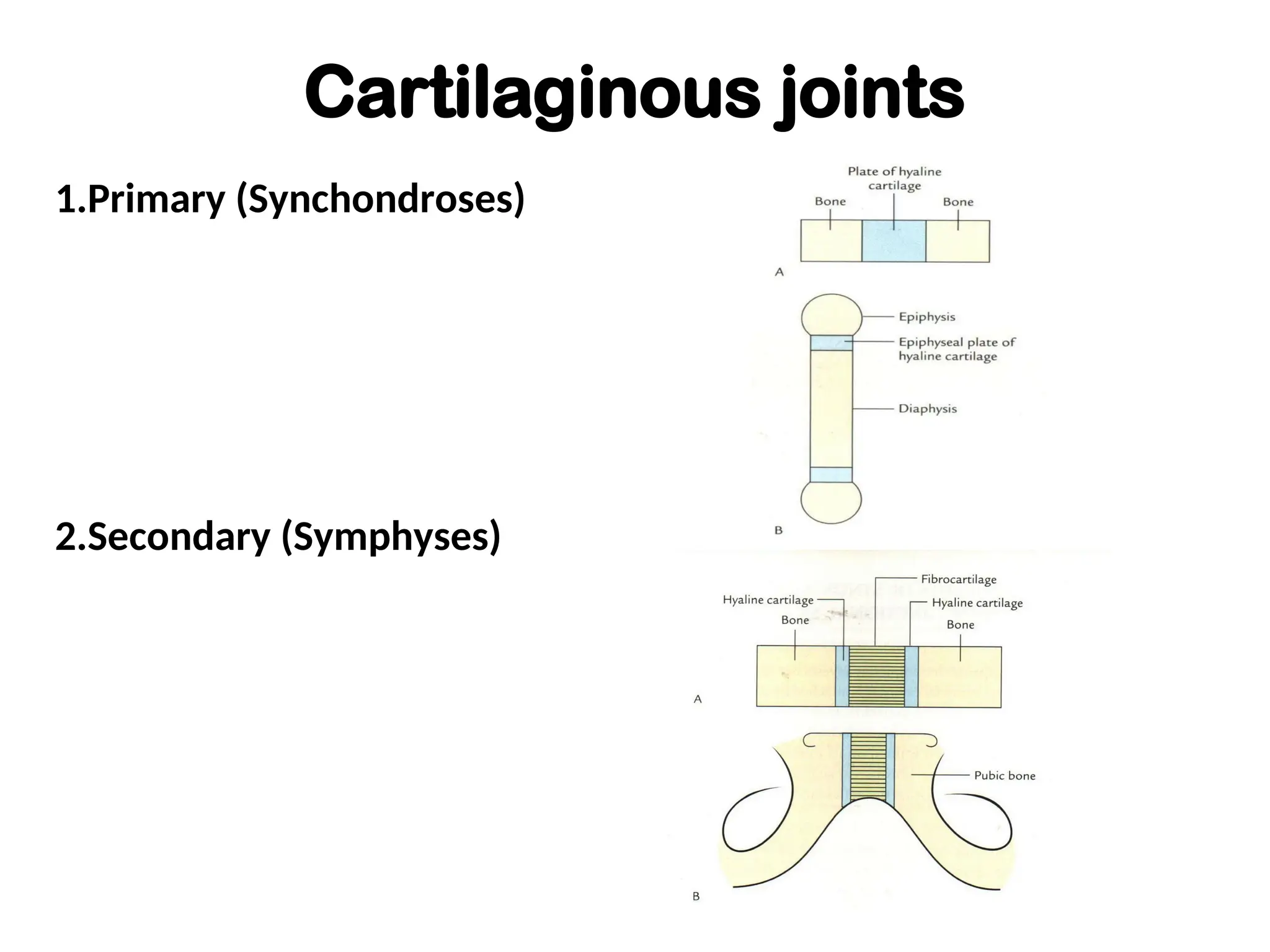
2. Cartilaginous: articulating bones are united by cartilage
(hyaline or fibrocartilage) with no joint cavity.
3. Synovial: articulating bones are separated by a fluid-filled joint
cavity.
Fibrous joints
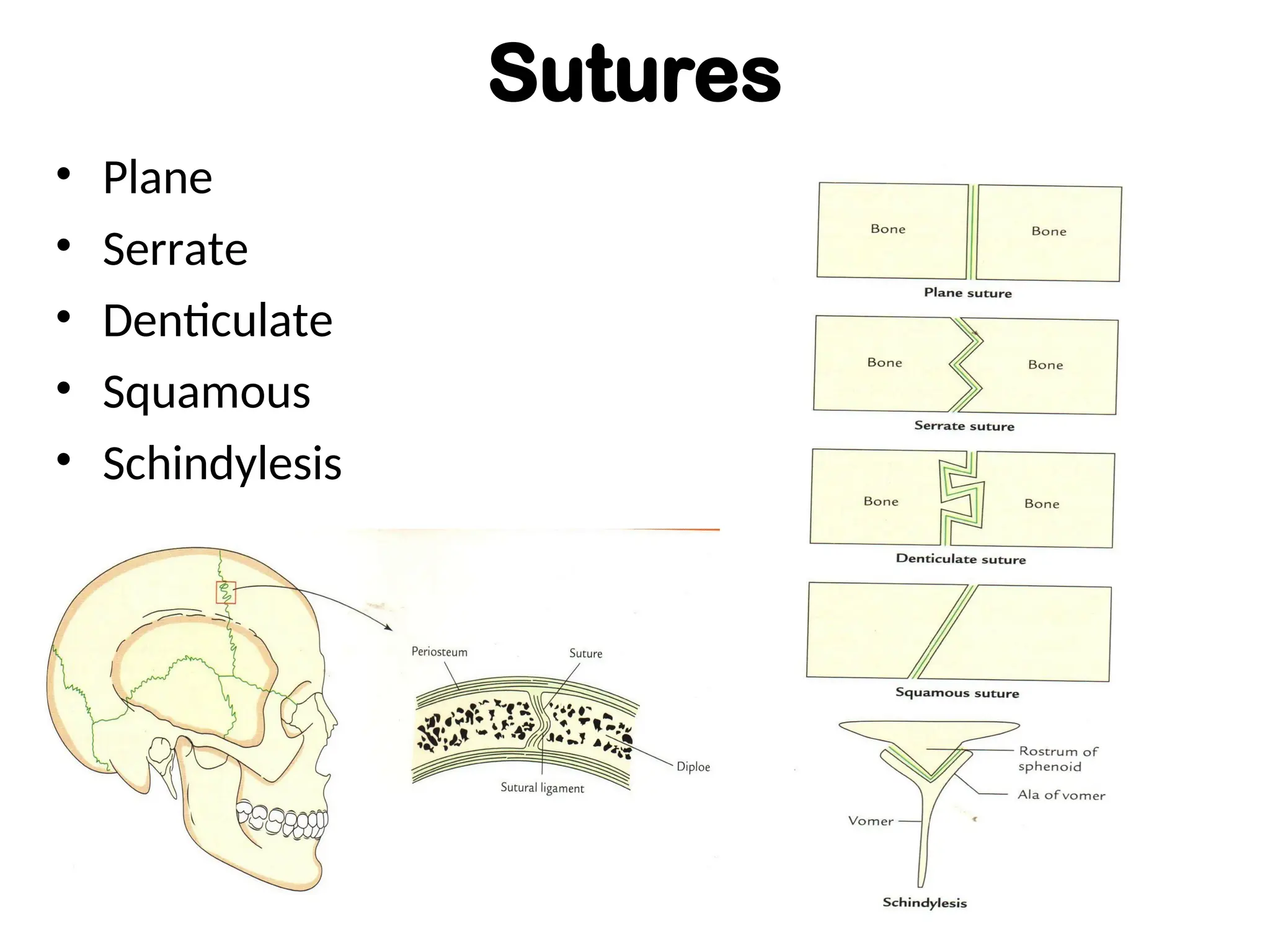
1. Sutures:articular surfaces are connected by a thin layer of
connective tissue. They are confined to the skull and
are immovable.
2. Syndesmoses: bones are connected by a considerably greater
amount of connective tissue than in sutures in
the form of interosseous ligaments and
membranes. Slight movement is permitted.
e.g. interosseous tibiofibular joints,
interroseous radioulnar joints.
3. Gomphoses (peg and socket joint): articulation of teeth in
alveolar sockets of mandible and maxilla by
periodontal ligament.
Synovial joints
• Mostevolved and freely movable joints
• Have a joint cavity filled with synovial fluid
• Often termed as diarthrodial joints
• Components:
1. Fibrous capsule
2. Synovial membrane
3. Ligaments
4. Articular cartilage
5. Articular disc or meniscus
6. Bursae
7. Fat pads (Haversian glands)
12.
Classification of Synovialjoints
(A) According to shape of articular surfaces:
1. Plane
2. Hinge
3. Pivot
4. Condylar
5. Ellipsoid
6. Saddle
7. Ball and socket
13.
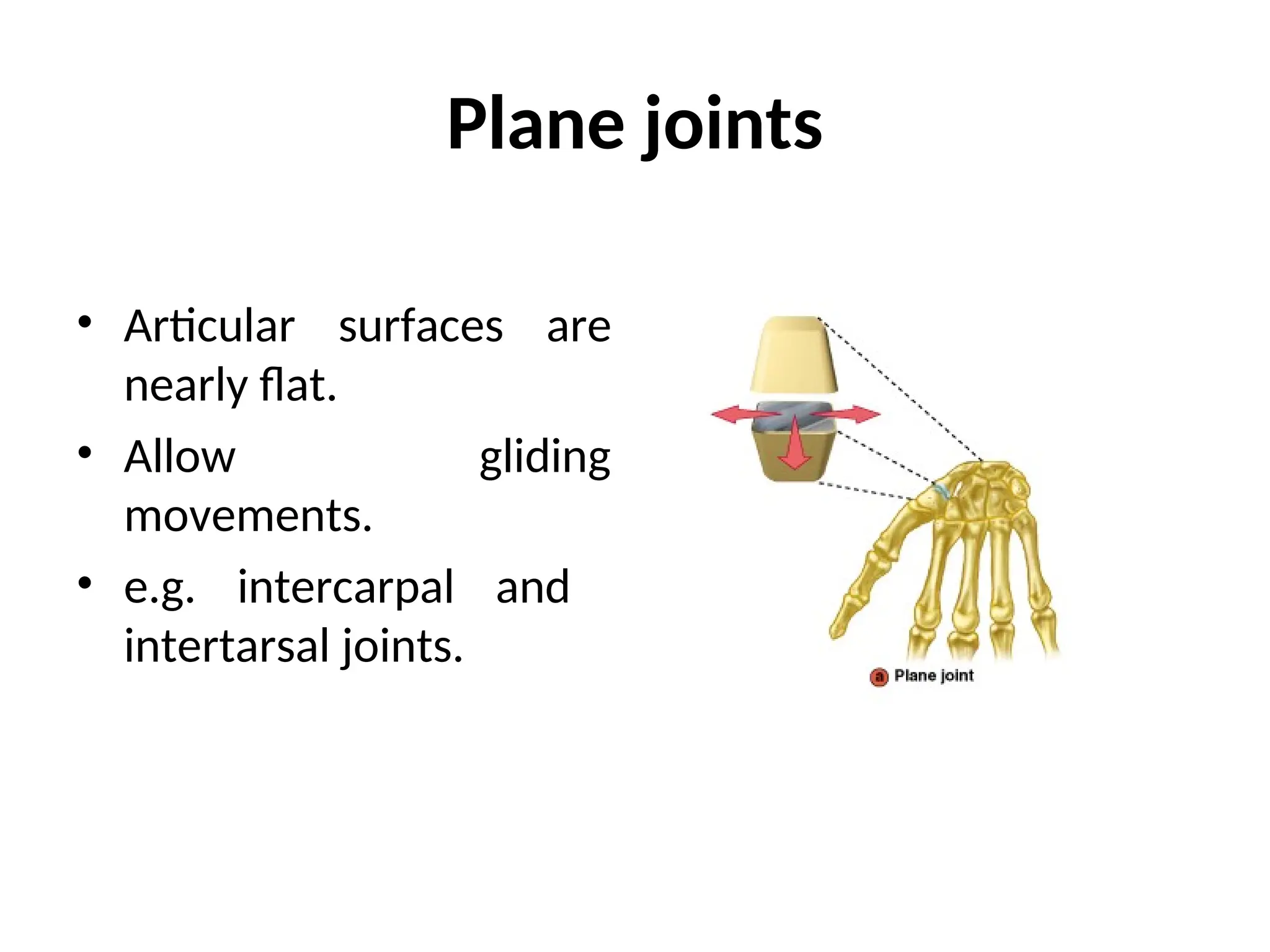
Plane joints
• Articularsurfaces are
nearly flat.
• Allow gliding
movements.
• e.g. intercarpal and
intertarsal joints.
14.
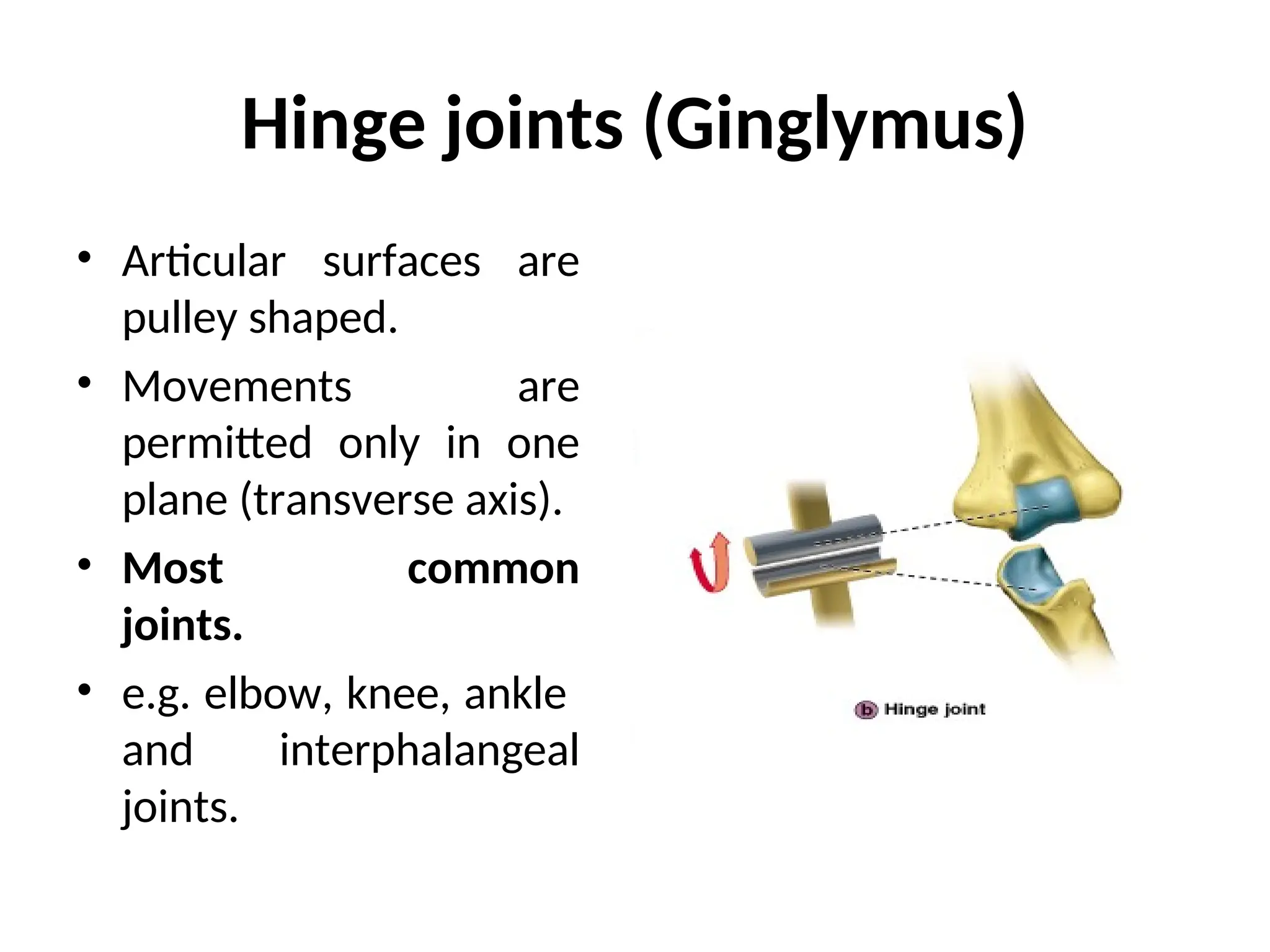
Hinge joints (Ginglymus)
•Articular surfaces are
pulley shaped.
• Movements are
permitted only in one
plane (transverse axis).
• Most common
joints.
• e.g. elbow, knee, ankle
and interphalangeal
joints.
15.
Pivot joints (Trochoidjoints)
• Rounded end of one bone
fits into
the concavity of another
bone.
• The rounded
part is surrounded by a
ligament.
• Limited rotation
around a central axis.
• e.g. superior radio-ulnar and
median atlanto-axial joints.
16.
Condylar joints
• Roundarticular surface
of one bone fits into a
socket-type articular
surface of another bone.
• Permit movements in
two directions.
• e.g. knee and temporo-
mandibular joints.
17.
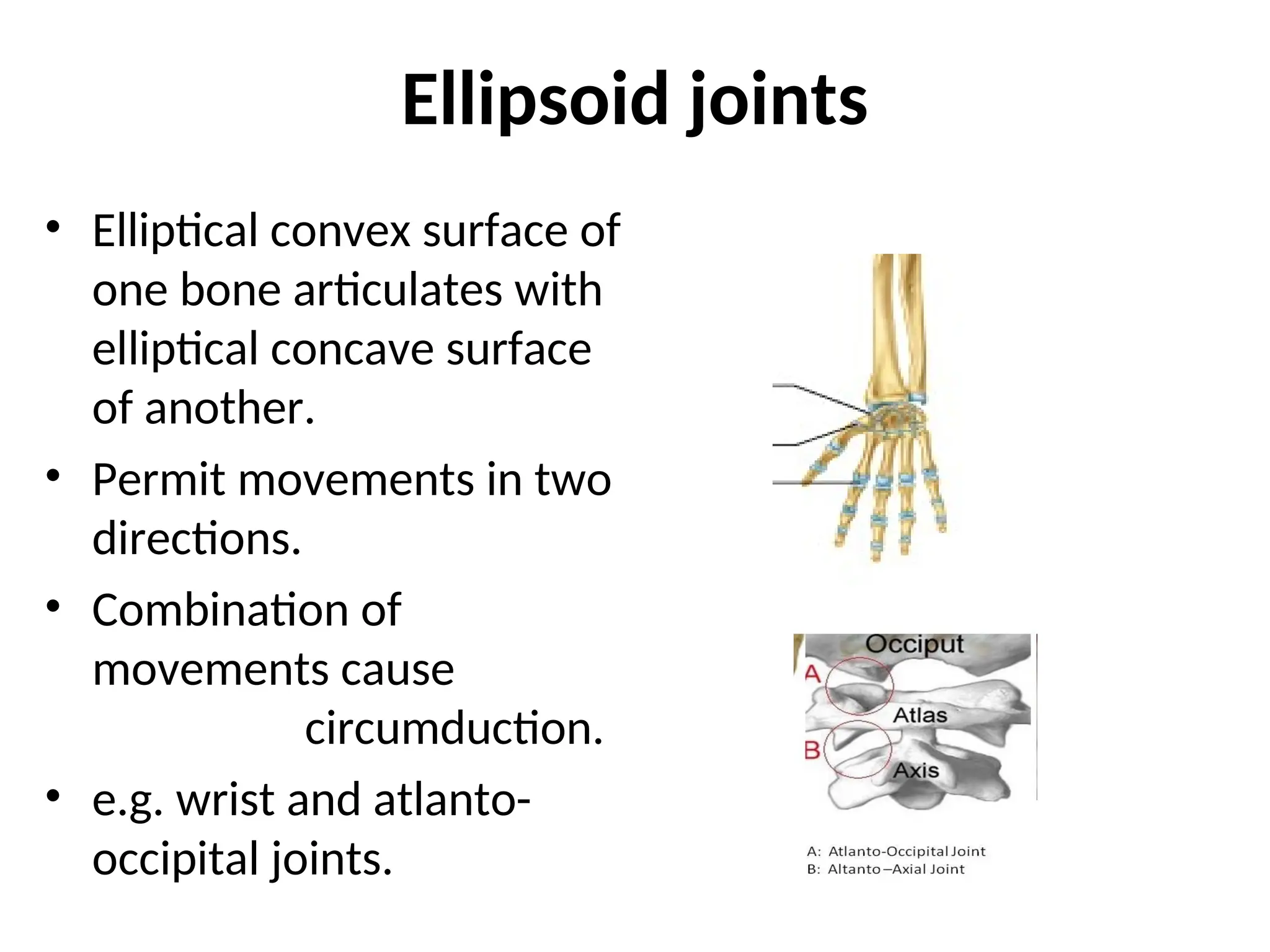
Ellipsoid joints
• Ellipticalconvex surface of
one bone articulates with
elliptical concave surface
of another.
• Permit movements in two
directions.
• Combination of
movements cause
circumduction.
• e.g. wrist and atlanto-
occipital joints.
18.
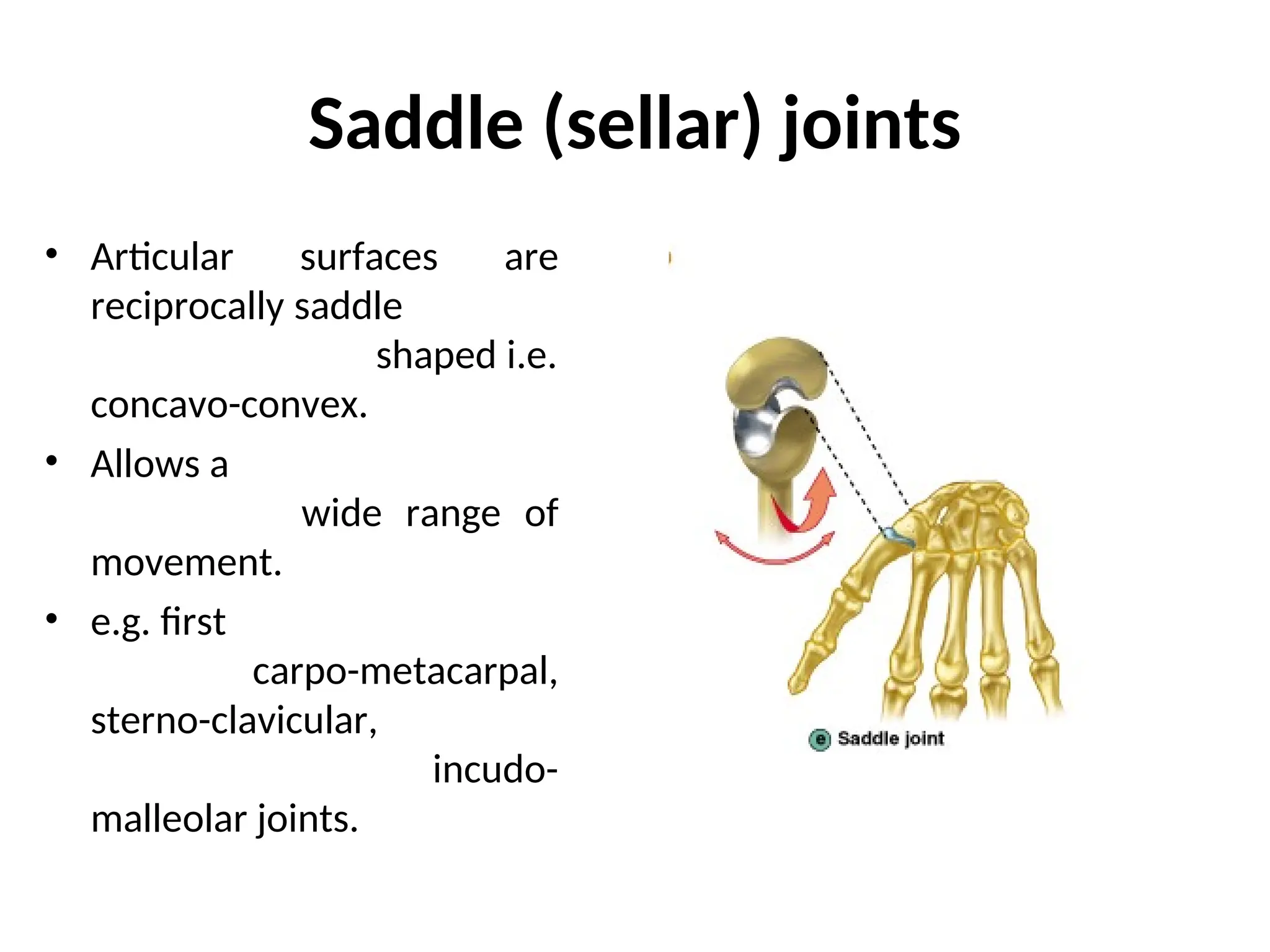
Saddle (sellar) joints
•Articular surfaces are
reciprocally saddle
shaped i.e.
concavo-convex.
• Allows a
wide range of
movement.
• e.g. first
carpo-metacarpal,
sterno-clavicular,
incudo-
malleolar joints.
19.
Ball and socket(spheroidal) joints
• Rounded convex surface
of one bone fits into the
cup-like socket of another
bone.
• Permits greatest range
of
movements.
• e.g. shoulder, hip and
incudo-
stapedial joints.
20.
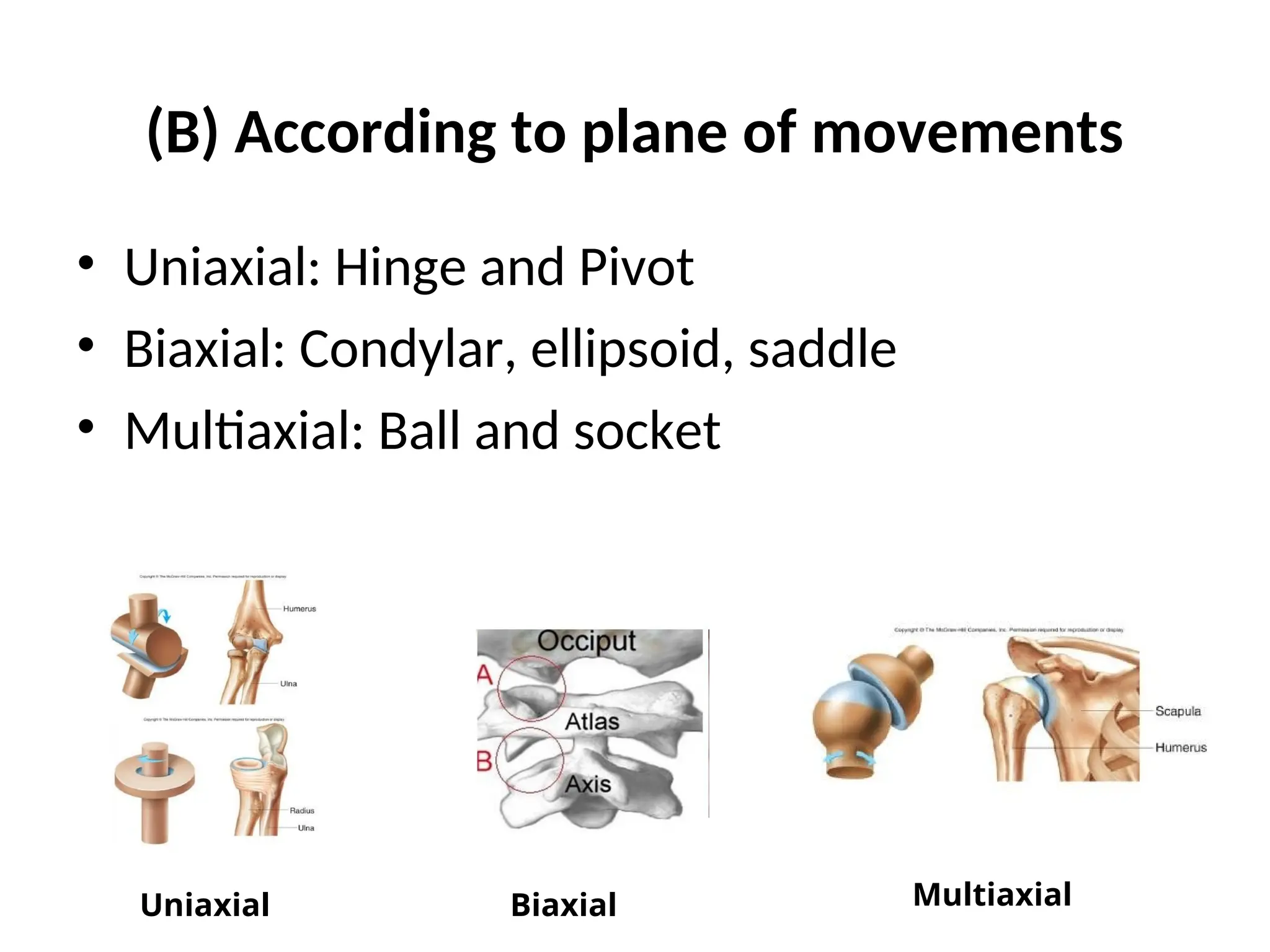
(B) According toplane of movements
• Uniaxial: Hinge and Pivot
• Biaxial: Condylar, ellipsoid, saddle
• Multiaxial: Ball and socket
Uniaxial Biaxial Multiaxial
21.
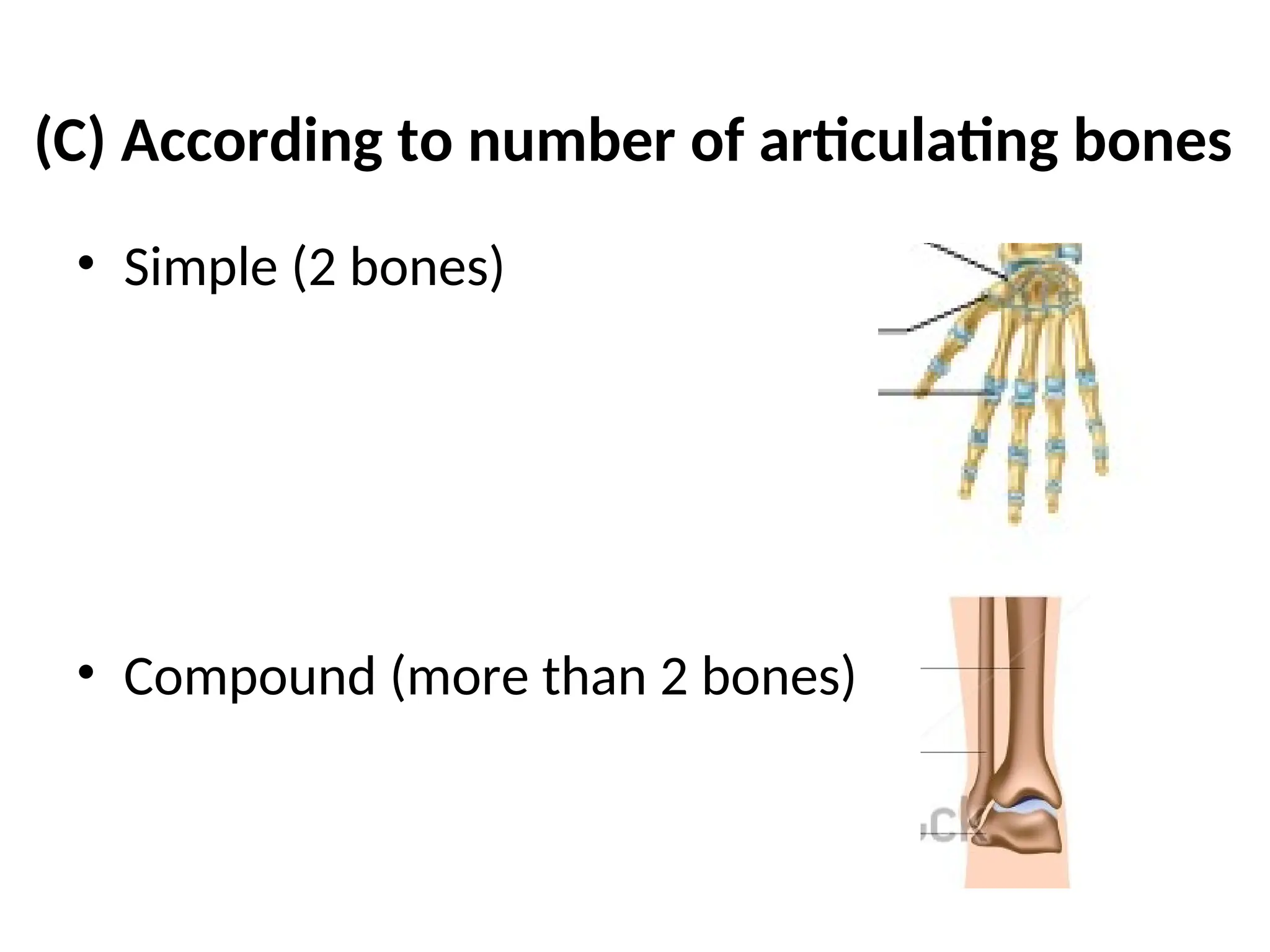
(C) According tonumber of articulating bones
• Simple (2 bones)
• Compound (more than 2 bones)
Special movements:
1. Inversion:movement of the foot medially
2. Eversion: movement of the foot laterally
3. Protraction: movement of the mandible forward
4. Retraction: movement of the protracted part back
to its starting position
5. Elevation: lifting a body part superiorly
6. Depression: moving the elevated part inferiorly
7. Opposition: touching the thumb to the tips of
other fingers
MCQs
1. All ofthe following are examples of the
fibrous joint except:
a) Suture
b) Syndesmosis
c) Symphysis
d) Gomphosis
26.
MCQs
2. All ofthe following are examples of the
synovial joint except:
a) Pivot
b) Saddle
c) Syndesmosis
d)Ellipsoid
27.
MCQs
3. Subtype gomphosisis classified under:
a) Biaxial synovial joint
b) Symphysis
c) Fibrous joint
d) Synchondrosis
28.
MCQs
4. All ofthe following are characteristic features
of a synovial joint except:
a)Articular surfaces are covered by a articular
cartilage
b) Have a joint cavity filled with synovial fluid
c)Mostly are freely movable joints
d) Articular cartilage are covered by synovial
membrane
29.
MCQs
5. All ofthe following secondary cartilaginous
joints belong to axial skeleton except:
a)Manubriosternal joint
b) Intervertebral discs
c) Symphysis pubis
d) Symphysis menti