Joint Movement
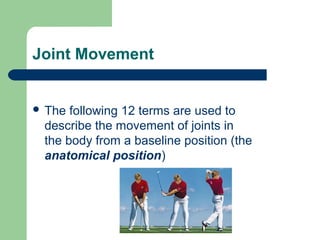
 The following 12 terms are used to
describe the movement of joints in
the body from a baseline position (the
anatomical position)
Joint Movement – Flexion & Extension
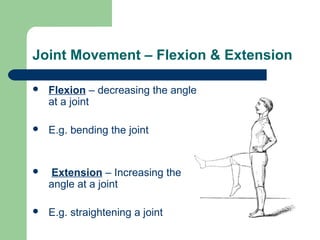
 Flexion – decreasing the angle
at a joint
 E.g. bending the joint
 Extension – Increasing the
angle at a joint
 E.g. straightening a joint
Joint Movement – Abduction &
Adduction
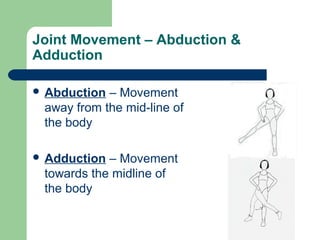
 Abduction – Movement
away from the mid-line of
the body
 Adduction – Movement
towards the midline of
the body
Joint Movement – Rotation &
Circumduction
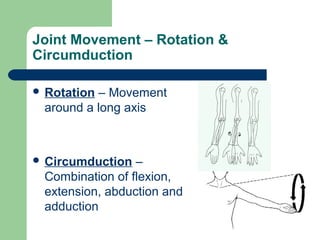
 Rotation – Movement
around a long axis
 Circumduction –
Combination of flexion,
extension, abduction and
adduction
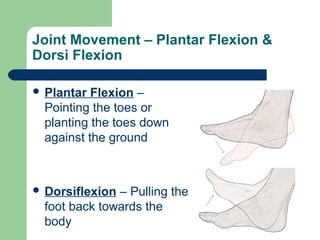
Joint Movement – Plantar Flexion &
Dorsi Flexion
 Plantar Flexion –
Pointing the toes or
planting the toes down
against the ground
 Dorsiflexion – Pulling the
foot back towards the
body
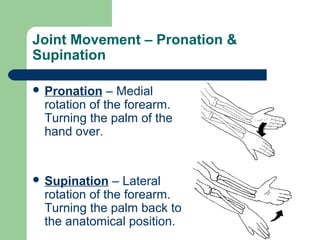
Joint Movement – Pronation &
Supination
 Pronation – Medial
rotation of the forearm.
Turning the palm of the
hand over.
 Supination – Lateral
rotation of the forearm.
Turning the palm back to
the anatomical position.
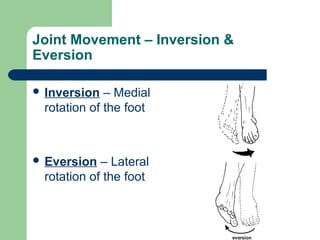
Joint Movement – Inversion &
Eversion
 Inversion – Medial
rotation of the foot
 Eversion – Lateral
rotation of the foot

Joint movement

  • 1.
    Joint Movement  Thefollowing 12 terms are used to describe the movement of joints in the body from a baseline position (the anatomical position)
  • 2.
    Joint Movement –Flexion & Extension  Flexion – decreasing the angle at a joint  E.g. bending the joint  Extension – Increasing the angle at a joint  E.g. straightening a joint
  • 3.
    Joint Movement –Abduction & Adduction  Abduction – Movement away from the mid-line of the body  Adduction – Movement towards the midline of the body
  • 4.
    Joint Movement –Rotation & Circumduction  Rotation – Movement around a long axis  Circumduction – Combination of flexion, extension, abduction and adduction
  • 5.
    Joint Movement –Plantar Flexion & Dorsi Flexion  Plantar Flexion – Pointing the toes or planting the toes down against the ground  Dorsiflexion – Pulling the foot back towards the body
  • 6.
    Joint Movement –Pronation & Supination  Pronation – Medial rotation of the forearm. Turning the palm of the hand over.  Supination – Lateral rotation of the forearm. Turning the palm back to the anatomical position.
  • 7.
    Joint Movement –Inversion & Eversion  Inversion – Medial rotation of the foot  Eversion – Lateral rotation of the foot