Bone Movements
All the appendicular bones move at
the joints. They normally serve as levers to
allow body movements like pulling and
lifting of loads.
Most of these bones can make a
variety of movements like rotate, up-and-
down, bend and stretch , close and open,
and sway.
Some parts of the bones like fingers
and toes can only make close and open
motions. The kind of movement bones can do
depends on the kind of joint.
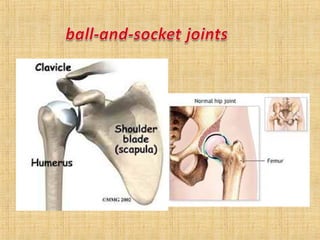
The hip and shoulder can move freely
because they have ball-and-socket joints. The
arms of the body can move more freely than
legs. That is because the shoulder blade is
only loosely attached to the chest wall.
At the hip, a number of ligaments circle
the bones like a collar to keep the joint in
place.
Bone Joints
Bones are hard and stiff, yet they
move in different ways.
A joint is the point or part where two
or more bones connect. There are two
kinds of joints: immovable or fixed joint
and movable joint.
1.Fixed joints
In an immovable joint, the bones are
tightly held together such that they
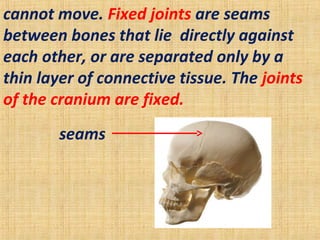
cannot move. Fixed joints are seams
between bones that lie directly against
each other, or are separated only by a
thin layer of connective tissue. The joints
of the cranium are fixed.
seams
2. Movable Joints
Movable joints allow bones to move.
There are three kinds of movable
joints: hinge joint, ball-and-socket
joint, and pivot joint.
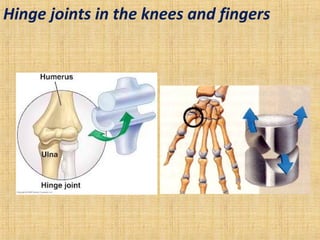
a. A hinge joint allows forward and
backward movements in only one
plane. It allows “bending and
straightening” or “close and open”
movements only. Knees, fingers and
toes have hinge joints.
Hinge joints in the knees and fingers
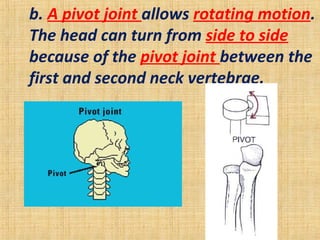
b. A pivot joint allows rotating motion.
The head can turn from side to side
because of the pivot joint between the
first and second neck vertebrae.
You can rotate your forearm, sole, and
hand because of pivot joint. The
elbow, ankle, and wrist have both
pivot and hinge joints.
c. A ball-and-socket joint allows the
greatest freedom of movement. It
allows various movements such as
twisting, rotation and the up-and-
down movement. Joints in the pelvis
and shoulders are ball-and-socket.
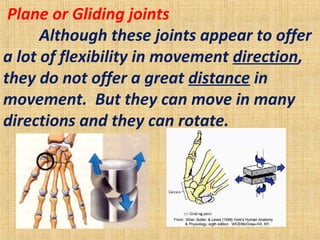
 Plane or Gliding joints
 Although these joints appear to offer 
a lot of flexibility in movement direction, 
they do not offer a great distance in 
movement.  But they can move in many 
directions and they can rotate.

Bone movements

  • 1.
    Bone Movements All theappendicular bones move at the joints. They normally serve as levers to allow body movements like pulling and lifting of loads. Most of these bones can make a variety of movements like rotate, up-and- down, bend and stretch , close and open, and sway. Some parts of the bones like fingers
  • 2.
    and toes canonly make close and open motions. The kind of movement bones can do depends on the kind of joint. The hip and shoulder can move freely because they have ball-and-socket joints. The arms of the body can move more freely than legs. That is because the shoulder blade is only loosely attached to the chest wall. At the hip, a number of ligaments circle the bones like a collar to keep the joint in place.
  • 3.
    Bone Joints Bones arehard and stiff, yet they move in different ways. A joint is the point or part where two or more bones connect. There are two kinds of joints: immovable or fixed joint and movable joint. 1.Fixed joints In an immovable joint, the bones are tightly held together such that they
  • 4.
    cannot move. Fixedjoints are seams between bones that lie directly against each other, or are separated only by a thin layer of connective tissue. The joints of the cranium are fixed. seams
  • 5.
    2. Movable Joints Movablejoints allow bones to move. There are three kinds of movable joints: hinge joint, ball-and-socket joint, and pivot joint. a. A hinge joint allows forward and backward movements in only one plane. It allows “bending and straightening” or “close and open” movements only. Knees, fingers and toes have hinge joints.
  • 6.
    Hinge joints inthe knees and fingers
  • 7.
    b. A pivotjoint allows rotating motion. The head can turn from side to side because of the pivot joint between the first and second neck vertebrae.
  • 8.
    You can rotateyour forearm, sole, and hand because of pivot joint. The elbow, ankle, and wrist have both pivot and hinge joints. c. A ball-and-socket joint allows the greatest freedom of movement. It allows various movements such as twisting, rotation and the up-and- down movement. Joints in the pelvis and shoulders are ball-and-socket.
  • 10.