joints
Miss. Sheetal Patil M. Pharm
Rani Chennamma College Of Pharmacy,
Belagavi
 Joint
 Joint also called an articulation or arthrosis is a point of contact between two
bones.
 Arthrology is the science of studying joints.
 Joint is a junction between two or more bones or cartilages.
 It is a device to permit movement.
 With the exception of the hyoid bone, every bone in the body is connected to
or forms a joint.
 There are 230 joints in the body.
 Joint Functions
1. Hold the skeletal bones together
2. Allow the skeleton some flexibility so gross movement can occur
3. Make bone growth possible
 Functional classification
 Functionally joints are classified depending upon the degree of movements they
permit
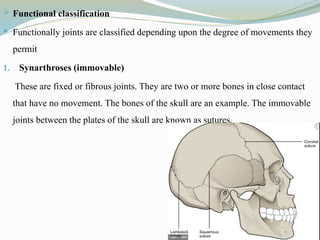
1. Synarthroses (immovable)
These are fixed or fibrous joints. They are two or more bones in close contact
that have no movement. The bones of the skull are an example. The immovable
joints between the plates of the skull are known as sutures.
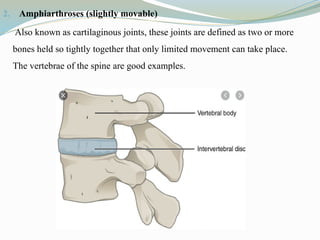
2. Amphiarthroses (slightly movable)
Also known as cartilaginous joints, these joints are defined as two or more
bones held so tightly together that only limited movement can take place.
The vertebrae of the spine are good examples.
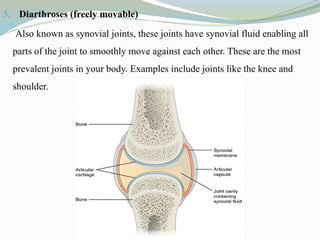
3. Diarthroses (freely movable)
Also known as synovial joints, these joints have synovial fluid enabling all
parts of the joint to smoothly move against each other. These are the most
prevalent joints in your body. Examples include joints like the knee and
shoulder.
 Structural Classification
Joints can be classified by the type of the tissue present (fibrous,
cartilaginous or synovial) and the presence of synovial cavity. They are
classified as:
1. Fibrous joints
2. Cartilaginous joints
3. Synovial joints
1. Fibrous Joints
 Fibrous joints are connected by dense, tough connective tissue that is rich in
collagen fibers.
 These are fixed or immovable joints.
 They lack synovial cavity.
 There are three types of fibrous joints.
a. Sutures
b. Syndesmoses
c. Gomphosis
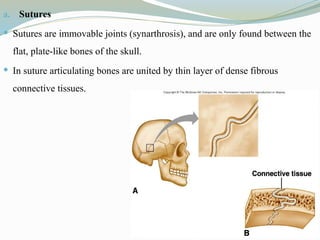
a. Sutures
 Sutures are immovable joints (synarthrosis), and are only found between the
flat, plate-like bones of the skull.
 In suture articulating bones are united by thin layer of dense fibrous
connective tissues.
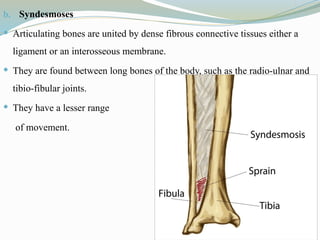
b. Syndesmoses
 Articulating bones are united by dense fibrous connective tissues either a
ligament or an interosseous membrane.
 They are found between long bones of the body, such as the radio-ulnar and
tibio-fibular joints.
 They have a lesser range
of movement.
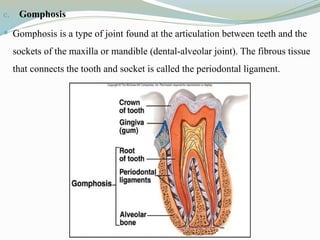
c. Gomphosis
 Gomphosis is a type of joint found at the articulation between teeth and the
sockets of the maxilla or mandible (dental-alveolar joint). The fibrous tissue
that connects the tooth and socket is called the periodontal ligament.
2. Cartilaginous joints
 They lack synovial cavity.
 In cartilaginous joint, the bones are united by fibrocartilage or hyaline
cartilage.
 There are two main types
a. Synchondroses
b. Symphyses
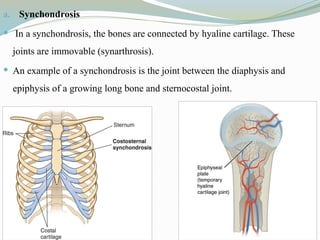
a. Synchondrosis
 In a synchondrosis, the bones are connected by hyaline cartilage. These
joints are immovable (synarthrosis).
 An example of a synchondrosis is the joint between the diaphysis and
epiphysis of a growing long bone and sternocostal joint.
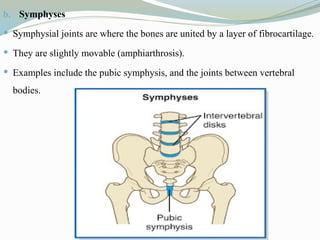
b. Symphyses
 Symphysial joints are where the bones are united by a layer of fibrocartilage.
 They are slightly movable (amphiarthrosis).
 Examples include the pubic symphysis, and the joints between vertebral
bodies.
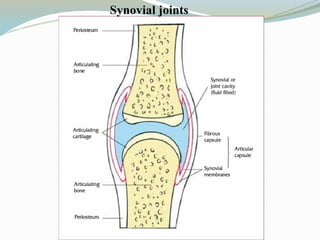
3. Synovial joints
 Synovial joints contains space between bones called the synovial cavity.
 They are freely movable (diarthrosis).
 Other characteristics of synovial joints are presence of articular cartilage and
articular capsule a fibrous connective tissue structure that is attached to each
bone just outside the area of the bone’s articulating surface (periosteum).
 Articular capsule consists of two layers the outer fibrous membrane and the
inner synovial membrane.
Synovial joints
 Outer fibrous membrane (dense irregular connective tissue).
 Provides flexibility, permit movement at a joint.
 Inner synovial membrane (areolar connective tissue)
 The cells of this membrane secrete synovial fluid a thick, slimy fluid that provides
lubrication to reduce friction between the bones of the joint.
• Outside of their articulating surfaces, the bones are connected together by
ligaments, which are strong bands of fibrous connective tissue. These
strengthen and support the joint.
 Synovial fluid
 Synovial fluid supplies oxygen and nutrients and removes carbon dioxide
and metabolic wastes from the chondrocytes in the surrounding cartilage.
 Synovial fluid lubricates the articulating joints and reduces friction between
the bones.
 Classification Of Synovial Joints
 Classification of joints is based on the type and degree of movement
permitted and depending on the shape of their articular surfaces.
 The six types of synovial joints are:
i. Planar joint
ii. Hinge joint
iii. Pivot joint
iv. Condyloid joint
v. Saddle joint
vi. Ball-and socket-joints
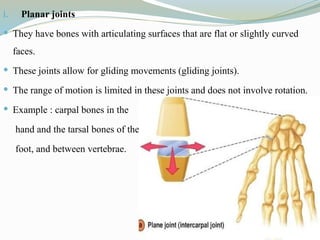
i. Planar joints
 They have bones with articulating surfaces that are flat or slightly curved
faces.
 These joints allow for gliding movements (gliding joints).
 The range of motion is limited in these joints and does not involve rotation.
 Example : carpal bones in the
hand and the tarsal bones of the
foot, and between vertebrae.
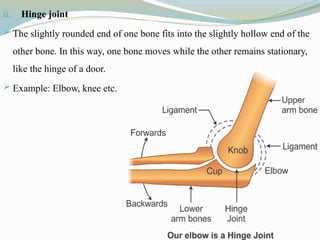
ii. Hinge joint
 The slightly rounded end of one bone fits into the slightly hollow end of the
other bone. In this way, one bone moves while the other remains stationary,
like the hinge of a door.
 Example: Elbow, knee etc.
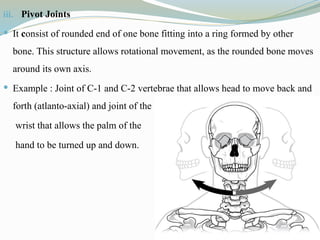
iii. Pivot Joints
 It consist of rounded end of one bone fitting into a ring formed by other
bone. This structure allows rotational movement, as the rounded bone moves
around its own axis.
 Example : Joint of C-1 and C-2 vertebrae that allows head to move back and
forth (atlanto-axial) and joint of the
wrist that allows the palm of the
hand to be turned up and down.
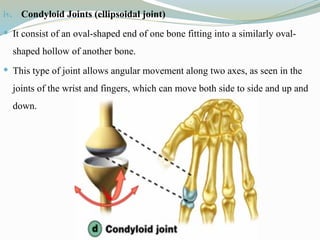
iv. Condyloid Joints (ellipsoidal joint)
 It consist of an oval-shaped end of one bone fitting into a similarly oval-
shaped hollow of another bone.
 This type of joint allows angular movement along two axes, as seen in the
joints of the wrist and fingers, which can move both side to side and up and
down.
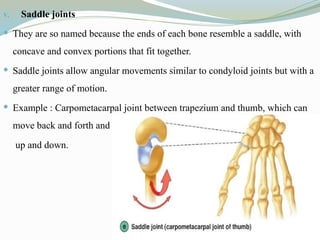
v. Saddle joints
 They are so named because the ends of each bone resemble a saddle, with
concave and convex portions that fit together.
 Saddle joints allow angular movements similar to condyloid joints but with a
greater range of motion.
 Example : Carpometacarpal joint between trapezium and thumb, which can
move back and forth and
up and down.
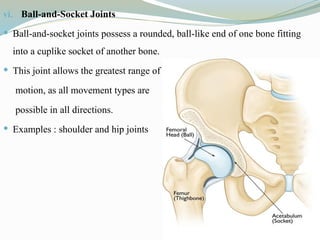
vi. Ball-and-Socket Joints
 Ball-and-socket joints possess a rounded, ball-like end of one bone fitting
into a cuplike socket of another bone.
 This joint allows the greatest range of
motion, as all movement types are
possible in all directions.
 Examples : shoulder and hip joints
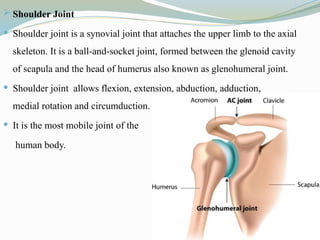
 Shoulder Joint
 Shoulder joint is a synovial joint that attaches the upper limb to the axial
skeleton. It is a ball-and-socket joint, formed between the glenoid cavity
of scapula and the head of humerus also known as glenohumeral joint.
 Shoulder joint allows flexion, extension, abduction, adduction,
medial rotation and circumduction.
 It is the most mobile joint of the
human body.
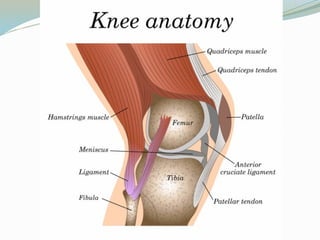
 Knee Joint
 The knee is one of the largest and most complex joints in the body.
 The knee joint is a hinge type synovial joint.
 It is formed by articulations between the patella, femur and tibia.
 Tendons connect the knee bones to the leg muscles that move the knee
joint. Ligaments join the knee bones and provide stability to the knee.
 It is a complex hinge joint composed of two articulations; the tibiofemoral
joint and patellofemoral joint.
 The tibiofemoral joint : Is an articulation between the tibia and the femur.
 The patellofemoral joint : Is an articulation between the patella and the
femur.
 Movement: Flexion, extension, slight medial rotation and lateral rotation of leg.
Movements Allowed By Synovial Joints
 Three basic types of movement are:
1. Gliding – One bone across the surface of another
2. Angular movement – Movements change the angle between bones
a) Flexion
b) Extension
c) Abduction
d) Adduction
3. Rotation – Movement around a bone's long axis
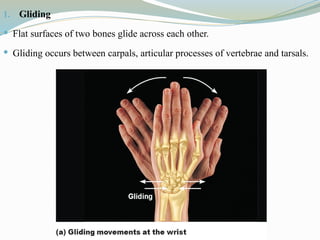
1. Gliding
 Flat surfaces of two bones glide across each other.
 Gliding occurs between carpals, articular processes of vertebrae and tarsals.
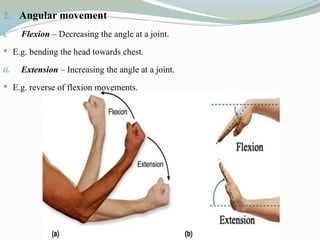
2. Angular movement
i. Flexion – Decreasing the angle at a joint.
 E.g. bending the head towards chest.
ii. Extension – Increasing the angle at a joint.
 E.g. reverse of flexion movements.
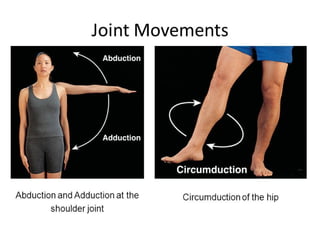
iii. Abduction – Movement away from the mid-line of the body.
 E.g. moving femur laterally at the hip joint.
iv. Adduction – Movement towards the midline of the body.
 E.g. reverse of abduction movements.
v. Circumduction – Combination of flexion, extension, abduction and
adduction.
 E.g. moving the hand in a circle at a wrist joint.
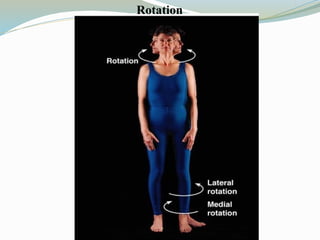
3. Rotation
 Turning of a bone around its own long axis.
 e.g. turning the head from side to side at the atlanto-axial joint (between C-1
& C-2 vertebrae), hip & shoulder joints.
Rotation
Disorders Of Joints
 A joint is where two or more bones come together, like the knee, hip, elbow,
or shoulder. Joints can be damaged by many types of injuries or diseases,
including arthritis, dislocations, gout etc.
 Arthritis
 Arthritis is the swelling and tenderness of one or more of joints. The main
symptoms of arthritis are joint pain and stiffness, which typically worsen
with age. The most common types of arthritis are osteoarthritis and
rheumatoid arthritis.
 Rheumatoid Arthritis
 A chronic inflammatory disorder affecting many joints, including those in the
hands and feet.
 It causes inflammation, swelling, and pain in and around the joints and other
body organs.
 Osteoarthritis (OA)
 It is a degenerative joint disease. It occurs when the cartilage between bones
disintegrates. Cartilage cushions your bones from rubbing together. As the
cartilage disintegrates, it can cause pain, stiffness, and swelling.
 Gout
 A form of arthritis characterised by severe pain, redness and tenderness in
joints.
 Gout is a form of arthritis caused by excess uric acid in the bloodstream. The
symptoms of gout are due to the formation of uric acid crystals in the joints.
Thank You

B. Pharm_I Sem_Unit II_Chapter 3_Joints.pptx

  • 1.
    joints Miss. Sheetal PatilM. Pharm Rani Chennamma College Of Pharmacy, Belagavi
  • 2.
     Joint  Jointalso called an articulation or arthrosis is a point of contact between two bones.  Arthrology is the science of studying joints.  Joint is a junction between two or more bones or cartilages.  It is a device to permit movement.  With the exception of the hyoid bone, every bone in the body is connected to or forms a joint.  There are 230 joints in the body.
  • 3.
     Joint Functions 1.Hold the skeletal bones together 2. Allow the skeleton some flexibility so gross movement can occur 3. Make bone growth possible
  • 4.
     Functional classification Functionally joints are classified depending upon the degree of movements they permit 1. Synarthroses (immovable) These are fixed or fibrous joints. They are two or more bones in close contact that have no movement. The bones of the skull are an example. The immovable joints between the plates of the skull are known as sutures.
  • 5.
    2. Amphiarthroses (slightlymovable) Also known as cartilaginous joints, these joints are defined as two or more bones held so tightly together that only limited movement can take place. The vertebrae of the spine are good examples.
  • 6.
    3. Diarthroses (freelymovable) Also known as synovial joints, these joints have synovial fluid enabling all parts of the joint to smoothly move against each other. These are the most prevalent joints in your body. Examples include joints like the knee and shoulder.
  • 7.
     Structural Classification Jointscan be classified by the type of the tissue present (fibrous, cartilaginous or synovial) and the presence of synovial cavity. They are classified as: 1. Fibrous joints 2. Cartilaginous joints 3. Synovial joints
  • 8.
    1. Fibrous Joints Fibrous joints are connected by dense, tough connective tissue that is rich in collagen fibers.  These are fixed or immovable joints.  They lack synovial cavity.  There are three types of fibrous joints. a. Sutures b. Syndesmoses c. Gomphosis
  • 9.
    a. Sutures  Suturesare immovable joints (synarthrosis), and are only found between the flat, plate-like bones of the skull.  In suture articulating bones are united by thin layer of dense fibrous connective tissues.
  • 10.
    b. Syndesmoses  Articulatingbones are united by dense fibrous connective tissues either a ligament or an interosseous membrane.  They are found between long bones of the body, such as the radio-ulnar and tibio-fibular joints.  They have a lesser range of movement.
  • 11.
    c. Gomphosis  Gomphosisis a type of joint found at the articulation between teeth and the sockets of the maxilla or mandible (dental-alveolar joint). The fibrous tissue that connects the tooth and socket is called the periodontal ligament.
  • 12.
    2. Cartilaginous joints They lack synovial cavity.  In cartilaginous joint, the bones are united by fibrocartilage or hyaline cartilage.  There are two main types a. Synchondroses b. Symphyses
  • 13.
    a. Synchondrosis  Ina synchondrosis, the bones are connected by hyaline cartilage. These joints are immovable (synarthrosis).  An example of a synchondrosis is the joint between the diaphysis and epiphysis of a growing long bone and sternocostal joint.
  • 14.
    b. Symphyses  Symphysialjoints are where the bones are united by a layer of fibrocartilage.  They are slightly movable (amphiarthrosis).  Examples include the pubic symphysis, and the joints between vertebral bodies.
  • 15.
    3. Synovial joints Synovial joints contains space between bones called the synovial cavity.  They are freely movable (diarthrosis).  Other characteristics of synovial joints are presence of articular cartilage and articular capsule a fibrous connective tissue structure that is attached to each bone just outside the area of the bone’s articulating surface (periosteum).  Articular capsule consists of two layers the outer fibrous membrane and the inner synovial membrane.
  • 16.
  • 17.
     Outer fibrousmembrane (dense irregular connective tissue).  Provides flexibility, permit movement at a joint.  Inner synovial membrane (areolar connective tissue)  The cells of this membrane secrete synovial fluid a thick, slimy fluid that provides lubrication to reduce friction between the bones of the joint. • Outside of their articulating surfaces, the bones are connected together by ligaments, which are strong bands of fibrous connective tissue. These strengthen and support the joint.
  • 18.
     Synovial fluid Synovial fluid supplies oxygen and nutrients and removes carbon dioxide and metabolic wastes from the chondrocytes in the surrounding cartilage.  Synovial fluid lubricates the articulating joints and reduces friction between the bones.
  • 19.
     Classification OfSynovial Joints  Classification of joints is based on the type and degree of movement permitted and depending on the shape of their articular surfaces.  The six types of synovial joints are: i. Planar joint ii. Hinge joint iii. Pivot joint iv. Condyloid joint v. Saddle joint vi. Ball-and socket-joints

  • 20.
    i. Planar joints They have bones with articulating surfaces that are flat or slightly curved faces.  These joints allow for gliding movements (gliding joints).  The range of motion is limited in these joints and does not involve rotation.  Example : carpal bones in the hand and the tarsal bones of the foot, and between vertebrae.
  • 21.
    ii. Hinge joint The slightly rounded end of one bone fits into the slightly hollow end of the other bone. In this way, one bone moves while the other remains stationary, like the hinge of a door.  Example: Elbow, knee etc.
  • 22.
    iii. Pivot Joints It consist of rounded end of one bone fitting into a ring formed by other bone. This structure allows rotational movement, as the rounded bone moves around its own axis.  Example : Joint of C-1 and C-2 vertebrae that allows head to move back and forth (atlanto-axial) and joint of the wrist that allows the palm of the hand to be turned up and down.
  • 23.
    iv. Condyloid Joints(ellipsoidal joint)  It consist of an oval-shaped end of one bone fitting into a similarly oval- shaped hollow of another bone.  This type of joint allows angular movement along two axes, as seen in the joints of the wrist and fingers, which can move both side to side and up and down.
  • 24.
    v. Saddle joints They are so named because the ends of each bone resemble a saddle, with concave and convex portions that fit together.  Saddle joints allow angular movements similar to condyloid joints but with a greater range of motion.  Example : Carpometacarpal joint between trapezium and thumb, which can move back and forth and up and down.
  • 25.
    vi. Ball-and-Socket Joints Ball-and-socket joints possess a rounded, ball-like end of one bone fitting into a cuplike socket of another bone.  This joint allows the greatest range of motion, as all movement types are possible in all directions.  Examples : shoulder and hip joints
  • 26.
     Shoulder Joint Shoulder joint is a synovial joint that attaches the upper limb to the axial skeleton. It is a ball-and-socket joint, formed between the glenoid cavity of scapula and the head of humerus also known as glenohumeral joint.  Shoulder joint allows flexion, extension, abduction, adduction, medial rotation and circumduction.  It is the most mobile joint of the human body.
  • 27.
     Knee Joint The knee is one of the largest and most complex joints in the body.  The knee joint is a hinge type synovial joint.  It is formed by articulations between the patella, femur and tibia.  Tendons connect the knee bones to the leg muscles that move the knee joint. Ligaments join the knee bones and provide stability to the knee.  It is a complex hinge joint composed of two articulations; the tibiofemoral joint and patellofemoral joint.  The tibiofemoral joint : Is an articulation between the tibia and the femur.  The patellofemoral joint : Is an articulation between the patella and the femur.  Movement: Flexion, extension, slight medial rotation and lateral rotation of leg.
  • 29.
    Movements Allowed BySynovial Joints  Three basic types of movement are: 1. Gliding – One bone across the surface of another 2. Angular movement – Movements change the angle between bones a) Flexion b) Extension c) Abduction d) Adduction 3. Rotation – Movement around a bone's long axis
  • 30.
    1. Gliding  Flatsurfaces of two bones glide across each other.  Gliding occurs between carpals, articular processes of vertebrae and tarsals.
  • 31.
    2. Angular movement i.Flexion – Decreasing the angle at a joint.  E.g. bending the head towards chest. ii. Extension – Increasing the angle at a joint.  E.g. reverse of flexion movements.
  • 32.
    iii. Abduction –Movement away from the mid-line of the body.  E.g. moving femur laterally at the hip joint. iv. Adduction – Movement towards the midline of the body.  E.g. reverse of abduction movements. v. Circumduction – Combination of flexion, extension, abduction and adduction.  E.g. moving the hand in a circle at a wrist joint.
  • 34.
    3. Rotation  Turningof a bone around its own long axis.  e.g. turning the head from side to side at the atlanto-axial joint (between C-1 & C-2 vertebrae), hip & shoulder joints.
  • 35.
  • 36.
    Disorders Of Joints A joint is where two or more bones come together, like the knee, hip, elbow, or shoulder. Joints can be damaged by many types of injuries or diseases, including arthritis, dislocations, gout etc.
  • 37.
     Arthritis  Arthritisis the swelling and tenderness of one or more of joints. The main symptoms of arthritis are joint pain and stiffness, which typically worsen with age. The most common types of arthritis are osteoarthritis and rheumatoid arthritis.  Rheumatoid Arthritis  A chronic inflammatory disorder affecting many joints, including those in the hands and feet.  It causes inflammation, swelling, and pain in and around the joints and other body organs.
  • 38.
     Osteoarthritis (OA) It is a degenerative joint disease. It occurs when the cartilage between bones disintegrates. Cartilage cushions your bones from rubbing together. As the cartilage disintegrates, it can cause pain, stiffness, and swelling.  Gout  A form of arthritis characterised by severe pain, redness and tenderness in joints.  Gout is a form of arthritis caused by excess uric acid in the bloodstream. The symptoms of gout are due to the formation of uric acid crystals in the joints.
  • 39.