Body Movement - Human
Created by Udipta10
Bones and their function
• Bones are rigid organ that constitute part of
the endoskeleton of vertebrates consist of
calcium.
• They support and protect the various organs
of the body, produce red and white blood
cells and store minerals.
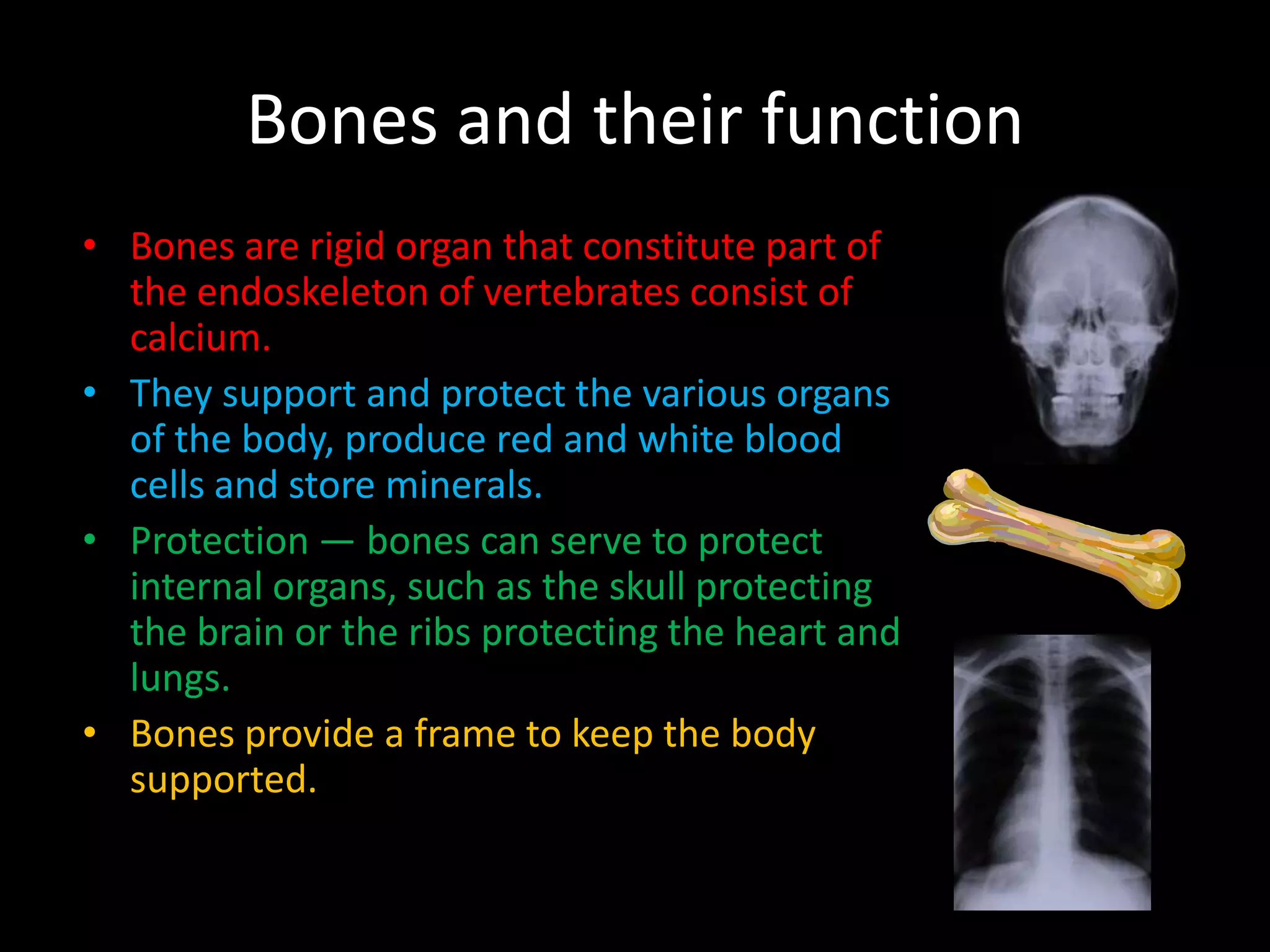
• Protection — bones can serve to protect
internal organs, such as the skull protecting
the brain or the ribs protecting the heart and
lungs.
• Bones provide a frame to keep the body
supported.
Type of Joint
Hinge Joint
Movable Joint

Pivot Joint

Joint
Gliding Joint
Ball & Socket
Joint
Immovable
Joint

Fixed Joint
Ball and Socket Joint
• The ball and socket joint (or spheroidal joint)
is a joint in which the ball-shaped surface of
one rounded bone fits into the cup-like
depression of another bone.
• These are found in the hip, where the
rounded head of the femur (ball) rests in the
cup-like acetabulum (socket) of the pelvis,
and in the glenohumeral joint of the
shoulder, where the rounded head of the
humerus (ball) rests in the cup-like glenoid
fossa (socket) of the shoulder blade.
Hinge Joint
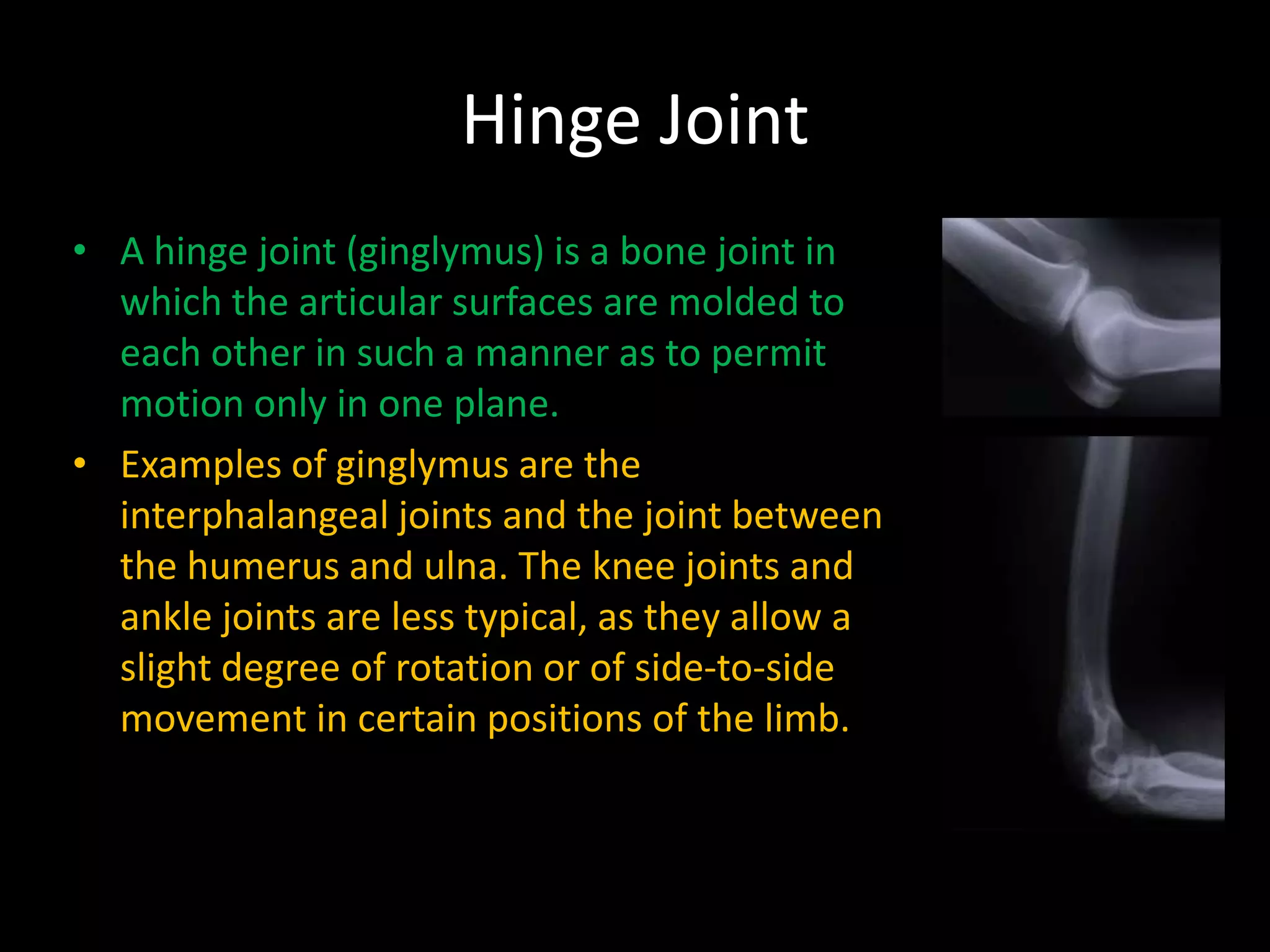
• A hinge joint (ginglymus) is a bone joint in
which the articular surfaces are molded to
each other in such a manner as to permit
motion only in one plane.
• Examples of ginglymus are the
interphalangeal joints and the joint between
the humerus and ulna. The knee joints and
ankle joints are less typical, as they allow a
slight degree of rotation or of side-to-side
movement in certain positions of the limb.
Pivot Joint
• Pivot joints allow for rotation, which can be
external (for example when rotating an arm
outward), or internal (as in rotating an arm
inward). When rotating the forearm, these
movements are typically called pronation and
supination.
• This joint enable us to move our head up,
down, right and left and are present in our
neck.
Gliding Joint
• A plane joint (arthrodial joint, gliding joint,
plane articulation) is a synovial joint which,
under physiological conditions, allows only
gliding movement.
• The opposed surfaces of the bones are flat or
almost flat, with movement limited by their
tight joint capsules.
• Typically, they are found in the wrists and
ankles.
Fixed Joint
• Some joints between bone in our head are
different from those we have dicussed as it
doesn’t move.
• Fixed bones are only found in our upper jaw
and skull and our teeth
Question Answer
Q.1. What are the function of human body?
A- The function of human body are :1. They give us frame to our human body
2. They protect some of the important organ in our body.
3. They help us to move our body
4. They produce RBC, WBC and store phosphorus and
calcium.
Q.2. What are cartilage?
A- Cartilage are part of skeletal system that are not as hard as
bone that can be bent easily and are found in pinnae , nose
top and between joint and bones.
Q.3. Why joints can’t move without muscle?
A- It is so because muscle work in pair for example when we
close our elbow our biceps contracts and triceps rest and
when we open our elbow triceps contracts and biceps rest
which enable the joint in our elbows can move easily.
Q.4. Why bone marrows are important for us?
A- Bone marrows are flexible and soft substance present in
our bone that produce Red Blood Cell (RBC) and White
Blood Cell (WBC) which act as a anti body in our blood.
Q.5. Why adult have less bones than babies?
A- It is so because the bone of babies are not joined together
at the birth so they have 300 bones but adult have many
bones joined together by joints so they have 206 bones.
Q.6. What is the difference between endoskeleton and
exoskeleton?
A- Endoskeleton are skeleton that are found inside the body
e.g. Skull in human and exoskeleton are skeleton that are
found outside the body e.g. Shell of snail.
Q.7. What are the difference between ligament and tendon?
A- Ligament are thread – like structure that joins two bones
together and tendon are thread – like structure that joins
muscles with bones for better body movement
Q.8. What is the difference cartilage and bone?
A- Bone can be bent easily and are not brittle but bones can
not be bent easily and are brittle.
The End

Body movement - human

  • 1.
    Body Movement -Human Created by Udipta10
  • 2.
    Bones and theirfunction • Bones are rigid organ that constitute part of the endoskeleton of vertebrates consist of calcium. • They support and protect the various organs of the body, produce red and white blood cells and store minerals. • Protection — bones can serve to protect internal organs, such as the skull protecting the brain or the ribs protecting the heart and lungs. • Bones provide a frame to keep the body supported.
  • 3.
    Type of Joint HingeJoint Movable Joint Pivot Joint Joint Gliding Joint Ball & Socket Joint Immovable Joint Fixed Joint
  • 4.
    Ball and SocketJoint • The ball and socket joint (or spheroidal joint) is a joint in which the ball-shaped surface of one rounded bone fits into the cup-like depression of another bone. • These are found in the hip, where the rounded head of the femur (ball) rests in the cup-like acetabulum (socket) of the pelvis, and in the glenohumeral joint of the shoulder, where the rounded head of the humerus (ball) rests in the cup-like glenoid fossa (socket) of the shoulder blade.
  • 5.
    Hinge Joint • Ahinge joint (ginglymus) is a bone joint in which the articular surfaces are molded to each other in such a manner as to permit motion only in one plane. • Examples of ginglymus are the interphalangeal joints and the joint between the humerus and ulna. The knee joints and ankle joints are less typical, as they allow a slight degree of rotation or of side-to-side movement in certain positions of the limb.
  • 6.
    Pivot Joint • Pivotjoints allow for rotation, which can be external (for example when rotating an arm outward), or internal (as in rotating an arm inward). When rotating the forearm, these movements are typically called pronation and supination. • This joint enable us to move our head up, down, right and left and are present in our neck.
  • 7.
    Gliding Joint • Aplane joint (arthrodial joint, gliding joint, plane articulation) is a synovial joint which, under physiological conditions, allows only gliding movement. • The opposed surfaces of the bones are flat or almost flat, with movement limited by their tight joint capsules. • Typically, they are found in the wrists and ankles.
  • 8.
    Fixed Joint • Somejoints between bone in our head are different from those we have dicussed as it doesn’t move. • Fixed bones are only found in our upper jaw and skull and our teeth
  • 9.
    Question Answer Q.1. Whatare the function of human body? A- The function of human body are :1. They give us frame to our human body 2. They protect some of the important organ in our body. 3. They help us to move our body 4. They produce RBC, WBC and store phosphorus and calcium. Q.2. What are cartilage? A- Cartilage are part of skeletal system that are not as hard as bone that can be bent easily and are found in pinnae , nose top and between joint and bones.
  • 10.
    Q.3. Why jointscan’t move without muscle? A- It is so because muscle work in pair for example when we close our elbow our biceps contracts and triceps rest and when we open our elbow triceps contracts and biceps rest which enable the joint in our elbows can move easily. Q.4. Why bone marrows are important for us? A- Bone marrows are flexible and soft substance present in our bone that produce Red Blood Cell (RBC) and White Blood Cell (WBC) which act as a anti body in our blood.
  • 11.
    Q.5. Why adulthave less bones than babies? A- It is so because the bone of babies are not joined together at the birth so they have 300 bones but adult have many bones joined together by joints so they have 206 bones. Q.6. What is the difference between endoskeleton and exoskeleton? A- Endoskeleton are skeleton that are found inside the body e.g. Skull in human and exoskeleton are skeleton that are found outside the body e.g. Shell of snail.
  • 12.
    Q.7. What arethe difference between ligament and tendon? A- Ligament are thread – like structure that joins two bones together and tendon are thread – like structure that joins muscles with bones for better body movement Q.8. What is the difference cartilage and bone? A- Bone can be bent easily and are not brittle but bones can not be bent easily and are brittle.
  • 13.