Announcements


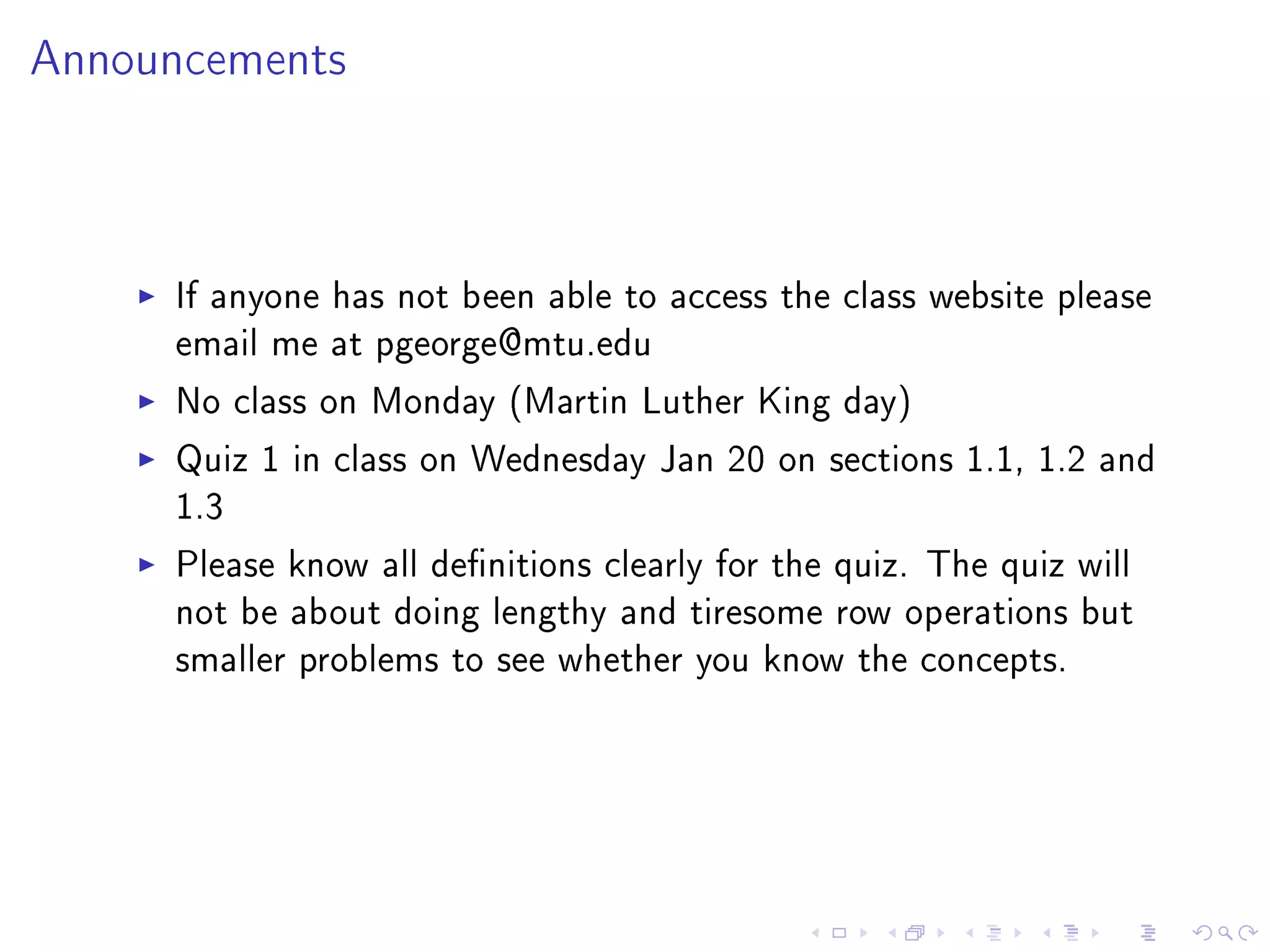
     If anyone has not been able to access the class website please
     email me at pgeorge@mtu.edu
     No class on Monday (Martin Luther King day)
     Quiz 1 in class on Wednesday Jan 20 on sections 1.1, 1.2 and
     1.3
     Please know all denitions clearly for the quiz. The quiz will
     not be about doing lengthy and tiresome row operations but
     smaller problems to see whether you know the concepts.
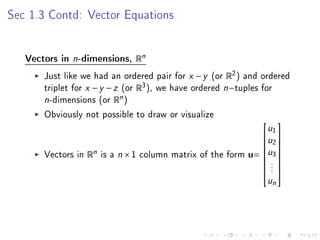
Sec 1.3 Contd: Vector Equations


   Vectors in   n-dimensions, Rn
       Just like we had an ordered pair for x − y (or R2 ) and ordered
       triplet for x − y − z (or R3 ), we have ordered n−tuples for
       n-dimensions (or Rn )
       Obviously not possible to draw or visualize
                                                              u1 
                                                              
                                                             u 
                                                              2
       Vectors in Rn is a n × 1 column matrix of the form u= u3 
                                                              
                                                              .
                                                              .
                                                              
                                                               .
                                                                un
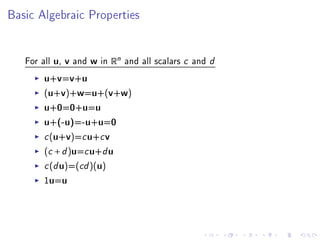
Basic Algebraic Properties


   For all u, v and w in Rn and all scalars   c and d
       u+v=v+u
       (u+v)+w=u+(v+w)
       u+0=0+u=u
       u+(-u)=-u+u=0
       c (u+v)=c u+c v
       (c + d )u=c u+d u
       c (d u)=(cd )(u)
       1u=u
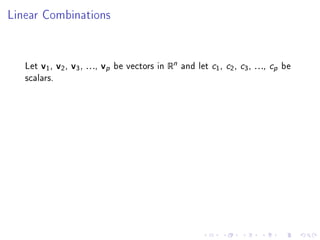
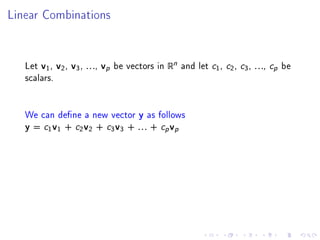
Linear Combinations


   Let v1 , v2 , v3 , . . ., vp be vectors in Rn and let   c1, c2, c3, . . ., cp be
   scalars.
Linear Combinations


   Let v1 , v2 , v3 , . . ., vp be vectors in Rn and let   c1, c2, c3, . . ., cp be
   scalars.


   We can dene a new vector y as follows
   y = c1 v1 + c2 v2 + c3 v3 + . . . + cp vp
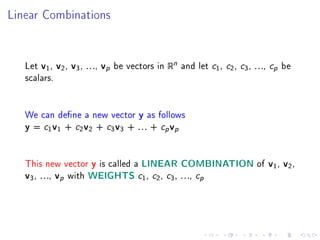
Linear Combinations


   Let v1 , v2 , v3 , . . ., vp be vectors in Rn and let   c1, c2, c3, . . ., cp be
   scalars.


   We can dene a new vector y as follows
   y = c1 v1 + c2 v2 + c3 v3 + . . . + cp vp


   This new vector y is called a LINEAR COMBINATION of v1 , v2 ,
   v3 , . . ., vp with WEIGHTS c1 , c2 , c3 , . . ., cp
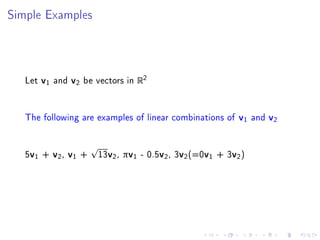
Simple Examples


   Let v1 and v2 be vectors in R2


   The following are examples of linear combinations of v1 and v2


   5v 1 + v 2 , v 1 +   13v2 , πv1 - 0.5v2 , 3v2 (=0v1 + 3v2 )
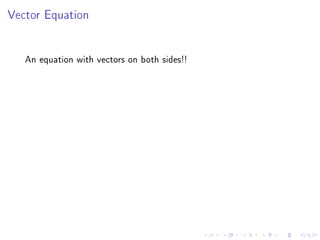
Vector Equation


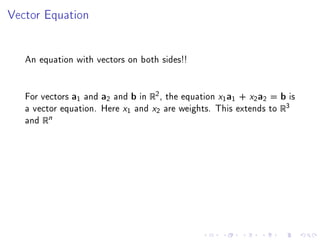
   An equation with vectors on both sides!!
Vector Equation


   An equation with vectors on both sides!!


   For vectors a1 and a2 and b in R2 , the equation x1 a1 + x2 a2 = b is
   a vector equation. Here x1 and x2 are weights. This extends to R3
   and Rn
Vector Equation


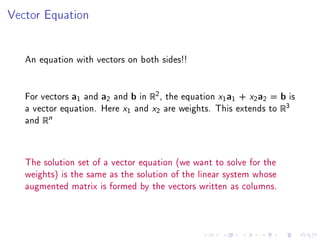
   An equation with vectors on both sides!!


   For vectors a1 and a2 and b in R2 , the equation x1 a1 + x2 a2 = b is
   a vector equation. Here x1 and x2 are weights. This extends to R3
   and Rn


   The solution set of a vector equation (we want to solve for the
   weights) is the same as the solution of the linear system whose
   augmented matrix is formed by the vectors written as columns.
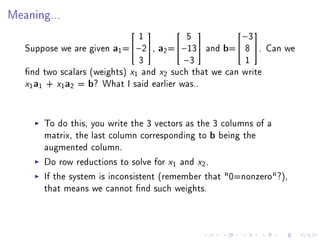
Meaning...


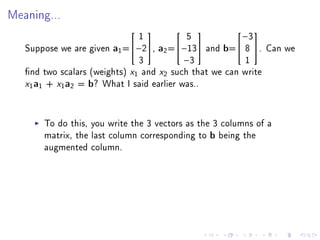
                               1           5            −3
                                                      

   Suppose we are given a1 =−2, a2 =−13 and b= 8 . Can we
                               3          −3             1
   nd two scalars (weights) x1 and x2 such that we can write
   x1a1 + x1a2 = b? What I said earlier was..

       To do this, you write the 3 vectors as the 3 columns of a
       matrix, the last column corresponding to b being the
       augmented column.
Meaning...


                               1           5            −3
                                                      

   Suppose we are given a1 =−2, a2 =−13 and b= 8 . Can we
                               3          −3             1
   nd two scalars (weights) x1 and x2 such that we can write
   x1a1 + x1a2 = b? What I said earlier was..

       To do this, you write the 3 vectors as the 3 columns of a
       matrix, the last column corresponding to b being the
       augmented column.
       Do row reductions to solve for x1 and x2 .
Meaning...


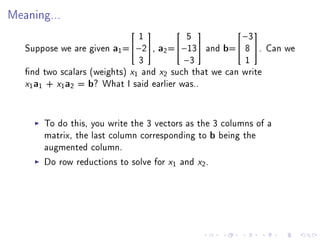
                               1           5            −3
                                                    

   Suppose we are given a1 =−2, a2 =−13 and b= 8 . Can we
                               3          −3             1
   nd two scalars (weights) x1 and x2 such that we can write
   x1a1 + x1a2 = b? What I said earlier was..

       To do this, you write the 3 vectors as the 3 columns of a
       matrix, the last column corresponding to b being the
       augmented column.
       Do row reductions to solve for x1 and x2 .
       If the system is inconsistent (remember that 0=nonzero?),
       that means we cannot nd such weights.
Meaning...

                               1           5            −3
                                                     

   Suppose we are given a1 =−2, a2 =−13 and b= 8 . Can we
                               3          −3             1
   nd two scalars (weights) x1 and x2 such that we can write
   x1a1 + x1a2 = b? What I said earlier was..

       To do this, you write the 3 vectors as the 3 columns of a
       matrix, the last column corresponding to b being the
       augmented column.
       Do row reductions to solve for x1 and x2 .
       If the system is inconsistent (remember that 0=nonzero?),
       that means we cannot nd such weights.
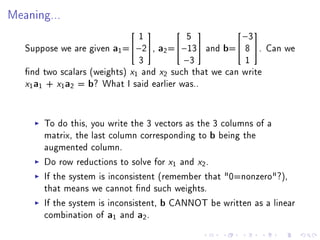
       If the system is inconsistent, b CANNOT be written as a linear
       combination of a1 and a2 .
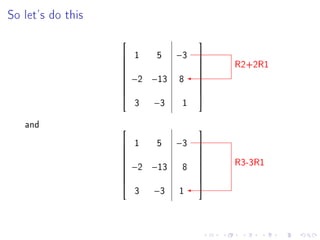
So let's do this


                                
                    1   5 −3
                                     R2+2R1
                                 
                                
                                
                    −2 −13 8
                                
                                 
                                
                                
                                
                     3 −3    1

   and                          
                    1   5 −3    
                                
                                     R3-3R1
                                
                    −2 −13 8
                                
                                 
                                
                                
                                
                     3 −3 1
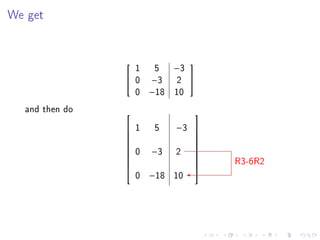
We get


                  1 5 −3
                              
                 0 −3   2 
                  0 −18 10
  and then do                 
                 1    5   −3 
                             
                             
                 0   −3   2 
                             
                                   R3-6R2
                             
                             
                             
                    0 −18 10
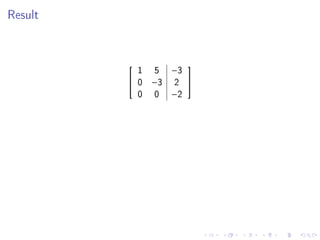
Result


           1 5 −3
                 
          0 −3 2 
           0 0 −2
Result


                              1 5 −3
                                         
                             0 −3 2 
                              0 0 −2
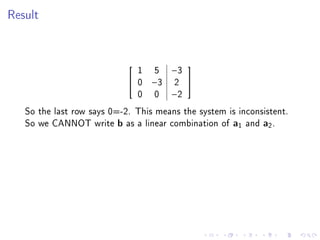
   So the last row says 0=-2. This means the system is inconsistent.
   So we CANNOT write b as a linear combination of a1 and a2 .
Result


                              1 5 −3
                                          
                             0 −3 2 
                              0 0 −2
   So the last row says 0=-2. This means the system is inconsistent.
   So we CANNOT write b as a linear combination of a1 and a2 .


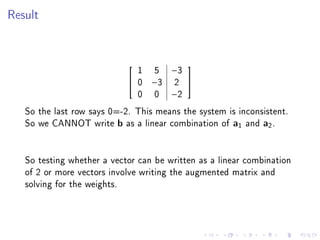
   So testing whether a vector can be written as a linear combination
   of 2 or more vectors involve writing the augmented matrix and
   solving for the weights.
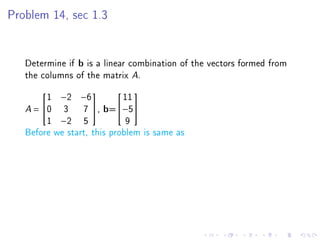
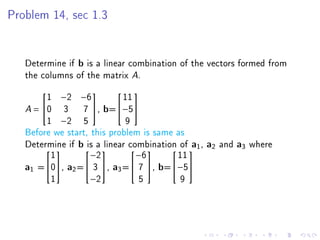
Problem 14, sec 1.3


   Determine if b is a linear combination of the vectors formed from
   the columns of the matrix A.

        1 −2 −6             11
                           

   A = 0 3 7 , b=−5
        1 −2 5               9
   Before we start, this problem is same as
Problem 14, sec 1.3


   Determine if b is a linear combination of the vectors formed from
   the columns of the matrix A.

        1 −2 −6             11
                           

   A = 0 3 7 , b=−5
        1 −2 5               9
   Before we start, this problem is same as
   Determine if b a 
                   is linear combination of  1 , a2 and a3 where
                                             a
         1          −2         −6         11
                                    

   a1 =0, a2 = 3 , a3 = 7 , b=−5
         1          −2          5         9
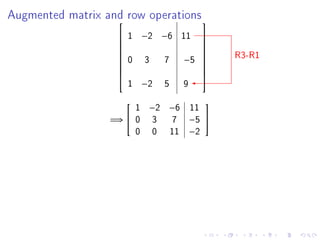
Augmented matrix and row operations
                                     
                    1 −2 −6 11       
                                     
                                          R3-R1
                                     
                    0 3   7 −5
                                     
                                      
                                     
                                     
                                     
                     1 −2 5 9

                       1 −2 −6 11
                                     

                  =⇒  0 3   7 −5 
                       0 0 11 −2
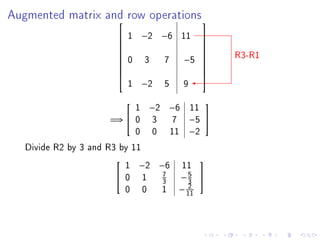
Augmented matrix and row operations
                                      
                         1 −2 −6 11   
                                      
                                           R3-R1
                                      
                         0 3   7 −5
                                      
                                       
                                      
                                      
                                      
                          1 −2 5 9

                           1 −2 −6 11
                                      

                      =⇒  0 3   7 −5 
                           0 0 11 −2
   Divide R2 by 3 and R3 by 11
                         1 −2 −6 11
                                      
                               7
                        0 1
                               3 −5 
                                  3
                                  2
                         0 0 1 − 11
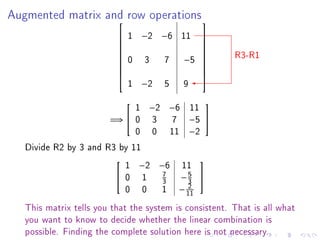
Augmented matrix and row operations
                                               
                           1 −2 −6 11          
                                               
                                                        R3-R1
                                               
                           0 3   7 −5
                                               
                                                
                                               
                                               
                                               
                            1 −2 5 9

                             1 −2 −6 11
                                               

                        =⇒  0 3   7 −5 
                             0 0 11 −2
   Divide R2 by 3 and R3 by 11
                            1 −2 −6 11
                                              
                                  7
                           0 1
                                  3 −5 
                                     3
                                     2
                            0 0 1 − 11
   This matrix tells you that the system is consistent. That is all what
   you want to know to decide whether the linear combination is
   possible. Finding the complete solution here is not necessary.
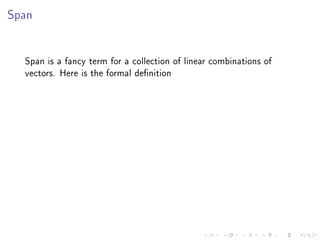
Span


  Span is a fancy term for a collection of linear combinations of
  vectors. Here is the formal denition
Span


  Span is a fancy term for a collection of linear combinations of
  vectors. Here is the formal denition


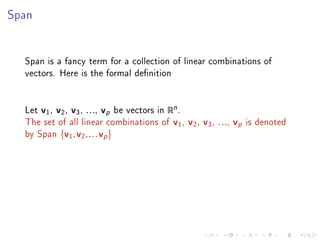
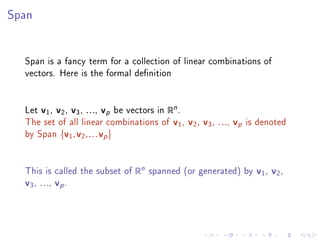
  Let v1 , v2 , v3 , . . ., vp be vectors in Rn .
  The set of all linear combinations of v1 , v2 , v3 , . . ., vp is denoted
  by Span v1 , v2 , . . . vp
Span


  Span is a fancy term for a collection of linear combinations of
  vectors. Here is the formal denition


  Let v1 , v2 , v3 , . . ., vp be vectors in Rn .
  The set of all linear combinations of v1 , v2 , v3 , . . ., vp is denoted
  by Span v1 , v2 , . . . vp


  This is called the subset of Rn spanned (or generated) by v1 , v2 ,
  v 3 , . . ., v p .
Span


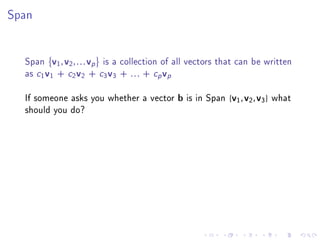
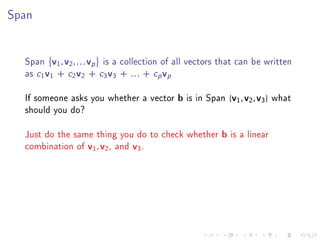
  Span v1 , v2 , . . . vp is a collection of all vectors that can be written
  as c1 v1 + c2 v2 + c3 v3 + . . . + cp vp

  If someone asks you whether a vector b is in Span {v1 , v2 , v3 } what
  should you do?
Span


  Span v1 , v2 , . . . vp is a collection of all vectors that can be written
  as c1 v1 + c2 v2 + c3 v3 + . . . + cp vp

  If someone asks you whether a vector b is in Span {v1 , v2 , v3 } what
  should you do?

  Just do the same thing you do to check whether b is a linear
  combination of v1 , v2 , and v3 .
Span


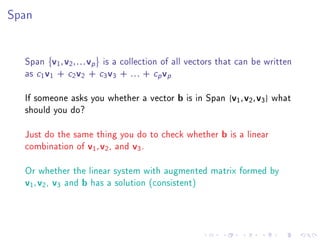
  Span v1 , v2 , . . . vp is a collection of all vectors that can be written
  as c1 v1 + c2 v2 + c3 v3 + . . . + cp vp

  If someone asks you whether a vector b is in Span {v1 , v2 , v3 } what
  should you do?

  Just do the same thing you do to check whether b is a linear
  combination of v1 , v2 , and v3 .

  Or whether the linear system with augmented matrix formed by
  v1 , v2 , v3 and b has a solution (consistent)
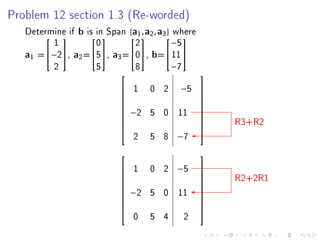
Problem 12 section 1.3 (Re-worded)

   Determine if b is in Span {a1a2 , a3 where
                                 ,      }
         1           0         2          −5
                                        

   a1 =−2, a2 =5, a3 =0, b= 11 
         2           5         8          −7
                                                 
                            1 0 2      −5 
                                          
                                          
                            −2 5 0    11 
                                          
                                                      R3+R2
                                          
                                          
                                          
                               2   5 8 −7
                                                 
                            1 0 2 −5
                                                      R2+2R1
                                                  
                                                 
                                                 
                            −2 5 0 11
                                                 
                                                  
                                                 
                                                 
                                                 
                               0   5 4     2
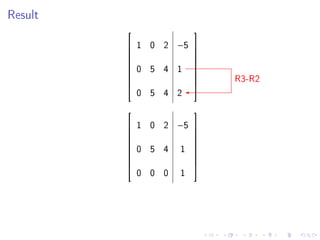
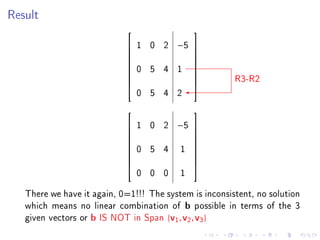
Result

                        
          1 0 2 −5      
                        
                        
          0 5 4 1
                        
                         
                             R3-R2
                        
                        
                        
             0 5 4 2
                        
          1 0 2 −5      
                        
                        
          0 5 4 1
                        
                         
                        
                        
                        
             0 0 0   1
Result

                                             
                             1 0 2 −5        
                                             
                                             
                             0 5 4 1
                                             
                                              
                                                        R3-R2
                                             
                                             
                                             
                                0 5 4 2
                                             
                             1 0 2 −5        
                                             
                                             
                             0 5 4 1
                                             
                                              
                                             
                                             
                                             
                                0 0 0     1

   There we have it again, 0=1!!! The system is inconsistent, no solution
   which means no linear combination of b possible in terms of the 3
   given vectors or b IS NOT in Span {v1 , v2 , v3 }
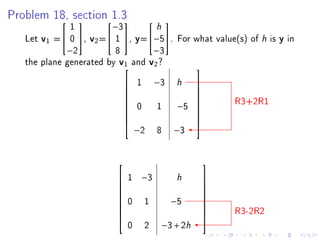
Problem 18, section 1.3
           
              1
                    
                        −3
                                
                                   h 

   Let v1 = 0 , v2 = 1 , y=−5. For what value(s) of      h is y in
             −2          8        −3
   the plane generated by v1 and v2 ?
                                                 
                              1 −3
                             
                                          h       
                                                  
                                                          R3+2R1
                                                 
                              0  1 −5
                                                 
                                                  
                                                 
                                                 
                                                 
                               −2 8 −3


                                                     
                          1 −3
                         
                                          h           
                                                      
                                                     
                          0 1           −5
                                                     
                                                      
                                                          R3-2R2
                                                     
                                                     
                                              h
                                                     
                             0   2   −3 + 2
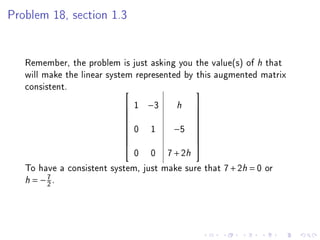
Problem 18, section 1.3


   Remember, the problem is just asking you the value(s) of h that
   will make the linear system represented by this augmented matrix
   consistent.                               
                            1 −3
                           
                                        h    
                                             
                                            
                            0 1        −5
                                            
                                             
                                            
                                            
                              0 0 7 + 2h
                                            

   To have a consistent system, just make sure that 7 + 2h = 0 or
   h = −2.
        7
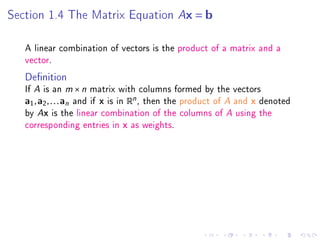
Section 1.4 The Matrix Equation                      Ax = b

   A linear combination of vectors is the product of a matrix and a
   vector.
   Denition
   If   A is an m × n matrix with columns formed by the vectors
   a1 , a2 , . . . an and if x is in Rn , then the
                                           product of A and x denoted
         A
   by x is the linear combination of the   columns of A using the
   corresponding entries in x as weights.
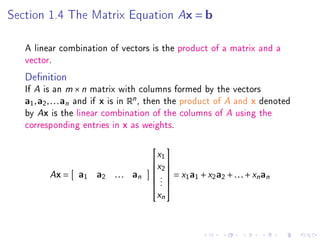
Section 1.4 The Matrix Equation                      Ax = b

   A linear combination of vectors is the product of a matrix and a
   vector.
   Denition
   If   A is an m × n matrix with columns formed by the vectors
   a1 , a2 , . . . an and if x is in Rn , then the
                                           product of A and x denoted
         A
   by x is the linear combination of the   columns of A using the
   corresponding entries in x as weights.

                                              x1 
                                           

                                              x2 
           Ax =                               .  = x1 a1 + x2 a2 + . . . + xn an
                                          
                              . . . an
                                          
                   a1    a2
                                              .
                                                
                                              .
                                          
                                           xn
                                          
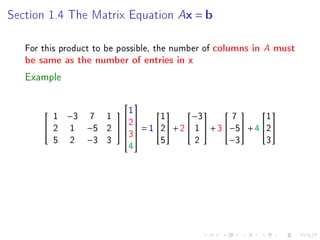
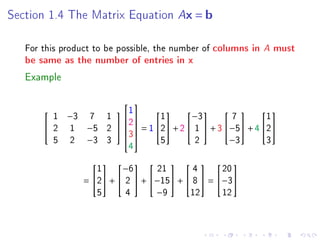
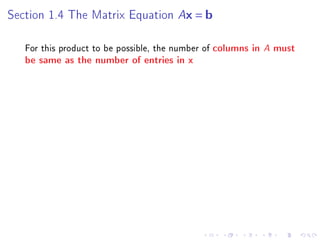
Section 1.4 The Matrix Equation         Ax = b

   For this product to be possible, the number of columns in   A must
   be same as the number of entries in x
Section 1.4 The Matrix Equation         Ax = b

   For this product to be possible, the number of columns in   A must
   be same as the number of entries in x

   Example

                   1
                     
         1 −3 7 1          1       −3         7       1
                                                 
                    2
        2 1 −5 2    = 1 2 + 2  1  + 3 −5 + 4 2
                    3
         5 2 −3 3            5        2        −3       3
                            4
Section 1.4 The Matrix Equation         Ax = b

   For this product to be possible, the number of columns in   A must
   be same as the number of entries in x

   Example

                   1
                     
         1 −3 7 1          1       −3         7       1
                                                 
                    2
        2 1 −5 2    = 1 2 + 2  1  + 3 −5 + 4 2
                    3
         5 2 −3 3            5        2        −3       3
                            4

                    1     −6      21       4      20
                                    

                 = 2 +  2  + −15 +  8  = −3
                    5      4      −9      12      12
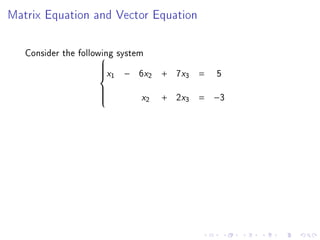
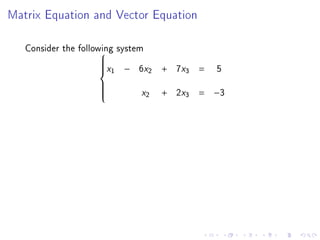
Matrix Equation and Vector Equation


   Consider the following system
                      
                      x    − 6 2   x      x
                                       + 7 3       5
                     
                     
                      1
                                              =

                               x2         x
                                       + 2 3   = −3
                     
                     
                     
                     
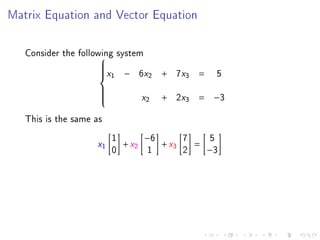
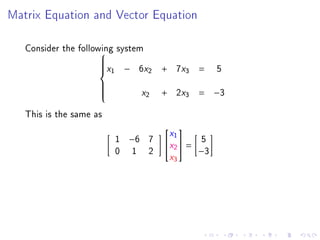
Matrix Equation and Vector Equation


   Consider the following system
                      
                         x         x
                               − 6 2      x
                                       + 7 3       5
                     
                     
                      1
                                              =

                                  x2      x
                                       + 2 3   = −3
                     
                     
                     
                     

   This is the same as
                             1      −6      7    5
                    x1       0
                               + x2
                                     1
                                       + x3
                                            2
                                              =
                                                −3
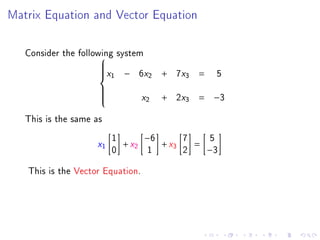
Matrix Equation and Vector Equation


   Consider the following system
                      
                         x         x
                               − 6 2      x
                                       + 7 3       5
                     
                     
                      1
                                              =

                                  x2      x
                                       + 2 3   = −3
                     
                     
                     
                     

   This is the same as
                             1      −6      7    5
                    x1       0
                               + x2
                                     1
                                       + x3
                                            2
                                              =
                                                −3

   This is the Vector Equation.
Matrix Equation and Vector Equation


   Consider the following system
                      
                      x    − 6 2   x      x
                                       + 7 3       5
                     
                     
                      1
                                              =

                               x2         x
                                       + 2 3   = −3
                     
                     
                     
                     
Matrix Equation and Vector Equation


   Consider the following system
                      
                         x    − 6 2x   + 7 3 x       5
                     
                     
                      1
                                                =

                                 x2    + 2 3 x   = −3
                     
                     
                     
                     

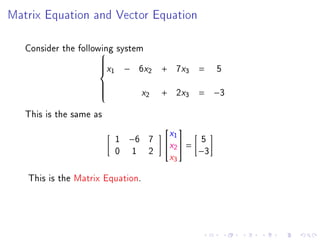
   This is the same as
                                        x
                                        
                             1 −6 7  1  5
                             0 1 2
                                     x2 = −3
                                        x3
Matrix Equation and Vector Equation


   Consider the following system
                      
                         x    − 6 2x   + 7 3 x       5
                     
                     
                      1
                                                =

                                  x2   + 2 3 x   = −3
                     
                     
                     
                     

   This is the same as
                                        x
                                        
                             1 −6 7  1  5
                             0 1 2
                                     x2 = −3
                                        x3
   This is the Matrix Equation.
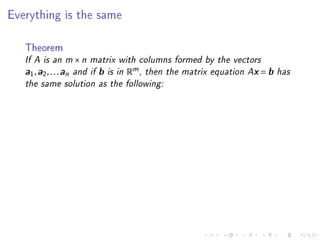
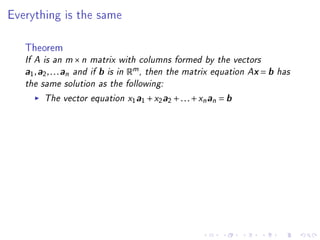
Everything is the same


   Theorem
   If A is an m × n matrix with columns formed by the vectors
   a1 , a2 , . . . an and if b is in Rm , then the matrix equation Ax = b has
   the same solution as the following:
Everything is the same


   Theorem
   If A is an m × n matrix with columns formed by the vectors
   a1 , a2 , . . . an and if b is in Rm , then the matrix equation Ax = b has
   the same solution as the following:
         The vector equation x1a1 + x2a2 + . . . + xn an = b
Everything is the same


   Theorem
   If A is an m × n matrix with columns formed by the vectors
   a1 , a2 , . . . an and if b is in Rm , then the matrix equation Ax = b has
   the same solution as the following:
         The vector equation x1a1 + x2a2 + . . . + xn an = b
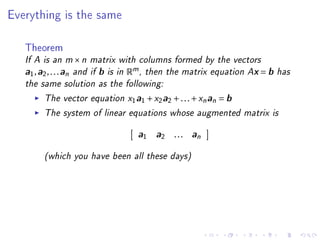
         The system of linear equations whose augmented matrix is
                                  a1 a2 . . . an

        (which you have been all these days)
Everything is the same


   Theorem
   If A is an m × n matrix with columns formed by the vectors
   a1 , a2 , . . . an and if b is in Rm , then the matrix equation Ax = b has
   the same solution as the following:
         The vector equation x1a1 + x2a2 + . . . + xn an = b
         The system of linear equations whose augmented matrix is
                                  a1 a2 . . . an

        (which you have been all these days)
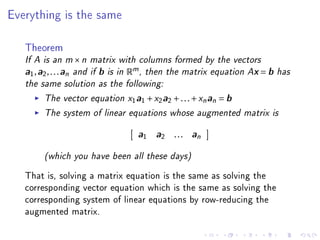
   That is, solving a matrix equation is the same as solving the
   corresponding vector equation which is the same as solving the
   corresponding system of linear equations by row-reducing the
   augmented matrix.
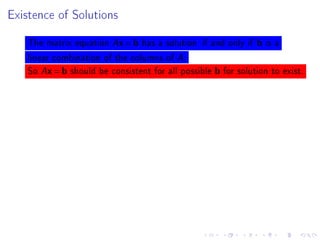
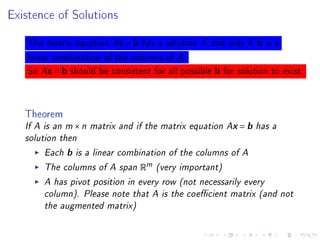
Existence of Solutions


    The matrix equation Ax = b has a solution if and only if b is a
    linear combination of the columns of A.
    So Ax = b should be consistent for all possible b for solution to exist.
Existence of Solutions


    The matrix equation Ax = b has a solution if and only if b is a
    linear combination of the columns of A.
    So Ax = b should be consistent for all possible b for solution to exist.


   Theorem
   If A is an m × n matrix and if the matrix equation Ax = b has a
   solution then
        Each b is a linear combination of the columns of A
        The columns of A span Rm (very important)
        A has pivot position in every row (not necessarily every
        column). Please note that A is the coecient matrix (and not
        the augmented matrix)
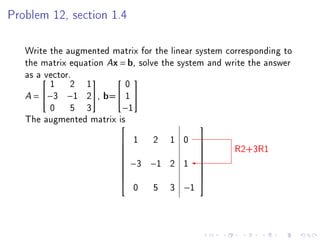
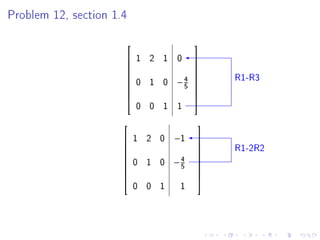
Problem 12, section 1.4


   Write the augmented matrix for the linear system corresponding to
   the matrix equation Ax = b, solve the system and write the answer
   as avector.
         1 2 1             0
                         

   A=  −3 −1 2, b= 1 
         0 5 3            −1
   The augmented matrix is
                                            
                           1  2 1 0
                                                      R2+3R1
                                             
                                            
                                            
                           −3 −1 2 1
                                            
                                             
                                            
                                            
                                            
                            0 5 3 −1
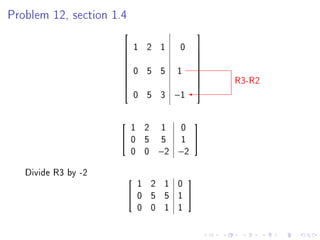
Problem 12, section 1.4

                                           
                       1 2 1       0       
                                           
                                           
                       0 5 5      1
                                           
                                            
                                                R3-R2
                                           
                                           
                                           
                             0 5 3 −1


                       1 2 1 0
                                           
                      0 5 5   1 
                       0 0 −2 −2

   Divide R3 by -2
                           1 2 1 0
                                       
                          0 5 5 1 
                           0 0 1 1
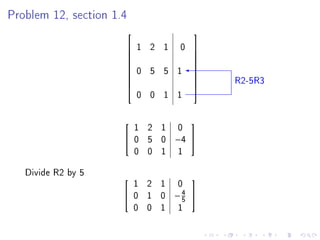
Problem 12, section 1.4

                                   
                       1 2 1 0     
                                   
                                   
                       0 5 5 1
                                   
                                    
                                        R2-5R3
                                   
                                   
                                   
                          0 0 1 1


                        1 2 1 0
                                   
                       0 5 0 −4 
                        0 0 1 1

   Divide R2 by 5
                        1 2 1 0
                                   
                       0 1 0 −4 
                               5
                        0 0 1 1
Problem 12, section 1.4


                                     
                       1 2 1 0 
                                
                                          R1-R3
                                
                       0 1 0 −4 
                                
                              5 
                                
                                
                          0 0 1 1
                                     
                       1 2 0 −1
                                          R1-2R2
                                      
                                     
                                     
                       0 1 0 −4
                                     
                               5
                                      
                                     
                                     
                                     
                          0 0 1   1
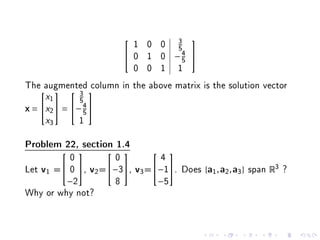
1 0 0 3
                                        
                                 5
                         0 1 0 −4 
                                  5
                          0 0 1 1
The augmented column in the above matrix is the solution vector
    x1  5 
           3

x= x2  = − 4 
              5
    x3       1

Problem 22, section 1.4
          0          0        4
                              

Let v1 = 0 , v2 =−3, v3 =−1. Does {a1 , a2 , a3 } span R3 ?
         −2          8        −5
Why or why not?
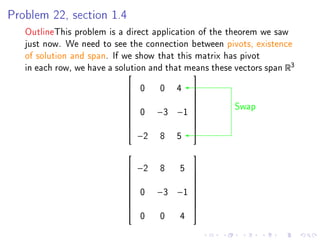
Problem 22, section 1.4

   OutlineThis problem is a direct application of the theorem we saw
   just now. We need to see the connection between pivots, existence
   of solution and span. If we show that this matrix has pivot
   in each row, we have a solution and that means these vectors span R3
                                             
                             0  0 4 
                                     
                                                       Swap
                                     
                             0 −3 −1 
                                     
                                     
                                     
                                     
                              −2 8 5
                                             
                             −2 8  5         
                                             
                                             
                             0 −3 −1
                                             
                                              
                                             
                                             
                                             
                                0    0    4
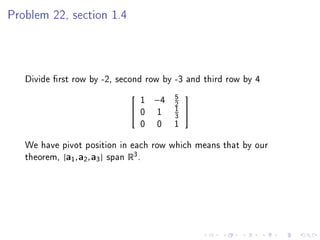
Problem 22, section 1.4


   Divide rst row by -2, second row by -3 and third row by 4
                                   5
                              1 −4 2
                                         
                             0 1 1 
                                   3
                              0 0 1

   We have pivot position in each row which means that by our
   theorem, {a1 , a2 , a3 } span R3 .
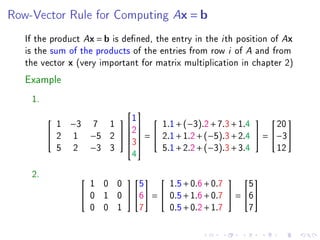
Row-Vector Rule for Computing            Ax = b
   If the product Ax = b is dened, the entry in the i th position of Ax
   is the sum of the products of the entries from row i of A and from
   the vector x (very important for matrix multiplication in chapter 2)
   Example
    1.
                     1
                       
           1 −3 7 1        1.1 + (−3).2 + 7.3 + 1.4     20
                                                      
                      2 
          2 1 −5 2    = 2.1 + 1.2 + (−5).3 + 2.4  = −3
                      3
           5 2 −3 3          5.1 + 2.2 + (−3).3 + 3.4     12
                              4

    2.
                   1 0 0    5      1. 5 + 0. 6 + 0. 7   5
                                                      
                  0 1 0  6 =  0.5 + 1.6 + 0.7  = 6
                   0 0 1    7      0.5 + 0.2 + 1.7      7

Linear Combination, Matrix Equations

  • 1.
    Announcements If anyone has not been able to access the class website please email me at pgeorge@mtu.edu No class on Monday (Martin Luther King day) Quiz 1 in class on Wednesday Jan 20 on sections 1.1, 1.2 and 1.3 Please know all denitions clearly for the quiz. The quiz will not be about doing lengthy and tiresome row operations but smaller problems to see whether you know the concepts.
  • 2.
    Sec 1.3 Contd:Vector Equations Vectors in n-dimensions, Rn Just like we had an ordered pair for x − y (or R2 ) and ordered triplet for x − y − z (or R3 ), we have ordered n−tuples for n-dimensions (or Rn ) Obviously not possible to draw or visualize u1   u   2 Vectors in Rn is a n × 1 column matrix of the form u= u3    . .   . un
  • 3.
    Basic Algebraic Properties For all u, v and w in Rn and all scalars c and d u+v=v+u (u+v)+w=u+(v+w) u+0=0+u=u u+(-u)=-u+u=0 c (u+v)=c u+c v (c + d )u=c u+d u c (d u)=(cd )(u) 1u=u
  • 4.
    Linear Combinations Let v1 , v2 , v3 , . . ., vp be vectors in Rn and let c1, c2, c3, . . ., cp be scalars.
  • 5.
    Linear Combinations Let v1 , v2 , v3 , . . ., vp be vectors in Rn and let c1, c2, c3, . . ., cp be scalars. We can dene a new vector y as follows y = c1 v1 + c2 v2 + c3 v3 + . . . + cp vp
  • 6.
    Linear Combinations Let v1 , v2 , v3 , . . ., vp be vectors in Rn and let c1, c2, c3, . . ., cp be scalars. We can dene a new vector y as follows y = c1 v1 + c2 v2 + c3 v3 + . . . + cp vp This new vector y is called a LINEAR COMBINATION of v1 , v2 , v3 , . . ., vp with WEIGHTS c1 , c2 , c3 , . . ., cp
  • 7.
    Simple Examples Let v1 and v2 be vectors in R2 The following are examples of linear combinations of v1 and v2 5v 1 + v 2 , v 1 + 13v2 , πv1 - 0.5v2 , 3v2 (=0v1 + 3v2 )
  • 8.
    Vector Equation An equation with vectors on both sides!!
  • 9.
    Vector Equation An equation with vectors on both sides!! For vectors a1 and a2 and b in R2 , the equation x1 a1 + x2 a2 = b is a vector equation. Here x1 and x2 are weights. This extends to R3 and Rn
  • 10.
    Vector Equation An equation with vectors on both sides!! For vectors a1 and a2 and b in R2 , the equation x1 a1 + x2 a2 = b is a vector equation. Here x1 and x2 are weights. This extends to R3 and Rn The solution set of a vector equation (we want to solve for the weights) is the same as the solution of the linear system whose augmented matrix is formed by the vectors written as columns.
  • 11.
    Meaning... 1 5 −3       Suppose we are given a1 =−2, a2 =−13 and b= 8 . Can we 3 −3 1 nd two scalars (weights) x1 and x2 such that we can write x1a1 + x1a2 = b? What I said earlier was.. To do this, you write the 3 vectors as the 3 columns of a matrix, the last column corresponding to b being the augmented column.
  • 12.
    Meaning... 1 5 −3       Suppose we are given a1 =−2, a2 =−13 and b= 8 . Can we 3 −3 1 nd two scalars (weights) x1 and x2 such that we can write x1a1 + x1a2 = b? What I said earlier was.. To do this, you write the 3 vectors as the 3 columns of a matrix, the last column corresponding to b being the augmented column. Do row reductions to solve for x1 and x2 .
  • 13.
    Meaning... 1 5 −3       Suppose we are given a1 =−2, a2 =−13 and b= 8 . Can we 3 −3 1 nd two scalars (weights) x1 and x2 such that we can write x1a1 + x1a2 = b? What I said earlier was.. To do this, you write the 3 vectors as the 3 columns of a matrix, the last column corresponding to b being the augmented column. Do row reductions to solve for x1 and x2 . If the system is inconsistent (remember that 0=nonzero?), that means we cannot nd such weights.
  • 14.
    Meaning... 1 5 −3       Suppose we are given a1 =−2, a2 =−13 and b= 8 . Can we 3 −3 1 nd two scalars (weights) x1 and x2 such that we can write x1a1 + x1a2 = b? What I said earlier was.. To do this, you write the 3 vectors as the 3 columns of a matrix, the last column corresponding to b being the augmented column. Do row reductions to solve for x1 and x2 . If the system is inconsistent (remember that 0=nonzero?), that means we cannot nd such weights. If the system is inconsistent, b CANNOT be written as a linear combination of a1 and a2 .
  • 15.
    So let's dothis    1 5 −3 R2+2R1       −2 −13 8          3 −3 1 and    1 5 −3    R3-3R1    −2 −13 8          3 −3 1
  • 16.
    We get 1 5 −3    0 −3 2  0 −18 10 and then do    1 5 −3       0 −3 2    R3-6R2       0 −18 10
  • 17.
    Result 1 5 −3    0 −3 2  0 0 −2
  • 18.
    Result 1 5 −3    0 −3 2  0 0 −2 So the last row says 0=-2. This means the system is inconsistent. So we CANNOT write b as a linear combination of a1 and a2 .
  • 19.
    Result 1 5 −3    0 −3 2  0 0 −2 So the last row says 0=-2. This means the system is inconsistent. So we CANNOT write b as a linear combination of a1 and a2 . So testing whether a vector can be written as a linear combination of 2 or more vectors involve writing the augmented matrix and solving for the weights.
  • 20.
    Problem 14, sec1.3 Determine if b is a linear combination of the vectors formed from the columns of the matrix A. 1 −2 −6 11     A = 0 3 7 , b=−5 1 −2 5 9 Before we start, this problem is same as
  • 21.
    Problem 14, sec1.3 Determine if b is a linear combination of the vectors formed from the columns of the matrix A. 1 −2 −6 11     A = 0 3 7 , b=−5 1 −2 5 9 Before we start, this problem is same as Determine if b a  is linear combination of  1 , a2 and a3 where a 1 −2 −6 11      a1 =0, a2 = 3 , a3 = 7 , b=−5 1 −2 5 9
  • 22.
    Augmented matrix androw operations    1 −2 −6 11    R3-R1    0 3 7 −5          1 −2 5 9 1 −2 −6 11   =⇒  0 3 7 −5  0 0 11 −2
  • 23.
    Augmented matrix androw operations    1 −2 −6 11    R3-R1    0 3 7 −5          1 −2 5 9 1 −2 −6 11   =⇒  0 3 7 −5  0 0 11 −2 Divide R2 by 3 and R3 by 11 1 −2 −6 11   7  0 1 3 −5  3 2 0 0 1 − 11
  • 24.
    Augmented matrix androw operations    1 −2 −6 11    R3-R1    0 3 7 −5          1 −2 5 9 1 −2 −6 11   =⇒  0 3 7 −5  0 0 11 −2 Divide R2 by 3 and R3 by 11 1 −2 −6 11   7  0 1 3 −5  3 2 0 0 1 − 11 This matrix tells you that the system is consistent. That is all what you want to know to decide whether the linear combination is possible. Finding the complete solution here is not necessary.
  • 25.
    Span Spanis a fancy term for a collection of linear combinations of vectors. Here is the formal denition
  • 26.
    Span Spanis a fancy term for a collection of linear combinations of vectors. Here is the formal denition Let v1 , v2 , v3 , . . ., vp be vectors in Rn . The set of all linear combinations of v1 , v2 , v3 , . . ., vp is denoted by Span v1 , v2 , . . . vp
  • 27.
    Span Spanis a fancy term for a collection of linear combinations of vectors. Here is the formal denition Let v1 , v2 , v3 , . . ., vp be vectors in Rn . The set of all linear combinations of v1 , v2 , v3 , . . ., vp is denoted by Span v1 , v2 , . . . vp This is called the subset of Rn spanned (or generated) by v1 , v2 , v 3 , . . ., v p .
  • 28.
    Span Spanv1 , v2 , . . . vp is a collection of all vectors that can be written as c1 v1 + c2 v2 + c3 v3 + . . . + cp vp If someone asks you whether a vector b is in Span {v1 , v2 , v3 } what should you do?
  • 29.
    Span Spanv1 , v2 , . . . vp is a collection of all vectors that can be written as c1 v1 + c2 v2 + c3 v3 + . . . + cp vp If someone asks you whether a vector b is in Span {v1 , v2 , v3 } what should you do? Just do the same thing you do to check whether b is a linear combination of v1 , v2 , and v3 .
  • 30.
    Span Spanv1 , v2 , . . . vp is a collection of all vectors that can be written as c1 v1 + c2 v2 + c3 v3 + . . . + cp vp If someone asks you whether a vector b is in Span {v1 , v2 , v3 } what should you do? Just do the same thing you do to check whether b is a linear combination of v1 , v2 , and v3 . Or whether the linear system with augmented matrix formed by v1 , v2 , v3 and b has a solution (consistent)
  • 31.
    Problem 12 section1.3 (Re-worded) Determine if b is in Span {a1a2 , a3 where , } 1 0 2 −5       a1 =−2, a2 =5, a3 =0, b= 11  2 5 8 −7    1 0 2 −5       −2 5 0 11    R3+R2       2 5 8 −7    1 0 2 −5 R2+2R1       −2 5 0 11          0 5 4 2
  • 32.
    Result    1 0 2 −5       0 5 4 1    R3-R2       0 5 4 2    1 0 2 −5       0 5 4 1          0 0 0 1
  • 33.
    Result    1 0 2 −5       0 5 4 1    R3-R2       0 5 4 2    1 0 2 −5       0 5 4 1          0 0 0 1 There we have it again, 0=1!!! The system is inconsistent, no solution which means no linear combination of b possible in terms of the 3 given vectors or b IS NOT in Span {v1 , v2 , v3 }
  • 34.
    Problem 18, section1.3  1   −3   h  Let v1 = 0 , v2 = 1 , y=−5. For what value(s) of h is y in −2 8 −3 the plane generated by v1 and v2 ?    1 −3  h   R3+2R1    0 1 −5          −2 8 −3    1 −3  h      0 1 −5    R3-2R2     h   0 2 −3 + 2
  • 35.
    Problem 18, section1.3 Remember, the problem is just asking you the value(s) of h that will make the linear system represented by this augmented matrix consistent.    1 −3  h      0 1 −5        0 0 7 + 2h   To have a consistent system, just make sure that 7 + 2h = 0 or h = −2. 7
  • 36.
    Section 1.4 TheMatrix Equation Ax = b A linear combination of vectors is the product of a matrix and a vector. Denition If A is an m × n matrix with columns formed by the vectors a1 , a2 , . . . an and if x is in Rn , then the product of A and x denoted A by x is the linear combination of the columns of A using the corresponding entries in x as weights.
  • 37.
    Section 1.4 TheMatrix Equation Ax = b A linear combination of vectors is the product of a matrix and a vector. Denition If A is an m × n matrix with columns formed by the vectors a1 , a2 , . . . an and if x is in Rn , then the product of A and x denoted A by x is the linear combination of the columns of A using the corresponding entries in x as weights. x1    x2  Ax = .  = x1 a1 + x2 a2 + . . . + xn an  . . . an  a1 a2 .   .  xn 
  • 38.
    Section 1.4 TheMatrix Equation Ax = b For this product to be possible, the number of columns in A must be same as the number of entries in x
  • 39.
    Section 1.4 TheMatrix Equation Ax = b For this product to be possible, the number of columns in A must be same as the number of entries in x Example  1   1 −3 7 1   1 −3 7 1          2  2 1 −5 2    = 1 2 + 2  1  + 3 −5 + 4 2 3 5 2 −3 3 5 2 −3 3 4
  • 40.
    Section 1.4 TheMatrix Equation Ax = b For this product to be possible, the number of columns in A must be same as the number of entries in x Example  1   1 −3 7 1   1 −3 7 1          2  2 1 −5 2    = 1 2 + 2  1  + 3 −5 + 4 2 3 5 2 −3 3 5 2 −3 3 4 1 −6 21 4 20           = 2 +  2  + −15 +  8  = −3 5 4 −9 12 12
  • 41.
    Matrix Equation andVector Equation Consider the following system  x − 6 2 x x + 7 3 5    1  = x2 x + 2 3 = −3    
  • 42.
    Matrix Equation andVector Equation Consider the following system  x x − 6 2 x + 7 3 5    1  = x2 x + 2 3 = −3     This is the same as 1 −6 7 5 x1 0 + x2 1 + x3 2 = −3
  • 43.
    Matrix Equation andVector Equation Consider the following system  x x − 6 2 x + 7 3 5    1  = x2 x + 2 3 = −3     This is the same as 1 −6 7 5 x1 0 + x2 1 + x3 2 = −3 This is the Vector Equation.
  • 44.
    Matrix Equation andVector Equation Consider the following system  x − 6 2 x x + 7 3 5    1  = x2 x + 2 3 = −3    
  • 45.
    Matrix Equation andVector Equation Consider the following system  x − 6 2x + 7 3 x 5    1  = x2 + 2 3 x = −3     This is the same as x   1 −6 7  1  5 0 1 2 x2 = −3 x3
  • 46.
    Matrix Equation andVector Equation Consider the following system  x − 6 2x + 7 3 x 5    1  = x2 + 2 3 x = −3     This is the same as x   1 −6 7  1  5 0 1 2 x2 = −3 x3 This is the Matrix Equation.
  • 47.
    Everything is thesame Theorem If A is an m × n matrix with columns formed by the vectors a1 , a2 , . . . an and if b is in Rm , then the matrix equation Ax = b has the same solution as the following:
  • 48.
    Everything is thesame Theorem If A is an m × n matrix with columns formed by the vectors a1 , a2 , . . . an and if b is in Rm , then the matrix equation Ax = b has the same solution as the following: The vector equation x1a1 + x2a2 + . . . + xn an = b
  • 49.
    Everything is thesame Theorem If A is an m × n matrix with columns formed by the vectors a1 , a2 , . . . an and if b is in Rm , then the matrix equation Ax = b has the same solution as the following: The vector equation x1a1 + x2a2 + . . . + xn an = b The system of linear equations whose augmented matrix is a1 a2 . . . an (which you have been all these days)
  • 50.
    Everything is thesame Theorem If A is an m × n matrix with columns formed by the vectors a1 , a2 , . . . an and if b is in Rm , then the matrix equation Ax = b has the same solution as the following: The vector equation x1a1 + x2a2 + . . . + xn an = b The system of linear equations whose augmented matrix is a1 a2 . . . an (which you have been all these days) That is, solving a matrix equation is the same as solving the corresponding vector equation which is the same as solving the corresponding system of linear equations by row-reducing the augmented matrix.
  • 51.
    Existence of Solutions The matrix equation Ax = b has a solution if and only if b is a linear combination of the columns of A. So Ax = b should be consistent for all possible b for solution to exist.
  • 52.
    Existence of Solutions The matrix equation Ax = b has a solution if and only if b is a linear combination of the columns of A. So Ax = b should be consistent for all possible b for solution to exist. Theorem If A is an m × n matrix and if the matrix equation Ax = b has a solution then Each b is a linear combination of the columns of A The columns of A span Rm (very important) A has pivot position in every row (not necessarily every column). Please note that A is the coecient matrix (and not the augmented matrix)
  • 53.
    Problem 12, section1.4 Write the augmented matrix for the linear system corresponding to the matrix equation Ax = b, solve the system and write the answer as avector. 1 2 1 0    A= −3 −1 2, b= 1  0 5 3 −1 The augmented matrix is    1 2 1 0 R2+3R1       −3 −1 2 1          0 5 3 −1
  • 54.
    Problem 12, section1.4    1 2 1 0       0 5 5 1    R3-R2       0 5 3 −1 1 2 1 0    0 5 5 1  0 0 −2 −2 Divide R3 by -2 1 2 1 0    0 5 5 1  0 0 1 1
  • 55.
    Problem 12, section1.4    1 2 1 0       0 5 5 1    R2-5R3       0 0 1 1 1 2 1 0    0 5 0 −4  0 0 1 1 Divide R2 by 5 1 2 1 0    0 1 0 −4  5 0 0 1 1
  • 56.
    Problem 12, section1.4    1 2 1 0    R1-R3    0 1 0 −4     5      0 0 1 1    1 2 0 −1 R1-2R2       0 1 0 −4   5        0 0 1 1
  • 57.
    1 0 03   5  0 1 0 −4  5 0 0 1 1 The augmented column in the above matrix is the solution vector x1  5    3 x= x2  = − 4  5 x3 1 Problem 22, section 1.4 0 0 4       Let v1 = 0 , v2 =−3, v3 =−1. Does {a1 , a2 , a3 } span R3 ? −2 8 −5 Why or why not?
  • 58.
    Problem 22, section1.4 OutlineThis problem is a direct application of the theorem we saw just now. We need to see the connection between pivots, existence of solution and span. If we show that this matrix has pivot in each row, we have a solution and that means these vectors span R3    0 0 4    Swap    0 −3 −1          −2 8 5    −2 8 5       0 −3 −1          0 0 4
  • 59.
    Problem 22, section1.4 Divide rst row by -2, second row by -3 and third row by 4 5 1 −4 2    0 1 1  3 0 0 1 We have pivot position in each row which means that by our theorem, {a1 , a2 , a3 } span R3 .
  • 60.
    Row-Vector Rule forComputing Ax = b If the product Ax = b is dened, the entry in the i th position of Ax is the sum of the products of the entries from row i of A and from the vector x (very important for matrix multiplication in chapter 2) Example 1.  1   1 −3 7 1   1.1 + (−3).2 + 7.3 + 1.4 20      2   2 1 −5 2    = 2.1 + 1.2 + (−5).3 + 2.4  = −3 3 5 2 −3 3 5.1 + 2.2 + (−3).3 + 3.4 12 4 2. 1 0 0 5 1. 5 + 0. 6 + 0. 7 5         0 1 0  6 =  0.5 + 1.6 + 0.7  = 6 0 0 1 7 0.5 + 0.2 + 1.7 7