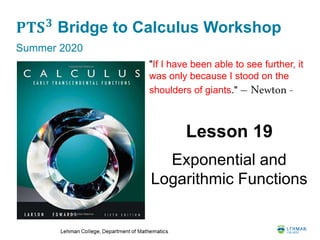
𝐏𝐓𝐒 𝟑
Bridge to Calculus Workshop
Summer 2020
Lesson 19
Exponential and
Logarithmic Functions
"If I have been able to see further, it
was only because I stood on the
shoulders of giants." – Newton -
Lehman College, Department of Mathematics
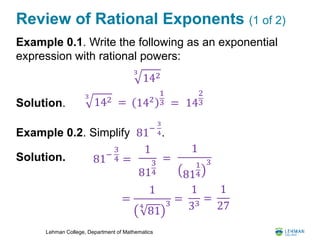
Review of Rational Exponents (1 of 2)
Example 0.1. Write the following as an exponential
expression with rational powers:
Solution.
Example 0.2. Simplify 81−
3
4.
Solution.
3
142
3
142 = 142
1
3 = 14
2
3
81−
3
4 =
1
81
3
4
=
1
81
1
4
3
=
1
4
81
3 =
1
33
=
1
27
Lehman College, Department of Mathematics
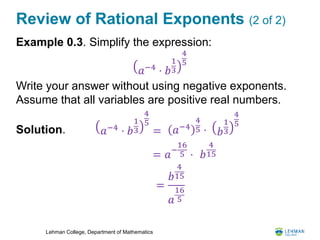
Review of Rational Exponents (2 of 2)
Example 0.3. Simplify the expression:
Write your answer without using negative exponents.
Assume that all variables are positive real numbers.
Solution.
𝑎−4
⋅ 𝑏
1
3
4
5
𝑎−4 ⋅ 𝑏
1
3
4
5
= 𝑎−4
4
5 ⋅ 𝑏
1
3
4
5
= 𝑎−
16
5 ⋅ 𝑏
4
15
=
𝑏
4
15
𝑎
16
5
Lehman College, Department of Mathematics
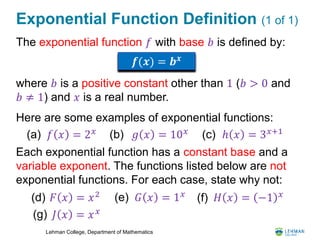
Exponential Function Definition (1 of 1)
The exponential function 𝑓 with base 𝑏 is defined by:
where 𝑏 is a positive constant other than 1 (𝑏 > 0 and
𝑏 ≠ 1) and 𝑥 is a real number.
Here are some examples of exponential functions:
Each exponential function has a constant base and a
variable exponent. The functions listed below are not
exponential functions. For each case, state why not:
𝒇(𝒙) = 𝒃 𝒙
𝑓 𝑥 = 2 𝑥
(a) 𝑔 𝑥 = 10 𝑥
(b) ℎ 𝑥 = 3 𝑥+1
(c)
𝐹 𝑥 = 𝑥2
(d) 𝐺 𝑥 = 1 𝑥(e) 𝐻 𝑥 = −1 𝑥
(f)
𝐽 𝑥 = 𝑥 𝑥(g)
Lehman College, Department of Mathematics
Graphing Exponential Functions (1 of 5)
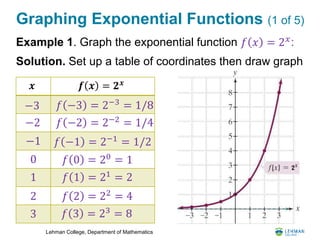
Example 1. Graph the exponential function 𝑓 𝑥 = 2 𝑥
:
Solution. Set up a table of coordinates then draw graph
𝒙 𝒇 𝒙 = 𝟐 𝒙
1 𝑓 1 = 21
= 2
2 𝑓 2 = 22
= 4
3 𝑓 3 = 23
= 8
0 𝑓 0 = 20 = 1
−1 𝑓 −1 = 2−1 = 1/2
−2 𝑓 −2 = 2−2
= 1/4
−3 𝑓 −3 = 2−3
= 1/8
Lehman College, Department of Mathematics
Graphing Exponential Functions (2 of 5)
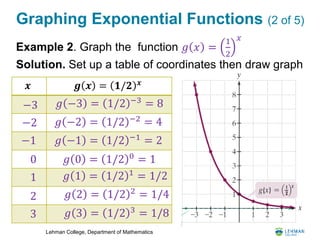
Example 2. Graph the function 𝑔 𝑥 =
1
2
𝑥
Solution. Set up a table of coordinates then draw graph
𝒙 𝒈 𝒙 = 𝟏/𝟐 𝒙
1 𝑔 1 = 1/2 1 = 1/2
2 𝑔 2 = 1/2 2 = 1/4
3 𝑔 3 = 1/2 3
= 1/8
0 𝑔 0 = 1/2 0
= 1
−1 𝑔 −1 = 1/2 −1
= 2
−2 𝑔 −2 = 1/2 −2
= 4
−3 𝑔 −3 = 1/2 −3
= 8
Lehman College, Department of Mathematics
Graphing Exponential Functions (3 of 5)
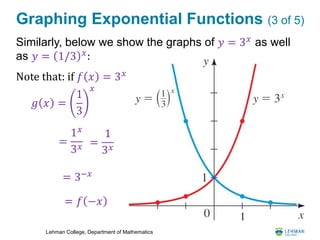
Similarly, below we show the graphs of 𝑦 = 3 𝑥
as well
as 𝑦 = 1/3 𝑥
:
Note that: if 𝑓 𝑥 = 3 𝑥
= 3−𝑥
𝑔 𝑥 =
1
3
𝑥
=
1 𝑥
3 𝑥 =
1
3 𝑥
= 𝑓 −𝑥
Lehman College, Department of Mathematics
Graphing Exponential Functions (4 of 5)
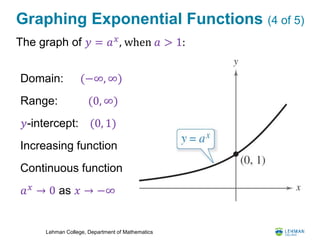
The graph of 𝑦 = 𝑎 𝑥
, when 𝑎 > 1:
Domain: (−∞, ∞)
Range: (0, ∞)
𝑦-intercept: (0, 1)
Increasing function
Continuous function
𝑎 𝑥
→ 0 as 𝑥 → −∞
Lehman College, Department of Mathematics
Graphing Exponential Functions (5 of 5)
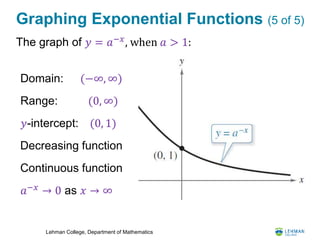
The graph of 𝑦 = 𝑎−𝑥
, when 𝑎 > 1:
Domain: (−∞, ∞)
Range: (0, ∞)
𝑦-intercept: (0, 1)
Decreasing function
Continuous function
𝑎−𝑥
→ 0 as 𝑥 → ∞
Lehman College, Department of Mathematics
Exponential Equations (1 of 4)
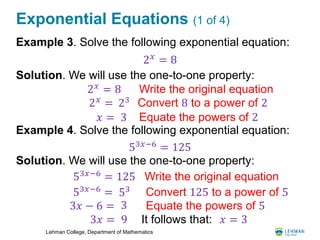
Example 3. Solve the following exponential equation:
Solution. We will use the one-to-one property:
Example 4. Solve the following exponential equation:
Solution. We will use the one-to-one property:
2 𝑥
= 8
2 𝑥 = 8 Write the original equation
2 𝑥 = 23 Convert 8 to a power of 2
𝑥 = 3 Equate the powers of 2
53𝑥−6 = 125
53𝑥−6
= 125 Write the original equation
53𝑥−6 = 53 Convert 125 to a power of 5
3𝑥 − 6 = Equate the powers of 53
3𝑥 = 9 It follows that: 𝑥 = 3
Lehman College, Department of Mathematics
Exponential Equations (2 of 4)
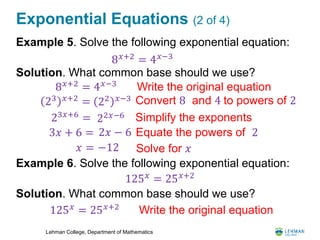
Example 5. Solve the following exponential equation:
Solution. What common base should we use?
Example 6. Solve the following exponential equation:
Solution. What common base should we use?
8 𝑥+2 = 4 𝑥−3
8 𝑥+2
= 4 𝑥−3
Write the original equation
23 𝑥+2
= Convert 8 and 4 to powers of 2
3𝑥 + 6 = 2𝑥 − 6 Equate the powers of 2
22 𝑥−3
23𝑥+6
= 22𝑥−6 Simplify the exponents
𝑥 = −12 Solve for 𝑥
125 𝑥 = 25 𝑥+2
125 𝑥 = 25 𝑥+2
Write the original equation
Lehman College, Department of Mathematics
Exponential Equations (3 of 4)
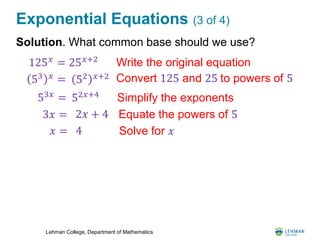
Solution. What common base should we use?
53 𝑥
= Convert 125 and 25 to powers of 5
3𝑥 = 2𝑥 + 4 Equate the powers of 5
52 𝑥+2
53𝑥
= 52𝑥+4
Simplify the exponents
𝑥 = 4 Solve for 𝑥
125 𝑥
= 25 𝑥+2
Write the original equation
Lehman College, Department of Mathematics
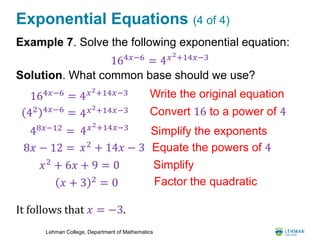
Exponential Equations (4 of 4)
Example 7. Solve the following exponential equation:
Solution. What common base should we use?
It follows that 𝑥 = −3.
42 4𝑥−6 = Convert 16 to a power of 4
8𝑥 − 12 = 𝑥2
+ 14𝑥 − 3 Equate the powers of 4
4 𝑥2+14𝑥−3
48𝑥−12
= 4 𝑥2+14𝑥−3
Simplify the exponents
𝑥2
+ 6𝑥 + 9 = 0
Factor the quadratic
164𝑥−6 = 4 𝑥2+14𝑥−3 Write the original equation
164𝑥−6 = 4 𝑥2+14𝑥−3
𝑥 + 3 2 = 0
Simplify
Lehman College, Department of Mathematics
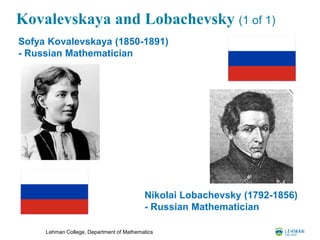
Kovalevskaya and Lobachevsky (1 of 1)
Nikolai Lobachevsky (1792-1856)
- Russian Mathematician
Sofya Kovalevskaya (1850-1891)
- Russian Mathematician
Lehman College, Department of Mathematics
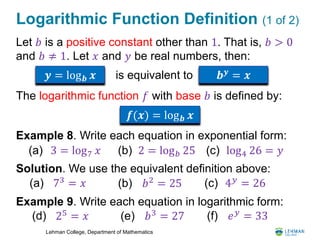
Logarithmic Function Definition (1 of 2)
Let 𝑏 is a positive constant other than 1. That is, 𝑏 > 0
and 𝑏 ≠ 1. Let 𝑥 and 𝑦 be real numbers, then:
The logarithmic function 𝑓 with base 𝑏 is defined by:
Example 8. Write each equation in exponential form:
Solution. We use the equivalent definition above:
Example 9. Write each equation in logarithmic form:
𝒚 = log 𝒃 𝒙 is equivalent to 𝒃 𝒚 = 𝒙
𝒇(𝒙) = log 𝒃 𝒙
3 = log7 𝑥(a) 2 = log 𝑏 25(b) log4 26 = 𝑦(c)
73 = 𝑥(a) 𝑏2
= 25(b) 4 𝑦 = 26(c)
25 = 𝑥(d) 𝑏3 = 27(e) 𝑒 𝑦
= 33(f)
Lehman College, Department of Mathematics
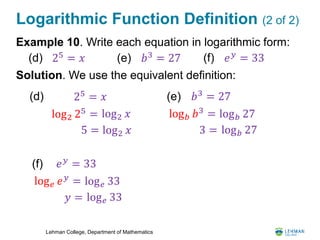
Logarithmic Function Definition (2 of 2)
Example 10. Write each equation in logarithmic form:
Solution. We use the equivalent definition:
25
= 𝑥(d) 𝑏3 = 27(e) 𝑒 𝑦 = 33(f)
25 = 𝑥(d)
log2 𝑥log2 25
=
5 = log2 𝑥
𝑏3
= 27(e)
log 𝑏 27log 𝑏 𝑏3
=
3 = log 𝑏 27
𝑒 𝑦
= 33(f)
log 𝑒 33log 𝑒 𝑒 𝑦
=
𝑦 = log 𝑒 33
Lehman College, Department of Mathematics
Graphing Logarithmic Functions (1 of 1)
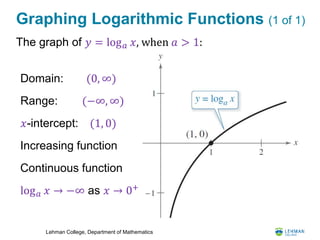
The graph of 𝑦 = log 𝑎 𝑥, when 𝑎 > 1:
Domain: (0, ∞)
Range: (−∞, ∞)
𝑥-intercept: (1, 0)
Increasing function
Continuous function
log 𝑎 𝑥 → −∞ as 𝑥 → 0+
Lehman College, Department of Mathematics
Natural & Common Logarithms (1 of 2)
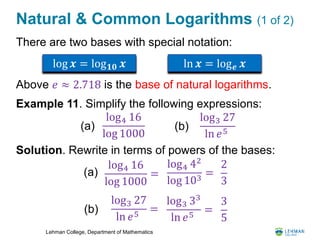
There are two bases with special notation:
Above 𝑒 ≈ 2.718 is the base of natural logarithms.
Example 11. Simplify the following expressions:
Solution. Rewrite in terms of powers of the bases:
log 𝒙 = log 𝟏𝟎 𝒙 ln 𝒙 = log 𝒆 𝒙
log4 16
log 1000
log4 16
log 1000
=
log4 42
log 103
=
2
3
(a)
log3 27
ln 𝑒5(b)
(a)
log3 27
ln 𝑒5
=(b)
log3 33
ln 𝑒5
=
3
5
Lehman College, Department of Mathematics
Properties of Logarithms (1 of 13)
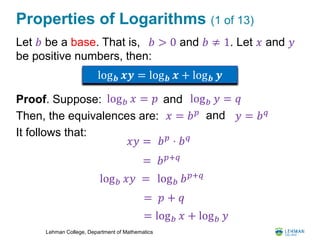
Let 𝑏 be a base. That is, 𝑏 > 0 and 𝑏 ≠ 1. Let 𝑥 and 𝑦
be positive numbers, then:
Proof. Suppose:
Then, the equivalences are:
It follows that:
log 𝒃 𝒙𝒚 = log 𝒃 𝒙 + log 𝒃 𝒚
log 𝑏 𝑥 = 𝑝 log 𝑏 𝑦 = 𝑞and
𝑥 = 𝑏 𝑝 and 𝑦 = 𝑏 𝑞
𝑥𝑦 = 𝑏 𝑝
⋅ 𝑏 𝑞
= 𝑏 𝑝+𝑞
log 𝑏 𝑥𝑦 = log 𝑏 𝑏 𝑝+𝑞
= 𝑝 + 𝑞
= log 𝑏 𝑥 + log 𝑏 𝑦
Lehman College, Department of Mathematics
Properties of Logarithms (2 of 13)
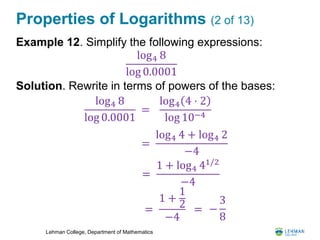
Example 12. Simplify the following expressions:
Solution. Rewrite in terms of powers of the bases:
log4 8
log 0.0001
log4 8
log 0.0001
=
log4 4 ⋅ 2
log 10−4
=
log4 4 + log4 2
−4
=
1 + log4 41/2
−4
=
1 +
1
2
−4
= −
3
8
Lehman College, Department of Mathematics
Properties of Logarithms (3 of 13)
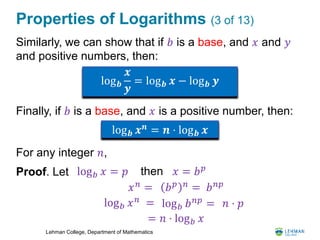
Similarly, we can show that if 𝑏 is a base, and 𝑥 and 𝑦
and positive numbers, then:
Finally, if 𝑏 is a base, and 𝑥 is a positive number, then:
For any integer 𝑛,
Proof. Let
log 𝒃
𝒙
𝒚
= log 𝒃 𝒙 − log 𝒃 𝒚
log 𝒃 𝒙 𝒏
= 𝒏 ⋅ log 𝒃 𝒙
log 𝑏 𝑥 = 𝑝 then 𝑥 = 𝑏 𝑝
𝑥 𝑛
= 𝑏 𝑝 𝑛
= 𝑏 𝑛𝑝
log 𝑏 𝑥 𝑛 = log 𝑏 𝑏 𝑛𝑝
= 𝑛 ⋅ 𝑝
= 𝑛 ⋅ log 𝑏 𝑥
Lehman College, Department of Mathematics
Properties of Logarithms (4 of 13)
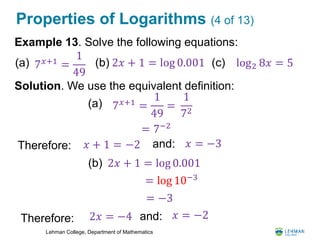
Example 13. Solve the following equations:
Solution. We use the equivalent definition:
7 𝑥+1
=
1
49
(a) 2𝑥 + 1 = log 0.001(b) log2 8𝑥 = 5(c)
(a) 7 𝑥+1
=
1
49
=
1
72
= 7−2
Therefore: 𝑥 + 1 = −2
2𝑥 + 1 = log 0.001(b)
= log 10−3
= −3
Therefore: 2𝑥 = −4 and: 𝑥 = −2
and: 𝑥 = −3
Lehman College, Department of Mathematics
Properties of Logarithms (5 of 13)
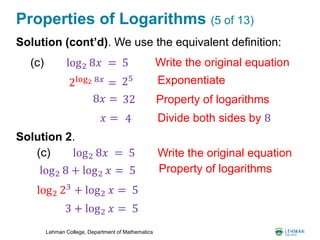
Solution (cont’d). We use the equivalent definition:
Solution 2.
log2 8𝑥 = 5(c) Write the original equation
Exponentiate
Property of logarithms
2log2 8𝑥 = 25
8𝑥 = 32
𝑥 = 4 Divide both sides by 8
Write the original equation
log2 8 + log2 𝑥 = 5 Property of logarithms
log2 23
+ log2 𝑥 = 5
3 + log2 𝑥 = 5
log2 8𝑥 = 5(c)
Lehman College, Department of Mathematics
Properties of Logarithms (6 of 13)
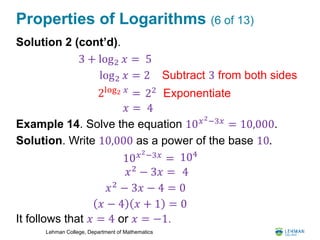
Solution 2 (cont’d).
Example 14. Solve the equation 10 𝑥2−3𝑥 = 10,000.
Solution. Write 10,000 as a power of the base 10.
It follows that 𝑥 = 4 or 𝑥 = −1.
3 + log2 𝑥 = 5
log2 𝑥 = 2 Subtract 3 from both sides
Exponentiate2log2 𝑥
= 22
𝑥 = 4
10 𝑥2−3𝑥 = 104
𝑥2
− 3𝑥 = 4
𝑥2
− 3𝑥 − 4 = 0
𝑥 − 4 𝑥 + 1 = 0
Lehman College, Department of Mathematics
Properties of Logarithms (7 of 13)
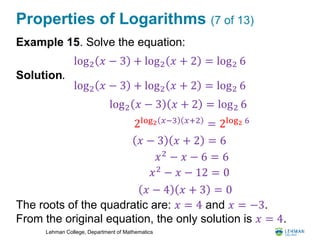
Example 15. Solve the equation:
Solution.
The roots of the quadratic are: 𝑥 = 4 and 𝑥 = −3.
From the original equation, the only solution is 𝑥 = 4.
log2 𝑥 − 3 + log2 𝑥 + 2 = log2 6
log2 𝑥 − 3 𝑥 + 2 = log2 6
2log2 𝑥−3 𝑥+2 = 2log2 6
𝑥 − 3 𝑥 + 2 = 6
𝑥2 − 𝑥 − 6 = 6
𝑥2
− 𝑥 − 12 = 0
𝑥 − 4 𝑥 + 3 = 0
Lehman College, Department of Mathematics
Properties of Logarithms (8 of 13)
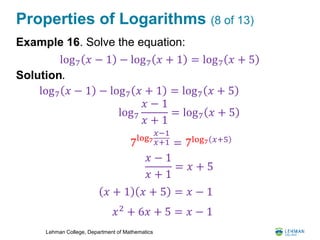
Example 16. Solve the equation:
Solution.
log7 𝑥 − 1 − log7 𝑥 + 1 = log7 𝑥 + 5
log7
𝑥 − 1
𝑥 + 1
= log7 𝑥 + 5
7log7
𝑥−1
𝑥+1 = 7log7 𝑥+5
𝑥 − 1
𝑥 + 1
= 𝑥 + 5
𝑥 + 1 𝑥 + 5 = 𝑥 − 1
𝑥2
+ 6𝑥 + 5 = 𝑥 − 1
Lehman College, Department of Mathematics
Properties of Logarithms (9 of 13)
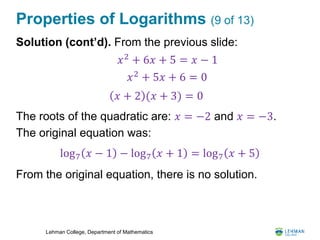
Solution (cont’d). From the previous slide:
The roots of the quadratic are: 𝑥 = −2 and 𝑥 = −3.
The original equation was:
From the original equation, there is no solution.
𝑥2
+ 6𝑥 + 5 = 𝑥 − 1
𝑥2
+ 5𝑥 + 6 = 0
𝑥 + 2 (𝑥 + 3) = 0
log7 𝑥 − 1 − log7 𝑥 + 1 = log7 𝑥 + 5
Lehman College, Department of Mathematics
Properties of Logarithms (10 of 13)
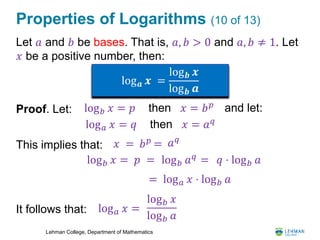
Let 𝑎 and 𝑏 be bases. That is, 𝑎, 𝑏 > 0 and 𝑎, 𝑏 ≠ 1. Let
𝑥 be a positive number, then:
Proof. Let:
This implies that:
It follows that:
log 𝒂 𝒙 =
log 𝒃 𝒙
log 𝒃 𝒂
log 𝑏 𝑥 = 𝑝 then 𝑥 = 𝑏 𝑝 and let:
log 𝑎 𝑥 = 𝑞 then 𝑥 = 𝑎 𝑞
𝑥 = 𝑏 𝑝
= 𝑎 𝑞
log 𝑏 𝑥 = 𝑝 = 𝑞 ⋅ log 𝑏 𝑎
= log 𝑎 𝑥 ⋅ log 𝑏 𝑎
log 𝑏 𝑎 𝑞
=
log 𝑎 𝑥 =
log 𝑏 𝑥
log 𝑏 𝑎
Lehman College, Department of Mathematics
Properties of Logarithms (11 of 13)
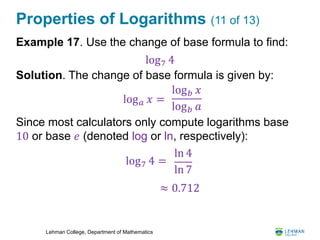
Example 17. Use the change of base formula to find:
Solution. The change of base formula is given by:
Since most calculators only compute logarithms base
10 or base 𝑒 (denoted log or ln, respectively):
log7 4
log 𝑎 𝑥 =
log 𝑏 𝑥
log 𝑏 𝑎
log7 4 =
ln 4
ln 7
≈ 0.712
Lehman College, Department of Mathematics
Properties of Logarithms (12 of 13)
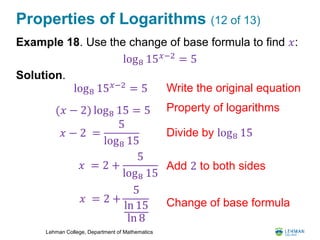
Example 18. Use the change of base formula to find 𝑥:
Solution.
log8 15 𝑥−2
= 5
log8 15 𝑥−2 = 5 Write the original equation
(𝑥 − 2) log8 15 = 5 Property of logarithms
𝑥 − 2 =
5
log8 15
Divide by log8 15
𝑥 = 2 +
5
log8 15
𝑥 = 2 +
5
ln 15
ln 8
Add 2 to both sides
Change of base formula
Lehman College, Department of Mathematics
Properties of Logarithms (13 of 13)
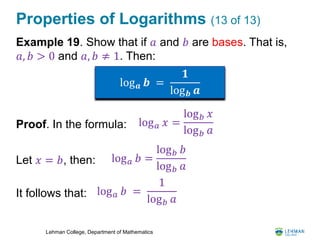
Example 19. Show that if 𝑎 and 𝑏 are bases. That is,
𝑎, 𝑏 > 0 and 𝑎, 𝑏 ≠ 1. Then:
Proof. In the formula:
Let 𝑥 = 𝑏, then:
It follows that:
log 𝒂 𝒃 =
𝟏
log 𝒃 𝒂
log 𝑎 𝑥 =
log 𝑏 𝑥
log 𝑏 𝑎
log 𝑎 𝑏 =
1
log 𝑏 𝑎
log 𝑎 𝑏 =
log 𝑏 𝑏
log 𝑏 𝑎

Lesson 19: Exponential and Logarithmic Functions

  • 1.
    𝐏𝐓𝐒 𝟑 Bridge toCalculus Workshop Summer 2020 Lesson 19 Exponential and Logarithmic Functions "If I have been able to see further, it was only because I stood on the shoulders of giants." – Newton -
  • 2.
    Lehman College, Departmentof Mathematics Review of Rational Exponents (1 of 2) Example 0.1. Write the following as an exponential expression with rational powers: Solution. Example 0.2. Simplify 81− 3 4. Solution. 3 142 3 142 = 142 1 3 = 14 2 3 81− 3 4 = 1 81 3 4 = 1 81 1 4 3 = 1 4 81 3 = 1 33 = 1 27
  • 3.
    Lehman College, Departmentof Mathematics Review of Rational Exponents (2 of 2) Example 0.3. Simplify the expression: Write your answer without using negative exponents. Assume that all variables are positive real numbers. Solution. 𝑎−4 ⋅ 𝑏 1 3 4 5 𝑎−4 ⋅ 𝑏 1 3 4 5 = 𝑎−4 4 5 ⋅ 𝑏 1 3 4 5 = 𝑎− 16 5 ⋅ 𝑏 4 15 = 𝑏 4 15 𝑎 16 5
  • 4.
    Lehman College, Departmentof Mathematics Exponential Function Definition (1 of 1) The exponential function 𝑓 with base 𝑏 is defined by: where 𝑏 is a positive constant other than 1 (𝑏 > 0 and 𝑏 ≠ 1) and 𝑥 is a real number. Here are some examples of exponential functions: Each exponential function has a constant base and a variable exponent. The functions listed below are not exponential functions. For each case, state why not: 𝒇(𝒙) = 𝒃 𝒙 𝑓 𝑥 = 2 𝑥 (a) 𝑔 𝑥 = 10 𝑥 (b) ℎ 𝑥 = 3 𝑥+1 (c) 𝐹 𝑥 = 𝑥2 (d) 𝐺 𝑥 = 1 𝑥(e) 𝐻 𝑥 = −1 𝑥 (f) 𝐽 𝑥 = 𝑥 𝑥(g)
  • 5.
    Lehman College, Departmentof Mathematics Graphing Exponential Functions (1 of 5) Example 1. Graph the exponential function 𝑓 𝑥 = 2 𝑥 : Solution. Set up a table of coordinates then draw graph 𝒙 𝒇 𝒙 = 𝟐 𝒙 1 𝑓 1 = 21 = 2 2 𝑓 2 = 22 = 4 3 𝑓 3 = 23 = 8 0 𝑓 0 = 20 = 1 −1 𝑓 −1 = 2−1 = 1/2 −2 𝑓 −2 = 2−2 = 1/4 −3 𝑓 −3 = 2−3 = 1/8
  • 6.
    Lehman College, Departmentof Mathematics Graphing Exponential Functions (2 of 5) Example 2. Graph the function 𝑔 𝑥 = 1 2 𝑥 Solution. Set up a table of coordinates then draw graph 𝒙 𝒈 𝒙 = 𝟏/𝟐 𝒙 1 𝑔 1 = 1/2 1 = 1/2 2 𝑔 2 = 1/2 2 = 1/4 3 𝑔 3 = 1/2 3 = 1/8 0 𝑔 0 = 1/2 0 = 1 −1 𝑔 −1 = 1/2 −1 = 2 −2 𝑔 −2 = 1/2 −2 = 4 −3 𝑔 −3 = 1/2 −3 = 8
  • 7.
    Lehman College, Departmentof Mathematics Graphing Exponential Functions (3 of 5) Similarly, below we show the graphs of 𝑦 = 3 𝑥 as well as 𝑦 = 1/3 𝑥 : Note that: if 𝑓 𝑥 = 3 𝑥 = 3−𝑥 𝑔 𝑥 = 1 3 𝑥 = 1 𝑥 3 𝑥 = 1 3 𝑥 = 𝑓 −𝑥
  • 8.
    Lehman College, Departmentof Mathematics Graphing Exponential Functions (4 of 5) The graph of 𝑦 = 𝑎 𝑥 , when 𝑎 > 1: Domain: (−∞, ∞) Range: (0, ∞) 𝑦-intercept: (0, 1) Increasing function Continuous function 𝑎 𝑥 → 0 as 𝑥 → −∞
  • 9.
    Lehman College, Departmentof Mathematics Graphing Exponential Functions (5 of 5) The graph of 𝑦 = 𝑎−𝑥 , when 𝑎 > 1: Domain: (−∞, ∞) Range: (0, ∞) 𝑦-intercept: (0, 1) Decreasing function Continuous function 𝑎−𝑥 → 0 as 𝑥 → ∞
  • 10.
    Lehman College, Departmentof Mathematics Exponential Equations (1 of 4) Example 3. Solve the following exponential equation: Solution. We will use the one-to-one property: Example 4. Solve the following exponential equation: Solution. We will use the one-to-one property: 2 𝑥 = 8 2 𝑥 = 8 Write the original equation 2 𝑥 = 23 Convert 8 to a power of 2 𝑥 = 3 Equate the powers of 2 53𝑥−6 = 125 53𝑥−6 = 125 Write the original equation 53𝑥−6 = 53 Convert 125 to a power of 5 3𝑥 − 6 = Equate the powers of 53 3𝑥 = 9 It follows that: 𝑥 = 3
  • 11.
    Lehman College, Departmentof Mathematics Exponential Equations (2 of 4) Example 5. Solve the following exponential equation: Solution. What common base should we use? Example 6. Solve the following exponential equation: Solution. What common base should we use? 8 𝑥+2 = 4 𝑥−3 8 𝑥+2 = 4 𝑥−3 Write the original equation 23 𝑥+2 = Convert 8 and 4 to powers of 2 3𝑥 + 6 = 2𝑥 − 6 Equate the powers of 2 22 𝑥−3 23𝑥+6 = 22𝑥−6 Simplify the exponents 𝑥 = −12 Solve for 𝑥 125 𝑥 = 25 𝑥+2 125 𝑥 = 25 𝑥+2 Write the original equation
  • 12.
    Lehman College, Departmentof Mathematics Exponential Equations (3 of 4) Solution. What common base should we use? 53 𝑥 = Convert 125 and 25 to powers of 5 3𝑥 = 2𝑥 + 4 Equate the powers of 5 52 𝑥+2 53𝑥 = 52𝑥+4 Simplify the exponents 𝑥 = 4 Solve for 𝑥 125 𝑥 = 25 𝑥+2 Write the original equation
  • 13.
    Lehman College, Departmentof Mathematics Exponential Equations (4 of 4) Example 7. Solve the following exponential equation: Solution. What common base should we use? It follows that 𝑥 = −3. 42 4𝑥−6 = Convert 16 to a power of 4 8𝑥 − 12 = 𝑥2 + 14𝑥 − 3 Equate the powers of 4 4 𝑥2+14𝑥−3 48𝑥−12 = 4 𝑥2+14𝑥−3 Simplify the exponents 𝑥2 + 6𝑥 + 9 = 0 Factor the quadratic 164𝑥−6 = 4 𝑥2+14𝑥−3 Write the original equation 164𝑥−6 = 4 𝑥2+14𝑥−3 𝑥 + 3 2 = 0 Simplify
  • 14.
    Lehman College, Departmentof Mathematics Kovalevskaya and Lobachevsky (1 of 1) Nikolai Lobachevsky (1792-1856) - Russian Mathematician Sofya Kovalevskaya (1850-1891) - Russian Mathematician
  • 15.
    Lehman College, Departmentof Mathematics Logarithmic Function Definition (1 of 2) Let 𝑏 is a positive constant other than 1. That is, 𝑏 > 0 and 𝑏 ≠ 1. Let 𝑥 and 𝑦 be real numbers, then: The logarithmic function 𝑓 with base 𝑏 is defined by: Example 8. Write each equation in exponential form: Solution. We use the equivalent definition above: Example 9. Write each equation in logarithmic form: 𝒚 = log 𝒃 𝒙 is equivalent to 𝒃 𝒚 = 𝒙 𝒇(𝒙) = log 𝒃 𝒙 3 = log7 𝑥(a) 2 = log 𝑏 25(b) log4 26 = 𝑦(c) 73 = 𝑥(a) 𝑏2 = 25(b) 4 𝑦 = 26(c) 25 = 𝑥(d) 𝑏3 = 27(e) 𝑒 𝑦 = 33(f)
  • 16.
    Lehman College, Departmentof Mathematics Logarithmic Function Definition (2 of 2) Example 10. Write each equation in logarithmic form: Solution. We use the equivalent definition: 25 = 𝑥(d) 𝑏3 = 27(e) 𝑒 𝑦 = 33(f) 25 = 𝑥(d) log2 𝑥log2 25 = 5 = log2 𝑥 𝑏3 = 27(e) log 𝑏 27log 𝑏 𝑏3 = 3 = log 𝑏 27 𝑒 𝑦 = 33(f) log 𝑒 33log 𝑒 𝑒 𝑦 = 𝑦 = log 𝑒 33
  • 17.
    Lehman College, Departmentof Mathematics Graphing Logarithmic Functions (1 of 1) The graph of 𝑦 = log 𝑎 𝑥, when 𝑎 > 1: Domain: (0, ∞) Range: (−∞, ∞) 𝑥-intercept: (1, 0) Increasing function Continuous function log 𝑎 𝑥 → −∞ as 𝑥 → 0+
  • 18.
    Lehman College, Departmentof Mathematics Natural & Common Logarithms (1 of 2) There are two bases with special notation: Above 𝑒 ≈ 2.718 is the base of natural logarithms. Example 11. Simplify the following expressions: Solution. Rewrite in terms of powers of the bases: log 𝒙 = log 𝟏𝟎 𝒙 ln 𝒙 = log 𝒆 𝒙 log4 16 log 1000 log4 16 log 1000 = log4 42 log 103 = 2 3 (a) log3 27 ln 𝑒5(b) (a) log3 27 ln 𝑒5 =(b) log3 33 ln 𝑒5 = 3 5
  • 19.
    Lehman College, Departmentof Mathematics Properties of Logarithms (1 of 13) Let 𝑏 be a base. That is, 𝑏 > 0 and 𝑏 ≠ 1. Let 𝑥 and 𝑦 be positive numbers, then: Proof. Suppose: Then, the equivalences are: It follows that: log 𝒃 𝒙𝒚 = log 𝒃 𝒙 + log 𝒃 𝒚 log 𝑏 𝑥 = 𝑝 log 𝑏 𝑦 = 𝑞and 𝑥 = 𝑏 𝑝 and 𝑦 = 𝑏 𝑞 𝑥𝑦 = 𝑏 𝑝 ⋅ 𝑏 𝑞 = 𝑏 𝑝+𝑞 log 𝑏 𝑥𝑦 = log 𝑏 𝑏 𝑝+𝑞 = 𝑝 + 𝑞 = log 𝑏 𝑥 + log 𝑏 𝑦
  • 20.
    Lehman College, Departmentof Mathematics Properties of Logarithms (2 of 13) Example 12. Simplify the following expressions: Solution. Rewrite in terms of powers of the bases: log4 8 log 0.0001 log4 8 log 0.0001 = log4 4 ⋅ 2 log 10−4 = log4 4 + log4 2 −4 = 1 + log4 41/2 −4 = 1 + 1 2 −4 = − 3 8
  • 21.
    Lehman College, Departmentof Mathematics Properties of Logarithms (3 of 13) Similarly, we can show that if 𝑏 is a base, and 𝑥 and 𝑦 and positive numbers, then: Finally, if 𝑏 is a base, and 𝑥 is a positive number, then: For any integer 𝑛, Proof. Let log 𝒃 𝒙 𝒚 = log 𝒃 𝒙 − log 𝒃 𝒚 log 𝒃 𝒙 𝒏 = 𝒏 ⋅ log 𝒃 𝒙 log 𝑏 𝑥 = 𝑝 then 𝑥 = 𝑏 𝑝 𝑥 𝑛 = 𝑏 𝑝 𝑛 = 𝑏 𝑛𝑝 log 𝑏 𝑥 𝑛 = log 𝑏 𝑏 𝑛𝑝 = 𝑛 ⋅ 𝑝 = 𝑛 ⋅ log 𝑏 𝑥
  • 22.
    Lehman College, Departmentof Mathematics Properties of Logarithms (4 of 13) Example 13. Solve the following equations: Solution. We use the equivalent definition: 7 𝑥+1 = 1 49 (a) 2𝑥 + 1 = log 0.001(b) log2 8𝑥 = 5(c) (a) 7 𝑥+1 = 1 49 = 1 72 = 7−2 Therefore: 𝑥 + 1 = −2 2𝑥 + 1 = log 0.001(b) = log 10−3 = −3 Therefore: 2𝑥 = −4 and: 𝑥 = −2 and: 𝑥 = −3
  • 23.
    Lehman College, Departmentof Mathematics Properties of Logarithms (5 of 13) Solution (cont’d). We use the equivalent definition: Solution 2. log2 8𝑥 = 5(c) Write the original equation Exponentiate Property of logarithms 2log2 8𝑥 = 25 8𝑥 = 32 𝑥 = 4 Divide both sides by 8 Write the original equation log2 8 + log2 𝑥 = 5 Property of logarithms log2 23 + log2 𝑥 = 5 3 + log2 𝑥 = 5 log2 8𝑥 = 5(c)
  • 24.
    Lehman College, Departmentof Mathematics Properties of Logarithms (6 of 13) Solution 2 (cont’d). Example 14. Solve the equation 10 𝑥2−3𝑥 = 10,000. Solution. Write 10,000 as a power of the base 10. It follows that 𝑥 = 4 or 𝑥 = −1. 3 + log2 𝑥 = 5 log2 𝑥 = 2 Subtract 3 from both sides Exponentiate2log2 𝑥 = 22 𝑥 = 4 10 𝑥2−3𝑥 = 104 𝑥2 − 3𝑥 = 4 𝑥2 − 3𝑥 − 4 = 0 𝑥 − 4 𝑥 + 1 = 0
  • 25.
    Lehman College, Departmentof Mathematics Properties of Logarithms (7 of 13) Example 15. Solve the equation: Solution. The roots of the quadratic are: 𝑥 = 4 and 𝑥 = −3. From the original equation, the only solution is 𝑥 = 4. log2 𝑥 − 3 + log2 𝑥 + 2 = log2 6 log2 𝑥 − 3 + log2 𝑥 + 2 = log2 6 log2 𝑥 − 3 𝑥 + 2 = log2 6 2log2 𝑥−3 𝑥+2 = 2log2 6 𝑥 − 3 𝑥 + 2 = 6 𝑥2 − 𝑥 − 6 = 6 𝑥2 − 𝑥 − 12 = 0 𝑥 − 4 𝑥 + 3 = 0
  • 26.
    Lehman College, Departmentof Mathematics Properties of Logarithms (8 of 13) Example 16. Solve the equation: Solution. log7 𝑥 − 1 − log7 𝑥 + 1 = log7 𝑥 + 5 log7 𝑥 − 1 − log7 𝑥 + 1 = log7 𝑥 + 5 log7 𝑥 − 1 𝑥 + 1 = log7 𝑥 + 5 7log7 𝑥−1 𝑥+1 = 7log7 𝑥+5 𝑥 − 1 𝑥 + 1 = 𝑥 + 5 𝑥 + 1 𝑥 + 5 = 𝑥 − 1 𝑥2 + 6𝑥 + 5 = 𝑥 − 1
  • 27.
    Lehman College, Departmentof Mathematics Properties of Logarithms (9 of 13) Solution (cont’d). From the previous slide: The roots of the quadratic are: 𝑥 = −2 and 𝑥 = −3. The original equation was: From the original equation, there is no solution. 𝑥2 + 6𝑥 + 5 = 𝑥 − 1 𝑥2 + 5𝑥 + 6 = 0 𝑥 + 2 (𝑥 + 3) = 0 log7 𝑥 − 1 − log7 𝑥 + 1 = log7 𝑥 + 5
  • 28.
    Lehman College, Departmentof Mathematics Properties of Logarithms (10 of 13) Let 𝑎 and 𝑏 be bases. That is, 𝑎, 𝑏 > 0 and 𝑎, 𝑏 ≠ 1. Let 𝑥 be a positive number, then: Proof. Let: This implies that: It follows that: log 𝒂 𝒙 = log 𝒃 𝒙 log 𝒃 𝒂 log 𝑏 𝑥 = 𝑝 then 𝑥 = 𝑏 𝑝 and let: log 𝑎 𝑥 = 𝑞 then 𝑥 = 𝑎 𝑞 𝑥 = 𝑏 𝑝 = 𝑎 𝑞 log 𝑏 𝑥 = 𝑝 = 𝑞 ⋅ log 𝑏 𝑎 = log 𝑎 𝑥 ⋅ log 𝑏 𝑎 log 𝑏 𝑎 𝑞 = log 𝑎 𝑥 = log 𝑏 𝑥 log 𝑏 𝑎
  • 29.
    Lehman College, Departmentof Mathematics Properties of Logarithms (11 of 13) Example 17. Use the change of base formula to find: Solution. The change of base formula is given by: Since most calculators only compute logarithms base 10 or base 𝑒 (denoted log or ln, respectively): log7 4 log 𝑎 𝑥 = log 𝑏 𝑥 log 𝑏 𝑎 log7 4 = ln 4 ln 7 ≈ 0.712
  • 30.
    Lehman College, Departmentof Mathematics Properties of Logarithms (12 of 13) Example 18. Use the change of base formula to find 𝑥: Solution. log8 15 𝑥−2 = 5 log8 15 𝑥−2 = 5 Write the original equation (𝑥 − 2) log8 15 = 5 Property of logarithms 𝑥 − 2 = 5 log8 15 Divide by log8 15 𝑥 = 2 + 5 log8 15 𝑥 = 2 + 5 ln 15 ln 8 Add 2 to both sides Change of base formula
  • 31.
    Lehman College, Departmentof Mathematics Properties of Logarithms (13 of 13) Example 19. Show that if 𝑎 and 𝑏 are bases. That is, 𝑎, 𝑏 > 0 and 𝑎, 𝑏 ≠ 1. Then: Proof. In the formula: Let 𝑥 = 𝑏, then: It follows that: log 𝒂 𝒃 = 𝟏 log 𝒃 𝒂 log 𝑎 𝑥 = log 𝑏 𝑥 log 𝑏 𝑎 log 𝑎 𝑏 = 1 log 𝑏 𝑎 log 𝑎 𝑏 = log 𝑏 𝑏 log 𝑏 𝑎