
RATIONAL
EXPRESSIONS
1 – Evaluating Rational Expressions
2 – Simplifying Rational Expressions
3 – Multiplying and Dividing Rational Expressions
4 – Adding and Subtracting Rational Expressions with the
Same Denominator and Least Common Denominators
5 – Adding and Subtracting Rational Expressions with
Different Denominators
6 – Solving Equations Containing Rational Expressions
7 – Problem Solving with Rational Expressions
8 – Simplifying Complex Fractions
SECTIONS
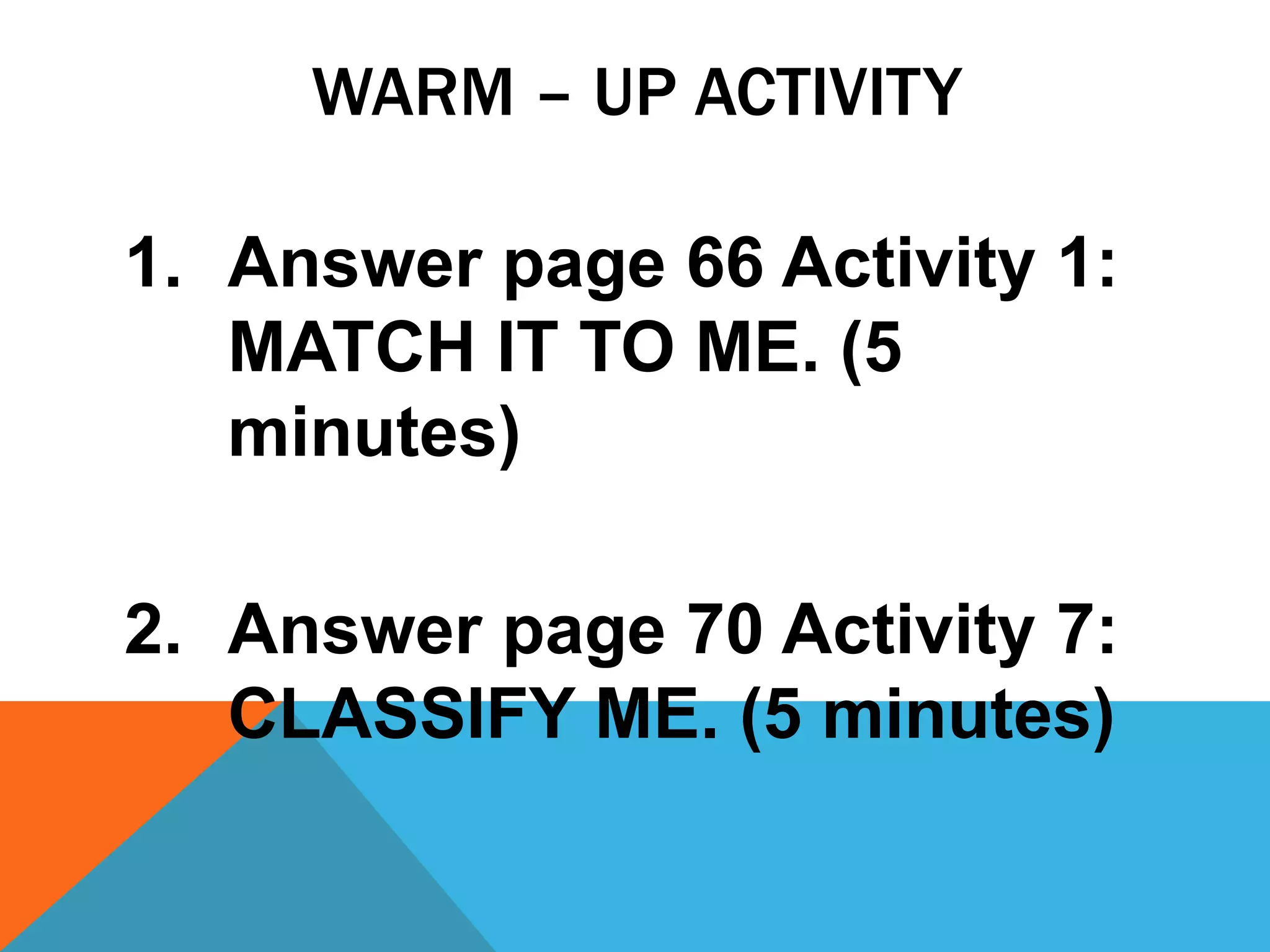
WARM – UP ACTIVITY
1. Answer page 66 Activity 1:
MATCH IT TO ME. (5
minutes)
2. Answer page 70 Activity 7:
CLASSIFY ME. (5 minutes)
RATIONAL EXPRESSIONS
Q
P
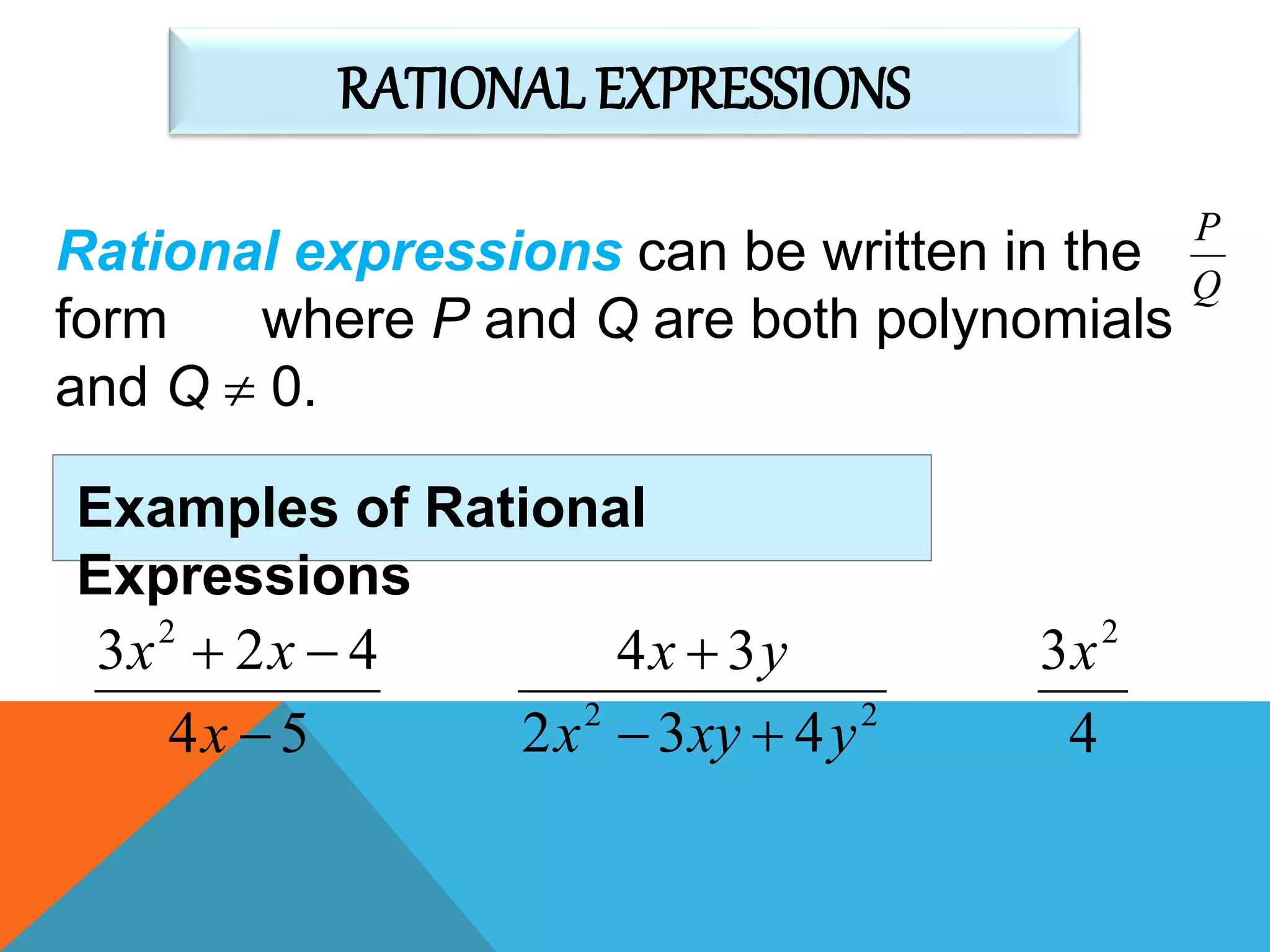
Rational expressions can be written in the
form where P and Q are both polynomials
and Q  0.
Examples of Rational
Expressions
54
423 2


x
xx
22
432
34
yxyx
yx


4
3 2
x
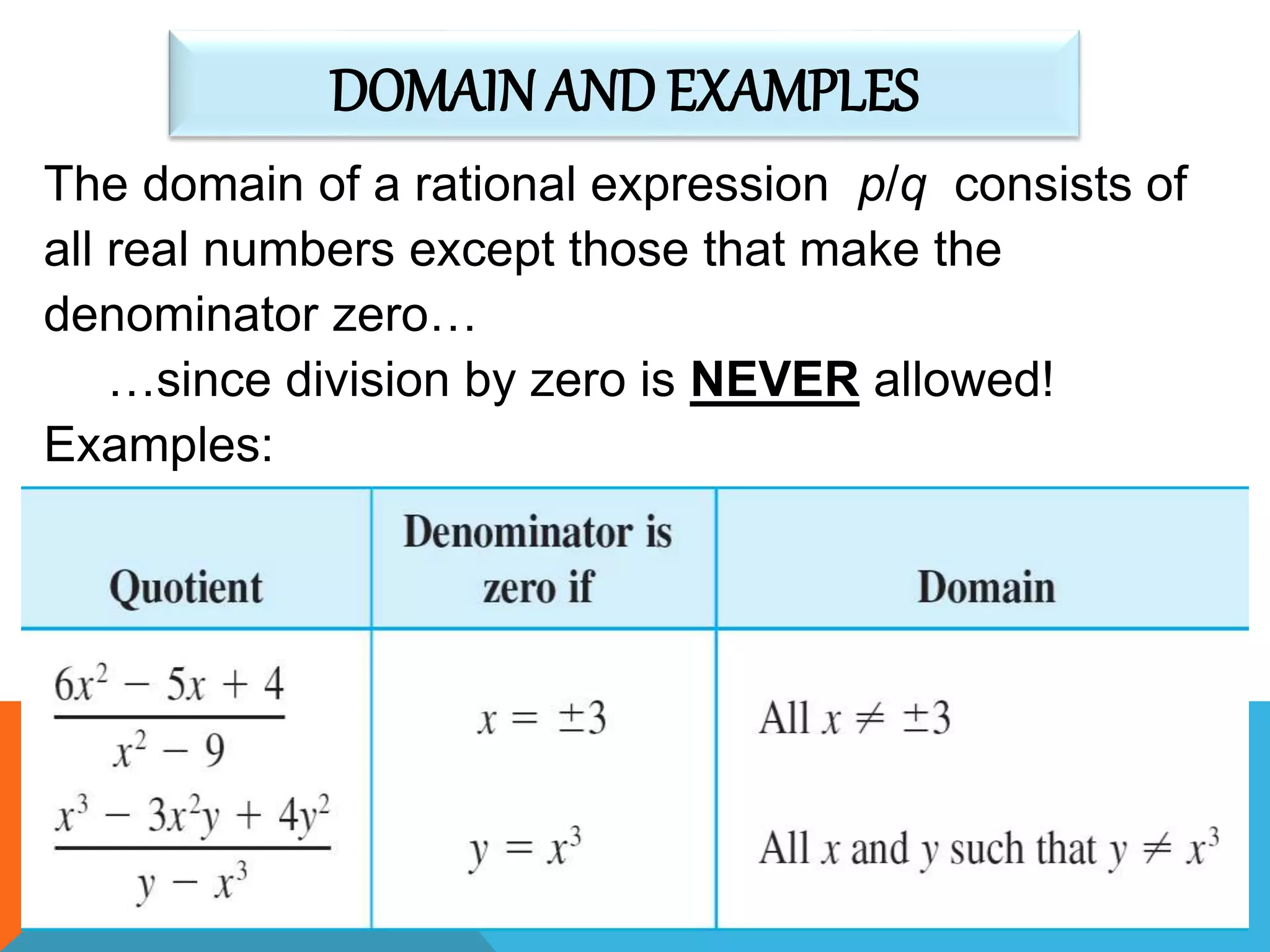
The domain of a rational expression p/q consists of
all real numbers except those that make the
denominator zero…
…since division by zero is NEVER allowed!
Examples:
DOMAIN AND EXAMPLES
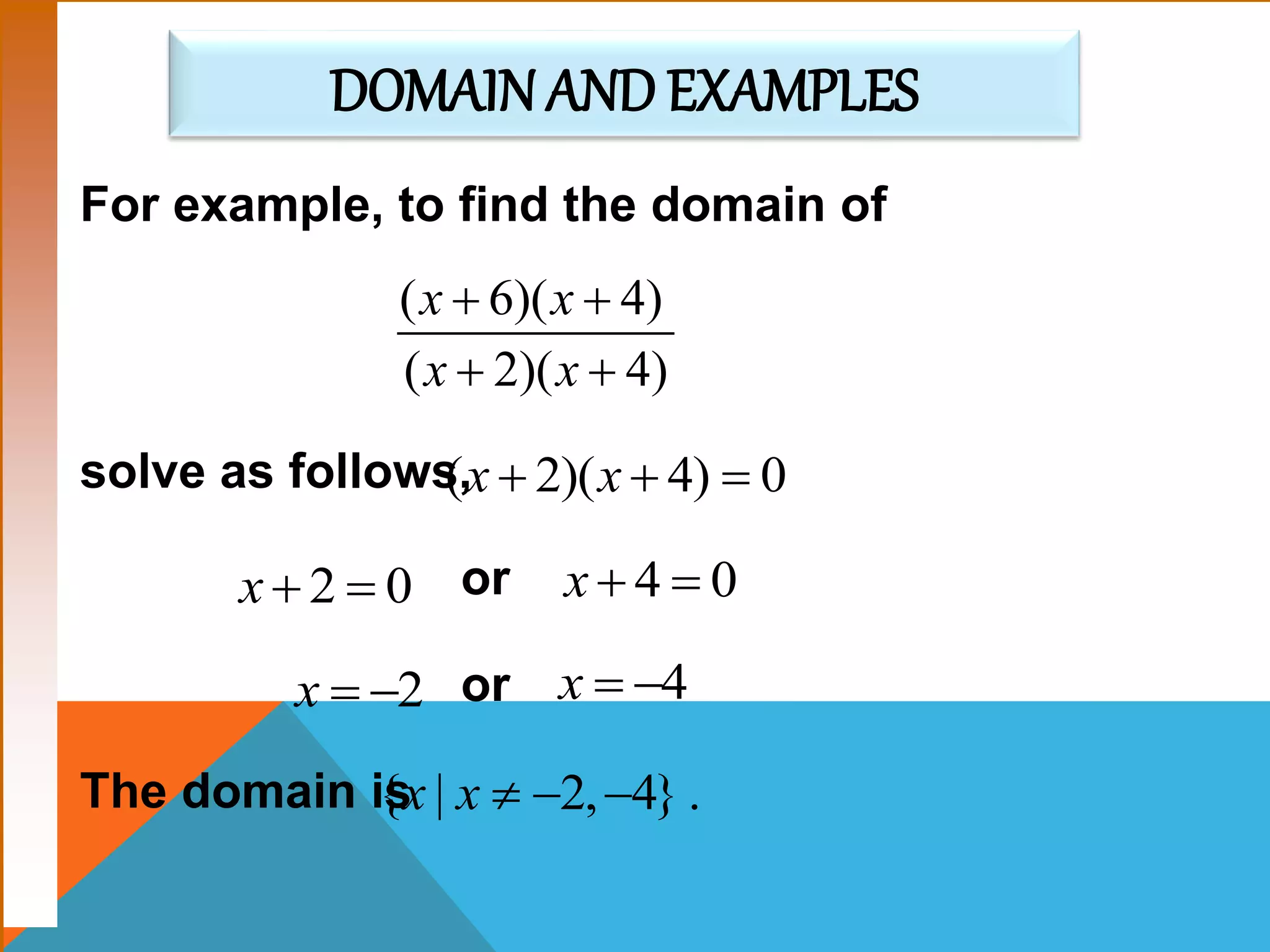
For example, to find the domain of
solve as follows,
or
or
The domain is
( 6)( 4)
( 2)( 4)
x x
x x
 
 
( 2)( 4) 0x x  
2 0x   4 0x  
2x   4x  
{ | 2, 4} .x x   
DOMAIN AND EXAMPLES
SUMMARY:
The domain of a rational expression
is the set of real numbers for which
the expression is defined.
The domain consists of all real
numbers except those that make
the denominator 0.
EVALUATING
RATIONAL
EXPRESSIONS
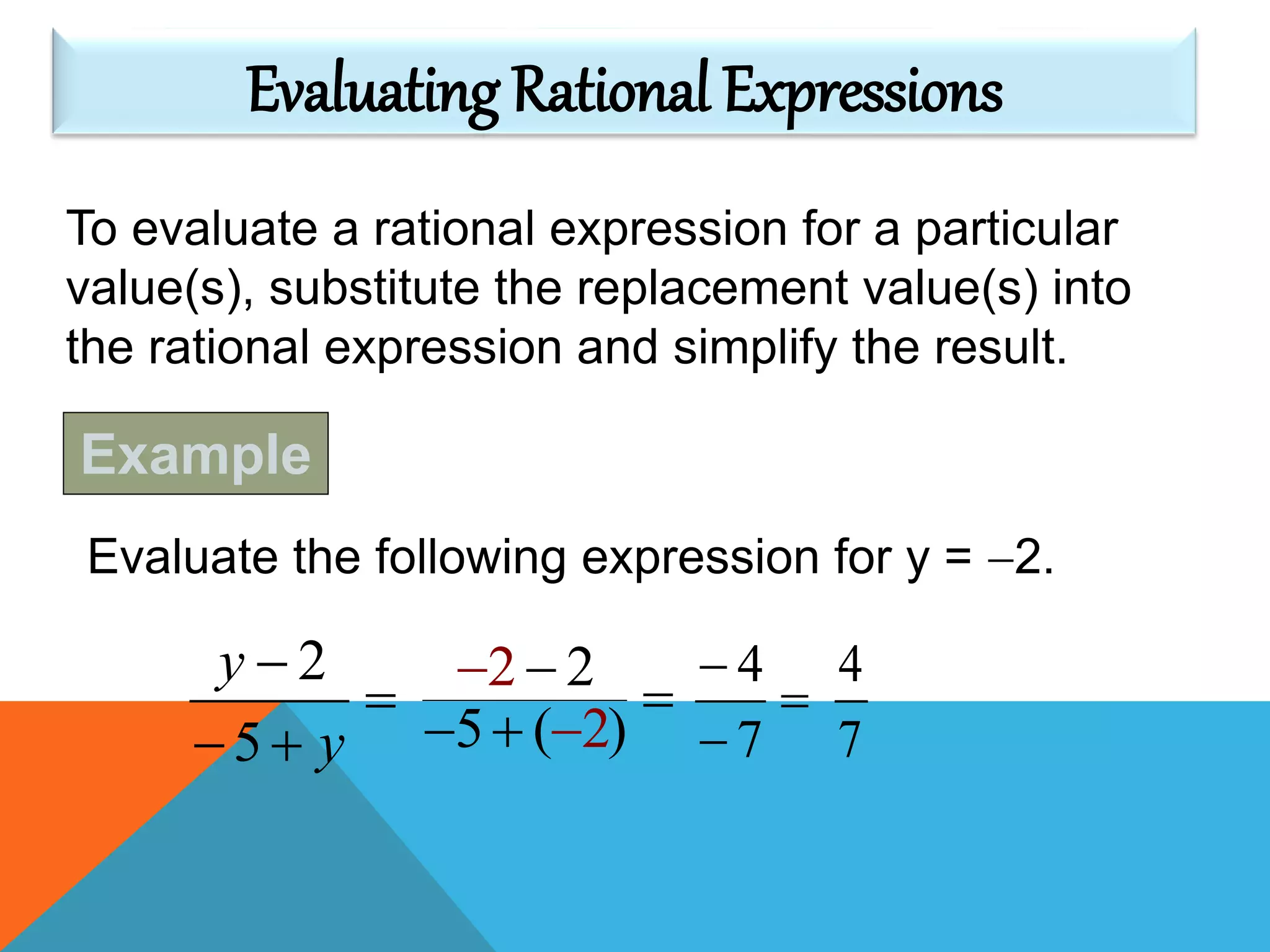
To evaluate a rational expression for a particular
value(s), substitute the replacement value(s) into
the rational expression and simplify the result.
Evaluating Rational Expressions
Example
Evaluate the following expression for y = 2.



y
y
5
2
)
2 2
( 25


 





7
4
7
4
In the previous example, what would happen
if we tried to evaluate the rational
expression for y = 5?



y
y
5
2 5 2
5 5


  0
3
This expression is UNDEFINED!
Evaluating Rational Expressions
We have to be able to determine when
a rational expression is undefined.
A rational expression is undefined
when the denominator is equal to zero.
The numerator being equal to zero is
okay (the rational expression simply
equals zero).
Undefined Rational Expressions
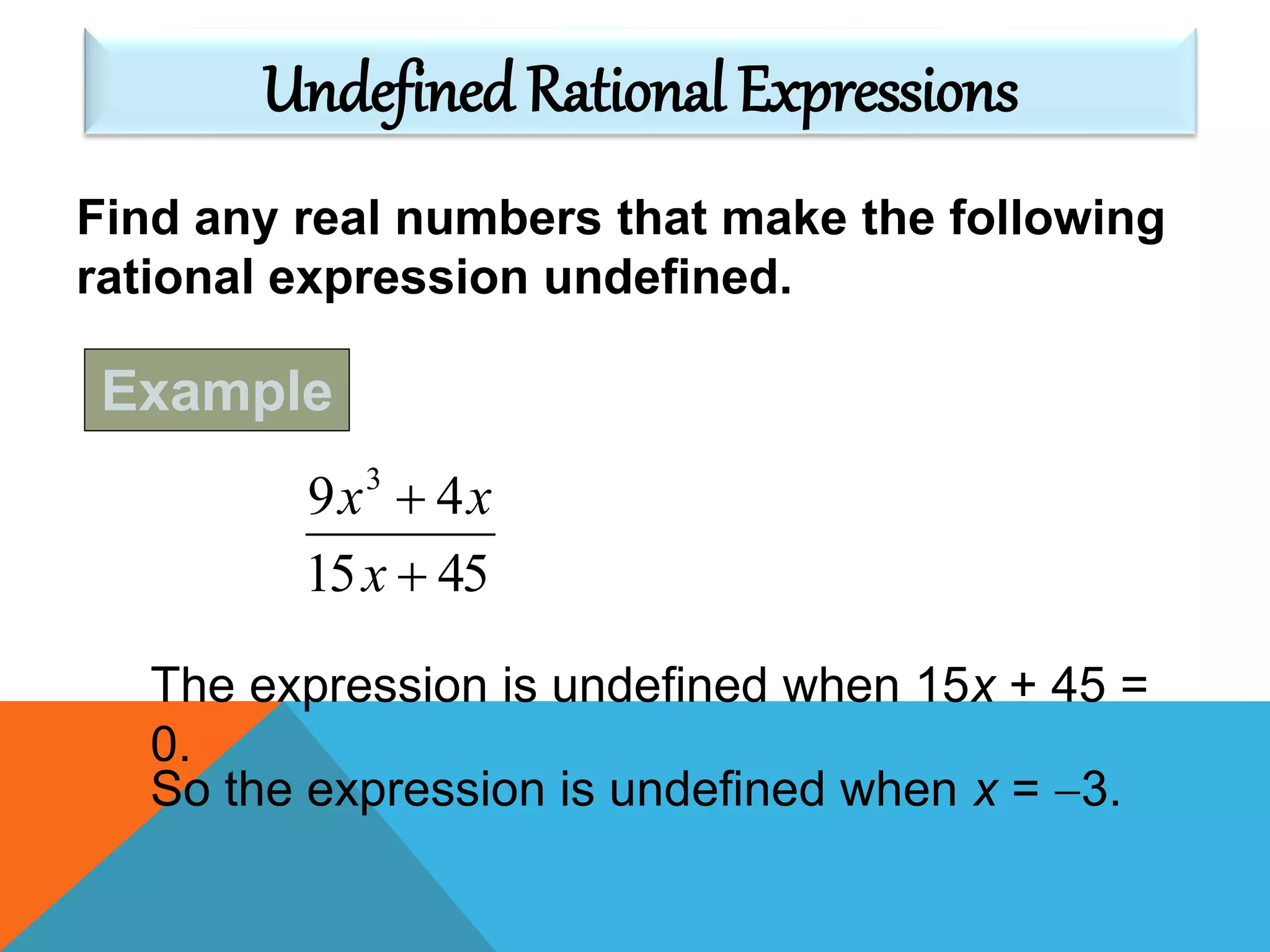
Find any real numbers that make the following
rational expression undefined.
4515
49 3


x
xx
The expression is undefined when 15x + 45 =
0.
So the expression is undefined when x = 3.
Undefined Rational Expressions
Example
NOW YOU TRY! 
Evaluate each rational expression.
1.
𝟑𝒙+𝟓
𝒙+𝟑
if x = 4
2.
𝟓𝒙 𝟐−𝟏
𝒙+𝟐
if x = −2
3.
4𝑦𝑧
3𝑥2 𝑦2 if x = 2, y = −1 and z = 0
4.
3𝑥𝑧
4(𝑥+2)
if x = 0 and z = −5
5.
𝑥2+3𝑥−2
1−2𝑥
if x = -2
SIMPLIFYING
RATIONAL
EXPRESSIONS
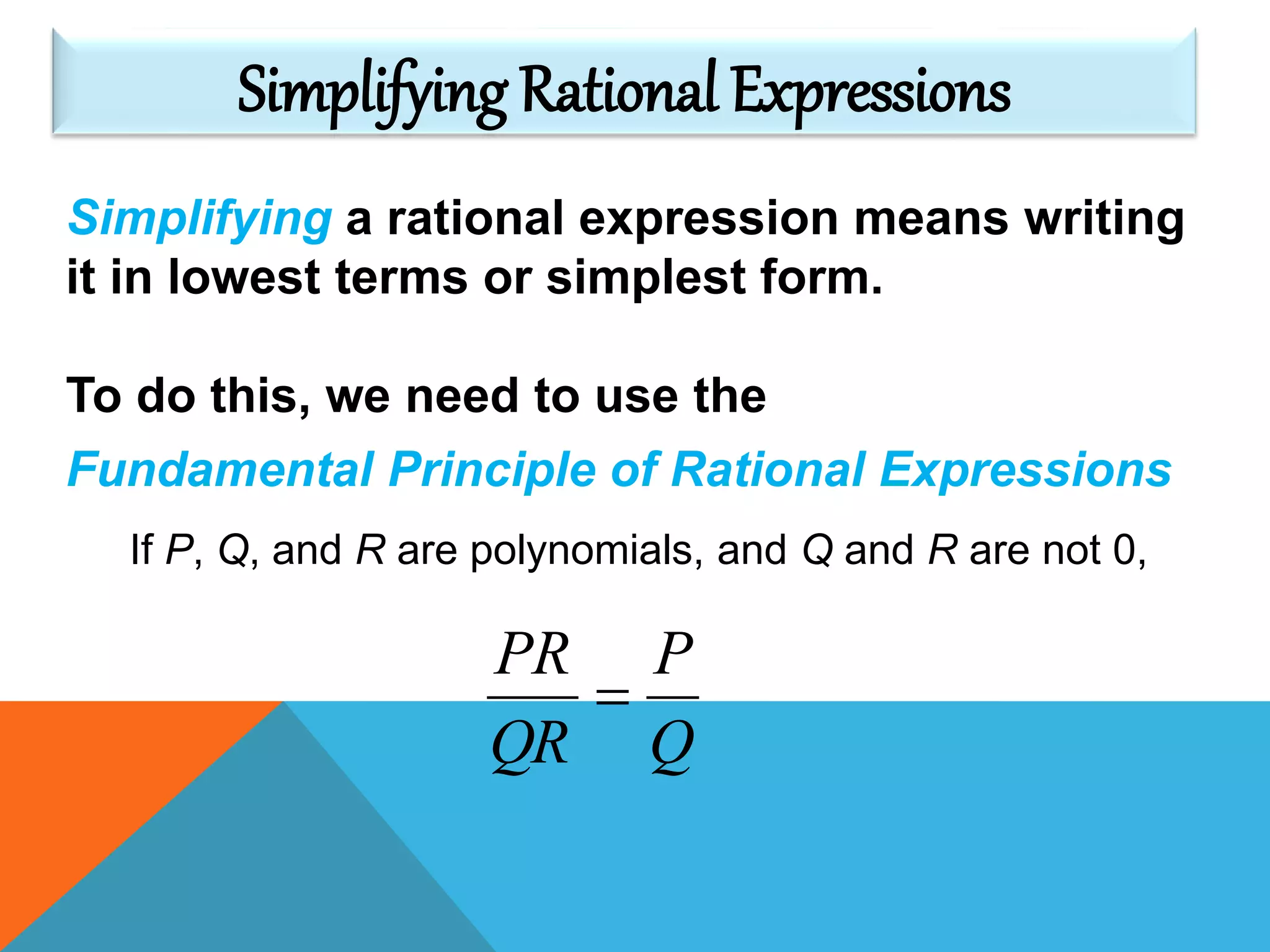
Simplifying a rational expression means writing
it in lowest terms or simplest form.
To do this, we need to use the
Fundamental Principle of Rational Expressions
If P, Q, and R are polynomials, and Q and R are not 0,
Q
P
QR
PR

Simplifying Rational Expressions
Simplifying a Rational Expression
1) Completely factor the numerator and
denominator.
2) Apply the Fundamental Principle of
Rational Expressions to eliminate common
factors in the numerator and denominator.
Warning!
Only common FACTORS can be eliminated
from the numerator and denominator. Make
sure any expression you eliminate is a
factor.
Warm Up
Simplify each expression.
1. 2.
Factor each expression.
3. x2 + 5x + 6 4. 4x2 – 64
(x + 2)(x + 3)
5. 2x2 + 3x + 1 6. 9x2 + 60x + 100
(2x + 1)(x + 1) (3x +10)2
W H E N S I M P L I F Y I N G A R AT I O N A L
E X P R E S S I O N , B E G I N B Y
FA C TO R I N G O U T T H E G R E AT E S T
C O M M O N FA C TO R I N T H E
N U M E R ATO R A N D D E N O M I N ATO R .
N E X T, FA C TO R T H E N U M E R ATO R
A N D D E N O M I N ATO R C O M P L E T E LY.
T H E N C A N C E L A N Y C O M M O N
FA C TO R S .
(2x – 8)(2x + 8)
EXAMPLE VIDEO ON SIMPLIFYING
RATIONAL EXPRESSIONS
MATH 8Rational Expressions_ Writing in Lowest Terms - Ex 1.mp4
Example 2: Simplifying Rational
Expressions
Simplify each rational expression, if possible. Identify
any excluded values.
Factor 14.
4
Simplify the following expression.



xx
x
5
357
2



)5(
)5(7
xx
x
x
7
Example
Simplify the following expression.



20
43
2
2
xx
xx



)4)(5(
)1)(4(
xx
xx
5
1


x
x
Example
Simplify the following expression.



7
7
y
y



7
)7(1
y
y
1
Example
Simplify the expression:


2
25 100
5 10
t
t
   22
Solution:
25 4 25 2 ( 2)25 100
5 10 5( 2) 5( 2)
5 25
t t tt
t t t
  
 
  

 2 ( 2)t t 
5 ( 2)t 
5( 2)t 
More Example
Simplify the expression:


3
4 12
x
x
Solution:
3 3
4 12 4( 3)
Note that 1( ) .
Thus, 3 1(3 ).
3 3
So we have
4( 3)
x x
x x
a b b a
x x
x x
x
 

 
   
   
 

 4 1(3 )x 
1
.
4
 
More Example
NOW YOU TRY!
ACTIVITY
TIME
MULTIPLYING AND DIVIDING
RATIONAL EXPRESSIONS
MULTIPLYING RATIONALEXPRESSIONS
Multiplying rational expressions when P,
Q, R, and S are polynomials with Q  0
and S  0.
QS
PR
S
R
Q
P

Note that after multiplying such expressions,
our result may not be in simplified form, so we
use the following techniques.
Multiplying rational expressions
1) Factor the numerators and
denominators.
2) Multiply the numerators and multiply
the denominators.
3) Simplify or write the product in lowest
terms by applying the fundamental
principle to all common factors.
Multiply the following rational expressions.

12
5
10
6
3
2
x
x
x
4
1



32252
532
xxx
xxx
Example
Multiply the following rational expressions.





mnm
m
nm
nm
2
2
)(
)()(
))((
nmmnm
mnmnm


nm
nm



Example
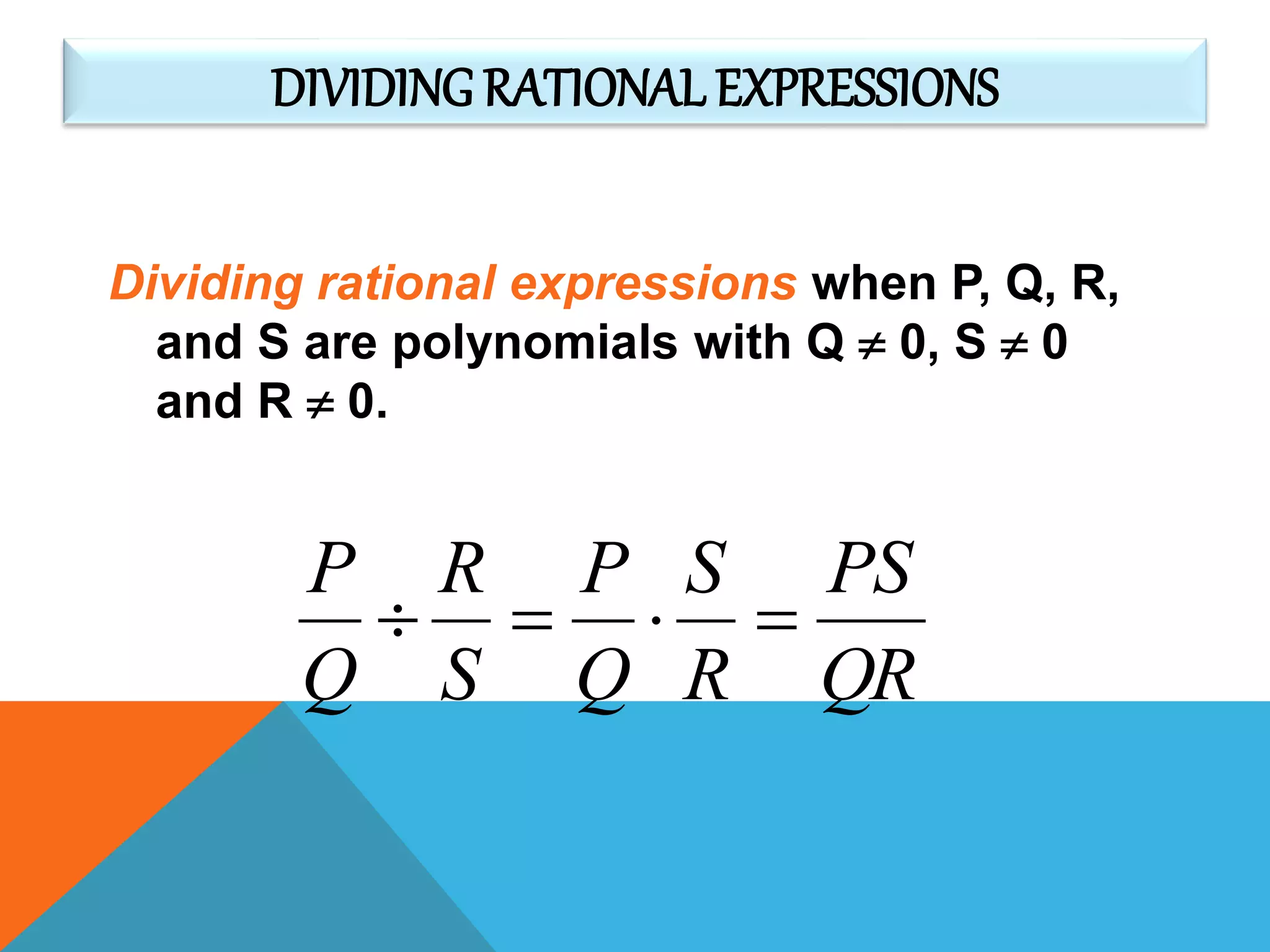
DIVIDING RATIONAL EXPRESSIONS
Dividing rational expressions when P, Q, R,
and S are polynomials with Q  0, S  0
and R  0.
QR
PS
R
S
Q
P
S
R
Q
P

When dividing rational expressions,
first change the division into a
multiplication problem, where you
use the reciprocal of the divisor as
the second factor.
Then treat it as a multiplication
problem (factor, multiply, simplify).
DIVIDING RATIONAL EXPRESSIONS
Divide the following rational expression.




25
155
5
)3( 2
xx




155
25
5
)3( 2
x
x



)3(55
55)3)(3(
x
xx
3x
Example
UNITS OF MEASURE
Converting Between Units of Measure
Use unit fractions (equivalent to 1), but with
different measurements in the numerator
and denominator.
Multiply the unit fractions like rational
expressions, canceling common units in the
numerators and denominators.
Convert 1008 square inches into square feet.













in12
ft1
in12
ft1
ft.sq.7
(1008 sq in)
(2·2·2·2·3·3·7 in ·
in)















in
ft
in
ft
322
1
322
1
Example
ADDING AND SUBTRACTING RATIONAL
EXPRESSIONS WITH THE SAME
DENOMINATOR AND LEAST COMMON
DENOMINATORS
RATIONAL EXPRESSIONS
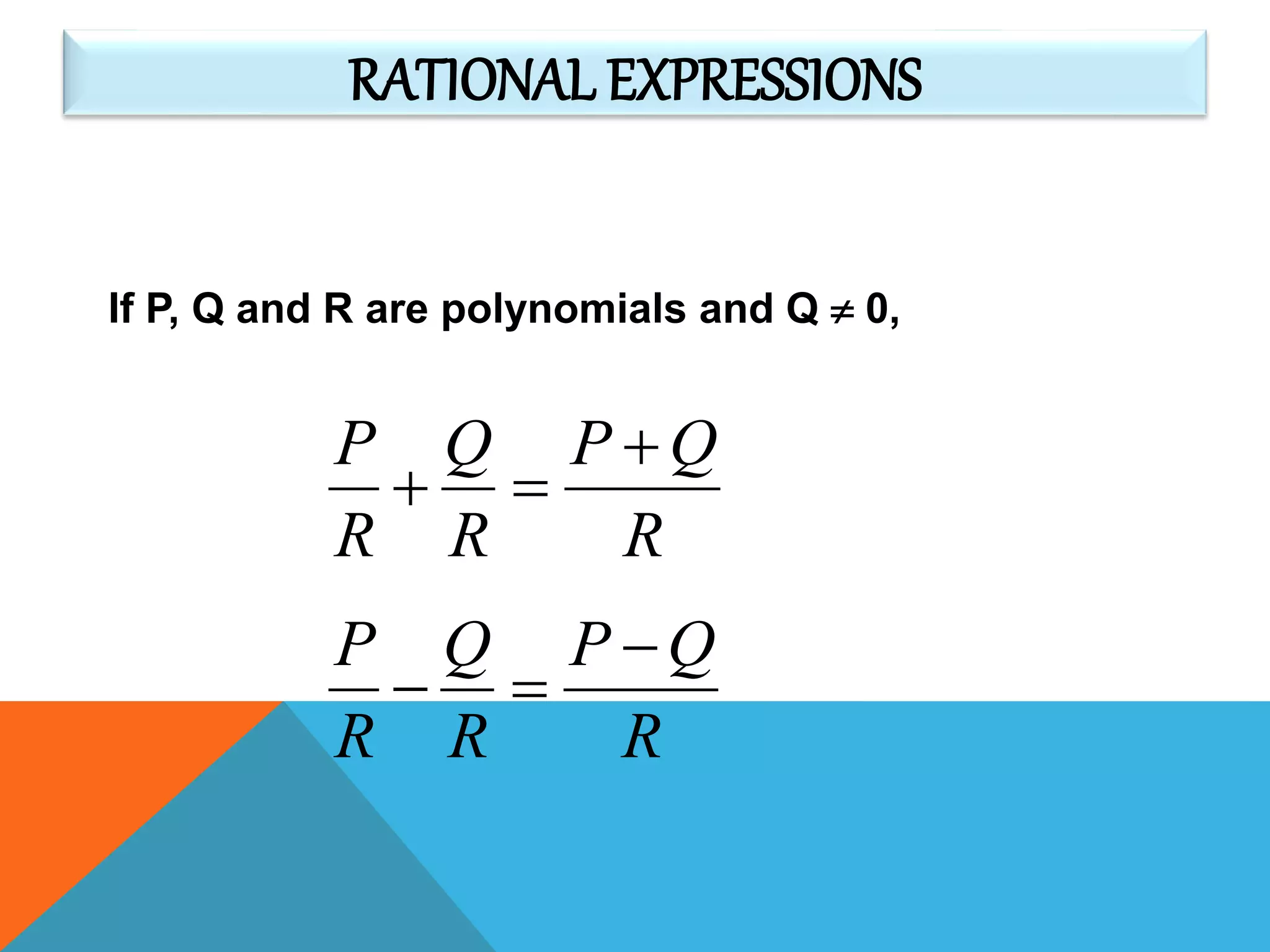
If P, Q and R are polynomials and Q  0,
R
QP
R
Q
R
P 

R
QP
R
Q
R
P 

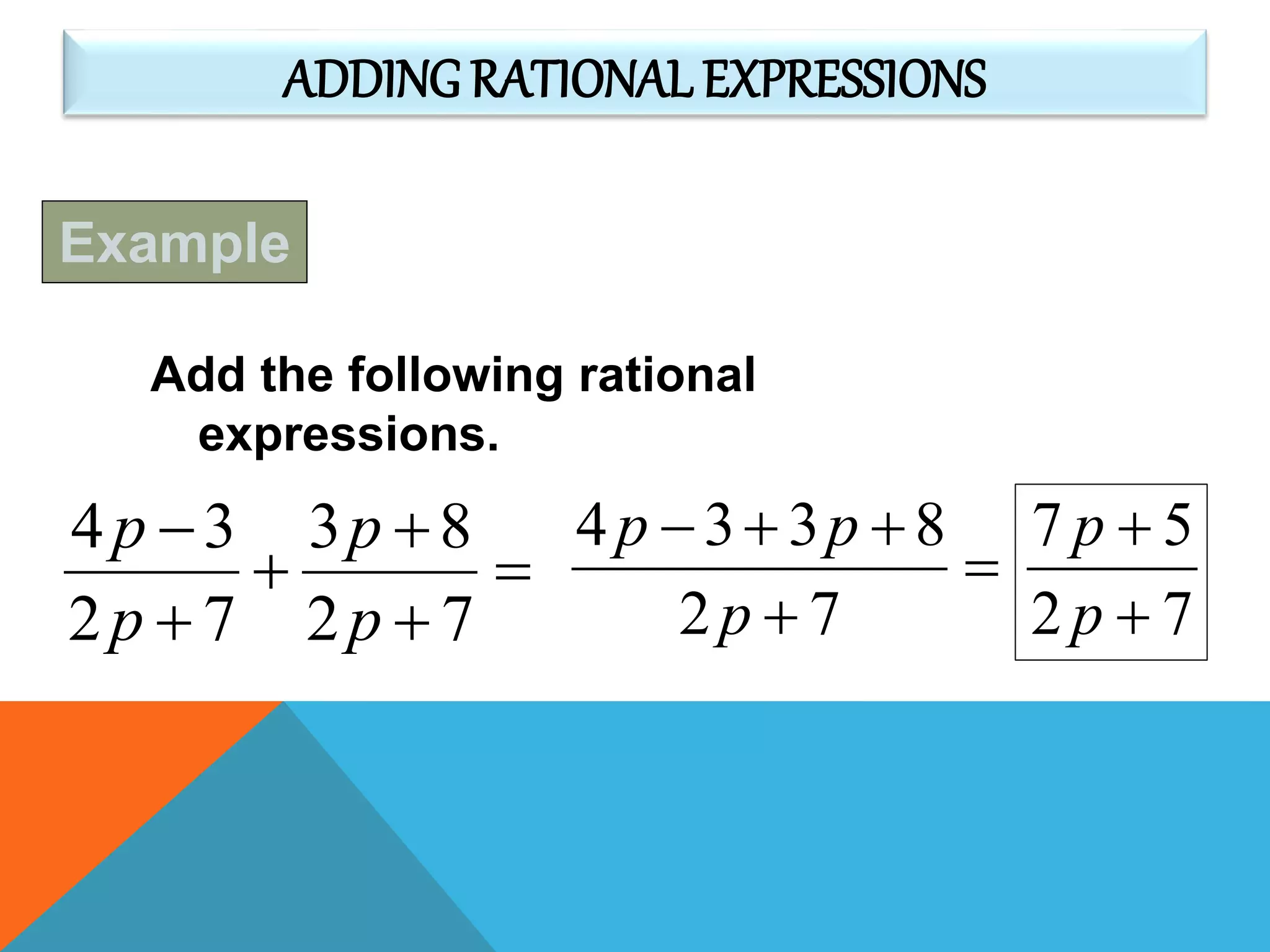
ADDING RATIONAL EXPRESSIONS
Add the following rational
expressions.






72
83
72
34
p
p
p
p
72
57


p
p



72
8334
p
pp
Example
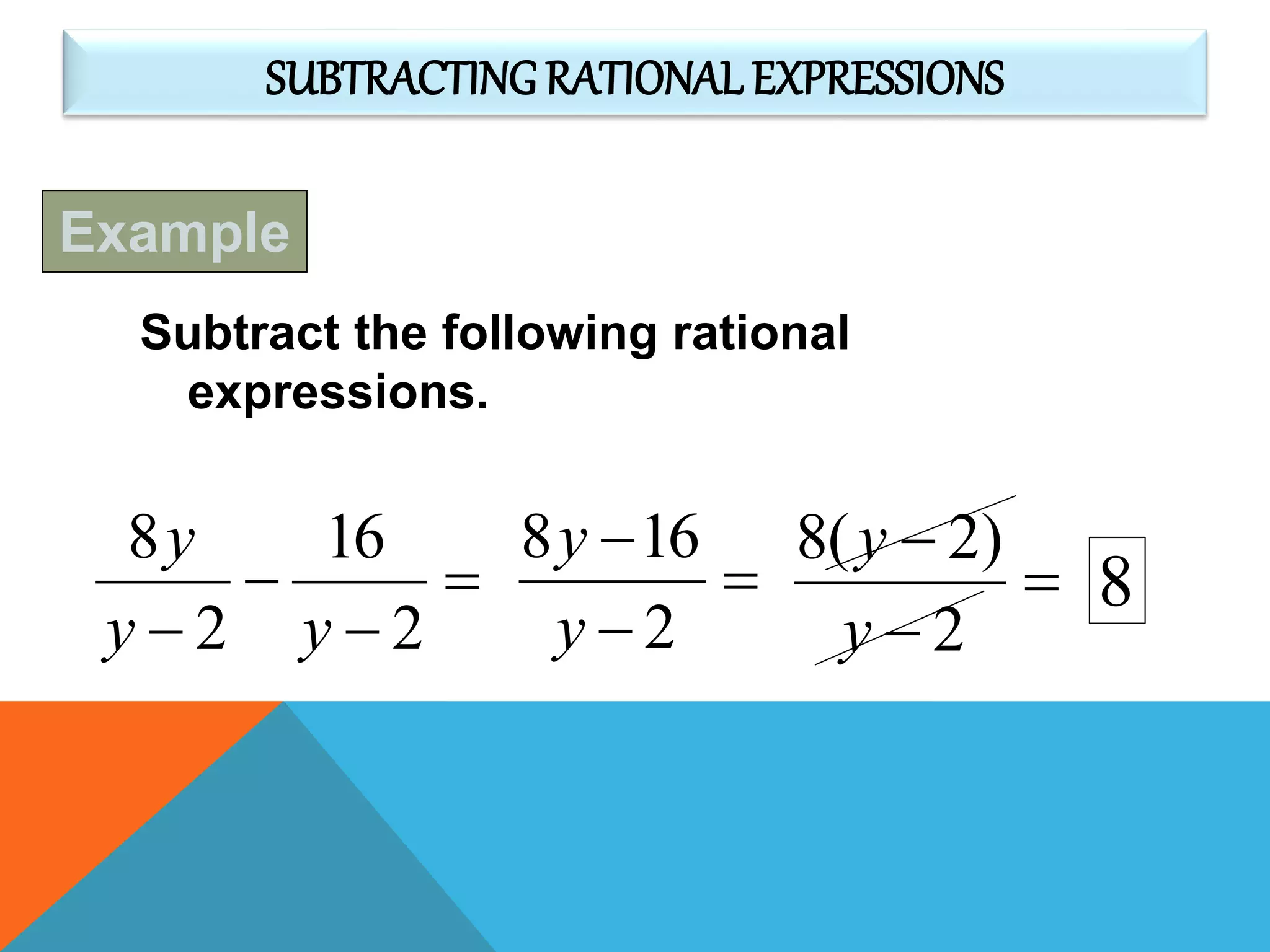
SUBTRACTING RATIONAL EXPRESSIONS
Subtract the following rational
expressions.



 2
16
2
8
yy
y



2
168
y
y



2
)2(8
y
y
8
Example
Subtract the following rational
expressions.



 103
6
103
3
22
yyyy
y



103
63
2
yy
y



)2)(5(
)2(3
yy
y
5
3
y
Example
LEAST COMMONDENOMINATORS
To add or subtract rational expressions with
unlike denominators, you have to change
them to equivalent forms that have the
same denominator (a common
denominator).
This involves finding the least common
denominator of the two original rational
expressions.
To find a Least Common Denominator:
1) Factor the given denominators.
2) Take the product of all the unique
factors.
Each factor should be raised to a
power equal to the greatest number of times
that factor appears in any one of the
factored denominators.
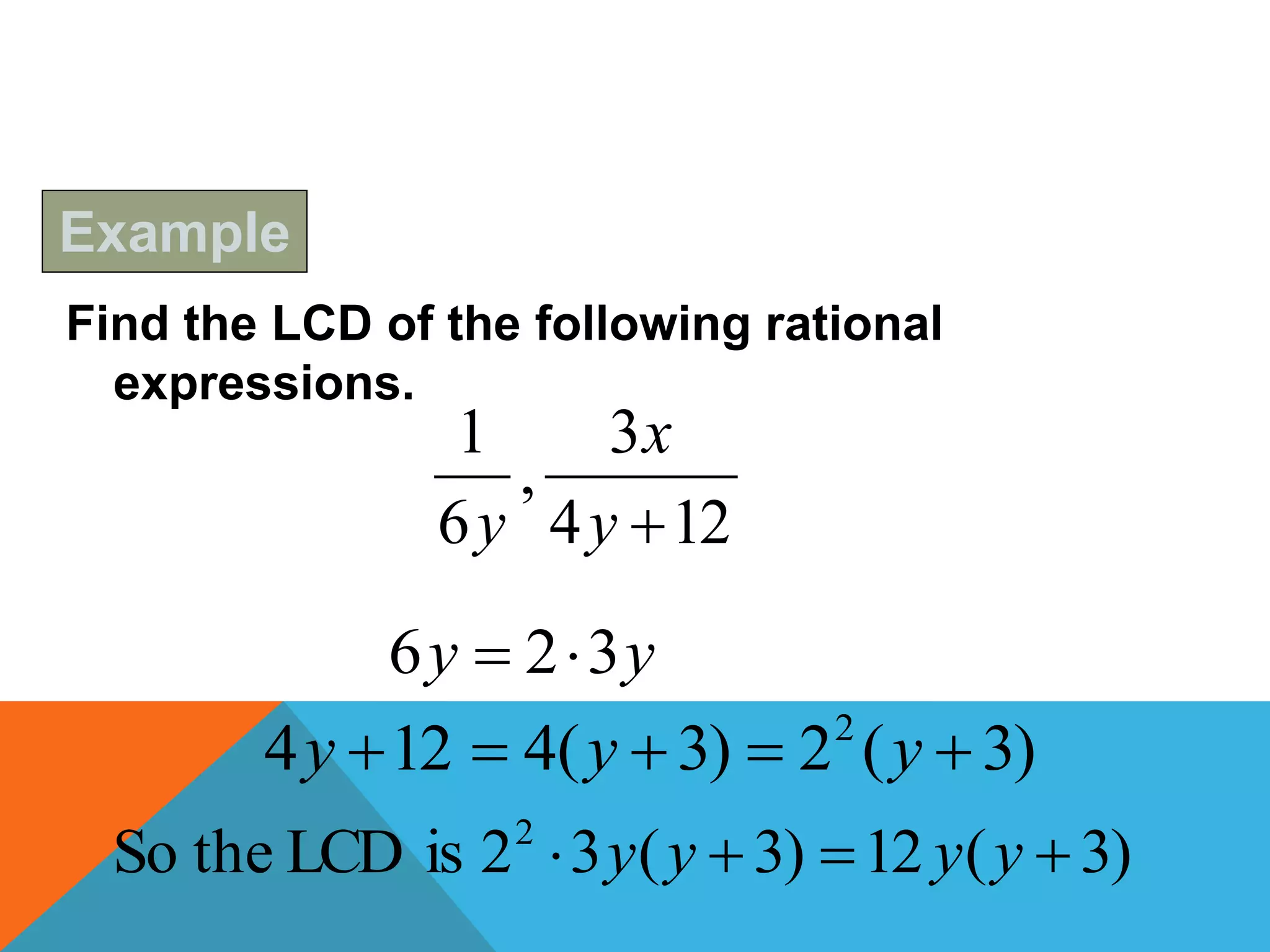
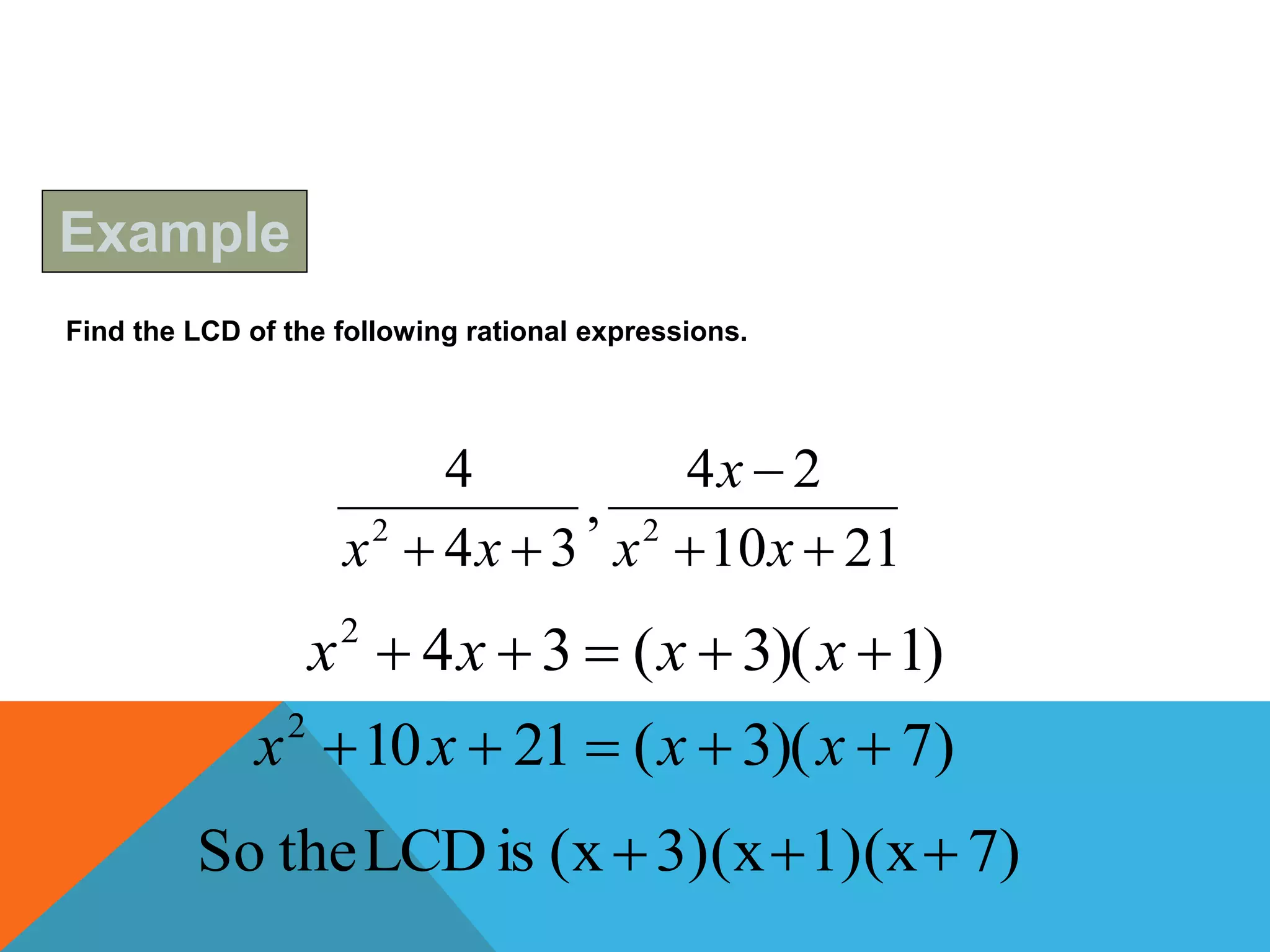
Find the LCD of the following rational
expressions.
124
3
,
6
1
y
x
y
yy 326 
)3(2)3(4124 2
 yyy
)3(12)3(32isLCDtheSo 2
 yyyy
Example
Find the LCD of the following rational expressions.
2110
24
,
34
4
22


 xx
x
xx
)1)(3(342
 xxxx
)7)(3(21102
 xxxx
7)1)(x3)(x(xisLCDtheSo 
Example
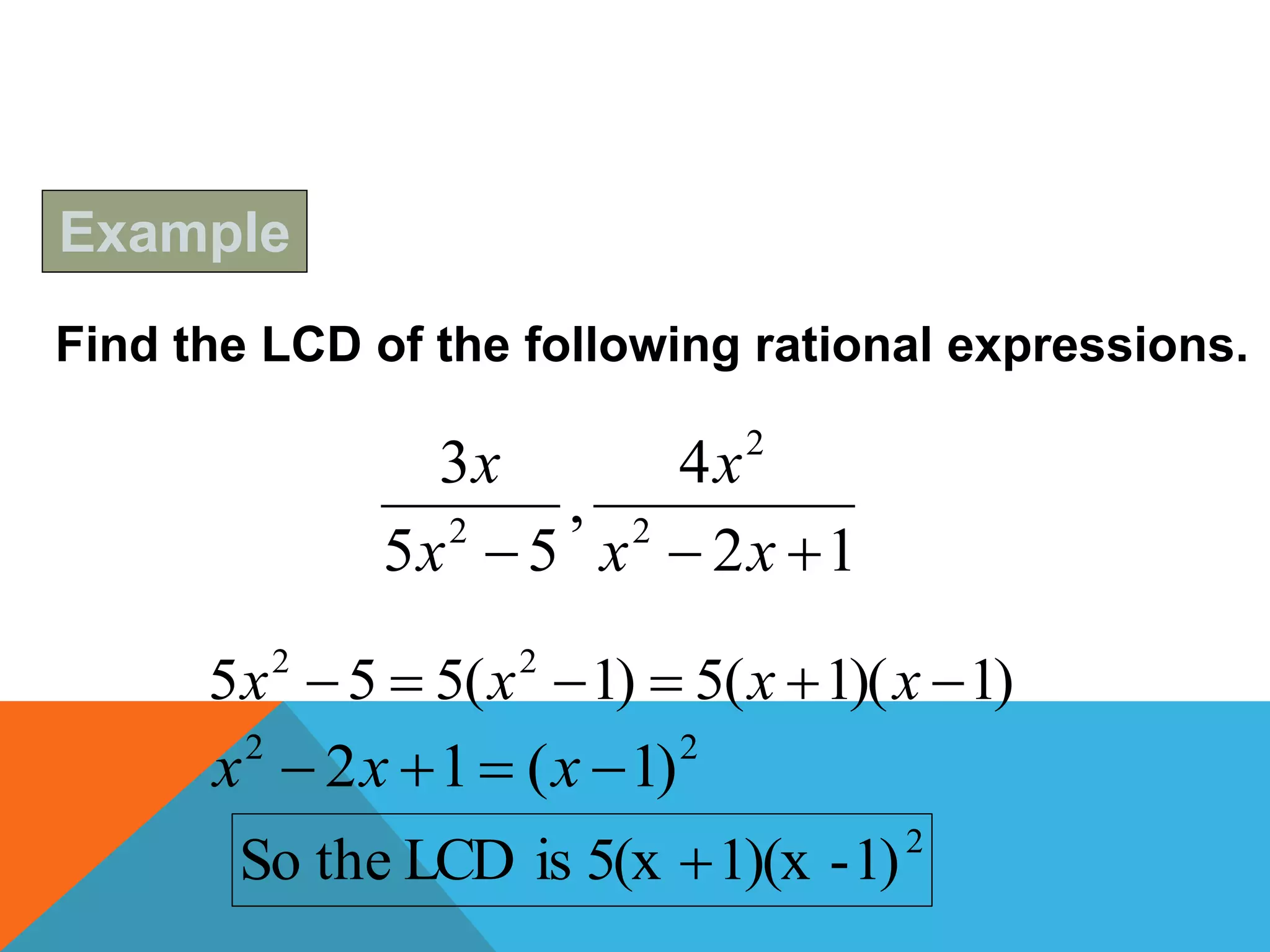
Find the LCD of the following rational expressions.
12
4
,
55
3
2
2
2
 xx
x
x
x
)1)(1(5)1(555 22
 xxxx
22
)1(12  xxx
2
1)-1)(x5(xisLCDtheSo 
Example
Find the LCD of the following rational expressions.
xx  3
2
,
3
1
Both of the denominators are already factored.
Since each is the opposite of the other, you can
use either x – 3 or 3 – x as the LCD.
Example
MULTIPLYING BY 1
To change rational expressions into
equivalent forms, we use the principal that
multiplying by 1 (or any form of 1), will give
you an equivalent expression.
RQ
RP
R
R
Q
P
Q
P
Q
P


 1
EQUIVALENTEXPRESSIONS
Rewrite the rational expression as an
equivalent rational expression with the given
denominator.
95
729
3
yy

5
9
3
y
 4
4
5
8
8
9
3
y
y
y 9
4
72
24
y
y
Example
ADDING AND SUBTRACTING
RATIONAL EXPRESSIONS WITH
DIFFERENT DENOMINATORS
UNLIKE DENOMINATORS
As stated in the previous section, to
add or subtract rational expressions
with different denominators, we have
to change them to equivalent forms
first.
Adding or Subtracting Rational Expressions
with Unlike Denominators
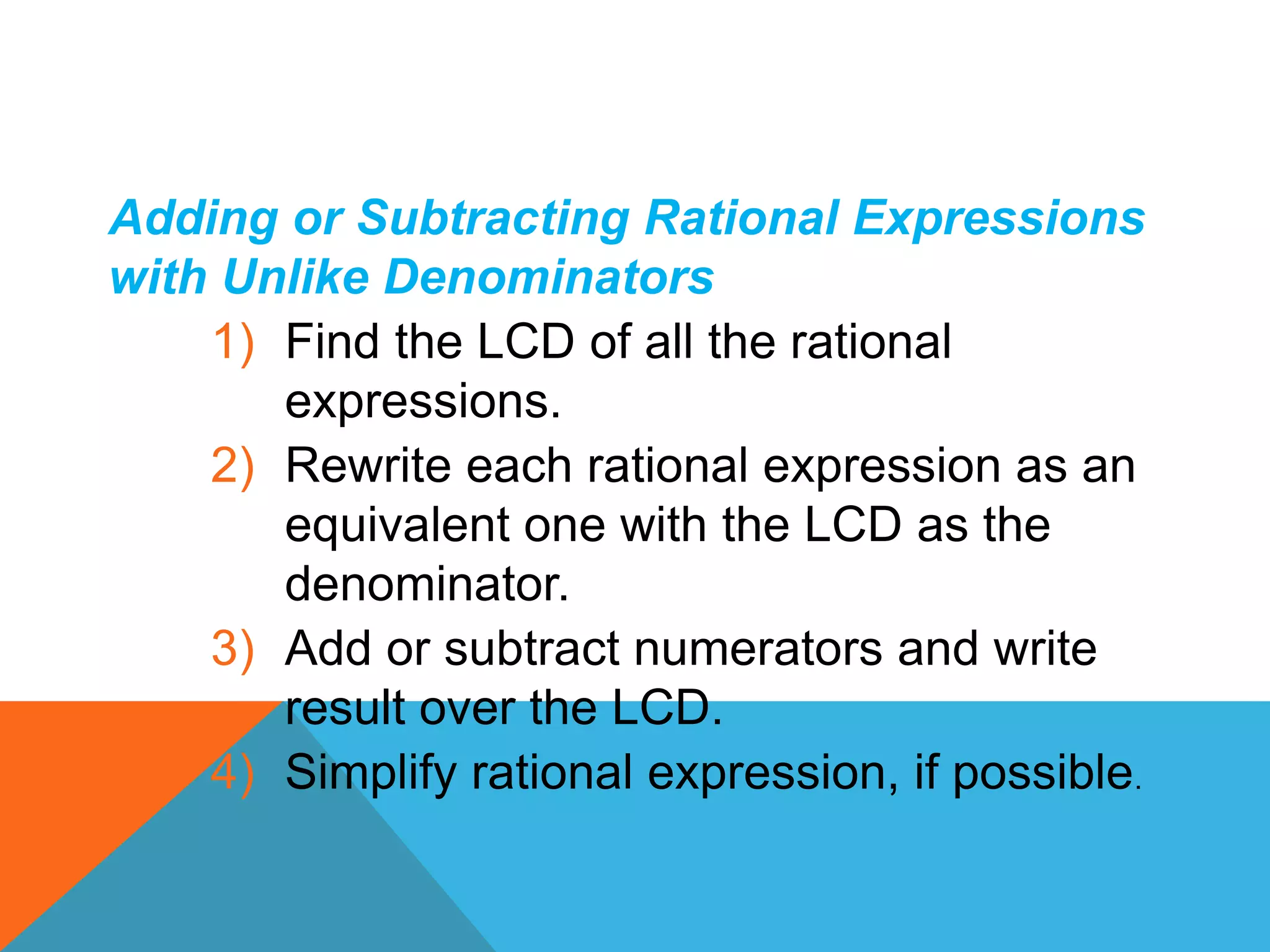
1) Find the LCD of all the rational
expressions.
2) Rewrite each rational expression as an
equivalent one with the LCD as the
denominator.
3) Add or subtract numerators and write
result over the LCD.
4) Simplify rational expression, if possible.
ADDING WITHUNLIKE DENOMINATORS
Add the following rational expressions.

aa 6
8
7
15
aa 6
8
,
7
15






aa 67
87
76
156

aa 42
56
42
90

a42
146
a21
73
Example
SUBTRACTING WITHUNLIKE DENOMINATORS
Subtract the following rational expressions.
xx 26
3
,
62
5




 xx 26
3
62
5



 62
3
62
5
xx

 62
8
x



)3(2
222
x 3
4
x
Example
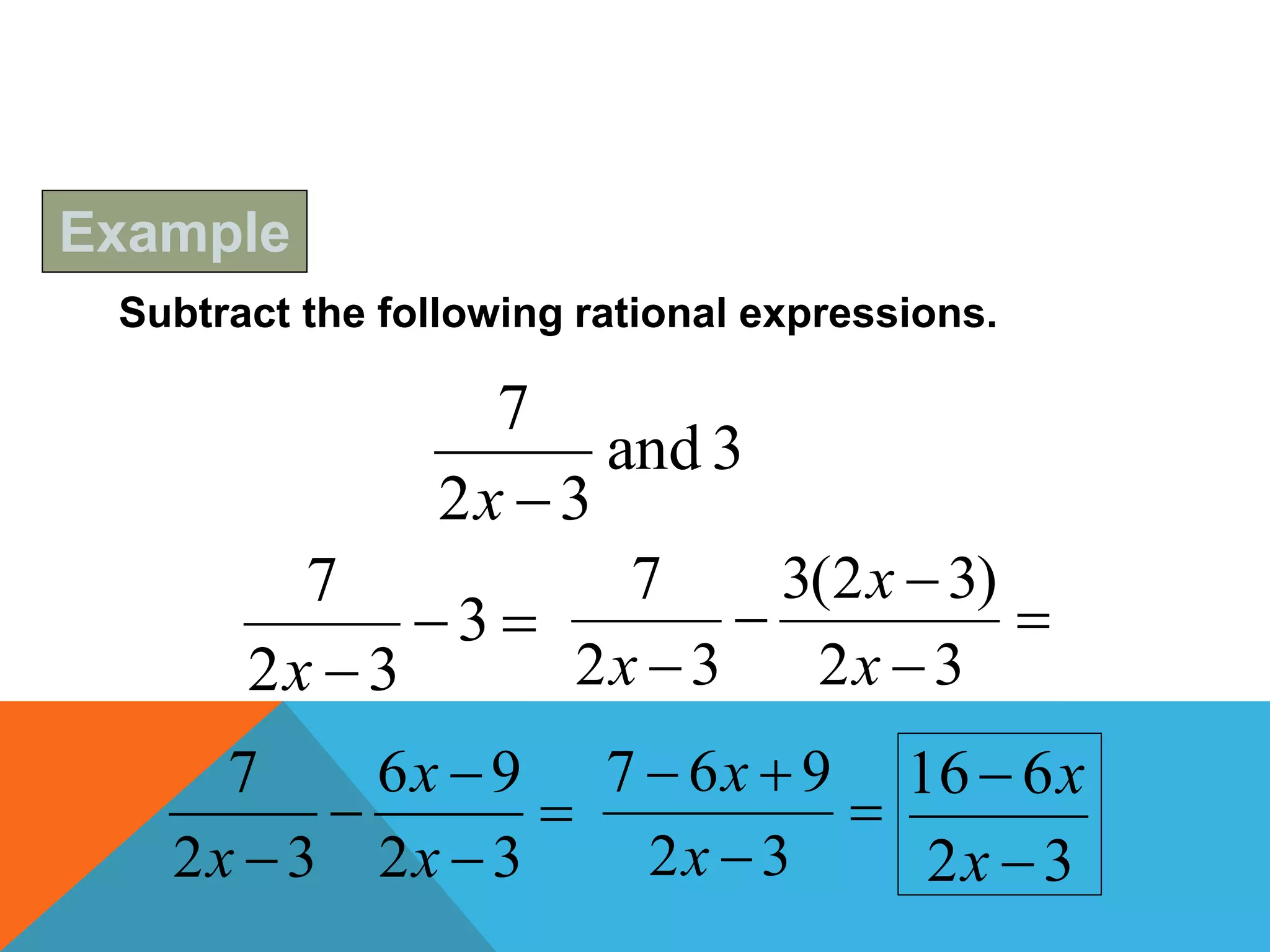
Subtract the following rational expressions.
3and
32
7
x


3
32
7
x




 32
)32(3
32
7
x
x
x




 32
96
32
7
x
x
x



32
967
x
x
32
616


x
x
Example
ADDINGWITHUNLIKE DENOMINATORS
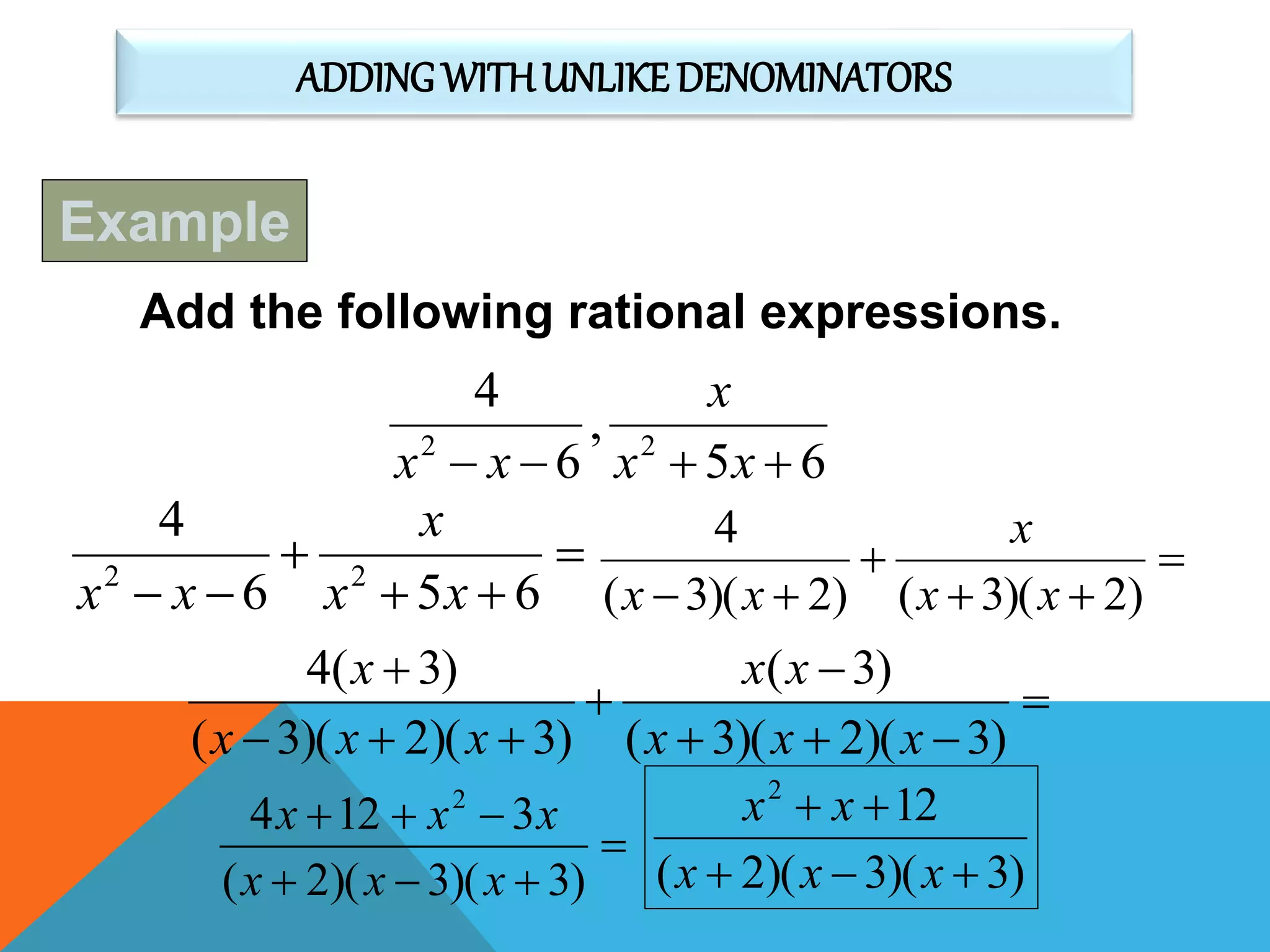
Add the following rational expressions.
65
,
6
4
22
 xx
x
xx



 656
4
22
xx
x
xx



 )2)(3()2)(3(
4
xx
x
xx






)3)(2)(3(
)3(
)3)(2)(3(
)3(4
xxx
xx
xxx
x



)3)(3)(2(
3124 2
xxx
xxx
)3)(3)(2(
122


xxx
xx
Example
SOLVING EQUATIONS
CONTAINING RATIONAL
EXPRESSIONS
SOLVING EQUATIONS
First note that an equation contains an equal
sign and an expression does not.
To solve EQUATIONS containing rational
expressions, clear the fractions by multiplying
both sides of the equation by the LCD of all the
fractions.
Then solve as in previous sections.
Note: this works for equations only, not
simplifying expressions.
6
7
1
3
5

x
x
x
x 6
6
7
1
3
5
6 












xx 7610 
x10
7
3 610
5
1 

6
7
1
30
5

6
7
1
6
1
 true
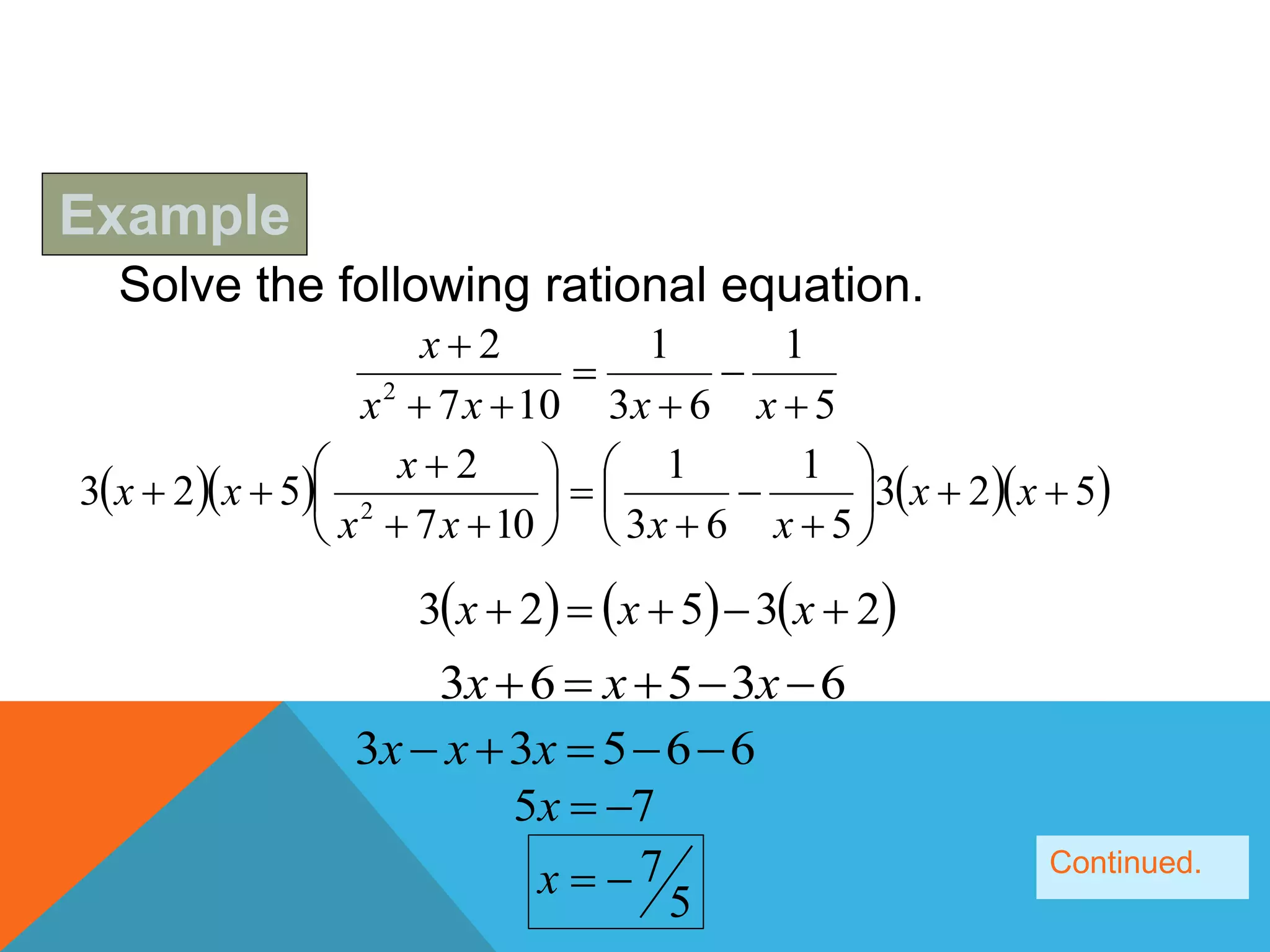
Solve the following rational equation.
Check in the original
equation.
Example
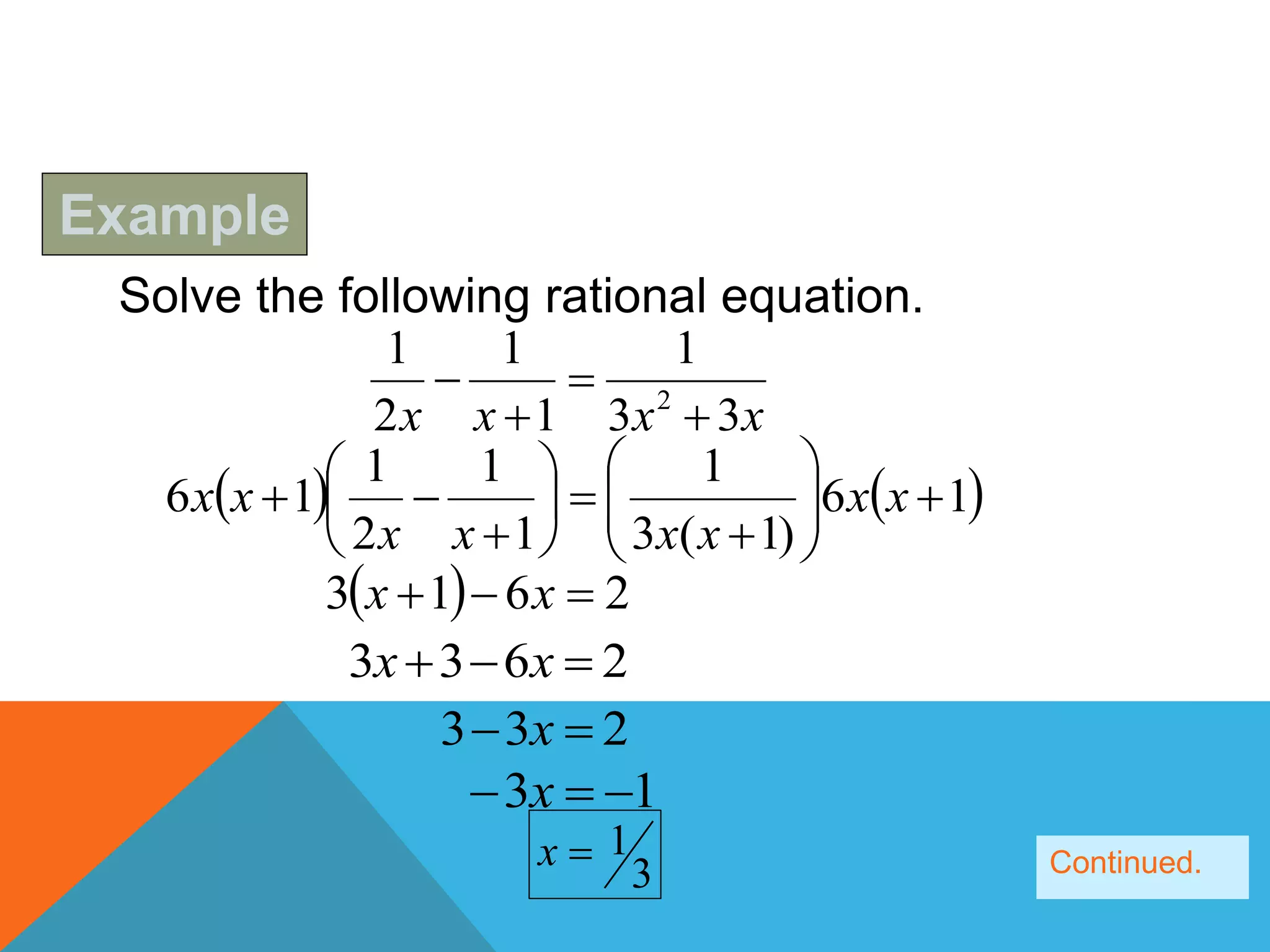
xxxx 33
1
1
1
2
1
2




   16
)1(3
1
1
1
2
1
16 













 xx
xxxx
xx
  2613  xx
2633  xx
233  x
13  x
Solve the following rational equation.
3
1x
Example
Continued.
       
21 1 1 1
3 3 3 3
1 1 1
2 1 3 3
 
 
1
3
1
1
4
3
2
3


4
3
4
3
4
6
 true
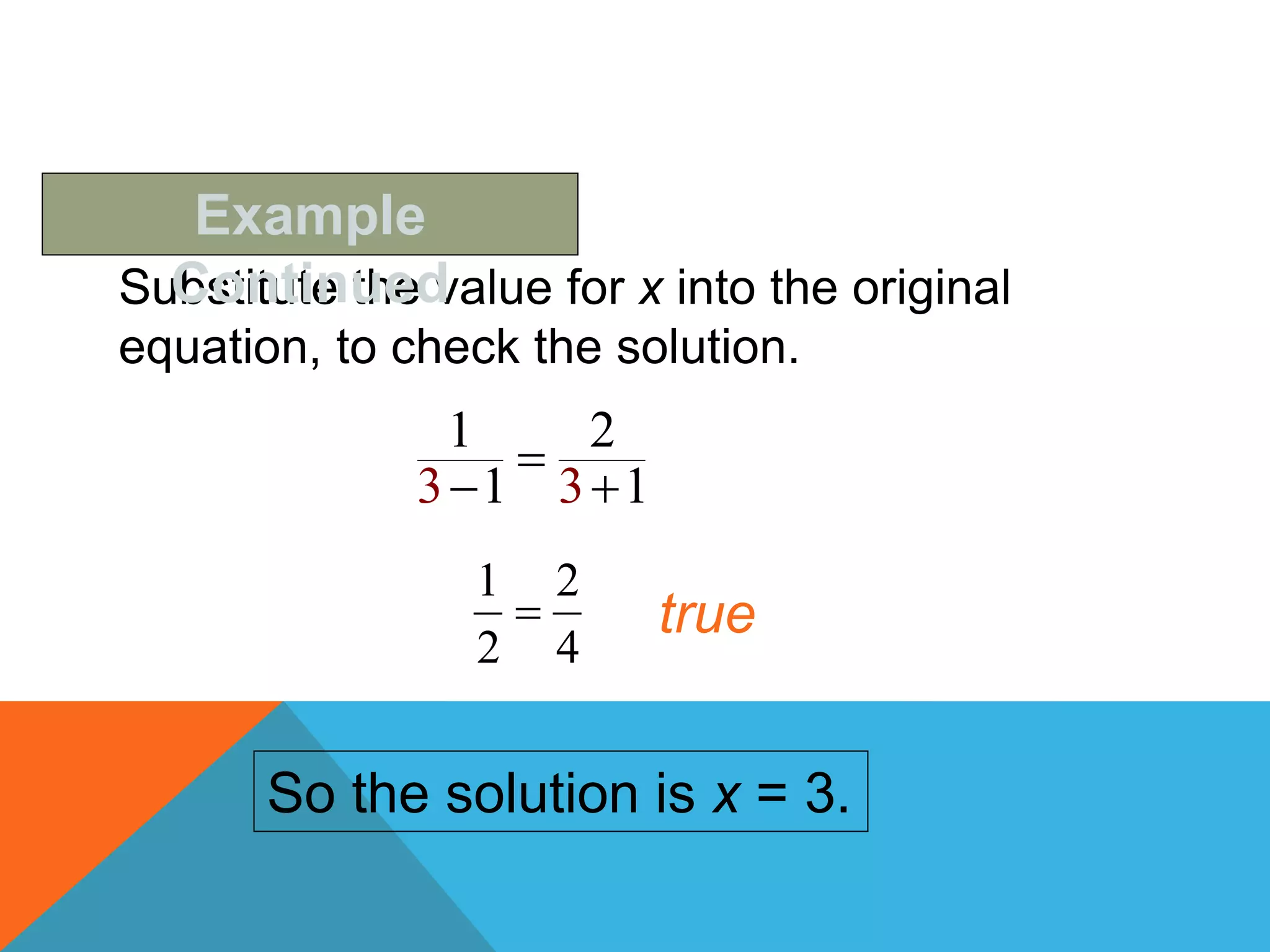
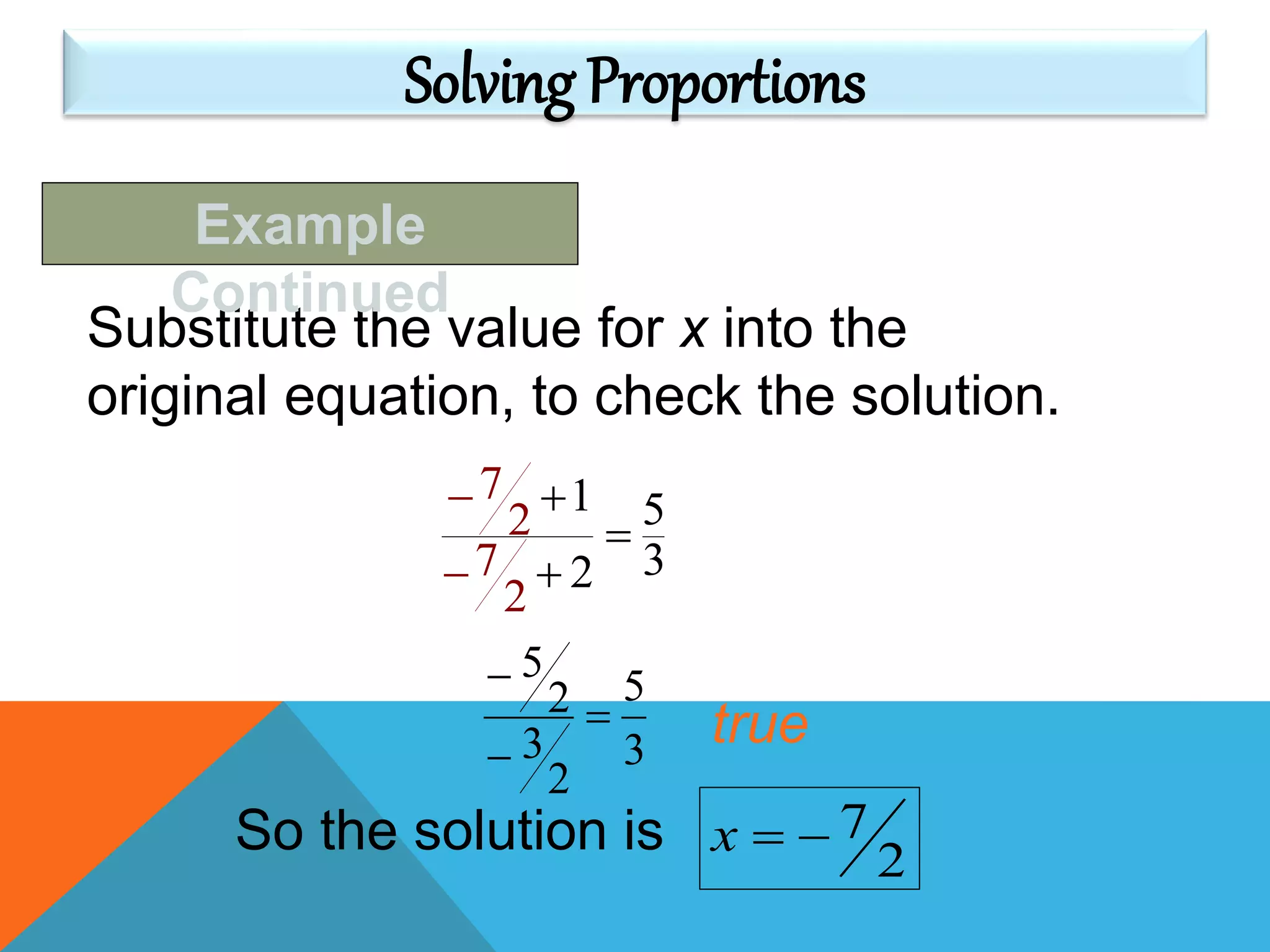
Substitute the value for x into the original
equation, to check the solution.
So the solution is 3
1x
Example
Continued
Solve the following rational equation.
Example
Continued.
5
1
63
1
107
2
2






xxxx
x
     523
5
1
63
1
107
2
523 2

















 xx
xxxx
x
xx
     23523  xxx
63563  xxx
66533  xxx
75 x
5
7x
Substitute the value for x into the original
equation, to check the solution.
Example
Continued
5
18
1
6
5
21
1
10
5
49
25
49
5
3




true
So the solution
is
5
7x
       2
7 2 1 15
3 6 57 10
7 77 7
5 55 5
 
 
     
18
5
9
5
18
5 
Solve the following rational equation.
Example
Continued.
1
2
1
1


 xx
     11
1
2
1
1
11 













 xx
xx
xx
 121  xx
221  xx
x3
Substitute the value for x into the original
equation, to check the solution.
Example
Continued
3 3
1 2
1 1

 
4
2
2
1
 true
So the solution is x = 3.
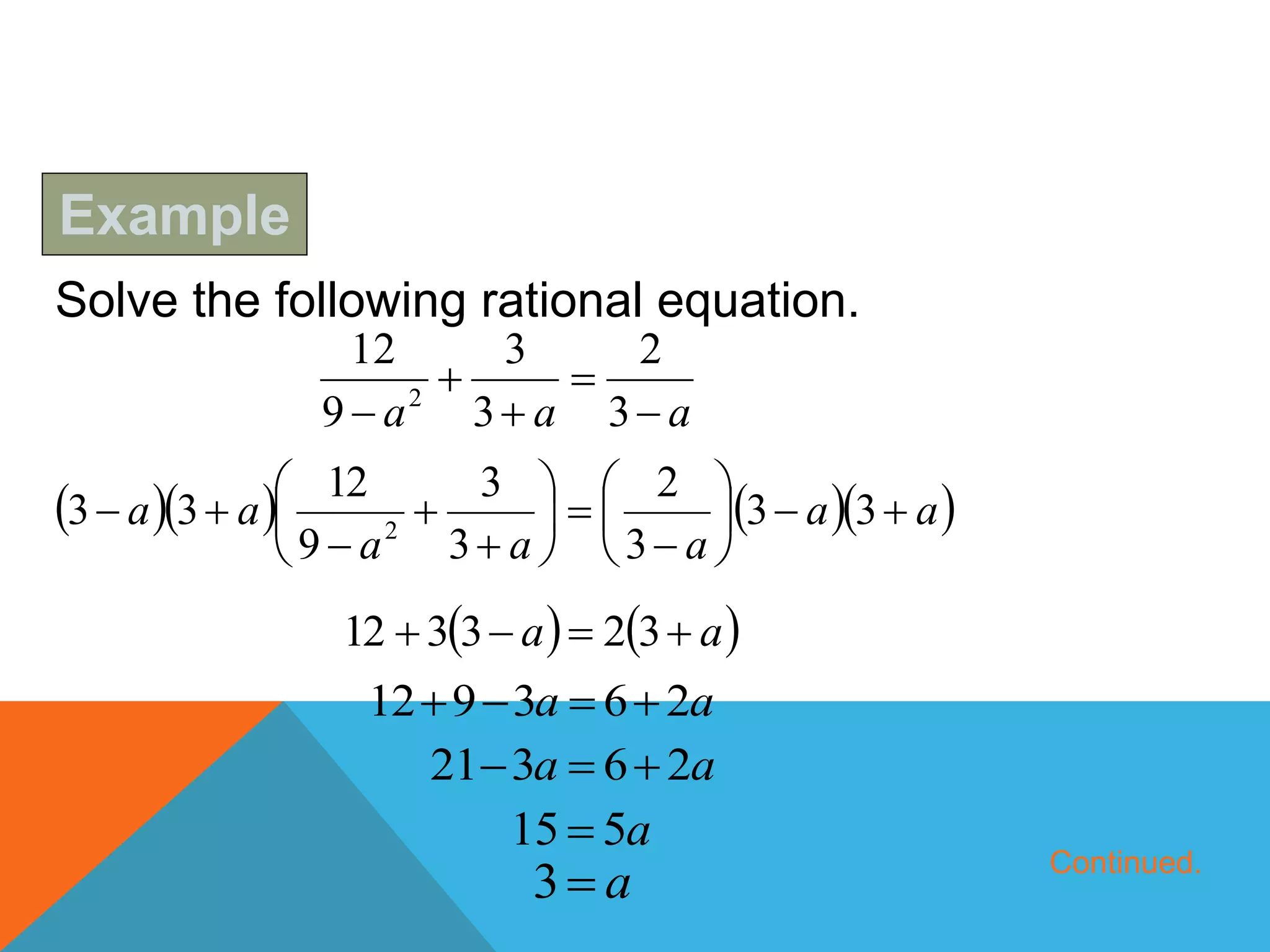
Solve the following rational equation.
Example
Continued.
aaa 



 3
2
3
3
9
12
2
     aa
aaa
aa 















 33
3
2
3
3
9
12
33 2
   aa  323312
aa 263912 
aa 26321 
a515 
a3
Substitute the value for x into the original
equation, to check the solution.
Example
Continued
Since substituting the suggested value of a into
the equation produced undefined expressions,
the solution is .
2
12 3 2
39 33 33
 
 
0
2
5
3
0
12

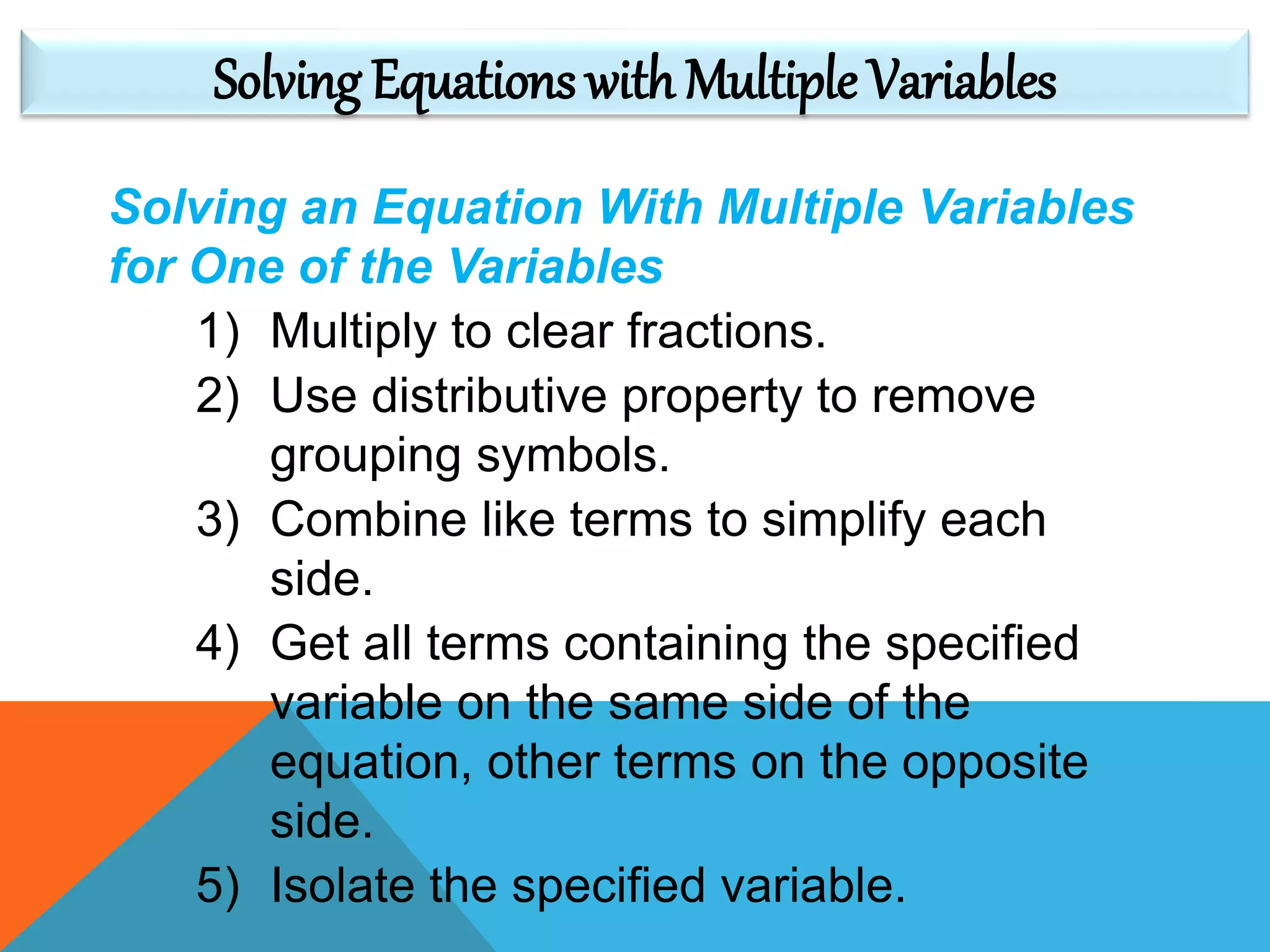
Solving an Equation With Multiple Variables
for One of the Variables
1) Multiply to clear fractions.
2) Use distributive property to remove
grouping symbols.
3) Combine like terms to simplify each
side.
4) Get all terms containing the specified
variable on the same side of the
equation, other terms on the opposite
side.
5) Isolate the specified variable.
Solving Equations with Multiple Variables
21
111
RRR

21
21
21
111
RRR
RRR
RRR 









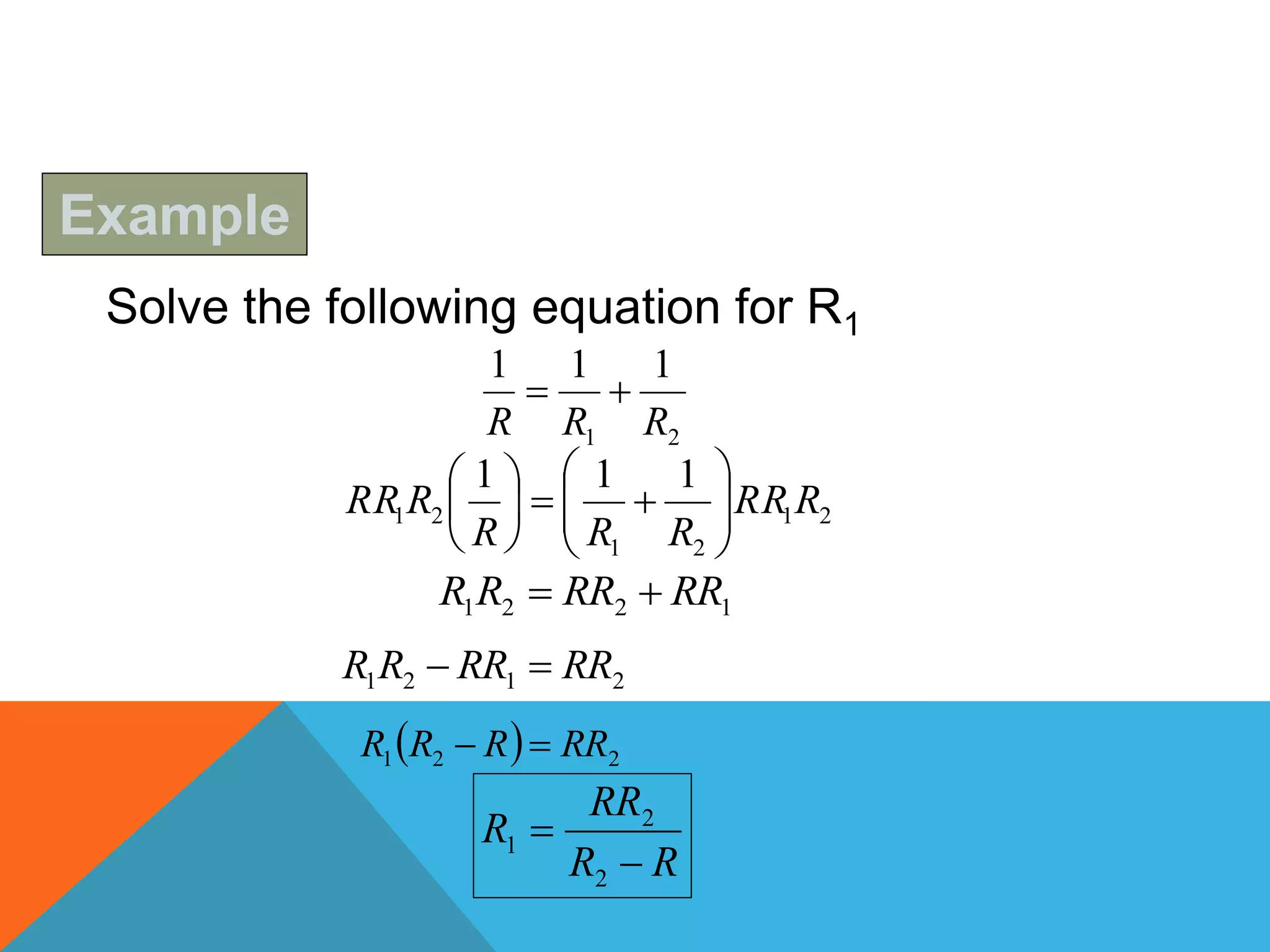


1221 RRRRRR 
2121 RRRRRR 
  221 RRRRR 
RR
RR
R


2
2
1
Solve the following equation for R1
Example
PROBLEM SOLVING WITH
RATIONAL EQUATIONS
RATIOS ANDRATES
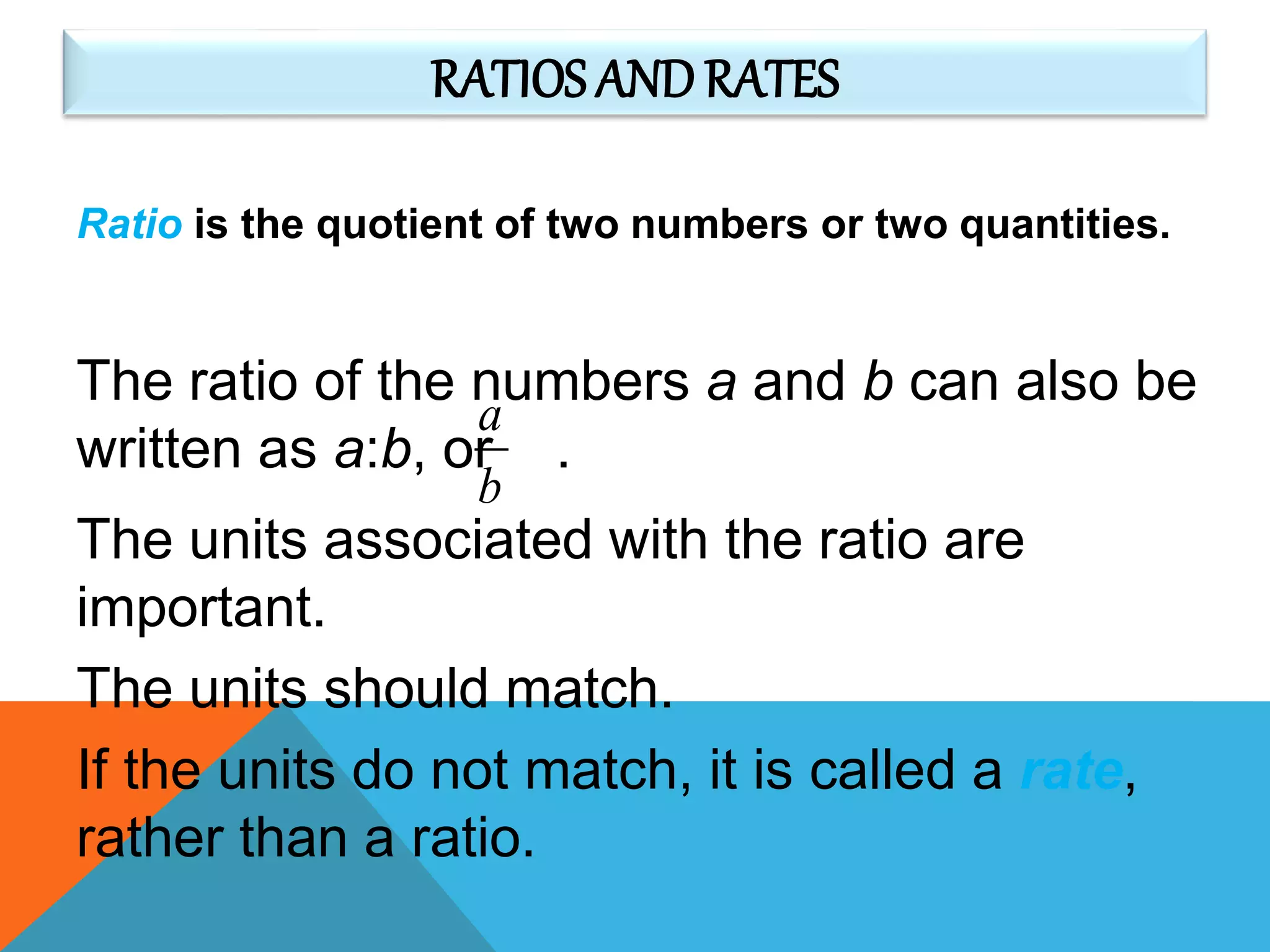
Ratio is the quotient of two numbers or two quantities.
The units associated with the ratio are
important.
The units should match.
If the units do not match, it is called a rate,
rather than a ratio.
The ratio of the numbers a and b can also be
written as a:b, or .
b
a
PROPORTIONS
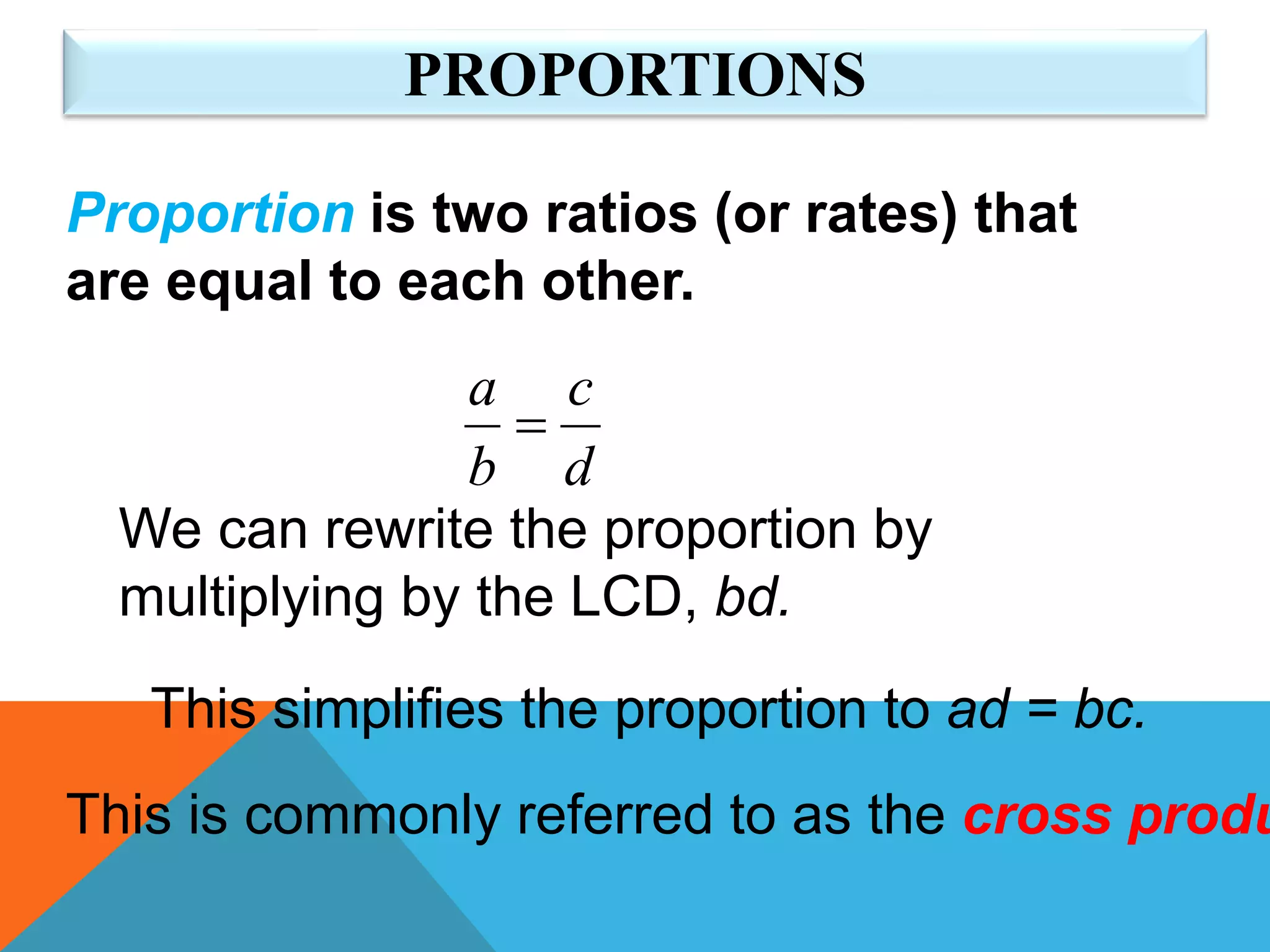
Proportion is two ratios (or rates) that
are equal to each other.
d
c
b
a

We can rewrite the proportion by
multiplying by the LCD, bd.
This simplifies the proportion to ad = bc.
This is commonly referred to as the cross produ
SOLVING PROPORTIONS
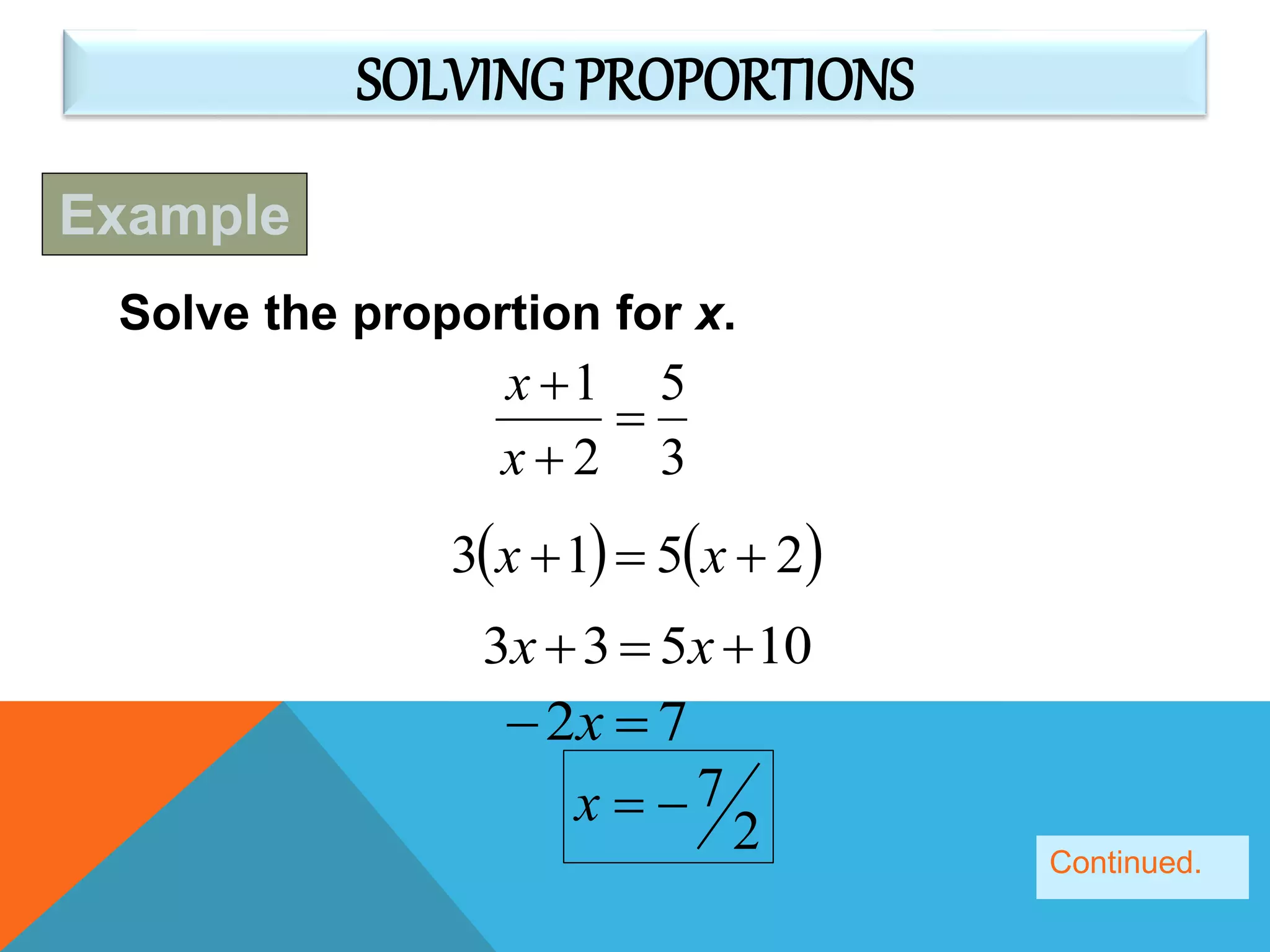
Solve the proportion for x.
3
5
2
1



x
x
   2513  xx
10533  xx
72  x
2
7x
Example
Continued.
3
5
2
3
2
5



true
Substitute the value for x into the
original equation, to check the solution.
So the solution is 2
7x
7
2
7
1 5
32
2





Example
Continued
Solving Proportions
If a 170-pound person weighs approximately 65
pounds on Mars, how much does a 9000-pound
satellite weigh?
Marsonsatellitepound-x
Marsonpersonpound-65
Earthonsatellitepound-9000
Earthonpersonpound-170

000,585659000170 x
pounds3441170/585000 x
Example
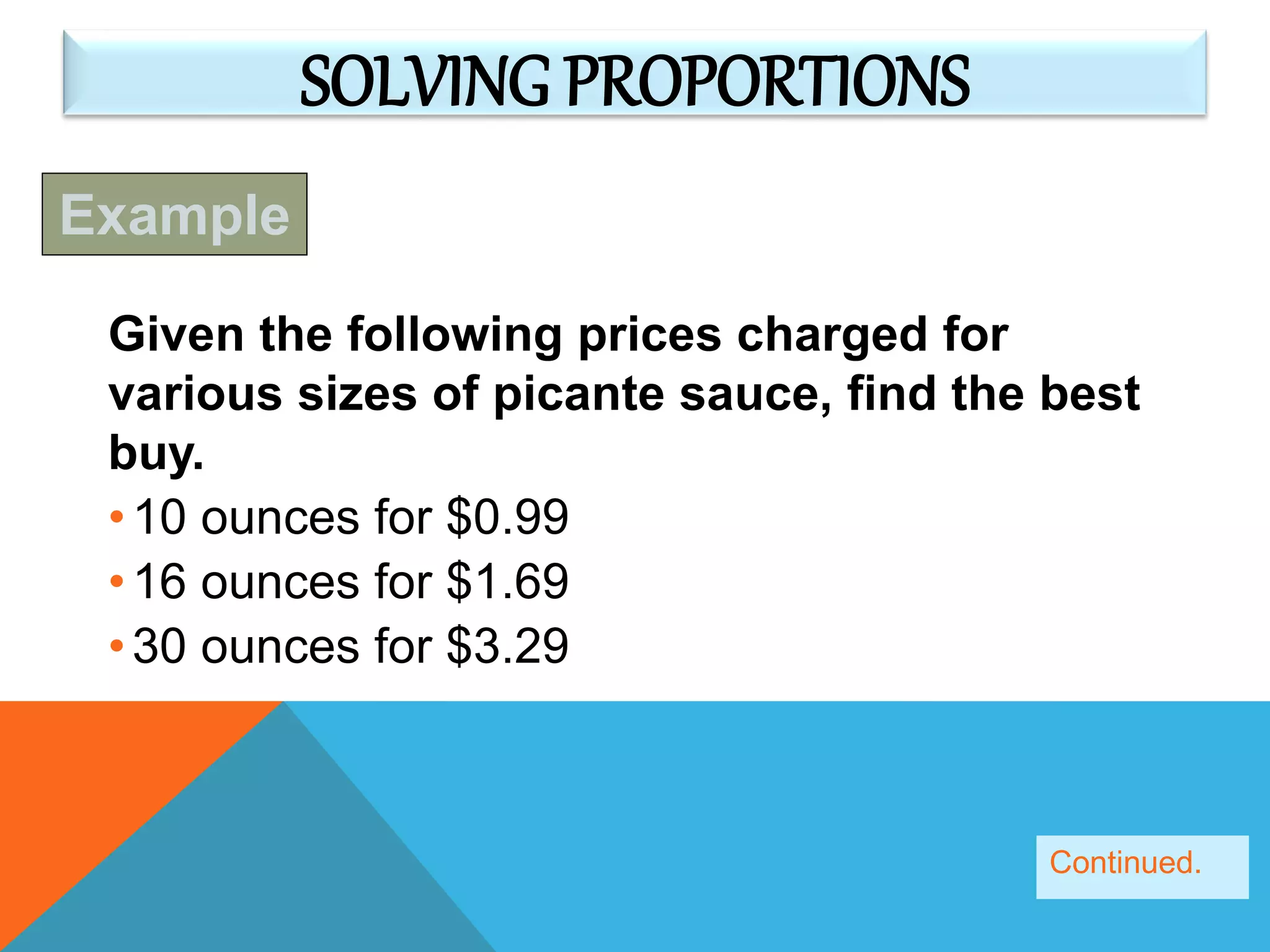
SOLVING PROPORTIONS
Given the following prices charged for
various sizes of picante sauce, find the best
buy.
•10 ounces for $0.99
•16 ounces for $1.69
•30 ounces for $3.29
Example
Continued.
Size Price Unit Price
10 ounces $0.99 $0.99/10 = $0.099
16 ounces $1.69 $1.69/16 = $0.105625
30 ounces $3.29 $3.29/30  $0.10967
The 10 ounce size has the lower unit price, so it is
the best buy.
Example
Continued
FINDINGAN UNKNOWNNUMBER
Example
Continued
The quotient of a number and 9 times its
reciprocal is 1. Find the number.
Read and reread the problem. If we let
n = the number, then
= the reciprocal of the number
n
1
1.)
Understand
Continued
2.) Translate
Example continued
The quotient
of

a number
n
and 9 times its
reciprocal






n
1
9
is
=
1
1
Example continued
3.)
Solve
Continued
1
1
9 






n
n
1
9







n
n
1
9

n
n
92
n
3,3 n
Example continued
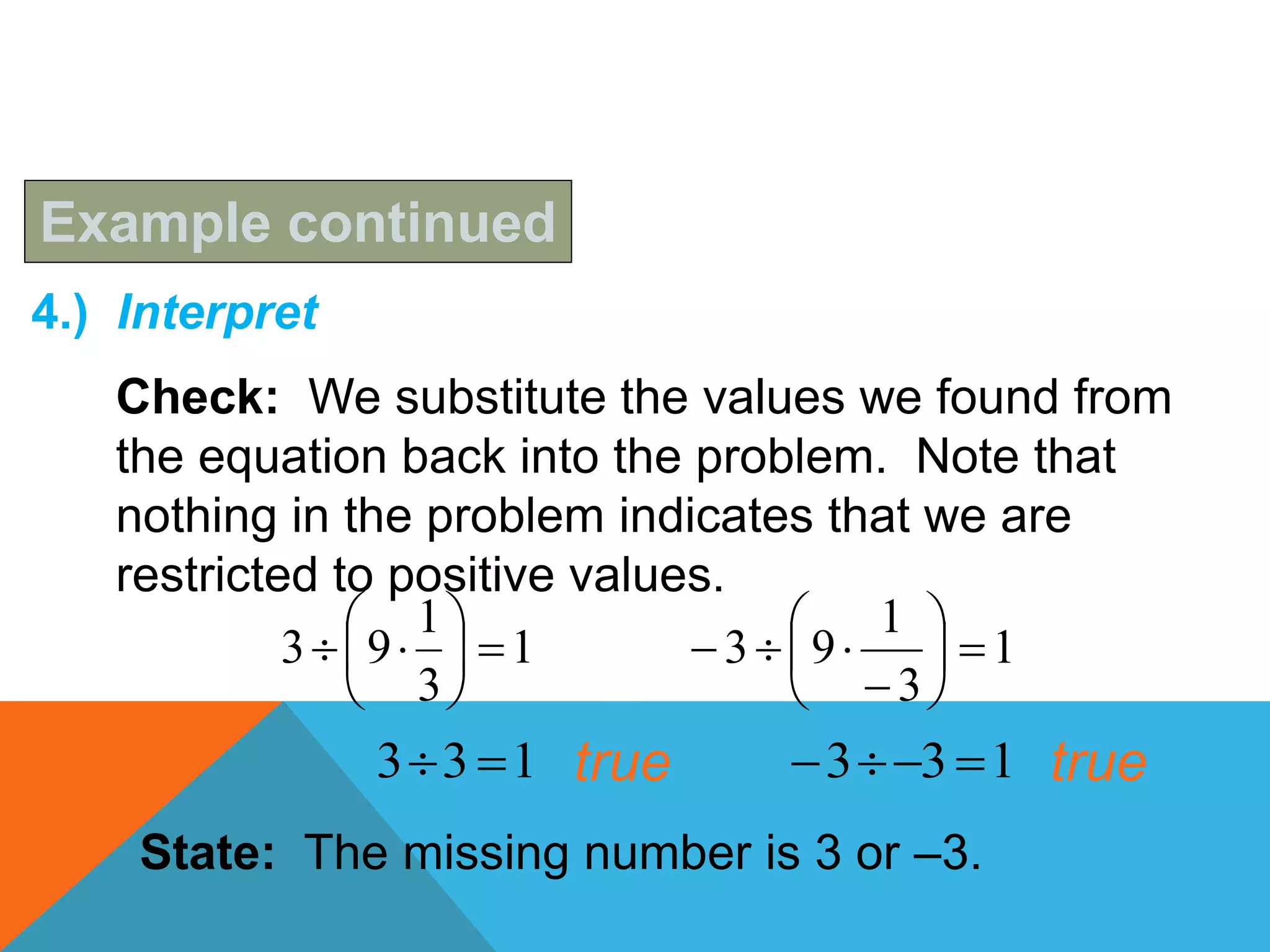
4.) Interpret
Check: We substitute the values we found from
the equation back into the problem. Note that
nothing in the problem indicates that we are
restricted to positive values.
1
3
1
93 






133 
1
3
1
93 







133 
State: The missing number is 3 or –3.
true true
SOLVING A WORK PROBLEM
Example
Continued
An experienced roofer can roof a house in 26 hours. A beginner needs 39
hours to do the same job. How long will it take if the two roofers work
together?
Read and reread the problem. By using the times for each roofer to complete
the job alone, we can figure out their corresponding work rates in portion of
the job done per hour.
1.) Understand
Experienced roofer 26 1/26
Beginner roofer 39 /39
Together t 1/t
Time in hrs Portion job/hr
Continued
2.) Translate
Example continued
t
1
39
1
26
1

Since the rate of the two roofers working
together would be equal to the sum of the
rates of the two roofers working
independently,
Example continued
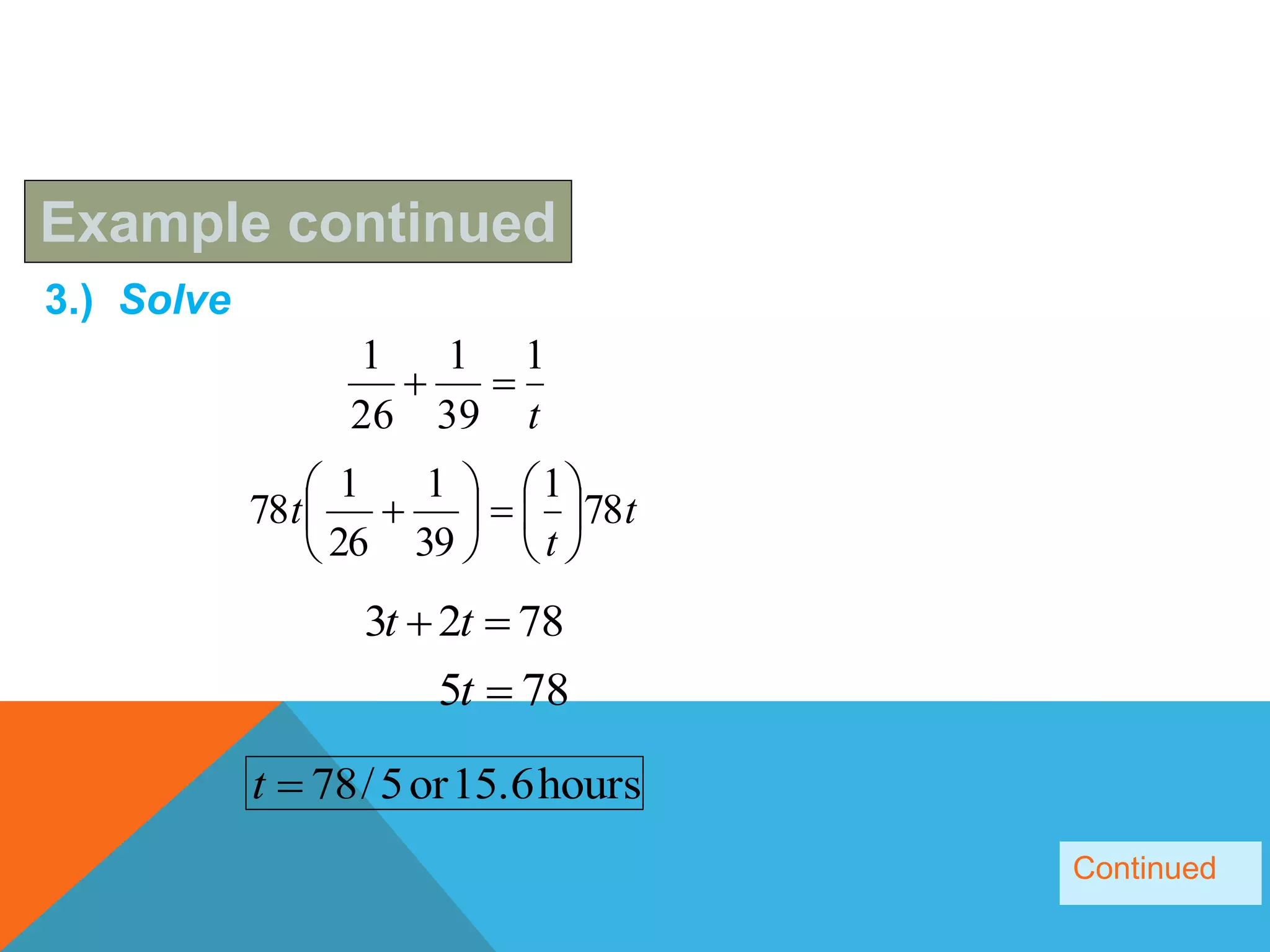
3.) Solve
Continued
t
1
39
1
26
1

t
t
t 78
1
39
1
26
1
78 












7823  tt
785 t
hours15.6or5/78t
Example continued
4.) Interpret
Check: We substitute the value we found from
the proportion calculation back into the problem.
State: The roofers would take 15.6 hours
working together to finish the job.
5
78
1
39
1
26
1

78
5
78
2
78
3
 true
SOLVING A RATE PROBLEM
Example
Continued
The speed of Lazy River’s current is 5 mph. A boat travels 20 miles
downstream in the same time as traveling 10 miles upstream. Find the
speed of the boat in still water.
Read and reread the problem. By using the formula d=rt, we can rewrite the
formula to find that t = d/r.
We note that the rate of the boat downstream would be the rate in still water +
the water current and the rate of the boat upstream would be the rate in still
water – the water current.
1.) Understand
Down 20 r + 5 20/(r + 5)
Up 10 r – 5 10/(r – 5)
Distance rate time = d/r
Continued
2.) Translate
Example continued
Since the problem states that the time to travel
downstairs was the same as the time to travel
upstairs, we get the equation
5
10
5
20


 rr
Example continued
3.) Solve
Continued
5
10
5
20


 rr
     55
5
10
5
20
55 













 rr
rr
rr
   510520  rr
501010020  rr
15010 r
mph15r
Example continued
4.) Interpret
Check: We substitute the value we found from
the proportion calculation back into the problem.
515
10
515
20



10
10
20
20
 true
State: The speed of the boat in still water is 15
mph.
SIMPLIFYING COMPLEX
FRACTIONS
COMPLEX RATIONAL FRACTIONS
Complex rational expressions (complex
fraction) are rational expressions whose
numerator, denominator, or both contain
one or more rational expressions.
There are two methods that can be used
when simplifying complex fractions.
SIMPLIFYING COMPLEXFRACTIONS
Simplifying a Complex Fraction (Method 1)
1) Simplify the numerator and denominator
of the complex fraction so that each is a
single fraction.
2) Multiply the numerator of the complex
fraction by the reciprocal of the
denominator of the complex fraction.
3) Simplify, if possible.
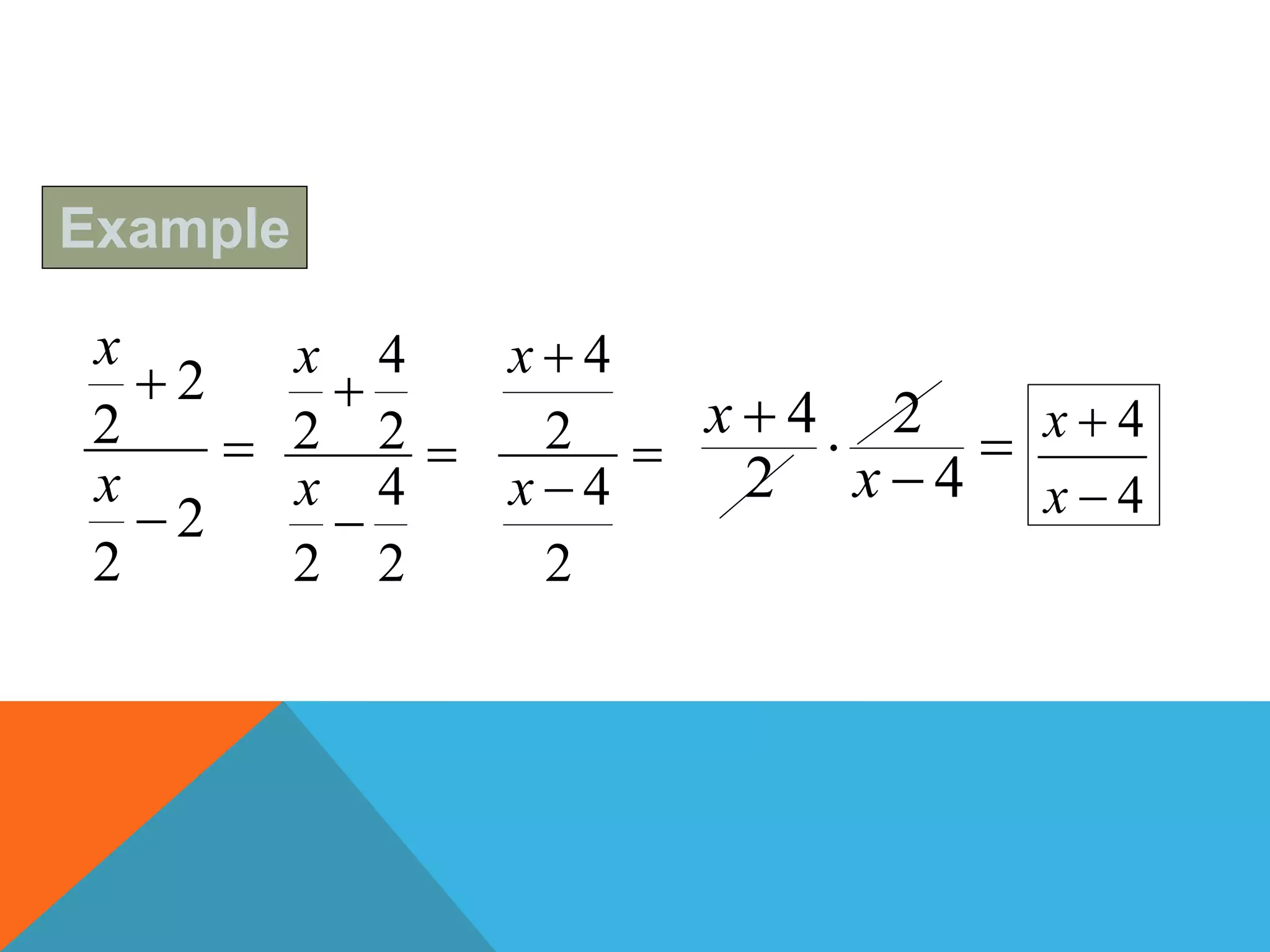



2
2
2
2
x
x



2
4
2
2
4
2
x
x



2
4
2
4
x
x
4 2
2 4
x
x

 
 4
4


x
x
Example
Method 2 for simplifying a complex
fraction
1) Find the LCD of all the fractions in
both the numerator and the
denominator.
2) Multiply both the numerator and the
denominator by the LCD.
3) Simplify, if possible.
6
51
3
21
2


y
y 2
2
6
6
y
y
  2
2
56
46
yy
y


Example

Rational expressions

  • 1.
  • 2.
    1 – EvaluatingRational Expressions 2 – Simplifying Rational Expressions 3 – Multiplying and Dividing Rational Expressions 4 – Adding and Subtracting Rational Expressions with the Same Denominator and Least Common Denominators 5 – Adding and Subtracting Rational Expressions with Different Denominators 6 – Solving Equations Containing Rational Expressions 7 – Problem Solving with Rational Expressions 8 – Simplifying Complex Fractions SECTIONS
  • 3.
    WARM – UPACTIVITY 1. Answer page 66 Activity 1: MATCH IT TO ME. (5 minutes) 2. Answer page 70 Activity 7: CLASSIFY ME. (5 minutes)
  • 4.
    RATIONAL EXPRESSIONS Q P Rational expressionscan be written in the form where P and Q are both polynomials and Q  0. Examples of Rational Expressions 54 423 2   x xx 22 432 34 yxyx yx   4 3 2 x
  • 5.
    The domain ofa rational expression p/q consists of all real numbers except those that make the denominator zero… …since division by zero is NEVER allowed! Examples: DOMAIN AND EXAMPLES
  • 6.
    For example, tofind the domain of solve as follows, or or The domain is ( 6)( 4) ( 2)( 4) x x x x     ( 2)( 4) 0x x   2 0x   4 0x   2x   4x   { | 2, 4} .x x    DOMAIN AND EXAMPLES
  • 7.
    SUMMARY: The domain ofa rational expression is the set of real numbers for which the expression is defined. The domain consists of all real numbers except those that make the denominator 0.
  • 8.
  • 9.
    To evaluate arational expression for a particular value(s), substitute the replacement value(s) into the rational expression and simplify the result. Evaluating Rational Expressions Example Evaluate the following expression for y = 2.    y y 5 2 ) 2 2 ( 25          7 4 7 4
  • 10.
    In the previousexample, what would happen if we tried to evaluate the rational expression for y = 5?    y y 5 2 5 2 5 5     0 3 This expression is UNDEFINED! Evaluating Rational Expressions
  • 11.
    We have tobe able to determine when a rational expression is undefined. A rational expression is undefined when the denominator is equal to zero. The numerator being equal to zero is okay (the rational expression simply equals zero). Undefined Rational Expressions
  • 12.
    Find any realnumbers that make the following rational expression undefined. 4515 49 3   x xx The expression is undefined when 15x + 45 = 0. So the expression is undefined when x = 3. Undefined Rational Expressions Example
  • 13.
    NOW YOU TRY! Evaluate each rational expression. 1. 𝟑𝒙+𝟓 𝒙+𝟑 if x = 4 2. 𝟓𝒙 𝟐−𝟏 𝒙+𝟐 if x = −2 3. 4𝑦𝑧 3𝑥2 𝑦2 if x = 2, y = −1 and z = 0 4. 3𝑥𝑧 4(𝑥+2) if x = 0 and z = −5 5. 𝑥2+3𝑥−2 1−2𝑥 if x = -2
  • 14.
  • 15.
    Simplifying a rationalexpression means writing it in lowest terms or simplest form. To do this, we need to use the Fundamental Principle of Rational Expressions If P, Q, and R are polynomials, and Q and R are not 0, Q P QR PR  Simplifying Rational Expressions
  • 16.
    Simplifying a RationalExpression 1) Completely factor the numerator and denominator. 2) Apply the Fundamental Principle of Rational Expressions to eliminate common factors in the numerator and denominator. Warning! Only common FACTORS can be eliminated from the numerator and denominator. Make sure any expression you eliminate is a factor.
  • 17.
    Warm Up Simplify eachexpression. 1. 2. Factor each expression. 3. x2 + 5x + 6 4. 4x2 – 64 (x + 2)(x + 3) 5. 2x2 + 3x + 1 6. 9x2 + 60x + 100 (2x + 1)(x + 1) (3x +10)2 W H E N S I M P L I F Y I N G A R AT I O N A L E X P R E S S I O N , B E G I N B Y FA C TO R I N G O U T T H E G R E AT E S T C O M M O N FA C TO R I N T H E N U M E R ATO R A N D D E N O M I N ATO R . N E X T, FA C TO R T H E N U M E R ATO R A N D D E N O M I N ATO R C O M P L E T E LY. T H E N C A N C E L A N Y C O M M O N FA C TO R S . (2x – 8)(2x + 8)
  • 18.
    EXAMPLE VIDEO ONSIMPLIFYING RATIONAL EXPRESSIONS MATH 8Rational Expressions_ Writing in Lowest Terms - Ex 1.mp4
  • 19.
    Example 2: SimplifyingRational Expressions Simplify each rational expression, if possible. Identify any excluded values. Factor 14. 4
  • 20.
    Simplify the followingexpression.    xx x 5 357 2    )5( )5(7 xx x x 7 Example
  • 21.
    Simplify the followingexpression.    20 43 2 2 xx xx    )4)(5( )1)(4( xx xx 5 1   x x Example
  • 22.
    Simplify the followingexpression.    7 7 y y    7 )7(1 y y 1 Example
  • 23.
    Simplify the expression:   2 25100 5 10 t t    22 Solution: 25 4 25 2 ( 2)25 100 5 10 5( 2) 5( 2) 5 25 t t tt t t t           2 ( 2)t t  5 ( 2)t  5( 2)t  More Example
  • 24.
    Simplify the expression:   3 412 x x Solution: 3 3 4 12 4( 3) Note that 1( ) . Thus, 3 1(3 ). 3 3 So we have 4( 3) x x x x a b b a x x x x x                  4 1(3 )x  1 . 4   More Example
  • 25.
  • 26.
  • 27.
    MULTIPLYING RATIONALEXPRESSIONS Multiplying rationalexpressions when P, Q, R, and S are polynomials with Q  0 and S  0. QS PR S R Q P 
  • 28.
    Note that aftermultiplying such expressions, our result may not be in simplified form, so we use the following techniques. Multiplying rational expressions 1) Factor the numerators and denominators. 2) Multiply the numerators and multiply the denominators. 3) Simplify or write the product in lowest terms by applying the fundamental principle to all common factors.
  • 29.
    Multiply the followingrational expressions.  12 5 10 6 3 2 x x x 4 1    32252 532 xxx xxx Example
  • 30.
    Multiply the followingrational expressions.      mnm m nm nm 2 2 )( )()( ))(( nmmnm mnmnm   nm nm    Example
  • 31.
    DIVIDING RATIONAL EXPRESSIONS Dividingrational expressions when P, Q, R, and S are polynomials with Q  0, S  0 and R  0. QR PS R S Q P S R Q P 
  • 32.
    When dividing rationalexpressions, first change the division into a multiplication problem, where you use the reciprocal of the divisor as the second factor. Then treat it as a multiplication problem (factor, multiply, simplify).
  • 33.
    DIVIDING RATIONAL EXPRESSIONS Dividethe following rational expression.     25 155 5 )3( 2 xx     155 25 5 )3( 2 x x    )3(55 55)3)(3( x xx 3x Example
  • 34.
    UNITS OF MEASURE ConvertingBetween Units of Measure Use unit fractions (equivalent to 1), but with different measurements in the numerator and denominator. Multiply the unit fractions like rational expressions, canceling common units in the numerators and denominators.
  • 35.
    Convert 1008 squareinches into square feet.              in12 ft1 in12 ft1 ft.sq.7 (1008 sq in) (2·2·2·2·3·3·7 in · in)                in ft in ft 322 1 322 1 Example
  • 36.
    ADDING AND SUBTRACTINGRATIONAL EXPRESSIONS WITH THE SAME DENOMINATOR AND LEAST COMMON DENOMINATORS
  • 37.
    RATIONAL EXPRESSIONS If P,Q and R are polynomials and Q  0, R QP R Q R P   R QP R Q R P  
  • 38.
    ADDING RATIONAL EXPRESSIONS Addthe following rational expressions.       72 83 72 34 p p p p 72 57   p p    72 8334 p pp Example
  • 39.
    SUBTRACTING RATIONAL EXPRESSIONS Subtractthe following rational expressions.     2 16 2 8 yy y    2 168 y y    2 )2(8 y y 8 Example
  • 40.
    Subtract the followingrational expressions.     103 6 103 3 22 yyyy y    103 63 2 yy y    )2)(5( )2(3 yy y 5 3 y Example
  • 41.
    LEAST COMMONDENOMINATORS To addor subtract rational expressions with unlike denominators, you have to change them to equivalent forms that have the same denominator (a common denominator). This involves finding the least common denominator of the two original rational expressions.
  • 42.
    To find aLeast Common Denominator: 1) Factor the given denominators. 2) Take the product of all the unique factors. Each factor should be raised to a power equal to the greatest number of times that factor appears in any one of the factored denominators.
  • 43.
    Find the LCDof the following rational expressions. 124 3 , 6 1 y x y yy 326  )3(2)3(4124 2  yyy )3(12)3(32isLCDtheSo 2  yyyy Example
  • 44.
    Find the LCDof the following rational expressions. 2110 24 , 34 4 22    xx x xx )1)(3(342  xxxx )7)(3(21102  xxxx 7)1)(x3)(x(xisLCDtheSo  Example
  • 45.
    Find the LCDof the following rational expressions. 12 4 , 55 3 2 2 2  xx x x x )1)(1(5)1(555 22  xxxx 22 )1(12  xxx 2 1)-1)(x5(xisLCDtheSo  Example
  • 46.
    Find the LCDof the following rational expressions. xx  3 2 , 3 1 Both of the denominators are already factored. Since each is the opposite of the other, you can use either x – 3 or 3 – x as the LCD. Example
  • 47.
    MULTIPLYING BY 1 Tochange rational expressions into equivalent forms, we use the principal that multiplying by 1 (or any form of 1), will give you an equivalent expression. RQ RP R R Q P Q P Q P    1
  • 48.
    EQUIVALENTEXPRESSIONS Rewrite the rationalexpression as an equivalent rational expression with the given denominator. 95 729 3 yy  5 9 3 y  4 4 5 8 8 9 3 y y y 9 4 72 24 y y Example
  • 49.
    ADDING AND SUBTRACTING RATIONALEXPRESSIONS WITH DIFFERENT DENOMINATORS
  • 50.
    UNLIKE DENOMINATORS As statedin the previous section, to add or subtract rational expressions with different denominators, we have to change them to equivalent forms first.
  • 51.
    Adding or SubtractingRational Expressions with Unlike Denominators 1) Find the LCD of all the rational expressions. 2) Rewrite each rational expression as an equivalent one with the LCD as the denominator. 3) Add or subtract numerators and write result over the LCD. 4) Simplify rational expression, if possible.
  • 52.
    ADDING WITHUNLIKE DENOMINATORS Addthe following rational expressions.  aa 6 8 7 15 aa 6 8 , 7 15       aa 67 87 76 156  aa 42 56 42 90  a42 146 a21 73 Example
  • 53.
    SUBTRACTING WITHUNLIKE DENOMINATORS Subtractthe following rational expressions. xx 26 3 , 62 5      xx 26 3 62 5     62 3 62 5 xx   62 8 x    )3(2 222 x 3 4 x Example
  • 54.
    Subtract the followingrational expressions. 3and 32 7 x   3 32 7 x      32 )32(3 32 7 x x x      32 96 32 7 x x x    32 967 x x 32 616   x x Example
  • 55.
    ADDINGWITHUNLIKE DENOMINATORS Add thefollowing rational expressions. 65 , 6 4 22  xx x xx     656 4 22 xx x xx     )2)(3()2)(3( 4 xx x xx       )3)(2)(3( )3( )3)(2)(3( )3(4 xxx xx xxx x    )3)(3)(2( 3124 2 xxx xxx )3)(3)(2( 122   xxx xx Example
  • 56.
  • 57.
    SOLVING EQUATIONS First notethat an equation contains an equal sign and an expression does not. To solve EQUATIONS containing rational expressions, clear the fractions by multiplying both sides of the equation by the LCD of all the fractions. Then solve as in previous sections. Note: this works for equations only, not simplifying expressions.
  • 58.
    6 7 1 3 5  x x x x 6 6 7 1 3 5 6              xx7610  x10 7 3 610 5 1   6 7 1 30 5  6 7 1 6 1  true Solve the following rational equation. Check in the original equation. Example
  • 59.
    xxxx 33 1 1 1 2 1 2       16 )1(3 1 1 1 2 1 16                xx xxxx xx   2613  xx 2633  xx 233  x 13  x Solve the following rational equation. 3 1x Example Continued.
  • 60.
           21 1 1 1 3 3 3 3 1 1 1 2 1 3 3     1 3 1 1 4 3 2 3   4 3 4 3 4 6  true Substitute the value for x into the original equation, to check the solution. So the solution is 3 1x Example Continued
  • 61.
    Solve the followingrational equation. Example Continued. 5 1 63 1 107 2 2       xxxx x      523 5 1 63 1 107 2 523 2                   xx xxxx x xx      23523  xxx 63563  xxx 66533  xxx 75 x 5 7x
  • 62.
    Substitute the valuefor x into the original equation, to check the solution. Example Continued 5 18 1 6 5 21 1 10 5 49 25 49 5 3     true So the solution is 5 7x        2 7 2 1 15 3 6 57 10 7 77 7 5 55 5           18 5 9 5 18 5 
  • 63.
    Solve the followingrational equation. Example Continued. 1 2 1 1    xx      11 1 2 1 1 11                xx xx xx  121  xx 221  xx x3
  • 64.
    Substitute the valuefor x into the original equation, to check the solution. Example Continued 3 3 1 2 1 1    4 2 2 1  true So the solution is x = 3.
  • 65.
    Solve the followingrational equation. Example Continued. aaa      3 2 3 3 9 12 2      aa aaa aa                  33 3 2 3 3 9 12 33 2    aa  323312 aa 263912  aa 26321  a515  a3
  • 66.
    Substitute the valuefor x into the original equation, to check the solution. Example Continued Since substituting the suggested value of a into the equation produced undefined expressions, the solution is . 2 12 3 2 39 33 33     0 2 5 3 0 12 
  • 67.
    Solving an EquationWith Multiple Variables for One of the Variables 1) Multiply to clear fractions. 2) Use distributive property to remove grouping symbols. 3) Combine like terms to simplify each side. 4) Get all terms containing the specified variable on the same side of the equation, other terms on the opposite side. 5) Isolate the specified variable. Solving Equations with Multiple Variables
  • 68.
    21 111 RRR  21 21 21 111 RRR RRR RRR             1221 RRRRRR 2121 RRRRRR    221 RRRRR  RR RR R   2 2 1 Solve the following equation for R1 Example
  • 69.
  • 70.
    RATIOS ANDRATES Ratio isthe quotient of two numbers or two quantities. The units associated with the ratio are important. The units should match. If the units do not match, it is called a rate, rather than a ratio. The ratio of the numbers a and b can also be written as a:b, or . b a
  • 71.
    PROPORTIONS Proportion is tworatios (or rates) that are equal to each other. d c b a  We can rewrite the proportion by multiplying by the LCD, bd. This simplifies the proportion to ad = bc. This is commonly referred to as the cross produ
  • 72.
    SOLVING PROPORTIONS Solve theproportion for x. 3 5 2 1    x x    2513  xx 10533  xx 72  x 2 7x Example Continued.
  • 73.
    3 5 2 3 2 5    true Substitute the valuefor x into the original equation, to check the solution. So the solution is 2 7x 7 2 7 1 5 32 2      Example Continued Solving Proportions
  • 74.
    If a 170-poundperson weighs approximately 65 pounds on Mars, how much does a 9000-pound satellite weigh? Marsonsatellitepound-x Marsonpersonpound-65 Earthonsatellitepound-9000 Earthonpersonpound-170  000,585659000170 x pounds3441170/585000 x Example
  • 75.
    SOLVING PROPORTIONS Given thefollowing prices charged for various sizes of picante sauce, find the best buy. •10 ounces for $0.99 •16 ounces for $1.69 •30 ounces for $3.29 Example Continued.
  • 76.
    Size Price UnitPrice 10 ounces $0.99 $0.99/10 = $0.099 16 ounces $1.69 $1.69/16 = $0.105625 30 ounces $3.29 $3.29/30  $0.10967 The 10 ounce size has the lower unit price, so it is the best buy. Example Continued
  • 77.
    FINDINGAN UNKNOWNNUMBER Example Continued The quotientof a number and 9 times its reciprocal is 1. Find the number. Read and reread the problem. If we let n = the number, then = the reciprocal of the number n 1 1.) Understand
  • 78.
    Continued 2.) Translate Example continued Thequotient of  a number n and 9 times its reciprocal       n 1 9 is = 1 1
  • 79.
  • 80.
    Example continued 4.) Interpret Check:We substitute the values we found from the equation back into the problem. Note that nothing in the problem indicates that we are restricted to positive values. 1 3 1 93        133  1 3 1 93         133  State: The missing number is 3 or –3. true true
  • 81.
    SOLVING A WORKPROBLEM Example Continued An experienced roofer can roof a house in 26 hours. A beginner needs 39 hours to do the same job. How long will it take if the two roofers work together? Read and reread the problem. By using the times for each roofer to complete the job alone, we can figure out their corresponding work rates in portion of the job done per hour. 1.) Understand Experienced roofer 26 1/26 Beginner roofer 39 /39 Together t 1/t Time in hrs Portion job/hr
  • 82.
    Continued 2.) Translate Example continued t 1 39 1 26 1  Sincethe rate of the two roofers working together would be equal to the sum of the rates of the two roofers working independently,
  • 83.
    Example continued 3.) Solve Continued t 1 39 1 26 1  t t t78 1 39 1 26 1 78              7823  tt 785 t hours15.6or5/78t
  • 84.
    Example continued 4.) Interpret Check:We substitute the value we found from the proportion calculation back into the problem. State: The roofers would take 15.6 hours working together to finish the job. 5 78 1 39 1 26 1  78 5 78 2 78 3  true
  • 85.
    SOLVING A RATEPROBLEM Example Continued The speed of Lazy River’s current is 5 mph. A boat travels 20 miles downstream in the same time as traveling 10 miles upstream. Find the speed of the boat in still water. Read and reread the problem. By using the formula d=rt, we can rewrite the formula to find that t = d/r. We note that the rate of the boat downstream would be the rate in still water + the water current and the rate of the boat upstream would be the rate in still water – the water current. 1.) Understand Down 20 r + 5 20/(r + 5) Up 10 r – 5 10/(r – 5) Distance rate time = d/r
  • 86.
    Continued 2.) Translate Example continued Sincethe problem states that the time to travel downstairs was the same as the time to travel upstairs, we get the equation 5 10 5 20    rr
  • 87.
    Example continued 3.) Solve Continued 5 10 5 20   rr      55 5 10 5 20 55                rr rr rr    510520  rr 501010020  rr 15010 r mph15r
  • 88.
    Example continued 4.) Interpret Check:We substitute the value we found from the proportion calculation back into the problem. 515 10 515 20    10 10 20 20  true State: The speed of the boat in still water is 15 mph.
  • 89.
  • 90.
    COMPLEX RATIONAL FRACTIONS Complexrational expressions (complex fraction) are rational expressions whose numerator, denominator, or both contain one or more rational expressions. There are two methods that can be used when simplifying complex fractions.
  • 91.
    SIMPLIFYING COMPLEXFRACTIONS Simplifying aComplex Fraction (Method 1) 1) Simplify the numerator and denominator of the complex fraction so that each is a single fraction. 2) Multiply the numerator of the complex fraction by the reciprocal of the denominator of the complex fraction. 3) Simplify, if possible.
  • 92.
  • 93.
    Method 2 forsimplifying a complex fraction 1) Find the LCD of all the fractions in both the numerator and the denominator. 2) Multiply both the numerator and the denominator by the LCD. 3) Simplify, if possible.
  • 94.
    6 51 3 21 2   y y 2 2 6 6 y y  2 2 56 46 yy y   Example