Announcements


     Quiz 3 tomorrow on sections 3.1 and 3.2
     No calculators for this quiz. You have to nd the determinants
     using the methods we have learned.
Section 5.1 Eigenvalues and Eigenvectors


   Comes from the German word eigen meaning proper or
   characteristic.


   Gives a better understanding of the linear transformation x → Ax in
   terms of elements that can be easily visualized.
Tacoma Narrows Bridge Collapse- 1940

    1. Bridge forming small waves like a river
Tacoma Narrows Bridge Collapse- 1940

    1. Bridge forming small waves like a river
    2. Initially assumed safe but oscillations grew with time
Tacoma Narrows Bridge Collapse- 1940

    1. Bridge forming small waves like a river
    2. Initially assumed safe but oscillations grew with time
    3. One edge of the road 28 ft higher than the other edge
Tacoma Narrows Bridge Collapse- 1940

    1.   Bridge forming small waves like a river
    2.   Initially assumed safe but oscillations grew with time
    3.   One edge of the road 28 ft higher than the other edge
    4.   Finally collapsed
Tacoma Narrows Bridge Collapse- 1940


   Explanation:
    1. Oscillation of bridge caused by the wind frequency being too
       close to the natural frequency of the bridge
Tacoma Narrows Bridge Collapse- 1940


   Explanation:
    1. Oscillation of bridge caused by the wind frequency being too
       close to the natural frequency of the bridge
    2. Natural frequency of the bridge is the eigenvalue of the
       smallest magnitude (based on a system that modeled the
       bridge)
Tacoma Narrows Bridge Collapse- 1940


   Explanation:
    1. Oscillation of bridge caused by the wind frequency being too
       close to the natural frequency of the bridge
    2. Natural frequency of the bridge is the eigenvalue of the
       smallest magnitude (based on a system that modeled the
       bridge)
    3. Eigenvalues are very important to engineers when they design
       structures.
Electrical Systems


   Radio Tuning
    1. Trying to match the frequency with which your station is
       broadcasting.
    2. Eigenvalues were used during the radio design by engineers.
Cars


       1. Use Eigenvalues to damp out noise for a quiet ride.
Cars


       1. Use Eigenvalues to damp out noise for a quiet ride.
       2. Also used in design of car stereo systems so that sounds create
          listening pleasure
       3. To reduce the vibration of the car due to the music.
Others


    1. Test for cracks in a solid. (avoids testing each and every inch
       of a beam for example)
Others


    1. Test for cracks in a solid. (avoids testing each and every inch
       of a beam for example)
    2. Used by oil companies to explore land for oil.
Others


    1. Test for cracks in a solid. (avoids testing each and every inch
       of a beam for example)
    2. Used by oil companies to explore land for oil.
    3. Applications in economics, physics, chemistry, biology (red
       blood cell production)
Others


    1. Test for cracks in a solid. (avoids testing each and every inch
       of a beam for example)
    2. Used by oil companies to explore land for oil.
    3. Applications in economics, physics, chemistry, biology (red
       blood cell production)
    4. Discrete (and continuous) linear dynamical systems (part of
       MA3521)
Others


    1. Test for cracks in a solid. (avoids testing each and every inch
       of a beam for example)
    2. Used by oil companies to explore land for oil.
    3. Applications in economics, physics, chemistry, biology (red
       blood cell production)
    4. Discrete (and continuous) linear dynamical systems (part of
       MA3521)
    5. Pure and Applied Mathematics
Back to matrix-vector product


                 3 −2                                  −1
   Let   A   =        . Find Au and Av where u =             and
                 1 0                                   −2
             2
   v=            (the image of u and v after being acted on by A.)
             1
Back to matrix-vector product


                 3 −2                                         −1
   Let   A   =        . Find Au and Av where u =                    and
                 1 0                                          −2
             2
   v=            (the image of u and v after being acted on by A.)
             1

                          3 −2     −1            −3 + 4        1
                 A   u=                     =             =
                          1 0      −2            −1 − 0        −1

                          3 −2     2            6−2       4
                 A   v=                 =             =        = 2v
                          1 0      1            2+0       2
y


        x
0
y


            x
    0


u
y


                    x
    0

            A   u
u
y


                    x
    0

            A   u
u
y


                    v
                        x
    0

            A   u
u
y


                        A   v

                    v
                                x
    0

            A   u
u
y


                        A   v

                    v
                                x
    0

            A   u
u
Observations


    1.   A   transforms u into a new vector.
Observations


    1.   A   transforms u into a new vector.
    2.   A   stretches or dilates v in the same direction.
Observations


    1.   A transforms u into a new vector.
    2.   A stretches or dilates v in the same direction.

    3.   Au is not a scalar multiple of u
Observations


    1.   A transforms u into a new vector.
    2.   A stretches or dilates v in the same direction.

    3.   Au is not a scalar multiple of u

    4.   Av is a scalar multiple of v
Observations


    1. A transforms u into a new vector.
    2. A stretches or dilates v in the same direction.
    3. Au is not a scalar multiple of u
    4. Av is a scalar multiple of v
    5. We are interested in the second case, where the new vector
       (result of action by A) is a scalar multiple of the original
       vector.
Eigenvalues and Eigenvectors


   In other words we are interested in studying equations of the form
   Ax = 2x or Ax = −3x.


   We look for vectors that are scalar multiples of themselves (could
   be same as the original vector)
Eigenvalues and Eigenvectors


   Denition
   An eigenvector of an n × n matrix A is a NON-ZERO vector x
   such that Ax = λx for some scalar λ.


   A scalar λ is called an eigenvalue of A if there is a nontrivial (or
   nonzero) solution x to Ax = λx; such an x is called an eigenvector
   corresponding to λ.
Why nonzero?


  Go back to Ax = λx. What is an obvious solution to this equation?
Why nonzero?


  Go back to Ax = λx. What is an obvious solution to this equation?


  We know that A0 = λ0 always. There is nothing interesting about
  the zero (or the trivial) solution. So we need a nonzero vector for
  eigenvector.
Why nonzero?


  Go back to Ax = λx. What is an obvious solution to this equation?


  We know that A0 = λ0 always. There is nothing interesting about
  the zero (or the trivial) solution. So we need a nonzero vector for
  eigenvector.


  An eigenvalue can be zero. (We will come back to this case later)
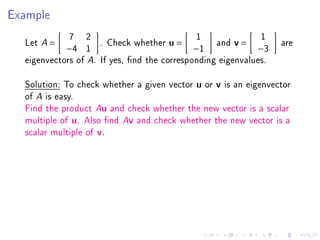
Example
                7   2                         1              1
  Let   A   =           . Check whether u =        and v =        are
                −4 1                          −1             −3
  eigenvectors of A. If yes, nd the corresponding eigenvalues.
Example
                7   2                         1              1
  Let   A   =           . Check whether u =        and v =        are
                −4 1                          −1             −3
  eigenvectors of A. If yes, nd the corresponding eigenvalues.

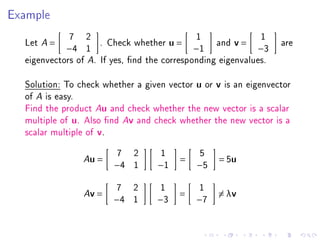
  Solution: To check whether a given vector u or v is an eigenvector
  of A is easy.
  Find the product Au and check whether the new vector is a scalar
  multiple of u. Also nd Av and check whether the new vector is a
  scalar multiple of v.
Example
                7   2                          1              1
  Let   A   =            . Check whether u =        and v =        are
                −4 1                           −1             −3
  eigenvectors of A. If yes, nd the corresponding eigenvalues.

  Solution: To check whether a given vector u or v is an eigenvector
  of A is easy.
  Find the product Au and check whether the new vector is a scalar
  multiple of u. Also nd Av and check whether the new vector is a
  scalar multiple of v.

                             7   2     1        5
                    A   u=                 =        = 5u
                             −4 1     −1       −5

                              7 2      1        1
                    A   v=                 =        = λv
                             −4 1     −3       −7
Example
                7   2                          1              1
  Let   A   =            . Check whether u =        and v =        are
                −4 1                           −1             −3
  eigenvectors of A. If yes, nd the corresponding eigenvalues.

  Solution: To check whether a given vector u or v is an eigenvector
  of A is easy.
  Find the product Au and check whether the new vector is a scalar
  multiple of u. Also nd Av and check whether the new vector is a
  scalar multiple of v.

                             7   2     1        5
                    A   u=                 =        = 5u
                             −4 1     −1       −5

                              7 2      1        1
                    A   v=                 =        = λv
                             −4 1     −3       −7
  So u is an eigenvector with λ = 5 and v is not an eigenvector.
Example

                7   2
  Let   A   =           . Show that 3 is an eigenvalue of   A   and nd the
                −4 1
  corresponding eigenvectors.

  Solution: 3 is an eigenvalue of   A   if and only if the equation Ax = 3x
  has a nontrivial solution.
Example

                7   2
  Let   A   =           . Show that 3 is an eigenvalue of   A   and nd the
                −4 1
  corresponding eigenvectors.

  Solution: 3 is an eigenvalue of A if and only if the equation Ax = 3x
  has a nontrivial solution. This means

                                  A   x − 3x = 0

  has a nontrivial solution. Or

                                (A − 3I )x = 0

  Back to homogeneous systems, trivial and nontrivial solutions.
Revisiting Homogeneous Systems


    1. Zero is always a solution (trivial solution).
    2. For nontrivial solutions, we need linearly dependent columns
Revisiting Homogeneous Systems


    1. Zero is always a solution (trivial solution).
    2. For nontrivial solutions, we need linearly dependent columns
    3. This means there are nonpivot columns or free variables
Revisiting Homogeneous Systems


    1.   Zero is always a solution (trivial solution).
    2.   For nontrivial solutions, we need linearly dependent columns
    3.   This means there are nonpivot columns or free variables
    4.   The free variables lead us to nontrivial solutions.
Example


  Write the matrix
                         7 2        3 0       4 2
            A   − 3I =          −         =         .
                         −4 1       0 3       −4 −2


  What do you think about the columns? Linearly dep/indep?
Example


  Write the matrix
                         7 2        3 0       4 2
            A   − 3I =          −         =         .
                         −4 1       0 3       −4 −2


  What do you think about the columns? Linearly dep/indep?They
  are linearly dependent. So the homogeneous system has
Example


  Write the matrix
                         7 2        3 0       4 2
            A   − 3I =          −         =         .
                         −4 1       0 3       −4 −2


  What do you think about the columns? Linearly dep/indep?They
  are linearly dependent. So the homogeneous system has nontrivial
  solutions. Thus 3 is an eigenvalue of A.
Example
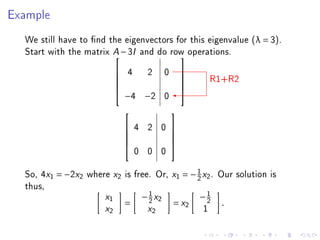
  We still have to nd the eigenvectors for this eigenvalue (λ = 3).
  Start with the matrix A − 3I and do row operations.
                                        
                         4  2 0
                                                 R1+R2
                                           
                                          
                                          
                          −4 −2 0
                                          

                                      
                            4 2 0 
                                  
                                  
                               0 0 0
                                  
Example
  We still have to nd the eigenvectors for this eigenvalue (λ = 3).
  Start with the matrix A − 3I and do row operations.
                                        
                          4  2 0
                                                          R1+R2
                                                  
                                                 
                                                 
                           −4 −2 0
                                                 

                                            
                               4 2 0 
                                     
                                     
                                  0 0 0
                                     


  So, 4x1 = −2x2 where   x2   is free. Or,   x1   = − 1 x2 .
                                                      2
Example
  We still have to nd the eigenvectors for this eigenvalue (λ = 3).
  Start with the matrix A − 3I and do row operations.
                                        
                            4  2 0
                                                             R1+R2
                                                    
                                                   
                                                   
                             −4 −2 0
                                                   

                                              
                                 4 2 0 
                                       
                                       
                                    0 0 0
                                       


  So, 4x1 = −2x2 where     x2   is free. Or,   x1   = − 1 x2 . Our solution is
                                                        2
  thus,
                      x1             − 1 x2
                                       2                −1
                                                         2
                                =              = x2            .
                      x2              x2                 1
Example


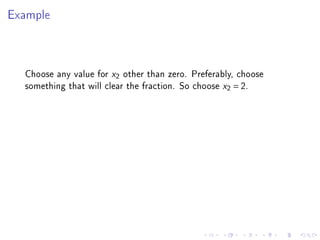
  Choose any value for x2 other than zero. Preferably, choose
  something that will clear the fraction. So choose x2 = 2.
Example


  Choose any value for x2 other than zero. Preferably, choose
  something that will clear the fraction. So choose x2 = 2. This gives,

                             x1         −1
                                         2         −1
                                   =2         =         .
                             x2          1         2

  Remember that this is       an   eigenvector of A. Depending on your
                                              −1
                                               2
  choice of   x2   , any scalar multiple of         is an eigenvector of A.
                                              1
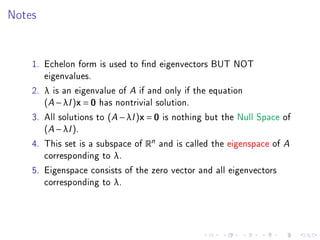
Notes


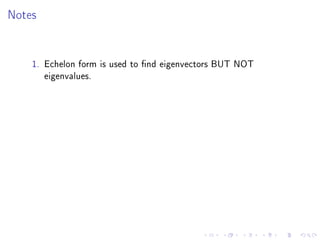
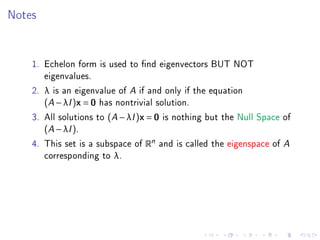
    1. Echelon form is used to nd eigenvectors BUT NOT
       eigenvalues.
Notes


    1. Echelon form is used to nd eigenvectors BUT NOT
       eigenvalues.
    2. λ is an eigenvalue of A if and only if the equation
       (A − λI )x = 0 has nontrivial solution.
Notes


    1. Echelon form is used to nd eigenvectors BUT NOT
       eigenvalues.
    2. λ is an eigenvalue of A if and only if the equation
       (A − λI )x = 0 has nontrivial solution.
    3. All solutions to (A − λI )x = 0 is nothing but the Null Space of
       (A − λI ).
Notes


    1. Echelon form is used to nd eigenvectors BUT NOT
       eigenvalues.
    2. λ is an eigenvalue of A if and only if the equation
       (A − λI )x = 0 has nontrivial solution.
    3. All solutions to (A − λI )x = 0 is nothing but the Null Space of
       (A − λI ).
    4. This set is a subspace of Rn and is called the eigenspace of A
       corresponding to λ.
Notes


    1. Echelon form is used to nd eigenvectors BUT NOT
       eigenvalues.
    2. λ is an eigenvalue of A if and only if the equation
       (A − λI )x = 0 has nontrivial solution.
    3. All solutions to (A − λI )x = 0 is nothing but the Null Space of
       (A − λI ).
    4. This set is a subspace of Rn and is called the eigenspace of A
       corresponding to λ.
    5. Eigenspace consists of the zero vector and all eigenvectors
       corresponding to λ.
Steps to check if λ is an eigenvalue


    1. Write the matrix   A   − λI
Steps to check if λ is an eigenvalue


    1. Write the matrix A − λI
    2. Check whether the columns are linearly dependent (existence
       of free variables)
Steps to check if λ is an eigenvalue


    1. Write the matrix A − λI
    2. Check whether the columns are linearly dependent (existence
       of free variables)
    3. If the columns are linearly dependent, λ is an eigenvalue.
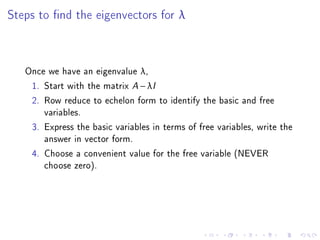
Steps to nd the eigenvectors for λ


   Once we have an eigenvalue λ,
    1. Start with the matrix A − λI
Steps to nd the eigenvectors for λ


   Once we have an eigenvalue λ,
    1. Start with the matrix A − λI
    2. Row reduce to echelon form to identify the basic and free
       variables.
Steps to nd the eigenvectors for λ


   Once we have an eigenvalue λ,
    1. Start with the matrix A − λI
    2. Row reduce to echelon form to identify the basic and free
       variables.
    3. Express the basic variables in terms of free variables, write the
       answer in vector form.
Steps to nd the eigenvectors for λ


   Once we have an eigenvalue λ,
    1. Start with the matrix A − λI
    2. Row reduce to echelon form to identify the basic and free
       variables.
    3. Express the basic variables in terms of free variables, write the
       answer in vector form.
    4. Choose a convenient value for the free variable (NEVER
       choose zero).
Example 6, section 5.1

         1                           3 6 7
                                           

   Is  −2  an eigenvector of   A= 3 3 7 . If yes, nd the
         1                           5 6 5
   corresponding eigenvalue.
Example 6, section 5.1

         1                           3 6 7
                                           

   Is  −2  an eigenvector of   A= 3 3 7 . If yes, nd the
         1                           5 6 5
   corresponding eigenvalue.

   Solution:

                 3 6 7      1       3 − 12 + 7      −2
                                                   
                3 3 7   −2  =  3 − 6 + 7  =  4 
                 5 6 5      1       5 − 12 + 5      −2
Example 6, section 5.1

         1                           3 6 7
                                           

   Is  −2  an eigenvector of   A= 3 3 7 . If yes, nd the
         1                           5 6 5
   corresponding eigenvalue.

   Solution:

                 3 6 7      1       3 − 12 + 7      −2
                                                       
                3 3 7   −2  =  3 − 6 + 7  =  4 
                 5 6 5      1       5 − 12 + 5      −2

                                                    1
                                                         

   The new vector is -2 times the old vector. So  −2  is an
                                                    1
   eigenvector of A with eigenvalue λ = −2.
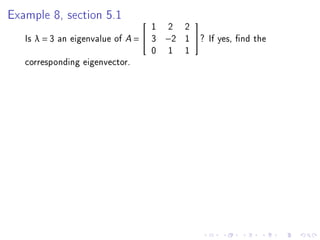
Example 8, section 5.1
                                   1 2 2
                                         

   Is λ = 3 an eigenvalue of A =  3 −2 1 ? If yes, nd the
                                   0 1 1
   corresponding eigenvector.
Example 8, section 5.1
                                   1 2 2
                                         

   Is λ = 3 an eigenvalue of A =  3 −2 1 ? If yes, nd the
                                   0 1 1
   corresponding eigenvector.

   Solution:
                  1 2 2        3 0 0       −2 2  2
                                                          

       A − 3I =  3 −2 1  −  0 3 0  =  3 −5 1 
                  0 1 1        0 0 3        0 1 −2
Example 8, section 5.1
                                   1 2 2
                                           

   Is λ = 3 an eigenvalue of A =  3 −2 1 ? If yes, nd the
                                   0 1 1
   corresponding eigenvector.

   Solution:
                  1 2 2        3 0 0       −2 2  2
                                                           

       A − 3I =  3 −2 1  −  0 3 0  =  3 −5 1 
                  0 1 1        0 0 3        0 1 −2
   How to know whether the columns are linearly dependent? You can
   check whether the determinant of this matrix is zero. (Or you could
   row reduce and check if there are free variables)
Example 8, section 5.1
                                   1 2 2
                                             

   Is λ = 3 an eigenvalue of A =  3 −2 1 ? If yes, nd the
                                   0 1 1
   corresponding eigenvector.

   Solution:
                  1 2 2        3 0 0       −2 2  2
                                                            

       A − 3I =  3 −2 1  −  0 3 0  =  3 −5 1 
                  0 1 1        0 0 3        0 1 −2
   How to know whether the columns are linearly dependent? You can
   check whether the determinant of this matrix is zero. (Or you could
   row reduce and check if there are free variables)
   If det(A − 3I ) = 0, that means A − 3I has linearly dependent columns
   (or there is a nontrivial solution).
Example 8, section 5.1
                                   1 2 2
                                             

   Is λ = 3 an eigenvalue of A =  3 −2 1 ? If yes, nd the
                                   0 1 1
   corresponding eigenvector.

   Solution:
                  1 2 2        3 0 0       −2 2  2
                                                              

       A − 3I =  3 −2 1  −  0 3 0  =  3 −5 1 
                  0 1 1        0 0 3        0 1 −2
   How to know whether the columns are linearly dependent? You can
   check whether the determinant of this matrix is zero. (Or you could
   row reduce and check if there are free variables)
   If det(A − 3I ) = 0, that means A − 3I has linearly dependent columns
   (or there is a nontrivial solution).

   Here det(A − 3I ) = 0 (Do this yourself), so the columns are linearly
   dependent and so λ = 3 is an eigenvalue.
To nd an eigenvector, start with     A   − 3I and row reduce

                                  −2      2 2
                                                 

                    A   − 3I =  3        −5 1 
                                  0       1 −2

Divide R1 by -2 and we get

                                1 −1 −1
                                                 

                     A − 3I =  3 −5 1 
                                0 1 −2
                                             
                     1 −1 −1 0
                                                      R2-3R1
                                              
                                             
                                             
                     3 −5 1 0
                                             
                                              
                                             
                                             
                                             
                      0 1 −2 0
                     
                            1 −1 −1 0           
                                                
                                                
                            0 −2 4 0
                                                
                                                         R3+0.5R2
                                                 
                                                
                                                
                                                
                             0 1 −2 0

                               1 −1 −1 0
                                                    
                             0 −2 4 0 
                               0 0 0 0
We have   x2   = 2x3   and x1 = x2 + x3 = 3x3 .Our solution is thus,
                                      3x3          3
                                                    
                           x1
                        x2      =  2x3  = x3  2  .
                           x3         x3           1
Choose   x3   = 1 and we have
                                               3
                                              
                                    x1
                                 x2      =  2 .
                                    x3         1
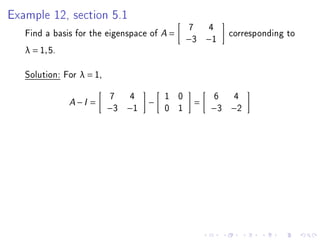
Example 12, section 5.1
                                            7   4
   Find a basis for the eigenspace of A =           corresponding to
                                            −3 −1
   λ = 1, 5.
Example 12, section 5.1
                                            7       4
   Find a basis for the eigenspace of A =                   corresponding to
                                            −3 −1
   λ = 1, 5.

   Solution: For λ = 1,

                          7   4       1 0               6    4
               A   −I =           −             =
                          −3 −1       0 1           −3 −2
Example 12, section 5.1
                                                   7       4
   Find a basis for the eigenspace of A =                          corresponding to
                                                 −3 −1
   λ = 1, 5.

   Solution: For λ = 1,

                          7        4       1 0                 6    4
               A   −I =                −               =
                          −3 −1            0 1             −3 −2
                                              
                            6  4 0
                                                           R2+0.5R1
                                               
                                              
                                              
                             −3 −2 0
                                              

                                          
                                6 4 0 
                                      
                                      
                                   0 0 0
                                      
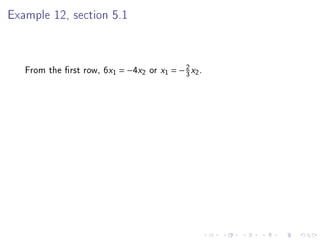
Example 12, section 5.1


   From the rst row, 6x1 = −4x2 or   x1   = − 2 x2 .
                                               3
Example 12, section 5.1


   From the rst row, 6x1 = −4x2 or   x1   = − 2 x2 . Our solution is thus,
                                               3

                      x1       − 2 x2
                                 3                −2
                                                   3
                           =               = x2         .
                      x2        x2                 1
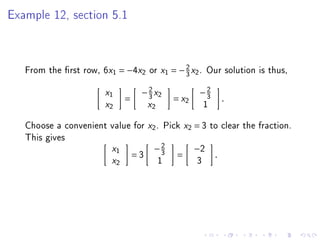
Example 12, section 5.1


   From the rst row, 6x1 = −4x2 or         x1   = − 2 x2 . Our solution is thus,
                                                     3

                      x1          − 2 x2
                                    3                       −2
                                                             3
                             =                   = x2                  .
                      x2              x2                       1

   Choose a convenient value for      x2   . Pick     x2   = 3 to clear the fraction.
   This gives
                        x1             −2
                                        3                  −2
                                 =3               =                .
                        x2                 1               3
Example 12, section 5.1
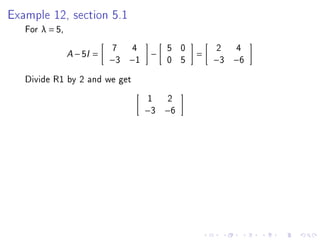
   For λ = 5,
                             7   4       5 0       2   4
                A   − 5I =           −         =
                             −3 −1       0 5       −3 −6
Example 12, section 5.1
   For λ = 5,
                             7   4       5 0       2   4
                A   − 5I =           −         =
                             −3 −1       0 5       −3 −6

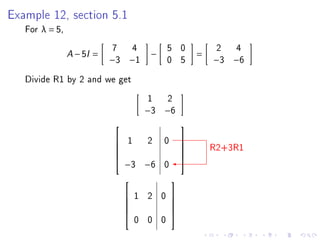
   Divide R1 by 2 and we get
                                     1 2
                                     −3 −6
Example 12, section 5.1
   For λ = 5,
                             7       4       5 0          2   4
                A   − 5I =               −           =
                             −3 −1           0 5         −3 −6

   Divide R1 by 2 and we get
                                         1 2
                                         −3 −6
                                                
                              1  2 0
                                                         R2+3R1
                                                 
                                                
                                                
                               −3 −6 0
                                                

                                            
                                  1 2 0 
                                        
                                        
                                     0 0 0
                                        
Example 12, section 5.1


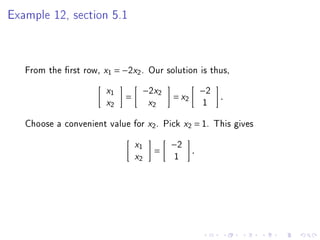
   From the rst row,   x1   = −2x2 . Our solution is thus,
Example 12, section 5.1


   From the rst row,   x1   = −2x2 . Our solution is thus,

                        x1          −2x2           −2
                                =           = x2        .
                        x2           x2            1
Example 12, section 5.1


   From the rst row,   x1   = −2x2 . Our solution is thus,

                        x1           −2x2                       −2
                                =                 = x2               .
                        x2               x2                     1

   Choose a convenient value for         x2   . Pick   x2   = 1. This gives

                                    x1           −2
                                          =                 .
                                    x2            1
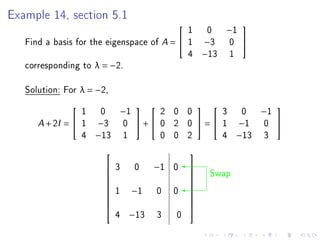
Example 14, section 5.1
                                            1 0 −1
                                                 

   Find a basis for the eigenspace of A =  1 −3 0 
                                            4 −13 1
   corresponding to λ = −2.

   Solution: For λ = −2,

                 1 0 −1        2 0 0       3 0 −1
                                                  

      A + 2I =  1 −3  0  +  0 2 0  =  1 −1 0 
                 4 −13 1       0 0 2       4 −13 3
Example 14, section 5.1
                                            1 0 −1
                                                          

   Find a basis for the eigenspace of A =  1 −3 0 
                                            4 −13 1
   corresponding to λ = −2.

   Solution: For λ = −2,

                 1 0 −1        2 0 0       3 0 −1
                                                          

      A + 2I =  1 −3  0  +  0 2 0  =  1 −1 0 
                 4 −13 1       0 0 2       4 −13 3
                                           
                        3    0    −1 0
                                                    Swap
                                            
                                           
                                           
                        1   −1     0   0
                                           
                                            
                                           
                                           
                                           
                           4 −13    3   0
                    
 1   −1    0    0
                         R2-3R1
                     
                                  R3-4R1
                    
                    
 3    0    −1   0
                    
                     
                    
                    
                    
    4 −13   3    0
                    
 1   −1    0    0
                         R2-3R1
                     
                                  R3-4R1
                    
                    
 3    0    −1   0
                    
                     
                    
                    
                    
    4 −13   3    0
                    
  1 −1 0  0         
                    
                    
  0 3 −1 0
                    
                         R3+3R2
                     
                    
                    
                    
   0 −9 3 0
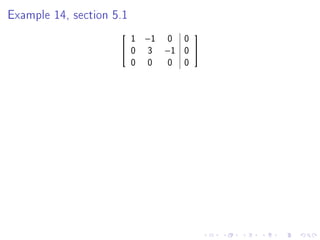
Example 14, section 5.1
                       1 −1 0 0
                               
                      0 3 −1 0 
                       0 0 0 0
Example 14, section 5.1
                             1 −1 0 0
                                             
                            0 3 −1 0 
                             0 0 0 0
   Here x3 is a free variable.
   From the second row, 3x2 = x3 or x2 = 1 x3 .
                                           3
   From rst row, x1 = x2 and so x1 = 1 x3 .
                                      3
Example 14, section 5.1
                                1 −1 0 0
                                             
                               0 3 −1 0 
                                0 0 0 0
   Here x3 is a free variable.
   From the second row, 3x2 = x3 or x2 = 1 x3 .
                                           3
   From rst row, x1 = x2 and so x1 = 1 x3 .
                                      3
   Our solution is thus,
                                 1       1 
                         x1
                                3 3   x
                                              3
                      x2  =  1 x3  = x3  1  .
                                3             3
                       x3       x3            1
Example 14, section 5.1
                                   1 −1 0 0
                                                     
                                  0 3 −1 0 
                                   0 0 0 0
   Here x3 is a free variable.
   From the second row, 3x2 = x3 or x2 = 1 x3 .
                                           3
   From rst row, x1 = x2 and so x1 = 1 x3 .
                                      3
   Our solution is thus,
                                    1       1 
                            x1
                                   3 3   x
                                                 3
                         x2  =  1 x3  = x3  1  .
                                   3             3
                          x3       x3            1
   Choose   x3   = 3 and we have

                                                1
                                               
                                     x1
                                  x2      =  1 .
                                     x3         3
Any Surprises to Expect?


   Try problems 13 and 15 in your homework. There might be
   something interesting going on in these cases. If you get stuck, we
   will go over them in class tomorrow.
Triangular Matrices

   Theorem
   The eigenvalues of a triangular matrix are the entries on its main

   diagonal.
Triangular Matrices

   Theorem
   The eigenvalues of a triangular matrix are the entries on its main

   diagonal.


   Proof.
   For simplicity, consider a 3 × 3 upper triangular matrix. Then

                                        0 0
                                        λ                   −λ
                                                                                  
                a11   a12   a13                       a11         a12        a13

   A   −λI =  0      a22   a23   − 0 λ 0  =        0        a22   −λ    a23       
                0     0     a33       0 0 λ             0          0        a33   −λ

   (A − λI )x = 0 has a free variable if and only if atleast one of the
   diagonal entries is zero. This happens if and only if λ equals one of
   the entries a11 , a22 , a33 of A.
Triangular Matrices


   Example
    1. Let
                                      5 1 9
                                                 

                                 A=  0 2 3 
                                      0 0 6
       The eigenvalues of   A   are 5, 2 and 6.
Triangular Matrices


   Example
    1. Let
                                      5 1 9
                                                 

                                 A=  0 2 3 
                                      0 0 6
       The eigenvalues of   A   are 5, 2 and 6.
    2. Let
                                     4 1 9
                                                 

                                 A= 0 0 3 
                                     0 0 6
       The eigenvalues of   A   are 4, 0 and 6.

Eigenvalues and Eigenvectors (Tacoma Narrows Bridge video included)

  • 1.
    Announcements Quiz 3 tomorrow on sections 3.1 and 3.2 No calculators for this quiz. You have to nd the determinants using the methods we have learned.
  • 2.
    Section 5.1 Eigenvaluesand Eigenvectors Comes from the German word eigen meaning proper or characteristic. Gives a better understanding of the linear transformation x → Ax in terms of elements that can be easily visualized.
  • 3.
    Tacoma Narrows BridgeCollapse- 1940 1. Bridge forming small waves like a river
  • 4.
    Tacoma Narrows BridgeCollapse- 1940 1. Bridge forming small waves like a river 2. Initially assumed safe but oscillations grew with time
  • 5.
    Tacoma Narrows BridgeCollapse- 1940 1. Bridge forming small waves like a river 2. Initially assumed safe but oscillations grew with time 3. One edge of the road 28 ft higher than the other edge
  • 6.
    Tacoma Narrows BridgeCollapse- 1940 1. Bridge forming small waves like a river 2. Initially assumed safe but oscillations grew with time 3. One edge of the road 28 ft higher than the other edge 4. Finally collapsed
  • 7.
    Tacoma Narrows BridgeCollapse- 1940 Explanation: 1. Oscillation of bridge caused by the wind frequency being too close to the natural frequency of the bridge
  • 8.
    Tacoma Narrows BridgeCollapse- 1940 Explanation: 1. Oscillation of bridge caused by the wind frequency being too close to the natural frequency of the bridge 2. Natural frequency of the bridge is the eigenvalue of the smallest magnitude (based on a system that modeled the bridge)
  • 9.
    Tacoma Narrows BridgeCollapse- 1940 Explanation: 1. Oscillation of bridge caused by the wind frequency being too close to the natural frequency of the bridge 2. Natural frequency of the bridge is the eigenvalue of the smallest magnitude (based on a system that modeled the bridge) 3. Eigenvalues are very important to engineers when they design structures.
  • 10.
    Electrical Systems Radio Tuning 1. Trying to match the frequency with which your station is broadcasting. 2. Eigenvalues were used during the radio design by engineers.
  • 11.
    Cars 1. Use Eigenvalues to damp out noise for a quiet ride.
  • 12.
    Cars 1. Use Eigenvalues to damp out noise for a quiet ride. 2. Also used in design of car stereo systems so that sounds create listening pleasure 3. To reduce the vibration of the car due to the music.
  • 13.
    Others 1. Test for cracks in a solid. (avoids testing each and every inch of a beam for example)
  • 14.
    Others 1. Test for cracks in a solid. (avoids testing each and every inch of a beam for example) 2. Used by oil companies to explore land for oil.
  • 15.
    Others 1. Test for cracks in a solid. (avoids testing each and every inch of a beam for example) 2. Used by oil companies to explore land for oil. 3. Applications in economics, physics, chemistry, biology (red blood cell production)
  • 16.
    Others 1. Test for cracks in a solid. (avoids testing each and every inch of a beam for example) 2. Used by oil companies to explore land for oil. 3. Applications in economics, physics, chemistry, biology (red blood cell production) 4. Discrete (and continuous) linear dynamical systems (part of MA3521)
  • 17.
    Others 1. Test for cracks in a solid. (avoids testing each and every inch of a beam for example) 2. Used by oil companies to explore land for oil. 3. Applications in economics, physics, chemistry, biology (red blood cell production) 4. Discrete (and continuous) linear dynamical systems (part of MA3521) 5. Pure and Applied Mathematics
  • 18.
    Back to matrix-vectorproduct 3 −2 −1 Let A = . Find Au and Av where u = and 1 0 −2 2 v= (the image of u and v after being acted on by A.) 1
  • 19.
    Back to matrix-vectorproduct 3 −2 −1 Let A = . Find Au and Av where u = and 1 0 −2 2 v= (the image of u and v after being acted on by A.) 1 3 −2 −1 −3 + 4 1 A u= = = 1 0 −2 −1 − 0 −1 3 −2 2 6−2 4 A v= = = = 2v 1 0 1 2+0 2
  • 20.
    y x 0
  • 21.
    y x 0 u
  • 22.
    y x 0 A u u
  • 23.
    y x 0 A u u
  • 24.
    y v x 0 A u u
  • 25.
    y A v v x 0 A u u
  • 26.
    y A v v x 0 A u u
  • 27.
    Observations 1. A transforms u into a new vector.
  • 28.
    Observations 1. A transforms u into a new vector. 2. A stretches or dilates v in the same direction.
  • 29.
    Observations 1. A transforms u into a new vector. 2. A stretches or dilates v in the same direction. 3. Au is not a scalar multiple of u
  • 30.
    Observations 1. A transforms u into a new vector. 2. A stretches or dilates v in the same direction. 3. Au is not a scalar multiple of u 4. Av is a scalar multiple of v
  • 31.
    Observations 1. A transforms u into a new vector. 2. A stretches or dilates v in the same direction. 3. Au is not a scalar multiple of u 4. Av is a scalar multiple of v 5. We are interested in the second case, where the new vector (result of action by A) is a scalar multiple of the original vector.
  • 32.
    Eigenvalues and Eigenvectors In other words we are interested in studying equations of the form Ax = 2x or Ax = −3x. We look for vectors that are scalar multiples of themselves (could be same as the original vector)
  • 33.
    Eigenvalues and Eigenvectors Denition An eigenvector of an n × n matrix A is a NON-ZERO vector x such that Ax = λx for some scalar λ. A scalar λ is called an eigenvalue of A if there is a nontrivial (or nonzero) solution x to Ax = λx; such an x is called an eigenvector corresponding to λ.
  • 34.
    Why nonzero? Go back to Ax = λx. What is an obvious solution to this equation?
  • 35.
    Why nonzero? Go back to Ax = λx. What is an obvious solution to this equation? We know that A0 = λ0 always. There is nothing interesting about the zero (or the trivial) solution. So we need a nonzero vector for eigenvector.
  • 36.
    Why nonzero? Go back to Ax = λx. What is an obvious solution to this equation? We know that A0 = λ0 always. There is nothing interesting about the zero (or the trivial) solution. So we need a nonzero vector for eigenvector. An eigenvalue can be zero. (We will come back to this case later)
  • 37.
    Example 7 2 1 1 Let A = . Check whether u = and v = are −4 1 −1 −3 eigenvectors of A. If yes, nd the corresponding eigenvalues.
  • 38.
    Example 7 2 1 1 Let A = . Check whether u = and v = are −4 1 −1 −3 eigenvectors of A. If yes, nd the corresponding eigenvalues. Solution: To check whether a given vector u or v is an eigenvector of A is easy. Find the product Au and check whether the new vector is a scalar multiple of u. Also nd Av and check whether the new vector is a scalar multiple of v.
  • 39.
    Example 7 2 1 1 Let A = . Check whether u = and v = are −4 1 −1 −3 eigenvectors of A. If yes, nd the corresponding eigenvalues. Solution: To check whether a given vector u or v is an eigenvector of A is easy. Find the product Au and check whether the new vector is a scalar multiple of u. Also nd Av and check whether the new vector is a scalar multiple of v. 7 2 1 5 A u= = = 5u −4 1 −1 −5 7 2 1 1 A v= = = λv −4 1 −3 −7
  • 40.
    Example 7 2 1 1 Let A = . Check whether u = and v = are −4 1 −1 −3 eigenvectors of A. If yes, nd the corresponding eigenvalues. Solution: To check whether a given vector u or v is an eigenvector of A is easy. Find the product Au and check whether the new vector is a scalar multiple of u. Also nd Av and check whether the new vector is a scalar multiple of v. 7 2 1 5 A u= = = 5u −4 1 −1 −5 7 2 1 1 A v= = = λv −4 1 −3 −7 So u is an eigenvector with λ = 5 and v is not an eigenvector.
  • 41.
    Example 7 2 Let A = . Show that 3 is an eigenvalue of A and nd the −4 1 corresponding eigenvectors. Solution: 3 is an eigenvalue of A if and only if the equation Ax = 3x has a nontrivial solution.
  • 42.
    Example 7 2 Let A = . Show that 3 is an eigenvalue of A and nd the −4 1 corresponding eigenvectors. Solution: 3 is an eigenvalue of A if and only if the equation Ax = 3x has a nontrivial solution. This means A x − 3x = 0 has a nontrivial solution. Or (A − 3I )x = 0 Back to homogeneous systems, trivial and nontrivial solutions.
  • 43.
    Revisiting Homogeneous Systems 1. Zero is always a solution (trivial solution). 2. For nontrivial solutions, we need linearly dependent columns
  • 44.
    Revisiting Homogeneous Systems 1. Zero is always a solution (trivial solution). 2. For nontrivial solutions, we need linearly dependent columns 3. This means there are nonpivot columns or free variables
  • 45.
    Revisiting Homogeneous Systems 1. Zero is always a solution (trivial solution). 2. For nontrivial solutions, we need linearly dependent columns 3. This means there are nonpivot columns or free variables 4. The free variables lead us to nontrivial solutions.
  • 46.
    Example Writethe matrix 7 2 3 0 4 2 A − 3I = − = . −4 1 0 3 −4 −2 What do you think about the columns? Linearly dep/indep?
  • 47.
    Example Writethe matrix 7 2 3 0 4 2 A − 3I = − = . −4 1 0 3 −4 −2 What do you think about the columns? Linearly dep/indep?They are linearly dependent. So the homogeneous system has
  • 48.
    Example Writethe matrix 7 2 3 0 4 2 A − 3I = − = . −4 1 0 3 −4 −2 What do you think about the columns? Linearly dep/indep?They are linearly dependent. So the homogeneous system has nontrivial solutions. Thus 3 is an eigenvalue of A.
  • 49.
    Example Westill have to nd the eigenvectors for this eigenvalue (λ = 3). Start with the matrix A − 3I and do row operations.    4 2 0 R1+R2      −4 −2 0      4 2 0      0 0 0  
  • 50.
    Example Westill have to nd the eigenvectors for this eigenvalue (λ = 3). Start with the matrix A − 3I and do row operations.    4 2 0 R1+R2      −4 −2 0      4 2 0      0 0 0   So, 4x1 = −2x2 where x2 is free. Or, x1 = − 1 x2 . 2
  • 51.
    Example Westill have to nd the eigenvectors for this eigenvalue (λ = 3). Start with the matrix A − 3I and do row operations.    4 2 0 R1+R2      −4 −2 0      4 2 0      0 0 0   So, 4x1 = −2x2 where x2 is free. Or, x1 = − 1 x2 . Our solution is 2 thus, x1 − 1 x2 2 −1 2 = = x2 . x2 x2 1
  • 52.
    Example Chooseany value for x2 other than zero. Preferably, choose something that will clear the fraction. So choose x2 = 2.
  • 53.
    Example Chooseany value for x2 other than zero. Preferably, choose something that will clear the fraction. So choose x2 = 2. This gives, x1 −1 2 −1 =2 = . x2 1 2 Remember that this is an eigenvector of A. Depending on your −1 2 choice of x2 , any scalar multiple of is an eigenvector of A. 1
  • 54.
    Notes 1. Echelon form is used to nd eigenvectors BUT NOT eigenvalues.
  • 55.
    Notes 1. Echelon form is used to nd eigenvectors BUT NOT eigenvalues. 2. λ is an eigenvalue of A if and only if the equation (A − λI )x = 0 has nontrivial solution.
  • 56.
    Notes 1. Echelon form is used to nd eigenvectors BUT NOT eigenvalues. 2. λ is an eigenvalue of A if and only if the equation (A − λI )x = 0 has nontrivial solution. 3. All solutions to (A − λI )x = 0 is nothing but the Null Space of (A − λI ).
  • 57.
    Notes 1. Echelon form is used to nd eigenvectors BUT NOT eigenvalues. 2. λ is an eigenvalue of A if and only if the equation (A − λI )x = 0 has nontrivial solution. 3. All solutions to (A − λI )x = 0 is nothing but the Null Space of (A − λI ). 4. This set is a subspace of Rn and is called the eigenspace of A corresponding to λ.
  • 58.
    Notes 1. Echelon form is used to nd eigenvectors BUT NOT eigenvalues. 2. λ is an eigenvalue of A if and only if the equation (A − λI )x = 0 has nontrivial solution. 3. All solutions to (A − λI )x = 0 is nothing but the Null Space of (A − λI ). 4. This set is a subspace of Rn and is called the eigenspace of A corresponding to λ. 5. Eigenspace consists of the zero vector and all eigenvectors corresponding to λ.
  • 59.
    Steps to checkif λ is an eigenvalue 1. Write the matrix A − λI
  • 60.
    Steps to checkif λ is an eigenvalue 1. Write the matrix A − λI 2. Check whether the columns are linearly dependent (existence of free variables)
  • 61.
    Steps to checkif λ is an eigenvalue 1. Write the matrix A − λI 2. Check whether the columns are linearly dependent (existence of free variables) 3. If the columns are linearly dependent, λ is an eigenvalue.
  • 62.
    Steps to ndthe eigenvectors for λ Once we have an eigenvalue λ, 1. Start with the matrix A − λI
  • 63.
    Steps to ndthe eigenvectors for λ Once we have an eigenvalue λ, 1. Start with the matrix A − λI 2. Row reduce to echelon form to identify the basic and free variables.
  • 64.
    Steps to ndthe eigenvectors for λ Once we have an eigenvalue λ, 1. Start with the matrix A − λI 2. Row reduce to echelon form to identify the basic and free variables. 3. Express the basic variables in terms of free variables, write the answer in vector form.
  • 65.
    Steps to ndthe eigenvectors for λ Once we have an eigenvalue λ, 1. Start with the matrix A − λI 2. Row reduce to echelon form to identify the basic and free variables. 3. Express the basic variables in terms of free variables, write the answer in vector form. 4. Choose a convenient value for the free variable (NEVER choose zero).
  • 66.
    Example 6, section5.1 1 3 6 7     Is  −2  an eigenvector of A= 3 3 7 . If yes, nd the 1 5 6 5 corresponding eigenvalue.
  • 67.
    Example 6, section5.1 1 3 6 7     Is  −2  an eigenvector of A= 3 3 7 . If yes, nd the 1 5 6 5 corresponding eigenvalue. Solution: 3 6 7 1 3 − 12 + 7 −2         3 3 7   −2  =  3 − 6 + 7  =  4  5 6 5 1 5 − 12 + 5 −2
  • 68.
    Example 6, section5.1 1 3 6 7     Is  −2  an eigenvector of A= 3 3 7 . If yes, nd the 1 5 6 5 corresponding eigenvalue. Solution: 3 6 7 1 3 − 12 + 7 −2         3 3 7   −2  =  3 − 6 + 7  =  4  5 6 5 1 5 − 12 + 5 −2 1   The new vector is -2 times the old vector. So  −2  is an 1 eigenvector of A with eigenvalue λ = −2.
  • 69.
    Example 8, section5.1 1 2 2   Is λ = 3 an eigenvalue of A =  3 −2 1 ? If yes, nd the 0 1 1 corresponding eigenvector.
  • 70.
    Example 8, section5.1 1 2 2   Is λ = 3 an eigenvalue of A =  3 −2 1 ? If yes, nd the 0 1 1 corresponding eigenvector. Solution: 1 2 2 3 0 0 −2 2 2       A − 3I =  3 −2 1  −  0 3 0  =  3 −5 1  0 1 1 0 0 3 0 1 −2
  • 71.
    Example 8, section5.1 1 2 2   Is λ = 3 an eigenvalue of A =  3 −2 1 ? If yes, nd the 0 1 1 corresponding eigenvector. Solution: 1 2 2 3 0 0 −2 2 2       A − 3I =  3 −2 1  −  0 3 0  =  3 −5 1  0 1 1 0 0 3 0 1 −2 How to know whether the columns are linearly dependent? You can check whether the determinant of this matrix is zero. (Or you could row reduce and check if there are free variables)
  • 72.
    Example 8, section5.1 1 2 2   Is λ = 3 an eigenvalue of A =  3 −2 1 ? If yes, nd the 0 1 1 corresponding eigenvector. Solution: 1 2 2 3 0 0 −2 2 2       A − 3I =  3 −2 1  −  0 3 0  =  3 −5 1  0 1 1 0 0 3 0 1 −2 How to know whether the columns are linearly dependent? You can check whether the determinant of this matrix is zero. (Or you could row reduce and check if there are free variables) If det(A − 3I ) = 0, that means A − 3I has linearly dependent columns (or there is a nontrivial solution).
  • 73.
    Example 8, section5.1 1 2 2   Is λ = 3 an eigenvalue of A =  3 −2 1 ? If yes, nd the 0 1 1 corresponding eigenvector. Solution: 1 2 2 3 0 0 −2 2 2       A − 3I =  3 −2 1  −  0 3 0  =  3 −5 1  0 1 1 0 0 3 0 1 −2 How to know whether the columns are linearly dependent? You can check whether the determinant of this matrix is zero. (Or you could row reduce and check if there are free variables) If det(A − 3I ) = 0, that means A − 3I has linearly dependent columns (or there is a nontrivial solution). Here det(A − 3I ) = 0 (Do this yourself), so the columns are linearly dependent and so λ = 3 is an eigenvalue.
  • 74.
    To nd aneigenvector, start with A − 3I and row reduce −2 2 2   A − 3I =  3 −5 1  0 1 −2 Divide R1 by -2 and we get 1 −1 −1   A − 3I =  3 −5 1  0 1 −2    1 −1 −1 0 R2-3R1       3 −5 1 0          0 1 −2 0
  • 75.
      1 −1 −1 0       0 −2 4 0   R3+0.5R2        0 1 −2 0 1 −1 −1 0    0 −2 4 0  0 0 0 0 We have x2 = 2x3 and x1 = x2 + x3 = 3x3 .Our solution is thus, 3x3 3       x1  x2  =  2x3  = x3  2  . x3 x3 1 Choose x3 = 1 and we have 3     x1  x2  =  2 . x3 1
  • 76.
    Example 12, section5.1 7 4 Find a basis for the eigenspace of A = corresponding to −3 −1 λ = 1, 5.
  • 77.
    Example 12, section5.1 7 4 Find a basis for the eigenspace of A = corresponding to −3 −1 λ = 1, 5. Solution: For λ = 1, 7 4 1 0 6 4 A −I = − = −3 −1 0 1 −3 −2
  • 78.
    Example 12, section5.1 7 4 Find a basis for the eigenspace of A = corresponding to −3 −1 λ = 1, 5. Solution: For λ = 1, 7 4 1 0 6 4 A −I = − = −3 −1 0 1 −3 −2    6 4 0 R2+0.5R1      −3 −2 0      6 4 0      0 0 0  
  • 79.
    Example 12, section5.1 From the rst row, 6x1 = −4x2 or x1 = − 2 x2 . 3
  • 80.
    Example 12, section5.1 From the rst row, 6x1 = −4x2 or x1 = − 2 x2 . Our solution is thus, 3 x1 − 2 x2 3 −2 3 = = x2 . x2 x2 1
  • 81.
    Example 12, section5.1 From the rst row, 6x1 = −4x2 or x1 = − 2 x2 . Our solution is thus, 3 x1 − 2 x2 3 −2 3 = = x2 . x2 x2 1 Choose a convenient value for x2 . Pick x2 = 3 to clear the fraction. This gives x1 −2 3 −2 =3 = . x2 1 3
  • 82.
    Example 12, section5.1 For λ = 5, 7 4 5 0 2 4 A − 5I = − = −3 −1 0 5 −3 −6
  • 83.
    Example 12, section5.1 For λ = 5, 7 4 5 0 2 4 A − 5I = − = −3 −1 0 5 −3 −6 Divide R1 by 2 and we get 1 2 −3 −6
  • 84.
    Example 12, section5.1 For λ = 5, 7 4 5 0 2 4 A − 5I = − = −3 −1 0 5 −3 −6 Divide R1 by 2 and we get 1 2 −3 −6    1 2 0 R2+3R1      −3 −6 0      1 2 0      0 0 0  
  • 85.
    Example 12, section5.1 From the rst row, x1 = −2x2 . Our solution is thus,
  • 86.
    Example 12, section5.1 From the rst row, x1 = −2x2 . Our solution is thus, x1 −2x2 −2 = = x2 . x2 x2 1
  • 87.
    Example 12, section5.1 From the rst row, x1 = −2x2 . Our solution is thus, x1 −2x2 −2 = = x2 . x2 x2 1 Choose a convenient value for x2 . Pick x2 = 1. This gives x1 −2 = . x2 1
  • 88.
    Example 14, section5.1 1 0 −1   Find a basis for the eigenspace of A =  1 −3 0  4 −13 1 corresponding to λ = −2. Solution: For λ = −2, 1 0 −1 2 0 0 3 0 −1       A + 2I =  1 −3 0  +  0 2 0  =  1 −1 0  4 −13 1 0 0 2 4 −13 3
  • 89.
    Example 14, section5.1 1 0 −1   Find a basis for the eigenspace of A =  1 −3 0  4 −13 1 corresponding to λ = −2. Solution: For λ = −2, 1 0 −1 2 0 0 3 0 −1       A + 2I =  1 −3 0  +  0 2 0  =  1 −1 0  4 −13 1 0 0 2 4 −13 3    3 0 −1 0 Swap       1 −1 0 0          4 −13 3 0
  • 90.
      1 −1 0 0 R2-3R1  R3-4R1      3 0 −1 0          4 −13 3 0
  • 91.
      1 −1 0 0 R2-3R1  R3-4R1      3 0 −1 0          4 −13 3 0    1 −1 0 0       0 3 −1 0   R3+3R2        0 −9 3 0
  • 92.
    Example 14, section5.1 1 −1 0 0    0 3 −1 0  0 0 0 0
  • 93.
    Example 14, section5.1 1 −1 0 0    0 3 −1 0  0 0 0 0 Here x3 is a free variable. From the second row, 3x2 = x3 or x2 = 1 x3 . 3 From rst row, x1 = x2 and so x1 = 1 x3 . 3
  • 94.
    Example 14, section5.1 1 −1 0 0    0 3 −1 0  0 0 0 0 Here x3 is a free variable. From the second row, 3x2 = x3 or x2 = 1 x3 . 3 From rst row, x1 = x2 and so x1 = 1 x3 . 3 Our solution is thus,    1   1  x1 3 3 x 3  x2  =  1 x3  = x3  1  . 3 3 x3 x3 1
  • 95.
    Example 14, section5.1 1 −1 0 0    0 3 −1 0  0 0 0 0 Here x3 is a free variable. From the second row, 3x2 = x3 or x2 = 1 x3 . 3 From rst row, x1 = x2 and so x1 = 1 x3 . 3 Our solution is thus,    1   1  x1 3 3 x 3  x2  =  1 x3  = x3  1  . 3 3 x3 x3 1 Choose x3 = 3 and we have 1     x1  x2  =  1 . x3 3
  • 96.
    Any Surprises toExpect? Try problems 13 and 15 in your homework. There might be something interesting going on in these cases. If you get stuck, we will go over them in class tomorrow.
  • 97.
    Triangular Matrices Theorem The eigenvalues of a triangular matrix are the entries on its main diagonal.
  • 98.
    Triangular Matrices Theorem The eigenvalues of a triangular matrix are the entries on its main diagonal. Proof. For simplicity, consider a 3 × 3 upper triangular matrix. Then 0 0 λ −λ       a11 a12 a13 a11 a12 a13 A −λI =  0 a22 a23 − 0 λ 0  =  0 a22 −λ a23  0 0 a33 0 0 λ 0 0 a33 −λ (A − λI )x = 0 has a free variable if and only if atleast one of the diagonal entries is zero. This happens if and only if λ equals one of the entries a11 , a22 , a33 of A.
  • 99.
    Triangular Matrices Example 1. Let 5 1 9   A=  0 2 3  0 0 6 The eigenvalues of A are 5, 2 and 6.
  • 100.
    Triangular Matrices Example 1. Let 5 1 9   A=  0 2 3  0 0 6 The eigenvalues of A are 5, 2 and 6. 2. Let 4 1 9   A= 0 0 3  0 0 6 The eigenvalues of A are 4, 0 and 6.