Multiply–Add Rule: AnAk = An+k
Divide–Subtract Rule: An
Ak
Power–Multiply Rule: (An)k = Ank , (An Bm)k = Ank Bmk
Exponents
= An – k
Exponent–Rules
0-power Rule: A0 = 1 (A=0)
=
1
Ak
1
Ak
A0
Ak
½ - Power Rule: A½ = A , the square root of A,
because (A½)2 = A = (A)2, so A½ = A
because 1 = = A1–1 = A0
A1
A1
Negative Power Rule: A–k =
because = A0–k = A–k
1/n - Power Rule: A1/n = A , the nth root of A.
n
(divide–subtract)
(divide–subtract)
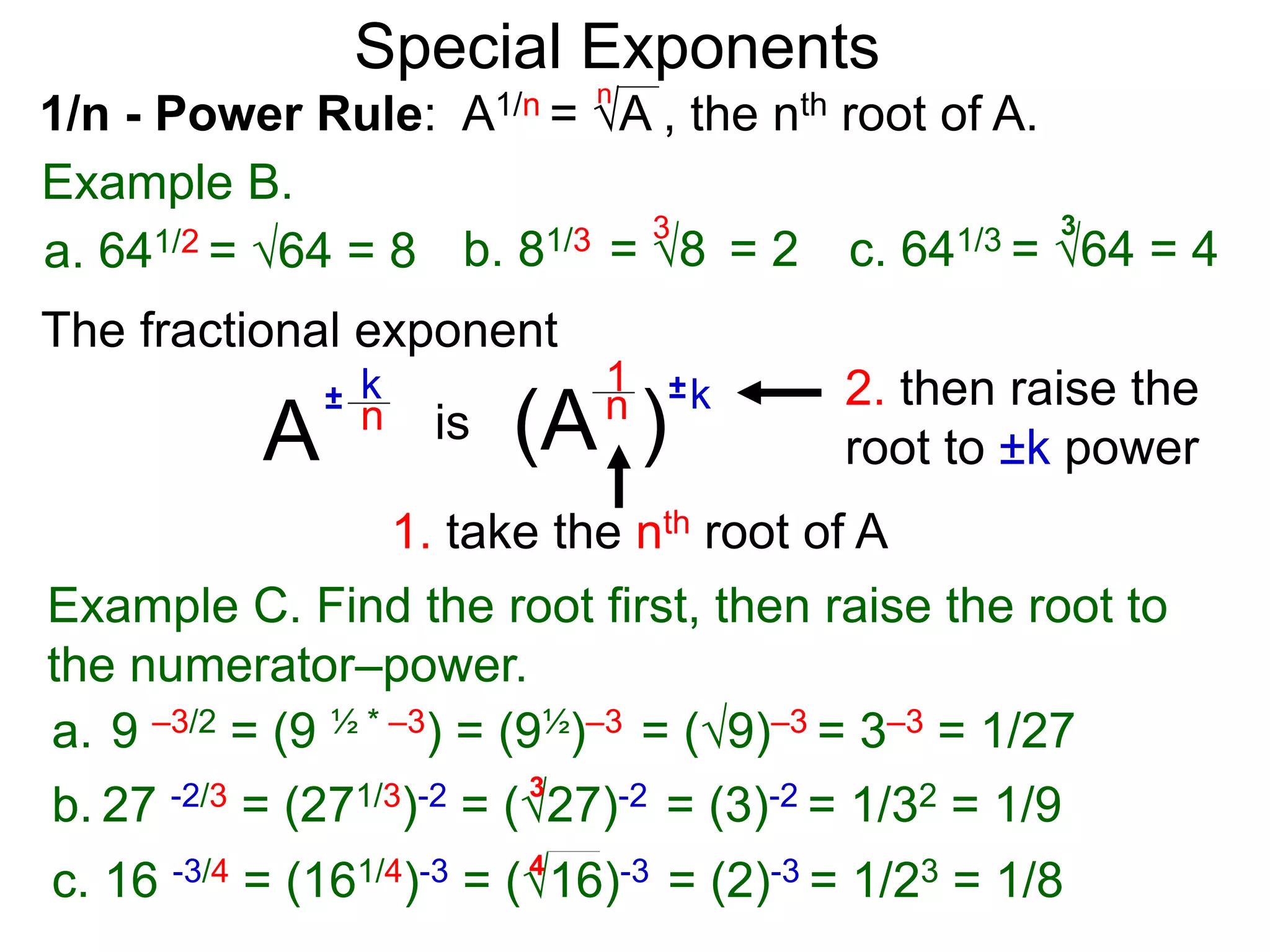
Special Exponents
Example B.
c. 641/3 = 64 = 4
3
b. 81/3 = 8 = 2
3
a. 641/2 = 64 = 8
a. 9 –3/2 = (9 ½ * –3) = (9½)–3 = (9)–3 = 3–3 = 1/27
Example C. Find the root first, then raise the root to
the numerator–power.
The fractional exponent
A
k
n
±
(A ) k
n ±
1
is
1. take the nth root of A
2. then raise the
root to ±k power
c. 16 -3/4 = (161/4)-3 = (16)-3 = (2)-3 = 1/23 = 1/8
4
b. 27 -2/3 = (271/3)-2 = (27)-2 = (3)-2 = 1/32 = 1/9
3
1/n - Power Rule: A1/n = A , the nth root of A.
n
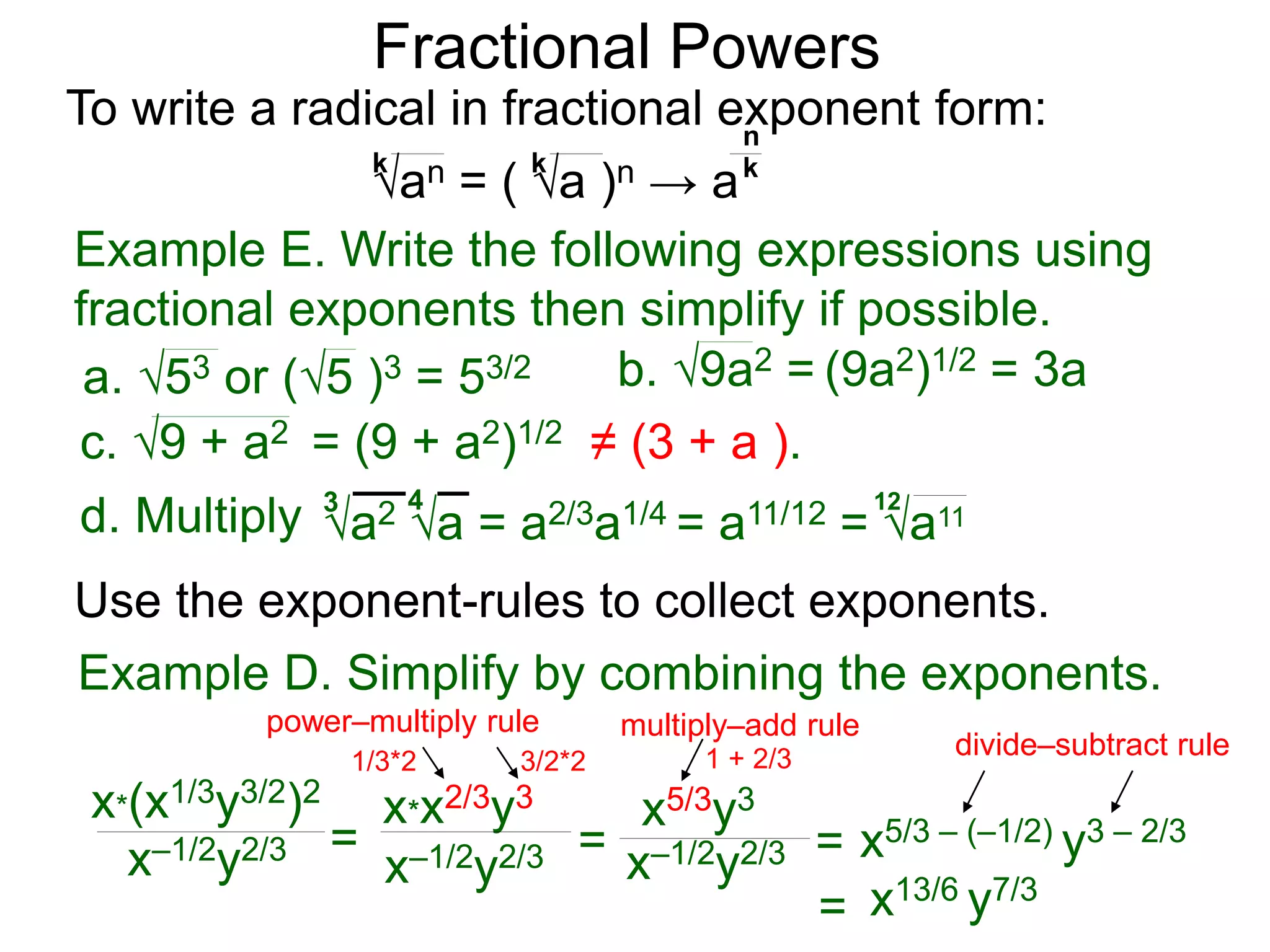
Fractional Powers
x*(x1/3y3/2)2
x–1/2y2/3 =
x*x2/3y3
x–1/2y2/3 = x–1/2y2/3 =
x5/3y3
x5/3 – (–1/2) y3 – 2/3
= x13/6 y7/3
Example D. Simplify by combining the exponents.
power–multiply rule
1/3*2 3/2*2
multiply–add rule
1 + 2/3 divide–subtract rule
To write a radical in fractional exponent form:
an = ( a )n → a
k k k
n
Example E. Write the following expressions using
fractional exponents then simplify if possible.
a2 a = a2/3a1/4 = a11/12 = a11
3 4 12
c. 9 + a2 = (9 + a2)1/2 ≠ (3 + a ).
a. 53 or (5 )3 = 53/2 b. 9a2 = (9a2)1/2 = 3a
d. Multiply
Use the exponent-rules to collect exponents.
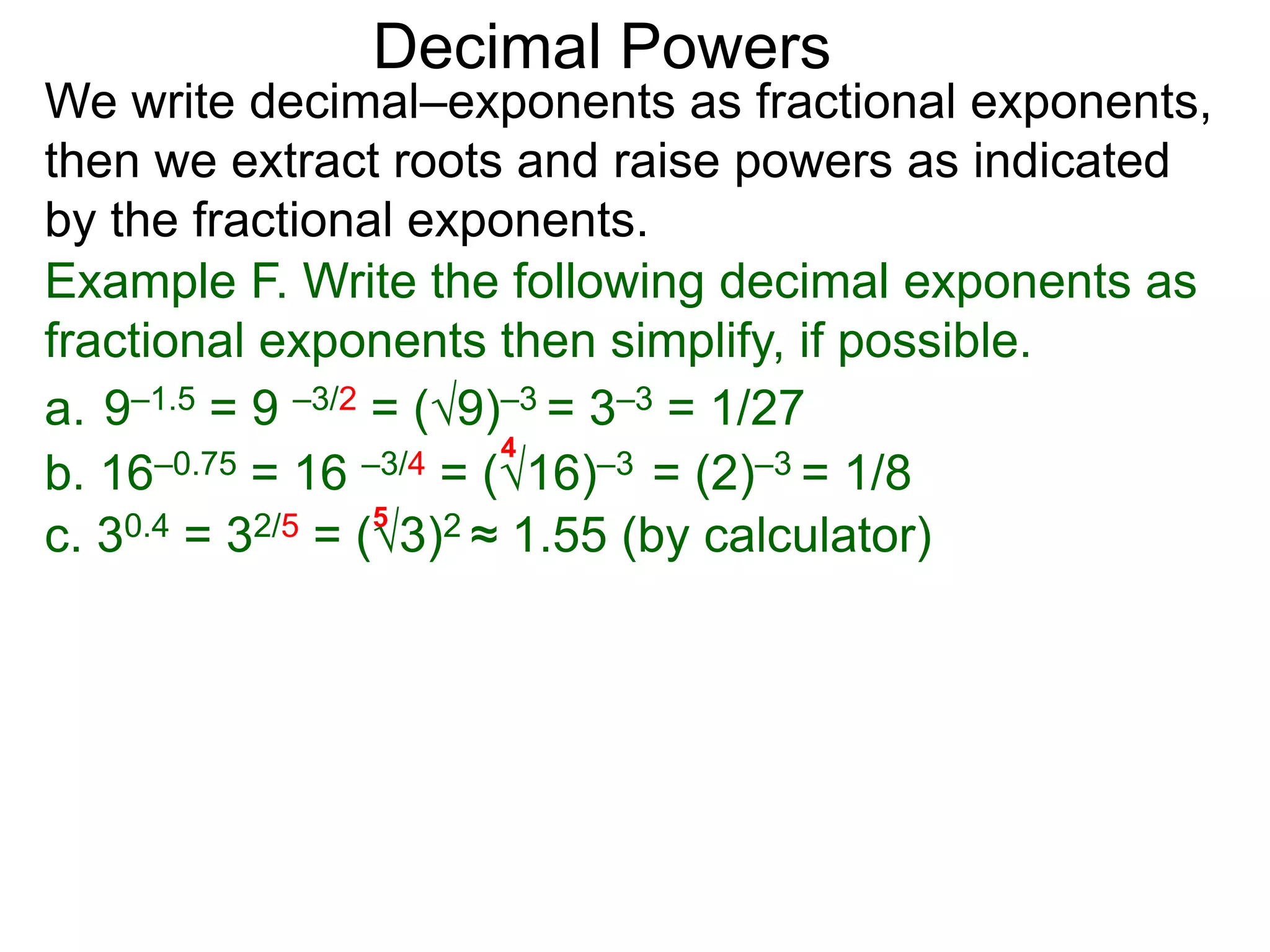
Decimal Powers
We write decimal–exponents as fractional exponents,
then we extract roots and raise powers as indicated
by the fractional exponents.
Example F. Write the following decimal exponents as
fractional exponents then simplify, if possible.
a. 9–1.5 = 9 –3/2 = (9)–3 = 3–3 = 1/27
b. 16–0.75 = 16 –3/4 = (16)–3 = (2)–3 = 1/8
4
c. 30.4 = 32/5 = (3)2 ≈ 1.55 (by calculator)
5
(Answers to odd problems) Exercise A.
1. 1/2 3. 1/8 5.1/27 7. 1/64 9.3/2
11.1/18 13.1/6
Exercise B.
1. 𝑥8 3. 1/𝑥2 5.𝑥7/𝑦2 7. 1/𝑥4 9. 𝑥3
11.
1
𝑥7 13.
𝑦8
36𝑥6 15. 2𝑥+3 17. 𝑎2𝑥+3
Exercise C. 1. 8 3. (−8)
2
3 5. 8/27 7. 16 9. 1/8
Exponents
Exercise D.
1. 𝑥3 3. 8𝑥4 6
𝑦17 5.
6 𝑦
𝑥3 7. 3𝑎11 2𝑏5
9. 4−5 11.
5
𝑥16 13.
6
(2𝑥 + 1)13 15.
6
sin(𝑥)17
Exercise E. 1.𝑞/𝑝 3. −3 5. 13 7. 2/3 9. 5/6 11. –1/4
Exercise F.
1. 𝑥 = 4, 𝑦 = 2, 𝑧 = 3 3. 𝑥 = 3, 𝑦 = −1, 𝑧 = 6

1.1 exponents t

  • 1.
    Multiply–Add Rule: AnAk= An+k Divide–Subtract Rule: An Ak Power–Multiply Rule: (An)k = Ank , (An Bm)k = Ank Bmk Exponents = An – k Exponent–Rules 0-power Rule: A0 = 1 (A=0) = 1 Ak 1 Ak A0 Ak ½ - Power Rule: A½ = A , the square root of A, because (A½)2 = A = (A)2, so A½ = A because 1 = = A1–1 = A0 A1 A1 Negative Power Rule: A–k = because = A0–k = A–k 1/n - Power Rule: A1/n = A , the nth root of A. n (divide–subtract) (divide–subtract)
  • 2.
    Special Exponents Example B. c.641/3 = 64 = 4 3 b. 81/3 = 8 = 2 3 a. 641/2 = 64 = 8 a. 9 –3/2 = (9 ½ * –3) = (9½)–3 = (9)–3 = 3–3 = 1/27 Example C. Find the root first, then raise the root to the numerator–power. The fractional exponent A k n ± (A ) k n ± 1 is 1. take the nth root of A 2. then raise the root to ±k power c. 16 -3/4 = (161/4)-3 = (16)-3 = (2)-3 = 1/23 = 1/8 4 b. 27 -2/3 = (271/3)-2 = (27)-2 = (3)-2 = 1/32 = 1/9 3 1/n - Power Rule: A1/n = A , the nth root of A. n
  • 3.
    Fractional Powers x*(x1/3y3/2)2 x–1/2y2/3 = x*x2/3y3 x–1/2y2/3= x–1/2y2/3 = x5/3y3 x5/3 – (–1/2) y3 – 2/3 = x13/6 y7/3 Example D. Simplify by combining the exponents. power–multiply rule 1/3*2 3/2*2 multiply–add rule 1 + 2/3 divide–subtract rule To write a radical in fractional exponent form: an = ( a )n → a k k k n Example E. Write the following expressions using fractional exponents then simplify if possible. a2 a = a2/3a1/4 = a11/12 = a11 3 4 12 c. 9 + a2 = (9 + a2)1/2 ≠ (3 + a ). a. 53 or (5 )3 = 53/2 b. 9a2 = (9a2)1/2 = 3a d. Multiply Use the exponent-rules to collect exponents.
  • 4.
    Decimal Powers We writedecimal–exponents as fractional exponents, then we extract roots and raise powers as indicated by the fractional exponents. Example F. Write the following decimal exponents as fractional exponents then simplify, if possible. a. 9–1.5 = 9 –3/2 = (9)–3 = 3–3 = 1/27 b. 16–0.75 = 16 –3/4 = (16)–3 = (2)–3 = 1/8 4 c. 30.4 = 32/5 = (3)2 ≈ 1.55 (by calculator) 5
  • 8.
    (Answers to oddproblems) Exercise A. 1. 1/2 3. 1/8 5.1/27 7. 1/64 9.3/2 11.1/18 13.1/6 Exercise B. 1. 𝑥8 3. 1/𝑥2 5.𝑥7/𝑦2 7. 1/𝑥4 9. 𝑥3 11. 1 𝑥7 13. 𝑦8 36𝑥6 15. 2𝑥+3 17. 𝑎2𝑥+3 Exercise C. 1. 8 3. (−8) 2 3 5. 8/27 7. 16 9. 1/8 Exponents Exercise D. 1. 𝑥3 3. 8𝑥4 6 𝑦17 5. 6 𝑦 𝑥3 7. 3𝑎11 2𝑏5 9. 4−5 11. 5 𝑥16 13. 6 (2𝑥 + 1)13 15. 6 sin(𝑥)17 Exercise E. 1.𝑞/𝑝 3. −3 5. 13 7. 2/3 9. 5/6 11. –1/4 Exercise F. 1. 𝑥 = 4, 𝑦 = 2, 𝑧 = 3 3. 𝑥 = 3, 𝑦 = −1, 𝑧 = 6