Announcements


     Today's material will not be a part of Test 2.
     Review for Test 2 tomorrow. Please come prepared with
     questions.
     Exam 2 will be on Feb 25 Thurs in class.
     Please collect your graded exams on friday from Fisher 214.
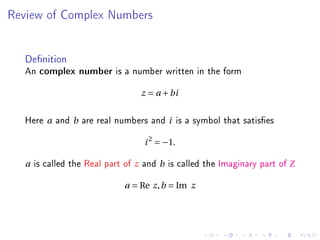
Review of Complex Numbers


   Denition
   An complex number is a number written in the form
                                   z = a + bi


   Here   a   and b are real numbers and i is a symbol that satises
                                    i 2 = −1.

   a   is called the Real part of z and b is called the Imaginary part of Z
                               a = Re z, b = Im z
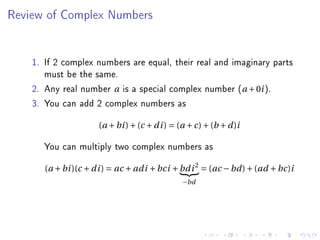
Review of Complex Numbers


    1. If 2 complex numbers are equal, their real and imaginary parts
       must be the same.
    2. Any real number a is a special complex number (a + 0i ).
    3. You can add 2 complex numbers as
                      (a + bi ) + (c + d i ) = (a + c) + (b + d )i

       You can multiply two complex numbers as
       (a + bi )(c + d i ) = ac + ad i + bci + bd i 2 = (ac − bd ) + (ad + bc)i
                                                −bd
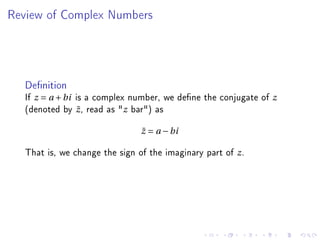
Review of Complex Numbers


   Denition
   If z = a + bi is a complex number, we dene the conjugate of z
   (denoted by z , read as z bar) as
                  ¯

                                ¯
                                z = a − bi

   That is, we change the sign of the imaginary part of z .
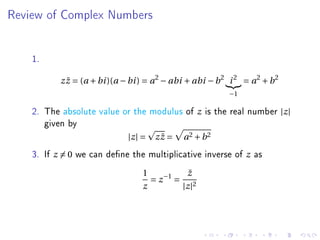
Review of Complex Numbers


    1.
             z z = (a + bi )(a − bi ) = a 2 − abi + abi − b 2 i 2 = a 2 + b 2
               ¯
                                                               −1

    2. The absolute value or the modulus of          z   is the real number |z|
       given by
                                |z| =    ¯
                                        zz =     a2 + b2
    3. If   z =0   we can dene the multiplicative inverse of       z   as
                                     1          z¯
                                       = z −1 = 2
                                     z         |z|
Back to Eigenvalues


    1. The char equation of an n × n matrix involves an n th degree
       polynomial.
    2. This equation has exactly n roots, if we include complex roots.
    3. If the char equation of A has some complex roots, we get very
       important information about A
    4. Very important in problems involving vibrations and rotations
       in space.
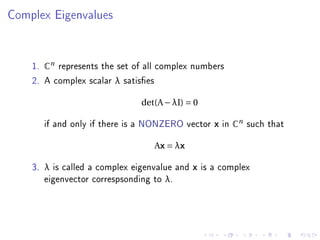
Complex Eigenvalues


    1. Cn represents the set of all complex numbers
    2. A complex scalar λ satises
                                 det(A − λI) = 0

         if and only if there is a NONZERO vector x in Cn such that
                                    Ax = λx

    3.   λ is called a complex eigenvalue and x is a complex
         eigenvector correspsonding to λ.
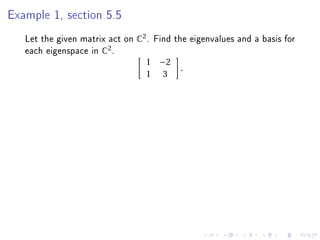
Example 1, section 5.5


   Let the given matrix act on C2 . Find the eigenvalues and a basis for
   each eigenspace in C2 .
                                 1 −2
                                          .
                                 1 3
Example 1, section 5.5


   Let the given matrix act on C2 . Find the eigenvalues and a basis for
   each eigenspace in C2 .
                                  1 −2
                                            .
                                  1 3
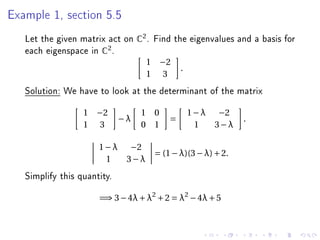
   Solution: We have to look at the determinant of the matrix
                  1 −2            1 0           1 − λ −2
                             −λ         =                   .
                  1 3             0 1             1   3−λ

                      1 − λ −2
                                    = (1 − λ)(3 − λ) + 2.
                        1   3−λ
   Simplify this quantity.
                      =⇒ 3 − 4λ + λ2 + 2 = λ2 − 4λ + 5
Example 1, section 5.5


   Use the quadratic formula (factorization will not work here)
Example 1, section 5.5


   Use the quadratic formula (factorization will not work here)

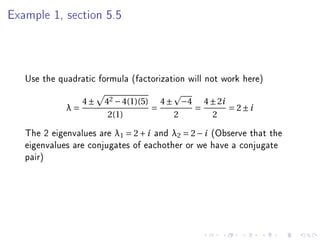
                  4±   42 − 4(1)(5) 4 ± −4 4 ± 2i
             λ=                    =      =       = 2±i
                        2(1)           2     2

   The 2 eigenvalues are λ1 = 2 + i and λ2 = 2 − i (Observe that the
   eigenvalues are conjugates of eachother or we have a conjugate
   pair)
Example 1, section 5.5


   We now have to nd the eigenvector for each eigenvalue. Start
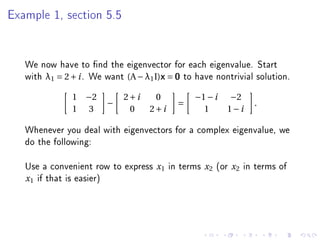
   with λ1 = 2 + i . We want (A − λ1 I)x = 0 to have nontrivial solution.
Example 1, section 5.5


   We now have to nd the eigenvector for each eigenvalue. Start
   with λ1 = 2 + i . We want (A − λ1 I)x = 0 to have nontrivial solution.
               1 −2          2+i    0           −1 − i       −2
                        −                   =                          .
               1 3            0    2+i            1         1−i

   Whenever you deal with eigenvectors for a complex eigenvalue, we
   do the following:

   Use a convenient row to express   x1   in terms   x2   (or   x2   in terms of
   x 1 if that is easier)
Example 1, section 5.5


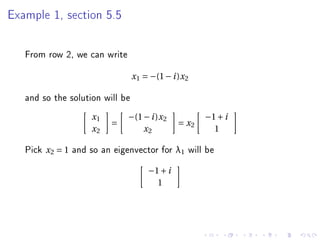
   From row 2, we can write
                                  x 1 = −(1 − i )x 2

   and so the solution will be
                       x1        −(1 − i )x 2          −1 + i
                            =                   = x2
                       x2            x2                  1

   Pick   x2 = 1   and so an eigenvector for λ1 will be
                                       −1 + i
                                         1
Example 1, section 5.5


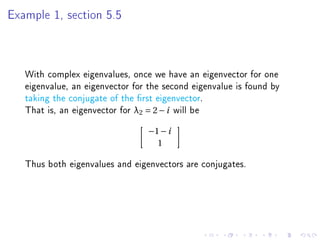
   With complex eigenvalues, once we have an eigenvector for one
   eigenvalue, an eigenvector for the second eigenvalue is found by
   taking the conjugate of the rst eigenvector.
   That is, an eigenvector for λ2 = 2 − i will be
                                 −1 − i
                                   1

   Thus both eigenvalues and eigenvectors are conjugates.
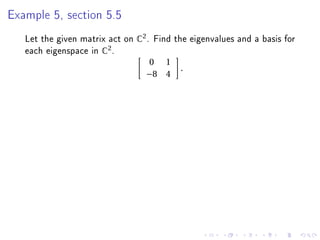
Example 5, section 5.5


   Let the given matrix act on C2 . Find the eigenvalues and a basis for
   each eigenspace in C2 .
                                 0 1
                                          .
                                 −8 4
Example 5, section 5.5


   Let the given matrix act on C2 . Find the eigenvalues and a basis for
   each eigenspace in C2 .
                                   0 1
                                            .
                                   −8 4
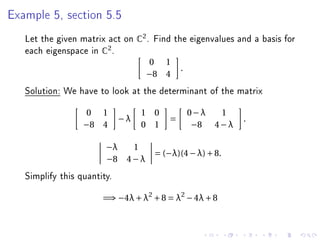
   Solution: We have to look at the determinant of the matrix
                  0 1             1 0           0−λ   1
                             −λ         =                   .
                  −8 4            0 1            −8 4 − λ

                        −λ   1
                                    = (−λ)(4 − λ) + 8.
                        −8 4 − λ
   Simplify this quantity.
                       =⇒ −4λ + λ2 + 8 = λ2 − 4λ + 8
Example 5, section 5.5


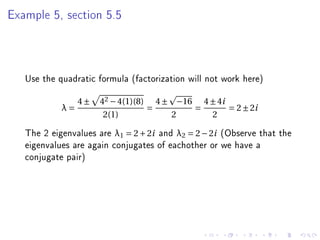
   Use the quadratic formula (factorization will not work here)
Example 5, section 5.5


   Use the quadratic formula (factorization will not work here)

                 4±   42 − 4(1)(8) 4 ± −16 4 ± 4i
            λ=                    =       =       = 2 ± 2i
                       2(1)           2      2

   The 2 eigenvalues are λ1 = 2 + 2i and λ2 = 2 − 2i (Observe that the
   eigenvalues are again conjugates of eachother or we have a
   conjugate pair)
Example 5, section 5.5


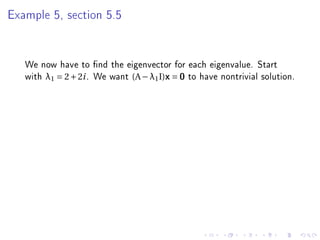
   We now have to nd the eigenvector for each eigenvalue. Start
   with λ1 = 2 + 2i . We want (A − λ1 I)x = 0 to have nontrivial solution.
Example 5, section 5.5


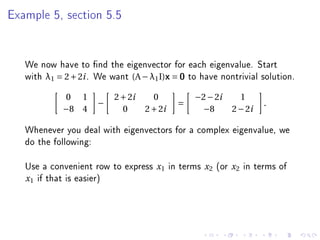
   We now have to nd the eigenvector for each eigenvalue. Start
   with λ1 = 2 + 2i . We want (A − λ1 I)x = 0 to have nontrivial solution.
             0 1          2 + 2i     0            −2 − 2i           1
                      −                       =                             .
            −8 4            0      2 + 2i          −8             2 − 2i

   Whenever you deal with eigenvectors for a complex eigenvalue, we
   do the following:

   Use a convenient row to express    x1    in terms   x2   (or   x2   in terms of
   x 1 if that is easier)
Example 5, section 5.5


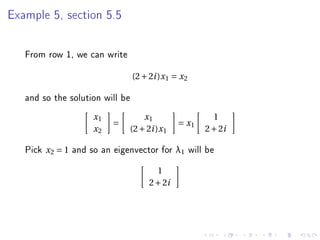
   From row 1, we can write
                                  (2 + 2i )x 1 = x 2

   and so the solution will be
                        x1           x1                  1
                             =                  = x1
                        x2       (2 + 2i )x 1          2 + 2i

   Pick   x2 = 1   and so an eigenvector for λ1 will be
                                         1
                                       2 + 2i
Example 5, section 5.5


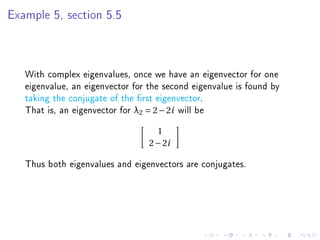
   With complex eigenvalues, once we have an eigenvector for one
   eigenvalue, an eigenvector for the second eigenvalue is found by
   taking the conjugate of the rst eigenvector.
   That is, an eigenvector for λ2 = 2 − 2i will be
                                    1
                                  2 − 2i

   Thus both eigenvalues and eigenvectors are conjugates.
Understanding Complex Eigenvalues


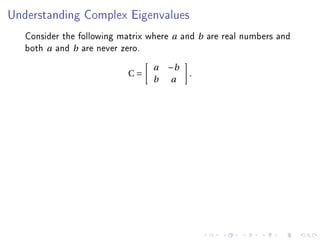
   Consider the following matrix where   a   and b are real numbers and
   both a and b are never zero.
                                  a   −b
                            C=                 .
                                  b    a
Understanding Complex Eigenvalues


   Consider the following matrix where   a    and b are real numbers and
   both a and b are never zero.
                                     a   −b
                            C=                  .
                                     b    a


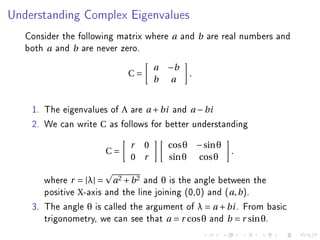
    1. The eigenvalues of A are a + bi and a − bi
    2. We can write C as follows for better understanding
                            r    0       cos θ − sin θ
                      C=                                  .
                            0    r       sin θ cos θ

       where r = |λ| = a 2 + b 2 and θ is the angle between the
       positive X-axis and the line joining (0,0) and (a, b ).
    3. The angle θ is called the argument of λ = a + bi . From basic
       trigonometry, we can see that a = r cos θ and b = r sin θ.
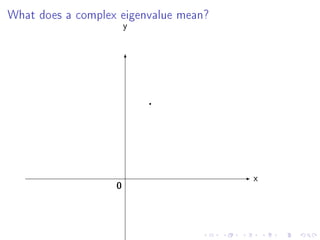
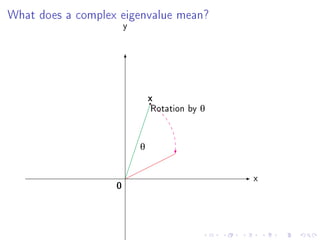
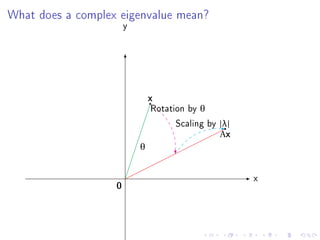
What does a complex eigenvalue mean?
                       y


                                       x
                   0
What does a complex eigenvalue mean?
                       y


                               x
                               Rotation by θ


                           θ


                                               x
                   0
What does a complex eigenvalue mean?
                       y


                               x
                               Rotation by θ
                                     Scaling by |λ|
                                                Ax
                           θ


                                                      x
                   0
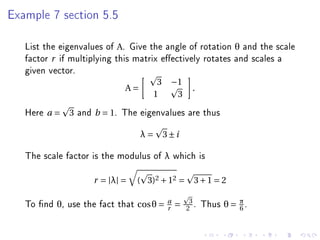
Example 7 section 5.5


   List the eigenvalues of A. Give the angle of rotation θ and the scale
   factor r if multiplying this matrix eectively rotates and scales a
   given vector.
                                        3    −1
                               A=                      .
                                       1      3

   Here   a=   3   and b = 1. The eigenvalues are thus
                                    λ=      3±i

   The scale factor is the modulus of λ which is

                       r = |λ| =   ( 3)2 + 12 =        3+1 = 2

   To nd θ, use the fact that cos θ = a =
                                       r          2
                                                   3
                                                       . Thus θ = π .
                                                                  6
Use of Eigenvalues in Long Term Behavior


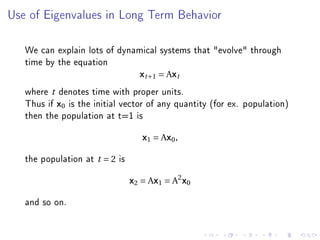
   We can explain lots of dynamical systems that evolve through
   time by the equation
                               xt +1 = Axt
   where t denotes time with proper units.
   Thus if x0 is the initial vector of any quantity (for ex. population)
   then the population at t=1 is
                                      x1 = Ax0 ,

   the population at   t =2   is
                                   x2 = Ax1 = A2 x0

   and so on.
Use of Eigenvalues in Long Term Behavior


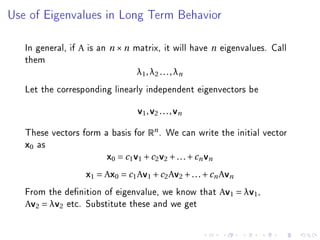
   In general, if   A   is an n × n matrix, it will have n eigenvalues. Call
   them
                                      λ 1 , λ2 . . . , λ n
   Let the corresponding linearly independent eigenvectors be
                                       v1 , v2 . . . , vn

   These vectors form a basis for Rn . We can write the initial vector
   x0 as
                       x0 = c1 v1 + c2 v2 + . . . + cn vn
                        x1 = Ax0 = c1 Av1 + c2 Av2 + . . . + cn Avn
   From the denition of eigenvalue, we know that Av1 = λv1 ,
   Av2 = λv2 etc. Substitute these and we get
Use of Eigenvalues in Long Term Behavior


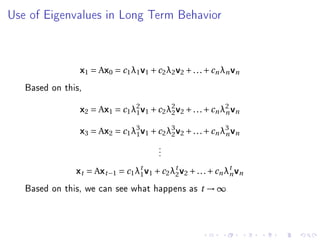
                x1 = Ax0 = c1 λ1 v1 + c2 λ2 v2 + . . . + cn λn vn
   Based on this,
                x2 = Ax1 = c1 λ2 v1 + c2 λ2 v2 + . . . + cn λ2 vn
                               1          2                  n

                x3 = Ax2 = c1 λ3 v1 + c2 λ3 v2 + . . . + cn λ3 vn
                               1          2                  n
                                        .
                                        .
                                        .
               xt = Axt −1 = c1 λ1 v1 + c2 λ2 v2 + . . . + cn λn vn
                                 t          t                  t


   Based on this, we can see what happens as         t →∞
Simple Predator-Prey Model

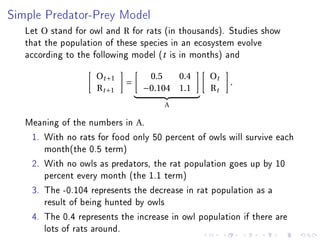
   Let O stand for owl and R for rats (in thousands). Studies show
   that the population of these species in an ecosystem evolve
   according to the following model (t is in months) and
                    Ot +1         0.5   0.4      Ot
                             =                        .
                    R t +1       −0.104 1.1      Rt
                                     A

   Meaning of the numbers in A.
    1. With no rats for food only 50 percent of owls will survive each
       month(the 0.5 term)
    2. With no owls as predators, the rat population goes up by 10
       percent every month (the 1.1 term)
    3. The -0.104 represents the decrease in rat population as a
       result of being hunted by owls
    4. The 0.4 represents the increase in owl population if there are
       lots of rats around.
Simple Predator-Prey Model


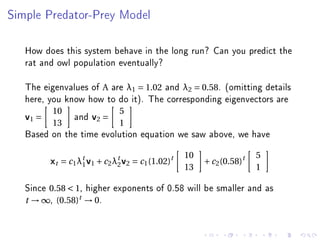
   How does this system behave in the long run? Can you predict the
   rat and owl population eventually?

   The eigenvalues of A are λ1 = 1.02 and λ2 = 0.58. (omitting details
   here, you know how to do it). The corresponding eigenvectors are
          10                  5
   v1 =          and v2 =
          13                  1
   Based on the time evolution equation we saw above, we have
                                                  10                   5
          xt = c1 λ1 v1 + c2 λ2 v2 = c1 (1.02)t
                   t          t
                                                       + c 2 (0.58)t
                                                  13                   1

   Since 0.58  1, higher exponents of 0.58 will be smaller and as
   t → ∞, (0.58)t → 0.
Simple Predator-Prey Model


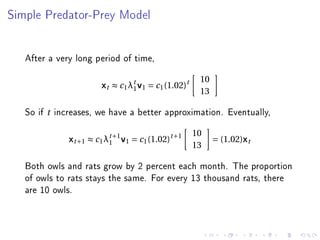
   After a very long period of time,
                                                     10
                       xt ≈ c1 λ1 v1 = c1 (1.02)t
                                t
                                                     13

   So if t increases, we have a better approximation. Eventually,
                                                    10
              xt +1 ≈ c1 λ1+1 v1 = c1 (1.02)t +1
                          t
                                                          = (1.02)xt
                                                    13

   Both owls and rats grow by 2 percent each month. The proportion
   of owls to rats stays the same. For every 13 thousand rats, there
   are 10 owls.

Complex Eigenvalues

  • 1.
    Announcements Today's material will not be a part of Test 2. Review for Test 2 tomorrow. Please come prepared with questions. Exam 2 will be on Feb 25 Thurs in class. Please collect your graded exams on friday from Fisher 214.
  • 2.
    Review of ComplexNumbers Denition An complex number is a number written in the form z = a + bi Here a and b are real numbers and i is a symbol that satises i 2 = −1. a is called the Real part of z and b is called the Imaginary part of Z a = Re z, b = Im z
  • 3.
    Review of ComplexNumbers 1. If 2 complex numbers are equal, their real and imaginary parts must be the same. 2. Any real number a is a special complex number (a + 0i ). 3. You can add 2 complex numbers as (a + bi ) + (c + d i ) = (a + c) + (b + d )i You can multiply two complex numbers as (a + bi )(c + d i ) = ac + ad i + bci + bd i 2 = (ac − bd ) + (ad + bc)i −bd
  • 4.
    Review of ComplexNumbers Denition If z = a + bi is a complex number, we dene the conjugate of z (denoted by z , read as z bar) as ¯ ¯ z = a − bi That is, we change the sign of the imaginary part of z .
  • 5.
    Review of ComplexNumbers 1. z z = (a + bi )(a − bi ) = a 2 − abi + abi − b 2 i 2 = a 2 + b 2 ¯ −1 2. The absolute value or the modulus of z is the real number |z| given by |z| = ¯ zz = a2 + b2 3. If z =0 we can dene the multiplicative inverse of z as 1 z¯ = z −1 = 2 z |z|
  • 6.
    Back to Eigenvalues 1. The char equation of an n × n matrix involves an n th degree polynomial. 2. This equation has exactly n roots, if we include complex roots. 3. If the char equation of A has some complex roots, we get very important information about A 4. Very important in problems involving vibrations and rotations in space.
  • 7.
    Complex Eigenvalues 1. Cn represents the set of all complex numbers 2. A complex scalar λ satises det(A − λI) = 0 if and only if there is a NONZERO vector x in Cn such that Ax = λx 3. λ is called a complex eigenvalue and x is a complex eigenvector correspsonding to λ.
  • 8.
    Example 1, section5.5 Let the given matrix act on C2 . Find the eigenvalues and a basis for each eigenspace in C2 . 1 −2 . 1 3
  • 9.
    Example 1, section5.5 Let the given matrix act on C2 . Find the eigenvalues and a basis for each eigenspace in C2 . 1 −2 . 1 3 Solution: We have to look at the determinant of the matrix 1 −2 1 0 1 − λ −2 −λ = . 1 3 0 1 1 3−λ 1 − λ −2 = (1 − λ)(3 − λ) + 2. 1 3−λ Simplify this quantity. =⇒ 3 − 4λ + λ2 + 2 = λ2 − 4λ + 5
  • 10.
    Example 1, section5.5 Use the quadratic formula (factorization will not work here)
  • 11.
    Example 1, section5.5 Use the quadratic formula (factorization will not work here) 4± 42 − 4(1)(5) 4 ± −4 4 ± 2i λ= = = = 2±i 2(1) 2 2 The 2 eigenvalues are λ1 = 2 + i and λ2 = 2 − i (Observe that the eigenvalues are conjugates of eachother or we have a conjugate pair)
  • 12.
    Example 1, section5.5 We now have to nd the eigenvector for each eigenvalue. Start with λ1 = 2 + i . We want (A − λ1 I)x = 0 to have nontrivial solution.
  • 13.
    Example 1, section5.5 We now have to nd the eigenvector for each eigenvalue. Start with λ1 = 2 + i . We want (A − λ1 I)x = 0 to have nontrivial solution. 1 −2 2+i 0 −1 − i −2 − = . 1 3 0 2+i 1 1−i Whenever you deal with eigenvectors for a complex eigenvalue, we do the following: Use a convenient row to express x1 in terms x2 (or x2 in terms of x 1 if that is easier)
  • 14.
    Example 1, section5.5 From row 2, we can write x 1 = −(1 − i )x 2 and so the solution will be x1 −(1 − i )x 2 −1 + i = = x2 x2 x2 1 Pick x2 = 1 and so an eigenvector for λ1 will be −1 + i 1
  • 15.
    Example 1, section5.5 With complex eigenvalues, once we have an eigenvector for one eigenvalue, an eigenvector for the second eigenvalue is found by taking the conjugate of the rst eigenvector. That is, an eigenvector for λ2 = 2 − i will be −1 − i 1 Thus both eigenvalues and eigenvectors are conjugates.
  • 16.
    Example 5, section5.5 Let the given matrix act on C2 . Find the eigenvalues and a basis for each eigenspace in C2 . 0 1 . −8 4
  • 17.
    Example 5, section5.5 Let the given matrix act on C2 . Find the eigenvalues and a basis for each eigenspace in C2 . 0 1 . −8 4 Solution: We have to look at the determinant of the matrix 0 1 1 0 0−λ 1 −λ = . −8 4 0 1 −8 4 − λ −λ 1 = (−λ)(4 − λ) + 8. −8 4 − λ Simplify this quantity. =⇒ −4λ + λ2 + 8 = λ2 − 4λ + 8
  • 18.
    Example 5, section5.5 Use the quadratic formula (factorization will not work here)
  • 19.
    Example 5, section5.5 Use the quadratic formula (factorization will not work here) 4± 42 − 4(1)(8) 4 ± −16 4 ± 4i λ= = = = 2 ± 2i 2(1) 2 2 The 2 eigenvalues are λ1 = 2 + 2i and λ2 = 2 − 2i (Observe that the eigenvalues are again conjugates of eachother or we have a conjugate pair)
  • 20.
    Example 5, section5.5 We now have to nd the eigenvector for each eigenvalue. Start with λ1 = 2 + 2i . We want (A − λ1 I)x = 0 to have nontrivial solution.
  • 21.
    Example 5, section5.5 We now have to nd the eigenvector for each eigenvalue. Start with λ1 = 2 + 2i . We want (A − λ1 I)x = 0 to have nontrivial solution. 0 1 2 + 2i 0 −2 − 2i 1 − = . −8 4 0 2 + 2i −8 2 − 2i Whenever you deal with eigenvectors for a complex eigenvalue, we do the following: Use a convenient row to express x1 in terms x2 (or x2 in terms of x 1 if that is easier)
  • 22.
    Example 5, section5.5 From row 1, we can write (2 + 2i )x 1 = x 2 and so the solution will be x1 x1 1 = = x1 x2 (2 + 2i )x 1 2 + 2i Pick x2 = 1 and so an eigenvector for λ1 will be 1 2 + 2i
  • 23.
    Example 5, section5.5 With complex eigenvalues, once we have an eigenvector for one eigenvalue, an eigenvector for the second eigenvalue is found by taking the conjugate of the rst eigenvector. That is, an eigenvector for λ2 = 2 − 2i will be 1 2 − 2i Thus both eigenvalues and eigenvectors are conjugates.
  • 24.
    Understanding Complex Eigenvalues Consider the following matrix where a and b are real numbers and both a and b are never zero. a −b C= . b a
  • 25.
    Understanding Complex Eigenvalues Consider the following matrix where a and b are real numbers and both a and b are never zero. a −b C= . b a 1. The eigenvalues of A are a + bi and a − bi 2. We can write C as follows for better understanding r 0 cos θ − sin θ C= . 0 r sin θ cos θ where r = |λ| = a 2 + b 2 and θ is the angle between the positive X-axis and the line joining (0,0) and (a, b ). 3. The angle θ is called the argument of λ = a + bi . From basic trigonometry, we can see that a = r cos θ and b = r sin θ.
  • 26.
    What does acomplex eigenvalue mean? y x 0
  • 27.
    What does acomplex eigenvalue mean? y x Rotation by θ θ x 0
  • 28.
    What does acomplex eigenvalue mean? y x Rotation by θ Scaling by |λ| Ax θ x 0
  • 29.
    Example 7 section5.5 List the eigenvalues of A. Give the angle of rotation θ and the scale factor r if multiplying this matrix eectively rotates and scales a given vector. 3 −1 A= . 1 3 Here a= 3 and b = 1. The eigenvalues are thus λ= 3±i The scale factor is the modulus of λ which is r = |λ| = ( 3)2 + 12 = 3+1 = 2 To nd θ, use the fact that cos θ = a = r 2 3 . Thus θ = π . 6
  • 30.
    Use of Eigenvaluesin Long Term Behavior We can explain lots of dynamical systems that evolve through time by the equation xt +1 = Axt where t denotes time with proper units. Thus if x0 is the initial vector of any quantity (for ex. population) then the population at t=1 is x1 = Ax0 , the population at t =2 is x2 = Ax1 = A2 x0 and so on.
  • 31.
    Use of Eigenvaluesin Long Term Behavior In general, if A is an n × n matrix, it will have n eigenvalues. Call them λ 1 , λ2 . . . , λ n Let the corresponding linearly independent eigenvectors be v1 , v2 . . . , vn These vectors form a basis for Rn . We can write the initial vector x0 as x0 = c1 v1 + c2 v2 + . . . + cn vn x1 = Ax0 = c1 Av1 + c2 Av2 + . . . + cn Avn From the denition of eigenvalue, we know that Av1 = λv1 , Av2 = λv2 etc. Substitute these and we get
  • 32.
    Use of Eigenvaluesin Long Term Behavior x1 = Ax0 = c1 λ1 v1 + c2 λ2 v2 + . . . + cn λn vn Based on this, x2 = Ax1 = c1 λ2 v1 + c2 λ2 v2 + . . . + cn λ2 vn 1 2 n x3 = Ax2 = c1 λ3 v1 + c2 λ3 v2 + . . . + cn λ3 vn 1 2 n . . . xt = Axt −1 = c1 λ1 v1 + c2 λ2 v2 + . . . + cn λn vn t t t Based on this, we can see what happens as t →∞
  • 33.
    Simple Predator-Prey Model Let O stand for owl and R for rats (in thousands). Studies show that the population of these species in an ecosystem evolve according to the following model (t is in months) and Ot +1 0.5 0.4 Ot = . R t +1 −0.104 1.1 Rt A Meaning of the numbers in A. 1. With no rats for food only 50 percent of owls will survive each month(the 0.5 term) 2. With no owls as predators, the rat population goes up by 10 percent every month (the 1.1 term) 3. The -0.104 represents the decrease in rat population as a result of being hunted by owls 4. The 0.4 represents the increase in owl population if there are lots of rats around.
  • 34.
    Simple Predator-Prey Model How does this system behave in the long run? Can you predict the rat and owl population eventually? The eigenvalues of A are λ1 = 1.02 and λ2 = 0.58. (omitting details here, you know how to do it). The corresponding eigenvectors are 10 5 v1 = and v2 = 13 1 Based on the time evolution equation we saw above, we have 10 5 xt = c1 λ1 v1 + c2 λ2 v2 = c1 (1.02)t t t + c 2 (0.58)t 13 1 Since 0.58 1, higher exponents of 0.58 will be smaller and as t → ∞, (0.58)t → 0.
  • 35.
    Simple Predator-Prey Model After a very long period of time, 10 xt ≈ c1 λ1 v1 = c1 (1.02)t t 13 So if t increases, we have a better approximation. Eventually, 10 xt +1 ≈ c1 λ1+1 v1 = c1 (1.02)t +1 t = (1.02)xt 13 Both owls and rats grow by 2 percent each month. The proportion of owls to rats stays the same. For every 13 thousand rats, there are 10 owls.