Announcements


     Quiz 3 after lecture.
     Grades will be updated online (including quiz 3 grades) over
     the weekend. Please let me know if you spot any mistakes.
     Exam 2 will be on Feb 25 Thurs in class. Details later.
     Make-up exams will be given only if there is an excused
     absence from the Dean of Students or a Doctor's note about
     sudden serious illness. No exceptions on this. Travel
     plans/broken alarm clock are unacceptable excuses.
Last Class...


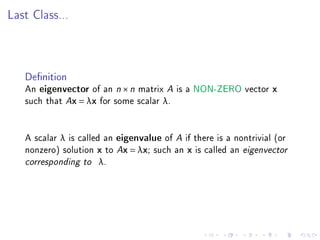
   Denition
   An eigenvector of an n × n matrix A is a NON-ZERO vector x
   such that Ax = λx for some scalar λ.


   A scalar λ is called an eigenvalue of A if there is a nontrivial (or
   nonzero) solution x to Ax = λx; such an x is called an eigenvector
   corresponding to λ.
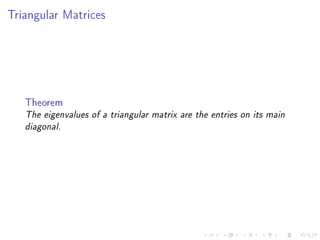
Triangular Matrices


   Theorem
   The eigenvalues of a triangular matrix are the entries on its main

   diagonal.
Triangular Matrices


   Example
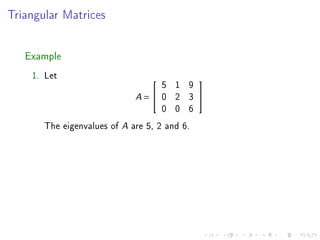
    1. Let
                                      5 1 9
                                             

                             A   =   0 2 3   
                                      0 0 6
       The eigenvalues of A are 5, 2 and 6.
Triangular Matrices


   Example
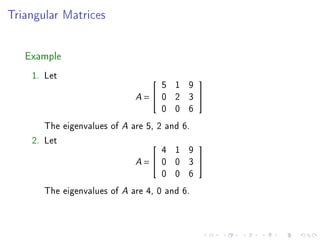
    1. Let
                                      5 1 9
                                             

                             A   =   0 2 3   
                                      0 0 6
       The eigenvalues of A are 5, 2 and 6.
    2. Let
                                    4 1 9
                                             

                             A= 0     0 3    
                                    0 0 6
       The eigenvalues of A are 4, 0 and 6.
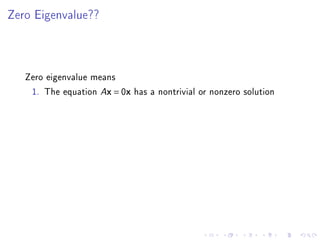
Zero Eigenvalue??


   Zero eigenvalue means
    1. The equation Ax = 0x has a nontrivial or nonzero solution
Zero Eigenvalue??


   Zero eigenvalue means
    1. The equation Ax = 0x has a nontrivial or nonzero solution
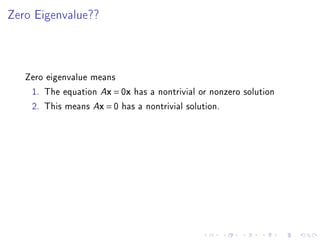
    2. This means Ax = 0 has a nontrivial solution.
Zero Eigenvalue??


   Zero eigenvalue means
    1. The equation Ax = 0x has a nontrivial or nonzero solution
    2. This means Ax = 0 has a nontrivial solution.
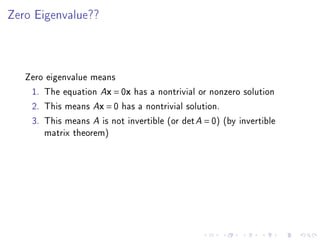
    3. This means A is not invertible (or det A = 0) (by invertible
       matrix theorem)
Zero Eigenvalue??


   Zero eigenvalue means
    1. The equation Ax = 0x has a nontrivial or nonzero solution
    2. This means Ax = 0 has a nontrivial solution.
    3. This means A is not invertible (or det A = 0) (by invertible
       matrix theorem)

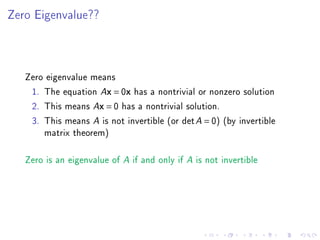
   Zero is an eigenvalue of A if and only if A is not invertible
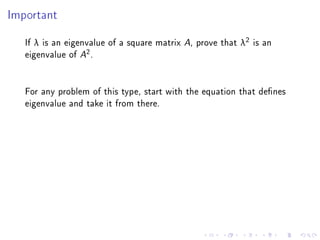
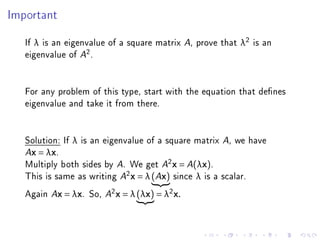
Important


   If λ is an eigenvalue of a square matrix A, prove that λ2 is an
   eigenvalue of A2 .


   For any problem of this type, start with the equation that denes
   eigenvalue and take it from there.
Important


   If λ is an eigenvalue of a square matrix A, prove that λ2 is an
   eigenvalue of A2 .


   For any problem of this type, start with the equation that denes
   eigenvalue and take it from there.


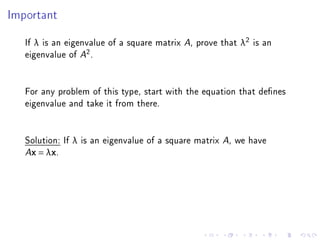
   Solution: If λ is an eigenvalue of a square matrix A, we have
   Ax = λx.
Important


   If λ is an eigenvalue of a square matrix A, prove that λ2 is an
   eigenvalue of A2 .


   For any problem of this type, start with the equation that denes
   eigenvalue and take it from there.


   Solution: If λ is an eigenvalue of a square matrix A, we have
   Ax = λx.

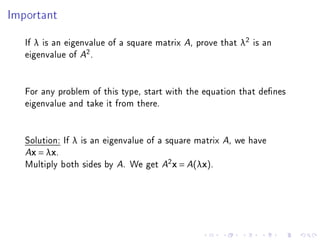
   Multiply both sides by A. We get A2 x = A(λx).
Important


   If λ is an eigenvalue of a square matrix A, prove that λ2 is an
   eigenvalue of A2 .

   For any problem of this type, start with the equation that denes
   eigenvalue and take it from there.


   Solution: If λ is an eigenvalue of a square matrix A, we have
   Ax = λx.

   Multiply both sides by A. We get A2 x = A(λx).
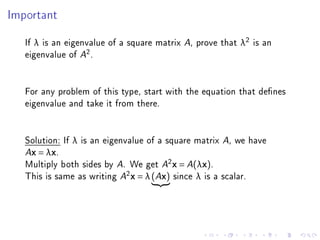
   This is same as writing A2 x = λ (Ax) since λ is a scalar.
Important


   If λ is an eigenvalue of a square matrix A, prove that λ2 is an
   eigenvalue of A2 .


   For any problem of this type, start with the equation that denes
   eigenvalue and take it from there.


   Solution: If λ is an eigenvalue of a square matrix A, we have
   Ax = λx.

   Multiply both sides by A. We get A2 x = A(λx).
   This is same as writing A2 x = λ (Ax) since λ is a scalar.
   Again Ax = λx. So, A2 x = λ (λx) = λ2 x.
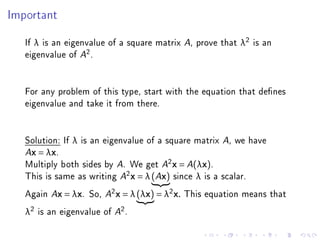
Important


   If λ is an eigenvalue of a square matrix A, prove that λ2 is an
   eigenvalue of A2 .


   For any problem of this type, start with the equation that denes
   eigenvalue and take it from there.


   Solution: If λ is an eigenvalue of a square matrix A, we have
   Ax = λx.

   Multiply both sides by A. We get A2 x = A(λx).
   This is same as writing A2 x = λ (Ax) since λ is a scalar.
   Again Ax = λx. So, A2 x = λ (λx) = λ2 x. This equation means that
   λ2   is an eigenvalue of A2 .
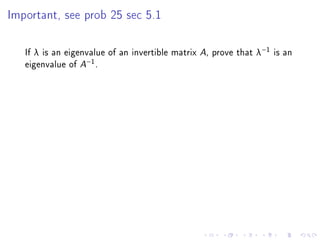
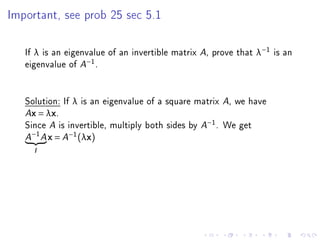
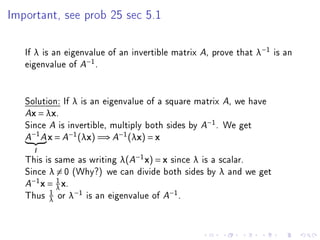
Important, see prob 25 sec 5.1


   If λ is an eigenvalue of an invertible matrix A, prove that λ−1 is an
   eigenvalue of A−1 .
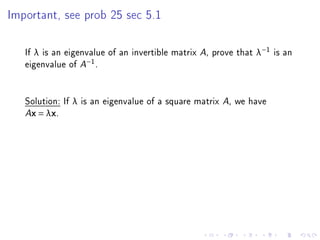
Important, see prob 25 sec 5.1


   If λ is an eigenvalue of an invertible matrix A, prove that λ−1 is an
   eigenvalue of A−1 .


   Solution: If λ is an eigenvalue of a square matrix A, we have
   Ax = λx.
Important, see prob 25 sec 5.1


   If λ is an eigenvalue of an invertible matrix A, prove that λ−1 is an
   eigenvalue of A−1 .


   Solution: If λ is an eigenvalue of a square matrix A, we have
   Ax = λx.

   Since A is invertible, multiply both sides by A−1 . We get
       −1
   A        A   x = A−1 (λx)
       I
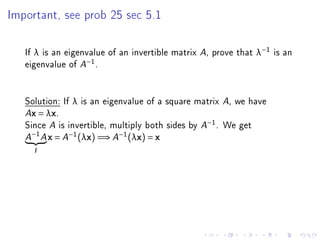
Important, see prob 25 sec 5.1


   If λ is an eigenvalue of an invertible matrix A, prove that λ−1 is an
   eigenvalue of A−1 .


   Solution: If λ is an eigenvalue of a square matrix A, we have
   Ax = λx.

   Since A is invertible, multiply both sides by A−1 . We get
       −1
   A        A   x = A−1 (λx) =⇒ A−1 (λx) = x
       I
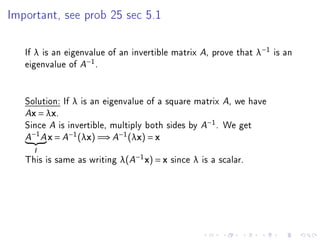
Important, see prob 25 sec 5.1


   If λ is an eigenvalue of an invertible matrix A, prove that λ−1 is an
   eigenvalue of A−1 .


   Solution: If λ is an eigenvalue of a square matrix A, we have
   Ax = λx.

   Since A is invertible, multiply both sides by A−1 . We get
       −1
   A        A   x = A−1 (λx) =⇒ A−1 (λx) = x
       I

   This is same as writing λ(A−1 x) = x since λ is a scalar.
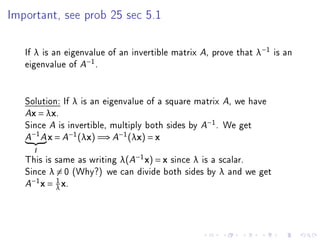
Important, see prob 25 sec 5.1


   If λ is an eigenvalue of an invertible matrix A, prove that λ−1 is an
   eigenvalue of A−1 .


   Solution: If λ is an eigenvalue of a square matrix A, we have
   Ax = λx.

   Since A is invertible, multiply both sides by A−1 . We get
       −1
   A        A   x = A−1 (λx) =⇒ A−1 (λx) = x
       I

   This is same as writing λ(A−1 x) = x since λ is a scalar.
   Since λ = 0 (Why?) we can divide both sides by λ and we get
     −1     1
   A    x = λ x.
Important, see prob 25 sec 5.1


   If λ is an eigenvalue of an invertible matrix A, prove that λ−1 is an
   eigenvalue of A−1 .


   Solution: If λ is an eigenvalue of a square matrix A, we have
   Ax = λx.

   Since A is invertible, multiply both sides by A−1 . We get
       −1
   A        A   x = A−1 (λx) =⇒ A−1 (λx) = x
       I

   This is same as writing λ(A−1 x) = x since λ is a scalar.
   Since λ = 0 (Why?) we can divide both sides by λ and we get
     −1     1
   A    x = λ x.
          1
   Thus λ or λ−1 is an eigenvalue of A−1 .
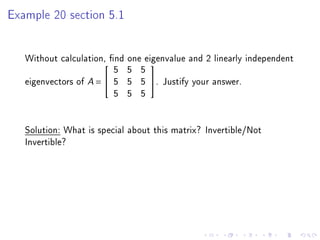
Example 20 section 5.1


   Without calculation, nd one eigenvalue and 2 linearly independent
                         5 5 5
                                

   eigenvectors of A =  5 5 5 . Justify your answer.
                         5 5 5


   Solution: What is special about this matrix? Invertible/Not
   Invertible?
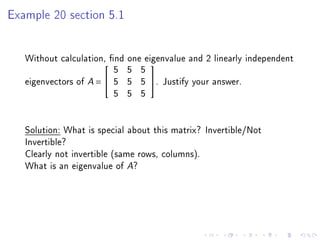
Example 20 section 5.1


   Without calculation, nd one eigenvalue and 2 linearly independent
                         5 5 5
                                

   eigenvectors of A =  5 5 5 . Justify your answer.
                         5 5 5


   Solution: What is special about this matrix? Invertible/Not
   Invertible?
   Clearly not invertible (same rows, columns).
   What is an eigenvalue of A?
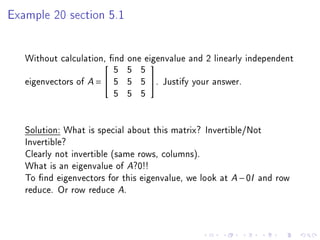
Example 20 section 5.1


   Without calculation, nd one eigenvalue and 2 linearly independent
                         5 5 5
                                

   eigenvectors of A =  5 5 5 . Justify your answer.
                         5 5 5


   Solution: What is special about this matrix? Invertible/Not
   Invertible?
   Clearly not invertible (same rows, columns).
   What is an eigenvalue of A?0!!
   To nd eigenvectors for this eigenvalue, we look at A − 0I and row
   reduce. Or row reduce A.
Example 20 section 5.1

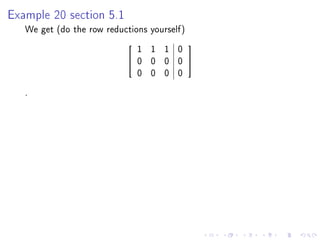
   We get (do the row reductions yourself)
                               1 1 1 0
                                            
                              0 0 0 0       
                               0 0 0 0
   .
Example 20 section 5.1

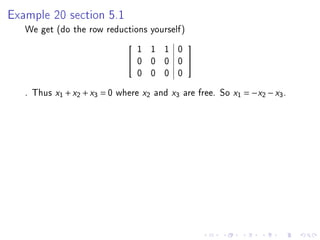
   We get (do the row reductions yourself)
                                 1 1 1 0
                                            
                                0 0 0 0     
                                 0 0 0 0
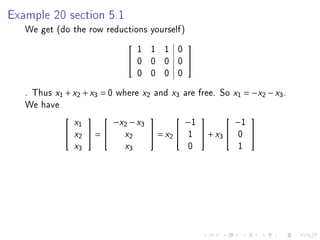
   . Thus x1 + x2 + x3 = 0 where x2 and x3 are free. So x1 = −x2 − x3 .
Example 20 section 5.1

   We get (do the row reductions yourself)
                                     1 1 1 0
                                                   
                                    0 0 0 0        
                                     0 0 0 0
   . Thus x1 + x2 + x3 = 0 where x2 and x3 are free. So x1 = −x2 − x3 .
   We have
                                                    −1              −1
                                                                  
                 x1           −x2 − x3
              x2  =          x2        = x2    1     + x3    0    
                 x3             x3                  0               1
Example 20 section 5.1

   We get (do the row reductions yourself)
                                     1 1 1 0
                                                    
                                    0 0 0 0         
                                     0 0 0 0
   . Thus x1 + x2 + x3 = 0 where x2 and x3 are free. So x1 = −x2 − x3 .
   We have
                                                     −1              −1
                                                                   
                 x1           −x2 − x3
              x2  =          x2         = x2    1     + x3    0    
                 x3             x3                   0               1
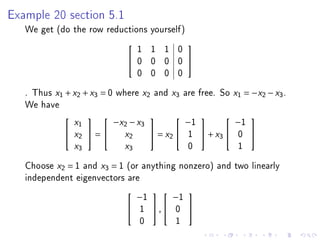
   Choose x2 = 1 and x3 = 1 (or anything nonzero) and two linearly
   independent eigenvectors are
                                     −1         −1
                                                  
                                    1    ,   0    
                                     0          1
Observations


    1. The eigenvalue λ = 0 has 2 linearly independent eigenvectors
Observations


    1. The eigenvalue λ = 0 has 2 linearly independent eigenvectors
    2. We say that this eigenspace is a two-dimensional subspace of
       R3 .
Observations


    1. The eigenvalue λ = 0 has 2 linearly independent eigenvectors
    2. We say that this eigenspace is a two-dimensional subspace of
       R3 .
    3. Examples with 2 linearly independent eigenvectors are very
       important for section 5.3 when we do diagonalization and in
       dierential equations where eigenvalues repeat.
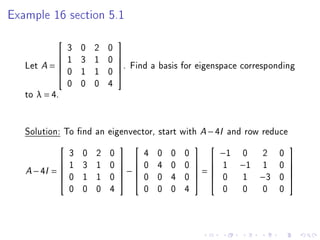
Example 16 section 5.1


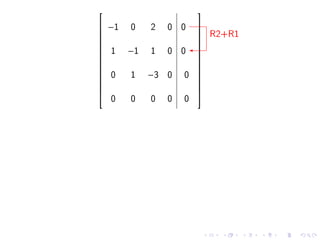
                  3   0   2   0
                                 
                 1   3   1   0
   Let A =                     . Find a basis for eigenspace corresponding
                                
                  0   1   1   0
           
             
                  0   0   0   4
   to λ = 4.


   Solution: To nd an eigenvector, start with A − 4I and row reduce
                  3   0   2   0         4   0   0   0           −1   0     2   0
                                                                              
                 1   3   1   0       0   4   0   0         1    −1   1    0   
       − 4I =                    −                   =
                                                                              
   A
                  0   1   1   0         0   0   4   0           0    1    −3   0
                                                                                   
                                                                              
                  0   0   0   4         0   0   0   4           0    0     0   0
                       
 −1 0  2       0 0
                            R2+R1
                        
                       
                       
 1 −1 1        0 0
                       
                        
                       
                       
                       
 0  1 −3       0   0
                       
                        
                       
                       
    0   0   0   0   0
                       
                       
 −1 0  2       0 0
                            R2+R1
                        
                       
                       
 1 −1 1        0 0
                       
                        
                       
                       
                       
 0  1 −3       0   0
                       
                        
                       
                       
    0   0   0   0   0
                       

                       
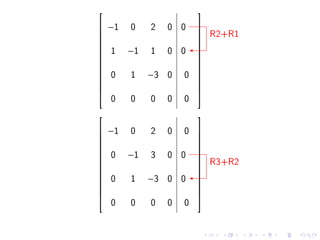
 −1 0  2       0   0   
                       
                       
 0 −1 3        0 0
                       
                        



                        
                        
                        
                            R3+R2
 0  1 −3       0 0
                       
                        
                       
                       
    0   0   0   0   0
                       
                   
 −1 0      2 0 0   
                   
                   
 0 −1      3 0 0
                   
                    
                   
                   
                   
 0  0      0 0 0
                   
                    
                   
                   
    0   0   0 0 0
                   
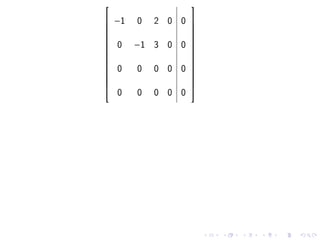
                           
                       −1 0            2 0 0     
                                                 
                                                 
                       0 −1            3 0 0
                                                 
                                                  
                                                 
                                                 
                                                 
                       0  0            0 0 0
                                                 
                                                  
                                                 
                                                 
                         0 0 0 0 0
                                                 

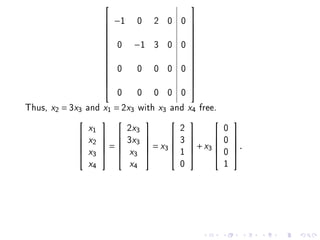
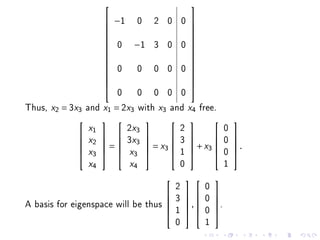
Thus, x2 = 3x3   and x1 = 2x3 with x3 and x4 free.
                              2x3             2              0
                                                          
                 x1

              2  
              x            3x3           3            0   
                  =             = x3           + x3        .
                                                             
                                              1              0
             
              x3           x3                             
                 x4           x4              0              1
                           
                       −1 0            2 0 0     
                                                 
                                                 
                       0 −1            3 0 0
                                                 
                                                  
                                                 
                                                 
                                                 
                       0  0            0 0 0
                                                 
                                                  
                                                 
                                                 
                         0 0 0 0 0
                                                 

Thus, x2 = 3x3   and x1 = 2x3 with x3 and x4 free.
                              2x3             2               0
                                                           
                 x1

              2  
              x            3x3           3             0   
                  =             = x3           + x3         .
                                                              
                                              1               0
             
              x3           x3                              
                 x4           x4              0               1

                                             2         0
                                                      
                                            3       0
A basis for eigenspace will be thus             ,
                                                  
                                                         .
                                                         
                                             1         0
                                    
                                                 
                                             0         1
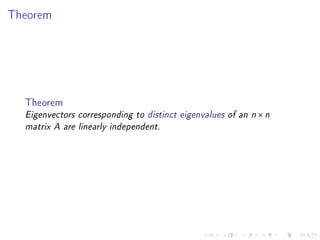
Theorem


  Theorem
  Eigenvectors corresponding to distinct eigenvalues of an n   ×n
  matrix A are linearly independent.
Next week...


    1. How to nd eigenvalues of a 2 × 2 and 3 × 3 matrix?
    2. The process of diagonalization (uses eigenvalues and
       eigenvectors)
    3. Finding complex eigenvalues
    4. Quick look at eigenvalues and eigenvectors being used to learn
       long-term behavior of a dynamical system.
    5. Quiz 4 (last quiz) will be on thurs Feb 18 based on sections
       3.3, 5.1 and 5.2.

Eigenvalues - Contd

  • 1.
    Announcements Quiz 3 after lecture. Grades will be updated online (including quiz 3 grades) over the weekend. Please let me know if you spot any mistakes. Exam 2 will be on Feb 25 Thurs in class. Details later. Make-up exams will be given only if there is an excused absence from the Dean of Students or a Doctor's note about sudden serious illness. No exceptions on this. Travel plans/broken alarm clock are unacceptable excuses.
  • 2.
    Last Class... Denition An eigenvector of an n × n matrix A is a NON-ZERO vector x such that Ax = λx for some scalar λ. A scalar λ is called an eigenvalue of A if there is a nontrivial (or nonzero) solution x to Ax = λx; such an x is called an eigenvector corresponding to λ.
  • 3.
    Triangular Matrices Theorem The eigenvalues of a triangular matrix are the entries on its main diagonal.
  • 4.
    Triangular Matrices Example 1. Let 5 1 9   A = 0 2 3  0 0 6 The eigenvalues of A are 5, 2 and 6.
  • 5.
    Triangular Matrices Example 1. Let 5 1 9   A = 0 2 3  0 0 6 The eigenvalues of A are 5, 2 and 6. 2. Let 4 1 9   A= 0 0 3  0 0 6 The eigenvalues of A are 4, 0 and 6.
  • 6.
    Zero Eigenvalue?? Zero eigenvalue means 1. The equation Ax = 0x has a nontrivial or nonzero solution
  • 7.
    Zero Eigenvalue?? Zero eigenvalue means 1. The equation Ax = 0x has a nontrivial or nonzero solution 2. This means Ax = 0 has a nontrivial solution.
  • 8.
    Zero Eigenvalue?? Zero eigenvalue means 1. The equation Ax = 0x has a nontrivial or nonzero solution 2. This means Ax = 0 has a nontrivial solution. 3. This means A is not invertible (or det A = 0) (by invertible matrix theorem)
  • 9.
    Zero Eigenvalue?? Zero eigenvalue means 1. The equation Ax = 0x has a nontrivial or nonzero solution 2. This means Ax = 0 has a nontrivial solution. 3. This means A is not invertible (or det A = 0) (by invertible matrix theorem) Zero is an eigenvalue of A if and only if A is not invertible
  • 10.
    Important If λ is an eigenvalue of a square matrix A, prove that λ2 is an eigenvalue of A2 . For any problem of this type, start with the equation that denes eigenvalue and take it from there.
  • 11.
    Important If λ is an eigenvalue of a square matrix A, prove that λ2 is an eigenvalue of A2 . For any problem of this type, start with the equation that denes eigenvalue and take it from there. Solution: If λ is an eigenvalue of a square matrix A, we have Ax = λx.
  • 12.
    Important If λ is an eigenvalue of a square matrix A, prove that λ2 is an eigenvalue of A2 . For any problem of this type, start with the equation that denes eigenvalue and take it from there. Solution: If λ is an eigenvalue of a square matrix A, we have Ax = λx. Multiply both sides by A. We get A2 x = A(λx).
  • 13.
    Important If λ is an eigenvalue of a square matrix A, prove that λ2 is an eigenvalue of A2 . For any problem of this type, start with the equation that denes eigenvalue and take it from there. Solution: If λ is an eigenvalue of a square matrix A, we have Ax = λx. Multiply both sides by A. We get A2 x = A(λx). This is same as writing A2 x = λ (Ax) since λ is a scalar.
  • 14.
    Important If λ is an eigenvalue of a square matrix A, prove that λ2 is an eigenvalue of A2 . For any problem of this type, start with the equation that denes eigenvalue and take it from there. Solution: If λ is an eigenvalue of a square matrix A, we have Ax = λx. Multiply both sides by A. We get A2 x = A(λx). This is same as writing A2 x = λ (Ax) since λ is a scalar. Again Ax = λx. So, A2 x = λ (λx) = λ2 x.
  • 15.
    Important If λ is an eigenvalue of a square matrix A, prove that λ2 is an eigenvalue of A2 . For any problem of this type, start with the equation that denes eigenvalue and take it from there. Solution: If λ is an eigenvalue of a square matrix A, we have Ax = λx. Multiply both sides by A. We get A2 x = A(λx). This is same as writing A2 x = λ (Ax) since λ is a scalar. Again Ax = λx. So, A2 x = λ (λx) = λ2 x. This equation means that λ2 is an eigenvalue of A2 .
  • 16.
    Important, see prob25 sec 5.1 If λ is an eigenvalue of an invertible matrix A, prove that λ−1 is an eigenvalue of A−1 .
  • 17.
    Important, see prob25 sec 5.1 If λ is an eigenvalue of an invertible matrix A, prove that λ−1 is an eigenvalue of A−1 . Solution: If λ is an eigenvalue of a square matrix A, we have Ax = λx.
  • 18.
    Important, see prob25 sec 5.1 If λ is an eigenvalue of an invertible matrix A, prove that λ−1 is an eigenvalue of A−1 . Solution: If λ is an eigenvalue of a square matrix A, we have Ax = λx. Since A is invertible, multiply both sides by A−1 . We get −1 A A x = A−1 (λx) I
  • 19.
    Important, see prob25 sec 5.1 If λ is an eigenvalue of an invertible matrix A, prove that λ−1 is an eigenvalue of A−1 . Solution: If λ is an eigenvalue of a square matrix A, we have Ax = λx. Since A is invertible, multiply both sides by A−1 . We get −1 A A x = A−1 (λx) =⇒ A−1 (λx) = x I
  • 20.
    Important, see prob25 sec 5.1 If λ is an eigenvalue of an invertible matrix A, prove that λ−1 is an eigenvalue of A−1 . Solution: If λ is an eigenvalue of a square matrix A, we have Ax = λx. Since A is invertible, multiply both sides by A−1 . We get −1 A A x = A−1 (λx) =⇒ A−1 (λx) = x I This is same as writing λ(A−1 x) = x since λ is a scalar.
  • 21.
    Important, see prob25 sec 5.1 If λ is an eigenvalue of an invertible matrix A, prove that λ−1 is an eigenvalue of A−1 . Solution: If λ is an eigenvalue of a square matrix A, we have Ax = λx. Since A is invertible, multiply both sides by A−1 . We get −1 A A x = A−1 (λx) =⇒ A−1 (λx) = x I This is same as writing λ(A−1 x) = x since λ is a scalar. Since λ = 0 (Why?) we can divide both sides by λ and we get −1 1 A x = λ x.
  • 22.
    Important, see prob25 sec 5.1 If λ is an eigenvalue of an invertible matrix A, prove that λ−1 is an eigenvalue of A−1 . Solution: If λ is an eigenvalue of a square matrix A, we have Ax = λx. Since A is invertible, multiply both sides by A−1 . We get −1 A A x = A−1 (λx) =⇒ A−1 (λx) = x I This is same as writing λ(A−1 x) = x since λ is a scalar. Since λ = 0 (Why?) we can divide both sides by λ and we get −1 1 A x = λ x. 1 Thus λ or λ−1 is an eigenvalue of A−1 .
  • 23.
    Example 20 section5.1 Without calculation, nd one eigenvalue and 2 linearly independent 5 5 5   eigenvectors of A =  5 5 5 . Justify your answer. 5 5 5 Solution: What is special about this matrix? Invertible/Not Invertible?
  • 24.
    Example 20 section5.1 Without calculation, nd one eigenvalue and 2 linearly independent 5 5 5   eigenvectors of A =  5 5 5 . Justify your answer. 5 5 5 Solution: What is special about this matrix? Invertible/Not Invertible? Clearly not invertible (same rows, columns). What is an eigenvalue of A?
  • 25.
    Example 20 section5.1 Without calculation, nd one eigenvalue and 2 linearly independent 5 5 5   eigenvectors of A =  5 5 5 . Justify your answer. 5 5 5 Solution: What is special about this matrix? Invertible/Not Invertible? Clearly not invertible (same rows, columns). What is an eigenvalue of A?0!! To nd eigenvectors for this eigenvalue, we look at A − 0I and row reduce. Or row reduce A.
  • 26.
    Example 20 section5.1 We get (do the row reductions yourself) 1 1 1 0    0 0 0 0  0 0 0 0 .
  • 27.
    Example 20 section5.1 We get (do the row reductions yourself) 1 1 1 0    0 0 0 0  0 0 0 0 . Thus x1 + x2 + x3 = 0 where x2 and x3 are free. So x1 = −x2 − x3 .
  • 28.
    Example 20 section5.1 We get (do the row reductions yourself) 1 1 1 0    0 0 0 0  0 0 0 0 . Thus x1 + x2 + x3 = 0 where x2 and x3 are free. So x1 = −x2 − x3 . We have −1 −1         x1 −x2 − x3  x2  =  x2  = x2  1  + x3  0  x3 x3 0 1
  • 29.
    Example 20 section5.1 We get (do the row reductions yourself) 1 1 1 0    0 0 0 0  0 0 0 0 . Thus x1 + x2 + x3 = 0 where x2 and x3 are free. So x1 = −x2 − x3 . We have −1 −1         x1 −x2 − x3  x2  =  x2  = x2  1  + x3  0  x3 x3 0 1 Choose x2 = 1 and x3 = 1 (or anything nonzero) and two linearly independent eigenvectors are −1 −1      1 , 0  0 1
  • 30.
    Observations 1. The eigenvalue λ = 0 has 2 linearly independent eigenvectors
  • 31.
    Observations 1. The eigenvalue λ = 0 has 2 linearly independent eigenvectors 2. We say that this eigenspace is a two-dimensional subspace of R3 .
  • 32.
    Observations 1. The eigenvalue λ = 0 has 2 linearly independent eigenvectors 2. We say that this eigenspace is a two-dimensional subspace of R3 . 3. Examples with 2 linearly independent eigenvectors are very important for section 5.3 when we do diagonalization and in dierential equations where eigenvalues repeat.
  • 33.
    Example 16 section5.1 3 0 2 0    1 3 1 0 Let A =  . Find a basis for eigenspace corresponding  0 1 1 0   0 0 0 4 to λ = 4. Solution: To nd an eigenvector, start with A − 4I and row reduce 3 0 2 0 4 0 0 0 −1 0 2 0        1 3 1 0   0 4 0 0   1 −1 1 0  − 4I =  − =       A 0 1 1 0 0 0 4 0 0 1 −3 0        0 0 0 4 0 0 0 4 0 0 0 0
  • 34.
      −1 0 2 0 0 R2+R1       1 −1 1 0 0           0 1 −3 0 0        0 0 0 0 0  
  • 35.
      −1 0 2 0 0 R2+R1       1 −1 1 0 0           0 1 −3 0 0        0 0 0 0 0      −1 0 2 0 0       0 −1 3 0 0          R3+R2  0 1 −3 0 0        0 0 0 0 0  
  • 36.
      −1 0 2 0 0       0 −1 3 0 0           0 0 0 0 0        0 0 0 0 0  
  • 37.
      −1 0 2 0 0       0 −1 3 0 0           0 0 0 0 0        0 0 0 0 0   Thus, x2 = 3x3 and x1 = 2x3 with x3 and x4 free. 2x3 2 0         x1  2    x   3x3  3   0  =  = x3   + x3  .      1 0   x3   x3      x4 x4 0 1
  • 38.
      −1 0 2 0 0       0 −1 3 0 0           0 0 0 0 0        0 0 0 0 0   Thus, x2 = 3x3 and x1 = 2x3 with x3 and x4 free. 2x3 2 0         x1  2    x   3x3  3   0  =  = x3   + x3  .      1 0   x3   x3      x4 x4 0 1 2 0      3   0 A basis for eigenspace will be thus  ,   .  1 0     0 1
  • 39.
    Theorem Theorem Eigenvectors corresponding to distinct eigenvalues of an n ×n matrix A are linearly independent.
  • 40.
    Next week... 1. How to nd eigenvalues of a 2 × 2 and 3 × 3 matrix? 2. The process of diagonalization (uses eigenvalues and eigenvectors) 3. Finding complex eigenvalues 4. Quick look at eigenvalues and eigenvectors being used to learn long-term behavior of a dynamical system. 5. Quiz 4 (last quiz) will be on thurs Feb 18 based on sections 3.3, 5.1 and 5.2.